


WITHIN 24 HOURS OF Jimmy Butler‘s franchise-altering ACL tear, Golden State Warriors general manager Mike Dunleavy admitted that the team’s new reality meant an altered approach could be necessary at the upcoming trade deadline.
“Maybe the parameters have changed,” Dunleavy said. “Maybe the goalposts have moved.”
One of the key roster-building checkpoints on the NBA calendar is one week away. In advance of the Feb. 5 trade deadline, the Warriors have several questions to answer, beginning with the ramifications of Butler’s injury.
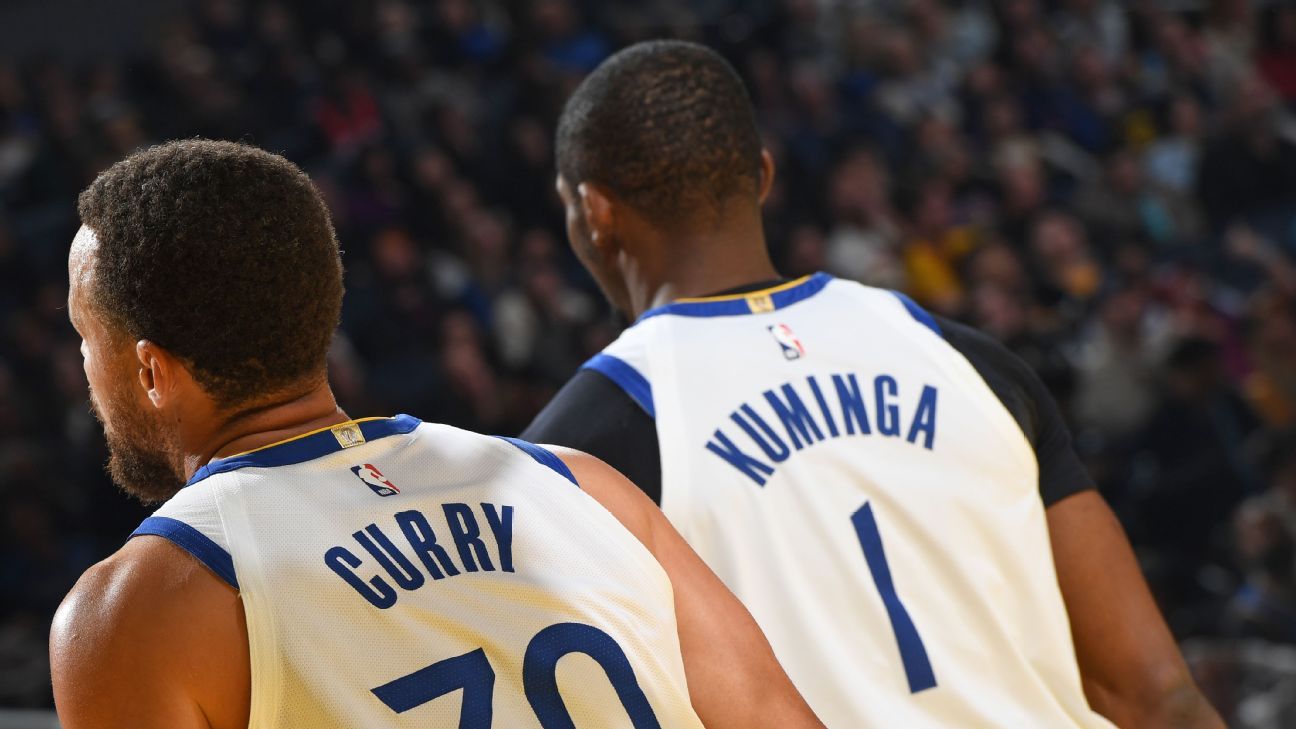
In the days since, team sources have described their approach as more future focused. With Butler in the lineup, they were exploring smaller-scale upgrades, attempting to use Jonathan Kuminga‘s $22.5 million salary to boost a surging team they believed was a fringe contender.
Realistic contention evaporated when Butler went down, reducing the front office’s appetite to spend an asset for a strictly win-now swing. It’s feasible they find a deal that raises the ceiling of this season’s team, but their focus is on better setting up the roster to enter the contention conversation for 2026-27 and beyond.
The Warriors’ prime target is the same dream name that has been on their radar for nearly a decade: Giannis Antetokounmpo. The big difference now is that Milwaukee’s door appears to finally be cracked open. ESPN’s Shams Charania reported on Wednesday that Bucks general manager Jon Horst has recently become willing to entertain the conversation.

What can the Warriors offer for Giannis?
League sources told ESPN that the Warriors have contacted the Bucks in the past week and expressed their firm interest in Antetokounmpo and their willingness to put a substantial offer on the table regardless of his calf strain and undetermined return timetable.
It’s unclear if Antetokounmpo would consider the Warriors on his wish list. But his desires, like any superstar soon to be extension eligible, matter within the conversation. A deadline trade for Kevin Durant last February fell through after Durant made it clear he didn’t want a reunion with the Warriors. A temperature check with Antetokounmpo will be needed, ensuring he would embrace a partnership with the Warriors even if they weren’t his first choice.
But the Bucks are in the driver’s seat of a car full of crowded motives, able to trade Antetokounmpo in the next week or wait until a fuller market might develop in the summer. If they opt to strike now, the Warriors — among the expected aggressive suitors — have arguably the most appealing pick package. The quicker Milwaukee acts, league executives believe, the better chance Golden State has to win the bidding war.
The Warriors can offer up to four first-rounders: 2026, 2028, 2032 unprotected and 2030 if it falls within the 1-20 range (top-20 protected owed to Washington as part of the Jordan Poole for Chris Paul trade). Because of Milwaukee’s outgoing picks, it could only command one additional pick swap.
In previous conversations about lower-level deals, the Warriors have been protective of their draft picks beyond the Stephen Curry era. This isn’t a lower-level conversation. The picks beyond the Curry era would be available to Milwaukee and valuable (though less so because the post-Curry era would suddenly include Antetokounmpo in his mid-30s).
“It would take a good amount [to move the post-Curry picks],” Dunleavy said. “Positionally, play style, archetype, all that. I would leave it pretty broad and open. But if there’s a great player to be had, we’ve got everything in the war chest that we would be willing to use.”
The Warriors have voiced to Butler a plan to keep him despite the ACL tear, believing he will rehab and boost them upon his return at some point next season. Dunleavy said he didn’t “envision” trading Butler. They are not actively shopping his contract, team sources said, but everything is on the table in an Antetokounmpo conversation — and Butler is the clear salary match, though a deal involving Draymond Green and several other rotation players is also plausible.
Rival teams — such as the New York Knicks (Karl-Anthony Towns, OG Anunoby) and Miami Heat (Tyler Herro, Kel’el Ware) — have superior young or mid-prime players to offer the Bucks. But Milwaukee has shown an interest in Kuminga dating to the summer, league sources said, and he would be viewed as an upside swing on a controllable contract as part of the return package.
Third-year guard Brandin Podziemski could also help nudge the needle, league sources said. The Milwaukee native is under contract next season at $5.7 million, the final year of his rookie contract. To help salary match, the Warriors could also absorb one of Milwaukee’s other veterans owed long-term money, such as Bobby Portis (three years, $43.5 million remaining) or Kyle Kuzma (two years, $42.7 million remaining).
What is the alternative plan?
If the Warriors don’t acquire Antetokounmpo, there isn’t anyone on the current trade market who will force this level of asset aggression from them, team sources said.
They’ve maintained a level of interest in New Orleans Pelicans wing Trey Murphy III, but have been stonewalled in conversations by a Joe Dumars-Troy Weaver front office that has so far voiced an unwillingness to move most of their young core, league sources said.
The Warriors have been linked to other midtier players such as the Brooklyn Nets‘ Michael Porter Jr. and Miami’s Andrew Wiggins, but team sources continue to throw cold water on those ideas. One team source said they haven’t and don’t plan to engage with Miami about a reunion with Wiggins.
What does it mean for Kuminga?
Despite Kuminga’s desire for a fresh start and a more consistent role away from the Warriors, Dunleavy has made it clear dating to the summer that he won’t move Kuminga if he doesn’t like the value of the deal.
Before the Butler injury, the front office had been more open to flipping Kuminga for a rotation player on a short-term deal who could help this season’s team compete.
But the Butler injury simultaneously stripped their title hopes — barring a big trade materializing — while also elevating Kuminga from out of the rotation to at least a 20-to 25-minute player.
“Now that Jimmy’s out, I mean there’s no question he’s going to play,” Kerr told ESPN. “He’s going to have a role. So I hope he gets back soon [from a minor bone bruise] because it’s a great opportunity for him and we need him. We need what he brings.”
The Warriors are still exploring Kuminga’s trade market, but team sources have described it as less likely he is moved in the wake of the Butler injury. He has a $24.3 million team option that could be utilized in the summer and a clearer path to playing time in the immediate, which could help boost his value and get both sides what they ultimately desire.
0:39
Jonathan Kuminga injures ankle, knee and leaves game in 2Q
Jonathan Kuminga leaves the game after injuring his ankle and knee late in the second quarter against the Mavericks.
What does it mean for the last chapter of the Curry-Kerr era?
The Warriors are 27-22, currently planted at No. 8 in the Western Conference, living in the play-in realm they’ve often inhabited the past half-decade.
“Our goals haven’t changed. We’re still trying to win,” Kerr said. “But obviously our ceiling isn’t as high. I mean, Jimmy’s one of the best players in the league and we felt pretty strongly that if you gave us a chance in the playoffs, we could make a run like we did last year.
“With Jimmy gone, obviously it’s just going to be so much harder to do that. But you still go for it. You still try to do everything you can to put yourself in position, get to the playoffs, and you never know what can happen.”
Curry turns 38 in March. The clock is ticking.
Kerr has maintained his belief that it is unwise for the franchise to burn valuable assets for marginal upgrades, but it’s clear those on the ground level would welcome an extra February boost, if reasonably obtainable.
“It’s up to Mike and Joe [Lacob],” Kerr said. “I’m in the last year of my contract, so nothing is guaranteed going forward. I always believe that they should do whatever makes the most sense for the franchise. But you do have Steph Curry and Steph’s still playing at high level and if there’s something we can do to give Steph more help, we should do it. What that means, it’s always in the details, what’s out there and what we have to give up.”
Kerr didn’t seek a contract extension entering the season. He believes the open-ended nature of his future is healthiest for both sides. He said he still isn’t leaning one way or the other about whether he will return for a 13th season coaching the Warriors.
“Let’s wait until the end of the year and see if everybody’s aligned,” Kerr said. “If we are, then we’ll keep going. If not, then we won’t. [It’ll depend] how the season ends, what the future looks like, all of that factors in. And they, meaning Joe and management, they’ve got a lot to think about. It’s a really interesting time for the organization.”