Twenty-three people have been killed in a Russian air strike on a village in eastern Ukraine, according to a local official.
The victims were ordinary people collecting their pensions in the Donetsk settlement of Yarova, said President Volodymr Zelensky. Donetsk regional leader Vadym Filashkin said emergency services were at the scene and as many people were wounded as killed.
Yarova is to the north of Slovyansk, one of the big cities in the region, and not far from the front line as Russian forces advance slowly in the east.
If confirmed, the death toll would be among the heaviest attacks on Ukrainian civilians in recent weeks, 42 months into Russia’s full-scale invasion.
Twenty-three people were killed in overnight air strikes on Ukraine’s capital Kyiv at the end of August.
At the weekend Russia launched its biggest air assault of the war on Kyiv so far, hitting the main government building in the capital, in what Zelensky said was a “ruthless” attack aimed at prolonging the war.
Posting graphic footage of the attack on Yarova online, Zelensky said there were “no words” to describe the latest Russian strikes. There was no immediate response from Russia’s military.
The head of the local administration in nearby Lyman, Oleksandr Zhuravlyov, said the attack took place at about 10:40 local time (07:40 GMT) on Tuesday, as pensions were being handed out.
Twenty-three people had been killed and another 18 wounded according to latest casualty figures, he told Ukraine’s public broadcaster Suspilne.
Pictures from the scene showed a badly damaged Ukrainian postal service vehicle of the type used to distribute pensions.
The head of the Ukrposhta service said the vehicle had been parked under trees as a security measure and a local postal official had been wounded in the attack. “Maybe someone gave away the co-ordinates,” he speculated.
Yarova sits on a key railway line between the cities of Lyman and Izium. It is also only about 6km (3.7 miles) away from the next village of Novoselivka, where Russian forces are closing in on the outskirts.
Zhuravlyov told Suspilne they had to work out how the postal service could continue to hand out pensions: “Because the front line is less than 10km away, we will ‘move away’ all these payments, so they can have their pensions in safer places.”
Ukraine’s state emergency service said another three people had died in earlier Russian shelling of settlements in Donetsk.
“The world must not remain silent,” Zelensky said, calling for a response from both the US, Europe and the G20 group of nations.
In the space of just a few quarters, AI systems moved from novel office tricks to everyday tools that quietly erase the first rungs of many careers. As a result, the entry-level American dream is getting squeezed out by “code and compute.”
The displacement starts where work is most codified, and it is happening fast enough that we can measure it in real time.
In AI-exposed fields such as software development and customer service, early-career employment is sliding. But older cohorts continue to hold their ground, according to a recent study by three researchers at Stanford. That means the Trump administration’s new “AI Action Plan,” framed around removing barriers and investing in AI infrastructure — such as taking a stake in Intel — risks intensifying the squeeze if it is not paired with robust worker policies.
In short, we need to match AI ambition with large-scale job retraining and a basic income floor, or risk watching opportunity narrow for the next generation.
The clearest pattern in the study is both simple and sobering. In the most AI-exposed occupations, workers aged 22 to 25 saw employment fall by 13 percent relative to peers in less-exposed roles, even after accounting for firm-level shocks. Wages barely budged, which means adjustment is happening through headcount rather than lower paychecks.
The timing matters. Since late 2022, when generative AI adoption exploded across workplaces, employment for 22- to 25-year-olds in the most exposed jobs fell by 6 percent, while the number of workers ages 35 to 49 in those same occupations grew by “6 to 9 percent.” That split lines up with a basic intuition about how AI affects the workplace. Entry-level roles lean on codified knowledge that models can replicate cheaply, whereas experienced workers contribute tacit judgment, domain context and organizational savvy, which AI cannot yet replace at scale.
The mechanism shows up when you sort jobs by how AI is used. Where AI primarily automates tasks, entry-level employment contracts. Where AI genuinely augments human work, employment for young workers stabilizes or grows. Tasks that can be pushed into a prompt are collapsing into tools. Tasks that require teams, customers and context are not.
The Trump administration has reoriented federal AI policy around acceleration. In January 2025, the White House issued “Removing Barriers to American Leadership in Artificial Intelligence,” an executive order that revoked the prior administration’s AI guardrail order and directed officials to produce an “Artificial Intelligence Action Plan.” The order’s thrust is to sustain and enhance American AI dominance, revise agency guidance to align with that goal, and clear away policies seen as obstacles.
Acceleration has value. It also has a labor cost, if you ignore the evidence. This is not an argument to slow AI, but to stop treating workforce policy as an optional add-on. An action plan that maximizes deployment while leaving displaced workers to absorb the shock will worsen the early-career crunch. That is a structural signal, not a temporary blip.
A durable AI strategy marries acceleration with transition support. Start with retraining that is built for the way modern workers actually learn. Fund employer-validated, short-cycle programs that move people into augmentative roles where employment is rising. Focus on skills that compound with AI instead of competing directly with it. Make training portable and time-bound. Replace fragmented grants with individual learning accounts that workers can draw on when tools change and tasks go away.
In addition, add wage-linked supports that keep people attached to the labor market while they retool. Temporary wage insurance cushions earnings losses when workers step down to reenter a new field. Subsidized apprenticeships in AI-complementary jobs provide supervised experience that no model can fake.
These are not theoretical ideas. They are pragmatic ways to turn early-career workers from the first victims of automation into the first beneficiaries of augmentation.
Finally, test a basic income floor where the data say risk is highest. The paper shows the sharpest dislocations among 22- to 25-year-olds in automation-exposed occupations. That is the right population for time-limited basic income pilots funded at the federal level and administered locally. Combine the stipend with mandatory participation in training or job placement, and you get the stability to retrain plus the nudge to stay engaged with work.
The point is not to replace jobs but to buy the time required for new tasks and new firms to materialize — a dynamic that past technology waves have delivered only after painful adjustments.
America needs two hands on the wheel. On one side, the administration should pursue AI leadership through research, standards and deployment. On the other, it must act on what the labor data already show. Early-career workers in AI-exposed jobs are losing footholds, and those losses are strongest where AI automates rather than augments.
Put these threads together and the policy path is clear. Pair the action plan with aggressive, employer-aligned retraining, wage-linked transition supports, and a basic income floor targeted to the workers absorbing the shock. That combination preserves U.S. dynamism and honors a core promise of economic growth, which is that progress should expand the circle of opportunity.
The alternative is a faster AI future with fewer places for new workers to stand.
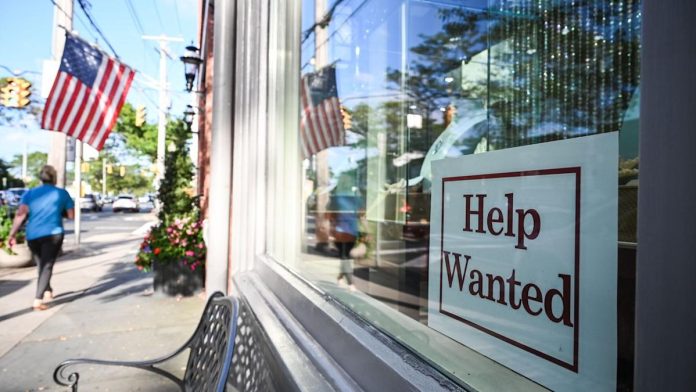
Small-business owners reported feeling more optimistic last month, as confidence in future sales picked up and bottom lines improved — though persistent hiring challenges and muted investment continued to weigh on sentiment.
The National Federation of Independent Business (NFIB) said Tuesday its monthly optimism index rose to 100.8 , up half a point from July. That’s above the 50-year average and a sign that small companies are feeling more stable than they did earlier in the year.
Expectations for sales improved sharply from the month before , with a net 12% of owners predicting higher volumes over the next three months, the survey found. That was the main driver behind the rise in optimism.
And more than two-thirds of those surveyed described their business as in good or excellent health, an improvement from July.
“Optimism increased slightly in August with more owners reporting stronger sales expectations and improved earnings,” said Bill Dunkelberg, NFIB’s chief economist. “Labor quality, however, remains the top issue on Main Street.”
Hiring remains difficult. About one in three small businesses pointed to job openings they couldn’t fill — the lowest share in five years, but still high by historical standards.
Companies in construction and manufacturing reported the most trouble finding skilled workers. More than half of owners trying to hire said they received few or no qualified applicants.
Prices are also showing signs of easing. Only 21% of owners said they raised prices in August, the lowest level this year. Plans for future price increases also declined, a sign that some inflation pressures may be cooling.
At the same time, borrowing costs improved slightly, with interest rates on short-term loans dipping to their lowest since mid-2023.
Uncertainty among small firms also eased, with NFIB’s gauge slipping to 93 in August. That’s still among the highest readings in the survey’s five-decade history.
Even with new federal tax breaks aimed at spurring investment, only about one in five owners plan major purchases such as equipment or property in the next six months — a slight drop from July.
The tax breaks, part of President Trump’s recently signed “One Big Beautiful Bill,” include permanent small-business deductions and expanded write-offs for equipment and investment, aimed at encouraging firms to spend more.
It comes after shipments to the U.S. plunged as the Trump administration ended a tariff exemption for low-value packages, a move that added new costs for many small businesses.
Still, business owners remain cautious. Just over one-third expect overall conditions to improve in the months ahead, and only 14% said now is a good time to expand.
Jeff Kassouf covers women’s soccer for ESPN, focusing on the USWNT and NWSL. In 2009, he founded The Equalizer, a women’s soccer news outlet, and he previously won a Sports Emmy at NBC Sports and Olympics.
Thompson’s move from her hometown National Women’s Soccer League team to the six-time defending English champions was one of the most expensive transfers in women’s soccer to date. The ramifications of it, however, stretch far beyond the financial.
Is it a good move for Thompson’s career? What will she bring to Chelsea? How bad is the situation for Angel City after losing Thompson? And is this really an problem for the NWSL at large?
A European dream come true — and a USWNT boost, too
Thompson told Chelsea’s website that she “[knew] in my heart” that she wanted to join the club after speaking with USWNT and former Chelsea head coach Emma Hayes. It’s clear that this was the move Thompson wanted, and ultimately a player needs to be in an environment where she is happy.
At Angel City, Thompson was their best player, able to stay close to come-and-suit-up alongside her younger sister. But Angel City remains stuck in the middle of the table in the NWSL and continues to struggle with consistency.
play
0:45
Alyssa Thompson with a Spectacular Goal vs. Seattle Reign FC
Alyssa Thompson (Angel City FC) with a Spectacular Goal vs. Seattle Reign FC, 03/31/2025
Thompson will not immediately or automatically be Chelsea’s best player, and that is likely part of her “why” for leaving. At Chelsea, the 20-year-old will be challenged daily in training by some of the world’s top players. She will still play regularly difficult league games, and she will also help Chelsea try to win that elusive UEFA Women’s Champions League title.
All of those things will expose Thompson to new playing styles and challenges. That should be good for her, which means it’s good for the USWNT, too. — Jeff Kassouf
Thompson’s new challenge at Chelsea
Chelsea’s signing of Thompson is another example of the club’s relentless drive to sign the next generation of elite talent. While her 22 international caps place her firmly in the here and now rather than just the future, the move is a reflection of the club’s “Vision 2030” strategy: bring in the best and brightest young players across the globe.
At just 20, Thompson fits that profile to perfection. With Mayra Ramírez sidelined until 2026 by a hamstring injury, Chelsea’s push to sign her was both a statement of intent and a practical necessity. She’s signed for five years, with Chelsea having high hopes for her ceiling.
Chelsea already boasts a squad purpose-built for winning titles, stacked with depth and world-class quality across every position. Adding Thompson, arguably one of the highest-rated young American players, only reinforces that strength.
Yet for all their domestic dominance, the one prize that has eluded the club is the Champions League, dating back to Emma Hayes’ 12-year tenure (2012-24) and Sonia Bompastor’s debut season ending the same way, a crushing loss against Barcelona in the semifinals, as it did the two seasons before. Determined to clear that final hurdle, Chelsea reinforced in key positions, building a squad even more capable of competing for a quadruple across the WSL, domestic cups, and Europe’s biggest stage.
Thompson’s ambition matches that of the club, too. “One, to win the Champions League,” she told club media, when asked about main aims for the future. “Two, I hope I develop a lot as a player, learn from the veterans on the team, and get their insight on things so that I can grow each year and become a better player. And third … win. A lot.”
But with that ambition comes Thompson’s biggest challenge. It will be no easy feat to break into a side where even world-class players fight for minutes. At Angel City, she was a face of the franchise, the No. 1 pick in the 2023 draft, and a hometown star. At Chelsea, she enters a forward line already boasting Sam Kerr, Lauren James and Catarina Macario, all established and deeply ingrained in the Blues’ system.
play
2:16
Keogh: Thompson to Chelsea a ‘big loss’ for the NWSL
Emily Keogh talks about USWNT forward Alyssa Thompson’s potential move to Chelsea from Angel City.
Thompson’s versatility is both her strength and, potentially, her biggest hurdle to regular playing time. She can feature wide or centrally, giving Bompastor options to experiment with her role. However, Chelsea already have several players of similar age and profile — James, Maika Hamano and Wieke Kaptein, to name just three — who have earned trust in the system and may initially be ahead of her in the rotation. Players who move too often between positions can struggle to claim one as their own, risking the fate of becoming a utility option off the bench rather than a cornerstone starter.
Thompson’s task will be to show Bompastor where she belongs in this Chelsea side, lock down that role, and then use her versatility as an added asset rather than a crutch. Oh, and she’ll have to do all of that while adapting to a move abroad, a highly competitive domestic league and a challenge of the newly restructured Champions League, which will be unlike any other competition she’s ever faced, even having gone to the 2023 World Cup.
If she succeeds, Thompson could become a defining piece in Chelsea’s bid to finally win in Europe and add more silverware to an already glittering trophy cabinet. If not, the gamble of trading star status in Los Angeles for fierce competition in London could prove costly. — Emily Keogh
A huge setback for Angel City (and the NWSL)
There is no other way to look at Thompson’s departure than a major step backwards for Angel City. Thompson was a No. 1 draft pick who was born and raised in Los Angeles. She was the face of the Angel City franchise, the main building block in a rebuild that was only just getting started. The dynamic forward was the best American forward in the NWSL this season.
And then, she was gone.
Chelsea’s payment for Thompson fell below the previously established world record of $1.5 million. Angel City might have lost leverage in the negotiations since Thompson wanted to go to Chelsea, but the fact that the fee was not astronomical made the optics worse for the NWSL side.
Thompson had just signed a long-term contract extension in January, with everything about this departure feeling abrupt. For Angel City, that has short- and long-term implications.
In the short term, Angel City is now in the thick of the playoff race without their star player. She can’t be replaced immediately (if at all) because the NWSL’s inbound transfer window has closed already — and before this deal began to pick up steam. Angel City could make an intra-league trade, but the team almost certainly won’t be able to do so for someone of comparable talent.
Yes, Angel City will have transfer funds to work with in the winter. Maybe they will use the funds to bring in several new players to deepen the roster.
This transfer, however, isn’t measured in dollars or pounds. The exchange rate is really the optics — and they are bad for Angel City and, by extension, the NWSL. Former USWNT teammate Alex Morgan, now an investor in the San Diego Wave, recently told ESPN she isn’t worried about so many top American stars like Thompson leaving the NWSL for Europe, but it’s not ideal for the league either. — Kassouf
However, unlike during the pandemic-delayed Games in Japan four years ago, the marathon and race walk events will remain in Tokyo.
In 2021, both events were moved to the cooler northern city of Sapporo due to heat concerns.
Both the men’s and women’s race walks are scheduled to start at 8:00am local time on Saturday in a bid to beat the heat.
In an Instagram post on Tuesday,, external Olympic 800m champion Keely Hodgkinson uploaded a photo from her Japanese training base with the caption: “Hot out here”.
Coe says the battle against climate change has fallen on sports leaders after inaction from governments.
“Governments have not stepped up to the plate and sport is going to have to take some unilateral judgments and decisions here,” added Coe.
“And we have reflected in the past, if we are committed to athlete welfare, then we should probably be openly committed to that.”
Maryland Gov. Wes Moore (D) formally launched his reelection on Tuesday, after he appeared to rule out a 2028 presidential run.
In a roughly two minute long announcement video, Moore contrasts himself with President Trump. Moore accuses the president of “bending over backwards for billionaires and big corporations.”
“I’m not from that world and y’all know I’m a person of action,” Moore says. “We are moving forward fast across this state and across party lines to prove to a dysfunctional Washington that there is a better way forward.”
Moore, an Army veteran, was first elected in 2022. He previously had not held elected office. According to a Maryland Now poll released last month, Moore holds a 50 percent approval rating in the state.
Moore’s reelection launch comes days after he said on NBC’s “Meet the Press” that he will not run for president in 2028.
“Yes, I’ll be serving a full term,” Moore told NBC’s Kristen Welker. “I’m excited about reelection. I’m excited about what I’m going to be able to do for the people of Maryland.”
“Do you rule out a run for president, governor?”
“Yeah, I’m not running for president,” Moore responded.
“You rule it out?” Welker asked.
“Yes, I’m not running for president,” he said.
Moore has consistently been floated as a potential 2028 Democratic contender. The governor stoked speculation earlier this year visiting the battleground of Pennsylvania and the early primary state of South Carolina. Additionally, Moore has gone toe-to-toe with Trump on crime amid the president’s threats to deploy the National Guard to Baltimore.
Paytrie, a Canadian fintech company, has joined the Circle Payments Network (CPN) to offer new real-time payment options from Canada to international destinations.
Paytrie aims to improve the stablecoin payment infrastructure in Canada by leveraging Circle Payments Network.
The integration with CPN is designed to broaden the usage of stablecoins such as USDC, offering Canadians “more efficient” global money transfers, stated Paytrie.
Paytrie’s involvement with USDC dates to the company’s inception, providing Canadian users access to the stablecoin through its core platform and participating in the Circle Alliance Program to promote stablecoin adoption.
As a FINTRAC-registered Money Services Business, Paytrie offers stablecoin-based payment solutions to both individuals and businesses.
The company indicated that it will continue to build on its regulatory and product offerings, with more details on the expanded capabilities through the Circle Payments Network to be shared in due course.
Paytrie chief strategy officer Jason Tong stated: “Integrating with CPN marks an important step forward in Paytrie’s mission to modernise money movement for Canadians. We are excited to explore how stablecoins can reduce costs, increase transparency, and provide always-on settlement for individuals and businesses in Canada.”
This initiative, aimed at curbing counterfeit tokens and bolstering transparency, was executed in partnership with Bluprynt, a fintech startup headed by Georgetown Law School professor Chris Brummer.
The pilot leveraged Bluprynt’s cryptographic and blockchain technology, allowing companies to trace their stablecoin tokens to the original, verified issuer.
“Canadian fintech Paytrie joins Circle Payments Network ” was originally created and published by Electronic Payments International, a GlobalData owned brand.
The information on this site has been included in good faith for general informational purposes only. It is not intended to amount to advice on which you should rely, and we give no representation, warranty or guarantee, whether express or implied as to its accuracy or completeness. You must obtain professional or specialist advice before taking, or refraining from, any action on the basis of the content on our site.
Handout photo issued by US Department of Justice of Jeffrey Epstein standing in front of his private plane
A US congressional panel has released a redacted copy of an alleged “birthday book” given to Jeffrey Epstein in 2003 celebrating his fiftieth birthday.
The book was released with a trove of documents that include the late convicted paedophile financier’s will and his personal address book – with contacts that include royalty, politicians across the globe, celebrities and models.
The 238-page book contains messages and photos sent by many of Epstein’s friends, including a letter carrying a signature resembling US President Donald Trump’s. Trump has denied ever writing the birthday note.
Epstein, a well-connected financier and convicted sex offender, was found dead by suicide in 2019 while awaiting a trial for sex trafficking.
What was released and why now?
The House Oversight Committee last month issued a legal summons for the executors of Epstein’s estate to produce a number of documents, including a birthday book which contains the note purportedly from Trump.
Lawyers for the estate sent documents to the committee afterwards.
On Monday, the committee released the alleged birthday book as well as Epstein’s will, entries from his contact books containing addresses from 1990 to 2019, and a non-prosecution agreement signed by him.
How did we get here?
The Trump administration has been grappling with growing calls for the so-called “Epstein files” to be released in their entirety – including from Trump’s Make America Great Again (Maga) base.
Reports emerged that the president was told in May by his attorney general that his name appeared in files related to the investigations into Epstein.
The pair were friends in the 1990s and early 2000s. Being named is not evidence of any criminal activity, nor has Trump ever been accused of wrongdoing in connection with the Epstein matter.
Trump had said during the 2024 election that he would be open to making more information public, and his campaign leaned into a belief popular among some Maga supporters that key truths about Epstein’s life and death were being hidden.
But he changed his position in July. The Department of Justice and FBI said in a memo that no more material would be released, while Trump said the case was closed and criticised his own supporters who had continued to press him on it.
Some of his conservative supporters had already voiced frustration with his administration’s handling of disclosures regarding the Epstein files, particularly after Attorney General Pam Bondi released documents that had already been available publicly.
Bipartisan pressure for more transparency persisted. In late July, the Republican House announced an early recess for the chamber, stalling efforts to force the release of Epstein-related documents within 30 days.
What did Trump allegedly write?
Reuters
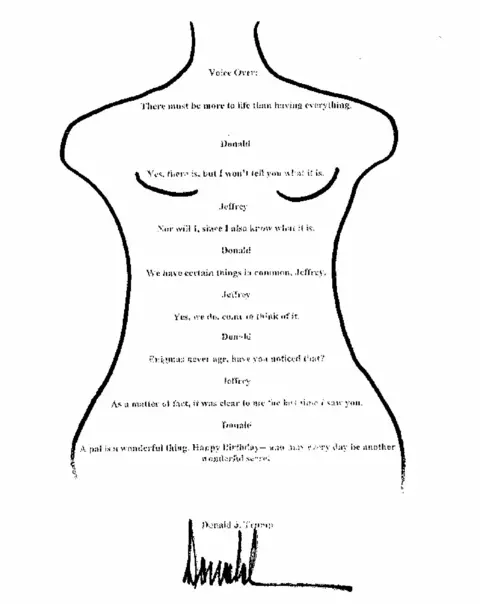
Democrats on the House Oversight Committee released the image on Monday, after the committee received it from the Epstein estate. The White House said “President Trump did not draw this picture, and he did not sign it”
The alleged entry from Trump contains a signed note outlined by a sketch of a woman’s body.
The final line reads: “A pal is a wonderful thing. Happy birthday – and may every day be another wonderful secret.”
This matches descriptions by the Wall Street Journal, which first reported the letter in July.
The note features what appears to be an imagined conversation between Trump and Epstein, where they agree there is “more to life than having everything” and that they “have certain things in common”.
Trump has not commented on the note’s release, though the White House has denied he produced anything for the book and said the signature on the note did not match Trump’s.
The White House said the president “did not draw this picture, and he did not sign it”.
Who else was named in the ‘birthday book’?
Entries from 40 people, divided into several categories such as “friends”, “business”, “science” and “Brooklyn”, were published, though the names under “family” and “girl friends” were redacted.
These people are not accused of any legal wrongdoing in connection with Epstein’s case.
The document contained a message which appears to have been written by former US President Bill Clinton. The author wrote about Epstein’s “childlike curiosity” and a “drive to make a difference”.
Clinton’s office has not responded to a BBC request for comment.
The entry by Lord Peter Mandelson, currently the UK ambassador to the US, calls Epstein “my best pal” and includes several photographs.
Alongside one picture of Lord Mandelson with two women, whose faces are obscured, he writes about meeting Epstein’s interesting – in inverted commas – friends.
An official spokesperson for Lord Mandelson has told the BBC that he “has long been clear that he very much regrets ever having been introduced to Epstein,” adding: “This connection has been a matter of public record for some time.”
There isn’t a letter from Prince Andrew. But an entry from an unidentified woman says that thanks to Epstein she had met the Prince, Bill Clinton and Trump.
The woman goes on to say she has “seen the private quarters of Buckingham Palace” and “sat on the Queen of England’s throne.” Prince Andrew has previously denied any wrongdoing.
What are the other entries about?
There’s a wide range of content from people from all walks of life – from occupants of the White House to women working as masseuses.
An unidentified woman recalled how she was a 22-year-old restaurant hostess until she met Epstein, after which she travelled the world and met many notable people including royals.
There were also photos of Epstein throughout the years – from his private jet to a random Asian medicine shop, and him embracing women whose faces were redacted.
Others sent him photos, some containing lewd scenes featuring wild animals from a safari including zebras and lions.
The book begins with an introduction by Ghislaine Maxwell – Epstein’s British co-conspirator and ex-girlfriend, who was convicted in 2021 of conspiring with Epstein to traffic girls for sex. She wrote that she hoped Epstein got “as much pleasure looking through” the book as she did putting it together.
It also includes a hand-written note from Epstein’s mother, who recalled his childhood as an “excellent” student before praising his “achievements” as an adult, including his limousines and magazine features about him.
What has the reaction been?
The release came with a note from the House Oversight Committee chairman James Comer, criticising Democratic committee members.
Comer said the Democrats were “cherry-picking documents and politicizing information received from the Epstein Estate”.
Vice-President JD Vance accused the Democrats of “concocting another fake scandal” designed to “smear President Trump with lies”.
The committee’s top Democrat said it was “time to end this White House cover-up”.
Congressman Robert Garcia wrote on X: “We got the Epstein note Trump says doesn’t exist.”
Meanwhile, Democratic Congresswoman Jasmine Crockett – who also sits on the committee – called for “full, unredacted Epstein files” to be released.
She added: “The survivors deserve justice, and the American people deserve the truth.”
WASHINGTON (AP) — Global warming in the U.S. is amping up the country’s sweet tooth, a new study found.
When the temperature rises, Americans — especially those with less money and education — drink lots more sugary beverages and a bit more frozen desserts. It amounts to more than 100 million pounds of added sugar (358 million kilograms) consumed in a year, compared to 15 years earlier, according to a team of researchers in the U.S. and United Kingdom writing in Monday’s Nature Climate Change.
“Climate change is shaping what you eat and how you eat and that might have a bad effect on your health,” said study co-author Duo Chan, a climate scientist at the University of Southampton.
“People tend to take in more sweetened beverages as the temperature is getting higher and higher,” Chan said. “Obviously under a warming climate that would cause you to drink more or take in more sugar. And that is going to be a severe problem when it comes to health.”
A little added sugar every day adds up
By tracking weather conditions and consumer purchases, the researchers found that sugar consumption rose as temperatures moved between 54-86 degrees Fahrenheit (about 12 and 30 degrees Celsius). And the warmer it got, the more sugar was consumed, until appetites began to lessen when it grew warmer than 86 degrees.
The daily difference from higher temperatures doesn’t amount to even a single candy bar for the average person. But it adds up over time and has a big effect, said University of California San Francisco endocrinology professor Dr. Robert Lustig, a specialist in pediatrics and obesity who wasn’t part of the study.
Lustig wrote in an email that among poorer Americans, just one added can of sugary soft drink per day increases diabetes risk by 29 percent — and temperature-related thirst plays a big part in America’s obesity epidemic.
The U.S.’s average annual temperature has gone up about 2.2 degrees (1.2 degrees Celsius) since 1895, according to the National Oceanic and Atmospheric Administration (NOAA).
To chart the impact on sugar consumption, researchers compared it to the American Heart Association recommendations: limiting daily intake to 36 grams for men and 25 grams for women.
The team then compared wind, precipitation and humidity records to the detailed purchase records of 40,000 to 60,000 American households from 2004 to 2019, not using any data after the pandemic hit. Then they looked at the nutritional information of the items bought. That allowed them to eliminate other factors to make a causal link and come up with a calculation for how much extra sugar is consumed per person per degree, said lead author Pan He, an environmental scientist at Cardiff University.
Researcher He said she started thinking about the study when she noticed that people in the U.S. tend to grab sugary soda when they are thirsty: “From a perspective of nutrition science or environmental science, that could be a problem,” she said.
Sugar consumption can vary with gender, income and education
The researchers found that men consumed more sugary soft drinks, and that the amount of added sugar consumed during hot weather was several times higher for low- and very low-income families than for the wealthiest, the study found.
People who work outside drank more sugary drinks than those who work inside, and the same went for families where the head of the household was less educated. White people have the highest added sugar effect, while Asian Americans showed no significant change in added sugar in the heat.
Lustig said sugary drinks are marketed and priced in a way to attract the poor, and in many disadvantaged communities the water tastes funny because of chemicals in them. Poor people are also less likely to have air conditioning and are more likely to work outside and need more hydration, Lustig and He said.
“It should concern us that the rate of the impact is larger in households where people make less money or are less educated,” said Dr. Courtney Howard, vice chair of the Global Climate and Health Alliance. “These groups tend to have lower baseline health status, so this is an area where climate-related changes appear to magnify existing health inequalities.”
Howard, an emergency room physician, was not part of the study.
The amount of sugar consumed is likely to soar in the future with more warming, Chan said.
But University of Washington health and climate scientist Kristie Ebi, who wasn’t part of the research, said as temperatures increase with human-caused climate change “there will be other issues of more importance than a small increase in sugary beverages.”
Cerence AI is set to launch an AI agent aimed at facilitating hands free mobile work within vehicles, in partnership with Microsoft.
This agent will operate on the agentic AI assistant platform, Cerence xUI, offering voice-first access to Microsoft 365 Copilot, OneNote, Outlook, and Teams.
The system is designed to tackle the increase in mobile work and related distracted driving risks. It will offer natural hands-free interaction, aiming to diminish the need for physical and visual engagement, thus reducing distractions.
The upcoming mobile work AI agent will be integrated into the vehicle’s system and will benefit from xUI’s orchestration capabilities across various automotive-grade AI agents.
It will also use contextual awareness to tailor its functionality to the user’s current situation, whether driving, in an autonomous vehicle, or parked, to ensure minimal distractions and a safer experience.
Users will be able to collaborate with the agent to compose messages, prepare meeting agendas, and expand notes into detailed documents using voice commands.
The agent will also provide morning briefings, daily summaries, and manage calendars by drawing context from Microsoft 365 Copilot services and the vehicle’s data.
Cerence AI chief revenue officer Christian Mentz stated: “With our new mobile work AI agent and its integration with Microsoft 365 Copilot services, we will help to minimise this impulse through a natural, voice-first experience that doesn’t compromise safety or security.
“The focus isn’t maximising productivity; it’s recognising the need for technology that supports smarter, safer work in a world that is increasingly mobile.”
Cerence AI noted that since the beginning of 2024, it has been working with Microsoft to deliver an “automotive-grade” technology in vehicles, allowing users to utilise ChatGPT via Microsoft Azure OpenAI within AI Foundry Models.
Furthermore, Cerence AI has developed an automotive-grade, embedded small language model (SLM), CaLLM Edge, in cooperation with Microsoft. The development leveraged Microsoft’s Phi-3 SLMs and Cerence’s automotive data to create AI capable of managing a variety of automotive scenarios.
In July 2025, Mercedes-Benz announced an expansion of its partnership with Microsoft to integrate popular business tools, including Teams, into its vehicles.
“Cerence AI to introduce mobile work AI agent for cars” was originally created and published by Just Auto, a GlobalData owned brand.
The information on this site has been included in good faith for general informational purposes only. It is not intended to amount to advice on which you should rely, and we give no representation, warranty or guarantee, whether express or implied as to its accuracy or completeness. You must obtain professional or specialist advice before taking, or refraining from, any action on the basis of the content on our site.