13 C
New York
Wednesday, April 29, 2026
Home Blog Page 126

How To Earn $500 A Month From General Mills Stock Ahead Of Q1 Earnings

0


With the recent buzz around General Mills, Inc‘s (NYSE:GIS) upcoming first-quarter report, set for release before the opening bell on Wednesday, Sept. 17, investors may be eyeing potential gains from the company’s dividends.

As of now, the packaged food company offers an annual dividend yield of 4.88%, which is a semi-annual dividend amount of 61 cents per share ($2.44 a year).

So, how can investors exploit its dividend yield to pocket a regular $500 monthly?

To earn $500 per month or $6,000 annually from dividends alone, you would need an investment of approximately $122,975 or around 2,459 shares. For a more modest $100 per month or $1,200 per year, you would need $24,605 or around 492 shares.

To calculate: Divide the desired annual income ($6,000 or $1,200) by the dividend ($2.44 in this case). So, $6,000 / $2.44 = 2,459 ($500 per month), and $1,200 / $2.44 = 492 shares ($100 per month).

Note that dividend yield can change on a rolling basis, as the dividend payment and the stock price both fluctuate over time.

How that works: The dividend yield is computed by dividing the annual dividend payment by the stock’s current price.

For example, if a stock pays an annual dividend of $2 and is currently priced at $50, the dividend yield would be 4% ($2/$50). However, if the stock price increases to $60, the dividend yield drops to 3.33% ($2/$60). Conversely, if the stock price falls to $40, the dividend yield rises to 5% ($2/$40).

Similarly, changes in the dividend payment can impact the yield. If a company increases its dividend, the yield will also increase, provided the stock price stays the same. Conversely, if the dividend payment decreases, so will the yield.

GIS Price Action: Shares of General Mills fell 0.7% to close at $50.01 on Wednesday.

Analysts expect the company to report quarterly earnings at 82 cents per share. That’s down from $1.07 per share in the year-ago period. General Mills projects quarterly revenue of $4.52 billion. Last year, it generated $4.85 billion, according to data from Benzinga Pro.

Read More:

Image: Shutterstock

UNLOCKED: 5 NEW TRADES EVERY WEEK. Click now to get top trade ideas daily, plus unlimited access to cutting-edge tools and strategies to gain an edge in the markets.

Get the latest stock analysis from Benzinga?

This article How To Earn $500 A Month From General Mills Stock Ahead Of Q1 Earnings originally appeared on Benzinga.com

© 2025 Benzinga.com. Benzinga does not provide investment advice. All rights reserved.

What we know about fatal shooting of conservative US activist

0


Students flee as Charlie Kirk is shot while speaking to a crowd of hundreds

Charlie Kirk, an influential conservative activist and a close ally of US President Donald Trump, was shot dead while speaking at an event at a university in Utah.

There is still a lot that is unclear about the incident but here is what we do know.

What happened?

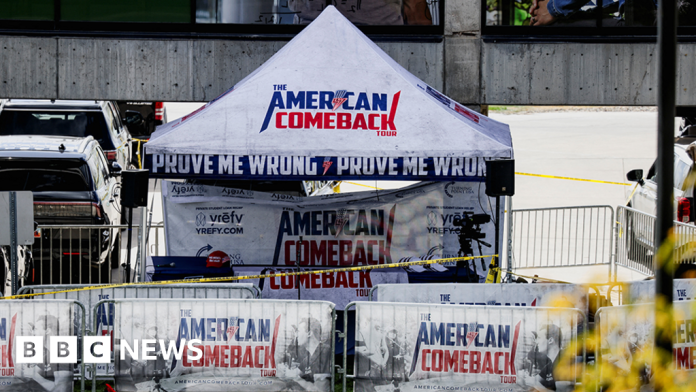
Kirk, 31, who had been invited to speak at Utah Valley University (UVU), was seated under a white gazebo addressing a crowd of about 3,000 people in the quad, an outdoor bowl courtyard.

According to eyewitnesses and videos taken at the scene, he was responding to a question about gun violence at the time.

“Do you know how many transgender Americans have been mass shooters over the last 10 years?” an audience member asked.

“Too many,” replied Kirk.

The questioner then said there had been five in 10 years and asked Kirk how many mass shooters there had been in that time.

“Counting or not counting gang violence?” was Kirk’s reply.

Then a single shot rang out.

It was about 12:20 local time.

Kirk can be seen recoiling in his chair, with blood visible on his neck, before the terrified crowd starts running.

“I heard a loud shot, a loud bang and then I saw his body actually – in slow motion – kind of fall over,” one eyewitness told reporters.

“We all dropped to the ground, and I want to say we sat like that for about 30 to 45 seconds, and then everyone around us got up and started running,” said Emma Pitts, a reporter from Deseret News.

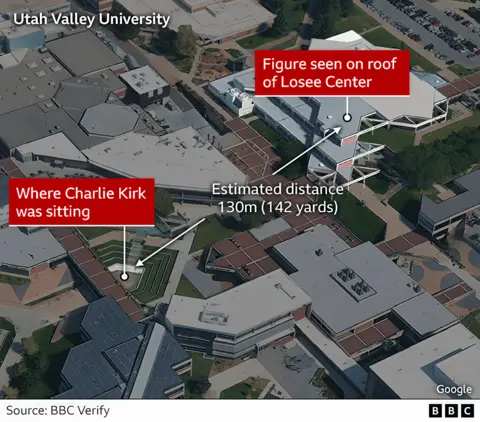
Aerial view of Utah Valley University campus showing several large, flat-roofed buildings arranged around open walkways and green spaces. In the bottom left of the image is a tiered outdoor seating area where Charlie Kirk was sat when he was shot. Toward the top right is the Losee Center, a large building with a visible rooftop where a person was seen. The two locations are approximately 130 meters (142 yards) apart. The campus layout includes interconnected paths between buildings and landscaped areas. Labels on the image mark the two key locations and the estimated distance between them.

Kirk was rushed to hospital in a private vehicle. Hours later, Trump confirmed his death on a post on Truth Social.

His wife Erika and their two young children were sat nearby watching him speak.

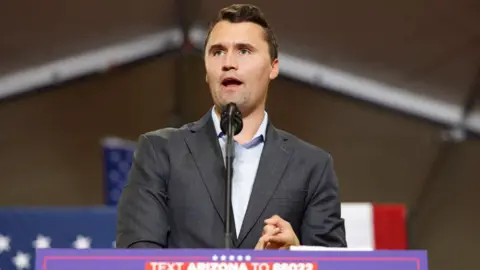
Getty Images Charlie Kirk speaking at a lectern while campaigning for Trump in 2024Getty Images

Charlie Kirk was a darling of the Maga movement and is credited with boosting young voter turnout

A manhunt for the suspect

Authorities say this was an assassination – but we don’t know yet who shot Kirk, or why.

Two people were arrested in the hours after the incident and later released. They have “no current ties” to the shooting, Utah officials have said.

“This shooting is still an active investigation,” the Department of Public Safety, which covers law enforcement in the state, said in its latest update.

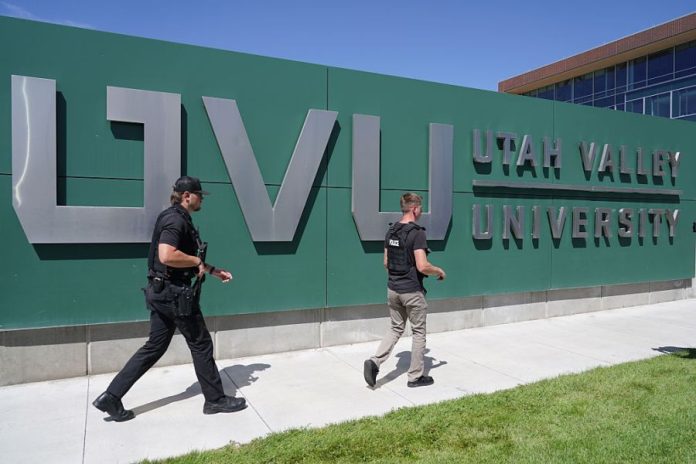
A massive manhunt is under way for the shooter. The campus has been locked down and heavily-armed police are going door-to-door as part of the search, the BBC’s Regan Morris reports from the campus.

Law enforcement officials say the killer is believed to have fired the fatal shot from the roof of a building that is located near the courtyard where Kirk was speaking.

They say they are going through CCTV footage, and believe the suspect was “dressed in dark clothing”.

BBC Verify has been examining videos posted on social media, which people claim show a figure on the roof of a university building after the attack.

It was posted on X after the shooting, but we cannot verify when it was filmed.

The poor quality of the video makes it hard to determine what the dark shape pictured in it might be. Based on the building’s characteristics, the BBC was able to identify it as UVU’s Losee Center – a campus spokesperson has said the shot came from there.

The figure on the roof was approximately 130m (142 yards) away from where Kirk was sitting.

Watch: Video claims to show someone on roof at university where Charlie Kirk was shot

Who was Charlie Kirk?

Kirk was one of the most high-profile conservative activists and media personalities in the US, and a trusted ally of President Trump. He was a guest at Trump’s presidential inauguration and a regular visitor to the White House.

As an 18-year-old in 2012, he co-founded Turning Point USA (TPUSA), a student organisation that aims to spread conservative ideals at liberal-leaning US colleges.

He became known for holding open-air debates on campuses across the country, fielding rapid-fire questions in a signature “change-my-mind”-style – just like he was doing on Wednesday when he was shot.

His social media feed and daily podcast offer a snapshot of what he often debated – the issues ranged from gun rights and climate change, to faith and family values.

Witnesses describe scene before and after Charlie Kirk shot

Kirk had many critics who saw him as a divisive figure that promoted controversial and, at times, conspiratorial beliefs such as the false claim that the 2020 election was stolen from Trump.

But he also had his fans, for whom he was a champion of free speech. They credit him with playing a key role in convincing younger voters to turn out for Trump in last year’s election. He was valued within the Trump administration for his keen understanding of the grassroots Maga (Make America Great Again) movement.

What has the reaction been?

There has been shock, grief and anger across the political spectrum.

“The Great, and even Legendary, Charlie Kirk, is dead. No-one understood or had the Heart of the Youth in the United States of America better than Charlie,” Trump said in a statement on Truth Social.

“He was loved and admired by ALL, especially me,” the president added, ordering that all flags be flown at half-mast across the country.

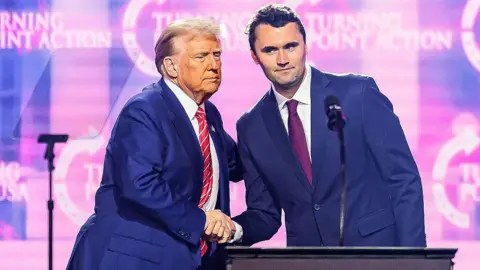
Getty Images Kirk pictured shaking hands with Trump in December at an event by TPUSAGetty Images

Kirk pictured with Trump in December at an event by TPUSA

Former US presidents have offered their condolences. Joe Biden, Trump’s predecessor, said there is “no place in our country for this kind of violence”, while Barack Obama called the shooting a “despicable act”, and said his family was praying for Kirk’s loved ones.

Several key White House officials expressed their sorrow, including Health Secretary RFK Jr and Secretary of State Marco Rubio.

UK Prime Minister Kier Starmer offered his sympathy in a statement: “We must all be free to debate openly and freely without fear.”

Italy’s Prime Minister Girogia Meloni said the “atrocious murder” was “a deep wound for democracy” while Argentinian President Javier Milei paid tribute to Kirk as “a formidable disseminator of the ideas of freedom and staunch defender of the West”.

Is political violence in the US increasing?

In the first six months of this year, the US has experienced about 150 politically-motivated attacks.

That is nearly twice as many as over the same period last year, an expert told Reuters news agency.

Mike Jensen – from the University of Maryland, which for more than 50 years has tracked political violence in a database – said the US is in a “a very, very dangerous spot right now”.

“This could absolutely serve as a kind of flashpoint that inspires more of it.”

Kirk’s murder is the latest in a string of high-profile attacks against political leaders in the US, including two attempted assassinations on Trump during his 2024 election campaign.

The president was injured in the ear after he was shot at a rally in Butler, Pennsylvania, last July and authorities say they thwarted a second attempt on his life at his West Palm Beach golf course two months later.

From the Oval Office on Wednesday night, Trump said “radical left political violence has hurt too many innocent people”.

Comments like these – which he has made regularly – have stirred controversy. Critics say they neglect to acknowledge that the spate of violence is affecting left-leaning politicians too, and could incite further attacks against Trump’s political opponents.

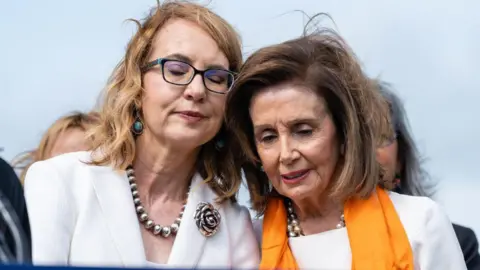
Getty Images Gabrielle Giffords closes her eyes and rests her head against Nancy Pelosi's. Both are wearing white tops with silver jewellery, and Pelosi is wearing an orange scarfGetty Images

Gabrielle Giffords and Nancy Pelosi, both targets of political violence themselves, have condemned the attack

In June, Minnesota’s top Democratic legislator and her husband were murdered in their home.

In April, Pennsylvania governor Josh Shapiro’s house was burned in an arson attack, while the Democrat and his family slept inside.

Other incidents this year include politically motivated fire attacks on Tesla dealerships and the killing of two Israeli embassy staffers in Washington.

In 2022, the husband of then-House Speaker Nancy Pelosi was bludgeoned with a hammer after a man broke into the couple’s home looking for the top-ranking Democrat with the intention of taking her hostage.

“The horrific shooting today at Utah Valley University is reprehensible,” Pelosi said in a post on X on Wednesday.

Former US representative Gabby Giffords – who survived being shot in the head during a meeting with constituents in 2011 – also condemned the attack.

“Democratic societies will always have political disagreements, but we must never allow America to become a country that confronts those disagreements with violence.”

Putin's bid to destroy NATO

0


Tuesday evening’s invasion of Polish airspace by 19 Russian drones — some by way of Belarus — was a repeat performance. It was different this time only because NATO aircraft responded, shooting them out of the sky.

The fact that the U.S. has 10,000 soldiers stationed in Poland apparently had no effect on Russian President Vladimir Putin’s decision. One can only conclude that U.S. boots on the ground in Poland have seemingly lost their deterrent value.

As Polish Foreign Minister Radek Sikorski said during a press conference, “Putin laughs at President Trump’s peace efforts.”

What is becoming evident is the message Russia is sending to NATO: Stop your support for Ukraine. Specifically, he wants to end the use of Poland’s Rzeszów-Jasionka airport to stage and fly NATO weapons and ammunition into Ukraine.

Shortly after the invasion, the U.S. built-up the small regional airport in southeastern Poland. According to the Financial Times, it soon became “the biggest hub for the transport of military equipment to Ukraine, as well as for the evacuation of wounded Ukrainian soldiers to hospitals across Europe.” It was defended by Patriot air defense systems.

But in April 2025, the Pentagon announced its decision to vacate the airfield, citing “cost-cutting” as the reason — temporarily halting shipments to Ukraine until Trump reversed the decision. This, coupled with the Trump administration’s decision last week to halt security assistance funds under Section 333 and the Baltic Security Initiative —  which helps finance the purchase of U.S. weapons, as well as ammunition, special forces training and intelligence support — may have helped green-light Putin’s decision.

Another element of the incursion was Russia’s probing the eastern flank of NATO to gather intelligence on their air defense networks, determine the composition and disposition of their launch sites and associated radars, and to measure response times for future operations. 

It could also serve as a Russian tool to create a division between Old NATO (Western Europe) and New NATO (Eastern Europe) — to fragment the NATO alliance by undermining its confidence in U.S. support.

Russian drones entered Polish airspace again Tuesday evening, only this time NATO aircraft responded and shot them down. Shortly afterwards, NATO Secretary General, Mark Rutte sent a message to Putin: “Stop the war in Ukraine. Stop the escalating war, which he is now basically mounting on innocent civilians and civilian infrastructure. Stop violating Allied airspace. And know that we stand ready, that we are vigilant, and that we will defend every inch of NATO territory.”

On the plus side, the NATO response was immediate, measured, and effective. Poland invoked Article 4 of the North Atlantic Treaty, and the incident will be brought before the North Atlantic Council for discussion; however, the bureaucratic speed of NATO will now be on full display. So will the reluctance of many NATO countries to confront directly an increasingly aggressive Russia.

Unlike Italian Prime Minister Giorgia Meloni’s postwar security concept for Ukraine, this discussion will not be completed in 24 hours, and the decision will not be unanimous.

It is unlikely that Hungary or Slovakia will support any action against Russia. NATO requires all members to agree on resolutions for them to pass. NATO decisions are made through a process of consensus, which means reaching an agreement supported by every member country.

That could leave Poland vulnerable. The Polish government has experienced this before. In September 1939, the United Kingdom and France, while declaring war on Nazi Germany, failed to come to Poland’s defense in what is now known as “The Phony War.”

Failure to gain consensus on Polish security could undermine confidence in the alliance — just as Putin may have envisioned. But it is not just Poland. It is all of NATO’s eastern flank.

On Tuesday, a Russian MI-8 helicopter entered Estonian airspace near the island of Vaindloo, in the Gulf of Finland — the third such incident this year. 

In July, two Russian Gerbera drones — one carrying more than 4 pounds of explosives — crossed into Lithuania from Belarus. In May, Finland alleged that two Russian aircraft violated its airspace.

Russian drones have also “crashed” in Romania, Moldova, and Croatia.

NATO needs a resurgence of American leadership. The U.S. must herd the cats — so that the alliance acts as one instead of as 32 member-countries seeking best individual outcomes. United we stand, divided we fall.

Yes, NATO aircraft shot down Russian drones over NATO territory on Wednesday, but will they be permitted to shoot down Russian aircraft that violate NATO airspace? Will they shoot down Putin’s ballistic missiles? 

Those decisions need to be made now, during the Article 4 proceedings — not when Russia inevitably escalates the situation even further. Pilots and operators of air defense systems need to know their rules of engagement now.

The Baltic States are prepared. Lithuanian Defense Minister Dovile Sakaliene confirms, “We are in a stance where we would be ready to shoot [them] down.”  Estonian Defense Forces spokesperson Maj. Taavi Karotamm said that country’s armed forces are allowed to “to engage hostile targets that have entered the Estonian airspace,” both under Estonian law and under NATO’s Integrated Air and Missile Defense rules of engagement.

NATO Air Policing is essential for deterrence, security and confidence in member countries. Three efforts provide that assurance: the Baltic States, Enhanced Air Policing on NATO’s eastern flank, and the Eastern Adriatic and Western Balkans.

But repeated probes along NATO’s eastern flanks must be met with a robust early warning system and an integrated air defense system, backed by a deep strike capability that can hit Russian and Belarusian airfields and ballistic missile and drone launch sites.

Putin keeps showing his willingness to escalate. He is now willing to threaten NATO in order to get what he wants in Ukraine. History cannot be allowed to repeat itself. Ukrainian President Volodymyr Zelensky cannot be the only Western leader to stand up to Putin.

Col. (Ret.) Jonathan Sweet served 30 years as an Army intelligence officer. Mark Toth writes on national security and foreign policy. 

Sacked referee David Coote denies indecent child image charge

0


Olimpia ZagnatBBC News, Nottingham

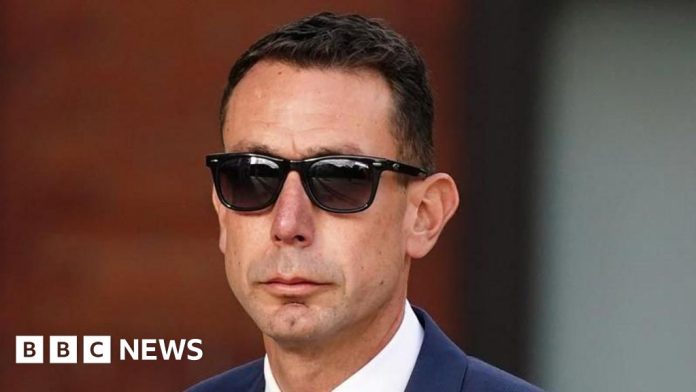
Jacob King/PA Wire A man with short dark hair and wearing in sunglassesJacob King/PA Wire

David Coote appeared at Nottingham Magistrates’ Court on Thursday

Former Premier League referee David Coote has pleaded not guilty to a charge of making an indecent image of a child.

The 43-year-old was charged on 12 August following an investigation by Nottinghamshire Police.

The force said the allegation related to a video file recovered by officers in February.

Ex-official Mr Coote, of Woodhill Road in Collingham, Nottinghamshire, appeared at Nottingham Magistrates’ Court on Thursday.

He spoke only to confirm his name, date of birth and enter his plea during the 18-minute hearing.

Mr Coote was granted conditional bail and is due to appear at Nottingham Crown Court on 9 October.

The charge of making an indecent image of a child refers to activities such as downloading, sharing or saving abuse photos or videos.

Mr Coote was sacked by the Professional Game Match Officals Limited (PGMOL) in December after a video of comments he made about former Liverpool boss Jurgen Klopp in 2020 came to light.

He was also banned by European football’s governing body Uefa until 30 June 2026.

Republicans urge Trump to greenlight Russia sanctions vote after incursion into Poland

0


Republican senators are urging President Trump to give them the green light to vote on a Russia sanctions package in the wake of Moscow’s incursion into Poland’s air space and Russian President Vladimir Putin’s seeming disinterest in ending the war with Ukraine.

Senate Republicans have pushed for months for Trump to back the chamber’s bipartisan package that would punish nations that import Russian oil, gas and uranium, only to see it languish without his support.

That mood is changing.

“I think it’s time for the sanctions bill to come to the floor,” Sen. Shelley Moore Capito (W.Va.), a member of GOP leadership, told The Hill. “I think the president’s got to make the final call on that, so I respect that, but I’m ready to vote for that.”

“It’s just a compounding situation,” she continued. “Every time it looks like Putin’s at the table and then he turns around and just pounds Kyiv or something like that. I think we’re getting closer on sanctions.” 

Sens. Lindsey Graham (R-S.C.) and Richard Blumenthal (D-Conn.) rolled out the package in mid-July, but it has remained dormant as Trump gave negotiations with Putin a full go, headlined by their meeting last month in Alaska. 

But little diplomatic progress has been made since that sit-down and the ensuing White House meeting with Ukrainian President Volodymyr Zelensky and European leaders. And in that time Putin has repeatedly launched barrages of drones and missiles into Ukraine, including the heaviest attack on Kyiv of the war on Sunday, which damaged a key government building.

Senate Majority Leader John Thune (R-S.D.) told reporters Wednesday that Poland’s shooting down of Russian drones in its airspace has “intensified interest” among Senate Republicans in the bill being brought to the floor expeditiously. 

“There’s a lot of, I would say, discussion now around, ‘We need to move.’ … Our members are very interested,” Thune told reporters, labeling the decision to fly drones over Polish airspace a “provocative act.” 

Multiple Republicans indicated they expect to lobby Trump to support the bill, especially after he pushed the European Union to slap China and India with 100 percent tariffs as part of a pressure campaign against Moscow. 

Graham told reporters he expected to meet with Trump on Wednesday afternoon. 

Trump on Wednesday expressed his displeasure with Russia’s action.

“What’s with Russia violating Poland’s airspace with drones? Here we go!” Trump wrote on Truth Social. 

The Graham-Blumenthal package would allow Trump to impose a 500 percent tariff of his own on countries that purchase Russian energy, with China and India atop the list. 

“He’s going to put more tariffs on other countries that buy cheap Russian oil. Europe needs to follow. If they don’t they’re going to make a huge mistake,” Graham told reporters. “The only way you end this war is to make China, India and Brazil pay such a price to keep propping Putin up and quit. They push him to the table.”

“[Putin] could care less about how many Russians die. He can evade sanctions. He’s never been my target. My target is those who buy cheap Russian oil to keep his war machine going,” Graham continued.

The decision by Warsaw to shoot down the drone marked the first time a NATO state has fired on Russia since the Ukraine war erupted more than three years ago, with Polish Prime Minister Donald Tusk declaring that Putin crossed the line.

“I have no reason to claim we’re on the brink of war, but a line has been crossed,” Tusk told the Polish Parliament. “This situation brings us the closest we have been to open conflict since World War II.”

But the question of when a vote will happen still remains unclear. 

Thune noted there were still “technical” issues with the bill that need to be ironed out and that he has a “couple of conversations” that have to take place before he schedules a vote.

Overall, the package has 84 co-sponsors, putting it well clear of a potential presidential veto. On top of the tariffs on various countries, the bill also includes additional sanctions on foreign firms that back Russian energy production. 

Blumenthal, the Democratic lead sponsor, emphasized Russia’s latest action “must be met promptly” with backing for NATO allies and passage of the package. 

“Putin’s reckless, brazen attack on a NATO ally must be met with more than condemnation. Trump’s ham-handed attempt at diplomacy has only appeased & emboldened Putin,” the Democrat wrote on social media. “NATO, led by the US, should quickly deliver arms & equipment to sustain Ukraine as it fights for its freedom. Military aid, in concert with bone-crushing sanctions on Russia & its oil customers, will send an unmistakable message to Putin: Ukraine & its allies will not balk in the face of adversity.”

“I call on Leader Thune to place the Graham-Blumenthal Sanctioning Russia Act on the floor for a vote immediately,” he added.

Oil prices settle up over $1 after global tensions mount; oversupply caps gains

0


By Arathy Somasekhar

HOUSTON (Reuters) – Oil prices settled higher on Wednesday by more than $1 a barrel as investors worried about possible supply disruptions after Poland downed drones in its airspace and the U.S. pushed for new sanctions on buyers of Russian oil the day after an Israeli attack in Qatar, but a report showing swelling U.S. supplies capped gains.

Brent crude futures settled up $1.10, or 1.7%, at $67.49 a barrel. U.S. West Texas Intermediate crude futures rose $1.04, or 1.7%, to settle at $63.67 a barrel.

Geopolitical tensions mounted when Poland shot down drones over its airspace during a widespread Russian attack in western Ukraine, the first shots by a NATO member in the Russia-Ukraine war. On Tuesday, prices had settled 0.6% higher after Israel said it had attacked leadership of the Palestinian militant group Hamas in Doha. Both benchmarks rose nearly 2% shortly after the attack, then retraced most of those gains.

Still, there was no immediate threat of oil supply disruption

“The dark cloud of surplus ahead is … hanging over the market with Brent trading two dollars lower than last Tuesday. Geopolitical risk premiums in oil rarely last long unless actual supply disruption kicks in,” SEB analysts said.

U.S. President Donald Trump has urged the European Union to impose 100% tariffs on China and India – major buyers of Russian oil – as a strategy to pressure Moscow to enter peace talks with Ukraine, according to sources.

With EU officials in Washington to discuss Russia sanctions, European Commission chief Ursula von der Leyen said on Wednesday the bloc was considering a faster phase-out of Russian fossil fuels as part of new measures aimed at Moscow.

The 27-member bloc is very unlikely to impose crippling tariffs on India or China, EU sources said.

Traders expect the Federal Reserve will cut U.S. interest rates at its September 16-17 meeting, which could boost economic activity and demand for oil.

Strong global economic growth in the next few years will increase demand for oil, U.S. Energy Secretary Chris Wright, said, cautioning that U.S. oil production may plateau for a little while.

U.S. crude stocks, gasoline and distillate inventories rose last week, the Energy Information Administration said, a bearish sign for the near-term supply outlook.

Crude inventories increased by 3.9 million barrels in the week to September 5, the EIA said. Analysts polled by Reuters had expected a draw of 1 million barrels.

U.S. gasoline stocks rose by 1.5 million barrels, compared with analysts’ estimates for a draw of 200,000 barrels. Distillate stockpiles, which include diesel and heating oil, rose by 4.7 million barrels, versus expectations for a rise of 35,000 barrels.

‘Widespread revulsion’ in Labour at at Mandelson’s Epstein links, says MP

0


Jennifer McKiernanPolitical reporter, BBC News

Reuters Lord MandelsonReuters

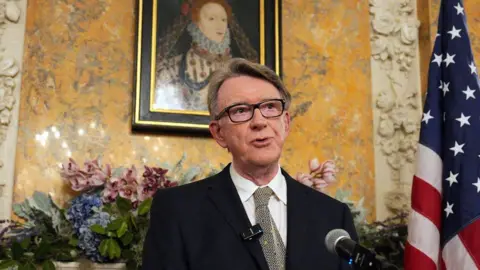
Labour MP Andy McDonald has said there is “widespread revulsion” in the party over Lord Mandelson’s links with convicted paedophile Jeffrey Epstein, amid growing calls for him to be sacked.

McDonald called for Mandelson to stand down “immediately” as the UK’s ambassador to Washington, following fresh revelations in emails about his relationship with Epstein.

The Conservatives are stepping up pressure on Sir Keir Starmer to sack Mandelson, with an urgent question from MP Neil O’Brien due in Parliament shortly.

Home Office Minister Mike Tapp this said the prime minister continues to have “confidence in Mandelson” and his abilities as ambassador, adding the “disturbing” emails made him “shudder”.

Lord Mandelson is reported by Bloomberg to have told Epstein to “fight for early release” shortly before he was sentenced to 18 months in prison, and told him, “I think the world of you” the day before he began his sentence for soliciting prostitution from a minor in June 2008.

McDonald told BBC Radio 4’s Today programme: “I’m afraid if he [Mandelson] doesn’t do the right thing and resign today then the prime minister should sack him.”

The PM will face “inescapable” questions about his own judgement in appointing Mandelson, said McDonald, who suggested the vetting process may have failed.

Asked how Labour MPs were feeling about Mandelson, McDonald said: “It is widespread revulsion that we, by association, being in the same party, are being brought under the microscope for something that he has done.

“There isn’t anybody in the Labour Party who is supporting Peter Mandelson today and the Prime Minister’s got to hear that and understand that he’ll weaken his position if he continues to support him.”

The MP for Middlesbrough and Thornaby East dismissed concerns sacking Mandelson could damage to relations with US President Donald Trump and urged Sir Keir to show he had a “moral compass” to honour Epstein’s victims.

Asked what he thought of Mandelson’s emails to Epstein on BBC Breakfast, Home Office Minister Mike Tapp said the emails made him physically “shudder”, adding: “I find it disturbing, those sorts of emails in honesty.”

Tapp, who has worked for the National Crime Agency, said: “I have arrested these vile paedophiles and had to meet many of the victims of these crimes, so it’s really important that’s clear.”

However, asked whether the government was reviewing Mandelson’s future as ambassador, Tapp said “the prime minister has confidence in his ability”

he added that that “the work he is doing in America is very important”, stressing the recent UK-US trade deal as well as their defence relationship around the threat from Russia.

Thin, red banner promoting the Politics Essential newsletter with text saying, “Get the latest political analysis and big moments, delivered straight to your inbox every weekday”. There is also an image of the Houses of Parliament.

Person of interest in fatal shooting of Charlie Kirk in custody, FBI says

0


Related video: Shouting breaks out in House after silent prayer for Charlie Kirk

A person of interest in the fatal shooting of conservative activist Charlie Kirk on Wednesday is in custody, according to the FBI and Utah Gov. Spencer Cox (R).

“The subject for the horrific shooting today that took the life of Charlie Kirk is now in custody. Thank you to the local and state authorities in Utah for your partnership with @fbi. We will provide updates when able,” FBI Director Kash Patel said in a Wednesday evening post on the social platform X. 

Kirk was fatally shot Wednesday afternoon while speaking at an event at Utah Valley University in Orem, Utah. 

Kirk was struck by a gunshot in the neck, according to the video footage from the scene shared on social media. President Trump confirmed Kirk’s death in a post on Truth Social. 

Shortly after the shooting, law enforcement briefly had a person of interest in custody, but he was released after authorities “identified that he did not match the shooting suspect and was not an accurate person of interest,” Utah Department of Public Safety Commissioner Beau Mason said during a press conference Wednesday afternoon. 

“However, he has been booked into the county jail by Utah Valley University Police Department for obstruction of justice,” Mason said. “We do still have an active investigation for the person of interest.” 

During the press conference, authorities also said the shooter was dressed in all dark clothing and that the shot came from on campus, potentially from a roof. In addition to local security, Kirk’s security was also present at the time of the shooting, noted Utah Valley University Police Chief Jeff Long.

It is believed the shooter acted alone, authorities said.

Cox also said a person of interest was in custody in remarks during the press conference, and he called the act “a political assassination.”

We will more than triple our revenue this year

0


OpenAI’s (OPAI.PVT) torrid pace of growth is poised to keep on going right into 2026.

“Revenue this year will grow over 3X. So about $13 billion in revenue from about $4 billion last year. So it’s tripling on a very big base as well,” OpenAI CFO Sarah Friar told me at the Goldman Sachs Communacopia conference on Tuesday.

“It is a wild pace that we’re on. You’re defining a whole new era of AI,” Friar said. She declined to put a timetable on OpenAI becoming a public company.

It’s been an eventful year for OpenAI. The release of ChatGPT 5 in early August was met with mixed reviews as users complained about the interface’s less-human responses. CEO Sam Altman acknowledged the company “screwed up” on the rollout.

A few weeks removed from this episode, Altman reportedly said the AI market was in a bubble.

Around the same time, the New York Times reported OpenAI was in talks to sell $6 billion in shares by current and former employees to investors. The deal would value OpenAI at about $500 billion, up from a $300 billion valuation in March.

Careful scrutiny remains, too, about the health of OpenAI partner and major investor Microsoft (MSFT).

OpenAI wants Microsoft to ease up its hold on its AI offerings as it ramps up growth. The pact between the two is slated to last until 2030 but could end earlier if OpenAI’s board declares it has developed artificial general intelligence (AGI).

Microsoft AI CEO Mustafa Suleyman downplayed any tension in the partnership in an interview with me in June.

“The relationship’s in pretty good shape,” he said. “It’s one of the best technology partnerships there has been, and it will continue for at least another five years, hopefully many decades after that.”

Meanwhile, investors question how long the AI hyper-growth cycle can last.

“We’re in the first inning, a lot of people have compared the AI era to things like the railway build-out, because it is a very capital-intensive build-out. But I think we are just beginning. We’ve maybe laid some track from New York to Baltimore, but we’re ultimately going to blanket the US and ultimately blanket the world,” said Friar.

“And so anyone who thinks this cycle is, you know, at a zenith is not seeing what I’m seeing.”

Brian Sozzi is Yahoo Finance’s Executive Editor and a member of Yahoo Finance’s editorial leadership team. Follow Sozzi on X @BrianSozzi, Instagram, and LinkedIn. Tips on stories? Email brian.sozzi@yahoofinance.com.


Emily Thornberry pulls out of deputy Labour leader race

0


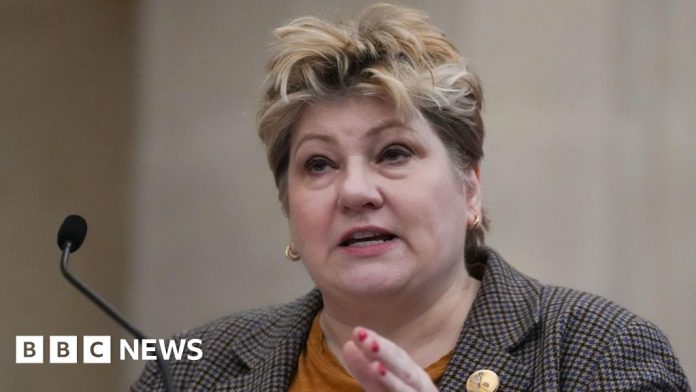
Emily Thornberry has announced she is withdrawing from the Labour deputy leadership contest, leaving four candidates left in the race to replace Angela Rayner.

Announcing her decision on social media, Thornberry said she was “deeply grateful” to Labour members for their support and added that it had been “a privilege to take part in this race with such brilliant women”.

Thornberry, who chairs the Commons foreign affairs committee, had gathered 13 nominations from Labour MPs, far short of the 80 needed to progress to the next stage of the contest.

Education Secretary Bridget Phillipson is the frontrunner so far, having secured backing from 116 of her parliamentary colleagues.

Lucy Powell – who was sacked as Commons leader last week – is her closest rival with 77 nominations.

Clapham and Brixton Hill MP Bell Ribeiro-Addy has 15 nominations and fellow left-winger Paula Barker, who represents the Liverpool Wavertree constituency, is on 14.

The candidates have until 17:00 on Thursday to get 80 nominations, otherwise they will have to drop out of the race.

Housing Minister Alison McGovern withdrew from the race on Wednesday and backed Phillipson after failing to pick up enough support.

In order to make it to the final ballot, deputy hopefuls will then have to win the backing of 5% of local parties or three Labour affiliated groups, such as a trade union.

Voting opens on 8 October and closes on 23 October, with the winner being announced two days later.

Candidates will have the chance to make their pitch to Labour members at hustings during the party’s conference, which takes place at the end of September.

The contest is an unwelcome distraction from Prime Minister Sir Keir Starmer, as it has the potential to become a vehicle for unhappy MPs and party members to express their discontent with the leadership.

Phillipson’s position as the only cabinet member in the race has helped her secure nominations from those MPs who are loyal to the government.

However, it may harm her in the eyes of party members, who may prefer a candidate who can be independent of the leadership.

Whatever the result, the deputy leader will not become deputy prime minister, as Sir Keir has already appointed David Lammy to the role.