10.9 C
New York
Thursday, April 30, 2026
Home Blog Page 140

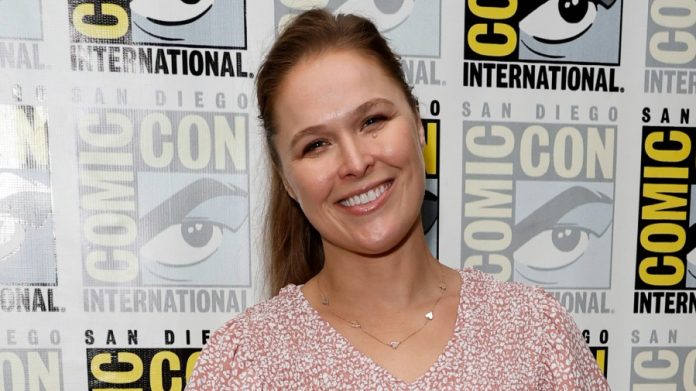
Ronda Rousey passes on UFC White House card: 'I got better s— to do'

0


Former MMA fighter Ronda Rousey says don’t expect to see her come out swinging at an Ultimate Fighting Championship (UFC) cage match at the White House. 

“I’m not fighting at the White House,” Rousey said in a recent interview on the “Lapsed Fan” podcast, when asked if anyone had reached out about the fight, scheduled to take place next June on the South Lawn. 

“After Mike Tyson being the biggest fight of the year, you never say never, but I ain’t fighting at the f—ing White House,” Rousey, a 38-year-old Olympian who retired from MMA in 2016, said. 

In July, President Trump floated the idea of hosting a UFC event at the White House next summer to help mark the United States’s 250th anniversary.

“We’re going to have a UFC fight, think of this, on the grounds of the White House,” Trump said. 

“We have a lot of land there. We’re going to build a little — we’re not, Dana’s going to do it. Dana’s great. One of a kind,” he said at the time, referring to UFC President Dana White.

Pressed on whether she would participate in the event if given the opportunity, Rousey responded to laughs, “Even if offered? I got better s— to do.”

Gold rallies to new record on U.S. rate cut hopes, Fed tension

0


By Anushree Mukherjee and Sherin Elizabeth Varghese

(Reuters) – Gold hit a record high above $3,600 an ounce on Tuesday, spurred by expectations of U.S. rate cuts, concerns about Federal Reserve independence and robust demand from investors and central banks.

Having hit a record high at $3,673.95 a troy ounce, spot gold was trading around $3,637.39 at 1524 GMT for a gain of more than 38% so far this year.

Analysts expect gold to trade in a $3,600-$3,900 range in the near to medium term and see potential for it to test $4,000 next year if economic and geopolitical uncertainties persist.

A Reuters survey published in July showed analysts expected gold prices to average $3,220 this year compared with $3,065 in the April survey and $2,756 an ounce in the January survey.

“Supportive for gold is the bearish dollar outlook underpinned by expectations of Fed cuts, investors distancing from U.S. assets and tariff-related economic uncertainty,” said Ricardo Evangelista, senior analyst at ActivTrades.

The dollar has fallen nearly 11% since Donald Trump returned to the White House in January. Expectations of further U.S. rate cuts will further undermine the U.S. currency, which when it falls makes dollar-denominated gold cheaper for holders of other currencies.

Traders see a 92% chance of a 25-basis-point rate cut in September when the Fed meets, according CME Group’s FedWatch tool.

Meanwhile, Trump’s criticism of Powell and attempts to remove Governor Lisa Cook have heightened concerns over the Fed’s independence and sparked further gold purchases.

“The most bullish wildcard is … potential interference with the U.S. Federal Reserve and concerns about the dollar’s status as a safe-haven,” said Julius Baer analyst Carsten Menke.

Among other factors fortifying gold’s appeal are security concerns emanating from the Middle East and between Russia and Ukraine. Central bank gold purchases such as those by China have also provided impetus to gold prices.

According to the World Gold Council, central banks plan to raise the gold portion of their reserves while reducing dollar reserves over the next five years.

Physically-backed gold exchange traded funds have also seen significant inflows. Holdings in the the SPDR Gold Trust, the world’s largest physical gold ETF, rose to 990.56 tons on September 2 for a over 12% increase so far this year and its highest since August 2022.

(Reporting by Anushree Mukherjee and Sherin Elizabeth Varghese in Bengaluru, additional reporting by Kavya Balaraman; Editing by Pratima Desai and xxxxx)

Prince Harry donates £1.1m to Children in Need

0


The Duke of Sussex has made a personal donation of £1.1m to a BBC Children in Need project in Nottingham supporting young people who have been affected by violence.

Prince Harry is on the second day of a UK visit, where he’s been attending charity events.

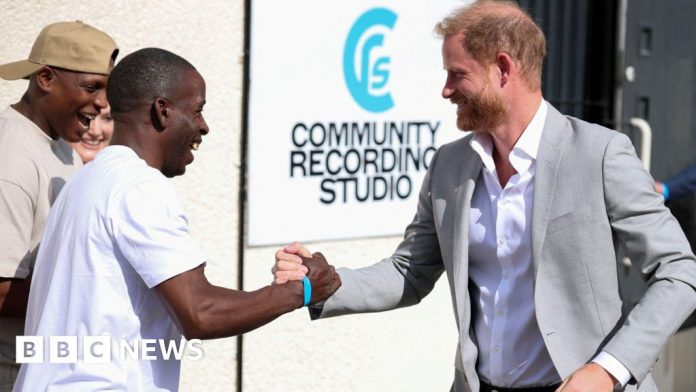
In Nottingham he visited the Community Recording Studio, an initiative supported by BBC Children in Need, where he applauded a rap music performance, giving a hug to one of the young people taking part.

The prince hoped the donation, from his own money rather than his Archewell organisation, would help “changemakers in the city continue their mission to create safe spaces… and offer hope and belonging to young people who need it most”.

Prince Harry told the event that “Nottingham has been a place where I’ve heard harrowing stories, learned important lessons, seen resilience, and felt truly inspired”.

“The challenges remain serious and sadly aren’t getting any easier,” said Prince Harry. “Violence impacting young people, particularly knife crime, continues to devastate lives, cut futures short, and leave families in grief.”

He praised the efforts of those in the city who were working to tackle issues such as “food poverty, racism and educational inequality”.

Looking relaxed and wearing jeans, Harry met youth workers and local groups at the recording studio and heard about their efforts to tackle violence in Nottingham, in a scheme supported by BBC Children in Need.

“You gave me goosebumps,” he said after listening to a rapper called Paige.

“I was proper nervous,” Paige told Prince Harry about her first visit to the recording studio. “I’d never seen a booth or a mic or anything. So I’m listening to all these rappers on YouTube – and I’m like, ‘How do they even make that?'”

A young comedian, Ki’miya, teased Prince Harry about different backgrounds growing up by saying: “I bet you never had to stand on a chair to get a Hobnob.”

As well as showing a few dance moves when he arrived, and turning down the chance to sing backing vocals, Prince Harry joined conversations about creating more positive opportunities for young people.

BBC Children in Need is now one of the country’s biggest funders of independent youth workers.

Tony Okotie, the charity’s director of impact, said the donation would help “create spaces where young people feel safe, heard, and empowered to build brighter futures”.

There have been previous significant donations by the prince. He gave £1.2m of the proceeds from his memoir Spare to Sentebale, the charity he co-founded in southern Africa, which he subsequently left in an acrimonious dispute.

Prince Harry arrived in the UK on Monday – and went to lay a wreath on the grave of Queen Elizabeth II in Windsor, on the third anniversary of her death.

But it is still not known whether he will meet his father King Charles during this visit to the UK, despite much speculation that a meeting is on the cards.

The two men have not met face to face since February 2024 and Prince Harry has talked emotionally in a BBC interview about wanting a “reconciliation” with his family.

While Prince Harry has been in Nottingham, his brother the Prince of Wales has been carrying out his own engagements – visiting a housing project in south London as part of his Homewards campaign to tackle homelessness.

On Monday, Prince Harry had attended the WellChild awards in London, while his brother Prince William was at a Women’s Institute meeting in Berkshire, with guests remembering the legacy of the late Queen Elizabeth.

Mamdani taps 'Gilded Age' star to read 'freakout' reaction to him from NY's mega-rich

0


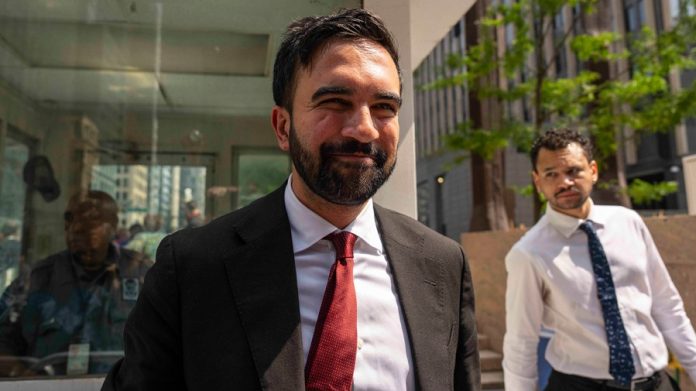
Zohran Mamdani’s campaign is offering a rich response to a news story detailing how the very wealthy feel about the New York City Democratic mayoral nominee, tapping a star of “The Gilded Age” to perform a “dramatic reading” of the article.

In a video posted by Mamdani on Monday, Morgan Spector is seen dressed as his railroad tycoon character, George Russell, from the HBO historical drama that’s set in the late 19th century and follows the lives of New York’s mega-rich. 

The 44-year-old actor then reads aloud selected passages from a New York Times story published last month titled “How Are the Very Rich Feeling About New York’s Next Mayor?”

“August in the Hamptons: Ocean breezes. Oversubscribed Tracy Anderson classes. Parking woes. And this year, with a New York City mayoral election looming in the fall, a freakout that the most sumptuous of summer staples hasn’t soothed,” Spector said in front of a background filled with books and lit candles. 

“Even overpriced lobster salad can’t seem to make people out here feel better,” Spector said, reciting a political fundraiser quoted in the Times’s piece. 

“What they are talking about is whether anyone, specifically former Gov. Andrew M Cuomo or Mayor Eric Adams, can beat the Democratic Socialist Zohran Mamdani,” Spector said in a pronounced manner.

“In June, he dared to say, on ‘Meet the Press’: ‘I don’t think that we should have billionaires,'” Spector said of Mamdani’s interview on the NBC program. Spector then eyed the camera directly and dramatically took a sip of a drink. 

“The Hamptons is basically in group therapy about the mayoral race,” Spector said, again quoting the political fundraiser cited by the Times. 

“In other words, the plutocrats are panicking,” Spector said, pulling from the same article. 

Spector has praised Mamdani before, referring to him as a “fantastic candidate” before he officially clenched the Democratic nomination for New York mayor in July. 

“He feels like a candidate who could have an amazing future as a left politician,” Spector told Rolling Stone. 

President Trump has repeatedly ripped Mamdani, a New York state Assembly member who identifies as a democratic socialist, calling him a “communist lunatic.”

JPMorgan elevates three insiders as global investment banking chairs on M&A revival

0


(Reuters) -JPMorgan Chase named three insiders as global chairs of its investment banking division on Tuesday, as U.S. banks position themselves to capitalize on a recovery in dealmaking activity in 2025.

Global mergers and acquisitions hit $2.6 trillion in the first seven months of the year, the highest since a 2021 pandemic-era peak, boosting investment banks’ prospects.

The three – Howard Chen, Charlie Dupree and Fred Turpin – will join a senior team that provides strategic advice to some of JPMorgan’s most important clients as the largest U.S. bank bolsters its investment banking division, a key driver of recent profits.

The lender beat estimates for second-quarter profit in July and its investment banking fees rose 7% to $2.5 billion, fueled by an increase in M&As and debt underwriting.

Chen, who joined JPMorgan in 2018, was most recently co-head of the North America financial institutions group, while Dupree served for the last seven years as vice chair of investment banking for M&A.

Turpin, most recently JPMorgan’s global head of media & communications investment banking, has been with the bank 30 years, having worked on deals such as T-Mobile and Sprint and Warner Media and Discovery, among others.

(Reporting by Pritam Biswas in Bengaluru; Editing by Pooja Desai)

Mitchum deodorants recalled after itchy, burning armpits claims

0


Faarea Masud & Connie BowkerBBC News

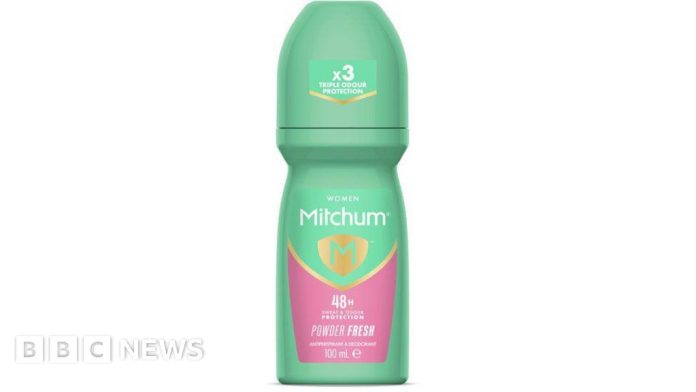
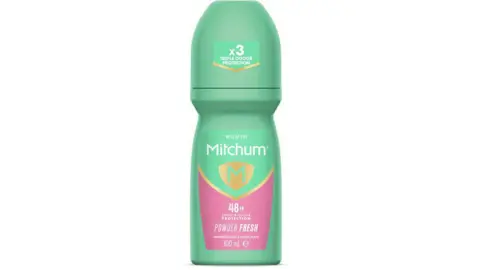
Mitchum A green and pink bottle of Mitchum powder-fresh roll-on deodorant.Mitchum

A well-known deodorant brand has apologised and recalled some of its roll-on products after customers were reportedly left with itchy, burning armpits.

Consumers of Mitchum’s 48-hour roll-on anti-perspirant and deodorant complained on social media how they experienced “agonising weeping spots”, redness and irritation after using the roll-ons.

Posting on TikTok, one customer claimed they wanted to “rip my armpits out”, while another said her underarms felt like they were “on fire”.

The company said it was “truly sorry” and explained how a change in the manufacturing process had led to the 100ml batches sold in the UK, Ireland and South Africa being affected and recalled.

Hundreds have taken to sharing videos of their experience on social media, including a customer who described how she was left in agony because of “weeping spots” under her arm.

“I won’t be using any Mitchum products again because I’m not risking this happening again,” she said.

One woman said she was unable to sleep after applying the roll-on to her skin because the deodorant left her with “second degree chemical burns on my armpits”.

Another described her underarm skin as developing a pink rash which had “scabbed over”.

A Mitchum spokesperson said the brand was “truly sorry some of our customers have experienced temporary irritation.”

In a statement, the company said: “We want to reassure there has been no change to the formula of our products, but we have identified a change in the manufacturing process affecting one of our raw materials.

“This has impacted how the roll-on interacts with the skin of some users.”

It said the issue had since been “resolved” and it was working to “remove the small amount of product” left in shops.

“In addition, we have reverted to the original manufacturing process to ensure no other batches are affected”, the spokesperson said.

Mitchum advised all those affected to contact its customer services team so it could “make this right”.

The firm has issued a list of all the affected 100ml roll-on products. These are:

  • Powder Fresh
  • Shower Fresh
  • Unscented
  • Pure Fresh
  • Flower Fresh
  • Ice Fresh
  • Clean Control
  • Sport

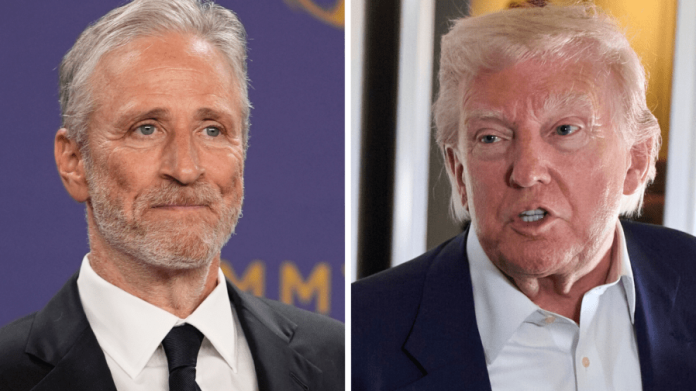
Jon Stewart mocks Trump Cabinet meetings: 'Vibe … is very Make-A-Wish kid'

0


Jon Stewart is mocking the way President Trump is treated at his Cabinet meetings, saying the praise he receives is similar to a “Make-A-Wish kid.”

“Whenever any of his biggest supporters are with him, it sounds like they’re saying goodbye,” the “Daily Show” host quipped to the audience during his monologue on Monday.

The Comedy Central show’s host played clips of White House officials commending Trump, including U.S. special envoy Steve Witkoff telling the president at an August Cabinet meeting that working for him was “the greatest honor” of his life. 

Stewart said, “Once you begin to notice this pattern, you begin to see really the whole vibe around this president is very Make-A-Wish kid.”

The Make-A-Wish Foundation, a nonprofit organization, grants “life-changing wishes” to children with critical illnesses. 

“Everyone who shows up to his office tries to make one of his dreams come true,” Stewart said of the attitude towards Trump. Stewart then cued up a clip of Trump being presented with an honorary U.S. Marshals Service badge during an event in the Oval Office last month. 

“Look how happy they made him! Gee whiz, mister, a real marshal?” Stewart exclaimed with feigned enthusiasm.

“Now you might be saying to yourself, the Make-A-Wish thing is a little much,” Stewart said. 

“A grown man would recognize when people are condescending to him, treating him like a child, tiptoeing around his fragile ego with the idea that this person is so easily manipulated that even the cheapest of gestures could be persuasive,” he added.

“You would f—ing think that,” Stewart, a frequent Trump critic, said to laughs before playing a news clip of FIFA President Gianna Infantino handing the World Cup Trophy to the president in the Oval Office last month.

“It’s for winners only, and since you’re a winner, you can as well touch it,” Infantino said. 

“Everything about the treatment of this president screams Make-A-Wish,” Stewart said. 

“I’m telling you, though, man, this goes way past trophy fondling and cereal box deputy badges: The people around Trump know that he is a never ending, insatiable black hole of wishes,” Stewart said, noting that several White House officials have floated him for a future Nobel Peace Prize. 

But Stewart then shifted his characterization, after denouncing a Monday Supreme Court ruling that lifted a judge’s limits on Los Angeles-area immigration stops based on a person speaking Spanish or working in a certain profession.

“The Supreme Court bent over backwards to grant Trump even his most unconstitutional wishes, like maybe you can arrest people for looking Mexican,” Stewart said.

“What kind of a Make-A-Wish kid wants to nullify the Fourth Amendment?” the “Daily Show” host said. 

“I’m beginning to think Trump isn’t a benign, suffering child at all. I’m beginning to think everybody treats Trump like this, not because he’s the Make-A-Wish kid, but because he’s that ‘Twilight Zone’ kid that any time somebody made him mad, he sent them out to the cornfield,” Stewart said, in a reference to a 1961 episode of the classic TV horror series. 

“This is where we’re at, America,” Stewart said with a shake of his head, telling the audience that the country is being “held hostage by the fragile ego of a man-baby president.”

Access to this page has been denied.

0


Access to this page has been denied because we believe you are using automation tools to browse the
website.

This may happen as a result of the following:

  • Javascript is disabled or blocked by an extension (ad blockers for example)
  • Your browser does not support cookies

Please make sure that Javascript and cookies are enabled on your browser and that you are not blocking
them from loading.

Reference ID: #ab92602b-8d88-11f0-b7f7-d83c58e979d5

Twenty-three killed in Russian strike on pension queue, Ukraine says

0


Twenty-three people have been killed in a Russian air strike on a village in eastern Ukraine, according to a local official.

The victims were ordinary people collecting their pensions in the Donetsk settlement of Yarova, said President Volodymr Zelensky. Donetsk regional leader Vadym Filashkin said emergency services were at the scene and as many people were wounded as killed.

Yarova is to the north of Slovyansk, one of the big cities in the region, and not far from the front line as Russian forces advance slowly in the east.

If confirmed, the death toll would be among the heaviest attacks on Ukrainian civilians in recent weeks, 42 months into Russia’s full-scale invasion.

Twenty-three people were killed in overnight air strikes on Ukraine’s capital Kyiv at the end of August.

At the weekend Russia launched its biggest air assault of the war on Kyiv so far, hitting the main government building in the capital, in what Zelensky said was a “ruthless” attack aimed at prolonging the war.

Posting graphic footage of the attack on Yarova online, Zelensky said there were “no words” to describe the latest Russian strikes. There was no immediate response from Russia’s military.

The head of the local administration in nearby Lyman, Oleksandr Zhuravlyov, said the attack took place at about 10:40 local time (07:40 GMT) on Tuesday, as pensions were being handed out.

Twenty-three people had been killed and another 18 wounded according to latest casualty figures, he told Ukraine’s public broadcaster Suspilne.

Pictures from the scene showed a badly damaged Ukrainian postal service vehicle of the type used to distribute pensions.

The head of the Ukrposhta service said the vehicle had been parked under trees as a security measure and a local postal official had been wounded in the attack. “Maybe someone gave away the co-ordinates,” he speculated.

Yarova sits on a key railway line between the cities of Lyman and Izium. It is also only about 6km (3.7 miles) away from the next village of Novoselivka, where Russian forces are closing in on the outskirts.

Zhuravlyov told Suspilne they had to work out how the postal service could continue to hand out pensions: “Because the front line is less than 10km away, we will ‘move away’ all these payments, so they can have their pensions in safer places.”

Ukraine’s state emergency service said another three people had died in earlier Russian shelling of settlements in Donetsk.

“The world must not remain silent,” Zelensky said, calling for a response from both the US, Europe and the G20 group of nations.

Trump’s AI action plan needs a safety net 

0


In the space of just a few quarters, AI systems moved from novel office tricks to everyday tools that quietly erase the first rungs of many careers. As a result, the entry-level American dream is getting squeezed out by “code and compute.”

The displacement starts where work is most codified, and it is happening fast enough that we can measure it in real time.

In AI-exposed fields such as software development and customer service, early-career employment is sliding. But older cohorts continue to hold their ground, according to a recent study by three researchers at Stanford. That means the Trump administration’s new “AI Action Plan,” framed around removing barriers and investing in AI infrastructure — such as taking a stake in Intel — risks intensifying the squeeze if it is not paired with robust worker policies.

In short, we need to match AI ambition with large-scale job retraining and a basic income floor, or risk watching opportunity narrow for the next generation. 

The clearest pattern in the study is both simple and sobering. In the most AI-exposed occupations, workers aged 22 to 25 saw employment fall by 13 percent relative to peers in less-exposed roles, even after accounting for firm-level shocks. Wages barely budged, which means adjustment is happening through headcount rather than lower paychecks.

The timing matters. Since late 2022, when generative AI adoption exploded across workplaces, employment for 22- to 25-year-olds in the most exposed jobs fell by 6 percent, while the number of workers ages 35 to 49 in those same occupations grew by “6 to 9 percent.” That split lines up with a basic intuition about how AI affects the workplace. Entry-level roles lean on codified knowledge that models can replicate cheaply, whereas experienced workers contribute tacit judgment, domain context and organizational savvy, which AI cannot yet replace at scale.

The mechanism shows up when you sort jobs by how AI is used. Where AI primarily automates tasks, entry-level employment contracts. Where AI genuinely augments human work, employment for young workers stabilizes or grows. Tasks that can be pushed into a prompt are collapsing into tools. Tasks that require teams, customers and context are not.

The Trump administration has reoriented federal AI policy around acceleration. In January 2025, the White House issued “Removing Barriers to American Leadership in Artificial Intelligence,” an executive order that revoked the prior administration’s AI guardrail order and directed officials to produce an “Artificial Intelligence Action Plan.” The order’s thrust is to sustain and enhance American AI dominance, revise agency guidance to align with that goal, and clear away policies seen as obstacles.

Acceleration has value. It also has a labor cost, if you ignore the evidence. This is not an argument to slow AI, but to stop treating workforce policy as an optional add-on. An action plan that maximizes deployment while leaving displaced workers to absorb the shock will worsen the early-career crunch. That is a structural signal, not a temporary blip. 

A durable AI strategy marries acceleration with transition support. Start with retraining that is built for the way modern workers actually learn. Fund employer-validated, short-cycle programs that move people into augmentative roles where employment is rising. Focus on skills that compound with AI instead of competing directly with it. Make training portable and time-bound. Replace fragmented grants with individual learning accounts that workers can draw on when tools change and tasks go away. 

In addition, add wage-linked supports that keep people attached to the labor market while they retool. Temporary wage insurance cushions earnings losses when workers step down to reenter a new field. Subsidized apprenticeships in AI-complementary jobs provide supervised experience that no model can fake.

These are not theoretical ideas. They are pragmatic ways to turn early-career workers from the first victims of automation into the first beneficiaries of augmentation. 

Finally, test a basic income floor where the data say risk is highest. The paper shows the sharpest dislocations among 22- to 25-year-olds in automation-exposed occupations. That is the right population for time-limited basic income pilots funded at the federal level and administered locally. Combine the stipend with mandatory participation in training or job placement, and you get the stability to retrain plus the nudge to stay engaged with work.  

The point is not to replace jobs but to buy the time required for new tasks and new firms to materialize — a dynamic that past technology waves have delivered only after painful adjustments.

America needs two hands on the wheel. On one side, the administration should pursue AI leadership through research, standards and deployment. On the other, it must act on what the labor data already show. Early-career workers in AI-exposed jobs are losing footholds, and those losses are strongest where AI automates rather than augments. 

Put these threads together and the policy path is clear. Pair the action plan with aggressive, employer-aligned retraining, wage-linked transition supports, and a basic income floor targeted to the workers absorbing the shock. That combination preserves U.S. dynamism and honors a core promise of economic growth, which is that progress should expand the circle of opportunity.

The alternative is a faster AI future with fewer places for new workers to stand. 

Gleb Tsipursky, Ph.D., serves as the CEO of the hybrid work consultancy Disaster Avoidance Experts and authored the best-seller “Returning to the Office and Leading Hybrid and Remote Teams.”