The TUC, the umbrella group for trade unions in the UK, is calling for Chancellor Rachel Reeves to consider a range of wealth taxes in November’s Budget to help boost investment in public services.
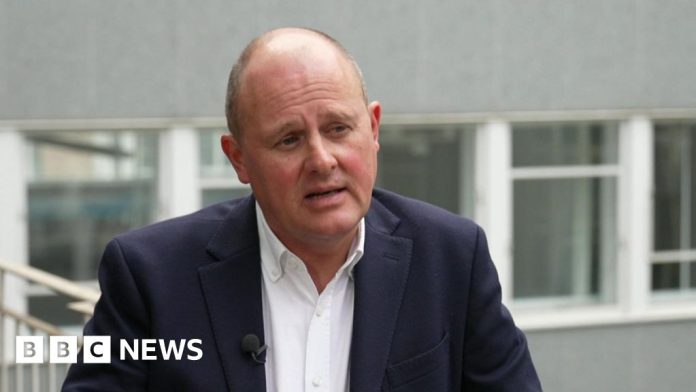
Their top official, general secretary Paul Nowak, told the BBC that people needed to see evidence of change.
“We need a progressive tax system – a tax on online gaming companies and gambling companies, a tax on windfall profits which the banks and financial institutions have seen over the last couple of years.”
The Treasury said the government’s number one priority was to grow the economy.
In the interview, Mr Nowak called for Reeves “not to take anything off the table” and look at other options including equalising capital gains tax with income tax and, he said, “a wealth tax itself”.
“It has been introduced in other countries including Spain, which has one of the fastest growing economies.”
Individual unions are likely to make similar demands when the TUC’s annual Congress gets under way this weekend.
Mr Nowak focused in particular on the case for levying more from financial institutions.
“Banks have record profits driven by a high-interest environment.
“We think we can still have a profitable bank sector and ask them to pay their fair share.”
The prime minister reiterated this week that Labour’s financial rules were non-negotiable.
So, to meet the chancellor’s self-imposed constraints on debt and borrowing, tax rises appear to be inevitable in November.
The debate in the Labour movement – and elsewhere – is over who to tax and by how much.
Mr Nowak argued that “the big four high street banks made £46bn in profits in one year alone”.
Charlie Nunn, the chief executive of Lloyds Bank, has previously spoken out against any potential tax rises for banks in the government’s Budget announcement this autumn.
He said efforts to boost the UK economy and foster a strong financial services sector “wouldn’t be consistent with tax rises”.
And when the left-leaning think tank the IPPR suggested further taxing bank profits, share prices fell.
Asked if this approach could make the markets jittery and potentially drive investors away, Mr Nowak said: “Britain is an attractive place for international investors” and he suggested there hadn’t been “an exodus of millionaires” after tax changes for non-doms and ending the VAT exemption for school fees.
He claimed that the TUC’s own polling suggested that introducing wealth taxes to fund public services was most popular among voters who had gone from Labour to Reform UK.
Nigel Farage’s party conference begins on Friday in Birmingham and Mr Nowak issued this warning to Keir Starmer: “Change still feels like a slogan not lived reality. There is a real danger if the government doesn’t deliver the change people want, they will become disillusioned with mainstream politics, and some will look for divisive alternatives like Reform.”
While the chancellor has been far from keen on a conventional wealth tax on assets, some in the wider Labour movement are pressing her to look at how those with “the broadest shoulders” pay more.
There is some hope that with a new economic adviser now ensconced in Downing Street and reporting to the prime minister, that the debate on tax is more open than before.
That adviser – Baroness Shafik – has called for taxation on wealth and land in the past.
“The public aren’t daft – they know there are difficult choices,” said Mr Nowak.
“We need a grown up conversation.”
A Treasury spokesman told the BBC that the government’s number one priority was to grow the economy and pointed to the chancellor’s words last month.
Rachel Reeves said: “We introduced increased taxes on private jets, on second homes and increased capital gains tax.
“So I think we’ve got the balance right in terms of how we tax those with the broadest shoulders. But any further decisions will be ones that are made at a budget in the normal way.”
Sen. Mitch McConnell (R-Ky.) compared the modern-day political landscape to the pre-World War II era in the United States, pointing specifically to tariffs and foreign policy.
In an interview published Wednesday with a local Kentucky newspaper, the Lexington Herald-Leader, McConnell reflected on his storied career in the Senate as the Republican leader and said he decided to use these two years before he leaves public service to “focus on what I thought was the most important thing I might have an impact on, and that’s defense and foreign policy.”
“I think this is the most dangerous period since before World War Two,” McConnell said in the interview, which was conducted on Friday.
“There’s certain similarities right now to the ‘30s,” he continued, pointing to the Smoot-Hawley tariff bill in 1930, which he said is “widely believed by historians and economists to have taken the depression worldwide.”
President Trump has similarly issued sweeping tariffs on many U.S. allies and close trading partners. He has done so in an effort to strike what he views as better deals for America to offset trade imbalances. Members of his administration have also touted the revenue generated by the tariffs, which American consumers of foreign products pay.
McConnell also noted similarities between those who oppose U.S. intervention globally today and those who held similar views before America was drawn into the Second World War.
He also expressed concern that the U.S. isn’t sufficiently prepared for what appears to be a growing alliance between some countries that are antagonistic toward the U.S.
On the same day the interview was published, China’s Xi Jinping, North Korea’s Kim Jong Un, and Russia’s Vladimir Putin appeared in public together for the first time, as Xi hosted the others as guests for his military parade in Beijing.
“Those who were totally anxious to stay out of all of what was going on in Europe were called ‘America First.’ Sound familiar? So what do we have today? North Korea, China, Russia, Iran and Iran’s proxies. They’re very different kinds of countries, but they have one thing in common: They hate us,” McConnell said. “So, when you talk about preparedness, we’re not prepared like we should be.”
McConnell also warned against failure in Ukraine as the U.S. president seeks to broker a peace deal to end the war with Russia.
“With regard to Ukraine, what we need to do is avoid the headline at the end of the war, ‘Russia wins, America loses.’ It has huge worldwide implications,” McConnell said.
“And for those who are concerned about the money, I think it’s important to remember that about half of the money was spent in this country, including in Kentucky, (with) 38 states modernizing our own industrial bases. We’ve sent older weapons to Ukraine,” he continued.
McConnell, the longest-serving Senate leader in history, announced last year that he would step away from his leadership role and retire from the Senate entirely at the end of his term next year.
Watch: Epstein survivors speak publicly outside US Capitol
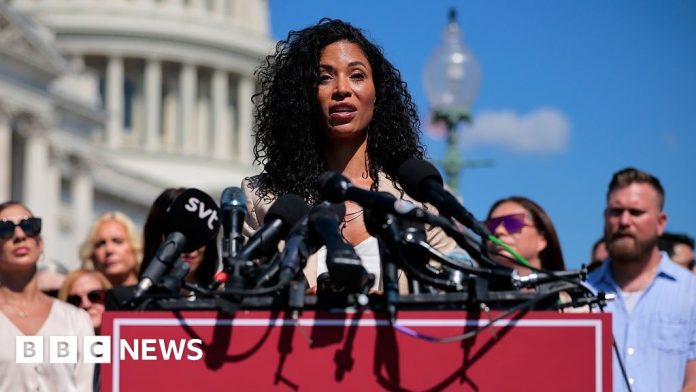
Victims of Jeffrey Epstein have shared emotional accounts of sexual abuse as they spoke on the steps of the US Capitol and called for lawmakers to release more files about the convicted sex offender.
One of the women, Lisa Phillips, said the group had begun compiling a confidential list of Epstein associates who they say were involved in abuse.
“We will confidentially compile the names we all know were regularly in the Epstein world,” she said. “It will be done by survivors, and for survivors.”
The event was organised by US lawmakers who are calling for more files from the Epstein investigation to be released publicly.
During the two-hour news conference on Wednesday, nine female Epstein accusers detailed their experiences and abuse at the hands of the disgraced financier.
Ms Phillips urged the Department of Justice to release all the documents and information it has from the investigation, adding that many victims were afraid of repercussions if they went public with names themselves.
A lawyer for the accusers added that they were scared of being sued or attacked because “nobody protected them the first time”.
Marina Lacerda, speaking publicly for the first time, said she worked for Epstein from the age of 14 until she was 17, when the disgraced financier determined she was “too old”.
“I was one of dozens of girls that I personally know who were forced into Jeffrey’s mansion… in New York City when we were just kids,” she said.
“A friend of mine in the neighbourhood told me that I could make $300 to give another guy a massage,” Lacerda said, while becoming visibly emotional. “It went from a dream job to the worst nightmare.”
Watch: Epstein victim, Marina Lacerda, speaks publicly for the first time
Liz Stein, who sued Epstein and Maxwell and who now works as a survivor mentor and policy adviser, told the BBC that she spoke at the Capitol rally to “humanise survivors” because she was tired of them being ignored.
“It’s really important for us all to remember that this is a crime. It’s a crime of sex trafficking. This isn’t a political issue, but it’s being politicised because of the people involved,” Ms Stein said.
Annie Farmer, 46, said at the rally that she was taken to New Mexico aged 16 to spend a weekend with Epstein. Her sister was also flown there and reported the abuse, she said, but nothing was done.
“We still do not know why that report wasn’t properly investigated, or why Epstein and his associates were allowed to harm hundreds, if not thousands, of other girls and young women,” she said.
Chauntae Davies addressed a question about the relationship between Trump and Epstein, saying the sex offender’s “biggest brag forever was that he was very good friends with Donald Trump”.
“He had a framed picture of him on his desk, with the two of them,” she said.
Watch: “This isn’t a political issue” – BBC interviews Epstein accuser
Trump was friendly with Epstein, but said they fell out in the early 2000s because the financier poached employees from the spa at Trump’s Florida golf club.
“This is a Democrat hoax that never ends,” Trump told reporters in the Oval Office on Wednesday when asked about the nearby news conference.
He said “nobody is ever satisfied” with the files that have been released, adding that the call for more releases is a distraction from his record in office.
“Really, I think it’s enough,” Trump said.
On Tuesday evening, 33,000 pages and several videos were made public by the House Oversight Committee, which has subpoenaed the justice department and Epstein estate. Most of those, however, were already in the public domain.
The top Democrat on the committee, Robert Garcia, said: “Don’t let this fool you.
“After careful review, Oversight Democrats have found that 97% of the documents received from the Department of Justice were already public.
“There is no mention of any client list or anything that improves transparency or justice for victims.”
It is believed that the Department of Justice has about 100,000 pages of material on Epstein.
The release on Tuesday followed last month’s publication of the Department of Justice interview with Ghislaine Maxwell, a convicted sex-trafficker and accomplice of Epstein.
In the transcripts – which run to 300 pages, some heavily redacted – Maxwell said that while she believed Trump and Epstein were friendly in social settings, she did not think they were close friends.
Two members of the House, Republican Thomas Massie of Kentucky and Democrat Ro Khanna of California, are trying to force a vote on compelling the justice department to release all documents in the case.
They were gathering signatures on Wednesday and will need the support of 218 lawmakers to prevail. That means six Republicans must support the plan.
“It’s shameful this has been called a hoax. This is not a hoax,” Massie said. “There are real victims to this criminal enterprise and the perpetrators are being protected because they are rich and powerful.”
The White House and Republican congressional leaders oppose the release of all of the files, saying it could expose the identities of innocent people.
In a Wednesday court filing the administration indicated it plans to vacate and reconsider the approval of the New England Wind 1 and 2 projects.
The filing does not give a reason why it is doing so, but it comes after the administration similarly targeted projects off the coasts of Rhode Island and Maryland.
The New England Wind projects would have been located about 20 nautical miles south of Martha’s Vineyard, Mass. Together, they were expected to provide enough power for more than 900,000 homes each year.
The New York Times reported Wednesday that White House chief of staff Susie Wiles and deputy chief of staff Stephen Miller are leading an effort under which federal agencies were directed to create plans to block offshore wind projects.
Asked about this, White House spokesperson Anna Kelly pointed The Hill to an executive order that directs agencies to review leasing and approval processes for offshore wind projects.
“Agencies are implementing that Executive Order by evaluating whether they have any policies in place that would advantage wind developers over more effective and reliable types of energy, such as coal, natural gas, and nuclear,” Kelly said.
Welcome to The Hill’s Energy & Environment newsletter, I’m Rachel Frazin — keeping you up to speed on the policies impacting everything from oil and gas to new supply chains.
How policy will affect the energy and environment sectors now and in the future:
ConocoPhillips says it will lay off up to 25% of its workforce, impacting thousands of jobs
NEW YORK (AP) — Oil giant ConocoPhillips is planning to lay off up to a quarter of its workforce, amounting to thousands of jobs, as part of broader efforts from the company to cut costs.
A quick-moving wildfire burned homes in a California Gold Rush town settled around 1850 by Chinese miners who were driven out of a nearby camp and the blaze grew without containment on Wednesday.
California’s biggest irrigation district is throwing its support behind a controversial water diversion project that aims to help relieve the Golden State’s historic battle with drought but also faces widespread local opposition.
House GOP leaders are urging their members to steer clear of the discharge petition aiming to force the Trump administration to release all the government files on Jeffrey Epstein. Read more
A federal judge invalidated the Trump administration’s freeze of $2.2 billion worth of federal grants to Harvard University, handing the school a major legal victory Wednesday. Read more
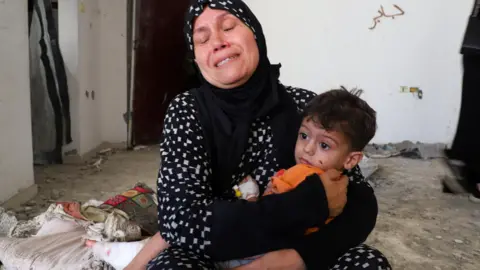
Three-year-old Ibrahim al-Mabhuh is held by his grandmother after an Israeli strike in Gaza City killed his parents and two sisters
Israeli forces are intensifying their attacks on the outskirts of Gaza City, residents say, as the military steps up preparations for a ground offensive to conquer it.
Hospitals said women and children were among more than 30 Palestinians killed in Israeli strikes in the city on Wednesday, most of them in the north and west.
The Israeli military’s chief of staff vowed to “continue striking Hamas’s centres of gravity until it is defeated” and its hostages freed.
The UN and aid groups said the Israeli operations were already having “horrific humanitarian consequences” for displaced families sheltering in the city, which is home to a million people and where a famine was declared last month.
Meanwhile, Israeli protesters took part in what they called a “day of disruption” to press their government to immediately agree a deal that would end the war in return for the release of all 48 Israeli and foreign hostages in Gaza, 20 of whom are believed to be alive.
Hospital officials said Israeli strikes and gunfire across the Gaza Strip had killed at least 46 people since midnight.
Gaza City’s Shifa hospital said it had received the bodies of 21 people, including five killed when an Israeli warplane targeted an apartment in the western Fisherman’s Port area.
One of the strikes killed the parents and two sisters of three-year-old Ibrahim al-Mabhuh, his grandmother said.
Umm Abu al-Abed Abu al-Jubein told Reuters news agency that she had found him buried underneath the rubble of a destroyed column in the home where the displaced family from the nearby town of Jabalia had been sheltering.
“He is the only one that God saved… We woke up to the boy screaming,” she said.
First responders said Israeli drones also dropped incendiary bombs in the vicinity of a clinic overnight in the northern Sheikh Radwan neighbourhood, where troops and tanks were reportedly advancing.
Videos posted on social media overnight appeared to a fire next to an ambulance inside the Sheikh Radwan Clinic’s compound, and another ambulance ablaze on a nearby street.
Residents also told Reuters that Israeli forces dropped grenades on three schools in Sheikh Radwan being used as shelters for displaced families, setting tents ablaze, and detonated armoured vehicles laden with explosives to destroy homes in the east of the neighbourhood.
“Sheikh Radwan is being burnt upside-down. The occupation [Israel] destroyed houses, burnt tents, and drones played audio messages ordering people to leave the area,” said Zakeya Sami, a 60-year-old mother of five.
The Israeli military said it was checking the reports.
During a visit to Gaza on Wednesday, the military’s Chief of Staff, Lt Gen Eyal Zamir, told troops: “We have entered the second phase of Operation ‘Gideon’s Chariots’ to fulfil the objectives of the war.”
“Returning our hostages is both a moral and national mission. We will continue striking Hamas’s centres of gravity until it is defeated.”
Hamas denounced what it called the “operations of systematic destruction” by Israeli forces in Gaza City, saying they constituted “an unprecedented violation” of international law.
EPA
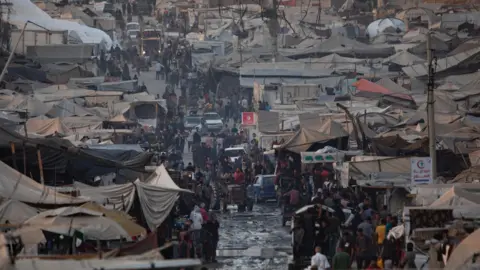
Most of the 82,000 newly displaced people have headed to the crowded coast west of Gaza City
UN agencies and their humanitarian partners in the Gaza Site Management Cluster said the announcement of intensified Israeli military operations in Gaza City on 7 August was “having horrific humanitarian consequences for people in displacement sites, many of whom were earlier displaced from North Gaza [governorate]”, which includes Jabalia.
They warned that many households were unable to move due to high costs and logistical challenges, as well as a lack of safe space. And they said forcing hundreds of thousands to move south could amount to forcible transfer under international law.
Since 14 August, more than 82,000 people had been newly displaced, according to the cluster. Most people moved towards the crowded coast. Only a third have left for southern Gaza, as the Israeli military has instructed.
The military has told them to head to the al-Mawasi area, saying medical care, water and food will be provided. However, the UN has the tent camps there are overcrowded and unsafe, and that southern hospitals are operating at several times their capacity.
On Tuesday, five children were killed while queuing for water at a tent camp in al-Mawasi. Witnesses said they were struck by an Israeli drone.
EPA
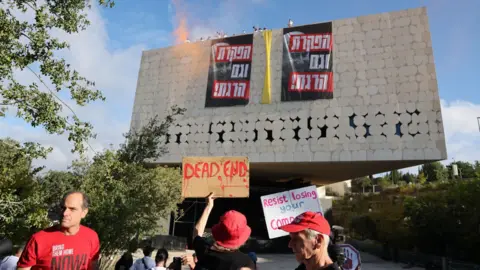
Israelis demanding a deal to end the war and free the hostages climbed onto the roof of the National Library in Jerusalem
Prime Minister Benjamin Netanyahu announced Israel’s intention to conquer all of Gaza after indirect talks with Hamas on a ceasefire and hostage release deal broke down in July.
The hostages’ families fear the offensive will endanger those held in Gaza City and want the prime minister to instead negotiate an agreement that would secure their release.
Regional mediators have presented a proposal that would see 10 living hostages and the bodies of 18 dead hostages released during a 60-day truce. However, Netanyahu has said he will only accept a comprehensive deal that would see them all freed and Hamas disarmed.
On Wednesday, Israelis demanding an immediate deal set fire to tyres and rubbish bins and damaged parked cars in Jerusalem.
Thirteen were arrested after they climbed on the roof of the National Library and displayed a banner that said: “You have abandoned and also killed.”
Some hostages’ relatives addressed a large crowd near the prime minister’s residence.
“My son Rom is dying, starving, and tortured. You can see in his eyes that he no longer wants to live. There is nothing harder a father can witness when he cannot do anything,” he said, according to the Haaretz newspaper.
“How is it possible that a month after my son’s video was released, showing the horrors there, the government leaves him there? And the prime minister wants to conquer more territory? I can’t understand that.”
US President Donald Trump, who helped broker the previous ceasefire and hostage release deal in January, wrote on social media: “Tell Hamas to IMMEDIATELY give back all 20 Hostages (Not 2 or 5 or 7!), and things will change rapidly. IT WILL END!”
The Israeli military launched a campaign in Gaza in response to the Hamas-led attack on southern Israel on 7 October 2023, in which about 1,200 people were killed and 251 others were taken hostage.
At least 63,746 people have been killed in Israeli attacks in Gaza since then, according to the territory’s Hamas-run health ministry.
The ministry also says 367 people, have so far died during the war as a result of malnutrition and starvation, including six over the past 24 hours.
The Sunshine State’s decades-old vaccine requirements for daycare facilities and public schools mandates children receive inoculations against disease like measles, whooping cough, polio, among others.
Ladapo said the state’s health department could remove mandates on about half a dozen vaccines while the state legislature would be needed to remove the rest. “Every last one of them is wrong and drips with disdain and slavery,” Ladapo, a longtime vaccine skeptic, said.
Florida is now trying to become the first state to remove vaccine mandates for schools, a move that has shocked health professionals who have long advocated for vaccine mandates in schools to prevent the spread of communicable diseases. Health officials who spoke with The Hill warned that Ladapo’s decision will have ripple effects across Florida communities and possibly the nation given the state’s popularity among tourists. More than 40 million people visited Florida between January and March 2025 alone, according to the governor’s office. “I would argue that this is the worst public health decision I’ve ever seen [from] a state health official,” said Georges Benjamin, executive director of the American Public Health Association. “This guy will have dead children at his feet.” Florida is among the U.S. states with a measles vaccination rate below 90 percent, with the coverage rate of kindergarteners during the 2023-2024 sitting at 88.1percent. An ideal coverage rate is considered to be 95 percent to prevent outbreaks. That coverage rate is lower than that of Texas’s — 94.3 percent — where one of the worse measles outbreaks in decades occurred this year, spreading through West Texas communities with vaccination rates significantly lower than average.
Welcome to The Hill’s Health Care newsletter, we’re Nathaniel Weixel, Joseph Choi and Alejandra O’Connell-Domenech — every week we follow the latest moves on how Washington impacts your health.
Related video: Changes Atop the CDCA coalition of West Coast, Democratic-led states on Wednesday announced a new public health alliance formed in defiance of Health and Human Services (HHS) Secretary Robert F. Kennedy Jr., with the states saying it will provide “science-driven” advice on vaccines. California Gov. Gavin Newsom (D), Oregon Gov. Tina Kotek (D) and Washington Gov. Bob Ferguson (D) announced the launch …
Health Secretary Robert F. Kennedy Jr. is the face of the federal government’s health care policies, but a new poll suggests few Americans trust his advice when it comes to their own medical decisions. An Economist/YouGov poll released Wednesday found that 26 percent of respondents said that they at least “somewhat” trust Kennedy’s medical advice, compared to 48 percent who said that they distrust him. …
Paul Offit, a pediatrician and vaccine expert who has often criticized Department of Health and Human Services (HHS) Secretary Robert F. Kennedy Jr., has been blocked from serving on a Food and Drug Administration (FDA) vaccine advisory panel. According to a spokesperson for the HHS, Offit was among several FDA advisory committee members whose Special Government Employee terms expired, making them ineligible to participate. …
Health and Human Services Secretary Robert F. Kennedy Jr. will face the Senate Finance Committee on Thursday where he’s expected to face intense questioning about the chaos happening at the Centers for Disease Control and Prevention under his rule.
In Other News
Branch out with a different read:
FDA commissioner on new COVID-19 vaccine rules: ‘Can’t be blind’
Food and Drug Administration (FDA) Commissioner Marty Makary says the agency will not overlook anything in developing new guidelines for updated COVID-19 vaccines. “A lot of people report vaccine injury,” Makary told “Elizabeth Vargas Reports” on Tuesday evening. “A lot of people report complications, including children who have died from the vaccine. So, we can’t just be blind.” COVID-19 …
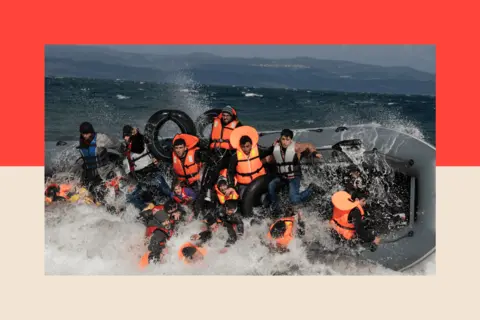
The day they appeared he could hardly believe his eyes. Small boat after small boat bearing in from the Turkish side. “I have so many memories that are coming back to me now,” says Paris Louamis, 50, a hotelier on the Greek island of Lesbos. “There were people from Syria, Afghanistan, many countries.”
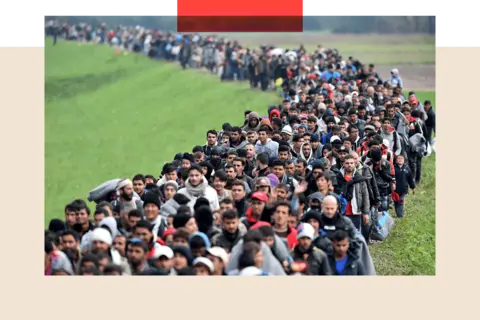
This was August 2015 and Europe was witnessing the greatest movement in population since the end of the Second World War. More than a million people would arrive in the EU over the next few months driven by violence in Syria, as well as Afghanistan and Iraq and elsewhere.
I witnessed the arrivals on Lesbos and met Paris Laoumis as he was busy helping exhausted asylum seekers near his hotel. “I am proud of what we did back then,” he tells me. Along with international volunteers he provided food and clothing to those arriving.
Today the beach is quiet. There are no asylum seekers. But Paris is worried. He believes another crisis is possible. With the number of arrivals rising over the summer months, his country’s migration minister has warned of the risk of an “invasion”, with thousands arriving from countries such as Sudan, Egypt, Bangladesh and Yemen.
Jeff J Mitchell/Getty Images
More than a million migrants and refugees crossed into Europe in 2015, sparking a crisis as countries struggled to cope with the influx
“Of course I worry. I can see the suffering of the people. They are not coming here but we see it on Crete (Greece’s largest island) where people have come. So it is possible that with the wars more people will come here.”
In 2015 I followed as the asylum seekers boarded ferries, trudged in the heat along railway lines, through cornfields, down country lanes and along highways, making their way up through the Balkans and onwards to Germany and Scandinavia.
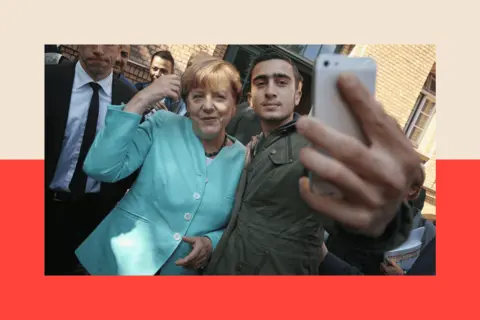
The numbers entering Germany jumped from 76,000 in July to 170,000 the following month. On the last day of August the Chancellor Angela Merkel declared ‘wir schaffen das’ – we can do it – interpreted by many as extending open arms to the asylum seekers.
“Germany is a strong country,” she said. “The motive with which we approach these things must be: we have achieved so much – we can do it! We can do it, and where something stands in our way, it has to be overcome, it has to be worked on.”
But the high emotions of that summer, when crowds welcomed asylum seekers along the roads north, seem to belong to a very different time.
Sean Gallup/Getty Images
Chancellor Angela Merkel declared “Wir schaffen das” – “We can do it” – widely seen as an open welcome to asylum seekers
That optimistic proclamation soon became a political liability for Mrs Merkel. Political opponents and some European leaders felt the words acted as a magnet for asylum seekers to the EU. Within a fortnight the Chancellor was forced to impose controls on Germany’s borders due to the influx of asylum seekers.
And a decade on, concerns over migration have become a major political issue in many European countries. The causes are complex and vary from country to country, but concerns around security, struggling economies and disillusionment with governing parties have all had a major role in shaping attitudes towards those who arrive who are fleeing war, hunger and economic desperation.
It has fuelled the rise of far right parties and seen centre and even left wing parties scramble to impose controls on migration, fearing electoral defeat by populist right-wingers. Data from the Atlas Institute of International Affairs shows how support for far right parties in Europe nearly doubled over the term of two electoral cycles to 27.6%.
Since 2015, when the UNHCR says over a million people entered Europe on asylum routes, there has been a dramatic drop in arrivals. But since 2016, the average number of people entering Europe has still been around 200,000 people a year. So far this year a total of 96,200 asylum seekers have been recorded arriving. So can tough new controls really further bring down the numbers trying to come to Europe? Or does global conflict and economic desperation make their continuing flow inevitable, with ebbs and flows in the numbers?
Hungary’s tough stance
In Hungary, the far right government of Prime Minister Viktor Orban, has taken one of the toughest approaches to migration. Back in September 2015, I was present when Hungary’s first fence was erected along the border with Serbia, and witnessed hundreds of people scrambling to cross into the EU before they could be shut out.
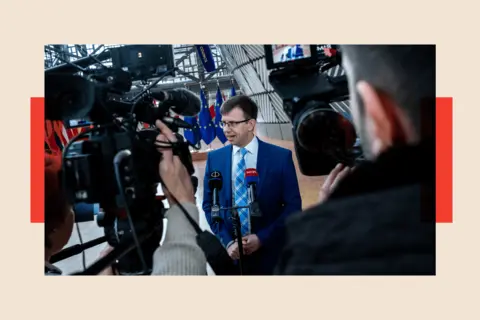
In Budapest, this week I met the country’s minister for the EU, János Bóka, who said Hungary’s approach has been vindicated by the restrictive measures now being put forward in the UK – where the government plan to make it harder for refugees to bring family members to the UK – as well as countries like Ireland, Denmark and Sweden.
Hungary began building a four-metre-high fence along its 175 kilometre southern border in June 2015
“We feel vindicated not only because of what’s going on in other countries in Europe. This is of course also a sign that we took the right path 10 years ago, that now we see most of the countries are doing what we have been doing for the past 10 years.”
Hungary immediately returns people who arrive at the border without permission to enter. They can only apply for asylum in the Serbian capital Belgrade, or in Kyiv in war battered Ukraine.
Human rights lawyer Timea Kovács says this effectively makes it impossible to enter the EU via Hungary. “Basically there is no legal way to enter the Hungarian territory as a refugee,” she asserts.
MARTIN BERTRAND/Hans Lucas/AFP via Getty Images
The EU now fines Hungary one million euros a day for breaching asylum obligations. Minister János Bóka insists the policy will not change
As a result Hungary is being fined one million Euros per day for breaching its responsibilities to asylum seekers under EU law. EU minister Bóka says the country is not about to change its policy. “If it is the price that we pay for the protection of our borders and maintaining peace and stability in Hungary, this is a price worth paying.”
But even such restrictive measures haven’t managed to entirely halt the entry of asylum seekers.
Austrian police told the BBC that there were between 20 to 50 people detected every day trying to enter their country illegally from Hungary. This is just the figure for those detected.
On a trip to the border with Serbia I heard the frustration of one group of Hungarian guards. We left the tar road and followed a patrol onto a dirt track into the forest. The trees closed over forming a natural tunnel. Bright sunlight gave way to shadows. The men in the vehicle ahead of us carried shotguns.
‘Just one big circus’
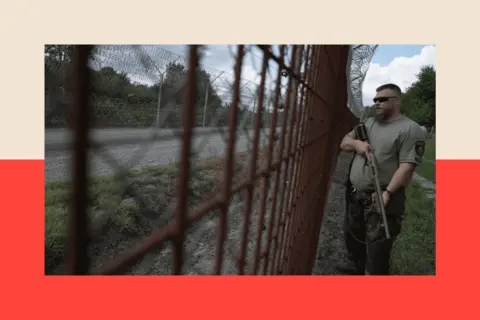
Dressed in military camouflage Sándor Nagy and Eric Molner are citizen volunteers, paid by the state to patrol the Hungarian side of the border with Serbia.
“I feel sad and angry, and most of all, worried about what is coming,” says Sandor. He believes Europe is failing to stop people from coming across its borders. “To be honest, what we experience here is basically just one big circus. What we see is that border defence here is mostly a show, a political performance.”
Citizen patrols like Sandor Nagy and Eric Molner (pictured) are paid by the state to guard Hungary’s border with Serbia
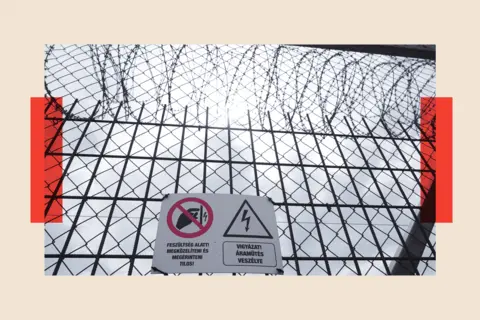
We emerge into a clearing where a 12ft high border fence appears, topped with barbed wire, equipped with sensors and cameras to detect illegal crossings.
“They simply cut through it, and groups rush in at several points at once—this has been the same for years.” The problem, he argues, is with organised crime, which is constantly one step ahead of the authorities. “This fence does not stop anyone in the long run … It delays the flow, but cannot stop it.”
A deluge of abuses
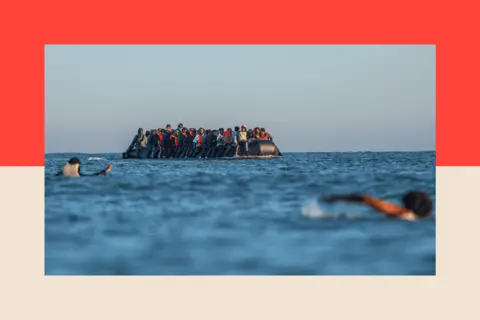
With the growth of criminal trafficking has come a deluge of human rights abuses, according to the United Nations. People traffickers dump people in the Sahara desert; others crowd them onto unsafe boats. Some of those who get through find themselves being forced back into the desert by local security forces.
More than 32,000 people have died trying to reach Europe in the past 10 years – including 1,300 dead or missing this year.
According to the UN’s International Organisation of Migration “much of this is happening in a situation of near complete impunity”.
Carl Court/Getty Images
More than 32,000 people have died trying to reach Europe over the past decade
The summer of 2015 was not only a summer of welcome. It prompted immediate changes in the approaches of several European states. Not just with the erection of the fence in Hungary but, among several examples, the deployment of riot police in Croatia, and migrants being detained in Slovenia.
By March 2016 – six months after Mrs Merkel’s statement – the EU had reached agreement with Turkey to keep migrants from crossing into Greece and Bulgaria.
Since then the EU has done deals with countries including Morocco, Tunisia, Libya and Egypt to prevent their countries being used as launch points to Europe.
Now, there are numerous well documented cases of asylum seekers being pushed back across EU borders by police and coast guards. Last January the European Court of Human Rights found Greece guilty of illegal and “systematic” pushbacks of asylum seekers to Turkey.
Paula Bronstein/Getty Images
There are numerous well documented cases of asylum seekers being pushed back across EU borders by police and coast guards.
Gerasimos Tsourapa, a professor of international relations at the University of Birmingham, describes the policy of outsourcing the asylum issue as a dramatic change for Europe. “The idea that migration can be leveraged for money or aid or other concessions, which was fairly exceptional for Europe in 2016, has now become a pattern.
“Migration diplomacy is contagious. Once the deal is struck then the logic spreads.”
There is also a paradox here, he says. “We are restricting asylum, we’re keeping borders closed, but we also need to find labour migrants to fill shortages and help our national economy.”
A changing Sweden
Persistent public concern has seen a rise in support for far right parties across the EU, even in places like Sweden, which historically prided itself as a welcoming nation for those fleeing persecution. The far right Sweden Democrats won 20.5 percent of the vote in the 2022 general election – making them the country’s second largest party. In return for supporting a minority coalition government they have seen much of their anti-migration platform shape government policy.
Family re-unification for migrants has been made more difficult, as have conditions for permanent residency, and asylum quotas have been substantially reduced.
Syrian refugee Abdulmenem Alsatouf remembers arriving in Sweden to a warm welcome in 2015
For the final leg of my journey I went to the western Swedish city of Karlstad, a picture postcard place on the banks of the River Klarälven, the longest waterway in Scandinavia.
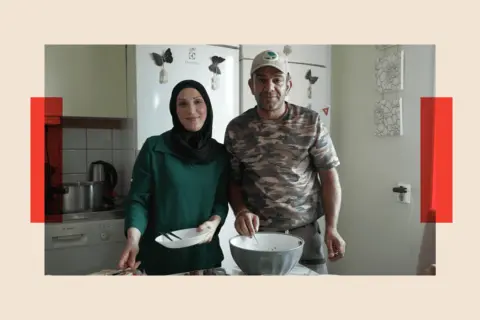
Syrian refugee, Abdulmenem Alsatouf, 44, remembered the welcome he received here in 2015.
That has changed, he says. “At the beginning people treated us very well. But after a few years — and after the government changed — things shifted. They became more racist.” He cites incidents of racist abuse, including one neighbour leaving a toy pig outside this devoutly Muslim family’s home.
I first met Abdulmenem and his family ten years ago as they were trying to reach Europe from Turkey. I remember their hope for a new life. Now his wife Nour says she would prefer to be in Syria. “They look at us as if we only came here to take their money or live off their aid. But that’s not true. When I first arrived, I studied Swedish for two years, I learned the language, I finished school. Then I went to work — cleaning, kitchens, childcare. I pay taxes here, just like anyone else. I’m part of this society.”
Why has Swedish public opinion shifted to the right on migration? One of the more frequently cited reasons in local media and by politicians is crime, specifically the rise of organised crime, with young perpetrators used to commit extreme violence. Since 2013 the rate of gun crime in the country has more than doubled.
People born abroad, and their children born in Sweden, are over-represented in crime statistics. But Sweden’s foreign ministry warns against a simplistic analysis of figures. It says low levels of education, unemployment, social segregation and refugee’s war trauma are all causes – not the fact of being a migrant.
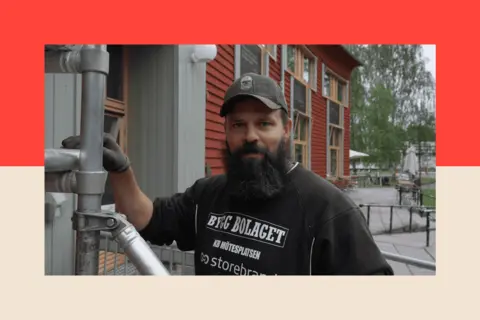
Outside the local cultural museum, where he and his apprentice were busy painting the walls, I met Daniel Hessarp, 46, who is among the 60% of Swedes that opinion polls record as being concerned about crime. “We see the statistics of the crimes, who does it and such. So, there you have the answer. We didn’t have this before in Sweden.
Karlstad resident Daniel Hessarp is among the majority of Swedes who say they worry about crime
The apprentice, Theo Bergsten, 20, said he wasn’t opposed to immigration because “you learn from, they learn from you…so it’s really nice also.” But he said the growth in crime was a “sad part” of the story.
Maria Moberg, a sociology lecturer at the University of Karlstad, says social media has allowed the far right’s message to thrive and find new support among those who feel excluded from society.
“Sweden Democrats are very open with [us] – they don’t want any asylum seekers. They actually want people to leave Sweden. And the whole government is sort of setting the agenda for being a hostile country. It’s more acceptable now to not be welcoming.”
Graves marked ‘Unknown’
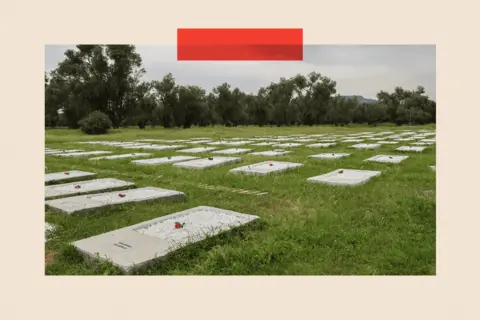
Back on Lesbos, I went to visit a place I have come to know over many years of reporting migration issues there. About 30 minutes drive from the Mytilene airport, in the middle of some olive groves, are the graves of asylum seekers who have died trying to reach here, or in the refugee camps set up after 2015. Numerous graves are simply marked ‘Unknown’, the last resting place of those who believed Europe would offer them a better life.
When I visited there were three fresh graves, and a fourth open waiting for a burial to take place. It is a sobering reminder that desperate people will keep trying to reach Europe, despite the enormous risks.
MANOLIS LAGOUTARIS/AFP via Getty Images
A cemetery in Greece holds the graves of refugees who drowned while trying to cross the Aegean Sea
So far this year the numbers of asylum seekers detected trying to reach Europe is down by 20 percent. The numbers may surge and fall, but the global crises that drive migration are not going to disappear. That is the fundamental challenge for politicians, whatever party is in power.
Top image credit: Beata Zawrzel/NurPhoto via Getty Images
BBC InDepth is the home on the website and app for the best analysis, with fresh perspectives that challenge assumptions and deep reporting on the biggest issues of the day. And we showcase thought-provoking content from across BBC Sounds and iPlayer too. You can send us your feedback on the InDepth section by clicking on the button below.


 BBC
BBC