Every week, more than 230 million people ask ChatGPT for health and wellness advice, according to OpenAI. The company says that many see the chatbot as an “ally” to help navigate the maze of insurance, file paperwork, and become better self-advocates. In exchange, it hopes you will trust its chatbot with details about your diagnoses, medications, test results, and other private medical information. But while talking to a chatbot may be starting to feel a bit like the doctor’s office, it isn’t one. Tech companies aren’t bound by the same obligations as medical providers. Experts tell The Verge it would be wise to carefully consider whether you want to hand over your records.
Health and wellness is swiftly emerging as a key battleground for AI labs and a major test for how willing users are to welcome these systems into their lives. This month two of the industry’s biggest players made overt pushes into medicine. OpenAI released ChatGPT Health, a dedicated tab within ChatGPT designed for users to ask health-related questions in what it says is a more secure and personalized environment. Anthropic introduced Claude for Healthcare, a “HIPAA-ready” product it says can be used by hospitals, health providers, and consumers. (Notably absent is Google, whose Gemini chatbot is one of the world’s most competent and widely used AI tools, though the company did announce an update to its MedGemma medical AI model for developers.)
OpenAI actively encourages users to share sensitive information like medical records, lab results, and health and wellness data from apps like Apple Health, Peloton, Weight Watchers, and MyFitnessPal with ChatGPT Health in exchange for deeper insights. It explicitly states that users’ health data will be kept confidential and won’t be used to train AI models, and that steps have been taken to keep data secure and private. OpenAI says ChatGPT Health conversations will also be held in a separate part of the app, with users able to view or delete Health “memories” at any time.
OpenAI’s assurances that it will keep users’ sensitive data safe have been helped in no small way by the company launching an identical-sounding product with tighter security protocols at almost the same time as ChatGPT Health. The tool, called ChatGPT for Healthcare, is part of a broader range of products sold to support businesses, hospitals, and clinicians working with patients directly. OpenAI’s suggested uses include streamlining administrative work like drafting clinical letters and discharge summaries and helping physicians collate the latest medical evidence to improve patient care. Similar to other enterprise-grade products sold by the company, there are greater protections in place than offered to general consumers, especially free users, and OpenAI says the products are designed to comply with the privacy obligations required of the medical sector. Given the similar names and launch dates — ChatGPT for Healthcare was announced the day after ChatGPT Health — it is all too easy to confuse the two and presume the consumer-facing product has the same level of protection as the more clinically oriented one. Numerous people I spoke to when reporting this story did so.
Even if you trust a company’s vow to safeguard your data… it might just change its mind.
Whichever security assurance we take, however, it is far from watertight. Users for tools like ChatGPT Health often have little safeguarding against breaches or unauthorized use beyond what’s in the terms of use and privacy policies, experts tell The Verge. As most states haven’t enacted comprehensive privacy laws — and there isn’t a comprehensive federal privacy law — data protection for AI tools like ChatGPT Health “largely depends on what companies promise in their privacy policies and terms of use,” says Sara Gerke, a law professor at the University of Illinois Urbana-Champaign.
Even if you trust a company’s vow to safeguard your data — OpenAI says it encrypts Health data by default — it might just change its mind. “While ChatGPT does state in their current terms of use that they will keep this data confidential and not use them to train their models, you are not protected by law, and it is allowed to change terms of use over time,” explains Hannah van Kolfschooten, a researcher in digital health law at the University of Basel in Switzerland. “You will have to trust that ChatGPT does not do so.” Carmel Shachar, an assistant clinical professor of law at Harvard Law School, concurs: “There’s very limited protection. Some of it is their word, but they could always go back and change their privacy practices.”
Assurances that a product is compliant with data protection laws governing the healthcare sector like the Health Insurance Portability and Accountability Act, or HIPAA, shouldn’t offer much comfort either, Shachar says. While great as a guide, there’s little at stake if a company that voluntarily complies fails to do so, she explains. Voluntarily complying isn’t the same as being bound. “The value of HIPAA is that if you mess up, there’s enforcement.”
There’s a reason why medicine is a heavily regulated field
It’s more than just privacy. There’s a reason why medicine is a heavily regulated field — errors can be dangerous, even lethal. There are no shortage of examples showing chatbots confidently spouting false or misleading health information, such as when a man developed a rare condition after he asked ChatGPT about removing salt from his diet and the chatbot suggested he replace salt with the sodium bromide, which was historically used as a sedative. Or when Google’s AI Overviews wrongly advised people with pancreatic cancer to avoid high-fat foods — the exact opposite of what they should be doing.
To address this, OpenAI explicitly states that their consumer-facing tool is designed to be used in close collaboration with physicians and is not intended for diagnosis and treatment. Tools designed for diagnosis and treatment are designated as medical devices and are subject to much stricter regulations, such as clinical trials to prove they work and safety monitoring once deployed. Although OpenAI is fully and openly aware that one of the major use cases of ChatGPT is supporting users’ health and well-being — recall the 230 million people asking for advice each week — the company’s assertion that it is not intended as a medical device carries a lot of weight with regulators, Gerke explains. “The manufacturer’s stated intended use is a key factor in the medical device classification,” she says, meaning companies that say tools aren’t for medical use will largely escape oversight even if products are being used for medical purposes. It underscores the regulatory challenges technology like chatbots are posing.
For now, at least, this disclaimer keeps ChatGPT Health out of the purview of regulators like the Food and Drug Administration, but van Kolfschooten says it’s perfectly reasonable to ask whether or not tools like this should really be classified as a medical device and regulated as such. It’s important to look at how it’s being used, as well as what the company is saying, she explains. When announcing the product, OpenAI suggested people could use ChatGPT Health to interpret lab results, track health behavior, or help them reason through treatment decisions. If a product is doing this, one could reasonably argue it might fall under the US definition of a medical device, she says, suggesting that Europe’s stronger regulatory framework may be the reason why it’s not available in the region yet.
“When a system feels personalized and has this aura of authority, medical disclaimers will not necessarily challenge people’s trust in the system.”
Despite claiming ChatGPT is not to be used for diagnosis or treatment, OpenAI has gone through a great deal of effort to prove that ChatGPT is a pretty capable medic and encourage users to tap it for health queries. The company highlighted health as a major use case when launching GPT-5, and CEO Sam Altman even invited a cancer patient and her husband on stage to discuss how the tool helped her make sense of the diagnosis. The company says it assesses ChatGPT’s medical prowess against a benchmark it developed itself with more than 260 physicians across dozens of specialties, HealthBench, that “tests how well AI models perform in realistic health scenarios,” though critics note it is not very transparent. Other studies — often small, limited, or run by the company itself — hint at ChatGPT’s medical potential too, showing that in some cases it can pass medical licensing exams, communicate better with patients, and outperform doctors at diagnosing illness, as well as help doctors make fewer mistakes when used as a tool.
OpenAI’s efforts to present ChatGPT Health as an authoritative source of health information could also undermine any disclaimers it includes telling users not to utilize it for medical purposes, van Kolfschooten says. “When a system feels personalized and has this aura of authority, medical disclaimers will not necessarily challenge people’s trust in the system.”
Companies like OpenAI and Anthropic are hoping they have that trust as they jostle for prominence in what they see as the next big market for AI. The figures showing how many people are already using AI chatbots for health suggest they may be onto something, and given the stark health inequalities and difficulties many face in accessing even basic care, this could be a good thing. At least, it could be, if that trust is well-placed. We trust our private information with healthcare providers because the profession has earned that trust. It’s not yet clear whether an industry with a reputation for moving fast and breaking things has earned the same.
Follow topics and authors from this story to see more like this in your personalized homepage feed and to receive email updates.
Jaime Kingis heading for a divorce after quietly tying the knot.
Austin Sosa filed for divorce from the Hart of Dixie alum on Jan. 22, according to court records obtained by TMZ and People.
Though neither have publicly shared exactly when they got married, Jaime confirmed her engagement to the investment banker in September, telling Heather McDonald on an episode of theJuicy Scoop podcast that the two initially “met through mutual friends.”
According to the 46-year-old, Austin popped the question with not one, but two engagement rings: one with an emerald-cut diamond and two jewels on each side set in platinum, as well as a family heirloom featuring a round gemstone.
“I feel like my engagement is to myself, in the best way,” Jaime shared in an October interview with Us Weekly. “To me, an engagement is really about a love for oneself.”
At the time, Jaime said she was not rushing down the aisle because she wanted to focus more on her sons James, 12, and Leo, 10, who were at the center of her yearslong custody battle with ex-husband Kyle Newman. (Jaime and Kyle settled their divorce in 2023, three years after their breakup.)
Price: $49.00 (as of Jan 23, 2026 12:57:52 UTC – Details)
From the brand
True Strength, True Beauty
Our products are not just supplements; they are a celebration of your inner beauty, strength, and true potential.
OUR MISSION
We are dedicated to providing you with the tools to take control of your health and overall well-being. We commit to empowering you to live life on your terms, with confidence and authenticity, with high quality products. Our products seamlessly integrate into daily rituals and mindfulness practices. Let our products be your companion on your journey towards a mindful and healthy life.
Product Dimensions : 3.09 x 3.09 x 6.3 inches; 1.37 Pounds Date First Available : September 1, 2021 Manufacturer : Swedish Nutra ASIN : B09F644JQC Best Sellers Rank: #169,998 in Health & Household (See Top 100 in Health & Household) #1,263 in Collagen Supplements Customer Reviews: 4.4 4.4 out of 5 stars (447) var dpAcrHasRegisteredArcLinkClickAction; P.when(‘A’, ‘ready’).execute(function(A) { if (dpAcrHasRegisteredArcLinkClickAction !== true) { dpAcrHasRegisteredArcLinkClickAction = true; A.declarative( ‘acrLink-click-metrics’, ‘click’, { “allowLinkDefault”: true }, function (event) { if (window.ue) { ue.count(“acrLinkClickCount”, (ue.count(“acrLinkClickCount”) || 0) + 1); } } ); } }); P.when(‘A’, ‘cf’).execute(function(A) { A.declarative(‘acrStarsLink-click-metrics’, ‘click’, { “allowLinkDefault” : true }, function(event){ if(window.ue) { ue.count(“acrStarsLinkWithPopoverClickCount”, (ue.count(“acrStarsLinkWithPopoverClickCount”) || 0) + 1); } }); }); HIGH DOSE: Each serving contains a 11,000 mg dose of Halal Certified Marine Collagen, type 1 and 3, hydrolyzed into component peptides for excellent absorption, enriched with active ingredients such as Hyaluronic Acid, Biotin and Vitamin C FOR HEALTHY SKIN: Collagen can help to support skin health, moisture and elasticity by working to minimize sun damage, fine lines and wrinkles GROW HAIR AND NAILS: Supplementing Collagen has been shown to stimulate normal hair growth by slowing hair loss and helping make fine hair appear thicker; it can also aid nail strength by correcting weak or damaged nail beds FASTER ABSORPTION: Our liquid supplement contains more active ingredients than pills and capsules, with a quicker absorption rate and results 20-DAY SUPPLY: One 500 ml bottle for a 20-day supply with a 25 ml daily dose; it comes in a delicious Natural Berry flavored shot and is fat-free, sugar-free and lactose-free, with 100% natural flavor and color; keep refrigerated for optimum taste
Bill Barnwell is a senior NFL writer for ESPN.com. He analyzes football on and off the field like no one else on the planet, writing about in-season X’s and O’s, offseason transactions and so much more.
He is the host of the Bill Barnwell Show podcast, with episodes released weekly. Barnwell joined ESPN in 2011 as a staff writer at Grantland.
If the 2024 season was the Year of the Superstar Running Back, then the end to the 2025 NFL campaign might turn this into the Year of the Superstar Wide Receiver.
The two most productive wideouts in football, the Rams‘ Puka Nacua and the Seahawks‘ Jaxon Smith-Njigba, are competing for a trip to the Super Bowl this weekend in the NFC Championship Game. Both of those teams made significant receiver additions in free agency this past offseason, as the Rams signedDavante Adams and the Seahawks went for former Rams wideout Cooper Kupp. The Patriots kicked quarterback Drake Maye into MVP gear with a series of additions over the past few offseasons, including Stefon Diggs, who signed a massive deal to join them in the spring. The Broncos are the exception here, but you get the idea: It sure has been helpful to have an impactful wideout or two in the lineup every week, deep into the postseason.
With that in mind, this upcoming offseason‘s wide receiver market is shaping up to be fascinating. This could be the most active market for veterans since 2022, when Adams, Tyreek Hill and A.J. Brown were traded for draft picks in a matter of weeks. Some of those moves produced Super Bowls, although in Hill’s case, it was for his old team, not his new one.
Brown is one of a number of wideouts who could be traded this offseason after a frustrating 2025 campaign. We could see a robust cap casualty market, too, with big-name stars leaving for new teams. And there are a few free agents coming off rookie deals who might land unexpectedly big contracts on the open market.
Today, I’ll run through just about every notable veteran receiver who might be changing teams this offseason. I’ll start, though, with the one wideout who should be staying put after being traded last summer. (Receivers are listed alphabetically within each section.)
For all the deserved criticism Cowboys owner and general manager Jerry Jones received for tradingMicah Parsons and then using most of that draft capital to land a lesser defensive player in Quinnen Williams, there’s no arguing that sending third- and fifth-round picks to the Steelers for Pickens and a sixth-round pick was a huge victory for Dallas. Pickens was a perfect fit for the Cowboys, who needed an outside receiver with size and vertical ability to complement CeeDee Lamb‘s work on the inside.
Pickens delivered with a career year. I had him as the third-best wideout in football and a first-team All-Pro after he racked up 93 catches for 1,429 yards and nine touchdowns. Pickens had to settle for a second-team All-Pro nod from the voters, but either way, we’re still talking about him as one of the six best receivers in the NFL in 2025. That’s a hugely talented and valuable player when you consider Pickens made $3.7 million in 2026.
If the Cowboys decide to let Pickens test the open market and move on after one season, it would be stunning if he landed anything short of $30 million per year with a multiyear guarantee. There will be teams wary of paying anyone Mike Tomlin and the Steelers wanted to let go, but there’s no denying Pickens’ talent and ability to impact games. He doesn’t even turn 25 until March, making him one of the younger free agents this offseason.
The problem for Pickens is that the tippy-top of the wide receiver market has risen faster than the franchise tag for those players. The franchise tag for wideouts in 2026 projects to come in at $28.6 million, making it easy for the Cowboys to justify using it. Even if Dallas decides it doesn’t want to sign Pickens to a long-term deal, it could tag and trade him.
The most likely scenario should see Pickens return to the Cowboys in 2026 on the franchise tag. If he can prove that 2025 wasn’t an outlier season, the Cowboys will be more inclined to sign him to a long-term deal. If not, well, Pickens would hit the open market next season. For now, though, the tag seems like the most plausible path for one of the league’s breakout stars.
An occasionally tumultuous run for Doubs in Green Bay likely came to an end in the Packers’ wild-card loss to the Bears. The underrated Doubs was suitably impactful in his final game, catching eight passes for 124 yards and a touchdown. That goes well with a 151-yard performance in his playoff debut, a win over the Cowboys in the 2023 wild-card round, and an 83-yard follow-up the subsequent week against the 49ers.
Given how often the Packers run the ball and how willing they are to rotate a deep, flat receiving corps, Doubs has also gone missing at times. He literally did so for a few practices in 2024, leading the Packers to suspend their 2022 fourth-round pick for a game. Doubs returned and played out the rest of his Packers tenure without incident, but GM Brian Gutekunst used two of his top three picks in the 2025 draft on wide receivers and extendedChristian Watson, who would have also been a free agent.
Doubs is therefore extremely likely to actually make it to free agency, which isn’t always the case for young wideouts. And there has been steady growth in his underlying metrics. Doubs’ yards per route run has improved during his time in Green Bay, from 1.4 during his rookie and second seasons to 1.8 in Year 3 and 1.9 in Year 4. Drops can be an issue, but the 6-foot-2 wideout produced a top-30 catch score this season, per ESPN’s receiver scores.
I’ll be fascinated to see where Doubs’ deal comes in. There’s a chance teams see him as only a midtier No. 2 receiver, leaving him something in the range of $15 million per year. I suspect there will be at least one team that sees him as a player with untapped potential who could blossom in a more pass-happy scheme and with a steadier, more reliable usage pattern. That team might be willing to go north of $20 million per season.
With Evans’ streak of 1,000-yard seasons broken by a series of injuries in 2025, the likely future Hall of Famer could hit free agency under uncertain circumstances. Two years ago, Evans was a free agent as a younger player without a significant injury in his past. He landed a two-year, $41 million pact to stay with Tampa Bay, and while he looked productive when he was on the field, Evans missed 12 of 34 possible games (and most of two others) because of various ailments.
On the field, Evans is still producing at a high level. His 2.3 yards per route run ranked 14th among all wideouts over the past two seasons. ESPN’s receiver score, though, suggested a major drop-off between 2024 and 2025 on a route-by-route basis, as Evans fell from second in overall score among wideouts to tied for 94th. One-year falloffs can happen with receiver score — Stefon Diggs went from fourth in 2022 to 53rd in 2023 before jumping back to third in 2024 and tying for first in 2025 — so I would be willing to believe that Evans could jump back toward the top of the charts in 2026.
The player Evans’ camp will try to link the star wideout to is Davante Adams, who hit free agency after a frustrating age-32 season and landed a two-year, $44 million contract with the Rams, including $26 million guaranteed at signing. Adams finished with 789 receiving yards in 14 games, but he formed a connection with Matthew Stafford and scored 14 touchdowns in his first year with Los Angeles.
Would the Bucs agree to that sort of deal? It might not make sense, given that they committed a three-year, $66 million deal to Chris Godwin Jr. last offseason and used their first-round pick on Emeka Egbuka, who was excellent in the first half before fading as the season went along. Tampa Bay needs to sign Jamel Dean, Cade Otton, Haason Reddick and Lavonte David (or their replacements) this offseason, and spending more than $20 million per year on a pair of wide receivers might not be the best use of its resources.
Evans is a franchise legend, though, and the rules can be different when those types of players are involved. It would surprising if he played somewhere else in 2026.
The two-year, $11.9 million deal Jennings signed before the 2024 season proved to be a bargain, as injuries opened up a role in the starting lineup for the former standout high school quarterback. Jennings delivered, racking up 132 catches for 1,618 yards and 15 touchdowns over the past two seasons. He also excelled on third down and in the red zone over that span, which adds some extra contextual value to his production. Throwing two touchdown passes on two tries in the postseason hasn’t hurt, either.
Jennings came into the league as a guy who might have profiled as a power slot option, but Kyle Shanahan has used him primarily as an outside target. Jennings took about 63% of his snaps there over the past two seasons. He has been a little more efficient working out of the slot, and I’d like to see whether the 2020 seventh-round pick could hit a new level if he joins a team that can afford him more snaps there.
Of course, that assumes he leaves the 49ers, which seems up in the air. Jennings unsuccessfully tried to hold in for a new deal last summer and wasn’t as productive while playing through shoulder and ankle injuries earlier this season, but he has been a valuable player for the 49ers in the second half and into the postseason. We’ll get to Brandon Aiyuk‘s uncertain future, but Ricky Pearsall also hasn’t yet established himself because of injuries, and George Kittle‘s status for the start of the 2026 season is unclear after he tore an Achilles in the win over the Eagles in the wild-card round.
At 29, this is probably Jennings’ only realistic chance of landing a multiyear guarantee. He might be worth more to the 49ers than anybody else, but if they want him back, they’re going to need to offer a significant raise to keep their homegrown wideout around.
The Jaguars were planning to cut Kirk last offseason, but at the last minute, the Texans surprisingly traded a seventh-round pick to acquire him from their divisional rivals, ensuring that they wouldn’t need to win Kirk’s affections in free agency. It was a fortuitous turn of events for Kirk, who ended up making the $16.3 million he was originally set to make in 2025, more than he could have expected to land had he actually hit the open market.
Kirk rewarded the Texans for their largesse, although it took a while. He didn’t make much of an impact during the regular season, racking up 28 catches for just 239 yards over 13 games. In the wild-card round, though, Kirk dramatically reemerged with a big game against the Steelers, turning nine targets into eight catches and 144 yards. He added a second touchdown and 20 receiving yards in the season-ending loss to the Patriots.
As a 29-year-old receiver mostly limited to slot work, Kirk won’t have a huge market in free agency. But he’s a well-regarded teammate and has an 1,108-yard season on his résumé, so he should find some guaranteed money as a third wideout on a receiver-needy team in 2026.
Last offseason, teams desperate for speed simply overpaid to sign replacement-level talent at wide receiver in free agency. The Rams brought back Tutu Atwell on a one-year, $10 million deal and got 192 receiving yards over 10 games, as the move into 13 personnel groupings and the ascension of Xavier Smith and Konata Mumpfield cut off Atwell’s access to the field as the third wideout behind Davante Adams and Puka Nacua.
The Jaguars signed Dyami Brown to an identical contract after a hot postseason in Washington, yet despite Travis Hunter‘s knee injury, they essentially lost interest in Brown after a slow start. Jacksonville traded for Jakobi Meyers and promoted Parker Washington ahead of him in the lineup. Brown played single-digit snaps down the stretch and was a healthy scratch in the season-ending loss to the Bills.
If speedy receivers who barely see the field are worth $10 million deals, Pierce’s pending free agency poses an interesting question: What if a speedy receiver who was actually good hit the market? Pierce narrowly topped 1,000 yards for the first time as a pro with a 132-yard effort against the Texans in Week 18, but his breakout wasn’t really a product of better quarterback play in 2025. His rate of off-target potential receptions was roughly the same in 2024 (23.5%) and 2025 (23.8%).
Really, there has been two versions of Pierce. The 2022-23 editions were more like Atwell and Brown as low-efficiency, high-reward deep threats, as he averaged just 1.1 yards per route run — 89th out of 101 qualifying wideouts. A cast of changing quarterbacks didn’t help, but Pierce wasn’t able to command a meaningful target share.
Over the past two years, though, Pierce has upped that yards per route run figure to 1.9 in 2024 and 2.2 in 2025. The combined 2.1 figure is good for 20th among wide receivers over that span, just ahead of players such as Jameson Williams and Tyreek Hill. And it would be tough to argue that Pierce was playing with better quarterbacks than either player over that two-year span. Pierce still commands one of the lower target shares in the league given his usage pattern as a downfield threat, but he has essentially been a slightly more efficient version of Williams, who signed a three-year, $80 million deal last season.
play
0:42
What is Alec Pierce’s fantasy outlook for 2026?
Matt Bowen breaks down the importance of Alec Pierce’s free agency destination for his fantasy value next season.
Pierce’s stat lines are sort of a throwback to another era. This is a league in which great wideouts might average only 11 or 12 yards per catch, as Amon-Ra St. Brown has over the past couple of seasons, trading big plays for steady completions and first downs. The NFL as a whole has moved toward shorter passes going back to the West Coast offense’s arrival in the 1980s, a trend that has only accelerated over the past decade.
Pierce, on the other hand, averaged 22.3 yards per reception in 2024 and 21.3 yards per catch in 2025, leading the league both times. The last time a player had two seasons with at least 30 catches or more while averaging more than 20 yards per reception over his first four pro campaigns was all the way back in 1994, when Alvin Harper did it in his third and fourth seasons for the Cowboys. DeSean Jackson, probably the most comparable receiver for Pierce in recent memory, averaged 18.6 yards per reception and then 22.5 yards per catch in a much more pass-happy Eagles offense early in his career.
Philosophically, the NFL is leaning more into the run and away from the quick game than it has in years. In part, that’s a product of defenses daring teams to run by playing two-deep shells and light boxes and creating a more fertile environment for rushing the football. We’re seeing offenses respond by getting bigger, leaning into two- and three-tight end sets and playing sixth offensive linemen up and down the field more often than they have in a decade, hoping to force defenses into playing bigger personnel groupings or bringing a safety into the box to help against the run. The ultimate goal is to find ways to create explosive plays against defenses that are doing whatever they can to take those off the table.
Pierce is a walking explosive-play threat, which makes him a very valuable player. I’m fascinated to see how high his market gets. Just updating the Williams contract for a projected 9% increase in the salary cap would be a three-year, $87.2 million pact. Even that would be selling Pierce short, because Williams wasn’t a free agent and could negotiate with only one team when he signed his extension with the Lions. (Pierce also doesn’t have any suspensions in his past, which could have made negotiations more difficult for Williams.)
I don’t think it’s wild at all to suggest that Pierce could be looking at something in the ballpark of $30 million per year in free agency, which brings the franchise tag into play. The 2026 tag for wide receivers is projected to come in at $28.1 million. A second franchise tag in 2027 would be a minimum of $33.7 million. If the Colts want to re-sign Pierce (or if Pierce hits the market), I would expect his asking price to be a minimum of $62 million guaranteed over the first two seasons. That’s a lot of money for a player who hasn’t profiled as a No. 1 receiver over his career, but true top-end speed is hard to come by.
Robinson quietly emerged in the second half of 2025 as something more than the gadget receiver he had been for most of his tenure with the Giants. Forced into the lead receiver role after Malik Nabers went down with a torn ACL and Darius Slayton floated in and out of the lineup, Robinson managed his first 1,000-yard season with a 113-yard performance against the Raiders before sitting out Week 18.
He averaged 2.1 yards per route run, way up from his 2023 (1.5) and 2024 (1.3) marks, both of which were below league average. That was driven by Robinson making his catches farther downfield. About 76% of Robinson’s targets between 2023 and 2024 were within 5 yards of the line of scrimmage. In 2025, that fell to 63%, leaving more opportunities for him to make plays downfield and create significant yardage. He had four catches on passes traveling 25 or more yards in the air this season after just one over the prior three seasons combined.
At the same time, 2025 was the first time Robinson averaged more than 10 yards per reception as a pro, making it to 11 yards per catch with Jaxson Dart at the helm for most of the season. At 5-foot-8 and 185 pounds, there are going to be teams that simply don’t see Robinson as anything more than a versatile player on throws near the line of scrimmage, which will limit his options in free agency relative to that of Pierce, even though they finished with similar yardage totals.
play
0:46
Will Wan’Dale Robinson and Jaxson Dart become fantasy relevant next season?
Stephania Bell breaks down the connection between Wan’Dale Robinson and Jaxson Dart and what it means for their fantasy future.
The player who comes to mind as a comparison for Robinson is Curtis Samuel, a fellow undersized second-round pick who had his best season just before hitting free agency. In 2021, Samuel signed a three-year, $34.5 million deal with Washington on the open market. That $11.5 million average salary would translate to $19.2 million with the projected 2026 cap. That might be a little high, but it wouldn’t be a surprise to see Robinson land a deal worth north of $15 million per year. And with the Giants wanting to surround Dart with playmakers while he’s on a rookie contract, I could see GM Joe Schoen justifying that sort of move.
Catch Samuel on the right week and he’s devastating. Samuel led the league in yards after catch score (in ESPN’s receiver scores) in 2021, 2022 and 2023, and he was second in 2024. He dropped off only to 10th in 2025. He’s still a special talent when it comes to breaking tackles and making something out of nothing. And while Samuel has never put together a full healthy season as a pro, he did manage to play 16 games for the second time in his seven-year career this season.
On the other hand, Samuel has consistent problems with drops and fumbles, with three of the latter coming on 89 touches in 2025. He has become less impactful as a runner, where he managed just four first downs on 17 carries this season. And with each passing year, Samuel’s 1,405-receiving yard, 365-rushing yard campaign of 2021 looks more and more like an outlier. He averaged nearly 111 yards from scrimmage that season and is at 61 yards from scrimmage per game across his six other seasons, a figure that fell all the way to 50 yards from scrimmage per game in 2025.
Samuel spent most of the season playing with various backup quarterbacks as opposed to Jayden Daniels, which obviously hurt Samuel’s chance at a big season. But even if you prorate out Samuel’s six games with Daniels under center, we end up with 99 catches for just 850 yards, which tells you how much of Samuel’s production came on screens and lateral throws around the line of scrimmage. His average target with Daniels on the field traveled just 4.5 yards in the air, which would rank 65th out of 67 wideouts in terms of target depth over a full season.
There’s a useful player here, but Samuel’s injury history, problems holding on to the football and age (he turns 30 in January) will limit his market. It would be surprising if Samuel landed a multiyear guarantee, and he’s likely to take a pay cut from the $17.5 million he made this season.
Shaheed profiles somewhere between Pierce and the Dyami Brown/Tutu Atwell class of downfield threats at receiver. In part, that’s because he’s coming off his least efficient season as a pro, with his yards per reception mark down about 6 yards from where it was over the prior three seasons. Shaheed made his first Pro Bowl this season as a return man, which will help his value, but he hasn’t had the sort of contract year Pierce has in Indianapolis. Shaheed is also nearly two years older than Pierce, which matters in free agency.
Viewed over his first four years, though, Shaheed has been a useful second/third wideout and return man while playing on some inconsistent Saints teams. I loved the fit for him in Seattle as a deep threat off play-action in Klint Kubiak’s offense, and Shaheed had four 70-plus-yard games in six tries last season during Kubiak’s lone season in New Orleans before suffering a season-ending knee injury. Shaheed opted for his meniscus to be repaired as opposed to replaced, which cost him more time out of the lineup in 2024 but typically leads to a healthier knee down the line.
As I wrote after this weekend’s games, Shaheed’s had one of the weirder seasons of any wideout in recent memory since joining the Seahawks. He has done virtually nothing as a wide receiver, with just 188 receiving yards over 10 games in the Pacific Northwest. And yet, he has been wildly impactful doing everything else, as he has run for 91 yards on eight carries and produced three return touchdowns, including the opening score in last week’s blowout win over the 49ers.
I would expect Shaheed to be looking at one-year deals with the hope of proving himself and earning a multiyear guarantee next offseason. The same arguments for Pierce having more value in this version of the NFL offensive meta apply to Shaheed, which will keep his floor reasonably high. An elevated version of the Atwell and Brown contracts from last season would see Shaheed land something like $15 million in 2026, which seems about right.
Thornton reestablished himself as a viable third wide receiver during his run in Kansas City. Playing with Patrick Mahomes obviously helped, and Thornton did experience the occasional drop, but the 2022 Patriots second-round pick was able to get open downfield on a regular basis before suffering a concussion, which eventually ended his season. He also handled kick returns for the Chiefs, taking his first snaps on special teams as a pro in the process.
Thornton profiles similarly to Dyami Brown as a Day 2 pick with a limited history of production but one who flashed when given an opportunity in a great offense during his final season before free agency. He will also be only 25 years old when he hits the market in March. There might be some sticker shock on the one-year deals given to Atwell and Brown given the meager returns, but Thornton should still be able to land a one-year deal for a significant raise on the $1.1 million he played for in 2025.
If you know what’s happening here, you might be the only one. The entire Aiyuk situation with the 49ers has been weird dating back to summer 2024, when the organization was reportedly close to trading its star receiver to the Steelers. At the last moment, though, the 49ers and Aiyuk agreed to a four-year, $120 million extension, seemingly ensuring Aiyuk’s future would be in red and gold for years to come.
Since then, Aiyuk has caught 25 passes for 374 yards. The 2020 first-round pick tore his right ACL and meniscus in 2024, ending his season. The team reportedly wanted to trade Aiyuk after the 2024 season, suggesting that it had some buyer’s remorse on the deal, but no move ever transpired. The expectation was that Aiyuk would return in 2025, but that never happened, with the WR reportedly missing rehab sessions. As a result, the 49ers elected to void the $24.9 million bonus that was previously guaranteed in Aiyuk’s contract. That decision would typically trigger a grievance from the player and the NFLPA, but Aiyuk has apparently decided against filing one.
play
0:34
49ers GM on Aiyuk: ‘He’s played his last snap with the Niners’
49ers GM John Lynch tells reporters WR Brandon Aiyuk has played his last snap with the team.
You don’t have to have a master’s degree in reading tea leaves to gain a sense of where this one is heading. And in case it still wasn’t clear, GM John Lynch said Wednesday, “I think it’s safe to say that he’s played his last snap with the Niners.”
Does Aiyuk have any trade value? The 49ers were in position to land a second-round pick for him in 2024 and wanted to get something in return for him last offseason, but it would be surprising if they were able to get anything more than a conditional pick for Aiyuk now. Even if Aiyuk’s 2026 compensation isn’t guaranteed, I’m not sure there will be many teams lining up to pay him the $27 million that’s currently due on his existing contract.
Aiyuk might be released or need to renegotiate that deal before landing somewhere else. One obvious landing spot is Washington, where the Commanders employ former 49ers executive Adam Peters and have an opening in their lineup at wide receiver with Deebo Samuel hitting free agency. Aiyuk was Jayden Daniels’ teammate at Arizona State, too. But even for a team with a quarterback on a rookie deal, $27 million would be a big ask for a player who hasn’t played since the middle of 2024.
The clock started ticking on Hill’s tenure with the Dolphins when he refused to enter the Week 18 game against the Jets in 2024 before suggesting that he wanted to play elsewhere afterward to reporters. Hill and the organization essentially memory holed that situation and those comments over the offseason, but that was more a product of Hill’s contract being guaranteed and untradable than anything else.
His production declined dramatically in 2024 from what had been league-best efficiency in 2022 and 2023. Things then took a further turn south when Hill dislocated his left knee and tore multiple ligaments in Week 4, ending his season. Hill was also accused of domestic violence by his estranged wife, opening the wideout up to potential league discipline.
Hill is due $36 million in 2026, all of which is nonguaranteed. There is a zero percent chance he’s going to play on that deal next season. He could theoretically return to the Dolphins on a reduced salary, but with Mike McDaniel fired, the Dolphins rebuilding and whatever happened at the end of 2024 leaving a bad taste in the organization’s mouth, it seems a safe bet that Hill has played his last snap in Miami. His options will depend on whether and when Hill is healthy enough to play.
There won’t be many memories of the Ridley era in Nashville. Unexpectedly signed to a four-year, $92 million deal by the Titans in free agency two years ago, he managed 1,017 yards in his first season with the team, but injuries limited Ridley to 17 catches for 303 yards over seven games in Year 2.
Ridley ran a catch rate of just 51.2% over his two seasons in Tennessee, and while he didn’t exactly have great quarterback play for most of those targets, that catch rate ended up 4.4% below expectation, per NFL Next Gen Stats. Tennessee’s other wideouts over that span ran a collective 4.7% catch rate below expectation, so Ridley wasn’t significantly better than the Titans’ other wideouts on less expensive contracts.
Ridley averaged an even 2 yards per route run over the past two seasons, so there’s still a solid NFL receiver here when the veteran is able to stay on the field. I’m not sure we’ve seen any sort of superstar ceiling from Ridley since he returned from his seasonlong suspension during the 2022 campaign, though, and the 31-year-old is recovering from a fractured fibula.
Just $3 million of Ridley’s $21.8 million compensation in 2026 is already guaranteed, and the coach and general manager who signed off on that deal are no longer in the building. Ridley wouldn’t get anything close to that $21.8 million figure in free agency, which creates leverage for Tennessee. If the front office pushes Ridley to take a pay cut, he would have to either accede to Tennessee’s terms or fend for himself in free agency, where he might just get the same reduction in salary the Titans would be offering.
Ridley has a $1 million bonus that gets paid in mid-March, which will encourage the Titans to make a decision on Ridley’s future relatively quickly, but I expect them to push for a friendlier contract in 2026. They need all the help for quarterback Cam Ward they can get, but they might want to get a more dynamic playmaker to work alongside Chimere Dike.
The decision to acquire Brown in a draft-day trade with the Titans was a coup for GM Howie Roseman, who originally attempted to sign Allen Robinson in free agency before pivoting to a much more successful Plan B. The Eagles expanded Brown’s snap share, making him an every-down receiver, and reaped the rewards: Brown had back-to-back 1,450-yard seasons, stayed on that pace over a 13-game campaign in 2024 and helped lead the Eagles to a Super Bowl last season.
Things went distinctly south in 2025. Brown managed to make it narrowly over 1,000 yards in 15 games, but he repeatedly expressed his frustration on and off the field as the Eagles struggled to find regular targets for their mercurial wideout. Brown finished the season with a disastrous postseason performance in the loss to the 49ers, as he dropped two passes and had to be separated from coach Nick Sirianni.
All of this puts Roseman in a difficult spot. The Eagles gave Brown a three-year, $100 million contract as part of his trade to Philadelphia, and unsurprisingly given his aggressiveness in negotiating new pacts, Roseman signed Brown to another three-year, $96 million extension in the spring of 2024. Brown technically still hasn’t started that second deal, although he has received a chunk of the money from that contract in bonuses.
play
1:54
How much blame does A.J. Brown deserve for Eagles’ loss? Stephen A. weighs in
Stephen A. Smith reacts to A.J. Brown’s performance in the Eagles’ playoff loss to the 49ers.
Brown is due a guaranteed $29 million in 2026. And if the Eagles trade Brown before June 1, they would be on the hook for $43.5 million in dead money. That’s not an unfathomable or unprecedented amount in the NFL when the salary cap projects to come in north of $300 million, and it would put the Eagles on pace to have about as much dead money in 2026 ($84 million) as they did in 2025 ($85.8 million). But it’s not a scenario Roseman was hoping to deal with when he signed that 2024 extension.
The Eagles would also need to find a replacement for Brown, who remains very efficient on a route-by-route basis. Brown was still sixth in the NFL in receiver score — down from first in 2024 and second in 2023 — and it won’t be easy to replace that sort of production. The Eagles could expect to land some meaningful draft capital for Brown, but I’m not sure that would be a first-round pick given the public frustrations Brown expressed this past season. Brown also will be 29 next season, and though that’s still not particularly old by wide receiver standards, teams grow more hesitant about trading significant draft capital for veterans as they approach 30.
The easiest thing for all parties involved might be giving the relationship one more shot and revisiting this in 2027, when most of the guaranteed money in Brown’s deal will have been paid out. But if the Eagles feel the need to push the eject button on their relationship with their top wideout, Brown will have a fascinating market. He’s still one of the league’s best wide receivers, even if he didn’t show it against the 49ers.
Though Coleman had a 36-yard catch-and-run against the Jaguars, the 2024 second-round pick has clearly fallen out of favor in Buffalo. Coleman was both benched for disciplinary reasons and subsequently healthy scratched multiple times in 2025. When he has been on the field, Coleman managed 59 catches for 404 yards and four touchdowns, much of which came in a comeback win over the Ravens in Week 1. He had 112 yards in that win and hasn’t topped 50 yards in a game since then. It seemed telling in the wild-card round that Tyrell Shavers — who was literally playing through a torn ACL — had more snaps in the second half than Coleman.
Coleman still has two years left on his rookie deal and will make $3.8 million between 2026 and 2027, most of which is already guaranteed. That’s a pittance for a player whom teams saw as a Day 2 pick heading into the 2024 draft, which is why there will be interest if the Bills do decide that a fresh start is best for all parties involved. Given that owner Terry Pegula seemed to blame the decision to draft Coleman on fired coach Sean McDermott during an explosive news conference Wednesday, it’s safe to say that Coleman is better off getting out of Buffalo.
The Commanders received a third-round pick (and moved a fifth-rounder) when they sentJahan Dotson to the Eagles, while the Cowboys sent a fourth-round pick to the Panthers for Jonathan Mingo and a seventh-round selection. The Bills should be able to get something in line with the latter price for Coleman, with teams betting they can get more out of his size and contested-catch ability than Buffalo.
play
1:54
Jeff Saturday in disbelief over Bills owner’s Brandon Beane-Keon Coleman comments
Jeff Saturday sounds off on Bills owner Terry Pegula’s defense of Brandon Beane regarding Keon Coleman.
It has been a bizarre career for Johnston, as the 2023 first-round pick was a rookie punchline for his hands. In Year 2, Johnston established himself as a playmaker and downfield option while still having a brutal run of drops against the Ravens. And then, this past season, Johnston’s hands … were mostly fine? Next Gen Stats still credited him with five drops, which isn’t ideal, but he also ran a catch rate 5.2% over expectation, which hints toward Johnston making more tough catches than the highlights might suggest. He was at minus-4.3% last season.
He got off to a hot start, with 22 catches for 337 yards and four touchdowns through the first four weeks of the season, but Johnston wasn’t able to sustain those numbers. As a receiver who makes his biggest impact as a downfield option, he probably suffered most among the Chargers wideouts from the injuries at tackle, which limited Justin Herbert‘s time to throw.
Oronde Gadsden‘s emergence as a vertical threat also seemed to mute Johnston’s impact. After topping 70 yards in each of his first four games, Johnston didn’t go over that total again until Week 16. Keenan Allen is a free agent, but the Chargers might feel as if they can move forward with Ladd McConkey in the slot, Gadsden as the move tight end and 2025 rookie Tre’ Harris as the team’s primary outside option, with the ability to add another receiver on the outside in free agency or at the draft.
Johnston can fill that role, but the Chargers have to decide on his fifth-year option for 2027 this offseason, a figure that projects at $17.5 million. That’s not going to be an unreasonable cost for a second wideout, but the Chargers have Herbert on a massive deal and also will pay McConkey before the 2027 season. Coach Jim Harbaugh and GM Joe Hortiz also inherited Johnston from the previous regime, so they’re not as attached to him as they would be for one of their own picks.
A trade might be the best thing for Johnston, who I think profiles best as a power slot receiver. With McConkey (and Allen this season) ahead of him for slot snaps, Johnston took only 13% of his snaps out of the slot in 2025. He averaged 2.6 yards per route run out of the slot, just about double what he averaged split out wide. A place where he can play in the slot on a regular basis might help unlock some untapped potential, and even if another team picks up his fifth-year option, it would be on the hook for only about $20 million combined over the next two seasons.
The Bills traded down twice when they drafted Coleman. The second time was with the Panthers, who selected Legette after moving up to No. 32. Like Coleman, Legette was a one-year college wonder whose size and athleticism appealed to NFL teams, but he hasn’t lived up to expectations.
Legette hasn’t fallen afoul of the organization, which is a plus relative to Coleman, but he also hasn’t been as productive. Coleman has averaged 1.7 yards per route run, suggesting that he could be a useful contributor with steadier playing time. Admittedly while playing with a less imposing quarterback, Legette has averaged just 1.1 yards per route run over that same period. He has had issues with drops, including a potential winning touchdown against the eventual champion Eagles last season in the final minute.
The Panthers still have a spot for Legette in the lineup when they play three-wide sets, but he has fallen behind Tetairoa McMillan and Jalen Coker in terms of priorities and production for Carolina. And there’s no reason why GM Dan Morgan would keep that spot open if the Panthers can find an upgrade this offseason. Legette is owed $4.4 million over the next two years, all of which is guaranteed, and he has a potential fifth-year option in 2028 that would come up for a decision after the 2026 season.
Carolina was willing to give up on Mingo, a top-40 pick, after only 24 games when the right trade offer emerged. I suspect it would be similar for Legette this offseason.
Moore has had a strange career in Chicago. The Bears were happy to add the now-28-year-old wideout as part of the trade that ultimately gave Bryce Young to the Panthers, and Moore responded with a 1,364-yard effort in his debut season with the Bears. But his numbers have gone down dramatically in each successive season. Moore averaged 80.1 receiving yards per game in the 2023 season; by 2025, that had fallen to 40.1.
There are unquestionably strengths to Moore’s game, including his willingness to go over the middle of the field and his ability with the ball in his hands. He has also developed a reputation for, depending on who you ask, freelancing or not always having his head in games. He looked to be sleepwalking through a lost 2024 season at times, and it certainly seems as if the 2018 first-round pick didn’t run the right route or make the right adjustment on the interception Caleb Williams threw in overtime during the divisional round loss to the Rams. It seemed telling that he wasn’t in the locker room after the game or during the locker cleanout Monday.
Since the Bears acquired Moore, they’ve used significant draft capital on wideouts Rome Odunze and Luther Burden III, along with tight end Colston Loveland. They’ve also hired coach Ben Johnson, and we don’t know if Johnson really sees Moore as an essential part of the offense. The Bears could lean into more 12 personnel groupings with Loveland and Cole Kmet next season or otherwise find more reasons to get out of their 11 personnel packages. And the Bears might also want to find more opportunities for an Olamide Zaccheaus-type player as their third wideout.
GM Ryan Poles signed Moore to a four-year, $110 million extension in the summer of 2024, a deal that starts next season. Moore’s $23.5 million base salary in 2026 is already guaranteed, and if he’s on the roster in mid-March, $15.5 million of Moore’s $23.5 million salary in 2027 becomes fully guaranteed. The Bears (or any team acquiring Moore) would essentially be on the hook for a one-year, $40 million deal or a two-year, $49 million pact before revisiting his contract after 2027.
play
1:08
Why ‘Mad Dog’ is mad at DJ Moore
Chris “Mad Dog” Russo sounds off on Bears wide receiver DJ Moore for not speaking to the media after the Bears’ loss to the Rams.
Moore is still a starting-caliber wideout, and there should be interest if the Bears do listen to offers. A middle-round pick would be a realistic return, but the real benefit might be freeing up $24.5 million in 2026 cash, which would allow Johnson and Poles to realign the offense in the coach’s preferred vision.
I made the case for a potential Thomas trade when writing about the Jaguars after their wild-card loss to the Bills. The current front office, which has been very aggressive with its roster decisions, didn’t draft Thomas. The 2024 first-rounder had an excellent rookie season, but he never really found a steady role in Liam Coen’s offense, with external concerns that he wasn’t showing the sort of physicality and commitment needed to thrive as an NFL wide receiver.
Those concerns were overblown, but Thomas was able to command targets on only 21.1% of his routes in 2025, down behind Parker Washington, Jakobi Meyers, Brenton Strange and even Travis Etienne Jr. That was up at 26.9% in 2024. Thomas lost nearly a full yard per route run, the difference between an elite campaign as a rookie and a below-average one in Year 2. He fell all the way to 157th (last place) in ESPN’s receiver scores.
I don’t believe Thomas is the worst receiver in the league. Teams won’t have trouble remembering what he did in 2024, when he seemed to glide through defenses and effortlessly separate from man coverage. Thomas is also owed just under $5 million combined over the next two seasons and has a potential fifth-year option in 2028, which would be incredibly valuable given his level of production as a rookie.
The Jaguars might prefer to keep Thomas to see if they can coax a resurgent year out of the 23-year-old, but with Travis Hunter returning to the lineup next year, Coen might prefer to move forward with Washington, Meyers, Hunter and either an outside addition or somebody like Tim Patrick (a pending free agent) as the wideout core. Critically, a Thomas trade would return meaningful draft capital for a Jaguars team that traded its 2026 first-round pick to the Browns to acquire Hunter.
There’s no reason for the Jaguars to trade Thomas unless they can land something significant in return. To me, that would be a first-round pick. And there should be teams at the bottom of the first round willing to send that sort of compensation back to Jacksonville. The Bills, who vanquished the Jaguars earlier this postseason, are an obvious fit. The Browns could justify sending Jacksonville’s first-round pick back to the Jaguars to acquire a much-needed wideout for their quarterback of the future. The Jets could put together a package that adds up to something more than a late first-rounder.
If the Jaguars do make Thomas available, there should be significant interest, even after an underwhelming 2025.
The Dolphins didn’t seem desperate to move Waddle at the trade deadline, and I don’t believe that they’ll operate with any sort of urgency to trade him this offseason. Waddle is still only 27, and he’ll still be young enough to play a meaningful role for the next Dolphins quarterback of the post-Tua Tagovailoa era.
Waddle also is owed only $68.6 million over the next three seasons, which both makes him very easy to keep around and increases his potential trade value. Sure, $22.9 million doesn’t sound like a bargain, but it’s already a pretty team-friendly deal in a league in which the top of the market is north of $40 million per year — and that number is only going to go up.
On the other hand, Waddle might profile as a high-end WR2 instead of a true WR1. Though he had a 1,356-yard season in his second campaign as a pro, he has yet to post a second season remotely close, in part because of a steady run of injuries. Waddle became Miami’s top wideout by default when Tyreek Hill was hurt in September, and though he averaged just under 81 receiving yards per game over the next six weeks, that figure fell to just 40 receiving yards per game over the ensuing six, with a rib injury keeping the 5-foot-10 wideout out of the season-ending loss to the Patriots.
You could make a case for Waddle as an underrated wide receiver, given that he played with a now-benched quarterback in Tagovailoa and across from a highly targeted Hill. You can alternately make the argument that Waddle has one outlier season and won’t have Mike McDaniel scheming spaces open in 2026. I’m somewhere in the middle. Waddle’s team-friendly contract and Miami’s complete absence of other wide receivers makes me think the Dolphins would want a first-round pick to move him this offseason. I’m not sure that would make sense for most teams.
Developers have been comparing the strengths and weaknesses of Anthropic’s Claude Code, Anysphere’s Cursor, and Microsoft’s GitHub Copilot for months now, looking for a winner. While no individual AI coding tool manages to be the best at every task that software developers do each day, Claude Code is increasingly coming out on top for its ease of use, both for developers and nontechnical users.
It seems like Microsoft agrees, as sources tell me the company is now encouraging thousands of its employees from some of its most prolific teams to pick up Claude Code and get coding, even if they’re not developers.
Microsoft first started adopting Anthropic’s Claude Sonnet 4 model inside its developer division in June last year, before favoring it for paid users of GitHub Copilot several months later. Now, Microsoft is going a step beyond using Anthropic’s AI models and widely adopting Claude Code across its biggest engineering teams.
Microsoft’s CoreAI team, the new AI engineering group led by former Meta engineering chief Jay Parikh, has been testing Claude Code in recent months, and last week Microsoft’s Experiences + Devices division were being asked to install Claude Code. This division is responsible for Windows, Microsoft 365, Outlook, Microsoft Teams, Bing, Edge, Surface, and more.
Even employees without any coding experience are being encouraged to experiment with Claude Code, to allow designers and project managers to prototype ideas. Microsoft has also approved the use of Claude Code across all of its code and repositories for its Business and Industry Copilot teams.
Software engineers at Microsoft are now expected to use both Claude Code and GitHub Copilot and give feedback comparing the two, I’m told. Microsoft sells GitHub Copilot as its AI coding tool of choice to its customers, but if these broad internal pilot programs are successful, then it’s possible the company could even eventually sell Claude Code directly to its cloud customers.
Microsoft is now one of Anthropic’s top customers, according to a recent report from The Information. The software maker is also counting selling Anthropic AI models toward Azure sales quotas, which is unusual given Microsoft typically only offers its salespeople incentives for homegrown products or models from OpenAI.
Microsoft’s decision to adopt Claude Code more broadly among its engineering teams certainly looks like a vote of confidence in Anthropic’s AI tools over its own, especially as it’s encouraging nontechnical employees to try out coding. But the reality is that Microsoft’s developers are likely to use a mix of AI tools, and adopting Claude Code is another part of that tool set.
“Companies regularly test and trial competing products to gain a better understanding of the market landscape,” says Frank Shaw, Microsoft’s communications chief, in a statement to Notepad. “OpenAI continues to be our primary partner and model provider on frontier models, and we remain committed to our long-term partnership.”
While Microsoft remains committed to OpenAI, it is increasingly working with Anthropic to bring its models and tools to Microsoft’s own teams and the software it sells to customers. Microsoft and Anthropic signed a deal in November that allows Microsoft Foundry customers to get access to Claude Sonnet 4.5, Claude Opus 4.1, and Claude Haiku 4.5. The deal also involves Anthropic committing to purchasing $30 billion of Azure compute capacity.
Microsoft has also started favoring Anthropic’s Claude models inside Microsoft 365 apps and Copilot recently, using them in specific apps or features where Anthropic’s models have proved more capable than OpenAI’s counterparts.
The big question here is, what does the increased use of Claude Code at Microsoft mean for its more than 100,000 code repositories? Microsoft told me last year that 91 percent of its engineering teams use GitHub Copilot and a variety of teams have been using the AI tool to speed up mundane tasks. Microsoft’s use of AI tools has been largely restricted to software engineers, but with Claude Code and Claude Cowork, Anthropic is increasingly focused on making coding and non-coding tasks more approachable, thanks to AI agent capabilities.
Microsoft is embracing the ease of use of Claude Code to allow more nontechnical employees to commit code using AI, and this broad pilot will certainly highlight the challenges and benefits of that shift. It also puts further pressure on junior developer roles, with fears in the industry that these roles are increasingly disappearing because of AI. Microsoft just took another big step toward a future where more autonomous AI agents are creating code, further wrestling control from its software engineers.
Microsoft is getting ready to show off two of its biggest Xbox games this year, Forza Horizon 6 and Fable, later today as part of its Xbox Developer Direct stream. There will also be a first in-depth look at Beast of Reincarnation and at least one other game shown, I’m hearing. Double Fine is ready to show off Kiln, a multiplayer, team-based brawler. I understand Double Fine has been holding playtests recently, where you play as a spirit that can inhabit pottery and carry water to douse an opponent’s kiln and put out a fire.
I wouldn’t be surprised to see Kiln appear as an early preview in the coming months, followed by Forza Horizon 6 in May and then Halo: Campaign Evolved. I keep hearing that both Fable and Gears of War: E-Day are currently targeting a release in the second half of this year. Microsoft is keen to release new Forza, Gears, Halo, and Fable games in 2026 to mark 25 years of Xbox.
Microsoft’s first Windows 11 update of 2026 stopped some computers from shutting down. It’s only January and Microsoft has had to rush out an emergency out-of-band fix that stopped some Windows 11 PCs from shutting down. The issues were limited to machines running Enterprise and IoT editions of Windows 11 version 23H2, but it’s yet another buggy update for Windows, which is becoming increasingly common.
Microsoft’s free Xbox Cloud Gaming is coming soon with ads. Microsoft is getting closer to launching its free streaming option for Xbox Cloud Gaming. The ad-supported feature has started appearing inside the Xbox app for PC, indicating “1 hour of ad-supported playtime per session.” I’m expecting to see this rollout with preroll ads in the coming weeks, but there could be limits of up to five hours free per month.
Microsoft wants to build 15 data centers in Mount Pleasant, Wisconsin. The empty land formerly owned by Foxconn is about to be transformed into Microsoft data centers. Leaders of the local village in Mount Pleasant, Wisconsin, approved plans for the data centers earlier this week, and final approval could come next week. Foxconn’s failed Wisconsin project had promised 13,000 jobs, but now the land will be filled with a 1.2-million-square-foot data center project that will hold hundreds of thousands of Nvidia’s AI GPUs.
The Xbox app is now available for all Arm-based Windows 11 PCs. After a rocky start to gaming on Windows on Arm, Microsoft has updated its Xbox app this week so it’s fully compatible with all Qualcomm-powered devices. More than 85 percent of the Xbox Game Pass catalog is also now compatible with Arm-based devices, but the majority of games will still need to be emulated using Microsoft’s Prism technology.
Microsoft Paint now has an AI-powered coloring book. Microsoft is adding more AI features to its Paint app this week. Windows testers can now try out a coloring book feature that lets you create coloring book pages from a text prompt. It’s available inside the Copilot button in Paint, and you have to have a Copilot Plus PC to be able to use it. Notepad (the app!) is also getting expanded Markdown syntax features and a new welcome experience to highlight features. I never thought I’d see the day that Notepad, a lightweight app, would need a welcome screen because of all the features Microsoft has packed in.
GitHub has a new Copilot SDK. Microsoft is announcing a technical preview of its GitHub Copilot SDK today, which brings the power of the GitHub Copilot CLI to any app. It essentially allows developers to bring GitHub Copilot capabilities as a programmable SDK for Python, TypeScript, Go, and .NET. Microsoft teams have already used this to build custom GUIs for agents, summarizing tools, YouTube chapter generators, and more.
Satya Nadella and former British Prime Minister Rishi Sunak chat AI. Former UK leader Rishi Sunak took on a senior adviser role at Microsoft and Anthropic last year, and he’s now appeared alongside Microsoft CEO Satya Nadella to discuss the future of AI. The roughly 30-minute talk didn’t have any surprising news, but Sunak did agree with Nvidia CEO Jensen Huang that “you may not lose your job to AI, but you may well lose your job to someone using AI.” Nadella thinks AI will make us all “managers of infinite minds,” much like how we have “information at your fingertips.”
Microsoft now sponsors the Mercedes-AMG F1 team. Microsoft is switching its F1 allegiances from Alpine to Mercedes-AMG for the 2026 season. A new multiyear partnership will see Mercedes-AMG use Microsoft technologies for race team operations and plaster the Microsoft logo in prominent positions on the 2026 Mercedes-AMG F1 car and on racing suits. There’s a big technical shake-up for the 2026 season, with all-new chassis, power units, and fuel regulations.
I’m always keen to hear from readers, so please drop a comment here, or you can reach me at notepad@theverge.com if you want to discuss anything else. If you’ve heard about any of Microsoft’s secret projects, you can reach me via email at notepad@theverge.com or speak to me confidentially on the Signal messaging app, where I’m tomwarren.01. I’m also tomwarren on Telegram, if you’d prefer to chat there.
Thanks for subscribing to Notepad.
Follow topics and authors from this story to see more like this in your personalized homepage feed and to receive email updates.
Zach Kram is a national NBA writer for ESPN.com, specializing in short- and long-term trends across the league’s analytics landscape. He previously worked at The Ringer covering the NBA and MLB. You can follow Zach on X via @zachkram.
The midpoint of the NBA season presents a new challenge for rookies. If the start of the season is difficult because of the higher level of competition, with bigger and faster and more skilled opponents, then the 41-game mark adds a new wrinkle just as rookies are starting to adjust: Now they must endure the grind of the longest basketball season they’ve ever played.
Last year’s NCAA national champion played 40 games; Warriors rookie Will Richard, who starred for that Florida team, reached the 40-game mark in the NBA on Tuesday night and still has half a season to go.
But that also provides a perfect opportunity to assess the rookie class with another ranking. Note: This is a ranking of the quality of the rookies’ play right now, rather than a long-term projection. Richard (who ranked seventh in the first edition of these rankings in November), the Hornets’ Sion James (eighth) and the Pelicans’ Jeremiah Fears (10th) fell out of the top 10 in this edition, with Fears as the last cut.
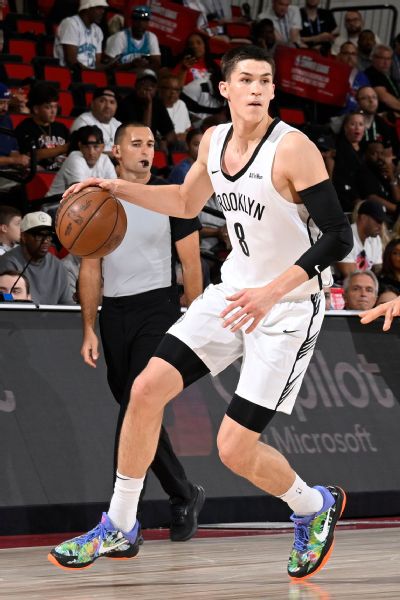
Demin is a player of extremes. He rarely gets to the rim and rarely draws free throws, but he’s a gifted passer and, at 6-foot-8, fits the modern archetype of a big lead playmaker. Demin’s 3-point accuracy has climbed to 39.8% — a major development given his 27% mark in college.
If Demin can consistently knock down his tries from deep, then defenses will be forced to guard him on the perimeter and he’ll be able to access his passing in a much greater way. When Demin shares the court with Michael Porter Jr., the Nets have a plus-3.6 net rating and a 120.1 offensive rating, per databallr, which is four ticks higher than the league average.
November ranking: Ninth
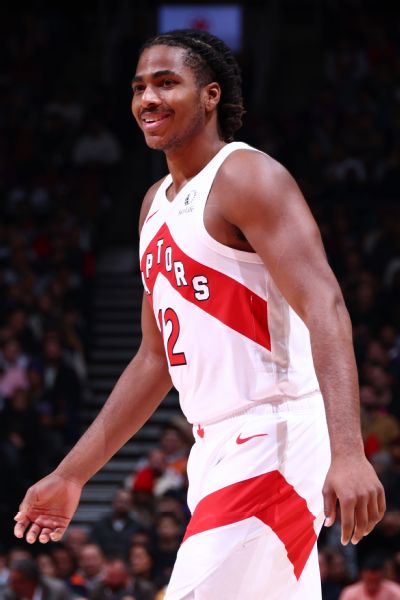
Despite being listed at 6-7, Murray-Boyles has spent 93% of his minutes at center, per Cleaning the Glass. That small-ball approach isn’t perfect, as Murray-Boyles has plenty of offensive limitations; he has made only 15 3-pointers in 37 games. But his switchability and movement make him an ideal fit on the defensive end: The Raptors have a 106.6 defensive rating when Murray-Boyles shares the court with Scottie Barnes, which is 10 points better than the league average.
November ranking: Not ranked
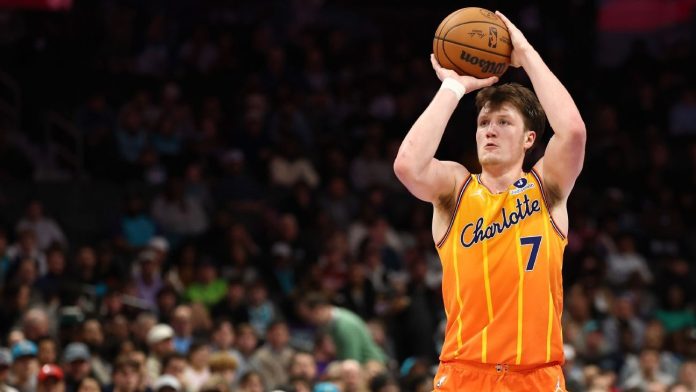
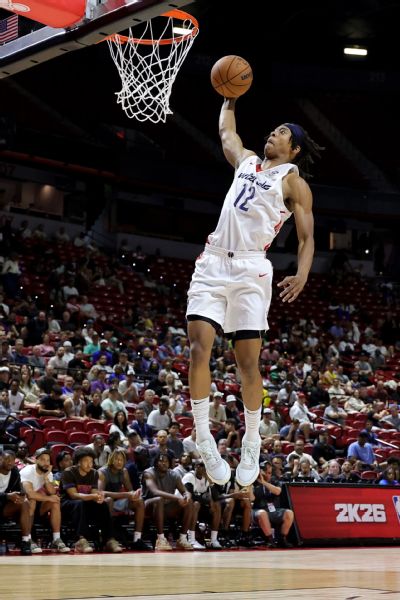
Shooting is arguably the most important single skill a player can possess in the modern NBA — and Johnson has that skill in abundance. The 19-year-old is making 39% of his 5.3 3-point attempts per game, and he has been just as efficient on pull-up attempts (40%) as catch-and-shoot tries (39%).
Johnson has also benefited from greater opportunities since the Wizards traded for Trae Young, not because Young is feeding him pinpoint passes yet — the former Hawks guard hasn’t made his Wizards debut — but because losing CJ McCollum and Corey Kispert in the deal means more playing time for Washington’s youngsters. Johnson’s four highest-minute games of the season (31 minutes once, 30 minutes three times) have all come in the week since the trade.
November ranking: Fifth
Kalkbrenner sat out a few weeks straddling the new year because of an elbow injury. But the reasons the second-round pick ranks above so many players drafted ahead of him in these rankings are the same as they were in the first edition. Kalkbrenner is a solid rim protector for a rookie, with 1.6 blocks per game and a 58% opposing field goal percentage at the rim that puts him next to the Nets’ Nic Claxton, the Portland Trail Blazers‘ Donovan Clingan and the Philadelphia 76ers‘ Joel Embiid on the NBA leaderboard.
And though Kalkbrenner isn’t doing anything particularly ambitious or revolutionary on offense, there’s still value in a big finisher who can make 77% of his shots. Rudy Gobert (72%) of the Minnesota Timberwolves is the only other player averaging at least four attempts who’s even at 70% this season.
November ranking: Fourth
Harper marks a tier jump in this ranking; nobody ranked below sixth was ever in true consideration to go any higher, while the next few players are all close and moved around at various points in the ranking process. There’s a case Harper deserves to go a couple of spots higher or also remain in fourth place, as he was in the last edition. But despite the No. 2 pick’s electric drives, savvy finishing at the rim and perimeter defense for an excellent young team, one major flaw is knocking him down a peg: shooting.
Harper is making only 74% of his free throws and 24% of his 3-pointers. Among 200 qualified players, he ranks 196th in true shooting percentage.
This isn’t just a short-term problem, as San Antonio aims to contend for the 2025-26 title; Harper’s shooting struggles could also lower his long-term ceiling. According to Stathead, here are the rookie guards since 2010 who shot worse than 75% on free throws and 30% on 3s (minimum 1,000 minutes), as Harper is now: Stephon Castle, Isaiah Collier, Cody Williams, Josh Christopher, Isaac Okoro, Jarrett Culver, Josh Okogie, Ben Simmons, Kris Dunn, Elfrid Payton, Michael Carter-Williams, Phil Pressey, Nate Wolters, Alexey Shved and Eric Bledsoe.
Very few players from that list developed into reliable starters, let alone offensive engines, and Simmons is the only one who became an All-Star. Perhaps Harper can follow in the footsteps of teammate Castle, who appears to be on that trajectory himself, despite his own continued shooting challenges. But that’s a sufficiently worrisome list of precedents that it bumps Harper down a couple of spots at this juncture.
November ranking: First
The season’s first rookie rankings ran at just about the moment that Coward was enjoying his early peak. He has slumped a bit since, falling to 34% from distance — though Coward remains efficient overall because he’s strong on 2-pointers and free throws. He remains a clear building block for Memphis as the franchise decides whether to stay its current course or begin a longer-term rebuild.
But more concerning is Coward’s lack of defensive activity, given that he seemingly checks all the boxes for a 3-and-D wing. The box score isn’t everything on defense, but Coward’s 0.5 steals and 0.3 blocks per game are rather lackluster. On a per-minute basis, Coward’s stock rate ranks 29th among 34 rookies with at least 250 minutes this season.
November ranking: 10th
By and large, most NBA rookies struggle more than they succeed. It’s sometimes better to search for glimpses of potential instead of looking at their overall statistical averages.
And my, does Queen ooze potential. Catch him on the right night, and he looks like the best rookie in the whole class: By game score, Queen’s 33-point triple-double against the Spurs in December is tied for the most impressive performance by a rookie this season.
But one key trend to monitor is that the Pelicans have really struggled when Queen plays with Zion Williamson. New Orleans has a minus-14.3 net rating in those minutes, with an offensive rating five points worse than league average and a defensive rating that’s nine points worse.
It’s still hard to envision exactly how Queen will contribute to a winning team in the future, given his poor fit with Williamson and his own considerable defensive shortcomings and lack of shooting range. (He’s 8 for 42, or 19%, on 3-pointers.) But Queen’s combination of size and playmaking ability is so intriguing that, even in a strong rookie class, he deserves a spot this high.
November ranking: Second
Edgecombe got off to a scorching start in October, slumped in November and has since rebounded to already be a solid NBA starter at 20 years old. Edgecombe isn’t very efficient overall, but his 37% mark on 3-pointers is a crucial improvement on the 34% he managed on the shorter college line at Baylor. And his defensive activity is stellar, as he’s averaging 1.5 steals and ranks 14th with 3.5 deflections per game.
The young guard still has ample room to improve. On pick-and-rolls, for instance, Edgecombe is averaging just 0.76 points per play, which ranks last among 94 players with at least 300 picks this season.
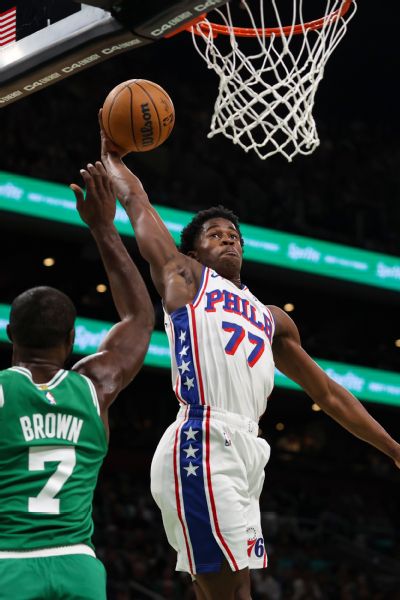
But the other factor in Edgecombe’s favor is his team context, as he’s putting up impressive overall numbers (15.8 points, 5.3 rebounds and 4.2 assists) while playing for a winner. Harper is the only other rookie near the top of this list who can say the same, and he’s coming off the bench while Edgecombe is playing 36 minutes a game in Philadelphia.
November ranking: Sixth
Flagg was never going to stay in the middle of these rankings for long. Despite a shaky start to his career while he played point guard, and a persistently inconsistent jump shot (28.6% on 3-pointers), he has made an impressive climb since November.
Flagg is unsurprisingly the most complete all-around rookie in this class. He’s the best defender — and it’s not particularly close — and his offensive strides in only two months are meaningful. In his first 10 games, Flagg averaged 13.9 points and 3.0 assists on 40% shooting, but he’s up to 20.4 points and 4.5 assists on 50% shooting since. Like Queen, Flagg checks off the “wow” factor.
Flagg sat out some time last week because of a sprained ankle, but he returned with no ill effects in a win at Madison Square Garden over the Knicks on Monday. Given his current trajectory, it wouldn’t remotely be a surprise to see him claim the top spot in the next set of rookie rankings.
November ranking: Third
Flagg is the heavy Rookie of the Year favorite (-750) according to betting markets, but his former Duke teammate has been the best rookie in the NBA this season. Whether it’s because he plays for the overlooked Hornets — who have quietly improved their point differential to an even 0.0 for the season — or because he was the No. 4 pick instead of the No. 1 selection, Knueppel has seemed underappreciated this season despite unprecedented production.
The main narrative surrounding Knueppel is his pursuit of various rookie 3-point records — he’s making 3.4 3-pointers per game on 43.5% shooting. The Kings’ Keegan Murray has the rookie record for most total made 3s, with 206, but Knueppel is on pace for 273.
Less discussed, but arguably even more impressive, is Knueppel’s overall efficiency. His 64.5% true shooting mark is the highest for any rookie in NBA history with at least a 20% usage rate in 1,200-plus minutes.
Most of the rookies near the top of that leaderboard are centers, but the most efficient rookie seasons from non-bigs belong to Sarunas Marciulionis (a longtime European pro before he came to the NBA as a 25-year-old rookie), Magic Johnson, Charles Barkley, James Worthy, Eric Gordon and Michael Jordan. That’s a remarkable list of comps.
Knueppel has benefited from rising efficiency leaguewide since the likes of Johnson and Jordan were rookies. Still, Knueppel’s true shooting is 11% better than the league average this season, which is comparable to those inner-circle Hall of Famers as rookies.
Just looking at this season, Knueppel’s true shooting percentage is higher than seven of the 10 All-Star starters (all except Nikola Jokic, Giannis Antetokounmpo and Shai Gilgeous-Alexander), and it’s third best among all high-usage guards, behind only Gilgeous-Alexander and Austin Reaves.
This would be an elite performance from an established veteran star — and Knueppel is accomplishing it as a 20-year-old halfway into his first NBA season. It’s this data point that vaults Knueppel to the top spot in these rankings and helps him fend off Flagg for now.
Stars are getting ready for a golden evening.
Indeed, Danielle Brooks and Lewis Pullman unveiled the 2026 Oscar nominees on Jan. 22 at the Samuel Goldwyn Theater in Los Angeles, Calif.
It's been…
Price: $58.97 (as of Jan 22, 2026 13:57:02 UTC – Details)
From the brand
Shop Our Products
Shop Our Products
Package Dimensions : 5.59 x 5.39 x 3.94 inches; 6.88 ounces Date First Available : March 5, 2021 Manufacturer : JetPack Supplement Manufacturer ASIN : B08Y62M7QQ Best Sellers Rank: #143,598 in Health & Household (See Top 100 in Health & Household) #1,118 in Collagen Supplements Customer Reviews: 3.3 3.3 out of 5 stars (150) var dpAcrHasRegisteredArcLinkClickAction; P.when(‘A’, ‘ready’).execute(function(A) { if (dpAcrHasRegisteredArcLinkClickAction !== true) { dpAcrHasRegisteredArcLinkClickAction = true; A.declarative( ‘acrLink-click-metrics’, ‘click’, { “allowLinkDefault”: true }, function (event) { if (window.ue) { ue.count(“acrLinkClickCount”, (ue.count(“acrLinkClickCount”) || 0) + 1); } } ); } }); P.when(‘A’, ‘cf’).execute(function(A) { A.declarative(‘acrStarsLink-click-metrics’, ‘click’, { “allowLinkDefault” : true }, function(event){ if(window.ue) { ue.count(“acrStarsLinkWithPopoverClickCount”, (ue.count(“acrStarsLinkWithPopoverClickCount”) || 0) + 1); } }); }); Complete multi-collagen blend: Our collagen powder combines Types I, II, III, V, and X collagen from grass-fed bovine, wild-caught fish, cage-free chicken bone broth, and eggshell membrane. This gives your body the most complete support for skin, joints, bones, hair, and nails without having to juggle multiple products. Fuel your metabolism and keep your body lean: With 18 grams of protein, 20 amino acids, plus L-Carnitine L-Tartrate, this multi collagen blend works to preserve muscle mass, support energy metabolism, and help you feel fuller for longer, making it easier to stay on track with weight management goals. Noticeable results for skin you’ll love: We’ve added Vitamin C for better collagen absorption and Hyaluronic Acid for hydration. Together, they work to smooth, plump, and firm your skin while reducing the look of fine lines and wrinkles, so you can feel confident in your glow. Move with comfort and support from within: Collagen’s amino acids, combined with glucomannan fiber, not only strengthen bones and joints but also promote a healthier gut. The result? More flexibility, easier digestion, and a body that feels good day after day. Clean, tested, and made for peace of mind: Every batch of our multi collagen complex is made in the USA, GMP-certified, and third-party tested. It’s gluten free, non-GMO, and free of soy, parabens, and artificial additives, because what you put into your body should be as pure as it is effective.
Timothy McCormack, a self-proclaimed gambling addict, received a two-year prison sentence Wednesday as he became the first defendant to be sentenced for his role in a sweeping conspiracy involving NBA players Terry Rozier and Jontay Porter.
A federal judge in Brooklyn handed down the sentence to McCormack, who defrauded sports betting platforms by using nonpublic information to place highly profitable wagers tied to the performance of NBA players allegedly in on the scheme.
“I’ve struggled with a gambling addiction for more than half my life,” McCormack said at his sentencing.
Judge LaShann DeArcy Hall’s sentence fell below the four-year sentence the government sought. The defense pushed for a sentence without prison time.
“He has an addiction,” DeArcy Hall said. “I don’t believe the conduct Mr. McCormack engaged in defines him.”
The judge also agreed with federal prosecutors that McCormack undermined integrity in sports.
“There is no question this is a serious crime,” DeArcy Hall said. “Sports matters to me as an individual, as it should to society.”
Prosecutor David Berman conceded McCormack was “not as culpable as some of his co-conspirators” but said he contributed to a “cold, hard fraud.”
“Without people like the defendant, these schemes can’t work,” Berman told the judge.
Rozier, who is on unpaid leave from the Miami Heat, pleaded not guilty in December to wire fraud and money laundering conspiracy charges stemming from accusations that he helped some friends win bets that revolved around his statistical performance in a game played in March 2023, when he was with the Charlotte Hornets.
He is free on $3 million bond and isn’t expected back in court until March.
Porter pleaded guilty to a federal conspiracy charge in 2024, admitting that he schemed to take himself out of games for gambling’s sake. He has been banned from the NBA and awaits sentencing.
Aaron Katersky of ABC News contributed to this report.
shows off leaked images of what appears to be the new accessory, outfitted with a magnetic Qi2 charging ring that delivers up to 15W of power, along with a USB-C cable offering up to 20W.
Winfuture suggests that the wireless power bank itself will have a 5,000 mAh battery capable of charging at up to 25W. The battery pack also appears to come with an arm that you can fold out to use as a stand. This isn’t the first time we’re hearing about this accessory; last December, 9to5Google spotted a Samsung “Magnetic Wireless Battery Pack” in the Wireless Power Consortium’s database.
As noted by Winfuture, the power bank could cost €59.90, or around $70.