

26 C
New York
Tuesday, May 5, 2026
Home Blog Page 215

The trade in US body parts that’s completely legal

0


Luke Mintz profile imageLuke MintzBBC News

BBC A treated image of a human body placed on a medical gurney.BBC

Harold Dillard was 56 when he was diagnosed with an aggressive cancer around his abdomen in November 2009. Within weeks the former car mechanic and handyman – a Texan “Mr Fix It” type who wore a cowboy hat and jeans nearly every day – was in end-of-life hospice care.

In his final days, Mr Dillard was visited at the hospice by a company called Bio Care. They asked if he might like to donate his body to medical science, where it could be used by doctors to practise knee replacement surgery. The company would cremate the parts of his body that weren’t used and return his ashes free of charge.

“His eyes lit up,” his daughter, Farrah Fasold, remembers. “He viewed that as lessening the burden on his family. Donating his body was the last selfless thing he could do.”

Mr Dillard died on Christmas Eve, and within hours, a car from Bio Care pulled up outside the hospice and drove his body away.

A few months later, his daughter received a call from the police. They had found her father’s head.
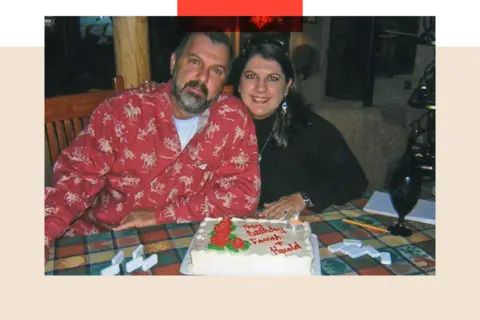
Harold Dillard pictured alongside his daughter Farrah Fasold

Harold Dillard’s body was “mutilated”, his daughter Farrah Fasold says

At the company’s warehouse, police say they found more than 100 body parts belonging to 45 people. “All of the bodies appeared to have been dismembered by a coarse cutting instrument, such as a chainsaw,” a detective wrote at the time.

Ms Fasold says she imagined her father’s body would be handled with respect – but instead it was “mutilated”, she believes.

“I would close my eyes at night and see huge red tubs filled with body parts. I had insomnia. I wasn’t sleeping.”

The company said at the time through a lawyer that they denied mistreating bodies. The firm no longer exists, and its former owners could not be reached for comment.

This was Ms Fasold’s first introduction to the world of so-called body brokers: private companies that acquire corpses, dissect them, and then sell the limbs for a profit, often to medical research centres.

For critics, the industry represents a modern form of grave-robbing. Others argue that body-donation is essential for medical research and that private companies are simply filling a gap left by universities, who consistently fail to acquire enough dead bodies to support their education and research programmes.

Although Ms Fasold didn’t realise it at the time, her father’s case sheds light on an emotion-fuelled debate that cuts to the centre of our ideas about life, and what it means to have a dignified death.

The body business

Since at least the 19th Century, when the teaching of medicine expanded, some scientifically-minded people have rather liked the idea that their corpse could be used to train doctors.

Brandi Schmitt is director of the anatomical donation programme at the University of California, a popular destination for people wishing to bequeath their bodies. She says last year they received 1,600 “whole-body donations”, and they have a list of almost 50,000 living people who have already registered to do so.

Often, body-donation is driven by simple altruism, she says: “A lot of people are either educated or interested in education.”

But financial factors come into play too. Funerals are expensive, Ms Schmitt says; many are tempted by the prospect of their body being taken away for free.

Like most medical schools, the University of California does not profit from its body-donation programme, and it has strict guidelines for how corpses – or cadavers, as they are known medically – should be handled.

But in recent decades, something more controversial has emerged in the US: a network of for-profit businesses that act as middlemen, acquiring bodies from individuals, dissecting them, and then selling them on. They are widely nicknamed body brokers, though the firms call themselves “non-transplant tissue banks”.

Some of their customers are universities, which use cadavers to train doctors. Others are medical engineering firms, which use limbs to test products like new hip implants.

The for-profit body part trade is effectively outlawed in the UK and other European countries, but looser regulation in the US has allowed the trade to flourish.

The largest investigation of its kind – conducted by Reuters journalist Brian Grow, in 2017 – identified 25 for-profit body broking companies in the US. One of them earned $12.5m (£9.3m) over three years from the body-part business.

Some of those firms are broadly respected, and claim to follow rigorous ethical guidelines. Others have been accused of disrespecting the dead and exploiting vulnerable people in grief.

A global trade

The trade has grown because of a gap in US regulation, says Jenny Kleeman, who spent years researching the topic for her book, The Price of Life.

Whilst the UK’s Human Tissue Act makes it illegal in almost all cases to profit from a body part, no comparable law exists in the US. Technically, the US’s Uniform Anatomical Gift Act bans the sale of human tissue – but the same law allows you to charge a “reasonable amount” for the “processing” of a body part.

These loose laws have turned the US into a global exporter of cadavers. In her book, Kleeman found that one of the largest US players shipped body parts to more than 50 countries, including the UK.

“In many countries, there is a shortfall of donations,” Ms Kleeman says. “And where they can get bodies is from America.”

There is no formal register of brokers, and official statistics are hard to find. But Reuters calculated that, from 2011 to 2015, private brokers in the US received at least 50,000 bodies, and distributed more than 182,000 body parts.

‘Bodies of the state’

For some, private body brokers represent the very worst sort of ambulance-chasing greed.

In his Reuters investigation, Mr Grow found cases of brokers becoming “intertwined with the American funeral industry” via arrangements in which funeral homes introduce brokers to relatives of the recently-deceased. In return, the home received a referral fee, sometimes exceeding $1,000 (£750).

Horror stories are easy to find – and because of the US’s light regulation, there’s often no legal recourse when things go wrong.

After her run-in with Bio Care, Ms Fasold hoped for a criminal prosecution. As well as the fact that her father’s limbs may have been cut with a chainsaw, she was unhappy about a package she had received in the post, in a zip-lock bag, which the company claimed was her father’s ashes. She says the contents did not look or feel like human ashes.

Harold Dillard

Harold Dillard was a classic Texan “cowboy”, his daughter says. She was told the company that handled her father’s remains had not broken any state laws

Bio Care’s owner was initially charged with fraud, but the charge was later withdrawn because prosecutors could not prove an intent to deceive.

Increasingly desperate, Ms Fasold contacted the local district prosecutor. But she was told that Bio Care had not broken any state criminal laws.

Equally as controversial are “bodies of the state” donations – when a homeless person dies on the street, or somebody dies in hospital without known next-of-kin, and their corpse is donated to science.

In theory, county officials first try to find relatives; only if they cannot locate anyone is the body given away.

But the BBC has heard that this may not always happen. Last year, Tim Leggett was scrolling a news app at his home in Texas when he found a list of local people whose bodies had been used in this way. He was shocked to see the name of his older brother, Dale, a forklift truck-operator who had died of respiratory failure a year earlier.

His brother’s body was used by a for-profit medical education company to train anaesthesiologists. It was one of more than 2,000 unclaimed bodies given to the University of North Texas Health Science Center between 2019 and 2024, under agreements with the Dallas and Tarrant counties.

“I was angry,” Mr Leggett says. “He would not want to be an object of discussion, or [to have] people pointing at him.”

His brother was a quiet man who mostly “just wanted to be left alone”, Mr Leggett remembers, and his aversion to technology made it difficult to stay in touch. Still, Mr Leggett says his brother was a human, like anyone else, who deserved dignity in death.

“He liked Marvel comic books; he had a cat that he named Cat,” he remembers.

In a statement to the BBC, the University of North Texas Health Science Center gave its “deepest apologies” to the affected families, and said it was “refocusing” its programme on education and “improv[ing] the quality of health for families and future generations”. Since the story first emerged last year, they said, they have fired staff who oversaw the programme.

Unfairly villainised?

But horror stories like these aside, others point out that body donation plays a crucial role in scientific discovery.

Ms Schmitt of the University of California says that at the most basic level, bodies are used to teach doctors, or for surgeons to practise complicated operations. Often, it’s the first time a medical student works with real flesh and blood – an experience that can’t be replicated from a textbook.

“Those students will go on to help people,” she says.

Then there are the cadavers used to help engineer new treatments. Ms Schmitt points to a number of technologies that were only developed, she says, after being tested on bodies. These include knee and hip replacements, robotic surgery, and pacemakers.
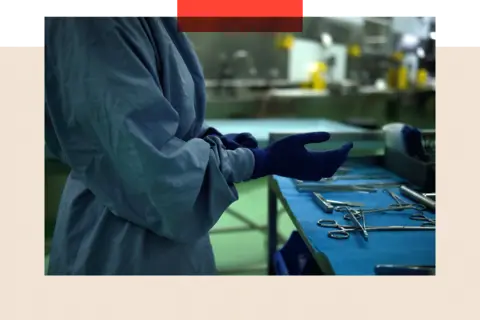
Bloomberg via Getty Images A surgeon puts on a pair of gloves while standing in front a table on which surgical instruments have been laidBloomberg via Getty Images

For many medical students, practising on a dead body is the first time they work with real flesh and blood

And some of the private brokers say they are being unfairly villainised. Kevin Lowbrera, who works for one of the big “body broking” companies, says its accreditation by the American Association of Tissue Banks means it has to follow guidelines determining how cadavers are treated and stored. Accreditation is voluntary – seven companies have signed up – and a private broker doesn’t need it to operate legally.

The problem is not with honest companies like his, Mr Lowbrera says – it is with the rogue players. “There are still programmes out there that are not accredited. I tell people all the time, stay away from them,” he says.

It would be wrong to regulate his whole industry out of existence, he says, because of some bad apples.

Beyond the for-profit trade?

Virtually everyone I speak to – on all sides of the debate – thinks that more regulation in the US is needed.

So, what could that look like?

Ms Schmitt, of the University of California, suggests the US could perhaps follow European countries and ban for-profit body broking.

She says there are some “legitimate costs” that come with processing a body – like spending on transport, and preservative chemicals. It’s reasonable for companies to charge for these, she says. But the idea of actually making a profit makes many feel squeamish. “The ability to sell or profit from human remains I think complicates the altruistic idea of donating for education,” she says.

She suggests the US could emulate its own policy on organ donation – which is governed by the Uniform Anatomical Gift Act, and prohibits the sale of organs.

But the author Ms Kleeman says that if the US banned for-profit body donation tomorrow, there simply wouldn’t be enough cadavers to go around.

“If you don’t want there to be a trade in these body parts, we need to get a way of more people donating altruistically,” she says.

She urges universities to launch more robust promotional campaigns, asking directly for body donations. “There isn’t the same public awareness campaign as there is for organ donation, for example.”

Once this shortage is addressed, she says, then the US could ban for-profit donation.

It’s also possible that advances in virtual reality (VR) technology mean that cadavers simply won’t be needed in the future. A trainee doctor could simply put on a headset and practice on a computer-generated patient.

In 2023, Case Western Reserve University became one of the first medical schools in the United States to remove human bodies from its training programme, and replace them with VR models.

Real human bodies preserve the “body’s colours and textures, [which] can make it difficult to discern, say, a nerve from a blood vessel”, Mark Griswold, a professor at the school, told the website Lifewire at the time. In contrast, their computer programme “gives students a crystal clear 3D map of these anatomical structures and their relationships to each other”, he said.

But Ms Kleeman says that, in general, VR technology is not yet good enough to replicate practicing on a cadaver.

For the time being, it seems, there will remain a demand for human bodies – as well as money to be made.

Additional reporting: Jacob Dabb

BBC InDepth is the home on the website and app for the best analysis, with fresh perspectives that challenge assumptions and deep reporting on the biggest issues of the day. And we showcase thought-provoking content from across BBC Sounds and iPlayer too. You can send us your feedback on the InDepth section by clicking on the button below.
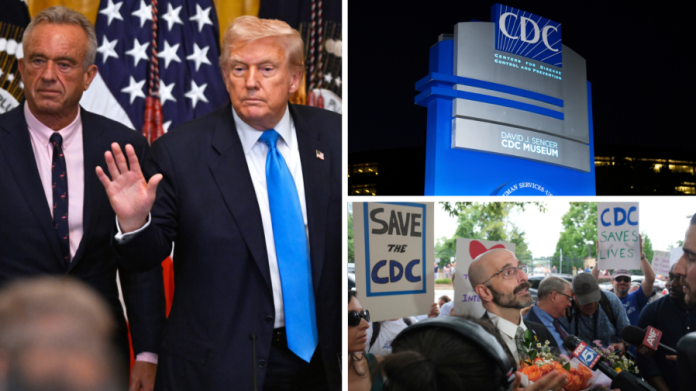
Sunday shows preview: Trump administration faces fallout from CDC leadership shakeup

0


President Trump’s administration is facing fallout from this week’s leadership shakeup at the Centers for Disease Control and Prevention (CDC), where the agency’s director was terminated and other top officials resigned

The president fired Susan Monarez on Wednesday after she clashed with Health and Human Services (HHS) Secretary Robert F. Kennedy, Jr., over vaccine policy. Monarez is contesting her firing. 

After Monarez’s firing, Demetre C. Daskalakis, director of the National Center for Immunization and Respiratory Diseases, Daniel Jernigan, director of the National Center for Emerging and Zoonotic Infectious Diseases, and CDC Chief Medical Officer Debra Houry resigned, arguing that the recent leadership changes are barring them from fulfilling their roles as public health officials. 

Kennedy and the administration defended Monarez’s firing, with the White House saying on Thursday that Trump has the “authority to fire those who are not aligned with his mission.”

Some Republican senators are at unease over the tumult at the CDC, while Sen. Bernie Sanders (I-Vt.), the ranking member on the Senate Health, Education, Labor and Pensions (HELP) Committee, called on Kennedy to step down from his post. 

Daskalakis is set to appear on ABC’s “This Week,” where he will likely discuss his resignation and what is ahead for the CDC. 

On Capitol Hill, lawmakers will be back in session next week after the August recess and will grapple with the upcoming funding fight as the deadline for a government shutdown approaches.

Sen. Marsha Blackburn (R-Tenn.) will be on Fox News’s “Sunday Morning Futures” where she will likely weigh in on the upcoming funding battle in the Senate. 

On Wednesday, a deadly shooting took place at Annunciation Catholic School in Minneapolis, where two children were killed and 18 others were injured by 23-year-old Robin Westman.

Mississippi State Superintendent of Education Lance Evans will be on NewsNation’s “The Hill Sunday,” where he will likely weigh in on the shooting.

Trump’s crackdown on crime in the nation’s capital has continued. Attorney General Pam Bondi said in a Saturday morning update that more than 80 arrests were made, and 11 illegal firearms were seized overnight in Washington. So far, police have made over 1,450 arrests since the president federalized the local law enforcement and deployed the National Guard. 

There, and other topics, are likely going to be discussed at the upcoming Sunday shows: 

NewsNation’s “The Hill Sunday”: Education Secretary Linda McMahon; Delaware Gov. Matt Meyer (D); Mississippi state Superintendent of Education Lance Evans and Professor Catherine Pakaluk. 

Fox News’ “Fox News Sunday”: U.S. Attorney for D.C. Jeanine Pirro; Sen. Bill Hagerty (R-Tenn.); Rep. Jake Auchincloss (D-Mass.).

ABC’s “This Week”: Maryland Gov. Wes Moore (D-Md.); Rep. Tom Emmer (R-Minn.); Former CDC official Demetre Daskalakis.

NBC’s “Meet the Press”: Sen. James Lankford (R-Okla.) and Rep. Ro Khanna (D-Calif.).

CNN’s “State of the Union”: Rep. Ilhan Omar (D-Minn.); Sebastian Gorka, deputy assistant to President Trump.

Fox News’ Sunday Morning Futures”: White House trade adviser Peter Navarro; House Oversight Committee Chair James Comer (R-Ky.); Sen. Marsha Blackburn (R-Tenn.); New York City Mayoral Candidate Curtis Sliwa (R) and former deputy national security adviser Victoria Coates. 

I Asked ChatGPT for the Most Common Myth About the Stock Market — Here’s What You Should Stop Believing

0


There are a lot of tall tales about the stock market. So many, in fact, that you might expect to see Paul Bunyan and Babe the Blue Ox stroll through the Wall Street Exchange. At their most benign, these myths offer some amusement. But at their worst, they can curtail you from investing altogether — leaving money on the table, instead of your wallet.

Find Out: I’m a Financial Advisor: 4 Investing Rules My Millionaire Clients Never Break

Read Next: 6 Popular SUVs That Aren’t Worth the Cost — and 6 Affordable Alternatives

Finding the biggest stock market myths to address them can be a challenge. So, I decided to start with one. And to find that one, I turned to ChatGPT and asked it to define the most common myth about the stock market.

As we all know, ChatGPT isn’t perfect, so you should check any information it provides against the advice of your real-life financial advisor or other experts.

According to ChatGPT, the most common stock market myth is that “the stock market is just like gambling.”

This didn’t come as a surprise. When I entered that particular phrase into Google, I got a seemingly infinite amount of material, from YouTube hits to Reddit communities to actual studies conducted by the National Institute of Health.

The top result I found was an Investopedia article titled, “Is Warren Buffett Right That the Stock Market is Like a Casino? What Investors Need to Know.” Well, dang, does Warren Buffett really believe that?

 Be Aware: Making This Common Investing Mistake? Experts Share the Easy (but Urgent) Fix

Using the Oracle of Omaha as my throughline, I decided to do further investigation. According to the article itself, Buffett has semi-regularly made this lament in letters to investors, calling it a result of certain modern tradition trends.

“The legendary investor claims patience and research are a thing of the past,” said writer Daniel Liberto. “Now, he says, the modern investor mindlessly jumps into stocks that are popular and hopes for a quick payoff as if they were at a casino.”

Buffett is particularly concerned with the ways that mobile gaming apps can create a “casino in your pocket” or a heightened temptation to play away that allows Wall Street to profit from users’ trading fees.

So how does this align with why ChatGPT thinks that the story holds resonance with people. It says that people can believe it because “stocks can be volatile and unpredictable in the short term,” while also offering that “some traders treat it like a casino, making reckless, speculative bets (e.g., meme stocks, options without understanding them).” And the way that media dramatizes big wins and losses doesn’t help.

Guillermo del Toro’s Netflix adaptation debuts in Venice

0


Steven McIntoshEntertainment reporter at the Venice Film Festival

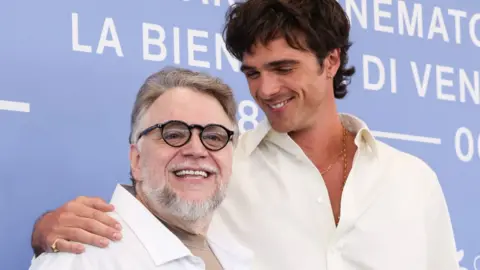
Getty Images Guillermo del Toro and Jacob Elordi attend the "Frankenstein" photocall during the 82nd Venice International Film Festival on August 30, 2025 in Venice, ItalyGetty Images

Saltburn star Jacob Elordi (right) stars as Frankenstein’s creation in the film from Guillermo del Toro (left)

A few years ago, Netflix boss Ted Sarandos was meeting with Guillermo del Toro when he asked the celebrated director which films were on his bucket list.

Del Toro answered with two names: “Pinocchio and Frankenstein.”

“Do it,” Sarandos replied, effectively agreeing to fund both projects for the streaming giant. The first film, Del Toro’s acclaimed dark-fantasy version of Pinocchio, arrived in 2022.

But when it came to starting work on Frankenstein, del Toro had one warning: “It’s big.”

He wasn’t joking. The Mexican filmmaker’s ambitious take on the famous mad scientist and his monstrous creation is one of the centrepieces of this year’s Venice Film Festival. It’s a project he has been working towards for decades.

“It’s sort of a dream, or more than that, a religion for me since I was a kid,” del Toro tells journalists at the festival.

He highlights Boris Karloff’s performance in the 1931 adaptation as particularly influential, but it’s taken a long time for del Toro’s own version to reach the screen.

“I always waited for the movie to be done in the right conditions, creatively, in terms of achieving the scope that it needed, to make it different, to make it on a scale that you could reconstruct the whole world,” he explains.

Now that the process has come to an end and the movie is about to be released, the director jokes he’s “now in postpartum depression”.

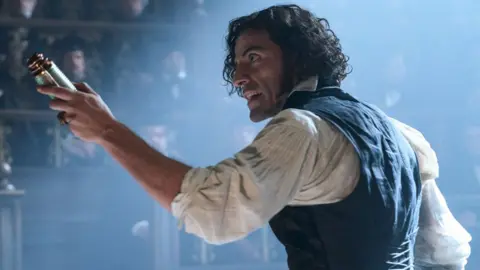
Netflix Oscar Isaac as Victor Frankenstein in FrankensteinNetflix

Oscar Isaac plays Frankenstein, a gifted scientist who gradually comes to regret his creation

Since the 1818 novel by Mary Shelley, there have been hundreds of films, TV series and comic books featuring some iteration of the famous character.

The latest adaptation sees Inside Llewyn Davis star Oscar Isaac take on the role of Victor Frankenstein, with Saltburn and Euphoria actor Jacob Elordi unrecognisable as the monster-like creature he gives life to.

Isaac recalls: “Guillermo said, ‘I’m creating this banquet for you, you just have to show up and eat’. And that was the truth, there was a fusion, I just hooked myself into Guillermo, and we flung ourselves down the well.

“I can’t believe I’m here right now,” he adds, “that we got to this place from two years ago. It just seemed like such a pinnacle.”

Andrew Garfield had originally been cast as the titular creature, but had to leave the project due to scheduling conflicts which arose from the Hollywood actors’ strike.

Elordi stepped in at short notice. “Guillermo came to me quite late in the process,” the actor recalls, “so I had about three weeks before I got to filming.

“It presented itself as a pretty monumental task, but like Oscar said, the banquet was there, and everybody was already eating by the time I got there, so just had to pull up a seat. It was a dream come true.”

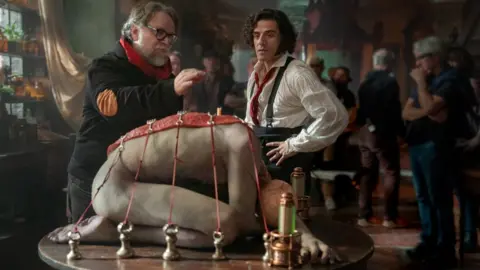
Netflix Director Guillermo del Toro and Oscar Issac as Victor Frankenstein on the set of FrankensteinNetflix

Del Toro said he tried to use real sets wherever possible, and keep CGI use to a minimum

The film is split into three parts – a prelude, followed by two versions of events told from the points of view of both Frankenstein and his creation.

It shows Frankenstein’s childhood and the factors that drove him to start work on the project in the first place. But it also encourages audiences to see things from the creature’s point of view – shining a light on how badly treated he was by his creator.

At 149 minutes, there is room for the characters and their back stories to be fleshed out. In early reviews of the film, most critics agreed it just about earns its run time.

“It perhaps might have been shortened, but del Toro’s sandbox is so irresistible, the return to big Hollywood moviemaking so pronounced, it must be hard to stop,” said Deadline’s Pete Hammond.

“Once a filmmaker on the scale of del Toro gets unleashed in the lab, why cut it short?”

But other reviews suggested it was far from del Toro’s best. The Independent’s Geoffrey McNab said it was “all show and little substance”, adding: “For all Del Toro’s formal mastery, this Frankenstein is ultimately short of the voltage needed really to bring it to life.”

There was much more enthusiasm from the Hollywood Reporter’s David Rooney, who wrote: “One of del Toro’s finest, this is epic-scale storytelling of uncommon beauty, feeling and artistry.”

And in a four-star review, Total Film’s Jane Crowther said: “Masterfully concocted and pertinent in theme, Guillermo del Toro’s Frankenstein is a classy, if somewhat safe, adaptation with awards legs.”

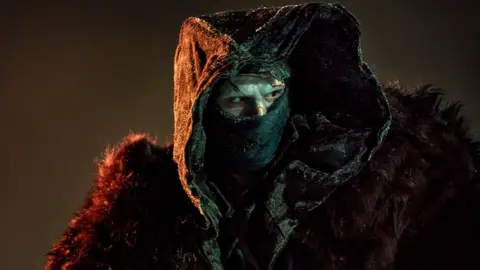
Netflix Jacob Elordi as FrankensteinNetflix

Jacob Elordi has been praised for his portrayal of the monster-like creature

Del Toro is one of his generation’s most beloved directors, treasured in the industry for his own love of cinema and his ambition for what it can do.

The 60-year-old is also Hollywood’s go-to filmmaker for stories involving monsters or other fantastical creatures. His credits include Pan Labrynth, Prometheus and The Shape of Water, which won him the Oscar for best picture and best director in 2018.

He has great affection for monsters and is known for humanising them in his films, evoking sympathy from the audience for characters previously seen as villains.

In Frankenstein’s case, he says: “I wanted the creature to be newborn. A lot of the interpretations are like accident victims, and I wanted beauty.”

Netflix Mia Goth as Elizabeth in FrankensteinNetflix

Mia Goth plays Elizabeth, who develops a close bond with the creature

His vision and attention to detail with Frankenstein extended to every aspect of the production, ensuring great care went into costumes and sets – which are overwhelmingly real, physical settings rather than computer-generated landscapes.

“CGI is for losers,” comments Waltz, to much laughter. Del Toro adds that filming with real-life backdrops ultimately draws out a better performance from the actors than using green screens.

He likens the distinction between CGI and physical craftsmanship to the difference between “eye candy and eye protein”, but adds he does use digital effects when absolutely necessary.

The idea of creating a sapient being which ends up operating on its own terms might sound familiar today, but del Toro says the movie is “not intended as a metaphor” for artificial intelligence, as some critics have suggested.

Instead, he reflects: “We live in a time of terror and intimidation, and the answer, which art is part of, is love. And the central question in the novel from the beginning is, what is it to be human?

“And there’s no more urgent task than to remain human in a time when everything is pushing towards a bipolar understanding of our humanity. And it’s not true, it’s entirely artificial.”

He continues: “The multi-chromatic characteristic of a human being is to be able to be black, white, grey, and all the shades in between. The movie tries to show imperfect characters, and the right we have to remain imperfect.”

Chicago mayor vows to fight Trump intervention, signs protective order

0


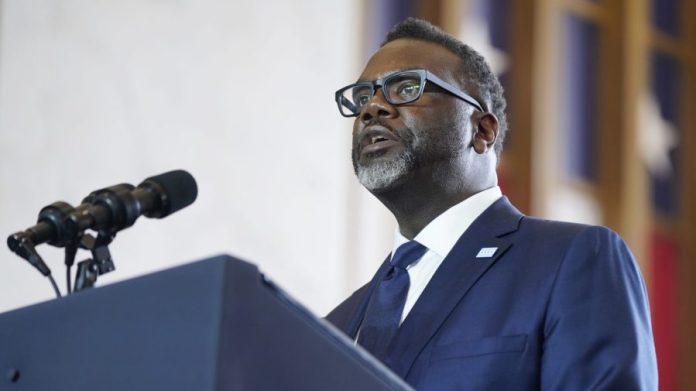
Chicago Mayor Brandon Johnson (D) signed an executive order detailing how the Windy City will attempt to respond to President Trump’s potential deployment of the National Guard. 

Johnson’s executive order, which he signed on Saturday, established the “Protecting Chicago Initiative” to protect the constitutional rights of Chicago residents amid the “possibility of imminent militarized immigration or National Guard deployment” into the city. 

The order is asking Trump to “stand down” from his threat to deploy the National Guard into Chicago and reaffirms the Chicago Police Department will “remain a locally controlled law enforcement agency.” 

“The City of Chicago will do everything in our power to defend our democracy and protect our communities. With this executive order, we send a resounding message to the federal government: we do not need nor want an unconstitutional and illegal military occupation of our city,” Johnson said in a statement.  

“We do not want military checkpoints or armored vehicles on our streets and we do not want to see families ripped apart. We will take any action necessary to protect the rights of all Chicagoans,” the mayor added. “Protecting Chicago is the next step in the work we have been doing to defend our city from federal overreach and illegal action.”

The order comes as the president said last week that the administration would focus on lowering the crime rate in Chicago next, after deploying the National Guard to Washington, D.C. Chicago has long struggled with gun violence, although fatal and nonfatal shootings are on a downward trend in the city in recent years, according to the city’s data. 

“Chicago’s a mess. You have an incompetent mayor. Grossly incompetent and we’ll straighten that one out probably next. That will be our next one after this,” Trump said at the White House. “And it won’t even be tough.”

Both Johnson and Illinois Gov. JB Pritzker (D) oppose Trump’s potential deployment of the National Guard. 

The administration is considering using a Navy base near Chicago to support its immigration crackdown efforts. It would reportedly involve deploying more than 200 Department of Homeland Security (DHS) agents and using the Naval Station Great Lakes as a staging area. 

“If these Democrats focused on fixing crime in their own cities instead of doing publicity stunts to criticize the President, their communities would be much safer. Cracking down on crime should not be a partisan issue, but Democrats suffering from TDS [Trump Derangement Syndrome] are trying to make it one,” White House spokeswoman Abigail Jackson said in a statement to The Hill’s sister network NewsNation.  

“They should listen to fellow Democrat Mayor Muriel Bowser who recently celebrated the Trump Administration’s success in driving down violent crime in Washington DC,” Jackson added.

GE Vernova Inc. (GEV)’s Shares Have Gained 50% Since Jim Cramer Said “I Don’t Think It’s Done”

0


We recently published Jim Cramer’s 20 Bold AI Predictions – See How They Played Out! GE Vernova Inc. (NYSE:GEV) is one of the stocks Jim Cramer recently discussed.

GE Vernova Inc. (GEV)'s Shares Have Gained 50% Since Jim Cramer Said "I Don't Think It's Done"
GE Vernova Inc. (GEV)’s Shares Have Gained 50% Since Jim Cramer Said “I Don’t Think It’s Done”

Copyright: kadmy / 123RF Stock Photo

GE Vernova Inc. (NYSE:GEV) has been a top Jim Cramer AI stock due to its exposure to the nuclear power industry. In fact, while Cramer has been a skeptic of nuclear in general due to long delivery times, he has continued to remain optimistic about GE Vernova Inc. (NYSE:GEV). Since his comments in January, the shares have gained 50%. During this time period, the stock dipped by 21.5% during the DeepSeek selloff as investors went risk-off with AI stocks. Then, GE Vernova Inc. (NYSE:GEV)’s shares jumped by 17.5% in July after the firm’s latest earnings report saw it beat analyst EPS and revenue estimates. Here is what Cramer said about GE Vernova Inc. (NYSE:GEV) in January:

“Wednesday we got some real firecrackers. The data center business is red hot and in order to fuel these warehouses full of servers and, you know, send the air conditioning in and all sorts of electricity, well, what do you gotta do? You need more power plants. That means they’re likely to place orders with nat-gas turbine maker GE Vernova, that’s another one of last year’s best performers. I don’t think it’s done.”

While we acknowledge the potential of GEV as an investment, our conviction lies in the belief that some AI stocks hold greater promise for delivering higher returns and have limited downside risk. If you are looking for an extremely cheap AI stock that is also a major beneficiary of Trump tariffs and onshoring, see our free report on the best short-term AI stock.

READ NEXT: 30 Stocks That Should Double in 3 Years and 11 Hidden AI Stocks to Buy Right Now.

Disclosure: None. This article is originally published at Insider Monkey.

‘The most sterile game there is’ – another controversial day for VAR

0


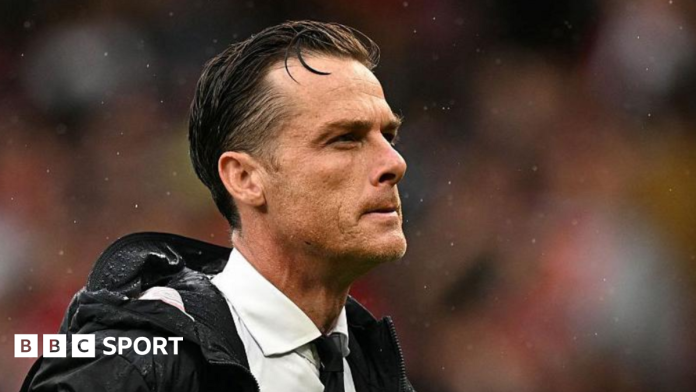
Burnley manager Scott Parker says video assistant referee decisions are threatening to turn football into “the most sterile game there is” after his side lost to a controversial late penalty on Saturday at Manchester United.

Ruben Amorim’s team were awarded a penalty deep into second-half stoppage time when Jaidon Anthony was penalised for grabbing Amad Diallo’s shirt inside the area.

Referee Sam Barrott initially waved play on, but after reviewing the incident on the pitchside monitor he awarded the spot-kick and Bruno Fernandes held his nerve to earn the hosts a 3-2 victory.

“It’s the way the game has gone – quadruple checking everything every minute,” Parker told BBC Match of the Day. “On the field, the referee didn’t give the foul.

“Then we’ve re-reffed it. It’s not the ref, it’s a fella 200-odd miles away in a box.”

Clarets striker Lyle Foster also had a goal ruled out for a marginal offside earlier in the second half, a decision the 24-year-old described as “unfair”.

The controversy at Old Trafford came after two highly contentious decisions in Chelsea’s 2-0 triumph over Fulham in Saturday’s lunchtime kick-off.

Referee Rob Jones ruled out Fulham teenager Josh King’s 21st-minute goal for a foul in the build-up, before Enzo Fernandez scored from the penalty spot after a Trevoh Chalobah cross had struck Ryan Sessegnon’s arm.

A seething Marco Silva told TNT Sports the decision to disallow King’s fine finish was “unbelievable”.

“I prefer not to say something, because I would be punished,” he added.

We may only be three games into the new Premier League season, but more often than not VAR is once again dominating post-match discussion.

Kari Lake announces 532 positions nixed at Voice of America, parent company

0


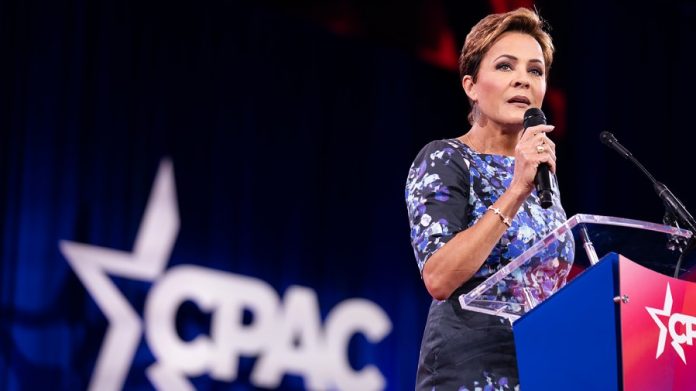
Kari Lake, President Trump’s top adviser to the U.S Agency for Global Media (USAGM), announced Friday night that 532 positions were nixed at USAGM and Voice of America.

In a post on X, Lake said the layoffs were conducted at President Trump’s direction “to help reduce the federal bureaucracy, improve agency service, and save the American people more of their hard-earned money.”

The reduction in force of USAGM “will likely improve its ability to function and provide the truth to people across the world who live under murderous Communist governments and other tyrannical regimes,” Lake added. “I look forward to taking additional steps in the coming months to improve the functioning of a very broken agency and make sure America’s voice is heard abroad where it matters most.”

A Thursday court document shows that Lake planned to lay off 46 USAGM employees and 486 VOA employees, and planned to keep 158 USAGM employees and 108 VOA employees.

Lake’s announcement comes on the heels of a federal judge barring the Trump administration from removing VOA’s director, Michael Abramowitz, from his post. U.S. District Judge Royce Lamberth‘s Thursday ruling states that Abramowitz, who was told he would be “subject to termination” starting Aug. 31, can only be removed from his position as director by a majority vote of the International Broadcasting Advisory Board.

The ruling dealt a blow to Lake and the Trump administration, which has been seeking to transform the English-language broadcaster into an “America First” outlet. The administration has been working to shrink VOA over recent months, including initiating similar large-scale layoffs in June, which were rescinded a week later.

Paula Hickey, the president of the union that represents VOA employees, pushed back on the layoffs in a statement to the New York Times, saying “the manner in which they are being executed reveals the contempt this administration has for federal employees and the rule of law.”

Best Buy Co., Inc. (BBY) Might Have A Tariff Problem, Says Jim Cramer

0


We recently published 11 Latest Stocks That Jim Cramer Just Talked About. Best Buy Co., Inc. (NYSE:BBY) is one of the stocks Jim Cramer recently discussed.

Electronics retailer Best Buy Co., Inc. (NYSE:BBY)’s shares have lost 13.8% year-to-date, courtesy of two massive selloffs in March and April that saw the shares dip by 13.3% and 25.8%, respectively. The March dip came as the firm cut its fiscal year 2026 revenue guidance to a midpoint of $41.5 billion from an earlier $41.8 billion. The guidance cut was due to tariffs, and unsurprisingly, the shares sank in April during the Liberation Day selloff. Cramer mentioned the impact of tariffs on Best Buy Co., Inc. (NYSE:BBY):

“You know the stock was down very badly at one point. Yeah well I mean I think that they, a lot of people feel that, their enterprise, well they have a tariff problem.”

Best Buy Co., Inc. (BBY) Might Have A Tariff Problem, Says Jim Cramer

Photo by Naomi Hébert on Unsplash

Here are Cramer’s previous comments about Best Buy Co., Inc. (NYSE:BBY):

“… Look, it’s not just Dow. We were attracted to two stocks from our Charitable Trust because of their high yields: Best Buy and Stanley Black & Decker. Best Buy would benefit from the biggest PC cycle in years because of Microsoft’s Copilot… Both stocks initially soared, same thesis. We sold Best Buy at a terrific profit… Best Buy stock now yields 5.6%, one of the highest-yielding retailers out there. In itself, though, not inspiring. The PC refresh cycle turned out to be a bust. President Trump’s tariffs will spike the price of Chinese and Korean appliances. Also, that Whirlpool can raise prices too, although judging by that hideous quarter just reported tonight by Whirlpool, where the company slashed its quarterly dividend from $1.75 to 90 cents a share, just what I’m talking about. Whirlpool needs all the help it can get. That’s not good for Best Buy. Again, I think you could be reaching for yield here. The problem is one of reassurance. If the dividend’s in jeopardy, management won’t say a word about it till they actually give you the cut.”

While we acknowledge the potential of BBY as an investment, our conviction lies in the belief that some AI stocks hold greater promise for delivering higher returns and have limited downside risk. If you are looking for an extremely cheap AI stock that is also a major beneficiary of Trump tariffs and onshoring, see our free report on the best short-term AI stock.

READ NEXT: 30 Stocks That Should Double in 3 Years and 11 Hidden AI Stocks to Buy Right Now.

Disclosure: None. This article is originally published at Insider Monkey.

Nicolas Jackson: Chelsea cancel Bayern Munich loan after Liam Delap injury

0


Many Chelsea supporters were already asking the same question during the match, about whether it was too late to cancel Jackson’s loan move to Germany.

Tyrique George, a 19-year-old winger from the academy, replaced Delap at Stamford Bridge and gave a creditable display while out of position, but he too could leave Chelsea before deadline day.

On George, Maresca said: “Today we played more than one hour with Tyrique [George], and he did brilliant.”

It was ironic that Chelsea’s only fit striker, Joao Pedro, was himself filling in for star attacker Cole Palmer in his favoured number 10 position.

When George was picked, Maresca looked short of options with winger Jamie Gittens – signed from Dortmund for £48.5m over the summer – the only other attacker on his bench.

It is a remarkable situation given Chelsea have more than £300m worth of attackers in their squad.

However, Chelsea had decided against carrying three senior strikers because of Jackson’s desire not to be an emergency back-up, and with Nkunku having been unhappy at the club for more than six months.

Pedro Neto showed last season that he is capable of filling in on an emergency basis, with Palmer and George both having played as up-front in the past. Academy striker Shim Mheuka, 17, is also top scorer in the under-21s league with four goals in three matches.

Meanwhile, winger Alejandro Garnacho was sat in the directors’ box on Saturday before completing a £40m move from Manchester United. Chelsea are also closing in on a move for Brighton’s Facundo Buonanotte, who is capable of playing as a 10 or on the right wing.

Chelsea would have eight attacking players for four roles on the pitch after the two Argentine attackers arrive, with a well-stocked academy in behind them.

However, they must be suitably worried about Delap to have taken a shock decision to pull the plug on Jackson’s move, at least for now, and bring him back to Stamford Bridge.