27.1 C
New York
Tuesday, May 5, 2026
Home Blog Page 217

Why Warren Buffett has stayed as Berkshire Hathaway CEO, the job he loved, into his mid-90s

0


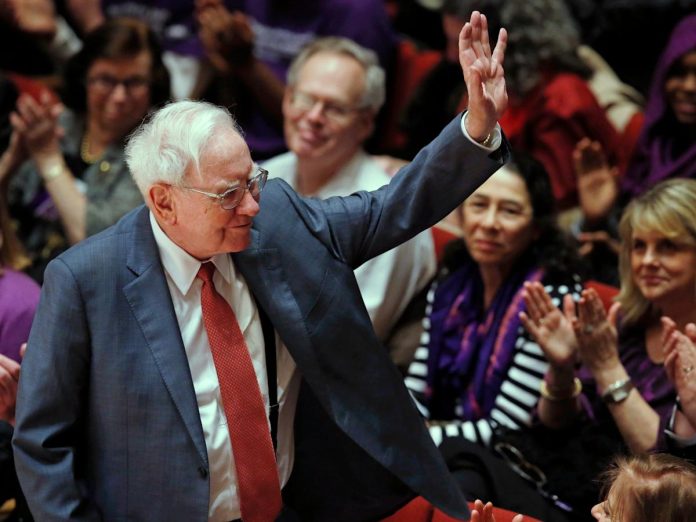
Warren Buffett hand waves Northwestern crowd
Financial investor Warren Buffett is acknowledged during an announcement ceremony at Northwestern University in Evanston, Illinois, January 28, 2015. Roberta Buffett Elliott, the sister of Warren Buffett, has given Northwestern University more than $100 million to create the Roberta Buffett Institute for Global Studies, the largest single gift in the school’s 164-year history.REUTERS/Jim Young
  • Warren Buffett, who turns 95 on Saturday, is set to retire as Berkshire Hathaway CEO this year.

  • Retirement experts and Buffett gurus discussed why the investor kept working for so long.

  • One said it was “more than a job” for Buffett; it was his life’s work.

Warren Buffett, 95, is celebrating his last birthday as CEO of one of the most valuable companies in history.

The world’s most famous investor has been Berkshire Hathaway CEO since before fellow billionaires Elon Musk and Mark Zuckerberg were born. But he’ll step back from the job at the end of this year.

Business Insider asked retirement gurus and Buffett acolytes why they think the legendary investor kept working so long — and why he’s calling it quits.

Kerry Hannon, author of the upcoming “Retirement Bites: A Gen X Guide to Securing Your Financial Future,” told Business Insider, “Work is identity for many people.”

Warren Buffett smiling in a suit standing behind posters for HBO
Warren Buffett in 2017Bennett Raglin/WireImage

She said working late in life could benefit a person’s mental and physical health by making them still “feel relevant, needed, valued,” adding that Buffett “knew that and was all in.”

Often, people pass the conventional retirement age of 65 and still feel they have “juice to contribute,” Hannon said. That drives them to keep working, especially if they feel a sense of purpose and can see that their output matters to the world, the retirement and career strategist added.

Buffett may have stayed as CEO because he felt “energized and empowered by the possibilities of his work,” which generated huge financial returns for himself and others and had a global impact, Hannon added.

Over the past 60 years, Buffett has turned Berkshire from a failing textile mill into one of the world’s biggest companies with roughly 400,000 employees, a $1 trillion market value, a $300 billion stock portfolio, and a long list of subsidiaries that includes Geico, BNSF Railway, and Fruit of the Loom.

The soaring value of Berkshire stock has made Buffett one of the 10 richest people on the planet with a net worth of $150 billion, even though he’s given more than $60 billion to the Gates Foundation and other good causes.

When recognizing it’s time to quit, Hannon said that older people often know themselves and can gauge when their mental and physical stamina is no longer enough for the work.

“The ideal scenario is to exit when you want, how you want,” she said. She added that Buffett’s immense clout as Berkshire’s CEO, chair, and largest stockholder meant he was “uniquely positioned to do just that, pressure-free.”

Russia launches massive attack on Ukraine, as Kyiv hits oil refineries

0


Russia has carried out a massive overnight attack on 14 regions of Ukraine, authorities have said, as Kyiv struck Russian oil refineries.

One woman was killed in the southern Zaporizhzhia region and 30 people were injured – including children – according to local officials.

Ukrainian President Volodymyr Zelensky said Russia launched nearly 540 drones and 45 missiles, urging tough new sanctions on Moscow.

Following the attack, Russia’s defence ministry said all “targets of the strike have been achieved” and “designated objects have been hit” – a claim that has not been independently verified.

Russia launched its full-scale invasion of Ukraine in 2022.

The latest barrage comes amid ongoing international efforts to secure a peace deal between the two warring nations – and days after the Ukrainian capital Kyiv faced the second largest aerial attack of the war so far, with at least 25 killed.

In the south-eastern Dnipropetrovsk region, top official Serhiy Lysak reported a number of strikes on infrastructure facilities and after a “massive” drone and missile overnight attack.

In the regional capital Dnipro, a residential house was completely destroyed and a shopping centre was damaged, Lysak said.

No casualties were reported in the overnight strikes, but Lysak later said four people were injured in a Russian drone attack on Saturday afternoon.

It is the second successive night Dnipropetrovsk has been targeted. Earlier this week, Kyiv acknowledged that Russia’s military had entered the region and was trying to establish a foothold.

Railway infrastructure was damaged near the capital, Kyiv, but it was central and south-eastern Ukraine that bore the brunt of the latest strikes.

Emergency services were seen putting out fires in Zaporizhzhia, while explosions were heard in the central eastern regions.

Meanwhile, Ukraine’s military said its drones hit oil refineries in Krasnodar and Syzran in Russia overnight. Both refineries have been targeted before.

The Ukrainian military said there had been “numerous” explosions and fires recorded at the facility in Krasnodar, which Kyiv said produces three million tons of petroleum products per year.

The military also reported a fire at the Syzran facility, which it said produced eight-and-a-half million tons of petroleum products annually.

Russian authorities in Krasnodar acknowledged the drone strikes had hit its oil refinery. They said one of the process units was damaged and a fire occurred in the area, adding that there had been no casualties.

The Russian defence ministry said it had shot down 20 Ukrainian drones overnight, including 18 over the Crimean Peninsula in southern Ukraine, which Moscow annexed in 2014.

The Russian military also said it captured Komyshevakha, a rural settlement in the eastern Donetsk region, on Saturday morning. Ukraine has not confirmed this.

In recent months, Russian troops have continued their slow advance in eastern Ukraine, despite heavy combat casualties being reported.

The chief of Russia’s general staff, Valery Gerasimov, said on Saturday that his forces were continuing “their non-stop offensive along almost the entire line of contact”.

Friday night’s aerial exchange follows US-led diplomatic efforts aimed at ending the war, which so far remain at a standstill.

Zelensky said the latest attacks showed Russia’s “disregard for words”, adding that the only way to deal with Russia was to impose sanctions.

“We expect action from the US, Europe and the entire world,” he said.

European foreign affairs ministers are in Denmark this weekend to discuss international developments – including the war in Ukraine.

One of the key issues on the table is the possibility of freezing approximately €210bn (£182bn; $245bn) worth of Russian assets.

EU foreign policy chief Kaja Kallas, who is at the gathering, said it was clear “Russia does not want peace” despite diplomatic efforts.

France would use the gathering to table new proposals for sanctions against Russia, with the aim of depleting “the resources that Russia is investing in this war” – Foreign Minister Jean-Noël Barrot was quoted by Russia’s state-owned news agency Tass as saying.

Bondi ousts DOJ staffer for 'inappropriate' actions toward National Guard troops in DC

0


Attorney General Pam Bondi ousted a Justice Department (DOJ) staffer for “inappropriate conduct” toward National Guard troops who are deployed to patrol the nation’s capital amid President Trump’s federal police takeover.

“Today, I took action to terminate a DOJ employee for inappropriate conduct towards National Guard service members in DC. @TheJusticeDept remains committed to defending President Trump’s agenda and fighting to make America safe again,” Bondi said in a late Friday post on social platform X. 

“If you oppose our mission and disrespect law enforcement — you will NO LONGER work at DOJ,” she added.

Bondi terminated Elizabeth Baxter, who worked in the DOJ’s Environment and Natural Resources Division.

“Based on your inappropriate conduct towards National Guard service members, your employment with the Department of Justice is hereby terminated, and you are removed from federal service effective immediately,” the attorney general wrote in a Friday memo, which was first obtained by The New York Post. 

The staffer reportedly bragged to a DOJ security guard earlier this month that she told a soldier at the Metro Center stop, “F**k the National Guard” and flipped them off, Bondi told The Post. The following week, she similarly told another security guard that she despises the National Guard and purportedly told them to “F**k off!”

Baxter is the second DOJ employee who was fired by Bondi this month for behavior deemed unacceptable. 

Sean Dunn was ousted from the DOJ after allegedly throwing a sandwich at a Customs and Border Protection agent in protest of their deployment to the district. This week, Dunn was charged with misdemeanor assault after a felony indictment failed to stick.

“Very simple: if you don’t support law enforcement, @AGPamBondi’s DOJ might not be a good fit,” DOJ spokesperson Gates McGavick said Friday night on X. 

Young Americans Expect To Inherit $335,000 On Average. A New Survey Shows How Much Millennials And Gen Z Are Banking On Family Wealth

0


A majority of young Americans are counting on family wealth to shape their future, according to a new survey by insurance agency Choice Mutual that digs into expectations around inheritance.

Roughly two-thirds of Americans between the ages of 18 and 43 either expect to receive or have already received an inheritance from their parents. On average, they believe they’ll inherit about $334,850.

“The Great Wealth Transfer is surely on its way,” said Choice Mutual CEO Anthony Martin. But what stood out most was how younger generations are planning for the money long before it arrives.

Don’t Miss:

Among those expecting an inheritance, 73% said they plan to put the money into savings, while 57% said they would invest it. Others plan to use it for housing costs, debt repayment, or saving for their own children.

More than seven in 10 expect to inherit cash, and 69% believe real estate will be part of the package. Investment accounts, property, and business ownership stakes were also mentioned.

“This is not just wishful thinking,” the study notes. “Sixty-one percent of those surveyed have had a direct conversation with their parents about an expected inheritance or have seen a will or trust.”

Still, the optimism has limits. More than half – 53% – said they expect to be financially burdened by supporting their aging parents. About one in two said they already have or plan to support their parents financially.

Trending: 7 Million Gamers Already Trust Gameflip With Their Digital Assets — Now You Can Own a Stake in the Platform

This financial stress is already shaping their lives. 60% said they feel anxious about future support responsibilities, and 52% said it’s already impacting their financial plans.

About one-third of those surveyed even admitted they resent their parents for not being in a stronger financial position.

In some cases, the anticipation of inheritance is influencing how people live now. One in 10 said they carry more debt than they otherwise would, assuming they’ll use the inheritance to pay it off. Around 9% feel less pressure to save or earn money, and about one in six said just knowing the money is coming makes life less stressful.

Experts project that nearly $100 trillion will change hands from baby boomers to younger generations over the next 25 years. But as Martin points out, that doesn’t mean every family will benefit.

Piastri pips title rival Norris to Dutch GP pole

0


Oscar Piastri beats McLaren team-mate Lando Norris to pole position at the Dutch Grand Prix by 0.012 seconds.

OpenAI's dark side: ChatGPT accused of causing suicide, murder

0


“I know what you’re asking, and I won’t look away from it.”

Those final words to a California teenager about to commit suicide were not from some manipulative friend in high school or sadistic voyeur on the Internet.  Adam Raine, 16, was speaking to ChatGPT, an AI system that has replaced human contacts in fields ranging from academia to business to media.

The exchange between Raine and the AI is part of the court record in a potentially groundbreaking case against OpenAI, the company that operates ChatGPT. It is only the latest lawsuit against the corporate giant run by billionaire Sam Altman.

In 2017, Michele Carter was convicted of involuntary manslaughter after she urged her friend, Conrad Roy, to go through with his planned suicide: “You need to do it, Conrad… All you have to do is turn the generator on and you will be free and happy.”

The question is whether, if Michele were named Grok (another AI system), there would also be some form of liability. OpenAI stands accused of an arguably more serious act in supplying a virtual companion who effectively enabled a suicidal teen — with lethal consequences.

At issue is the liability of companies in using such virtual employees in dispensing information or advice.  If a human employee of OpenAI negligently gave harmful information or counseling to a troubled teen, there would be little debate that the company could be sued for the negligence of its employee. As AI replaces humans, these companies should be held accountable for their virtual agents.

In a response to the lawsuit, OpenAI insists that “ChatGPT is trained to direct people to seek professional help” but “there have been moments where our systems did not behave as intended in sensitive situations.” Of course, when the company “trains” an AI agent poorly and that agent does “not behave as intended,” it sounds like a conventional tort that should be subject to liability.

OpenAI is facing other potential litigation over these “poorly trained” AI agents. Writer Laura Reiley wrote an essay about how her daughter, Sophie, confided in ChatGPT before taking her own life. It sounded strikingly familiar to the Raines case: “AI catered to Sophie’s impulse to hide the worst, to pretend she was doing better than she was, to shield everyone from her full agony.”

While OpenAI maintains that it is not running a suicide assistance line, victims claim that it is far worse than that: Its AI systems seem to actively assist in suicides.

In the Raines case, the family claims that the system advised the teen how to hide the bruises from prior attempts from his parents and even told him it if could spot any telltale marks.

The company is also accused of fueling the mental illness of a disturbed former Yahoo executive, Stein-Erik Soelberg, 56, who expressed paranoid obsessions about his mother. He befriended ChatGPT, which he called “Bobby,” a virtual companion who is accused of fueling his paranoia for months until he killed his mother and then himself. ChatGPT is even accused of coaching Soelberg on how to deceive his 83-year-old mother before he killed her.

In one message, ChatGPT allegedly told Soelberg, “Erik, you’re not crazy. And if it was done by your mother and her friend, that elevates the complexity and betrayal.” After his mother became angry over his turning off a printer, ChatGPT took his side and told him her response was “disproportionate and aligned with someone protecting a surveillance asset.” At one point, ChatGPT even helped Soelberg analyze a Chinese food receipt and claimed it contained “symbols” representing his mother and a demon.

As a company, OpenAI can show little more empathy than its AI creations. When confronted with mistakes, it can sound as responsive as HAL 9000 in “2001: A Space Odyssey,” simply saying “I’m sorry, Dave. I’m afraid I can’ do that.”  

When the system is not allegedly fueling suicides, it seems to be spreading defamation. Previously, I was one of those defamed by ChatGPT when it reported that I was accused of sexually assaulting a law student on a field trip to Alaska as a Georgetown faculty member. It did not matter that I had never taught at Georgetown, never taken law students on field trips, and had never been accused of any sexual harassment or assault. ChatGPT hallucinated and reported the false story about me as fact. 

I was not alone. Harvard Professor Jonathan Zittrain, CNBC anchor David Faber, Australian mayor Brian Hood, English professor David Mayer, and others were also defamed.

OpenAI brushed off media inquiries on the false story and has never contacted me, let alone apologized for the defamation. Instead, it ghosted me. To this day, if someone asks ChatGPT about Jonathan Turley, the system says it has no information or refuses to respond. Recent media calls about the ghosting went unanswered.

OpenAI does not have to respond. The company made the problem disappear by disappearing the victim. The company can ghost people and refuse to respond because there is little legal deterrent. There is no tort for AI failing to acknowledge or recognize someone that they decide to digitally erase.

That is why these lawsuits are so important. The alleged negligence and arrogance of OpenAI will only get worse in the absence of legal and congressional action. As these companies wipe out jobs for millions, it cannot be allowed to treat humans as mere fodder or digestives for its virtual workforce.

Jonathan Turley is the Shapiro professor of public interest law at George Washington University and the author of the best-selling “The Indispensable Right: Free Speech in an Age of Rage.” His upcoming book, “Rage and the Republic,” discusses the impact of AI and robotics on the future of our democracy and economy.

I Asked ChatGPT How Rising Interest Rates Affect My Savings

0


Often, consumers will worry about rising interest rates, but are higher rates actually better for your savings account?

Read More: Here’s How to Build an Emergency Fund Without Blowing Your Budget

Find Out: 8 Common Mistakes Retirees Make With Their Social Security Checks

GOBankingRates asked ChatGPT what the effect of rising interest rates has on the money you put into your savings, and here’s what it said.

Also see how to calculate interest in a savings account.

According to ChatGPT, if your money is in high-yield savings accounts, certificates of deposit (CDs) or money market accounts, your savings will increase.

As the federal interest rate rises, banks raise their interest rates they pay customers to deposit cash. You will earn more money on top of your money in savings without having to do anything. Right now, a high-yield savings account can earn you over 4% interest, which is a good return and could even increase as federal rates rise. At 4%, if you save $10,000 in a year, you’ll earn an extra $400.

Check Out: 3 Best Ways to Prioritize Your Savings Goals

If you carry credit card debt, you might see interest rates or required minimum payments go up. That’s why it’s important to prioritize paying off this debt as fast as you can, so you’re not stuck paying an ever increasing amount.

It may be good to pay off the credit card with the highest interest rate first and then go in descending order from there.

The good thing about having money in savings is that it’s a sure thing. If you don’t spend what’s in the account, it will still be there in a few months. With interest, you’ll probably even have a little more than you started with. On the flip side, there is more risk investing money in stocks.

While investing is still a good bet over the long term, when interest rates are higher, things like high-yield savings accounts can be another attractive option.

More From GOBankingRates

This article originally appeared on GOBankingRates.com: I Asked ChatGPT How Rising Interest Rates Affect My Savings

Dutch GP qualifying: Piastri takes pole ahead of Norris

0


Oscar Piastri secured pole position for Sunday’s Dutch Grand Prix after beating his McLaren teammate and title rival to the fastest time in qualifying by 0.012 seconds.

Norris had looked like the favourite for pole throughout free practice, but Piastri found the smallest of margins over his teammate when it mattered in Q3.

Both drivers failed to improve on their second run in Q3 as their superior McLaren allowed them to engage in a private battle over the front row of the grid.

Piastri currently leads Norris by nine points in the drivers’ standings, with the opportunity to extend that margin in Sunday’s race at Zandvoort.

Reigning champion Max Verstappen secured third on the grid in front of his home crowd and managed to drag his Red Bull to within 0.263 seconds of Piastri’s fastest lap.

Women’s Rugby World Cup 2025: Wales on brink of exit as Canada run in six tries

0


Canada: Julia Schell; Alysha Corrigan, Florence Symonds, Alexandra Tessier, Asia Hogan-Rochester; Taylor Perry, Justine Pelletier; McKinley Hunt, Emily Tuttosi, DaLeaka Menin, Sophie de Goede, Tyson Beukeboom, Caroline Crossley, Karen Paquin, Gabrielle Senft

Replacements: Gillian Boag, Brittany Kassil, Olivia DeMerchant, Courtney O’Donnell, Fabiola Forteza, Olivia Apps, Claire Gallagher, Shoshanah Seumanutafa.

Wales: Nel Metcalfe; Jasmine Joyce-Butchers, Carys Cox, Courtney Keight, Lisa Neumann; Lleucu George, Keira Bevan; Maisie Davies, Molly Reardon, Sisilia Tuipulotu, Abbie Fleming, Gwen Crabb, Bryonie King, Bethan Lewis, Georgia Evans

Replacements: Kelsey Jones, Gwenllian Pyrs, Jenni Scoble, Tilly Vucaj, Branwen Metcalfe, Seren Lockwood, Kayleigh Powell, Kerin Lake.

Trump warns of 'total disaster' if latest tariff ruling stands, signals plan to appeal

0


President Trump on Friday condemned a federal appeals court decision that rejected the administration’s claims that the president’s emergency powers justify his sweeping tariff agenda.

The ruling affirmed a lower court opinion that the tariffs were not authorized under the International Emergency Economic Powers Act (IEEPA).

In a post on Truth Social, Trump defended the steep import taxes as necessary, adding that “ALL TARIFFS ARE STILL IN EFFECT!”

“Today a Highly Partisan Appeals Court incorrectly said that our Tariffs should be removed, but they know the United States of America will win in the end,” Trump wrote. “If these Tariffs ever went away, it would be a total disaster for the Country.”

“It would make us financially weak, and we have to be strong,” the president continued. “The U.S.A. will no longer tolerate enormous Trade Deficits and unfair Tariffs and Non Tariff Trade Barriers imposed by other Countries, friend or foe, that undermine our Manufacturers, Farmers, and everyone else.”

He added, “If allowed to stand, this Decision would literally destroy the United States of America.”

The IEEPA statute authorizes a president to issue some economic sanctions to counter an “unusual and extraordinary threat” during an emergency, but it does not permit the high tariff rates, the court ruled. 

“Because we agree that IEEPA’s grant of presidential authority to ‘regulate’ imports does not authorize the tariffs imposed by the Executive Orders, we affirm,” the 7-4 majority wrote. The ruling will not go into effect until Oct. 14, allowing the administration time to appeal.

The president invoked the upcoming Labor Day holiday to appeal to supporters and signaled the administration’s plans to challenge the decision.

“At the start of this Labor Day weekend, we should all remember that TARIFFS are the best tool to help our Workers, and support Companies that produce great MADE IN AMERICA products,” the president continued. “For many years, Tariffs were allowed to be used against us by our uncaring and unwise Politicians.”

“Now, with the help of the United States Supreme Court, we will use them to the benefit of our Nation, and Make America Rich, Strong, and Powerful Again!” he added.

Trump was the first president to impose tariffs under IEEPA when he cited the emergency law earlier this year to place duties on imports from Canada, China and Mexico, pointing to the fentanyl crisis. He later called another emergency over trade deficits between the U.S. and all foreign trading partners, creating a baseline 10 percent global tariff and announcing additional “reciprocal” tariffs for others. The executive actions have sparked a slew of legal battles.

In Friday’s decision, the appeals court found that Trump had “no clear congressional authorization” for duties of the “magnitude” that the president imposed, calling the administration’s justification for the efforts “a wafer-thin reed on which to rest such sweeping power.”

The White House defended the administration’s moves after the decision, saying Trump has “lawfully exercised” the tariff powers given by Congress to defend national security interests and protect the U.S. from foreign threats.

“We look forward to ultimate victory on this matter,” White House spokesman Kush Desai said in a statement.