21.2 C
New York
Wednesday, May 6, 2026
Home Blog Page 220

Bernstein Reiterates Buy Rating on On Holding AG Stock, Keeps PT at $70

0


On Holding AG (NYSE:ONON) is one of the 9 Best Footwear Stocks to Buy Now. On August 13, Bernstein reiterated the Buy rating on On Holding AG (NYSE:ONON), keeping the price target at $70.

Aneesha Sherman from Bernstein retains the rating on On Holding following mixed results for the Q2 FY2025. The Swiss sports footwear firm posted revenue of CHF 749.2 million, an increase of 38% on a constant currency basis, exceeding expectations. The company reported a gross profit margin expansion to 61.5% and an adjusted EBITDA margin of 18.2%, indicating robust premium positioning.

Bernstein Reiterates Buy Rating on On Holding AG Stock, Keeps PT at $70

Sherman remains positive on the company’s exceptional growth in the DTC channel, with net sales up 54.3% from a year ago, increasing the DTC mix to 41.1% of sales. Moreover, On Holding’s triple-digit growth in the APAC region was a major boost, with net sales up 110.9% on a constant currency basis from a year ago. The company’s apparel business experienced a 75.5% growth on a constant currency basis, reflecting strong consumer engagement.

As of August 26, On Holding AG’s (NYSE:ONON) average price target of $68.53, based on analysts’ estimates, implies an upside of nearly 51.67% from current levels.

On Holding AG (NYSE:ONON) engages in the development and distribution of sports products, including athletic footwear, apparel, and accessories.

While we acknowledge the potential of ONON as an investment, we believe certain AI stocks offer greater upside potential and carry less downside risk. If you’re looking for an extremely undervalued AI stock that also stands to benefit significantly from Trump-era tariffs and the onshoring trend, see our free report on the best short-term AI stock.

READ NEXT: 30 Stocks That Should Double in 3 Years and 11 Hidden AI Stocks to Buy Right Now.

Disclosure: None. This article is originally published at Insider Monkey.

Showrunner wants to turn you into a prompter for the ‘Netflix of AI’

0


As one of the cofounders behind Oculus Story Studio, Edward Saatchi knows how hard it can be to sell people on new tech that bills itself as revolutionary. Even though Story Studio snagged an Emmy for one of its three animated features, a general lack of public interest in VR movies led Meta to shutter Oculus Story Studio back in 2017. The VR era has come and gone, but Saatchi is confident that Showrunner, his new pivot to generative AI that just received an influx of cash from Amazon, can succeed.

Unlike a lot of other gen AI-centric entertainment outfits focused on deploying the technology in ways that audiences aren’t necessarily meant to see, Saatchi and his team at studio Fable developed Showrunner with the intention of people using the platform to generate content tailored to their specific desires. Currently, Showrunner lives on a Discord server where users can generate short animated videos by selecting characters and art styles from a list, and then writing prompts dictating what those characters say and how they interact with the environments around them.

After being told that you want to see Elon Musk and Sam Altman standing in an office break room and having a conversation about turning homelessness into a software as a service, Showrunner will generate a clip that mostly fits that description. Showrunner’s clips are all styled to match the aesthetics of one of the platform’s preset shows, like Exit Valley, a cartoon that appears to be a cross between Silicon Valley and Family Guy. The characters’ awkward, AI-generated voices are meant to sound like the real people they are based on. And they tend to be animated with an odd stiffness that makes it clear how much of Showrunner’s output is automated by machines rather than crafted by experienced human artists.

For now, the service is free, but Fable intends to start charging subscribers somewhere between $10–$20 per month at some point in the future. And while Showrunner is currently limited to generating output based on its own catalog of original programming, other studios like Disney have reportedly expressed interest in licensing their IP to the platform.

When I spoke with Saatchi recently, he admitted to being a bit too high on his own supply during his time with Oculus and deeply humbled when that version of the company ultimately came to an end. That whiplash left him reconsidering what consumers really want out of their entertainment, and it convinced him that the answers lie in gen AI.

”You have no idea how arrogant we were right after Meta acquired Oculus, but I remember being in meetings across Hollywood to show off our ideas, and we were just like, ‘You guys are done; we’re taking over,’” Saatchi told me. “But our net impact on the industry was zero in the end, and our revenue from VR movies was probably $10.”

To Saatchi’s mind, the big issue with VR was that it kept users in a kind of limbo where they were expected to be both passive and interactive depending on which scenes they were watching. Alternating between those two modes of engagement, Saatchi told me, was part of Oculus’ plan to make its projects feel like crosses between traditional movies and video games. But Saatchi’s own disinterest in watching VR movies was a clear sign to him that the technology was a dead end he should move on from in favor of something more dynamic.

Saatchi’s interest in gen AI was actually sparked by a technical roadblock he and his collaborators ran into while developing a VR adaptation of Neil Gaiman’s 2003 children’s book, Wolves in the Walls. In both tellings of the story, a young girl named Lucy lives in constant fear of the wolves living in the walls of her house, while her family insists that the creatures aren’t real. Saatchi and his team wanted their version of Lucy to be able to have fluent conversations with players / viewers as she guided them through the various rooms in her house. But the character was limited to reciting canned bits of dialogue rather than responding with context-specific speech.

This hurdle got Saatchi thinking more seriously about how he might be able to build Lucy as a complex “digital being” capable of having complicated interactions with people. That concept put Saatchi on a path to working with a team from OpenAI to see if it was possible. It wasn’t, not really. But the experience of building a slightly more robust Lucy character convinced Saatchi that generative AI could be the key to creating a new kind of entertainment experience.

“We made Lucy into a character that you can talk to and video chat with,” Saatchi said. “But what we quickly realized is that if you want to make a character truly live — which became our big goal — then you have to build a simulation of their world. They can’t just be a brain in a jar, like one character by themselves. They have to have a family, they have to have a life.”

The idea of building simulations — sandboxed virtual environments defined by specific rules — to make AI characters feel more multifaceted by giving them contexts to exist in is what led to Showrunner using its SHOW-1 model to produce a series of unlicensed South Park episodes.

Showrunner could approximate South Park’s visual style and musical cues, but it struggled to re-create the show’s comedic patter or the kind of chemistry between characters that, traditionally, is rooted in human actors’ performances. Also, the ersatz South Park just wasn’t funny, and it felt more like poorly written fanfiction than episodes of television that people might actually want to watch. But to Saatchi, the experiment demonstrated that Showrunner could be fashioned into a service — one dedicated to giving its users a way to prompt up “shows” of their own, one AI generated scene at a time.

Saatchi speaks about Showrunner the way many pro-gen AI founders do — with an optimistic enthusiasm that doesn’t exactly feel justified when you look at what the platform is currently capable of churning out. He sees it as the “Netflix of AI” and thinks that, with enough users writing the right prompts, it could produce something comparable to The Simpsons, Euphoria, or Toy Story. But Saatchi also believes the real appeal to Showrunner is its ability to create entertainment that’s more interactive than traditional films and shows.

“We think the Toy Story of AI isn’t going to be a cheaply produced animated movie, it’s going to be something that’s playable,” Saatchi told me. “Most people feel that generative AI is a tool to make the same, but cheaper, and we’re trying to say it’s a new kind of medium. Cinema was not about saving theater owners money; it was highly disruptive and took years to explore as a medium. I feel like the industry is kind of cutting off that exploratory element with generative AI by just shoving it into movies.”

When I brought up the ongoing conversation about gen AI’s potential to put people in creative fields out of work, Saatchi said what almost everyone in his position says — that he sees Showrunner as a platform that’s meant to supplement traditionally produced entertainment rather than replace it. He told me that he finds the idea of studios embracing this kind of technology strictly for cost-saving reasons rather grim. Saatchi also stressed that, while Showrunner is built on a number of LLMs, the company works with human artists and animators to develop its visual assets “because something is just clearly lost without that.”

“I don’t think there’s any papering over the fact that AI is going to cut jobs, but that’s why we’re not very interested in the whole cheaper VFX paradigm that most other folks are going after,” Saatchi explained. “If all that we can do with such a powerful technology is just cut jobs, what was the point? Nobody’s gonna go to the cinema to say, ‘I heard this was the Toy Story of AI. I’ve really got to get my ticket because it’s so cool that they spent so little on this.’”

What Saatchi does think people will be willing to pay for is the ability to generate scenes based on licensed IP. Though Showrunner’s core use case right now is making short, unpolished clips based on Fable’s in-house properties, the company ultimately wants to partner with major studios like Disney to develop branded models that would allow, for example, you to prompt up scenes featuring characters from The Mandalorian. This would “give people a way to create millions of new scenes, thousands of episodes, or even their own movies,” Saatchi reasoned.

”Our idea would be that, instead of people getting excited about stormtroopers in ancient Rome, which is, like, a cheap concept, there’s a Star Wars model that 700 people have developed under Dave Filoni’s direction,” Saatchi said. “These models would have real characters and a world that could be explored through prompting, and you could also inadvertently trigger scenes within those worlds in a way that would make it feel as though you’re uncovering something unknown.”

A clip from Fable’s Everything Is Fine.

Throughout our conversation, Saatchi was insistent about Showrunner being a good thing and a revolutionary tool designed to give users a new way of engaging with media. But he agreed when I pointed out that the system he’s describing makes it sound like Showrunner would effectively turn its subscribers into unpaid employees working for some of Hollywood’s biggest and most powerful studios. Studios would own anything generated with Showrunner’s branded models trained on copyrighted IP, and users will eventually have to pay to use the service.

But Saatchi stressed that, while Showrunner definitely wants to work with companies like Disney, he is also interested in collaborating with smaller creators who would stand to benefit greatly from the company’s business model. An indie filmmaker could license their new project to Showrunner and subsequently be paid a portion of revenue share based on how many scenes people were generating with the model based on their movie. Saatchi could not give me a timeline on when Showrunner might start trying to establish those kinds of partnerships, but he was bullish about them being part of what makes the platform a boon to independent creators.

“This could create something where creators can earn money when people are emotionally connected enough to their work that they themselves want to make something with it,” Saatchi said. “Compare that to what creators earn just from people viewing their work online. Yes, there is a kind of ‘we’re all employees of Disney’ element, but from a moral point, I can’t think of a better way to do it.”

Listening to Saatchi describe what he wants Showrunner to become, it actually sounds a bit like Roblox and Fortnite. Not the building or battle royale of it all, but rather the way those games encourage players to create their own maps, share them, and get other people to do the same thing. The Roblox Corporation and Epic have both built platforms where being a consumer can also essentially mean being a worker — one whose labor serves only to contribute to the corporations’ bottom lines.

But whereas those games are free to play, Fable very much wants people paying upfront to use Showrunner. If Showrunner were truly capable of conjuring up imaginative, detailed worlds that felt like thoughtful works of art, Saatchi’s pitch might not sound so dubious and mildly exploitative on its face. But what Fable is shopping around right now sounds like yet another attempt at using AI to do something that human artists are already quite capable of doing much, much better.

15 Comments

Follow topics and authors from this story to see more like this in your personalized homepage feed and to receive email updates.


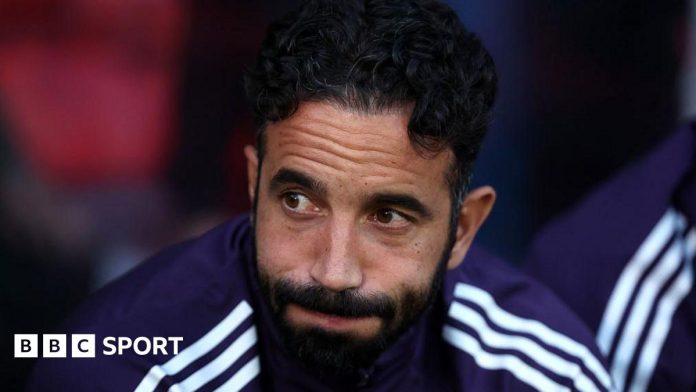
Manchester United tactics: Why Ruben Amorim’s gameplan isn’t working

0


What we have established is Amorim plays a positional style of football that looks to better opponents through overloads rather than individuals beating their man.

The way they look to do this is through specific passing routines.

United build with three at the back. These defenders look to play a straight pass into the feet of attackers, who look to lay it off to a team-mate – often a central midfielder – who then looks for a through ball over the top.

In the coaching world, this is sometimes referred to as an ‘up-back-through’, referencing the pass up the pitch, the pass backwards, then the through ball.

The reason for the direct pass up to the attacker is to entice the opposition centre-back to follow the attacker, which could open up space for a United player to run into. The player in behind could then play a cross for team-mates arriving in the box.

United captain Bruno Fernandes has been criticised for playing long passes rather than taking more touches, but it is likely this is under instruction, with Amorim wanting to free either the attacker or wing-back running in behind.

With these schemes based on playing with fewer touches, players who have a tendency to take more – or play centrally – such as Mainoo, are less natural fits.

Macron: Putin 'played' Trump if no Zelensky meeting commitment by Monday

0


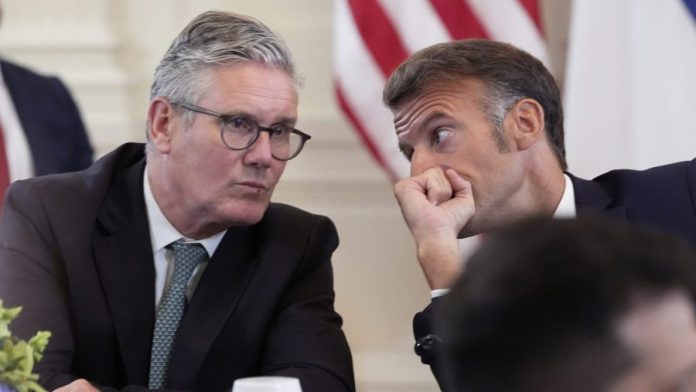
French President Emmanuel Macron issued a reminder Friday of President Trump’s deadline for Russian President Vladimir Putin to agree to meet Ukrainian President Volodymyr Zelensky.

“If that doesn’t happen by Monday, the deadline set by President Trump, it means that once again President Putin played President Trump,” Macron said Friday during a joint press conference with German Chancellor Friedrich Merz. 

Macron said he hopes the meeting between Zelensky and Putin, one that Russian officials so far have rejected, takes place, but added if it doesn’t, European leaders would push for primary and secondary sanctions to pressure the Kremlin to negotiate a peace deal. 

Merz, who, along with Macron, was one of the seven European leaders at the White House meeting with Trump and Zelensky last week, warned that the conflict in eastern Europe could continue for “many more” months. The German leader added that European countries will not “abandon” Kyiv but said Putin is not showing proof he is ready to meet with Zelensky, despite Trump’s demands for the bilateral talks.

Last Friday, while speaking with reporters at the White House, Trump said he expects to make a move in two weeks if a direct meeting between Zelensky and Putin is not set.

“We’re going to see whether or not they have a meeting, It’ll be interesting to see. If they don’t, why didn’t they have a meeting, because I told them to have a meeting,” the president said. “But I’ll know what I am going to do in two weeks.”

Zelensky on Friday also noted a previous statement by Trump that he would give Putin a week or two to agree on a meeting before possibly imposing penalties on Russia.

“Two weeks will be on Monday. And we will remind everybody,” Zelensky said.

So far, Russia has slow-walked Washington’s effort to broker a peace deal to end the 3 1/2 year war in eastern Europe. Ukraine has balked at making territorial concessions but says it’s ready for Zelensky to meet with Putin as it also negotiates postwar security guarantees with the U.S. and Europe.

Russian officials have questioned Zelensky’s legitimacy, and Moscow’s military has continued to pound Kyiv and other Ukrainian cities with drones and missile assaults. 

When asked Friday about Macron’s comments, White House deputy chief of staff Stephen Miller called the question “absurd” and added that the president has “achieved seven peace deals in seven months.” 

“Literally no president, not just in our lifetimes, but then I can think of an American history and no world leader anywhere today, anywhere on Earth has done more to advance world peace than President Trump,” Miller told reporters. 

Miller echoed Trump’s claim that the Russia-Ukraine war is “Biden’s war” and emphasized that Trump is working “steadfastly to end the killing, and that’s something that everybody in the world should celebrate.” 

Trump’s special envoy Steve Witkoff met with Zelensky’s chief of staff Andriy Yermak and Ukraine’s Deputy Foreign Minister Serhii Kyslytsia in New York City on Friday, where they discussed Russia’s continued bombardment of Ukraine. 

Yermak said he invited Witkoff, who has met with Putin five times this year, to visit Ukraine “in the near future.” 

“Ukraine supports President Trump’s firm resolve, as well as that of all partners, to achieve a lasting peace as soon as possible. Ukraine welcomes all peace initiatives put forward by the United States. But unfortunately, each of them is being stalled by Russia,” Yermak said on social platform X after the meeting. 

Yermak called for “global pressure” to “ensure Russia is genuinely ready to move toward peace and, in particular, to hold critically important leaders’ meetings for that purpose.” 

FDA Accepts a New Drug Application From Rhythm Pharmaceuticals (RYTM)

0


Rhythm Pharmaceuticals, Inc. (NASDAQ:RYTM) is one of the Best Mid Cap Growth Stocks to Buy According to Hedge Funds. On August 20, Rhythm Pharmaceuticals, Inc. (NASDAQ:RYTM) announced that the FDA had accepted its supplemental New Drug Application for setmelanotide to treat acquired hypothalamic obesity. Wall Street has shown bullish sentiment regarding the announcement.

Later on the same day, Michael Ulz from Morgan Stanley reiterated a Buy rating on Rhythm Pharmaceuticals, Inc. (NASDAQ:RYTM) with a price target of $109. He noted that the application targets acquired hypothalamic obesity and has been granted Priority Review. This shows a strong need for new treatments in this area.

FDA Accepts a New Drug Application From Rhythm Pharmaceuticals (RYTM)

Moreover, the analyst highlighted that the Phase 3 data from the TRANSCEND study were positive and showed significant reductions in BMI and a good safety profile. Management has noted that the European Medicines Agency is also reviewing the drug, which could lead to approval in Europe.

Rhythm Pharmaceuticals, Inc. (NASDAQ:RYTM) is a biopharmaceutical company developing precision medicines for rare genetic obesity disorders.

While we acknowledge the potential of RYTM as an investment, we believe certain AI stocks offer greater upside potential and carry less downside risk. If you’re looking for an extremely undervalued AI stock that also stands to benefit significantly from Trump-era tariffs and the onshoring trend, see our free report on the best short-term AI stock.

READ NEXT: 30 Stocks That Should Double in 3 Years and 11 Hidden AI Stocks to Buy Right Now.

Disclosure: None. This article is originally published at Insider Monkey.

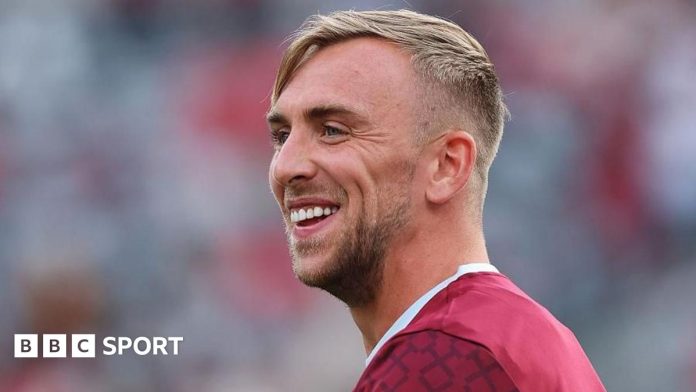
The Football Interview: Jarrod Bowen in his own words

0


Kelly: Has there been a turning point? It’s not been a straightforward linear journey. Your journey has been different to most footballers – from Hereford, Hull, then to the Premier League, winning a European trophy and with England. Is there one moment you can pinpoint that you think, actually, that’s where it all changed?

Jarrod: Probably when I got rejected from Cardiff before I went to Hereford because I went on trial to Cardiff for about six weeks and at the time I thought ‘Right my local team Hereford’s not got anything for me to have that path.’ I’ve gone to Cardiff, thought ‘I’ve done really well for six weeks and they’ve said no as well’. So I was kind of like ‘This is it now then… it’s not going to be.’

But then I think that rejection from Cardiff and then Hereford and then starting back up just made me appreciate it so much more. In the end I was just enjoying playing football because I didn’t know what was going to happen. I didn’t know if it was just going to end and I was playing at Hereford and I thought ‘It can’t get much better than this.’ I was happy with that. Then a few things happened.

I moved to Hull at 17, which was a big lifestyle difference. Three and a half hours away from home was absolutely horrendous but those things have all helped me off the pitch and then it helps you on the pitch as well. But I think if you can mature as a person off the pitch, it helps you.

So, a few things have happened, but I’d say that Cardiff rejection… I thought ‘This was the end, so let me be appreciative of playing when I can.’

Kelly: You’ve played in some huge matches already in your career. Which match, if you could relive one, would you play again?

Jarrod: I think one that sticks with me the most was probably the Europa Conference League final. I had never been involved in any sort of final before. Coming out, getting to the stadium a couple of hours before, going out to look at the pitch as you do, and it was packed.

That feeling of the final whistle going and you’re on the pitch… there’s a replay on YouTube that me and my dad watched the other day of the whole game… after the game ended I think the camera went to me and I had the biggest smile on my face, dropped to my knees and it was just like, the feeling of that, what it meant for us as a group, what it meant for the fans as well. I think that was such a great day.

Kelly: Did you say you and your dad were watching the whole game back recently?

Jarrod: Yeah.

Kelly: That shows you how much it means.

Jarrod: Yeah, he always watches it. He’s into rowing and canoeing, so he’s got a rowing machine and he’ll send me a picture of an hour and 29 minutes and it’s just the whole game. I’ve never watched it before. You knew how it’s going to go but I was still watching a little bit nervous and I’m thinking, ‘I know how the game goes, why am I so nervous?’ I can’t really remember the game fully. It’s been two years now, so to watch it from like two years on in a different way was a weird feeling but I loved watching it.

Kelly: Let’s talk a bit more about Jarrod Bowen the person. You’ve mentioned your dad multiple times already, so let’s start there and family and what it was like in the Bowen household growing up. Take me into a typical day.

Jarrod: Probably a similar upbringing to what most people have. I have a younger brother and sister, so I was the eldest child. They always said I was the favourite child because I was the first born – that’s still a thing. But I loved playing football. A very sporty family. My dad played rugby and football as well. My mum worked at the school that we grew up at. She still works there and that was kind of our life really.

Kelly: You must be the poster boy if your mum’s at the school. You must be like a local hero.

Jarrod: Like I said, my mum, when she comes down, she brings this whole box of things. She says “someone just asked me if…” and she’s the nicest woman in the world, so she will never say no to anyone, so she comes down with this box of stuff and I’ll sign it for everyone. It might be for a raffle or something like that. I’ve grown up in that area, still know pretty much everyone in that area, been to that school, so for them to want my things as well I think it means a lot to me for people to want to put me on the walls and want my signature.

Kelly: I want to know a bit more about your dad. He was an ex-footballer, and he played semi-professional. Is that correct?

Jarrod: He played for Conference-level Forest Green, Worcester… those sorts of teams… Hereford for a couple of years.

Kelly: Is it correct that you still follow his pre-season training routine that he does with you?

Jarrod: Yeah, well… this summer was the first time where I didn’t get called up for England, so I had a five/six-week period. I went home for three weeks I think it was, and we were training on the famous potato fields every single day, so I had a full pre-season with him. This season, my brother was doing it with me, my sister was doing it with me, even Dani [Jarrod’s wife] came out a few times and did it.

Kelly: Was she doing it as well?

Jarrod: Yeah, if you looked at it you would’ve thought, ‘What the hell is going on with this group of people?’ My dad was the kind of instructor, so to speak. It was like his boot camp, we called it, but it was just us running around this potato field and I thought ‘If anyone sees us, they’re going to think what is this? What are this group of four people doing?’ But we did it and it’s something I’ve done throughout my career, so I wanted to do it, and we did it.

Kelly: Does he come to West Ham games? Does he travel?

Jarrod: As much as he can, yeah.

Kelly: It’s far.

Jarrod: Yeah, it’s far, but he tries to come to as many games. He’s already thinking about the Sunderland game. He’s going to drive his camper van.

Kelly: I’m glad you’ve brought the camper van up because I wanted to talk to you about that. That camper van went to the Euros, didn’t it?

Jarrod: Yeah, the camper van went to the Euros! That was him, my brother, my two best mates. They all had a go at driving it. My two best mates were awful at driving it! I think they nearly wrote the camper van off, driving on the different side.


Mueller won't testify in House Epstein probe due to health issues: Report

0


Former FBI Director Robert Mueller will reportedly no longer appear before the House Oversight Committee due to health issues after House Oversight Chair James Comer (R-Ky.) requested his presence to provide testimony on convicted sex offender Jeffrey Epstein’s criminal activity, according to a recent report.

“The committee intends to withdraw its subpoena,” a source told Fox News Digital.

The Hill has contacted the House GOP Oversight Committee for comment.

Mueller was set to testify on Sept. 2 in a House probe that subpoenaed former President Clinton and former Secretary of State Hillary Clinton to provide information on Epstein’s whereabouts and inner circle.

During Mueller’s tenure at the FBI, a 60-count indictment was drafted for Epstein in 2007, but the next year, he pled guilty in Florida state court to two prostitution offenses, therefore receiving immunity from federal prosecution through a non-prosecution agreement.

Comer signaled that the former FBI director’s closed-door deposition would help uncover background on the deceased financier’s ability to evade federal charges.

“While the Department undertakes efforts to uncover and publicly disclose additional information related to Mr. Epstein and Ms. Maxwell’s cases, it is imperative that Congress conduct oversight of the federal government’s enforcement of sex trafficking laws generally and specifically its handling of the investigation and prosecution of Mr. Epstein and Ms. Maxwell,” Comer wrote in his letter to Mueller requesting his testimony. 

“The Committee may use the results of this investigation to inform legislative solutions to improve federal efforts to combat sex trafficking and reform the use of non-prosecution agreements and/or plea agreements in sex-crime investigations. Because you were FBI Director during the time when Mr. Epstein was under investigation by the FBI, the Committee believes that you possess knowledge and information relevant to its investigation,” he added.

Public interest has caused the private agreement to resurface as lawmakers search to hold Epstein’s former clients accountable. 

The Trump administration has pushed to unseal grand jury testimony and additional materials tied to the criminal proceedings for further transparency on the topic. 

Both President Trump and former President Clinton have faced criticism over their relationships with Epstein.

Stocks decline with tech shares; dollar weakens as Fed rate cut in view

0


By Caroline Valetkevitch

NEW YORK (Reuters) -Major stock indexes fell on Friday, with technology shares including Dell Technologies leading declines, while the dollar weakened against the euro after U.S. inflation data kept alive expectations of a September interest rate cut.

Dell dropped 8.9% after it reported results late Thursday that included high manufacturing costs for artificial intelligence-optimized servers. Other AI-related shares fell in the broader tech selloff including Nvidia, down 3.3%, and Broadcom, down 3.6%. The Nasdaq fell more than 1% and the S&P 500 technology index fell 1.6%.

The U.S. Commerce Department said on Friday its Personal Consumption Expenditures Price Index (PCE) rose 0.2% in July, versus an unrevised 0.3% increase in June and matching the estimate of economists polled by Reuters.

In the 12 months through July, PCE inflation increased 2.6% after climbing 2.6% in June. Stripping out the volatile food and energy components, the so-called core PCE Price Index increased 0.3% last month. That followed a 0.3% rise in core inflation in June.

“You have to love it when a plan comes together. Today’s numbers on both the personal consumption, expenditure, and income, and spending, were right down the middle of the fairway,” Art Hogan, chief markets strategist for B. Riley Wealth in Boston, said via email.

“This leaves the door wide open for the Fed to cut rates in September and likely again in October and in December.”

Traders are now pricing in 89% odds of a cut by the Federal Reserve next month, up from 84% before the data.

Traders had increased bets on more cuts after Fed Chair Jerome Powell last Friday adopted an unexpectedly dovish tone.

The euro was last up 0.11% at $1.1696. The dollar index, which measures the greenback against a basket of currencies, fell 0.09% to 97.79.

The Dow Jones Industrial Average fell 92.02 points, or 0.20%, to 45,544.88, the S&P 500 fell 41.60 points, or 0.64%, to 6,460.26 and the Nasdaq Composite fell 249.61 points, or 1.15%, to 21,455.55.

“Today is just weakness in the top of the market, in tech,” said Zachary Hill, head of portfolio management at Horizon Investments in Charlotte, North Carolina.

For the month, the S&P 500 rose 1.9%, the Dow rose 3.2% and the Nasdaq added 1.6%.

Major U.S. financial markets will be closed for the Labor Day holiday on Monday.

European shares closed lower, hitting their lowest in over two weeks, weighed down by British banks. Data released on Friday also showed French consumer prices rose slightly less than anticipated in August while Spain’s European Union-harmonized 12-month inflation rate was steady at 2.7%.

Edinburgh’s MacLean brothers set new record for Pacific row

0


Steven McKenzieBBC Scotland News

The MacLean Brothers Three happy, bearded, barechested men in a boat wave flares and play bagpipes as they come into harbour on a sunny day.  The MacLean Brothers

The brothers celebrated their arrival in Cairns with flares

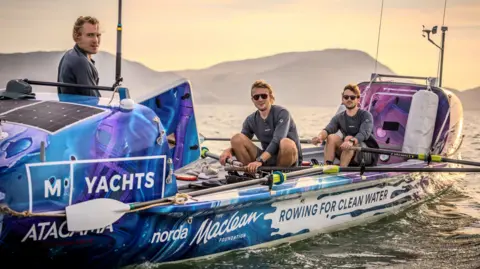
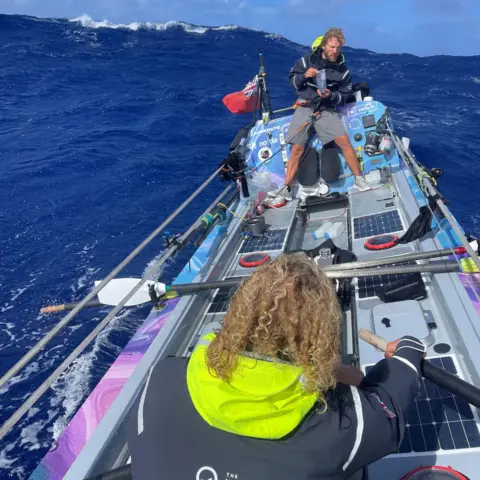
Three brothers from Edinburgh have claimed a new record for rowing non-stop and unsupported across the Pacific Ocean after 140 days at sea.

Jamie, Ewan and Lachlan MacLean endured violent tropical storms, which forced them into making lengthy detours on their 9,000-mile (14,484km) journey from Peru to Australia.

During one storm, Lachlan was swept overboard by a large wave before being pulled back into the boat.

The brothers, who have been reunited with their family and friends in Cairns, in eastern Australia, said they were looking forward to pizza – and a decent night’s sleep.

The MacLean brothers The brothers are in their boat Rose Emily, named after the sister they never knew, as their parents lost her during pregnancy. The boat is coloured blue and white and also has a purple tartan design. The boat is on the sea and there are hills in the distance.The MacLean brothers

The brothers started their challenge four and a half months ago

High winds

The Scots have beaten the previous record of 162 days for the fastest full, unassisted, non-stop Pacific row, set by Russian solo rower Fyodor Konyukhov in 2014.

The MacLeans completed their row in their boat, Rose Emily, named in memory of their unborn sister.

The brothers, who have so far raised more than £700,000 of a £1m target for clean water projects in Madagascar, had hoped to complete their journey in an even quicker time.

“We left just with a dream to get across this ocean and raise as much money as we can… and it’s just been absolutely insane, all of the support,” Ewan said in an Instagram post that was published as their boat approached Cairns.

But bad weather hampered the final stretch of their journey, including high winds overnight on Thursday and Friday.

Watch: Lachlan MacLean talks about the challenges of rowing the Pacific Ocean

Lachlan, speaking to BBC Scotland News on Thursday, said: “The main thing on all our minds, aside from seeing family and our girlfriends, is a freshly made bed with fresh linen sheets – and a shower.”

He said the row had been going relatively smoothly before the conditions became more challenging about half way across the ocean.

Lachlan said: “Up until then we had pretty consistent wind and weather.

“Then we had an anti-cyclone we couldn’t avoid.”

During the 36-hour storm in July, Lachlan was washed overboard.

The 27-year-old said he was lucky to be attached to the boat by a safety line during 40mph (64km/h) winds and 6m (20ft) waves.

He was dragged along behind the craft before Ewan, 33, was able to help him to scramble back on board.

Later, a cyclone forced the brothers to abandon a plan to land in Brisbane and they were forced to take a detour around the remote New Caledonia archipelago to avoid the storm.

The MacLean brothers Lachlan has blonde wavy hair and a short beard. He is wearing a grey t-shirt and has the sea behind him.The MacLean brothers

Lachlan survived being swept overboard during a storm

To complete the row unsupported, they could not land on an island to resupply, or accept help from any passing boats.

The brothers had to bring with them all their food – 500kg of freeze-dried food and 75kg of oats.

They had enough provisions to last 150 days, but Lachlan said they started rationing their supplies in the final few weeks just in case of further delays in reaching Australia.

Lachlan said: “We still had a reserve of military rations, but we didn’t want to tuck into them.

“They were there for an emergency, and they also don’t taste very good.”

He said the “final resort” if they ran out of all their supplies was a fishing rod they had brought with them to catch their own food.

The MacLean brothers Two of the brothers are in the small boat while at sea. The MacLean brothers

The brothers managed snatches of rest between long shifts at the oars

Morale was a key concern for the rowers, with sleep deprivation one of the biggest challenges.

The brothers, who completed a record-breaking rowed across the Atlantic in 2020, tried to get at least five or six hours of sleep in blocks of up to three hours around long shifts at the oars.

Sharing a chocolate bar, or making each other a coffee, helped to raise their spirits.

Lachlan said: “Our super power is being brothers.

“You can be totally frank with each other and we obviously have so much shared history, and that maybe means you are less likely to fall out.”

He said their primary motivation was the fundraising, and Lachlan thanked those who had donated.

He said: “We’re absolutely blown away by how it has gone.”

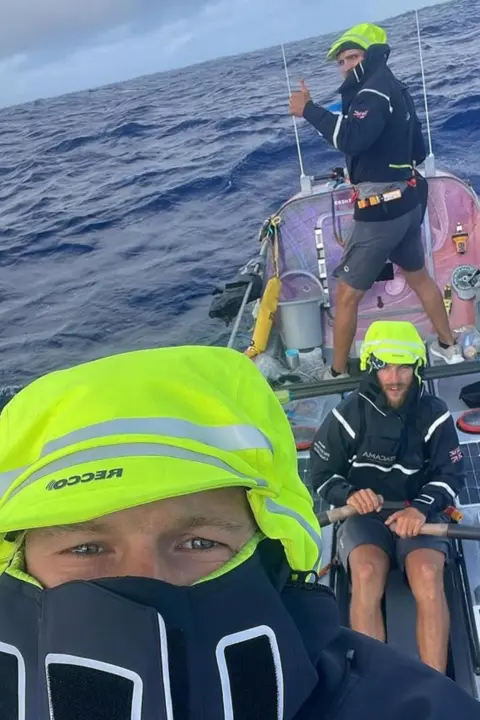
The MacLean brothers The three brothers are in the boat in rough sea conditions. They have shorts on but are wearing jackets with the hoods up.The MacLean brothers

The brothers said they were looking forward to fresh food and a good sleep

While looking forward to fresh food and a comfy bed, Lachlan said he would miss nights under star-filled skies and close encounters with whales, dolphins and sea birds.

Jamie, 32, described the adventure as “the most incredible, relentless and often surreal” of his life.

He said: “While I might miss the routine, the solitude, the sunsets, and sunrises and so much more, right now I’m just very glad to be back on land with my friends and family who I’ve missed so much.

“The whole thing will take a while to sink in.”

He added: “This won’t surprise anybody – but all I want is a pizza.

“Things got tough towards the end and we seriously thought we might run out of food.

“Despite how exhausted we were, we had to step up a gear and make it before supplies ran out, but now we get to eat proper food.

Ewan added: “The days have been long and yet the weeks have flown past, it’s strange to think of the time that we’ve spent out here.

“This has been the hardest thing I’ve ever done, and I couldn’t have even contemplated it without my brothers.”

RFK Jr. has never been briefed by CDC experts on measles, COVID-19 or flu, former official says

0


Dr. Demetre Daskalakis, the former head of the National Center for Immunization and Respiratory Diseases at the Centers for Disease Control and Prevention (CDC), on Thursday said Health and Human Services (HHS) Secretary Robert F. Kennedy Jr. has not been briefed by agency experts on measles, COVID-19 and the flu.

“No one from my center has ever briefed him on any of those topics,” Daskalakis told Kaitlan Collins during a Thursday evening appearance on CNN’s “The Source.”

“Perhaps he has alternate experts that he may trust more than the experts at CDC that the rest of the world regards as the best scientists in the areas,” he added.

The Hill has contacted HHS for comment.

Daskalakis resigned from his post on Wednesday following the Trump administration’s dismissal of CDC Director Susan Monarez, whom the White House said did not “align” with the president’s agenda.

He, alongside several other officials, decried new agency policies citing decision making based on a lack of scientific evidence, but rather a political agenda.

The former CDC official said Kennedy is receiving information from “somewhere,” but he has not come to CDC experts for advice on various infectious diseases, despite a recent measles outbreak that infected hundreds in states across the country.

“He’s getting information from somewhere, but that information is not coming from CDC experts who really are the world’s experts in this area […] and he’s not taking us up on several offers to brief him on these very important topics,” Daskalakis said.

His claims echo those included in his resignation letter, in which he wrote: “We are seven months into the new administration, and no CDC subject matter expert from my Center has ever briefed the Secretary. I am not sure who the Secretary is listening to, but it is quite certainly not to us.”

Kennedy was widely known as a vaccine critic prior to his Senate confirmation hearing, stirring controversy surrounding his fitness to serve at the helm of a department dedicated to ensuring public health. 

In recent months, the secretary has fired members of a committee dedicated to providing CDC officials with recommendations to improve standing immunizations and replaced them with individuals who promote anti-vaccine rhetoric.