
12.7 C
New York
Saturday, May 9, 2026
Home Blog Page 237

Newsom: 'I don't think Donald Trump wants another election'

0


California Gov. Gavin Newsom (D) on Wednesday said he doesn’t think President Trump doesn’t want another election in 2028 as he urged Americans to “wake up” to threats he said are posed by the administration. 

“I don’t think Donald Trump wants another election,” Newsom said at Politico’s “The California Agenda” summit in Sacramento. “I have two dozen ‘Trump 2028’ hats his folks keep sending me.” 

Trump, who is serving his second term, can’t run for another term under constitutional limits for the presidency. But he’s repeatedly floated the possibility – saying at one point that he was “not joking” about the prospect, though Republicans have interpreted it that way. 

Earlier this month, Trump chuckled as he said he would “probably not” seek a prohibited third term. 

“I’d like to run. I have the best poll numbers I’ve ever had,” Trump added on CNBC’s Squawk Box.

Later that same day, though, Trump acknowledged that Vice President Vance is “most likely” the heir apparent to the party in 2028, despite saying it’s “too early to talk about it.” 

The Trump Organization started selling “Trump 2028” hats on its website this spring. 

Newsom, who has repeatedly raised concerns about threats to democracy under Trump, said on Wednesday that he doesn’t think the 2028 comments are in jest. 

“People actually think this guy’s serious about having another election? You think he’s joking about 2028? You think when he brings foreign leaders to the Oval Office, and he goes to the White House store – have you seen this? Anyone? Is it just me? – and he shows ’em the 2028 hats? He’s not being serious? Wake up. You will lose your country.”

The governor pointed to Trump’s plans to build a massive ballroom on the White House campus, asking, “Who spends $200M on a ballroom and moves out of their house?”

Newsom, who himself is serving his second term as governor and cannot run for a third, has long been considered a top 2028 contender for the Democrats. A Morning Consult survey this week found Newsom’s hypothetical 2028 primary support had climbed 8 points since June, the only prospective Democrat who made “significant” gains in the poll.

Newsom clashed publicly with the Trump administration over immigration protests in California earlier this year, and has drawn the president’s ire over a just-passed plan to redraw the Golden State’s congressional lines in response to Trump-backed redistricting in Texas. Trump has promised a lawsuit against California to stop the plan.

And as the redistricting fight revved up in recent weeks, Newsom took to trolling Trump on social media, sending out social media posts from his office in a style mocking that of the president’s Truth Social missives.

He told the Politico summit crowd on Wednesday that he has a “kill switch” for posts, but that he vetoes “less every day.”

“I’m on the other side of giving a damn about people’s feelings about this moment. I will express myself more clearly and more concisely, because I see the threats in very vivid terms, in ways I never saw before,” Newsom said.

Analysis-Canadian Pacific joins Buffett in rejecting railroad consolidation, narrowing merger prospects

0


By Sabrina Valle

NEW YORK (Reuters) -Two major rail operators have taken themselves out of the merger game that has gripped the industry for the past month, reshaping the competitive landscape and raising the regulatory stakes for Union Pacific’s proposed $85 billion tie-up with Norfolk Southern .

Canadian Pacific Kansas City joined Warren Buffett’s BNSF Railway BNSF Railway on Tuesday in publicly rejecting participation in any near-term rail industry consolidation.

The move makes it less likely that a proposed $85 billion merger last month between top U.S. railroad operator Union Pacific and Norfolk would lead to more corporate marriages.

The merger would create the first east-west U.S. railroad operator, reshaping the movement of goods ranging from grains to autos across the country. The news raised concerns about market concentration and prompted heated speculation that rivals would need to join forces to remain competitive.

REGIONAL DUOPOLY

The U.S. rail industry has already undergone significant consolidation in recent decades, shrinking from dozens of carriers to six major class I railroads.

The U.S. freight rail industry is dominated by four top U.S.-based carriers – two in the west and two in the east. That means shippers have only two carrier options considering the point of origin.

Top railroad operator Union Pacific, which primarily operates in the west, proposed to join Norfolk, which has a strong foothold in the east. Initially, this prompted speculation that the other two U.S.-based railroad operators – BNSF Railway in the west and CSX in the east – could merge to stay competitive against a coast-to-coast giant.

That game has changed in the past days. First, Buffett-backed BNSF dropped out.

Two large Canadian railroad companies also operate in the United States. Canadian Pacific, the only one with a tri-national network, would be the next viable candidate to merge with CSX. But Tuesday’s announcement left CSX without a viable partner for a large merger.

HIGHER REGULATORY RISKS

The reduced chances of a consolidation wave raises the regulatory risks for Union Pacific’s attempt to buy Norfolk and go coast-to-coast.

If this was the only deal under review by the U.S. Surface Transportation Board, regulators would have greater concerns because a single large operator could muscle out smaller regional operators.

Expectations were different last month. When Union Pacific and Norfolk Southern disclosed they were in talks last month, board officials were gearing up to review two megamerger proposals, a person close to the discussions previously told Reuters.

Ohtani takes big leap, earns first win of season for Dodgers

0


LOS ANGELES — Shohei Ohtani‘s 87th pitch on Wednesday, a slider, induced a harmless groundout that also triggered a milestone. With it, the Los Angeles Dodgers‘ two-way superstar completed five innings for the first time since coming back from a second repair of his ulnar collateral ligament, a sign that his prolonged pitching rehab had finally reached its conclusion.

Ohtani, though, had no time to appreciate the moment — it was his turn to hit.

Rather than make the rounds along the third-base dugout and take a rest on the bench, Ohtani hurriedly donned a batting helmet, strapped on some elbow and shin guards, grabbed his bat and readied himself to lead off the bottom of the fifth inning. By that point, he had already done most of the heavy lifting — by igniting a four-run rally, by holding the visiting Cincinnati Reds to one run and by setting the tone in his first Dodger win of the season.

“I’m excited for Shohei,” Dodgers manager Dave Roberts said after a 5-1, sweep-clinching victory. “You know, he was one hitter away from not getting a chance to get a win because of the pitch count, so I think it was good for him to get that win.”

For now, at least, the Dodgers are essentially treating five innings — and thus, somewhere in the neighborhood of 90 pitches — as Ohtani’s limit this season. Ohtani called reaching that threshold “really key in terms of moving forward,” but the way he got there was just as important.

After back-to-back starts in which he allowed a combined nine runs in 8⅓ innings against the last-place Colorado Rockies and Los Angeles Angels, Ohtani relied heavily on his breaking pitches while limiting the Reds to one run — on a solo homer by Noelvi Marte — and striking out a season-high nine batters. Ohtani had not thrown a single curveball until his eighth start of the season, on Aug. 6, then flashed only 11 of them over a stretch of three outings. On Wednesday, Ohtani uncorked 17 of them, four of which resulted in strikeouts.

After relying heavily on his four-seam fastball and sweeper early in his return, Ohtani was suddenly leaning on what might amount to his fifth-best pitch, a key in his quest to consistently pitch deep into games.

“We’d had a plan of kind of living away from the fastball as much as we had in the past couple starts,” Dodgers catcher Dalton Rushing said. “That doesn’t mean we weren’t going to throw it tonight, but we were very off-speed-heavy early on. That just opened up doors later with the fastball for the last two innings.”

Early in his return, Ohtani explained, the goal was to make sure his fastball velocity was where it needed to be. The sweeper functioned as an effective secondary weapon, helping him navigate shorter outings. Those two accounted for 81% of the pitches Ohtani threw when he faced the Reds in Cincinnati on July 30, a start that was interrupted by leg cramps. About a month later, Ohtani threw only 35% sweepers and fastballs. The other 65% was absorbed by splitters, sinkers, cutters, sliders and, mostly, curveballs.

“I think the great thing about Shohei is he can command, when he’s right, four or five pitches,” Roberts said. “When you’re trying to go through a lineup three times, you’ve got to at times be able to go to different pitches and sequences. To continue to build him up and give us options if we want to get a little bit more length out of him is certainly helpful, but this was a good marker, to get to 90 pitches through five innings.”

Ohtani threw seven different pitches in a scoreless first inning, ranging from 76 to 99 mph. He issued two walks and threw two wild pitches in the second, but got out of the inning unscathed by striking out Ke’Bryan Hayes on a 100 mph fastball and Matt McLain on an 89 mph sweeper. After Marte’s homer in the top of the third — on a first-pitch cutter down the middle — Ohtani retired eight consecutive batters to finish his outing.

In the middle of that, he led off the bottom of the fourth with a line drive single, accounting for the first baserunner allowed by Reds left-hander Nick Lodolo. Teoscar Hernandez, Andy Pages, Enrique Hernandez and Rushing, who came through after the Reds intentionally walked Miguel Rojas ahead of him, contributed their own singles, giving the Dodgers a lead they would not relinquish.

The Dodgers went on to win their fourth straight game, giving themselves a two-game lead on the San Diego Padres in the National League West, and seem to be trending upward. Their bullpen, ravaged by injury for most of the year, is finally starting to round back into form. Their offense will get two key pieces back in Max Muncy and Tommy Edman in the near future. And their rotation — consisting of Blake Snell, Yoshinobu Yamamoto, Tyler Glasnow, Clayton Kershaw, Emmet Sheehan and Ohtani — looks especially formidable.

“Just looking at our roster, I really like where we’re at in terms of our starting pitchers and bullpen,” Ohtani said through an interpreter. “I just want to make sure that I do my part as a starting pitcher to go deeper into games and help out the bullpen.”

Value of small packages sent from China to UK more than doubles

0


Tommy Lumby

Business data journalist

Getty Images A delivery man in a green t-shirt hands a brown cardboard box to a woman with brown hair, wearing a stripy  top. The delivery man is holding a phone up for the woman to sign for the package.Getty Images

The value of small parcels shipped from China to the UK under an import tax exemption more than doubled last year to £3bn, exclusive data obtained by the BBC shows.

Chinese e-commerce giants such as Shein and Temu are thought to be drivers of this increase as sales of cheap goods to online shoppers in the UK continue to rise.

The UK government is reviewing the rules that mean imports of small packages worth £135 or less currently avoid customs duties.

But UK business owners and industry groups say they want swifter action to protect High Street retailers from being undercut, and consumers from potentially faulty goods.

Low-value imports sent from China to the UK totalled around £3bn in 2024-25, according to HM Revenue & Customs (HMRC) figures obtained by the BBC via a Freedom of Information request.

That was well over twice the £1.3bn recorded during the previous financial year.

The value of these deliveries from China made up 51% of all the small parcels shipped to the UK from around the world last year. That is up from 35% in 2023-24.

Katerina Buchy, director of Sheffield-based giftware wholesaler Ancient Wisdom, said low-value imports were hitting her company’s business because it couldn’t compete with the prices on sites like Shein and Temu.

“It’s affecting our customers as well. They’re not ordering from us because they know their customers can get it cheaper online,” said Ms Buchy, who has worked at the firm since 2004.

“I think the government should not allow these companies to export such high quantities of products under these rules because it’s just ridiculous.

“I’d like to know how much they are losing in taxes. We pay taxes. We employ more than 100 people.”

Katerina Buchy Katerina Buchy, a woman with long dark hair, wearing a dark grey top and a necklace, looks at the camera. The words "Ancient Wisdom" are written on the wall behind her in block capitals, and below that there is a shelf with cosmetic products on it.  Katerina Buchy

Katerina Buchy said low-value imports were hitting her business and clients

Temu and Shein have become popular among UK consumers in recent years for selling affordable items including clothes, homeware, electronics and toys.

Founded in China but now headquartered in Singapore, Shein recorded soaring profits last year.

It has tried to get itself on the New York and London stock exchanges, but has yet to secure a listing on either.

Both companies were questioned by MPs earlier this year over labour standards linked to the making of products sold on their platforms.

Natalie Berg, retail analyst at NBK Retail, said it was no surprise that the increase in the value of small parcels from China had coincided with the expansion of companies like Shein and Temu.

“They’ve gone from niche newcomers to retail powerhouses in a very short period of time,” she said.

But she warned that the removal of the tax exemption could disproportionately hit lower-income consumers, and small firms who use it to import goods.

She added: “This is a loophole that needs to be plugged, but the government must ensure that any changes don’t ultimately harm consumers or small businesses.”

‘Significant and growing threat’

The Treasury announced a review of low-value imports in April following lobbying from major retailers including Next and Sainsbury’s, which argued the exemption enabled overseas companies to undercut them.

But the British Retail Consortium (BRC) has called on ministers to take action now.

Andrew Opie, the BRC’s director of food and sustainability, said low-value imports posed “a significant and growing threat” to investment in UK High Streets as retailers faced unfair competition.

He added that they also exposed consumers to “unregulated, potentially unsafe products” because they did not go through the same customs check process as other goods.

A spokesperson for Temu said the company aimed to have at least half of the sellers using its UK platform based in the country by the end of the year.

“This approach helps consumers access affordable products while giving UK businesses a low-cost channel to reach new customers and grow,” the spokesperson said.

A spokesperson for Shein said the firm’s “on-demand” business model allowed it to make savings that it could pass on to its customers.

They added: “Vendors are required to comply with Shein’s code of conduct and stringent safety standards.”

Treasury review ongoing

The US has already ended its so-called “de minimis” exemption on imports of low-cost goods from China, but the policy will now be applied to the rest of the world from Friday.

The previous rule had allowed goods valued at $800 (£596) or less to enter the country without paying any tariffs.

The European Union also recently announced plans to charge a €2 flat fee on small packages worth €150 (£129) or less entering the bloc.

While the value of small parcels arriving in the UK from China has soared, when it comes to the actual number of items entering the country, the picture is less clear.

HMRC said it only records the number of customs declarations used for goods worth £135 or less, and multiple items can be included under one declaration.

It recorded around 281,000 customs declarations for low-value imports dispatched from China in 2024-25 – about 12% of the total.

A Treasury spokesperson said Chancellor Rachel Reeves’ review of the customs treatment of low-value imports was ongoing and would be published “in due course”.

They added: “We are a pro-business government that is backing Britain’s High Streets by protecting and extending business rates relief that would have ended without our action, permanently lowering rates for retailers from next year, and capping corporation tax at the lowest level in the G7 to encourage investment and growth.”

Additional reporting by Kris Bramwell.

Trump: Soros, son should be charged under racketeering law

0


President Trump on Wednesday said that billionaire George Soros and his son should be charged under racketeering law for allegedly “supporting violent Protests, and much more.”

“George Soros, and his wonderful Radical Left son, should be charged with RICO because of their support of Violent Protests, and much more, all throughout the United States of America,” Trump said in a post on his Truth Social platform.

“We’re not going to allow these lunatics to rip apart America any more, never giving it so much as a chance to ‘BREATHE,’ and be FREE. Soros, and his group of psychopaths, have caused great damage to our Country! That includes his Crazy, West Coast friends. Be careful, we’re watching you! Thank you for your attention to this matter!” the president added.

Federal RICO law, an acronym for Racketeer Influenced and Corrupt Organization, is aimed at organized criminal activity and can be used to address multiple different crimes. The president did not provide any evidence against Soros or his son, nor did he cite specific incidents.

Trump did not specify in his post which son of Soros’s he was talking about. According to a New York Times report from June, there are five Soros children and four sons.

One of the sons, Alex Soros, is the chair of Open Society Foundations, which his father founded. The younger Soros is also married to Huma Abedin, a longtime aide of former Secretary of State Hillary Clinton.

The elder Soros has long been a target of the right, with Rep. Nancy Mace (R-S.C.) previously claiming that he has funded groups involved in pro-Palestinian protests on college campuses.

The Hill has reached out to the Open Society Foundations for comment.

Crude Prices Fall Sharply as Global Oil Supply Concerns Ease

0


October WTI crude oil (CLV25) on Tuesday closed down -1.55 (-2.39%), and October RBOB gasoline (RBV25) closed down -0.0370 (-1.86%).

Crude oil and gasoline prices retreated on Tuesday as global crude supply concerns eased after Russia said one of its largest refineries will soon restart after repairs were made following a Ukrainian drone attack.  Gasoline prices were also under pressure as supply concerns eased with the restart of the BP refinery in Whiting, Indiana, the largest inland refinery in the US.  The 115,000 bpd Pipestill unit, which had been shuttered since August 19 due to storms and flooding, has now resumed operations.

Tuesday’s weaker dollar and better-than-expected US economic news were supportive for crude prices.  July US capital goods new orders nondefense ex-aircraft and parts, a proxy for capital spending, rose +1.1% m/m, stronger than expectations of +0.2% m/m.  Also, the Conference Board US Aug consumer confidence index fell -1.3 to 97.4, stronger than expectations of 96.5.  In addition, the Aug Richmond Fed manufacturing survey rose +13 to a 5-month high of -7, stronger than expectations of -11.

Global crude supply concerns eased after Russia announced that its Volgograd refinery, which can process 300,000 bpd of crude oil, will resume operations a week earlier than planned, as repairs to the refinery were made following drone attacks by Ukraine.

Weakness in the crude crack spread is bearish for oil prices as the crack spread fell to a 2.25-month low on Tuesday.  The weaker spread discourages refiners from purchasing crude oil and refining it into gasoline and distillates.

An increase in crude oil held worldwide on tankers is bearish for oil prices.  Vortexa reported Monday that crude oil stored on tankers that have been stationary for at least seven days rose by +11% w/w to 96.77 million bbl in the week ended August 22.

Crude prices also have support on concern that the Russian-Ukrainian war will continue, which could keep restrictions on Russian crude exports in place, and even secondary restrictions could be added.  Russian Foreign Minister Lavrov said Sunday that there was no meeting planned between the leaders of Russia and Ukraine and that there “needs to be an agenda first” for a meeting to take place.  “This agenda is not ready at all.”

How Tokyo is using AI-generated video to prepare for a Mt Fuji eruption

0


Tokyo authorities have released an AI-generated video showing what could happen in a worst-case scenario if Mount Fuji erupted.

The BBC’s Tessa Wong explains how this could impact Japan’s capital city, and what experts say about the likelihood of an eruption.

Video by Kellie Highet

What we know about Minneapolis Catholic school shooting

0


A shooter took the life of at least two students and injured 17 other people in an attack Wednesday on a morning Mass at a Catholic school in southern Minneapolis, according to police. 

Police identified the suspect as 23-year-old Robin Westman, from suburban Minneapolis. Police said the shooter barricaded the church door during the shooting, then died by suicide by gunshot. The suspect was dressed in black and carrying a rifle, pistol and shotgun, officials said.

The children killed in the attack were 8 and 10 years old. At least four children remain in critical condition, according to the chief of emergency medicine at one of the three hospitals treating victims. The remaining victims are expected to survive, Minneapolis Police Chief Brian O’Hara said in a Wednesday afternoon update.

“Don’t just say this is about thoughts and prayers right now, these kids were literally praying,” Minneapolis Mayor Jacob Frey said during an afternoon press conference. “It was the first week of school. They were in a church.”

Here’s what we know about the incident at Annunciation Catholic School:

Some children remain in critical condition

The chief of emergency medicine at the Hennepin County Medical Center said 11 people had been admitted to the hospital after the shooting, including seven who were in critical condition. He said four required an operating room, all children.  

Of the 17 victims, 14 were children and three were older parishioners, according to O’Hara. All remaining victims are expected to survive.

Children’s Minnesota, a pediatric trauma hospital, said in a statement that six children were admitted for care.

Some victims were also brought to the M Health Fairview Masonic Children’s Hospital. 

School shooting suspect had a manifesto

The suspect had a manifesto that was timed to go live on YouTube around the time of the attack, O’Hara said.

The manifesto has since been taken down and is being reviewed by investigators. The suspected shooter also wrote incendiary messages on gun magazines, including one that read “Kill Donald Trump.” Images of the gun magazines appeared in the manifesto, which also included a lengthy written note.

Search warrants underway

Search warrants are being carried out at locations related to the Minneapolis school shooting, including the school itself and three residences tied to the shooter, police said Wednesday afternoon.

A rifle, shotgun and pistol were determined to have been used to perpetuate the attack and all three were lawfully purchased by the suspect. Additional firearms are being recovered from the residences, O’Hara noted.

Shooter opened fire in middle of morning Mass

The shooter initially opened fire through a window as children were in pews praying, before entering the church and firing all three firearms, O’Hara said. 

Sen. Amy Klobuchar (D-Minn.) said during an interview on MSNBC that her longtime employee has three children who attend the school. 

“These kids are doing an all-school Mass and had to watch several of her friends get shot — one in the back, one in the neck,” Klobuchar told the outlet. “And they all got down under the pews and she — her daughter, of course, was not shot — but her daughter ended up being the one to tell one of the dads of one of the other kids that his daughter had been shot.”

A man who lived two blocks from the school described hearing 30 to 50 shots fired over several minutes. 

“There was so much of it,” Bill Bienemann said, describing the shots as “sporadic.”

“It was so, it was semiautomatic, it seemed like a rifle. Certainly didn’t sound like handgun and so he must’ve reloaded you know several times for sure,” he said.

Many questions remain as investigation underway

Police officials say they are still unsure of the motive behind the crime, which O’Hara called “incomprehensible.”

The FBI is investigating the shooting as an act of domestic terrorism and a hate crime targeting Catholics, however, Director Kash Patel said.

Investigators said the said the suspect did not have a criminal history.

Court documents indicate the shooter was born male and previously named Robert but changed their name to Robin at 17 to reflect their female identity.

Agents with the Bureau of Alcohol, Tobacco, Firearms and Explosives (ATF) were some of the first responders to the scene and have started tracing protocol for the firearms used in the shooting. 

Patel said agents were on the scene soon after the incident.

Follows spate of shootings in Minneapolis 

The school shooting occurred within 24 hours of another mass shooting in Minneapolis around 1:30 p.m. Tuesday. 

One person was killed and six more were injured when a gunman fired dozens of shots at a group of people on a sidewalk across from Cristo Rey Jesuit High School, authorities said. 

The gunman in that attack used a high-velocity rifle, police said. 

“This level of firepower unleashed in broad daylight is completely sickening and unacceptable,” O’Hara said of that shooting. The suspect, as of Wednesday afternoon, is still being sought by police.

Two more people were killed in two separate shootings later in the day.

One of those incidents occurred about a mile from the first shooting, leaving a man in his 20s dead. 

At 2:10 a.m. on Wednesday, police said a gunman approached a group on the sidewalk and started shooting, killing one man and injuring another, according to CBS News.

It was unclear if the shootings were related, police said.  

The incident also comes just months after former state House Speaker Melissa Hortman (D) and her husband, Mark, were killed in a fatal shooting in the city.

Updated 9:22 p.m. EDT.

Brett Samuels contributed.

Access to this page has been denied.

0


Access to this page has been denied because we believe you are using automation tools to browse the
website.

This may happen as a result of the following:

  • Javascript is disabled or blocked by an extension (ad blockers for example)
  • Your browser does not support cookies

Please make sure that Javascript and cookies are enabled on your browser and that you are not blocking
them from loading.

Reference ID: #9adf12da-83cb-11f0-9501-04612ac8b8b4

record burning in Spain and Portugal

0


Erwan Rivault

Data Designer, BBC Verify

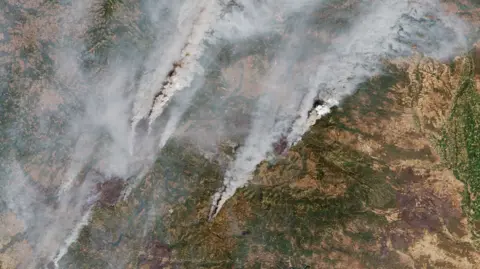
Copernicus Copernicus Sentinel-2 satellite image acquired on 16 August shows multiple fires in northern Spain.Copernicus

Unprecedented wildfires have scarred northern Spain in recent weeks

A record one million hectares – equivalent to about half the land area of Wales – have burned across the European Union so far this year, making it the worst wildfire season since records began in 2006.

Spain and Portugal have been hit especially hard, with roughly 1% of the entire Iberian Peninsula scorched, according to EU scientists.

The worsening fire season in the Mediterranean has been linked directly to climate change in a separate study by the World Weather Attribution group at Imperial College London.

Experts warn that more frequent and severe fires across Europe are likely to continue in the future.

More than two thirds of the area burned in the EU is in Spain and Portugal alone.

In Spain, more than 400,000 hectares have burned since the beginning of this year up until 26 August, according to the Copernicus European Forest Fire Information System (EFFIS).

This record is more than six times the Spanish average for this time period between 2006 and 2024.

Neighbouring Portugal has also suffered a record burn area of 270,000 hectares so far – almost five times the average for the same period.

The combined burn area across the Iberian peninsula this year is 684,000 hectares – four times the area of Greater London, and most of it burned in just two weeks.

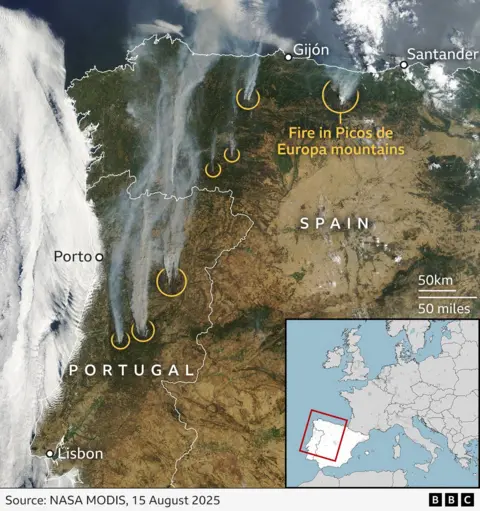
Fires have been concentrated in forested areas of northern Portugal and in Spain’s north-western regions of Galicia, Asturias and Castile and León.

Protected areas like Picos de Europa National Park have been impacted, as well as major routes on the Camino de Santiago pilgrimage network which usually attracts more than 100,000 visitors in the summer months.

The events have triggered the largest known deployment of the EU civil protection mechanism’s firefighting force.

Smoke from fires has dramatically decreased air quality in the area, with southerly wind sending smoke as far as France and the UK.

Satellite image acquired on 15 August 2025 shows smoke from multiple wildfires in Portugal and north-west Spain, including within the Picos de Europa mountains.

Climate change makes the conditions leading to wildfires more likely, but in a vicious cycle, the fires also release more planet-warming carbon dioxide gas (CO2) into our atmosphere.

CO2 released by fires in Spain this year has reached a record 17.68 million tonnes, according to the EU. This is more than any total annual CO2 emissions since 2003 from wildfires in that country, when data was first recorded by satellites.

For comparison, it is more than the total annual CO2 emitted by all of Croatia in 2023.

Firefighters have been battling blazes right across Europe this summer.

Climate change caused by humans made fire-prone conditions in Turkey, Greece and Cyprus about 10 times more likely, according to a rapid attribution study by World Weather Attribution group at Imperial College London.

It was responsible for a 22% increase in the extreme weather conditions behind the fires, said WWA.

It is causing more extreme heat, which dries out vegetation, increasing flammability, said Theodore Keeping, wildfire scientist at the centre for Environmental Policy, Imperial College London.

The continued burning of fossil fuels will lead to more of these extreme fires, the researchers warned.

“It was urgent 10 years ago to stop burning fossil fuels,” said Dr Fredi Otto, Professor in Climate Science at Imperial and leader of the WWA, describing it as “lethal for people and ecosystems”.

“Today, with 1.3C of warming [since pre-industrial times], we are seeing new extremes in wildfire behaviour that have pushed firefighters to their limit,” said Mr Keeping.

The scientists have begun a rapid analysis on the wildfires in Spain and Portugal and expect similar findings related to climate change.

Across Southern and Eastern Europe, rural depopulation is also contributing to the intense wildfires, Mr Keeping added.

In regions like Spain and Portugal, a rising number of young people are relocating to cities in search of more profitable employment. Once-managed agricultural land is being abandoned and becoming overgrown, eliminating fire breaks and increasing the amount of flammable vegetation vulnerable to intense blazes.

Fire-hardy ecosystems struggling to cope

Fires have always been an important component of Mediterranean ecosystems and much of the natural wildlife has co-evolved to exist alongside fire.

In fact, species like the Iberian hare benefit from the newly opened habitat and native cork oaks can quickly colonise burned land.

Management techniques such as prescribed burning and vegetation removal have long kept yearly fires in check.

And regrowth of burned vegetation have typically offset the carbon emissions from wildfire as carbon once again became stored in plants and soil.

However, modern wildfires are larger, more frequent and more severe. Where forested regions struggle to regrow before the next fire, they can become part of a climate feedback loop, according to Dr Thomas Smith, Associate Professor in Environmental Geography at the London School of Economics.

“A warming climate is driving more frequent and larger fires, which is in turn driving carbon emissions that remain in the atmosphere, which is leading to a warmer climate,” he explained.

The escalating risk from a hotter and drier climate makes fire management more difficult and poses a threat to long-term ecosystem stability.

There are also risks of accelerated soil erosion and water contamination from ashes washed into rivers and reservoirs, according to Professor Stefan Doerr, Director of the Centre for Wildlife Research at Swansea University.

Efforts to manage excess vegetation in fire-risk areas, as well as advances in preventing ignitions, fire detection and fire fighting could help reduce the number and severity fires in future.

Thin, green banner promoting the Future Earth newsletter with text saying, “The world’s biggest climate news in your inbox every week”. There is also a graphic of an iceberg overlaid with a green circular pattern.