There was no more perfect encapsulation of the Democratic Party’s crime problem than Joe Scarborough’s bruising interview with Chicago Mayor Brandon Johnson. “Morning Joe” is of late a more moderate voice among liberal commentators, and is using the platform to push the Democratic Party to move ever so slightly closer to the average voter’s views on some issues, like crime and policing.
Many polls show broad public support for President Trump’s efforts to reduce crime, which have included deploying federal troops to Washington, D.C. We should remain vigilant about increasing federalization of law enforcement, because we don’t want to live in a police state, but we also need to recognize the inarguable successes associate with such an approach. D.C. finally had a murder-free week, last week, thanks in part to the presence of the National Guard.
Trump thinks that what worked in D.C. could work elsewhere, and has suggested that other big cities beset with crime problems could benefit from an influx of federal troops and or resources. Chicago is one of those cities, but its far-left mayor is opposed to Trump’s plan.
When pressed on “Morning Joe” on whether the city should accept federal help, Johnson simply refused to directly answer the question, saying instead that he thought other things were more important than law enforcement.
And so Scarborough asked again. “Do you believe the streets of Chicago would be safer if you had all those other extraordinary programs put into place, which do have a history of being successful, if that’s complemented by having 5,000 more cops on the streets of Chicago?”
Johnson deflected once more: “I don’t believe that we should narrow that down to just police officers is what I’m saying. That’s an antiquated approach.”
After that second non-answer, Scarborough asked a third time, getting much the same response. “Look, we are working hard to make sure that our police department is fully supported,” Johnson said. “I don’t believe that just simply putting out an arbitrary number of police officers is the answer.”
The man either does not believe, or will not admit, that more police on the streets would deter crime — even though we know that it would.
Look, this aspect of crime isn’t complicated: If you have more police, you get less crime. Except for the most far-left scholars of criminology, experts — even those who support criminal justice reform — agree that when you have more members of law enforcement patrolling the streets, busting bad guys and clearing cases, you get less social disorder and not as many incidents of crime.
The question, though, is not really whether more police would help. It’s whether national police are a long-term solution — whether other trade-offs are worth considering, like civil liberties being undermined, and whether, frankly, there’s enough money to pull it off.
Chicago, for example, is facing significant budget constraints. Reason magazine’s Christian Britschgi notes that Johnson had to break a pledge not to raise taxes. In fact, he’s had to increase taxes on everything from digital streaming services to grocery bags to rideshare trips. He also tried to pass a $300 million property tax, but the city council killed it.
My point is, Chicago might want to think about whether it’s really going to say no to federal help. Getting our cities under control is expensive work.
Robby Soave is co-host of The Hill’s commentary show “Rising” and a senior editor for Reason Magazine. This column is an edited transcription of his daily commentary.
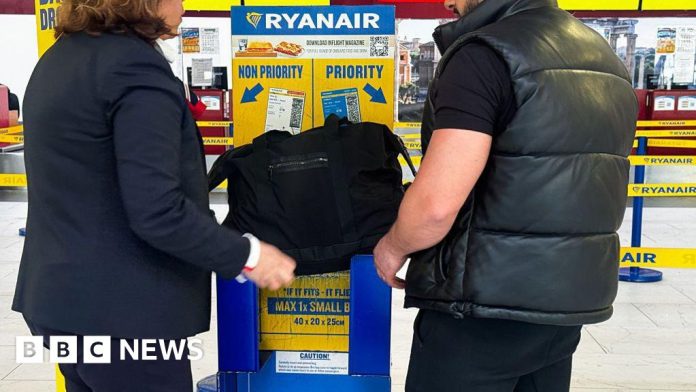
The bonus for Ryanair workers who intercept passengers with oversized cabin bags will rise from €1.50 to €2.50 per bag, the airline’s boss said.
Michael O’Leary told the BBC the change would come in this November, and that he made no apology for it.
Mr O’Leary said the bonus was meant to put off the small minority who brought cabin bags which were bigger than the size limit, insisting the airline was “not trying to catch people out”.
He added that if people “don’t comply with the rules and try to get on with an outsize bag, we will catch you and I would look forward to rewarding and bonusing our staff that pick out those oversize bags”.
Ryanair passengers are allowed a free bag to take on board, but can be charged up to £75 they try to bring a larger bag than allowed onto a flight, depending on the route and travel date.
The airline currently allows a small carry-on bag – with a size capped at 40cm x 20cm x 25cm and weight of 10kg – with every ticket.
However, this is set to increase to 40cm x 30cm x 20cm from September after a change in EU rules.
Mr O’Leary said about 200,000 passengers per year have to pay extra to put carry-on luggage in the hold, and that he did not feel sorry for “chancers” trying bring “rucksacks” aboard.
“We’re the airline with the lowest air fares in Europe,” he said. “Those are our rules. Please comply with the rules, as 99.9% of our 200 million passengers do, and you won’t have any problem.”
He said if people “comply with the bag rules then everyone will board faster” and there will be “fewer flight delays”.
In addition to increasing the bonus per bag, Ryanair is scrapping an €80 cap on how much staff can earn each month for catching people with bags that are too large.
The Ryanair chief executive also said he wanted “ground handlers to catch people who are scamming the system”.
Sustainable fuel ‘nonsense’
Mr O’Leary, who has previously voiced scepticism about sustainable aviation fuel (SAF), said there was “not a hope in hell” of the UK’s SAF mandate of 10% being met by 2030.
He said Ryanair would not be increasing how much SAF it used because supply “is not there”, and described SAF as “nonsense”.
The mandate starts in 2025 at 2% of total UK jet fuel demand, increasing to 10% in 2030 and then to 22% in 2040.
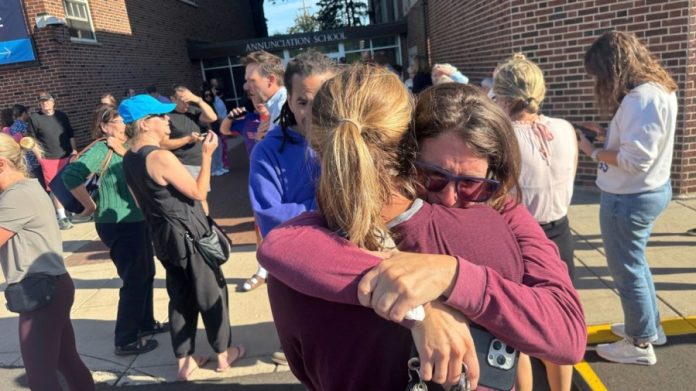
Two children were killed in the pews where they were worshipping on Wednesday by a shooter firing “cowardly” shooting at them during a back-to-school mass, Minneapolis Police Chief Brian O’Hara said at a press even outside Annunciation Catholic School.
O’Hara said the children killed with 8 years old and 10 years old. Both were killed while sitting in their pews for a worshipping service marking the first week of school.
The shooter, O’Hara said, was shooting from the outside of the church through the windows.
Seventeen others were injured in the shooting, including 14 children. O’Hara said two of the children were in critical condition.
The shooter shot himself and died, O’Hara said.
“The shear cruelty and cowardice of firing into a church of children is absolutely incomprehensible,” said O’Hara, who said the shooter was armed with a rifle and a pistol.
Authorities earlier had said a man dressed in all black and armed with a rifle was reported at the scene of the shooting. Emergency services has requested a mass casualty response. President Trump has been briefed on the shooting, and the FBI is also responding to the scene.
“I’m praying for our kids and teachers whose first week of school was marred by this horrific act of violence,” Minnesota Gov. Tim Walz wrote in a post on social media.
Minnesota’s senators also decried the shooting while offering thanks for first responders.
In other news, President Trump’s 50 percent tariff on imports from India went into effect Wednesday morning, weeks after he threatened “severe consequences” on trading partners that purchase Russian oil and gas.
The steep import tax comes as Trump continues to push Russia and Ukraine to come to a ceasefire agreement after meeting separately with the leaders of both nations earlier this month. The president, in his second term, has also soured on former ally Indian Prime Minister Narendra Modi.
The Trump administration also placed several employees of the Federal Emergency Management Agency on leave late Tuesday after they attached their name to a dissent letter against the agency’s policies earlier this week. More than 180 current and former staffers signed on to the letter, but the majority of those signing on did so anonymously.
The president also escalated his rhetoric around combating crime in the nation’s capital, telling reporters Tuesday that he would push for the death penalty in murder cases in D.C. and suggested early Wednesday he could work with Congress on a “comprehensive” crime bill.
Trump and Vice President Vance are expected to meet for lunch later Wednesday.
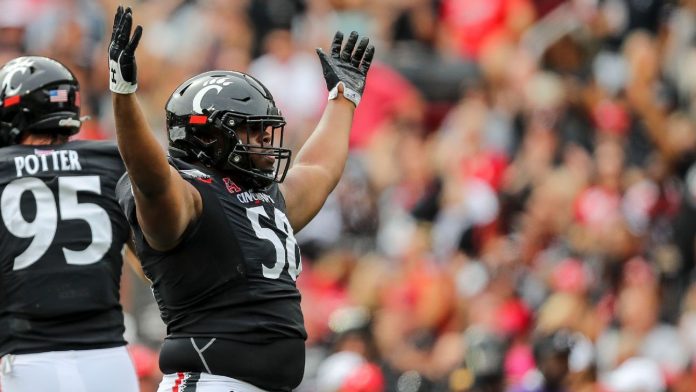
CINCINNATI — The burger is called “The Godfather,” named after Dontay Corleone, the West Cincinnati kid who blossomed into a star as one of the nation’s top defensive tackles for his hometown Cincinnati Bearcats in 2023. The way Tom Scott, owner of Bucketheads sports bar, saw it, partnering with a local star with a catchy nickname who, at 335 pounds, looked like someone who knew a good burger made for good business.
The deal was simple enough: Corleone would get $2 for each burger sold — a few dozen a week and a couple hundred during the bar’s famed “burger week” promotion. In exchange, he would make an occasional in-store appearance.
Corleone helped select the ingredients, too: A house burger topped with pulled pork, American cheese and a fried onion ring. The calorie count is, well …
“If you have to ask,” Scott said, “you don’t want to know.”
Two years after launching their partnership, with college football’s biggest stars routinely pulling in six or seven figure deals, the money Corleone earns from his burger seems like a relative pittance, Scott said. The thing is, Corleone has never complained, never asked for more and never turned down a chance to help out the business. The money was always a secondary part of the deal. For a player who prides himself on being true to his Cincinnati roots, Corleone takes care of his own.
“When I first got to college, my mom said I was here for three or four years, no transfer portal,” Corleone said. “I was never the guy to chase money. I was always loyalty over everything. I wanted that connection.”
So, when a doctor’s visit to address nagging back pain in summer 2024 turned into a potentially career-ending diagnosis of blood clots in his lung, it wasn’t just football Corleone feared losing. It was the connection to his city.
Instead, it has been the connection that endured, and it’s what carried him — through months of rehab and a season fighting his way back into game shape — and he has a new outlook on his career. As Corleone and the Bearcats kick off the 2025 season against Nebraska (9 p.m. ET on Thursday, ESPN), he no longer sees playing at Cincinnati as an act of loyalty — it’s a gift.
“Never take it for granted,” Corleone said. “That’s the thing I’m telling the young guys all the time now. Because it can all be taken away in an instant.”
CORLEONE LIKED TO play basketball to stay in good shape during the offseason, but last June, he noticed he couldn’t go more than a few trips up and down the court without being winded. He mentioned it to Cincinnati’s training staff, but he thought little of it.
A few days later, his back began to hurt. Aaron Himmler, Cincinnati’s senior associate athletic director for sports medicine, assumed Corleone had just tweaked a muscle.
A day after that, Corleone woke up in agony, struggling to breathe. This time, Himmler insisted on a trip to the campus medical center for a CAT scan.
“We just wanted to make sure nothing weird was going on,” Himmler said. “We figured we’d rule things out.”
Corleone was coming off a stellar 2023 campaign in which he had been among the nation’s most effective interior defensive linemen, racking up 11 pressures, 14 run stuffs and three sacks. He was a crucial part of the Bearcats plans in 2024, too, and Corleone assumed he would soon be off to the NFL.
Instead, the radiologist called Himmler back just a few hours after the scans with a grim diagnosis.
Corleone had a pulmonary embolism — blood clots in one of his lungs. Himmler’s heart sank. A few years earlier, another Cincinnati athlete was given the same diagnosis, and for them, it was career ending.
That was Corleone’s first thought, too.
“I thought it was all over with,” Corleone said.
Corleone was distraught. Himmler spent the next few days mostly by Corleone’s bedside, urging him not to think too far ahead. There were doctors who specialized in blood clots. Himmler had dealt with a few of them before. Medicine had gotten better, too. Himmler promised Cincinnati would “throw the full-court press” at the disease. There was hope, he promised.
But even Himmler wasn’t entirely certain.
“I’d be lying if I said that didn’t go through my mind [that it could be career ending],” he said. “I knew exactly how big that year was for him coming off all that success. That spotlight was getting really bright. It was a deflating moment.”
Himmler knew of specialists at the University of North Carolina, and he set a date to fly to Chapel Hill for more tests and a consultation with doctors there. But there would be a two-week wait before their visit.
That was Corleone’s low point. For 10 days, he barely left his apartment. Corleone’s mother, Resheda Myles, would call a few times a day to check on him, and if he didn’t answer, she would drive to his apartment and bang on the door until he opened it. She was among the few people he spoke to.
“He had high hopes of the NFL,” said coach Scott Satterfield. “The thought in his mind was he was never going to play football again. That’s devastating from a mental standpoint.”
That his career might be over was at the front of Corleone’s mind, but the weight of the loss was worsened because he felt certain he was letting down his family and friends in Cincinnati.
“I stayed [at UC] because the fan base is like a second family for me,” Corleone said. “But you also feel like the whole city’s riding on you. As an athlete, you always want to be like a superhero to people.”
Just before he was set to leave for Chapel Hill, Corleone donned a hoodie and made a trip to the grocery store down the road from his apartment. He kept the hood up and slouched his head, hoping he wouldn’t be noticed, but 335-pound defensive tackles tend to stand out.
He was walking into the store when a woman stopped him.
He froze. He knew what was coming next. Aren’t you Dontay Corleone? What’s the news on your health? What’s going to happen to the team without you?
Instead, she put her hand on his arm, looked him in the eye.
“How are you?” she asked. “Are you OK?”
He nearly burst into tears. That simple gesture was a reminder of why he was here. This city loved him as much as he loved it.
“There was this dark cloud over me, like — man, what are people going to think of me now,” he said. “I don’t think she could’ve understood how big that moment was for me.”
A few days later, on the flight back to Cincinnati, with a fresh perspective on his diagnosis and a blueprint from doctors on how to combat the blood clots, he turned to Himmler with a smile.
“I feel good about this,” he said. “I’m ready to go forward.”
DURING FALL CAMP last season, Corleone ran. While the rest of his teammates donned pads and worked through drills, Corleone ran. Not hitting, no contact, just running.
“That wasn’t getting me in [football] shape, so I knew the season would be different,” Corleone said. “I knew it would be hard. I knew it might not look good for scouts. But getting back on the field was what I needed. If I played one down, I’d cherish it forever.”
The medical team at Cincinnati had found a regiment of medicine that kept the blood clots at bay and workouts that would, gradually, get Corleone back onto the field, but it wasn’t until Week 2 of the season that he was officially cleared for contact. For a defensive tackle who makes his living delivering blows to multiple offensive linemen on each snap, that was a problem.
Corleone played 48 snaps in a loss to Pitt on Sept. 7 — less than three months after his diagnosis — and he was winded from the outset. Cincinnati dialed back his workload for the next two weeks, and by October, he started to feel something more like normal.
He ended 2024 with 26 tackles, 3.5 sacks and four QB hurries. Cincinnati ended on a five-game losing streak.
The season wasn’t what he had hoped, but he was back on the field, and that was worth celebrating, Corleone said.
Cincinnati also connected Corleone with former Tennessee offensive lineman Trey Smith, who had been a five-star recruit but nearly saw his career ended by a similar blood-clotting issue. Instead, Smith found medicine that allowed him to return to action, and he’s now entering his fifth season in the NFL.
The advice Smith offered: Stop trying to be a tough guy.
Suddenly it clicked for Corleone. His health issues weren’t something to hide from, but rather something to attack.
“The clouds went off, and there’s a big sun now where it just gave me a different approach,” Corleone said.
Corleone had often resisted working with trainers early in his career. He viewed injuries as a sign of weakness — something to play through, not treat. Now, he had a whole different appreciation for the Cincinnati training staff.
Each week, Himmler meets with members of the program’s mental health staff, dietitians, strength and conditioning coaches and sports medicine staff for what he calls a “performance team meeting,” going over the latest injury reports and scheming out game plans for players who needed extra attention. Corleone liked the idea, and so he asked to hold a separate meeting, just for him.
“Holistically, he’s leaving no boxes unchecked,” Himmler said. “I don’t know if I’ve ever seen somebody as motivated as he is right now.”
As much as the 2024 campaign felt like a lost season at times, Satterfield said he still turns on the film and watches in awe as Corleone eats up blockers.
“If you put one guy on him, he’s going straight to the backfield,” Satterfield said. “It happens every time.”
Still, Satterfield knows there’s more in the tank for his star defender. He’s a year removed from the lowest point of his career, armed with a new perspective, with more maturity.
This is the chance for Corleone to remind Cincinnati — and the rest of the college football world — what he can do.
Only, that’s not how Corleone is viewing this season. He insists he isn’t making up for lost time or trying to prove himself again to scouts or fans. He’s doing it because he has seen what it looks like to have football nearly disappear, and he has promised himself to make the most of whatever time he has left to play the game now.
“You go through something like that and still have the opportunity to play, that’s motivating enough,” defensive line coach Walter Stewart said. “‘I get to play ball.’ That’s been his approach. He’s very grateful.”
IN JUNE, CINCINNATI opened its new performance center and indoor practice facility — 180,000 square feet of state-of-the-art design that, Satterfield said, marked a watershed moment in the program’s climb from the Group of 5 to the upper echelons of the sport.
The event was attended by dignitaries from around campus, with an official ribbon cutting by Satterfield, AD John Cunningham and, at the edge of the stage, the kid from West Cincinnati.
Himmler couldn’t help but take a moment to consider how far Corleone had come in that moment. He arrived on campus as a quiet, understated 18-year-old, lightly recruited and eager to prove himself.
And now …
“Now he talks to donors,” Himmler said. “He’s cutting ribbons. The mountain of things he’s had to overcome — there’s just so much growth.”
Satterfield points to Cincinnati’s own trajectory over the past four years: A coaching change, a move to the Big 12, losing seasons and hope for a breakthrough. It all mirrors Corleone’s own journey.
In an era in which players might never build a bond with a campus or community, Corleone has become the epitome of what it means to be at — and be from — Cincinnati.
It’s the reason Corleone was there on stage, snipping a ribbon on the biggest investment the program has made into football in a generation. He’s the face of Cincinnati, and it’s the role he has always wanted.
“He loves having a legacy in Cincinnati,” Satterfield said. “He eats it up. He loves the city, and the city loves him.”
A few weeks before the ribbon cutting, Corleone bought a house with money he earned from NIL and revenue sharing and, of course, sales of hamburgers he can no longer eat. It’s a four-bed, four-bath brick home with burgundy shutters. It’s just two blocks from the house he grew up in, where a single mom raised three kids to work hard and cherish their roots.
Corleone has eyes on another house, too. He wants to buy one for his mom, but he’s waiting it out. After his first big NFL contract, he said he’ll get her the home of her dreams — big, beautiful and in any locale she wants. She has earned a chance to live in a paradise of her choosing.
Corleone hopes this is the season everything clicks to make that dream a reality. He’ll put up big numbers, wow NFL scouts, lead Cincinnati back to a bowl or, maybe, a Big 12 title. But his house, the one he bought this summer, is about his past, how far he has come and the people and the city that helped him get here.
“It still hits me how crazy it is,” Corleone said. “I came from nothing. Now I know wherever I go, I’ll always have a home in Cincinnati.”
The fire, which covers an area of around 10 sq miles, is inland between the seaside towns of Whitby and Scarborough
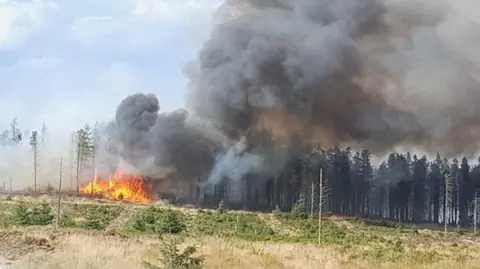
Fire crews battling a vast moorland blaze in North Yorkshire have said they have been hampered by exploding World War Two bombs and tank shells.
Emergency services have been tackling the fire, which covers about 10 sq miles (25 sq km), on Langdale Moor, in the North York Moors National Park, since Monday 11 August.
The county’s chief fire officer Jonathan Dyson said part of the site had been a tank training ground in the 1940s and there had been more than 18 explosions as the fire had burned down through the peat to previously hidden explosives.
Mr Dyson said the fire service was treating the incident as a “significant wildfire” and had requested help from other services across England.
Mr Dyson said in some places crews had to adopt a “very defensive fire-fighting strategy” due to the unexploded bombs.
“As the peat continues to burn down it is finding the Word War Two ordnance and therefore exploding and we have now experienced over 18 ordinance explosions within key areas.”
Watch: Drone footage captures scale of Langdale fire
Mr Dyson said up to the weekend they had made significant progress in managing and containing the fire but, with a change due to the wind and the temperature, the blaze had “more than doubled in 24 hours”.
“The fire has made a rapid spread further north and across to the north west,” he said.
Crews were trying to minimise the spread and had 10 appliances committed to the operation along with 60 firefighters, he explained.
“I have today made a request to National Resilience for national assets to be deployed to the area.”
Mr Dyson said the help would consist of up to 10 appliances from other fire services across England and was expected to arrive swiftly.
North Yorkshire Fire & Rescue Service/PA Wire
Part of the moor was used during World War Two for tank training
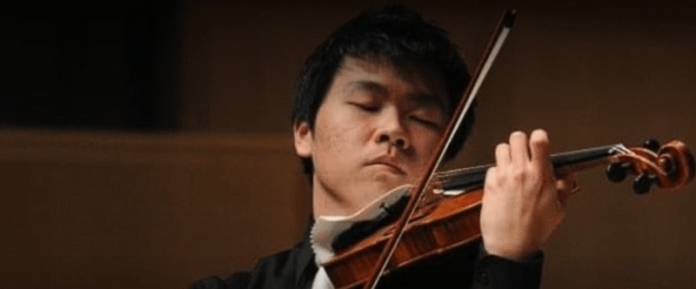
SALT LAKE CITY (KTVX/KUCW) – A 37-year-old professional violinist who has lived in Utah for most of his life was taken into ICE custody while on a work trip to Colorado last week.
John Shin immigrated to Utah on a visa with his father from South Korea when he was a child, according to his attorney Adam Crayk.
He went to elementary school, high school and college in the Beehive State, graduating from Utah State University before going on to play on some of the biggest stages, including a stint with the Utah Symphony and Ballet West.
On Tuesday, Shin’s wife, Danae Snow, an American citizen, told Nexstar’s KTVX/KUCW that she got a heartbreaking phone call from him on her birthday, Wednesday, Aug. 20.
“That morning, he was texting me, ‘Happy birthday, I love you so much,’ and then by that afternoon, I got the phone call, ‘Honey, I’ve been detained by ICE. I love you and the kids, and they’re sending me to a detainment center,” Snow said behind tears. “I just thought, ‘Oh my gosh, I don’t know how this can happen.'”
Snow described Shin as a charismatic, selfless person who not only contributes to society in a big way, but also to her family.
“They say that there’s stepdads and then there’s dads who step up, and he’s really the dad who stepped up, and he’s loved my kids just as his own,” Snow said.
According to Crayk, ICE arrested Shin because of a charge of impaired driving several years ago while he was struggling with the death of his father.
“It looks like John back in 2019 was charged with a DUI, but ultimately resolved his case in 2020 with an impaired driver [charge],” Crayk said. “He has successfully completed all of his probation, completed treatment classes, everything he was ordered to do … everything was completed.”
Shin had his driver’s license reinstated and was able to drive on Utah roads again with insurance.
“The problem that you have, though, is as someone who is coming to the United States and who doesn’t currently have proper documentation because when you get a DUI, DACA gets taken — immigration will not let you have DACA with a DUI,” Crayk said. “He becomes a priority, especially under the current administration, so he was taken into ICE custody because he accepted and did an agreement in Tooele County for an impaired driver, which caused ICE to take him into custody.”
Crayk is aiming to get Shin out of the ICE detention center in Aurora, Colorado, during Shin’s first court appearance next Tuesday.
In the meantime, musicians who played along with Shin have been demonstrating at the Utah state capitol throughout the week, in hopes of getting the attention of lawmakers.
Over the next few years, more than 4 million Americans will reach the age of 65 each year, according to a study from the Alliance for Lifetime Income and the Retirement Income Institute. But is this demographic, deemed “peak boomers,” ready for retirement? The study revealed that more than half (52.5%) of baby boomers nearing the age of 65 have less than $250,000 in assets for retirement.
You’ve saved and invested for retirement throughout your career. Now that the day has come, you might think it’s time to tap into your 401(k) or IRA immediately.
But experts said this is a mistake. “Doing so early can trigger taxes and penalties,” said Tansley Stearns, Community Financial Credit Union president and CEO. “Not only does this reduce your retirement nest egg, but you also lose out on potential growth.”
Instead, speak to a financial advisor about the best ways to stretch your retirement income through other forms of savings.
Likewise, many retirees are tempted to tap into Social Security benefits as soon as they turn 62. But this leads to a permanent reduction in your monthly benefits, according to experts.
Lisa A. Cummings, Esq., attorney and executive vice president at Cummings & Cummings Law, recommended using the Social Security benefit calculator online to compare your monthly benefit at your current age, full retirement age (FRA) and age 70.
“Waiting until full retirement age, or even later, can mean significantly more income for life,” Cummings said.
“Taxes don’t disappear when your paycheck does,” Cummings pointed out. “Withdrawals from traditional IRAs, 401(k)s and certain pensions are taxed as income. Social Security may also be taxable.”
Before you make a move, speak with a tax advisor to estimate your annual taxable income and consider tax strategies that can reduce those obligations, such as Roth conversions.
Strategic asset location, or the practice of getting investments into the right types of accounts, is another way to minimize taxable income in retirement, according to experts.
“For most people, we want to locate the assets we expect to grow the most (e.g., stocks) in Roth accounts, if available. This way, all of the future growth would not be taxed, as Roth accounts grow tax-free and distributions from Roth accounts are also tax-free,” said Aaron Brask, financial planner at Aaron Brask Capital.
He also suggested placing some higher-growth assets in a taxable brokerage account, which would be taxed at the capital gains rate — typically lower than the marginal tax rates for income. “Asset location is a subtle but impactful tax strategy that many people miss,” he said.
You don’t want to see your retirement income disappear due to taxes. But you also don’t want to see your investments diminish in a down market. The stock market inevitably has ups and downs. Can your retirement portfolio weather those changes?
“We might be on a bull market run, and people see these big [balances in their] accounts, so they might retire early,” said Mark Connely, CFP with Wealth Design Group in Houston, Texas. He recommended doing a “stress test” to see what would happen if your portfolio dropped by 20% or more. Can you live comfortably on that amount?
“Take 70% of the value you have right now and see if it delivers the income you want,” Connely suggested. “Also, make sure you’ve got three to five years of income set aside somewhere safe, secure and liquid so that even if there was a market correction, you can wait it out.”
While it’s smart to keep an emergency savings account to help manage market swings, you want to make sure most of your investments can keep pace with inflation over time. “Ensure your retirement strategy includes investments that outpace inflation to maintain your standard of living,” Stearns said.
Cummings recommended working with an investment advisor to choose allocations that can offset rising costs. “Review yearly to adjust as needed,” she said.
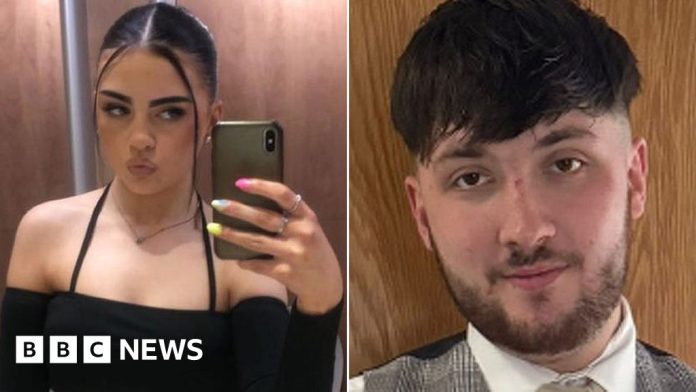
Mia Keevan, 17, and Trae Keenan died in separate incidents after attending Emerge music festival
Investigations are continuing after two young people died and two remain in hospital after attending the Emerge dance music festival in Belfast at the weekend.
Mia Keevan, 17, from County Tipperary in the Republic of Ireland, took unwell at the event and died shortly afterwards in hospital.
In a separate incident 24-year-old Trae Keenan, from County Down, died in rented accommodation in the city centre a few hours after the event ended.
Shine productions, which organised the festival, has been approached for comment.
Emerge music festival is the biggest dance music event in Northern Ireland.
It usually takes place over the August bank holiday weekend at Boucher Playing Fields in south Belfast and attracts crowds of about 40,000 dance music fans each day.
This year the festival was headlined by Fatboy Slim on Saturday and Bicep on Sunday, while Sammy Virji, Fjaak, Sonny Fodera and Danny Howard were also on the line up.
Pacemaker
Around 80,000 people attended the Emerge festival over the weekend
Mia was visiting Belfast from Carrick-on-Suir to attend the event.
Investigations are still continuing into what caused her death.
Belfast district commander Supt Allister Hagan said: “During the event it was reported that a 17-year-old girl had become unwell. Sadly, she subsequently died in hospital.”
“Police remained on the event site until Monday afternoon, 25 August.
“An investigation in order to establish the circumstances surrounding the tragic sudden death of this young person is ongoing, and our thoughts are with the family and friends of the deceased.”
Sarah Roche, who is raising money for Mia’s family, posted on an online fundraising page to say the teenager was a “bright, fun and much loved girl who touched the hearts of anyone that knew her”.
“Mia was such an outgoing person and lit up every room she walked into,” she said.
“Her laughter and warmth will never be forgotten by those lucky enough to have known her.”
Belfast City Council, which operates Boucher Playing Fields, said it “was deeply saddened by the death” and added that it sent “sincere condolences to the young person’s family at this difficult time”.
Pacemaker
The annual event is held at Boucher Playing Fields in south Belfast
Mr Keenan also attended the festival and took unwell and died after he returned to his rented accommodation in Belfast.
He worked as a chef and had a four-month-old son.
In a funeral notice he was described as a “dearly beloved son of Pamela and John and cherished father of Mason, loving brother of Shanice, Tyler, Claire and Toni and loving partner of Tiffany”.
Speaking to the Irish News, Shanice said the family was devastated following his death.
“Trae was someone that would do anything for anyone,” she said.
“He was very funny, very strong-hearted. He had the biggest smile you could ever see. He had so much stride in his walk.
“The whole town just loved him; everyone adored him.
“It still doesn’t feel real. It’s horrible.
“From his videos and stuff, he had the best night, he really did. But it is terrible how it ended.”
The Irish News reported Mr Keenan had previously suffered from heart complications and asthma.
The family told the newspaper he had suffered a panic attack and his death was not linked to drugs.
Pacemaker
Acts like Fatboy Slim and Bicep were headlining the event over the weekend
Police are still investigating both deaths and said a number of arrests were made over the weekend.
Supt Hagan said several organisations – including the Police Service of Northern Ireland and Belfast City Council were involved with making sure the festival passed off safely.
He said officers made seven arrests over the weekend and issued three fixed penalty notices, one caution and nine community resolution notices.
He said offences included disorderly behaviour, drink-driving, assault on police and possession of controlled drugs.
‘They really are heartbroken’
Alliance Party councillor for the Balmoral area, Micky Murray, said he has spoken to the family of Mia Keevan.
“You can only imagine what you would be going through if you were in their position. They really are heartbroken,” he said.
Murray told BBC News NI that he met the organisers of Emerge on Tuesday to talk over the incident.
“They put on these music festivals because they have a love of live music and they want to bring it to people,” he said.
“They are devastated this has happened on their watch.”
The councillor added Belfast City Council was to hold a “debrief” with Emerge and other key stakeholders on Wednesday.
“What this has done is open up a public conversation about how we keep young people safe when they go to these festivals.”