US President Donald Trump said on Monday he would immediately remove Federal Reserve governor Lisa Cook from her position on the central bank’s board of directors.
In an announcement made on his social media platform Truth Social, Trump posted a letter addressed to Cook in which he informed her of his decision and accused her of making “deceitful and potentially criminal” mortgage agreements.
Neither Cook or the Fed has commented on the sacking.
Trump has put increasing pressure on the Fed – especially its chair Jerome Powell – in recent weeks over what he sees as the US central bank’s unwillingness to lower interest rates. He has repeatedly floated the possibility of firing Powell.
According to Trump’s letter, Cook signed one document attesting that a property in Michigan would be her primary residence for the next year.
“Two weeks later, you signed another document for a property in Georgia stating that it would be your primary residence for the next year,” he said.
“It is inconceivable that you were not aware of your first commitment when making the second,” Trump said.
In a statement last week, after she was accused of mortgage fraud by the head of the Housing Finance Agency, Cook said she had “no intention of being bullied to step down from my position because of some questions raised in a tweet”.
She said she was “gathering the accurate information to answer any legitimate questions and provide the facts”.
Cook is the first African American woman to sit on the board, a position she has held since 2022.
First U.S. screwworm case in years confirmed in Maryland
Federal officials in the U.S. have found the first human case of the flesh-eating parasite New World Screwworm connected to ongoing outbreaks in Central America.
The Centers for Disease Control and Prevention worked with the Maryland Department of Health (MDH) to confirm the case on Aug.4, a spokesperson for the Department of Health and Human Services (HHS) told The Hill.
“Currently, the risk to public health in the United States from this introduction is very low,” HHS spokesperson Andrew Nixon wrote in an email to The Hill.
The bug was found on a person after they returned from traveling to El Salvador, which is currently experiencing an outbreak of the parasite. A MDH spokesperson said the person has recovered from an infection caused by the parasite and did not transmit the bug to other people or animals.
What to know:
New World screwworms are a type of parasitic fly that lays eggs in warm-blooded animals such as cattle, horses and sometimes household pets, according to the Department of Agriculture (USDA). Sometimes, the bug can infest people.
When the eggs hatch, the larvae burrow into open wounds in their host animal to feed, which can cause infection and even death.
The parasite is typically found in South America and the Caribbean, according to the CDC. But recent cases of the fly infecting cattle in Mexico have prompted the Trump administration to take action.
Treatment involves removing the larvae, which may require surgery.
Detected cases in cattle in the Mexican states of Oaxaca and Veracruz led to USDA Secretary Brooke Rollins announcing in May that the U.S. would be suspending cattle, horse and bison imports from Mexico.
The Trump administration had boosted efforts to combat the spread of the virus, including breeding millions of sterile flies to then spread over southern Texas and parts of Mexico.
Rollins’s agency estimates the parasites could cause $1.8 billion in economic damage in Texas alone.
Welcome to The Hill’s Health Care newsletter, we’re Nathaniel Weixel, Joseph Choi and Alejandra O’Connell-Domenech — every week we follow the latest moves on how Washington impacts your health.
Comedian Bill Maher warned Democrats on Friday about President Trump’s recent comments, in which he said his administration is “looking at” reclassifying marijuana as a less dangerous drug.
The Centers for Disease Control and Prevention (CDC) has chosen a known vaccine skeptic to lead its COVID-19 working group, which was originally established to discuss immunization recommendations at the start of the pandemic. A spokesperson for the Department of Health and Human Services (HHS) confirmed to The Hill that Retsef Levi, professor of operations management at the Massachusetts Institute of Technology’s Sloan School …
Related video: So, you’ve lost weight using Wegovy. Does that mean you can stop taking it? (AP) Patients using Ozempic and other GLP-1 drugs are reporting a complication not listed among the drug’s most common side effects. We’re not talking about “Ozempic babies,” but that’s also a thing. Dentists warn they’re seeing cases of something nicknamed “Ozempic teeth.” Medications …
Planned Parenthood sues South Carolina over Medicaid ban
An updated legal challenge from Planned Parenthood in South Carolina seeks to preserve Medicaid for its health centers after a recent Supreme Court decision allowed the state to restrict federal funding. The filing challenges the constitutionality of Gov. Henry McMaster’s (R) order that blocks Medicaid funds from clinics that provide abortions. The complaint asked a federal judge to block the policy and allow …
Posture is all about regular movement, exercise and positive mindsets
“Sit up straight!” – we’ve all heard that command barked at us many times.
For years we’ve been told that good posture means standing tall, shoulders back and your spine straight as a rod.
But that might not actually be true. According to Dr Xand van Tulleken, a doctor and BBC presenter, much of what we think we know about posture is outdated.
In fact, trying to hold yourself bolt upright all day could do more harm than good, he told Morning Live.
As the end of summer looms and many people return to work and studying, here are his three suggestions to improve your posture and in turn help look after your back.
1. Keep moving
Getty Images
Raising your arms above your head and moving your head from side to side can release tension
Posture is dynamic, not static. The worst thing you can do is stay locked in one position for hours whether that’s being perched at a desk, lounging on the sofa or scrolling on your phone.
Dr Xand says the key is to change it up.
There are lots of posture corrector straps, back braces and chairs that promise to change your life but “you just need to be moving around in the day”.
A lumbar cushion or an ergonomic chair can make sitting more comfortable and a wearable posture reminder might nudge you to stop hunching but none of these replace the basics of movement, strength and listening to your body.
“You can have the best chair, but if you spend eight hours sitting in it you’ll still have back pain.”
Dr Xand also cautions that some back gadgets marketed as improving posture can force you into one position that constrains and restricts your movement and that’s the opposite of what you want to be doing.
Make sure you stand, stretch and take regular breaks – even small shifts can reset your muscles, he says.
2. Build strength, not stiffness
Getty Images
Contrary to what some might think, perfect posture isn’t about balancing a book on your head
Good posture comes from strong muscles, but that doesn’t mean you need a gym membership or Olympic ambitions.
Dr Xand suggests regular exercises to build a stronger core and back.
Simple movements like raising your arms above your head and turning your head from side to side “can lift some tension and help you feel instantly better”.
“What we want is for our body to support itself,” Dr Xand explains.
Exercises like pilates and yoga can be a good way to stretch your body and target specific pain points, he says.
Stress can be a contributing factor to bad posture and back pain
Posture isn’t just about muscles, it’s also about mindset.
The way we sit, stand and move often reflects how stressed we’re feeling about what we’re doing.
Hunched shoulders at a laptop can be as much about deadlines as desk set-up so it’s important to reflect on your attitude towards work or study.
“Pain is not just about muscles, it’s emotional and psychological,” explains Dr Xand.
He says that previously people would be told to focus on their desk set-up without taking into account that pain can be a result of “stress, the amount of time you’re doing your job and whether you do any exercise.”
“Your seat height is important but other facts are also important,” he adds.
So, sometimes fixing your posture is as much about easing your schedule as it is about stretching your spine.
In some cases poor posture (not just back pain) can be down to an underlying medical condition and you should check in with your GP if concerned.
According to the NHS, if you’re suffering from back pain you should try and stay active, take anti-inflammatory medicines and try doing some exercises and stretches.
You should see a GP if your back pain doesn’t improve after treating it at home for a few weeks or the pain is getting worse over time.
Morning Live will be back on air on Monday 1st September.
Former national security adviser John Bolton called President Trump’s Ukraine strategy “incoherent” in an opinion piece published Monday.
“President Donald Trump’s Ukraine policy is no more coherent today than it was last Friday when his administration executed search warrants against my home and office,” Bolton said in the opinion piece for The Washington Examiner, titled “Trump’s utterly incoherent Ukraine strategy.”
“Collapsing in confusion, haste, and the absence of any discernible meeting of the minds among Ukraine, Russia, several European countries, and America, Trump’s negotiations may be in their last throes, along with his Nobel Peace Prize campaign,” he added.
Last Friday, federal agents searched Bolton’s home. The FBI confirmed there was “court-authorized law enforcement activity” happening close to Bolton’s house in Maryland, with the search reportedly linked to his handling of classified information.
Bolton, who served in Trump’s first administration, has become a critic of the president in recent years.
“The administration has tried to camouflage its disarray behind social media posts, such as Trump comparing his finger-pointing at Russian President Vladimir Putin to then-Vice President Richard Nixon during the famous kitchen debate with Nikita Khrushchev. Why Trump wants to be compared to the only president who resigned in disgrace is unclear,” Bolton said in his piece.
Since his return to office in January, Trump and his administration have pushed for an end to the war in Ukraine but have not had much luck. The president recently met with both Russian President Vladimir Putin in Alaska and Ukrainian President Volodymyr Zelensky in Washington, D.C., in a matter of days.
In an interview that aired Sunday, Russian Foreign Minister Sergey Lavrov said that Ukraine “has the right to exist” but added a caveat to that right related to territory.
“Ukraine has the right to exist, provided it must let people go,” Lavrov said. “The people whom they call terrorists, who they call species and who — during a referendum — several referenda in Novorossiya, in Donbas, in Crimea, decided that they belong to the Russian culture and the government which came to power as a result of the coup was determined as a priority to exterminate everything Russian.”
The Hill has reached out to the White House for comment.
Croydon, south London, where the council’s debts have now reached £1.5bn.
Communities across the UK are paying for spiralling levels of council borrowing with a fire sale of publicly owned facilities, a BBC study has found.
Schools, care homes, a boxing gym and even an Olympic legacy equestrian centre are among hundreds of buildings being sold as struggling councils seek to reduce a debt pile totalling £122bn.
Chief executive of the Local Government Information Unit (LGIU), Dr Jonathan Carr-West, said “public value” would continue to be eroded until the government came up with a long-term solution to council debt.
The government said it was aware the funding system for councils was “broken” and was pushing ahead with reforms to address the problem.
Councils across the UK can borrow money from banks or from the government to fund improvements in their areas – from building new schools to maintaining roads and providing sheltered housing.
They can also borrow to make investments intended to generate income.
Since 2010, they have bought shopping centres, office parks and solar farms as well as funding large housing developments with borrowed funds.
Most of that was done through an arm of the Treasury known as the Public Works Loans Board (PWLB) and until 2022 interest rates on that borrowing remained relatively low.
Last year, the Public Accounts Committee warned debt levels had become “unsustainable” despite curbs placed on borrowing for purely commercial aims in 2021.
But the BBC Shared Data Unit found those combined debts grew by 7% last year. Their combined £122bn of debt is now equivalent to £1,700 per UK resident.
Usually, authorities are not allowed to sell off assets in order to fund day-to-day services such as bin collections or social care.
But increasing numbers of councils in financial trouble are now being given powers to do so by the government.
Known as “capitalisation directions” they also allow councils to take out short-term loans to pay for day-to-day services – but add millions to the debt pile in the process.
This year, 30 councils were given those powers, last year it was 19.
Councils sold £2.9bn of public assets over the past two years other than social homes sold through the Right to Buy scheme. Those with the highest debts were twice as likely to have been among the highest sellers.
For Dr Carr-West, the system is unsustainable.
“As one local government finance officer said to me, ‘it’s essentially payday loans for local government,” he said.
“We are now seeing the selling off of assets and once they’re gone, they’re gone. So what was public value is now passing into private hands and that won’t come back.”
Not all council-owned buildings are directly used by the public in the way, for example, leisure centres are. Often authorities have legacy buildings that over time have come to be leased, such as shops, pubs and factories.
But Dr Carr-West said those “assets” still represent a public loss when sold as they can be vital when councils come to regenerate town centres and the cheaper rents and longer leases that local authorities can offer help to stimulate local economies.
‘Everything came down to finance’
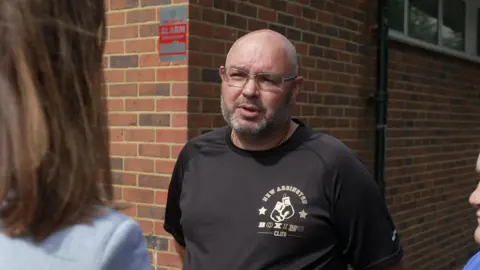
New Addington Boxing Club head coach Bill Graham says the long-term future of the club is unstable after it was forced to leave its community centre premises
In Croydon, south London, the council ploughed money into a large housing company, a shopping centre and a hotel, among a host of other investments. When the Covid pandemic hit, it lost millions and could not repay its debts.
Its £210m firesale of public property over the last four years would only cover about 15% of its current £1.5bn debt, which continued to grow last year. The authority’s elected mayor Jason Perry told the BBC the council spends £70m a year in debt repayments alone.
Among a “disposal” list were nurseries, community centres and tennis clubs.
New Addington Leisure and Community Centre – home to the estate’s boxing club – closed in February.
The club has 300 members and works with men and youths who would otherwise be involved in crime, according to head coach Bill Graham.
Although a group of volunteers raised £25,000 to keep going in a nearby school, its future remains uncertain.
“We help reduce crime, we help children not go to grab knives,” Mr Graham said.
“In the end, everything came down to finance – they said we need to sell our assets because of the situation we are in and that’s it.”
‘Meant to inspire a generation’
Tao Baker used to attend an equestrian centre in Greenwich until it was closed down and the site considered for sale by the local council
Greenwich Equestrian Centre was meant to introduce thousands of children in the south east London borough to the “joy of horse riding” in the wake of the 2012 Olympics, according to its then council leader.
The £1.6m facility, opened by Princess Anne in 2013, was also intended to provide training courses “for many people for years”.
But in November the council decided to sell it despite a community bid to take over its running, now backed by more than 4,500 signatures. Neither the petitioners, nor British Equestrian, which helped pay for the facility, say they were informed of the decision.
The Royal Borough of Greenwich Council saw its debts rise by £268m last year, largely, it says, to build or buy new affordable housing for the 26,000 people currently on its housing register.
But businesswoman Tao Baker, who has submitted plans to transfer the centre over to community ownership, believes a sale would be “short-sighted”.
It would “barely make a dent” to the debt pile, she says, while the loss of the centre would be felt for years to come.
At its peak the centre had an 18-month waiting list for free horse riding sessions and Ms Baker believes it could easily be sustainable with the right guidance.
But she says the council leadership is refusing to meet with her.
“I think the reason why the community really wants to save this is not just that it’s one-of-a-kind sporting facility and the only Olympic facility in Greenwich but it’s the way the council went about it.
“They knew there was a community petition to save the facility but they never disclosed that they were going to do this.”
Ms Baker says she has asked for numerous meetings with the council leadership over the past year, which have not been successful. The council said it welcomed offers from “any who can demonstrate a strong financial business case”.
A council spokesman said it welcomed any viable proposals to take over the “defunct” equestrian centre.
He added: “Like the rest of London, we desperately need shovels in the ground and roofs over people’s heads and we’re proud to have had the highest number of new affordable homes started of any borough in the capital last year.”
‘Debt is not inherently bad’
In the mid-2010s the coalition government encouraged town hall chiefs to broaden income streams by investing in property.
They did that by borrowing and, in many cases, council investments are continuing to pay off.
“Debt is not inherently bad,” according to Sarah Calkin, editor of the Local Government Chronicle. “It depends what it’s for.”
She said councils now “in trouble” tended to have taken out short-term private bank loans when interest rates were low – only to be stung with large rate rises further down the road.
Warrington Council’s £1.6bn debt means it is one of the most indebted in the country for the size of its population. It used Treasury loans to buy a retail park in Manchester, haulage distribution centres and a large shoe factory among other properties
The council said it had no choice but to invest in order to fill the gap in income it had received from central government under the revenue support grant.
Though that grant has increased in the years since the pandemic, core spending power for local authorities is around 18% down per person compared to 2010, the Institute for Fiscal Studes found.
Warrington’s leaders claimed to be making between £20m and £23m a year from those investments – which meant it could avoid making large cuts to services.
But government-appointed inspectors found the council had a “high exposure” to increased interest rates and was rapidly eating into its savings. Its out-of-town investments showed little or no public benefit to Warrington’s population.
In July, the government sent in ministerial envoys to get the council’s finances back on track.
The town’s former MP Andy Carter warned the council its strategy was risky on several occasions.
“We’re seeing decisions taken that I don’t believe would be taken in a commercial sense – a business wouldn’t be risking shareholder funds,” he said.
Mr Carr-West said spiralling levels of borrowing were ultimately a result of years of council underfunding.
“One third of councils are telling us that if nothing changes in terms of how they’re funded, they are going to go bust within five years,” he said.
“That’s down from 50% of councils telling us that in 2024. So we have made some progress.”
Dr Carr-West said there were increasing calls for the government, which is owed about 75% of the council debt through the PWLB, to write off large swathes of that debt.
Croydon Council said the support it received in loans and asset sales was “not sustainable” as they were “simply adding to [their] borrowing costs”.
A spokesperson said: “We cannot become financially sustainable and meet our Best Value Duty until a solution from government, such as a debt write off, is agreed.”
No such announcements about a debt write-off have been made.
In June, Prime Minister Sir Kier Starmer announced an overhaul of council central grant funding, promising to simplify the complicated funding formula used to distribute funds.
Labour says its plan will redistribute grants to focus on the most deprived areas as well. It has also started work on restructuring two-tier council areas, those with both county and district councils, to become unitary authorities.
A Ministry of Housing, Communities and Local Government spokesman said: “While councils are responsible for managing their own budgets, we know that the current funding system is broken which is why we are taking decisive action so local leaders can deliver the public services their communities rely on.
“We have announced over £3.4bn of new grant funding for local services on top of the £69bn already made available this year to boost council finances, and we will go further to reform the funding system, including at new unitary councils, to ensure it is fit for the future.”
Additional reporting by Catherine Heuston, Florence Cook and Paul Bradshaw.
The Bureau of Ocean Energy Management (BOEM) in a letter sent to Orsted, saying the stop-work order seeks “to address concerns related to the protection of national security interests of the United States and prevention of interference with reasonable uses of the exclusive economic zone, the high seas, and the territorial seas.”
It did not specify what those concerns are.
“You may not resume activities until BOEM informs you that BOEM has completed its necessary review,” the letter added.
“Americans deserve energy that is affordable, reliable, and built to last — not experimental and expensive wind projects that are proven failures,” Aubrie Spady, deputy press secretary for the Interior Department, told The Hill in an emailed statement on Monday.
Welcome to The Hill’s Energy & Environment newsletter, I’m Rachel Frazin — keeping you up to speed on the policies impacting everything from oil and gas to new supply chains.
A group of current and former Federal Emergency Management Agency (FEMA) employees warned Monday that the Trump administration is weakening the disaster response agency’s capacity and preventing it from carrying out its mission.
The operator of New England’s electric grid warned Monday that the Trump administration’s move to halt a nearly completed offshore wind farm will cause risks to the reliability of the electric grid.
Unemployment claims in the Los Angeles metropolitan area climbed by 12 percent to 17 percent due to the devastating effects of the Palisades and Eaton blazes, which ripped through the region this past January, a new report has found.
A federal judge on Monday doubled down that the Trump administration is “absolutely forbidden” from removing mistakenly deported man Kilmar Abrego Garcia from the U.S., for now. Read more
NEW YORK — Australian Open champion Madison Keys was undone by 89 unforced errors and was upset in the first round of the US Open 6-7 (10), 7-6 (3), 7-5 by Mexico’s Renata Zarazúa on Monday.
The sixth-seeded American made so many mistakes, including 14 double faults, that Zarazúa needed to produce just eight winners to earn the biggest victory of her career.
Zarazúa, ranked No. 82, had lost in either the first or second round in all eight of her previous Grand Slam appearances. She became the first Mexican player to knock off a top-10 seed at a major since Angélica Gavaldón, who defeated No. 3 seed Jana Novotná in the round of 16 at the 1995 Australian Open.
Before Keys, the last American woman seeded in the top 10 to lose in the first round at Flushing Meadows was No. 8 Chanda Rubin in 2003, to María Vento-Kabchi. It’s the only other instance of it happening at the New York tournament in the past 30 years.
“For the first time in a while … my nerves really got the better of me, and it kind of became a little bit paralyzing,” said Keys, the runner-up in New York to good friend Sloane Stephens in 2017 and a semifinalist in 2018 and 2023. “I felt like I was just slow. I wasn’t seeing things the way that I wanted to, which I feel like resulted in a lot of bad decisions and lazy footwork.”
Keys earned her first major championship at Melbourne Park in January, defeating No. 1 Aryna Sabalenka in the final.
“You always kind of feel first-round jitters and, as the day is getting closer, feeling a little bit more and more nervous,” said Keys. “But I feel like, for whatever reason, today I just couldn’t separate myself from … feeling like winning matters just way too much.”
Playing with her left thigh heavily taped, the big-hitting Keys struggled for stretches in Arthur Ashe Stadium against the 5-foot-3 Zarazúa, who came into the day with a 0-6 record against opponents ranked in the top 10.
“I’m a little bit small in height, so coming in here, it was like: ‘Oh, my god. This is huge,'” Zarazúa said about the largest stadium in Grand Slam tennis, which holds nearly 24,000 spectators.
“When I retire, I’m going to be really happy about it,” Zarazúa said, “so I was like, ‘Just enjoy it.'”
This one certainly was memorable, in part because it did not come easily and lasted 3 hours, 10 minutes.
Zarazúa trailed by a set — after frittering away five chances to take the opener — and 3-0 in the second. But she never went away.
“Kudos to her for making me play a lot of balls today,” Keys said. “I mean, she’s a tricky player.”
While Keys was one of 25 American players in the women’s singles draw, the 27-year-old Zarazúa is Mexico’s lone entrant in the bracket. She moved to San Antonio as a teen and is now based in Florida.
“In Mexico, yeah, it’s probably not the most famous sport,” Zarazúa said about tennis, which she picked up after starting out in gymnastics and diving.
“I got into tennis,” she explained, “just because my brother was playing, and he was like, ‘I think this is a bit safer sport.'”
In other women’s singles results Monday, two-time major champion Barbora Krejcikovatook down 18-year-old CanadianVictoria Mboko, an emerging star seeded 22nd who was making her US Open main draw debut fresh off her title run at Montreal, where she defeated four former major champions en route to her first WTA title.
Krejcikova is unseeded at Flushing Meadows, the first time she has been unseeded at a Slam since the 2021 French Open, where she went on to win her first major singles title.
Also advancing was No. 9 seed Elena Rybakina, a 6-3, 6-0 winner over 16-year-old American Julieta Pareja, the youngest player in either field at this year’s US Open. Fellow American Taylor Townsend moved on in straight sets against Antonia Ruzic.
“I’m very happy. It was a great run. I did a great thing on court, and I went until what I could achieve,” Garcia said. “Obviously you can always achieve more, and I was dreaming of achieving more. But I’m very happy and in peace with my decision to move forward with my life and close the chapter of being a tennis player.”
ESPN Research and The Associated Press contributed to this report.