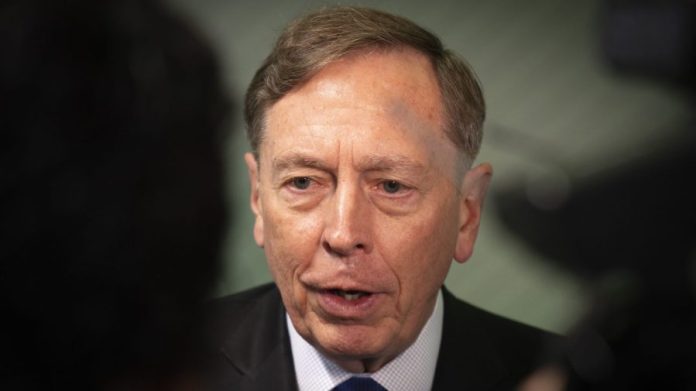
Retired Gen. David Petraeus, the former CIA director and former head of U.S. Central Command, on Sunday said he thinks Russian President Vladimir Putin has no intention of agreeing to a peace deal “unless he’s given additional territory.”
In an interview on ABC News’s “This Week,” Petraeus said he was not optimistic about the prospects of a meeting between Putin and Ukrainian President Volodymyr Zelensky — for which President Trump has been pushing — and said he does not see reason to believe such a meeting would prove successful, even if it did materialize.
“Out of the last two weeks, really, Jonathan, I think what should be clear to all, and I think it is even clear to President Trump, is that despite all of his efforts — again, which we applaud, to end the war, to stop the killing — Vladimir Putin clearly has no intention of doing that unless he’s given additional territory,” Petraeus told ABC News’s Jonathan Karl.
The former CIA director noted that the additional Ukrainian territory that Putin wants “is heavily fortified, and Russian forces would have to fight for years at the pace that they’re going” to capture it.
According to media reports, Putin wants all of the Donetsk and Luhansk regions in the Donbas, including areas Russia does not currently occupy, and is willing to freeze the front lines in Kherson and Zaporizhzhia — marking a slight retreat from Putin’s previous demand for all four regions outright.
Despite Trump’s claims of progress in peace talks, Russia has not shifted its core demands for Ukraine’s complete political and military capitulation, as Putin reiterated in his public remarks following the high-stakes summit with Trump in Alaska.
“He wants to displace President Zelensky, replace him with a pro-Russian figure, and frankly, to demilitarize Ukraine,” Petraeus said, “none of which can be acceptable to Ukraine nor to the European countries and the United States.”
“In fact, by the way, President Zelensky, under the Ukrainian constitution, doesn’t even have the authority to declare that certain territory would be controlled by the Russians. That would have to go to a national referendum,” Petraeus continued.
The former CENTCOM commander made clear that Putin remains the roadblock to peace and urged the U.S. and Ukrainian allies to push negotiations along by increasing aid to Ukraine.
“I think it should be clear: The obstacle to peace at this point in time is President Putin,” Petraeus said.
“And what we need to do is change those dynamics by helping Ukraine far more than we have so far: lifting restrictions on them, seizing the $300 billion of frozen reserve in European countries of Russian money, giving it to Ukraine, more sanctions on Russia, even including the Gazprom Bank and curtailing the export of oil further than we have already.”
Four years since the pandemic sent people home to work, companies have been intensifying their desire for a return to the office. Yet for many workers, flexible work arrangements are a must-have.
Peter Cappelli, a professor of management at the University of Pennsylvania’s Wharton School, has a new book co-written with Ranya Nehmeh, a workplace strategist. “In Praise of the Office: The Limits to Hybrid and Remote Work” lays out the business case for employers pushing for workers to get back to the office.
Here are edited excerpts from my recent conversation with Cappelli:
Kerry Hannon: Why has the case for in-office work never been stronger?
Peter Cappelli: We’ve gone through this period where there’s been big debates about remote work and a lot of companies have persisted in various kinds of remote, but mainly hybrid. At the moment, the recognition is growing across employers that it hasn’t worked so well.
When business returned and things became a little more normal, it became easier to start to see some of the drawbacks. It wasn’t enough just to keep the wheels going.
We’re at this inflection point now where companies really have to decide if they ever want to get people back. The longer you wait, the harder it is to ever get people to come back without a big fight.
Right now, people might be saying, ‘I will quit if I have to go back to the office,’ but it turns out they don’t mean it. The reason, of course, is it’s one thing to say that you will quit; it’s another to actually walk away from a paycheck.
What’s wrong with a hybrid work arrangement?
People just don’t come in. That’s maybe the single biggest factor. There is a growing awareness that people are really never there on their anchor days. If you want that for your company, you have to manage that attendance.
That’s on the shoulders of the managers themselves. It’s not that we don’t think you could have hybrid work, but if you’re going to do it, it requires a lot of effort on the part of management.
Lots of employers trumpeted the success of remote work not that long ago. What changed?
One thing that changed is the labor market softened. It’s not the case that people are job hopping right now because there just aren’t very many jobs offered. The number of jobs that are being offered with some kind of remote possibility is declining.
At the CEO level, immediately after the pandemic they were glad things were still running at all. Expectations were really low. What’s changed is the CEOs are now thinking we’re losing something, and the employee resistance to return to the office has weakened. That’s why we’re seeing the push right now.
Until recently, it was resistance from employees and a little kicking the can down the road. Employers didn’t want to take on their employees. The labor market was tight. In reality, remote work was a short-term solution during the pandemic that ended up causing a longer-term problem.
What’s the compelling advantage of in-person work?
There’s value in human interaction, what we learn from each other, the cooperation that we can get in solving problems, and the motivation and commitment that comes from being around other people.
Our view is not that you have to be in the office all the time — but social connections matter a lot. When you first began your career, imagine what it would’ve been like if no one was in the office. You’d be completely lost.
If you think about how we learn about office work, we learn by watching. You learn what the values of the organization are. You learn it from the conversations in the office. You can see how the boss reacts to different requests and different problems.
As you advance, you’ve got your ear to the ground, and you’ve got the opportunity to raise your hand and pitch in and have some influence. You can catch the boss between meetings and pass along a little tidbit of information, and you develop relationships with people where you can solve problems.
If you’re in the office and you need help from somebody, and it’s urgent, you just go around the corner and stick your head in their door and ask them a quick question.
Those are the kind of things that we miss when we move to remote — in addition to the general fact that people are energized by working with people.
With remote work, people also spend more time in meetings that are worthless. A lot of those things could be fixed, but the problem is they’re not.
What’s one thing that working in an office can give us that most people don’t think about?
You will have friends. You build your social network. Remote workers having shrinking social networks, and that contributes to the loneliness epidemic and the lack of social connections.
Is remote work as big as it appears to be in terms of the number of people who work that way?
No. In Europe, for example, where employees have always had more power, I figured remote work would stay. It hasn’t. Most everybody’s gone back to the office. In Asia, most everybody has gone back to the office. In the US, the best data we’ve got from the government, which is now a little dated but nobody believes it’s gone up since then, is that more than 70% of US employers have no remote or hybrid workers of any kind.
“We’re at this inflection point now where companies really have to decide if they ever want to get people back,” Peter Cappelli, a professor of management at the University of Pennsylvania’s Wharton School, said. (Photo courtesy of Peter Cappelli)
Now that sounds stunning. But remember, most employers are small. Remote work and hybrid work, in particular, is largely a big city, big company phenomenon. It isn’t everywhere, and it isn’t in all jobs. It’s only white-collar jobs.
The future of work is certainly not remote? Correct?
That’s right. Every once in a while somebody pops up a list of the employers that have fully remote work. It is almost always companies that begin as remote. By the way, the thing that struck me about those companies if you look at them, they’ve got a lot of rules about how to behave, and it’s quite different from the office. It requires a lot more management time and energy than we’ve given it.
What’s your parting thought for employers of how to approach the new world of work?
If you opt for remote or hybrid, good outcomes don’t happen by themselves. You can make it work, but it requires more time and effort for management, more rules, more practices, more leadership.
And for employees?
Be very practical. If you’re beginning your career, go to the office. Be careful about taking remote positions because I think it won’t be too long before CFOs start asking, ‘Why is Peter an employee at all? We don’t see him. Why not just make him a contractor?’ I imagine that will start happening pretty quickly.
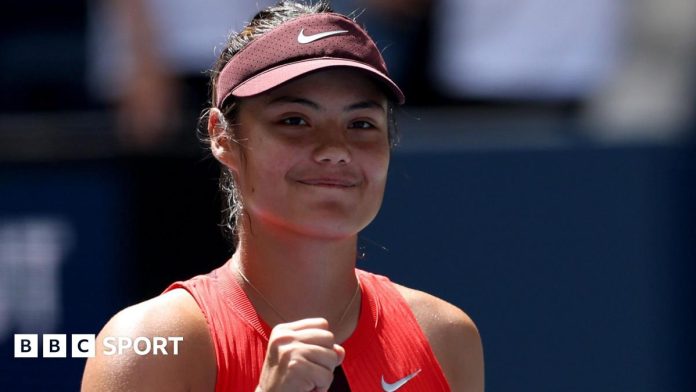
Having secured the first completed victory of this year’s tournament at 12:15 local time, Raducanu headed back out onto the practice courts at about 14:00.
New coach Francisco Roig, who agreed to join Raducanu’s team earlier this month, worked on her forehand returns from the baseline in a light-hearted session lasting about half an hour.
Roig has become a vocal presence in her courtside box – although there was little guidance or input needed against world number 130 Shibahara.
But, with the match taking place on a noisy Louis Armstrong Stadium, Raducanu said it would not have mattered even if Roig was trying to deliver instructions.
“You don’t really hear it unless you’re kind of lip-reading,” she said.
“I probably don’t take in much of what he’s saying, but when I feel like I really need it, I will go over.
“For the most part, especially when you’re in a match like today, I felt like I had most things under control on my side of the court.”
Despite only working with each other for a few weeks, the pair appeared to have gelled.
Lengthy car journeys to the Cincinnati Open, with Roig taking driving duties, strengthened their bond, and Roig has since started teaching Raducanu some Spanish.
“If anyone asks if I can say something in Spanish, I just bosh out some verb conjugations,” Raducanu joked.
“It’s not exactly the best conversation starter but I’m getting there.”
Chiropractic Jerome Poupel, a Frenchman based in London, provides another voice in Raducanu’s new-look team – as well as a quirky back story.
Poupel has previously worked with Formula 1 driver David Coulthard and racing legend AP McCoy, as well as treating horses.
“I don’t really know what he does with horses – I don’t ask questions! It just seems to work on them,” Raducanu said.
“I am a horse on my horoscope so I don’t know if that has any correlation.”
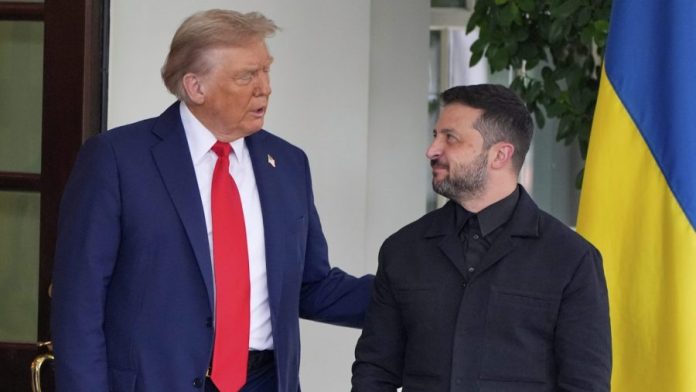
President Trump congratulated Ukrainian President Volodymyr Zelensky on the country’s Independence Day, saying in a letter that the American people believe in Ukraine’s future and respect its people’s sacrifices.
“Dear Mr. President: On behalf of the American people, I extend my congratulations and warmest wishes to you and the courageous people of Ukraine as you celebrate 34 years of independence,” Trump said in a letter, shared by Zelensky in a post on the social platform X early Sunday.
“The people of Ukraine have an unbreakable spirit, and your country’s courage inspires many. As you mark this important day, know the United States respects your fight, honors your sacrifices, and believes in your future as an independent nation,” Trump’s letter continued.
The letter comes as Trump has sought to facilitate a negotiated end to the war between Russia and Ukraine. Trump met with Zelensky and European leaders on Monday, three days after hosting Russian President Vladimir Putin for a high-stakes summit in Alaska.
While the president emerged from the meetings with some momentum toward negotiating a peace deal, Russian officials have indicated progress has slowed and that the prospects of a meeting between Zelensky and Putin are not imminent.
Trump reiterated his desire to end the war in his letter to Zelensky.
“Now is the moment to bring an end to the senseless killing. The United States supports a negotiated settlement that leads to a durable, lasting peace that ends the bloodshed and safeguards Ukraine’s sovereignty and dignity,” the U.S. president wrote. “God bless Ukraine.”
The Ukrainian leader thanked Trump “for your heartfelt congratulations on Ukraine’s Independence Day” and expressed gratitude for American support.
“We appreciate your kind words for the Ukrainian people, and we thank the United States for standing shoulder to shoulder with Ukraine in defending what is most valuable: independence, freedom, and guaranteed peace,” Zelensky wrote in his post, responding to Trump’s letter. “We believe that by working together, we can put an end to this war and achieve real peace for Ukraine.”
The White House did not respond immediately to request for comment.
Ethereum rose as high as $4,945 on Sunday, per data from CoinGecko, while CoinMarketCap shows an even higher jump to $4,948. ETH remains close to both marks, currently sitting at a price of $4,935 and up 4% on the day, according to CoinGecko.
The latest move comes after ETH surpassed the long-standing record of $4,878 set in November 2021. Ethereum skyrocketed in price Friday, with the rally triggered by Federal Reserve Chair Jerome Powell’s comments suggesting potential interest rate cuts.
That caused Ethereum to jump nearly 8% in an hour, with the broader crypto market also surging following these remarks. By the time ETH inched past its previous record in the late afternoon Friday, it was up 15% on the day.
Several factors have driven Ethereum’s recent boom. U.S. spot Ethereum ETFs have seen unprecedented demand, recently collecting over $1 billion in inflows in a single day for the first time since launching last year. The funds have been outperforming Bitcoin ETFs in recent weeks, flipping the earlier trend of BTC dominance.
Corporate accumulation by Ethereum treasury companies has also contributed to the surge. BitMine Immersion have amassed over $7 billion in ETH holdings, while SharpLink Gaming has accumulated more than $3.6 billion worth of the cryptocurrency.
Regulatory developments have further boosted Ethereum’s prospects. The SEC provided clearer guidance on staking services, allowing liquid staking providers to pay rewards without agency registration—a significant shift from the previous Biden administration’s more restrictive approach under President Trump.
Furthermore, the GENIUS Act’s passage established a U.S. regulatory framework for stablecoins, which predominantly operate on the Ethereum blockchain and are typically pegged to the U.S. dollar.
Will Ethereum continue rising and push past the $5,000 mark for the first time? Myriad users think it’s very likely, with 94% of them expecting it to reach that milestone by the end of 2025. (Disclaimer: Myriad is a product of Decrypt‘s parent company, DASTAN.)
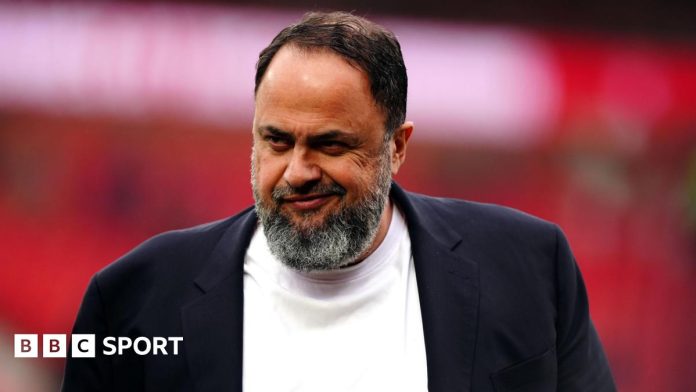
The Football Association is investigating a banner unfurled by Crystal Palace fans that depicted Nottingham Forest owner Evangelos Marinakis holding a gun to midfielder Morgan Gibbs-White’s head.
Forest are hugely disappointed that supporters were permitted to bring the banner into Selhurst Park, according to well-placed sources.
Crystal Palace have been approached for comment by the BBC.
Palace and Forest played out a 1-1 draw at Selhurst Park on Sunday but the clash was overshadowed by the banner which, in addition to the portrayal of Marinakis pointing a gun towards Gibbs-White, read: “Mr Marinakis is not involved in blackmail, match-fixing, drug trafficking or corruption!”
Marinakis has consistently denied any wrongdoing in relation to such allegations.
The FA is probing the banner and will decide whether Palace face punishment.
There are strict rules regarding messaging contained in such banners regarding foul language and defamatory, political and offensive slogans.
The banner will serve to heighten tensions between the two clubs following a controversial summer that saw Palace relegated into the Europa Conference League with Forest taking their place in the Europa League after the London club contravened Uefa’s multi-club ownership rules.
However, there is now major frustration at the City Ground that more was not done to prevent the banner from being displayed.
The banner is viewed at Forest as being inflammatory and xenophobic. They are privately questioning why Palace and the club’s ownership group consisting of Woody Johnson, Parish, Josh Harris and David Blitzer have not publicly criticised the banner.
Gibbs-White came close to leaving Forest for Tottenham earlier this summer after the London club appeared to trigger the England international’s £60m release clause.
But the midfielder ended up staying at the City Ground, signing a new deal,, external and speaking about his decision to stay alongside Marinakis.
The checkout line is where American dreams crash into American paychecks. Beneath the sterile glare of fluorescent lights, surrounded by shelves stacked with promises, ordinary Americans reach not for what they want, but for what they can afford.
And they do it again and again and again.
The woman ahead of you examines two identical-looking coffee makers. One bears a small “Made in USA” sticker and costs $89. The other, manufactured somewhere in Asia — most likely China — rings up at $29. She holds the American-made model for a moment, reading the label twice. Then she sets it back on the shelf and takes the cheaper one. Her face says it all. What looks like apathy toward American jobs is nothing but cold, merciless math — the difference between putting dinner on the table and making excuses to the kids.
No wonder support for “Made in America” has fallen from 60 percent to 50 percent in just two years. That 10-point drop is more than a shifting consumer taste; it’s a national ideal smashing up against everyday reality. For generations, the phrase carried real weight. It was pride forged into steel, stitched into seams, etched into every surface. Then it slipped.
“Made in America” stopped standing for quality and started standing for cost. Corporations learned they could slash expenses by shipping jobs overseas while keeping profits bloated. Consumers got cheaper goods, shareholders pocketed richer dividends, and American workers got pink slips. Still, the romance lingered.
Americans haven’t stopped loving the idea of supporting domestic manufacturing. They’ve simply run out of cash to afford their patriotism. The average American has barely anything in savings. Tens of millions of citizens can’t cover a $1,000 emergency without incurring new debt, and yet they are told to spend $3,000 on a “Made in America” iPhone. That tension feeds straight into politics.
The political divide over “Made in America” reveals an economic reality that runs deeper than partisanship. Sixty-six percent of Republicans say they prefer domestic products compared to 42 percent of Democrats. Tragically, the voters shouting loudest for “Made in America” are the very ones priced out of it. Working-class families who wave the flag for domestic industry still stock up at Walmart, Dollar General and Amazon — not out of disloyalty, but out of a need for basic survival. Their shopping carts don’t betray their values — they betray the brutal reality of living paycheck to paycheck.
They love the idea of buying American, and why wouldn’t they? Their parents and grandparents did precisely that — cars, appliances, tools, clothes. A Maytag washer ran for 20 years. A Ford pickup lasted for decades if you looked after it. “Made in America” once meant durability and quality. Back then, nobody wanted “Made in China” because America’s output was so superior —stronger steel, better engineering, standards that spoke for themselves.
But those days are long gone, and tariffs won’t bring them back. Slapping taxes on imports doesn’t revive craftsmanship; it just punishes families already on the edge. The single mother still can’t buy the American-made winter coat. The only change is that the Chinese version now costs $40 instead of $35.
Real solutions would dig into why American manufacturing lost its edge, and how to restore value, not just raise prices. That means cutting through the regulatory maze that adds thousands of dollars to production costs. It means rewriting a tax code that rewards companies for moving operations offshore. It means reviving vocational education, so the trades that built the country aren’t abandoned in favor of paper degrees for jobs that don’t exist.
Most fundamentally, it would acknowledge that Americans can’t buy American-made goods unless they earn American-level wages. You can’t rebuild factories while workers scrape by on service pay. You can’t revive industrial towns when their residents rely on food stamps and part-time retail jobs. Without wages that can support a family, “Made in America” is just a label on products nobody can buy.
The tragedy isn’t that Americans choose foreign goods over domestic ones. It’s that they’ve been forced into a position where supporting their own economy requires sacrificing their family’s welfare — where patriotism becomes a luxury and loving your country means choosing between heating bills and American-made shoes.
Walk down the empty Main Streets of Pennsylvania or Ohio, and you’ll see the truth written on every storefront. Boarded-up factories, once proud employers, now stand as monuments to offshoring. Families scrounge at dollar stores because everything else is out of reach. Young people leave for cities, not because they want to, but because there’s no work at home.
To make “Made in America” truly great again would mean more than empty promises or taxing imports. It will come only when American workers earn enough to buy what they build, when factories compete through excellence instead of protection, when patriotism and practicality finally pull in the same direction. Until then, Americans will keep facing that quiet heartbreak at the checkout counter. They will keep choosing their children over their country, because decent people, when forced into that cruel choice, always put love of family above love of flag.
The real question isn’t why Americans won’t buy American. It’s why America won’t pay Americans enough to afford American-made goods.
John Mac Ghlionn is a writer and researcher who explores culture, society and the impact of technology on daily life.
Employers are increasingly embracing artificial intelligence over human recruiters to screen potential job candidates.
More than 8 in 10 companies use AI to review resumes, 40% employ AI chatbots to communicate with candidates, and roughly a quarter use AI to conduct interviews, according to a Resume Builder survey. Another 19% plan to add AI for conducting interviews this year.
“The technology has caught on so quickly that many people aren’t ready for it,” Jim Chaffee, an AI expert at the University of Iowa, told Yahoo Finance.
“Using AI early in the process to screen out candidates is a useful and time-saving tool for employers,” he said, “but chatbots are not properly equipped to get more in-depth with a candidate, at which point human participation is vital.”
Companies hiring right now are inundated with job seekers, which has escalated the use of AI interview assistants in recent months, Chaffee said.
The number of Americans filing new applications for jobless benefits rose by the most in roughly three months last week, and unemployment claims have reached the highest level in nearly four years, according to data from the US Department of Labor.
Moreover, last month, there were 62,075 job cuts, up 29% from June, according to a recent report by Challenger, Gray & Christmas. That amps up the 2025 total to 806,383 layoffs, the highest January-to-July figure since the pandemic shutdowns of 2020.
“The applicant count that we’re receiving every day is astronomical,” said Devin Jones, a senior associate at ROCS Grad Staffing in Washington, D.C. “We have hundreds and hundreds of resumes and applications to go through, and for every single interview that we complete, we’re using an AI tool.
AI-led interviews are especially common with roles that require hard skills or technical requirements — accounting, data entry, and administrative positions, Jones said.
In reality, AI has been part of the job hunting process for years now. Nonetheless, job seekers are not happy about it. Only a quarter of job candidates trust AI will fairly evaluate them, according to recent research by Gartner, Inc. More than 6 in 10 candidates said they are more likely to apply to a position if the organization requires in-person interviews.
In AI-assisted interviews, applicants log on to a hiring platform like HireVue or Ribbon AI, where they provide videotaped responses to questions that either pop up on the screen or are verbally asked by an avatar. The sessions are typically under 30 minutes, but can stretch to an hour, Jones said.
The AI algorithms scan the video responses, looking for facial expressions, keyword usage and tone of voice. A transcript of the interview is then sent to a hiring manager or recruiter along with the bot’s take on the candidate’s performance.
I talked to several career strategists about the advice they’re giving their clients and have included my own expert tips. Here’s what you need to know:
Your AI interviewer is looking for the same kinds of things that a human would look for, Chaffee said.
“Job seekers should approach every interview the same way, whether having a human or an AI conversation,” said Christine Cruzvergara, chief education strategy officer at career platform Handshake. “This is critical because if you are qualified to move to the next round of interviews, chances are highly likely that a person will be reviewing your responses.”
“Introduce yourself and smile,” Jones said. “This is your audition tape.”
Candidates get nervous and clam up when there isn’t a person to talk to, she said. Turn the lights on so your face is brightly shown in soft light and your expressions and nonverbal cues are clear. Speak clearly and let your personality come through.
“It’s 10 times harder to let that shine through when you feel like you’re talking to yourself,” Jones added.
It really is more like acting than interviewing, so practice. If possible, practice with a friend or family member on the platform you’ll be using or something similar. With Zoom, for example, you can record it to review. This also helps with figuring out how loud to talk and how to position the screen and camera lens.
Watch and critique your recorded responses to improve your delivery. Keep your shoulders back and your hands quiet.
Workplace etiquette applies to all interview experiences, whether online or in-person, Cruzvergara said. “If you’re interviewing via video, keep your attire professional and your interview environment clear of distractions — no pets on the video.”
You’ll need a reliable internet connection, a webcam, and a microphone. Most computers and laptops have these built in.
Position your computer screen so you’re in the middle (horizontally) and the top of your head is near the top of the computer screen. You should be looking up slightly at the camera, a position that helps define your chin and subtly conveys a message of strength and confidence.
Chatbots are always on and always looking at you, so focus on speech clarity, facial expressions, body language, and eye contact because it will note these things in its report, Chaffee said. Try your best to look into the camera when talking. This can take discipline when you aren’t talking directly to another person.
These explore how you’ve handled work situations in the past. “Having examples ready will keep you from pausing too long, which sometimes triggers an AI to think you’re done answering the question,” Cruzvergara said.
Some bots are programmed to answer basic questions about the job or the employer, so go ahead and ask if it’s so equipped.
“Think of an AI interview not as a traditional conversation, but as a chance to do in-depth fact finding,” said Maggie Mistal, a career consultant and executive coach. “Unlike an interview with a person, you won’t be building rapport or camaraderie, but you can get solid information about the role, the company, and the skill sets they are searching to hire.”
Some of Mistal’s suggestions to ask the bot:
For people hired at my level, what’s their general career path for promotion?
How many years do employees typically stay at the firm?
Is this department a growing part of the company?
Which skill sets or experiences are particularly important for success in this job?
“Be factual in your responses to questions,” Mistal said. “Share specific details and add numbers where you can. For instance, don’t say, ‘I worked in sales and had success.’ Rather, say, ‘I closed a million dollars in sales, landed a large new customer, and was recognized for top performance by leadership with a bonus.’”
Sticky notes on your computer screen can prompt you with talking points to emphasize about your experience, why you’re a good fit for the job, and what questions to ask about the firm.
End your interview by saying a version of, “Thank you for considering me for the job. I look forward to hearing from you.” Smile, and continue eyeing the camera until the interview disconnects.
Then send a thoughtfully worded thank-you note to the hiring manager or recruiter who set it up.
“We receive the exact notes from thousands of candidates,” Jones said. “They’re all identical, carbon copies. Make your note unique, make it stand out. Refer to specific things you talked about. It’s an extension of the interview itself. If you send an AI written note that they’ve received before, you risk being immediately declined from that pipeline.”
The price tag for top college football talent has never been higher — but how high is it, really?
Schools had more money to spend this offseason entering the first year of revenue sharing with athletes. Power 4 programs ponied up to re-sign their returning players and combined to acquire more than 1,400 transfers via the portal. Players increasingly turned to agents to negotiate massive raises and maximize their value.
And yet, we still know too little about what college football players are actually earning. Agents share exaggerated sums in the interest of signing more clients. General managers downplay the numbers to avoid locker room issues. In the NFL, salary and contract data are easy to access. In this sport, without transparency, it’s an inefficient market with an incredibly wide spectrum of underpaid to overpaid players.
How much does a Power 4 starter cost at each position? To answer that question, ESPN surveyed more than 20 college general managers and agents. The goal was to better define the price ranges for each spot based on the deals completed for 2025 and what each side considers fair positional and market value.
To be clear, these price ranges do not reflect what everybody is making at the Power 4 level. There are million-dollar outliers with the elite players at most positions, and there are still good, young players earning less than $100,000. Talent retention is still more affordable than acquisition, so it’s the transfers who tend to reset the floor and ceiling. Agents say SEC and Big Ten programs continue to consistently outspend the ACC and Big 12, regardless of the revenue share cap.
After an unprecedented offseason of inflated spending raised the bar at every position, here’s what Power 4 players are now earning to start and compete at the highest level.
The going rate for good quarterback play quickly surpassed $1 million by the end of November as Power 4 programs re-negotiated deals with their starters to ensure they’d return for 2025 and stay out of the transfer portal. Coaches and GMs anticipated that if they didn’t lock in a seven-figure deal with their QB1, signing a replacement in the portal would be even more expensive. They were right about that.
Several Power 4 schools paid $1.5 million for their transfer quarterbacks this offseason, sources told ESPN, and the highest-paid QBs in the sport will make well over $2 million this year. The top end of the market includes highly coveted transfers such as Miami’s Carson Beck, Duke’s Darian Mensah and Oklahoma’s John Mateer, as well as rising former five-star recruits such as Michigan’s Bryce Underwood and Nebraska’s Dylan Raiola.
Keep in mind, though, that the elite young quarterbacks such as Texas’ Arch Manning and Florida’s DJ Lagway are still earning millions from major brand deals and don’t have to dip into their school’s revenue share or collective funds as much.
“The great ones are like $3 million,” one SEC GM said. “And if you don’t have one, it’s at least $1 million.” As one ACC director of player personnel (DPP) summed it up: “These dudes are getting paid paid.”
The coaching staffs who didn’t anticipate that or who suddenly needed a QB after theirs departed certainly experienced some sticker shock when the portal window opened in December.
“The numbers that were being thrown out there, I thought they were fake at first,” another ACC DPP said. “I was like, for that guy, $1.5 million to $2 million? What? And then I quickly found out that was just the market, that’s what was happening. So we had to step up to the plate and put our big-boy pants on and make a decision. It was certainly a real thing. Those are all real numbers, real money being paid out at that position.”
But when you combine a high number of departing seniors and heavy attrition at the position with programs having more to spend than ever before, it’s no wonder quarterback pay jumped to a seven-figure standard. Only 28 of the 68 programs in the Power 4 have a returning starter at QB entering Week 1.
Agents surveyed by ESPN agreed that Power 4 starters should be making between $1.5 and $2 million and that elite passers could be worth upward of $3 million to $4 million, though they noted there were a few instances this offseason where Power 4 programs managed to get their guy for closer to $800,000.
While Beck was able to leverage his NFL draft decision to maximize his value in the transfer portal, reps generally view the quarterback market as different from the rest. From their perspective, a QB is better off locking in the best situation and fit quickly during the portal window. Nico Iamaleava‘s post-spring exit from Tennessee also clearly demonstrated that the destinations and dollar figures on the table aren’t the same in April as they would’ve been back in January.
Running back: $300,000-$700,000
Good quarterbacks cost what they cost. Running back value is a totally different discussion, one that has been raging in the NFL in recent years. At the college level, staff opinions vary depending on where they are, what they run and who they have. As for the agents?
“I think anything below $750,000 for a starting running back at a serious program would be disrespectful, basically,” one agent argued.
Another agent pointed to Quinshon Judkins as proof that some teams will be willing to go up to seven figures for a top-tier No. 1 back. But Judkins’ move from Ole Miss to Ohio State last year looks more like a rare exception to the rule than a deal that resets the market at the position.
The opinions from recruiting staffers, including those at programs that shopped for portal running backs this offseason, were all over the place. One SEC GM said they’d expect a good Power 4 starting back to cost a minimum of $250,000. A DPP in the Big 12 said his program wouldn’t spend more than $300,000 on one. Others suspect the range is somewhere between $300,000 and $500,000. Most surveyed struggled with the idea of paying a back $500,000 or more unless he’s special.
“Anything more than that, I think you’re overvaluing the position, honestly,” an ACC DPP said.
A few top transfers such as Oklahoma’s Jaydn Ott and Texas Tech’s Quinten Joyner (who just went down with a season-ending knee injury) were able to maximize their value thanks to highly competitive portal recruitments. But other prized backs agreed to deals for less than $500,000, and several more who could’ve earned top dollar preferred to stay put.
“A lot of guys didn’t move,” one agent said. “The running back market, it was kind of weird.”
At Power 4 programs that had good supplies of returning rushers, the imminent revenue share cap forced some to make tough offseason decisions about who needed to get paid and who was expendable. The programs with major needs that had to sign two or more transfers were hunting for bargains this offseason.
Solid rotational backs aren’t cheap, either, with most agreeing they’re looking to be paid around $200,000. It’s no surprise we saw close to 50 Group of 5 and FCS running backs transfer this offseason to P4 schools hoping to get more affordable production.
Wide receiver: $400,000-$800,000
Personnel staffers and agents were fairly aligned when it came to how they perceived the wide receiver market. A true No. 1 receiver costs $700,000 or more and could be worth up to $1 million in some cases. Ohio State’s Jeremiah Smith is an extreme outlier, a generational talent worth so much more than $1 million.
“If you want a guy with any production, it started at $700,000 to $800,000,” one SEC GM said.
The next tier of wideouts, quality No. 2 and No. 3 receivers and starters, were typically valued at closer to the $300,000 to $500,000 range depending on their experience and production.
Year after year, more FBS wide receivers and defensive backs transfer than any other position group. There’s more than enough volume every offseason that programs can live out of the portal in recruiting and, therefore, don’t feel like they need to overspend on skill players.
This offseason, more than 500 FBS scholarship wide receivers entered their names in the transfer portal. Fewer than 200 of them were able to land at Power 4 programs.
“Receiver in the portal is such a saturated market,” one Big Ten GM argued. “Receivers are going to go in every year; that’s just the nature of the position. We always felt like you didn’t need to overpay. You can get an equal player who’s going to take $200,000 less.”
One ACC DPP acknowledged that he probably misjudged wide receiver value going into the December portal period after watching wideouts who made $150,000 to $175,000 last season earn so much more in the portal, including one who got away for more than $500,000.
Another Big Ten staffer said he believed starting wideouts who aren’t No. 1 receivers should be in the $250,000 to $400,000 range. But he paused to point out that blue-chip receiver recruits are now seeking serious paydays as well.
“Some of these freshmen are coming in and making more than your No. 2 receiver,” he said, “because the high school market is so inflated.”
Tight end: $200,000-$400,000
Some Power 4 programs were willing to go as high as $800,000 for all-conference caliber tight ends in the portal this offseason, sources told ESPN, but most aren’t spending anywhere close to that even on proven multi-year starters.
“I think $800,000 is insane,” an SEC GM argued. “That’s nuts.”
Several staffers surveyed said they were able to secure their top portal target for around $300,000 to $400,000. Others still believe that’s overvaluing the position and struggle to justify even going to $200,000. One agent said he was able to secure a $400,000 deal for a primarily blocking tight end whose previous school wouldn’t go any higher than $140,000.
“Tight end is so unique,” a Big 12 DPP said. “There’s just not a ton of them, and it’s very dependent on what they do. There are very few well-rounded tight ends out there.”
There is one player out there whom several GMs pointed to as the ultimate rare exception: Mark Bowman. The No. 26 overall recruit in the 2026 ESPN 300 from Mater Dei High School in California is committed to USC and is already evoking comparisons to Brock Bowers.
Bowman is expected to become one of the highest-paid tight ends in the country as a freshman next year with a seven-figure deal, sources told ESPN. Recruiting staffers see elite potential in the 6-foot-5, 225-pound pass catcher but were still blown away by his number, with one Big Ten staffer describing it as “astronomical.”
Bowman’s deal might not substantially raise the bar for his peers if coaches remain skeptical about spending on tight ends. But if he’s as impactful as Bowers was for Georgia as a Day 1 starter and the Trojans become CFP contenders, perhaps he’s worth every penny.
Offensive tackle: $500,000-$1 million
Offensive guard/center: $300,000-$700,000
Several GMs and DPPs acknowledged that the highest-paid position group on their roster for 2025 is their offensive line. If you had to reload with a bunch of new starters via the portal, the big men took up a big chunk of your roster budget.
Agents say recruiting battles for quality offensive tackles easily get up to $800,000 or $900,000 and can go all the way to $1.2 million or more for left tackles. GMs were more than willing to extend seven-figure offers for the best available tackles and quickly learned the starting point in conversations for starting tackles was no less than $500,000.
Nobody was more coveted than Nevada transfer Isaiah World, a projected first-round pick in ESPN’s early mock drafts for 2026. Sources told ESPN that World turned down a more than $2 million offer to sign with Oregon. Tackles with that kind of early-round potential rarely hit the open market, and it’s worth noting the highest bid might not always win out for pro prospects who are determined to maximize their potential and play for a title contender.
Interior offensive linemen were a little more affordable this offseason, and some staffers had success finding good bargains with guards and centers who had solid starting experience, but the highly competitive recruitments still crossed into the $600,000 to $700,000 range.
One fascinating element about offensive line recruiting in the transfer portal: Timing is everything. Teams that were able to lock up offensive linemen in early December likely got a good discount.
“No school that got the kid to sign early has ever overpaid,” one representative said. “The numbers only go up. The biggest mistake schools make is they wait on a kid they could’ve had for $300,000 and end up getting him for $600,000 — or they offer $600,000 and don’t get him.”
Once coveted targets start going off the board, desperation sets in for teams still dealing with serious needs. One agent said he’s seen Group of 5 linemen who might’ve been making $30,000 last year get offered close to $1 million to move up to the Power 4 level.
Notre Dame’s Rocco Spindler and Pat Coogan waiting until after the national championship game to enter the portal made them highly coveted as proven veteran starters. In one far more extreme instance, sources say a Power 4 team shelled out $1.5 million for an inexperienced tackle late in the winter portal window.
“Folks were desperate,” an ACC DPP said. “They thought the spring portal was going to be super dry.”
They’ve had to step up the pay for more than just their starting five. Multiple staffers said top reserves along the offense line are now expecting to make at least $200,000. All these factors drive home the point that programs ideally need to have success developing and retaining high school linemen if they hope to keep costs somewhat under control in this new era.
“The offensive line room is going to be the most expensive one everywhere,” one SEC GM reasoned, “because you have the most humans there and the acquisition cost is so high on every single one.”
Edge rushers: $500,000-$1 million
Much like in the NFL, college front offices view left tackles and pass rushers as the next-most-valuable positions behind quarterback.
“If it’s the right fit and a program that’s got some money,” an agent said, “they’ll pay $1 million for an edge.”
Texas Tech had an awful lot of money and was willing to make big-time spends here with Stanford’s David Bailey becoming one of the highest-paid defenders in college football at more than $2 million and Georgia Tech’s Romello Height earning more than $1 million this year, sources told ESPN.
For GMs and DPPs with portal needs, it quickly became clear that proven starters weren’t going for less than $500,000. A few staffers did tell ESPN they don’t have any edge defenders on their rosters making more than $500,000, and not everyone is willing to go as high as $1 million for a great one. But plenty were willing to cut big checks to get their guy.
One SEC GM said his school got turned down by an FCS transfer whom they’d offered $650,000. An agent said one of his defensive end clients had an ACC program come in late and triple his best offer to more than $700,000. Another GM said his program had to get up to $800,000 for the Group of 5 transfer they coveted.
“If you need a starter in the portal, good luck,” the SEC GM said.
Defensive tackles: $300,000-$800,000
Texas Tech was a big spender here, too, in its quest to assemble one of the best defensive lines in college football and made serious investments to land their top two targets, UCF’s Lee Hunter and Northern Illinois’ Skyler Gill-Howard.
The Red Raiders had a strategy with their December portal battles that proved incredibly effective: If they could get the right players on campus for an official visit, they’d pay whatever it took to shut down the recruitment. As one Big Ten GM politely put it, the sums Texas Tech was willing to spend “fudged up the market” at a few positions. Still, talented linemen with starting experience are rarely going to come cheap.
“The big guys are demanding the big premiums,” Texas Tech billionaire booster Cody Campbell told ESPN in February.
One agent who repped a top defensive tackle transfer said he fielded multiple $1 million offers, but the best long-term fit for his client ended up being a program that paid $800,000. Highly competitive recruitments could drive the price for a great defensive tackle up to $1 million, but several staffers surveyed agreed that a low-end Power 4 starter is probably worth closer to the $300,000 to $500,000 and were able to sign solid players in that price range.
“I’ve heard sometimes it can be even more expensive for defensive tackles than edges,” the Big Ten GM said, “because, just like the NFL, there are only so many humans that size that can move like that walking on planet Earth.”
Linebackers: $200,000-$500,000
This might be the position group with the greatest disparity in perception between agents and GMs. Multiple agents told ESPN they believed a good linebacker can fetch $500,000 to $700,000 with elite players going for as much as $1 million.
Front office staffers surveyed generally agreed that $300,000 to $500,000 was a more reasonable price range for quality starters. The easiest explanation for that gap might be the offseason portal cycle and the reality that few all-conference caliber linebackers hit the open market. In fact, only four linebackers made ESPN’s top 100 transfer rankings.
There weren’t many $500,000-plus linebackers in the portal, and some staffs intentionally spent less at this position by focusing their efforts on G5 or FCS transfers. One Big 12 school was able to land the top linebacker on its board, a veteran multi-year starter, for a mere $225,000.
“They were not going for an exorbitant amount of money,” an ACC GM said.
Schools might’ve been a little more willing to pay up to retain their returning starters, but bottom line, it comes down to how a staff values the position and how closely they’re trying to stick to a roster budget influenced by NFL standards.
“There are some linebackers starting at P4 schools who are on $200K deals and some who are making $600K, and I don’t think their talent is that big of a difference,” an agent said.
Cornerbacks: $300,000-$800,000
Safeties: $300,000-$700,000
Defensive back is always a high-volume position in the portal, with more than 650 FBS scholarship players transferring over the past year, and everybody plays a bunch of them. For those reasons, there’s plenty of room for debate around the cost of DBs.
Top-tier cornerbacks are still considered more valuable than safeties and are making at least $500,000 at the highest level. “There are so few really good ones,” an SEC GM argued. ACC and Big 12 programs have still been able to land starter corners on deals closer to the $300,000 to $400,000 range, but experience is expensive.
At safety, there were a few rare instances this offseason where all-conference-caliber players secured deals around $800,000, and some staffers suspect the top of the safety market actually ended up being just as expensive as the top of the corner market. One DPP at a program that paid more than $800,000 to re-sign their top safety justified it by pointing to the fact that there were several SEC programs interested in paying him even more.
“A couple guys were being shopped around for crazy amounts of money,” an ACC DPP said, “but I thought it was easier to find bargains at safety.”
This DPP’s coaching staff had a lot of work to do in the December portal window, and he had to quickly adjust to the rapid price inflation. As another staffer summed it up, everybody was suddenly a $200,000 to $300,000 player at every position.
“It didn’t matter what position you were talking to, if you came in at under $150,000 or $175,000, oh man, people take offense to that,” the ACC recruiter said. “They’d say, ‘All right, so you see me as a second- or third-team guy.’ Word was getting out. Agents were hip to the game. If they hear a number that starts with a one, that means depth chart.”
So they spent like they’ve never spent before. They did what they had to do to keep their returning players in the building and secure the recruits they coveted. We’re about to find out how many of these frenzied offseason spending sprees actually paid off and which players were truly worth every penny.
“You make some decisions you look back on like, ‘F— yeah,'” one Big Ten GM said. “You make some decisions you look back on where you’re like, ‘Damn it.’ That was the market, the market was telling me to pay him that much. But was he worth that? You’re going to have those. Every school in the country is looking at the same thing.”
While the Forest hierarchy may be divided, the fans showed at Selhurst Park they remain behind the manager.
Nuno took to the pitch at full-time and clapped and gave a thumbs-up to fans, who responded with chants of ‘Nuno, Nuno, Nuno’.
Then he turned and walked away – and it remains to be seen whether it will be for the final time.
Before the game, Forest fans told the BBC of their concern for the future of the manager who had taken them to their highest Premier League position since the mid-1990s when they finished seventh last season.
Fans Lynne and Lisa, speaking to the BBC’s Aaron Paul as they waited for the away players to arrive at Selhurst Park, remain hopeful Nuno will stay.
“It came out the blue on Friday, hopefully it will all get resolved,” they said.
The do not blame Marinakis, though, as they added: “We like his passion. He’s spending a lot of money, we can’t ask for more.”
The Forest performance at Palace perhaps indicated an uncertainty among the players, lacking the verve and fluency seen in their 3-1 opening-game win over Brentford.
Forest did not have a shot on target until the 57th minute, when Hudson-Odoi’s shot beat Palace keeper Dean Henderson at the near post.
Sympathy for Nuno had been in short supply from the home crowd before that equaliser.
“You’re getting sacked in the morning,” mocked some Eagles fans.
But, referring to Palace’s demotion from the Europa League to the Uefa Conference League for breaching multi-ownership rules, Forest fans responded with, “Europa League, you’re having a laugh”.
Forest, who took that Europa League spot on their league placing, finished much the stronger side and almost snatched victory in added time.
Striker Igor Jesus struck the post, while Hutchinson lifted a shot over the bar after an impressive late cameo.
It meant Forest missed the chance of successive wins to start a top-flight season for the first time since 1987-88 under Brian Clough, but stretched their unbeaten Premier League run against Palace to 11 games.