14.5 C
New York
Monday, May 11, 2026
Home Blog Page 288

Bannon faults lack of GOP town halls, cites failure to sell Trump's 'big beautiful bill'

0


Former Trump strategist Steve Bannon slammed House Republicans on Wednesday for not doing an effective job of selling the president’s “big, beautiful” law of tax and spending cuts over the summer recess.

“I haven’t seen a massive effort to sell the big beautiful bill and actually what it stands for,” Bannon said during his Wednesday “War Room” podcast. 

Bannon also criticized the lack of town halls held by Republicans to sell the bill, saying Republicans had gone home for the August recess but were not holding town hall events to sell the president’s most important legislative package.

Bannon described a “paucity of town halls,” though he acknowledged that town halls have become difficult to hold this year as a series have been interrupted by constituents loudly highlighting their complaints.

For example, Rep. Mike Flood (R-Neb.) recently heard boos and calls to tax the rich at a town hall in Lincoln, Neb., where he promoted the Trump legislation.

Bannon said he believed Democrats were behind some of these interruptions, but nonetheless suggested Republicans needed to hold the events.

He also said the GOP needed to reassess the way they talk about the legislation.

“For instance, we sell the big beautiful bill here in the supply side tax cut of it in a more sophisticated way, not just the Fox News talking points, in a more sophisticated way, with bright people than anybody,” Bannon told listeners.

The former White House strategist said big, beautiful bill talking points need to land with voters ahead of the next election cycle. He urged House Speaker Mike Johnson (R-La.) and Senate Majority Leader John Thune (R-S.D.) to press GOP lawmakers to laud the bill in public forums. 

“Johnson and Thune should cancel all overseas junkets for members and force them to have town halls, meet and greets, editorial board meetings — anything to get the word out on the BBB. The supply-side tax cut needs to be sold, and it ain’t gonna sell itself,” Bannon told Politico

“The 2026 midterms have started, and the Republicans are letting down the president.”

Diageo to brew Guinness at new facility in Ireland

0


Diageo is planning to brew Guinness at the new site it is building south-west of Dublin.

The brewery in County Kildare has been in the works for three years and is slated to started production in early 2026.

When Diageo first announced the plans for the site, it said the brewery would produce lager and ale brands including Hop House and Smithwick’s.

The brewery was originally projected to have a capacity of 2m hectolitres annually but Diageo has submitted a planning application to more than double that to 4.5m hectolitres.

The drinks giant also wants to brew Guinness and the non-alcoholic Guinness 0.0 at the site, shipping to undisclosed “emerging markets”.

Diageo said the St. James’s Gate brewery in Dublin will be “the heart and soul of Guinness”, continuing to brew for the “largest and most established markets” for the brand, including Ireland, the UK and the US.

Colin O’Brien, Diageo’s global head of beer supply said: “This planned expansion at Littleconnell is designed to position us for future global growth opportunities for Guinness and Guinness 0.0. By increasing our capacity, we can better serve emerging markets while strengthening Ireland’s position as a leading market for beer exports.”

The construction of the brewery in the town of Littleconnell began in June last year after an environmental complaint from a local resident was subsequently withdrawn.

“Diageo to brew Guinness at new facility in Ireland” was originally created and published by Just Drinks, a GlobalData owned brand.


The information on this site has been included in good faith for general informational purposes only. It is not intended to amount to advice on which you should rely, and we give no representation, warranty or guarantee, whether express or implied as to its accuracy or completeness. You must obtain professional or specialist advice before taking, or refraining from, any action on the basis of the content on our site.

Hundreds of thousands of Grok chats exposed in Google results

0


Liv McMahon

Technology reporter

Getty Images Grok logo displayed on a smartphone, with it's logo shown on a blurred, larger backdrop behind it. Getty Images

Hundreds of thousands of user conversations with Elon Musk’s artificial intelligence (AI) chatbot Grok have been exposed in search engine results – seemingly without users’ knowledge.

Unique links are created when Grok users press a button to share a transcript of their conversation – but as well as sharing the chat with the intended recipient, the button also appears to have made the chats searchable online.

A Google search on Thursday revealed it had indexed nearly 300,000 Grok conversations.

It has led one expert to describe AI chatbots as a “privacy disaster in progress”.

The BBC has approached X for comment.

The appearance of Grok chats in search engine results was first reported by tech industry publication Forbes, which counted more than 370,000 user conversations on Google.

Among chat transcripts seen by the BBC were examples of Musk’s chatbot being asked to create a secure password, provide meal plans for weight loss and answer detailed questions about medical conditions.

Some indexed transcripts also showed users’ attempts to test the limits on what Grok would say or do.

In one example seen by the BBC, the chatbot provided detailed instructions on how to make a Class A drug in a lab.

It is not the first time that peoples’ conversations with AI chatbots have appeared more widely than they perhaps initially realised when using “share” functions.

OpenAI recently rowed back an “experiment” which saw ChatGPT conversations appear in search engine results when shared by users.

A spokesperson told BBC News at the time it had been “testing ways to make it easier to share helpful conversations, while keeping users in control”.

They said user chats were private by default and users had to explicitly opt-in to sharing them.

Earlier this year, Meta faced criticism after shared users conversations with its chatbot Meta AI appeared in a public “discover” feed on its app.

‘Privacy disaster’

While users’ account details may be anonymised or obscured in shared chatbot transcripts, their prompts may still contain – and risk revealing – personal, sensitive information about someone.

Experts say this highlights mounting concerns over users’ privacy.

“AI chatbots are a privacy disaster in progress,” Prof Luc Rocher, associate professor at the Oxford Internet Institute, told the BBC.

They said “leaked conversations” from chatbots have divulged user information ranging from full names and location, to sensitive details about their mental health, business operations or relationships.

“Once leaked online, these conversations will stay there forever,” they added.

Meanwhile Carissa Veliz, associate professor in philosophy at Oxford University’s Institute for Ethics in AI, said users not being told shared chats would appear in search results is “problematic”.

“Our technology doesn’t even tell us what it’s doing with our data, and that’s a problem,” she said.

A green promotional banner with black squares and rectangles forming pixels, moving in from the right. The text says: “Tech Decoded: The world’s biggest tech news in your inbox every Monday.”

Hegseth is right to restore the Reconciliation Memorial

0


Secretary of Defense Pete Hegseth has announced plans to return the Arlington Confederate Memorial, otherwise known as the Reconciliation Memorial, to the Confederate portion of Arlington National Cemetery. This drew a rebuke from retired Army General Ty Seidule, former vice-chair of the Naming Commission, the body Congress created to review Confederate iconography within the Defense Department.

“By ordering the monument back,” Seidule wrote in The Hill recently , “Hegseth is subverting Congress and the will of the American people.”

Those are bold words from the general, who describes himself as a student of “Confederate commemoration.”  Well, I am the great-grandson of a Confederate soldier. My great-grandfather’s family included five Confederate cavalrymen and one infantryman. I’m an American person and I applaud Hegseth’s action.

Members of the Naming Commission have been misleading the American people, pretending they had a popular mandate to act that simply never existed. 

To hear them tell it — those few who are willing speak publicly, that is — Congress wholeheartedly endorses their work. But the commission’s creation was not by public acclaim or popular legislation. Rather, it was an obscure proposal, buried deep within the fiscal 2021 National Defense Authorization Act — the behemoth bill authorizing all U.S. military operations.

On Feb. 7, 2024, commission members held a seminar at Hamilton College in New York. One declared that Congress had given the commission’s work overwhelming support. “In voting to override” President Trump’s lame-duck veto of that bill, “bipartisan supermajorities of 81 senators and 322 representatives declared it was time to try to end Confederate commemorations. Two years later, in 2022, with the midterm election in full swing, about the same number if not more welcomed the Naming Commission’s report, endorsed its recommendations and greenlit the Defense Department to move out.”

The commission’s final report proclaims: “In passing the 2021 William M. ‘Mac’ Thornberry National Defense Authorization Act, the United States Congress determined that Confederates and the Confederacy no longer warrant commemoration through Department of Defense assets.” But if Congress enthusiastically endorses the commission’s recommendations, its judgements, and its sweeping opinion of its mandate, it sure has an odd way of showing it.

In reality, the Naming Commission had already disbanded long before average people even realized what it was doing — that its recommendations went fa beyond just changing the names of a few Army bases. The email address for its press point-of-contact was dead by the beginning of January 2023, and the commission’s website had already disappeared by April.

The only commissioner who was a sitting member of Congress and the only representative of a former Confederate state — Rep. Austin Scott (R-Ga.) — refused to answer questions about the commission’s actions. His staff told me that the commission had asked members not to comment publicly on its work.

Thousands of letters and emails, to hundreds of Congressional members and staffers, asking for explanations of the commission’s actions (and Congress’ oversight of it) have gone unanswered. In fact, it is almost impossible to find any member of Congress who wants to talk publicly about this matter. If this was Congress’s specific intention in passing that much bigger defense package, then why isn’t Capitol Hill trumpeting this rousing bipartisan success?

Many Union veterans were unhappy when the Reconciliation Memorial was erected in 1914. But other Northerners and Southerners saw the memorial as a demonstration that two dramatically different parts of a growing nation, despite holding irreconcilable opinions on what the nation’s Civil War experience meant, could reach an accommodation that both sides could live with. That would help the nation put the war’s trauma behind it and build a newly united nation.

To the allegation that the monument “clearly commemorates the Confederacy and its purpose — chattel slavery,” I would quote back the prepared remarks at the dedication ceremony by Washington Garner, Commander in Chief of the Grand Army of the Republic — the leading organization for Union Civil War veterans.

“This memorial structure speaks the language of peace and good-will,” he said. “It seems fitting that here in this place and on these grounds, once the home of Robert E. Lee, there should rest the remains of some of the gallant men who followed that great soldier even unto death. It is fitting here, in sight of the Nation’s Capital, and in this vast burial plot consecrated to American valor that some of our fellow countrymen, the representatives of once-hostile armies whose unsurpassed bravery is now a common heritage and pride, should rest in undisturbed slumber.”

One hundred years ago, veterans from opposing sides of our nation’s most divisive and traumatic war found a way to compromise, reconcile and move forward.

Two years ago, Congress’ agents determined that it was not only necessary but “the will of the American people” to undo all of that — to remove a statue from a remote part of a cemetery. Our enemies might interpret that as a sign that we are becoming an emotionally and culturally brittle people — as Osama Bin Laden once put it, “a weak horse.” 

Weak horses invite attack by predators. A strong and confident nation, on the other hand, demonstrates that it can handle the complexities of its history and does not feel compelled to judge people from the past based on present-day sensibilities. Hegseth’s decision to restore the Reconciliation Memorial to Arlington is a sign that the weak horses and “woke lemmings” are no longer in charge in Washington.

Donald Smith is a member of the Arizona Division of the Sons of Confederate Veterans.

Access to this page has been denied.

0


Access to this page has been denied because we believe you are using automation tools to browse the
website.

This may happen as a result of the following:

  • Javascript is disabled or blocked by an extension (ad blockers for example)
  • Your browser does not support cookies

Please make sure that Javascript and cookies are enabled on your browser and that you are not blocking
them from loading.

Reference ID: #7ffc1fb5-7e8e-11f0-a1f5-38f3e99f1d79

How to appeal results or resit exams

0


PA Media A young woman (l) wearing a black headscarf cries happy tears as she shows her GCSE results to her teacher, a woman wearing a dark suit, a colourful headwrap and large hoop earrings. PA Media

Hundreds of thousands of GCSE students in England, Northern Ireland and Wales have been finding out their grades today.

Here is everything you need to know about results, appeals and resits.

How can I appeal against my GCSE results?

If you do not think your grade is right, you should first talk to your school or college.

It will contact the exam board on your behalf and ask for your marks to be reviewed.

If you still think you have been unfairly graded after a review, you can ask your school or college to appeal.

The exam board will consider whether a correction is needed.

If you are still not satisfied, you can request a review from regulator Ofqual.

How do GCSE resits work if I fail an exam?

You can resit any GCSE exam the following academic year.

In England, students need maths and English GCSEs at grade 4 or above to qualify for further study – although you can prepare for resits alongside your new subjects.

Resits for both subjects take place from 4 November.

If you want to explore resitting a subject, you should speak to your school or college about the best course of action.

What time do GCSE results come out?

GCSE results came out on Thursday, 21 August from 08:00 BST.

Some students in England have been able to get their results via a new app which delivers grades directly to their phones from 11:00 BST on results day.

Around 95,000 pupils in Manchester and the West Midlands will use the app this summer, before it is rolled out more widely.

In Wales and Northern Ireland, results are usually distributed by schools and colleges.

How are GCSEs graded and what are the GCSE grade boundaries?

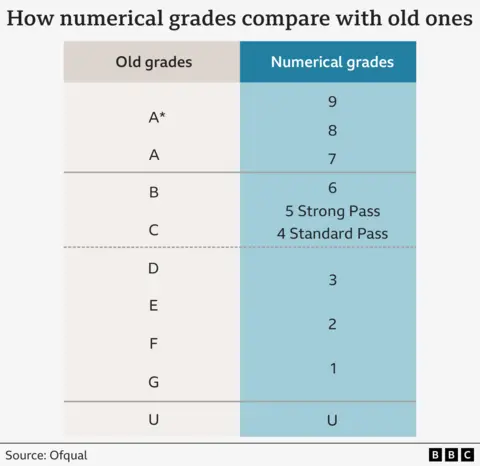
In England, GCSEs are graded using a numerical system from 9-1, rather than A-E as was previously the case.

Students need 4 for a “standard pass” and 5 for a “strong pass”.

In Wales and Northern Ireland, GCSEs are still graded using letters, unless an exam taken in those nations is managed by an English exam board.

Graphic How numerical grades compare with old ones: A* and A grades under the old system are now graded 9, 8 or 7 under the numerical system. Bs and Cs have been replaced by 6, a 5 Strong Pass or a 4 Standard Pass. D, E, F and G grades have been replaced by 3, 2 and 1. Grade U is still recorded as U. Source: Ofqual

Grade boundaries show the minimum number of marks you need for each grade, whether it is a number of letter.

They are decided by examiners and published on results day.

What are my options after GCSEs?

If you live in England, you must remain in official education or training until you turn 18.

You may choose to stay in full-time education, start an apprenticeship or work while studying part-time.

Many pupils go on to study A-levels. International Baccalaureate (IB) is also an option.

There is also a range of vocational courses you could take, such as National Vocational Qualifications (NVQs), BTec Level 3s, TechBacs, Cambridge Technicals and (in England only) T-levels.

Apprentices get paid a salary, as they spend 80% of their time in the workplace while being trained.

Getty Images A student revises at home with a book open in front of her. She is wearing a grey hoodie and appears to be working at a kitchen table, with her mum and younger sibling stood at a sink in the blurred background.Getty Images

When is results day in Scotland?

The Millennium Challenge Corporation advances US interests — don't kill it

0


The future is unclear for a key, 20-year-old U.S. government initiative advancing American interests around the world and blunting Chinese and Russian influence.  

The Millennium Challenge Corporation changed the way development assistance was done. It has lifted hundreds of millions of people out of poverty since its launch by President George W. Bush in 2004. It was a year after he created the President’s Emergency Plan for AIDS Relief, which has saved more than 26 million people over the past two decades, especially on the African continent. 

Both are perfect examples of American soft power at its best. But whereas the AIDS relief program has largely been spared recent budget cutting after some hiccups, the Millennium Challenge Corporation’s future is less clear. Its board meets this week to decide whether to terminate more than half of its portfolio of compacts and smaller threshold programs in various stages of development or implementation. These programs are in Africa and Asia, strategically important regions of the world in which China and Russia would be happy to take our place.  

The board should consider the impact of possible cuts to our country’s reputation as a reliable partner and whether such a reduction would actually benefit U.S. economic, national security and diplomatic interests.   

Although all government programs should be regularly reviewed for efficiency and effectiveness, it seems shortsighted to drastically reduce the footprint of an agency that has been successfully implementing its mandate to the benefit of U.S. interests. Congress has historically supported the Millennium Challenge Corporation as a model for development and a safeguard for our national security, and its funding level in the House fiscal 2026 appropriations bill demonstrates that support.  

The Millennium Challenge Corporation aims to reduce poverty through economic growth and exemplifies how the generosity of the American people can really make a difference overseas in ways that advance U.S. national interests while driving development.  

The program has expanded access to electricity in Benin and Georgia so that children can study after dark and hospitals can properly store vaccines. It has created the infrastructure to deliver clean water to homes and businesses in Cape Verde and Mongolia. And it has built or improved roads, airports, ports and bridges in many countries so that people can get to school or work — and efficiently deliver their goods to markets.  

In Africa, the program has educated more than 255,500 students, contributed more than 26 million megawatt-hours of electricity, guaranteed over 305,000 households and businesses have legal rights and protections over their land, and improved production for over 70,600 farmers.  

The Millennium Challenge Corporation has funded 82 agreements in 49 countries since 2004, benefiting nearly 400 million people. Twenty-five of these countries are in Africa, and these investments have benefited an estimated 154 million Africans.  

And it has done all this in financially sound ways. Moreover, this kind of assistance opens doors for the United States, including for American companies seeking to do business in and with these countries.  

The Millennium Challenge Corporation took a groundbreaking approach to foreign assistance, requiring that countries qualify based on rigorous third-party indicators measuring democratic governance, investment in health and education, and economic freedom. Countries that don’t meet these criteria aren’t eligible for compacts, which are binding agreements developed in partnership with qualifying countries with rigorous monitoring.  

As with the Bush-era AIDS program, the Millennium Challenge Corporation’s focus on Africa is well placed. By 2050, more than 25 percent of the world’s population will live there. By 2030, more than 40 percent of the world’s young people will be African. Already, more than half of the world’s 20 fastest-growing economies are in Africa, along with 65 percent of the world’s arable land and about 30 percent of the world’s mineral reserves.  

The Millennium Challenge Corporation engenders tremendous goodwill among the populations of recipient countries and helps counter efforts by Russia and China to insert themselves at the expense of U.S. interests. Whether through cultural engagement programs and educational opportunities, infrastructure investments or military interference, Beijing and Moscow seek to expand their influence in the region while at the same time spreading anti-Western propaganda and taking advantage of disenfranchised or struggling populations to export their authoritarian brand of governance. 

This is a risk for the African population, global security and American interests. Without this program, the picture would look much worse. It empowers its partners, championing country ownership of its development projects rather than holding them hostage to burdensome loan terms, like China does. It creates jobs, rather than taking them from the local population. Ut requires transparency and accountability for every dollar spent, as opposed to the shady, corrupt deals China and Russia seek.  

There must be accountability both from partner countries and the Millennium Challenge Corporation. The compact countries must maintain their performance on the indicators and implement the compact transparently. Meanwhile, they Millennium Challenge Corporation measures economic rates of return on its investments and rigorously evaluates every program for effectiveness and results. 

The Millennium Challenge Corporation demands democratic governance, investment in people, and policies supporting economic freedom from its partners so they can escape poverty and build strong economies, rather than undercutting democracy and saddling its partners with debt. At the same time, it creates opportunities for private investment and develops trade and economic partners. A drastic reduction in its work could leave unfinished projects that China would sweep in and complete — and claim credit for.  

The Millennium Challenge Corporation uses foreign assistance dollars responsibly to lift people out of poverty while strengthening U.S. diplomatic ties and economic partnerships — all while fostering a positive view of America among both citizens and governments. Its board should keep this in mind this week.  

Monica Vegas Kladakis is senior advisor for Outreach and Strategic Partnerships at the George W. Bush Institute and previously served as managing director for Threshold Programs at MCC. David J. Kramer is executive director the George W. Bush Institute. 

Waystar to Acquire Iodine Software in $1.25B Deal to Enhance AI-Powered Healthcare Platform

0


Waystar Holding Corp. (NASDAQ:WAY) is one of the best IPO stocks to buy according to Wall Street analysts. On July 24, Waystar entered into a definitive agreement to acquire Iodine Software for an enterprise value of $1.25 billion. The deal is expected to be funded with an even split of cash and stock. Waystar shareholders will own ~92% of the new combined company, while Iodine equity holders will own about 8%.

Advent, which is the largest shareholder of Iodine, will receive Waystar shares and has agreed to an 18-month lock-up period post-closing. The acquisition is anticipated to close by the end of 2025, pending regulatory approvals. The acquisition aims to enhance Waystar’s cloud-based platform by integrating Iodine’s AI-powered clinical intelligence software.

Waystar to Acquire Iodine Software in $1.25B Deal to Enhance AI-Powered Healthcare Platform

A close-up of a hand tapping away at a keyboard, using the company’s software to carry out a transaction.

The combined entity is projected to serve 17 of the 20 US News Best Hospitals and increase Waystar’s total addressable market by over 15%. The integration will use Iodine’s AI engine, called IodineIQ, which trains on patient encounters and clinical data to automate tasks. The companies anticipate more than $15 million in cost synergies within the first two years after the closing.

Waystar Holding Corp. (NASDAQ:WAY) is a company that develops a cloud-based software solution for healthcare payments.

While we acknowledge the potential of WAY as an investment, we believe certain AI stocks offer greater upside potential and carry less downside risk. If you’re looking for an extremely undervalued AI stock that also stands to benefit significantly from Trump-era tariffs and the onshoring trend, see our free report on the best short-term AI stock.

READ NEXT: 30 Stocks That Should Double in 3 Years and 11 Hidden AI Stocks to Buy Right Now.

Disclosure: None. This article is originally published at Insider Monkey.

Russia launches biggest wave of strikes on Ukraine for weeks

0


Russia has launched 574 drones and 40 missiles on Ukraine in one of the heaviest bombardments in weeks, Ukrainian officials say.

One person was killed in a drone and missile strike on the western city of Lviv, while 15 others were reported wounded in an attack on the south-western Transcarpathia region.

The attacks came as US President Donald Trump spearheads diplomatic moves to halt the war. Ukrainian Foreign Minister Andrii Sybiha said the strikes highlighted why efforts to bring it to an end were “so critical”.

President Volodymyr Zelensky has said Ukraine was ready to meet Russia’s Vladimir Putin “in neutral Europe” – mooting Switzerland or Austria – adding that he was not against Istanbul either.

Zelensky has stated his willingness to meet Putin in “any format”, although he has poured cold water on the idea of talks taking place in Budapest, which he said “is not easy today”.

The prospect of direct talks emerged after Trump met Putin in Alaska, and then hosted Zelensky and European leaders at the White House on Monday.

The US president initially suggested trilateral talks involving him, Putin and Zelensky, but has since suggested he might not take part: “Now I think it would be better if they met without me… If necessary, I’ll go.”

Ukraine’s air force counted 614 drones and other missiles fired by Russia overnight into Thursday and said it had stopped 577 of them. It is the biggest air attack since July.

While Russian strikes tend to focus on eastern regions close to the front lines, the latest attacks hit western areas as well.

Since the start of Russia’s full-scale invasion of Ukraine in 2022, its forces have occupied most of Ukraine’s eastern Donbas region, including Luhansk and Donetsk.

Russia currently controls around a fifth of Ukrainian territory, including the Crimean peninsula, which it annexed in 2014.

Sybiha said hypersonic, ballistic and cruise missiles were among the weapons used in the overnight barrage.

The Ukrainian air force said many of the attacks came from western Russia, as well as from the Black Sea, while one missile came from Russian-occupied Crimea.

In the western Lviv region, where one person was killed, three more were injured in attacks that damaged more than 20 civilian buildings including residential homes and a nursery.

Another 15 people were injured when cruise missiles hit a US electronics firm in the far south-western town of Mukachevo in Transcarpathia, not far from Ukraine’s borders with Hungary and Slovakia.

“One of the missiles struck a major American electronics manufacturer in our westernmost region, leading to serious damage and casualties,” Sybiha wrote on social media on Thursday. The plant produces coffee machines and other household goods, officials say.

Speaking to reporters on Thursday, Zelensky said there was still no sign from Moscow that they “truly intend to engage in substantive negotiations” to end the war.

He also made clear his lack of enthusiasm for Budapest as a host for potential talks on Thursday, citing Prime Minister Viktor Orban’s strong ties with Moscow: “I’m not saying that Orban’s policy was against Ukraine, but it was against supporting Ukraine.”

The idea of the Hungarian capital as a potential venue for peace talks has emerged in recent days. Hungarian Foreign Minister Peter Szijjarto said Budapest was ready to provide “appropriately fair and safe conditions” for negotiations to take place.

The Ukrainian leader also said Russian forces were massing on the southern front line in the Zaporizhzhia region – one of four regions of Ukraine that Russia now claims as its own.

“We can see that they continue transferring part of their troops from the Kursk direction to Zaporizhzhia.”

Navy pilot rescued after ejecting from jet off Virginia coast

0


NAVAL AIR STATION OCEANA, Va. (WAVY) – A Navy pilot is recovering after ejecting from an F/A-18E Super Hornet off the coast of Virginia.

Lt. Jackie Parashar, a public affairs officer for Naval Air Force Atlantic, confirmed to Nexstar’s WAVY that the mishap took place just before 10 a.m. EDT on Wednesday.

The pilot, assigned to Strike Fighter Squadron (VFA) 83, was conducting a routine training flight at the time, the Navy said. The squadron is based at Naval Air Station Oceana in Virginia Beach, Va. The pilot ejected and the plane crashed into the water. The Navy has not indicated yet what led to the crash.

Search and rescue crews responded and located the pilot at 11:21 a.m.

Dale Gauding, a spokesperson for Sentara, confirmed the Coast Guard brought a Navy pilot to Sentara Norfolk General Hospital Wednesday. 

The F/A-18E remained in the water as of publishing time.

The Navy said the cause of the mishap is under investigation.

This is the latest in a series of crashes involving Hampton Roads-based Navy fighter jets. In May, an F/A-18F Super Hornet was lost in the Red Sea after it went over the Norfolk, Va.-based USS Harry S. Truman aircraft carrier during an attempted landing and crashed into the sea. Both pilots ejected. About a week earlier, another fighter jet, an F/A-18E, also fell from the Truman into the Red Sea while sailors were towing the aircraft.

In December, another Hornet assigned to the “Red Rippers” of Strike Fighter Squadron 11 out of Naval Air Station Oceana, was shot down during an apparent “friendly fire” incident. That jet also took off from the Truman.

According to Naval Air Systems Command, the F/A-18E Super Hornet costs around $67 million.