The US has reached bilateral deportation agreements with Honduras and Uganda as part of its crackdown on illegal immigration, according documents obtained by the BBC’s US partner CBS.
Uganda has agreed to take an unclear number of African and Asian migrants who had claimed asylum on the US-Mexico border, and Honduras will receive several hundred deported people from Spanish-speaking countries, CBS said.
The move is part of an attempt by Donald Trump’s administration to get more countries to accept deported migrants that are not their own citizens.
Human rights campaigners have condemned the policy, saying migrants face the risk of being sent to countries where they could be harmed.
Under the agreement, Uganda has agreed to accept deported migrants as long as they don’t have criminal histories, but it’s unclear how many the country would ultimately take, CBS reported.
Honduras agreed to receive migrants over two years, including families travelling with children, but documents suggest it could decide to accept more.
Both deals are part of the Trump administration’s broader push for deportation arrangements with countries on several continents – including those with controversial human rights records.
So far, at least a dozen nations have agreed to accept deported migrants from other countries.
Last week, the US State Department announced it had signed a “safe third country” agreement with Paraguay to “share the burden of managing illegal immigration”.
The White House has also been actively courting several African nations, with Rwanda saying earlier this month it will take up to 250 migrants from the US.
A condition of the deal specifies that Rwanda would have “the ability to approve each individual proposed for resettlement”, a government spokesperson told the BBC.
Rwanda has previously been criticised for its human rights record, including the risk that those sent to the East African nation could be deported again to countries where they may face danger.
Earlier this year, Panama and Costa Rica agreed to take in several hundred African and Asian migrants from the US.
Government documents show the Trump administration has also approached countries like Ecuador and Spain to receive deported migrants, CBS reported.
Since the start of his second term, Trump has embarked on sweeping efforts to remove undocumented migrants – a key election promise that drew mass support during this campaign.
In June, the US Supreme Court cleared the way for Trump to resume deportations of migrants to countries other than their homeland without giving them the chance to raise the risks they might face.
At the time, Justices Sonia Sotomayor, Elena Kagan and Ketanji Brown Jackson dissented from the majority ruling, calling the decision “a gross abuse”.
UN rights experts and human rights groups have also argued that these removals to a nation that is not the migrant’s place of origin could violate international law.
The Trump administration launched its first TikTok account Tuesday as the fate of the social media app in the U.S. remains unclear.
“Every day I wake up determined to deliver a better life for the people all across this nation,” President Trump says in the first video shared to the account. “I am your voice.”
The caption accompanying the video reads, “America we are BACK! What’s up TikTok?”
TikTok’s future in the U.S. is still unknown as Trump continues to extend the deadline for the app’s China-based parent company, ByteDance, to divest or sell TikTok. Trump in June signed an executive order pushing the deadline to Sept. 17, marking the third time he has extended the deadline for the ban to take effect.
“We are grateful for President Trump’s leadership and support in ensuring that TikTok continues to be available for more than 170 million American users and 7.5 million U.S. businesses that rely on the platform as we continue to work with Vice President Vance’s Office,” TikTok said in a June statement.
The administration’s new TikTok account could signal that Trump will continue to allow the app to operate within the U.S. past the upcoming September deadline.
Imogen Farmer was taken shopping in London as a reward for her A-level grades last year
Hundreds of thousands of GCSE students are nervously waiting for their results this week – and for some, a shiny, often expensive reward might be at stake.
Ahead of results day on Thursday, BBC News has spoken to students and parents about whether the promise of jewellery, gifts or cash for grades can actually motivate teens to do better in their exams.
Imogen Farmer, from Essex, was taken with her twin sister to London by their parents after they got their A-level results last year and given some money to spend as a reward.
“I bought Vivienne Westwood jewellery and then they took us to quite a fancy restaurant that we’d always wanted to go to,” Imogen says.
“But I think I knew in the back of my head if I did well or even if I didn’t do well, I’m sure our parents would have taken us out anyway for working hard.”
Imogen doesn’t think the reward would have made a difference to the amount she studied as she was always “quite ambitious” – and her parents didn’t mention it until after her exams were over.
Jess Cooper, from Birmingham, jokes that her reward was “not getting kicked out of the house”.
“Good grades were a reflection of how hard you tried at school,” she says.
“My parents are very proud of me and tell me all the time. I’m very working class, we have the grit and we try our hardest.”
Both Imogen and Jess both say some students in their classes were offered money for each top grade they achieved – while others were even promised “first cars” if they got the results they needed.
Jess Cooper
Student Jess Cooper believes for those that don’t like school, rewards could make them more motivated
Some parents believe the offer of a reward or financial incentive can help with motivation.
Leon Smith, from Surrey, has given his children a £50 reward for passing their exams, saying it helps them get into the right mindset beforehand.
“It means that, when they revise, they have the motivation and they will spend an extra hour looking at their books rather than playing video games”, the father-of-six explains.
He says his son Isiah, who has just finished Year 6 and took his Sats earlier this year, was particularly motivated to do well after watching his older sister Reah receive the £50 prize the year before.
“It gives them some form of incentive and the ability to work towards something,” Leon says.
He now plans to offer rewards for his children at GCSE and A-levels too.
Leon Smith
Leon Smith plans to offer a financial reward to his children at GCSE and A-levels to help their motivation
Mum-of-two Elaine Dean, from Manchester, says the promise she made of cash-for-grades ended up costing her “more than anticipated”.
The former primary school teacher decided to give her son Zach between £5 and £15 based on each grade for his GCSE exams two years ago, but she says she was really rewarding his effort.
“You don’t want to build up too much pressure on them, praise and parental involvement throughout their school years is far more important,” she says.
Zach received his A-level exam results on Thursday.
“I think his reward is going to be a city break with his brother but he hasn’t decided yet.”
Do rewards for good grades work?
Experts say the effectiveness of rewards very much depends on the student and their relationship with learning.
Rewarding effort rather than grades can be a far more long-term and sustainable strategy for parents, according to psychologist Natasha Tiwari.
“Cash or big-ticket treats can work in the short term,” she says, but they also risk making students think of achievements as “transactional”.
She believes a special day out, or being allowed to redecorate their bedroom or host some family or friends can be a far more powerful reward than “cash in an envelope”.
Different rewards – or none at all – can create tension within friendship groups too, she says.
“There is a distinction to be made between a reward for good grades and a treat to acknowledge their effort,” says Manny Botwe, president of the Association of School and College Leaders.
Secondary school head Manny says he is sceptical of the long-term benefits of trying to reward performance.
“I worry about the youngsters who don’t get good results, it’s ‘deal or no deal’,” he says.
“My advice for parents would be not to make their children feel their value is directly related to the grades they get. From very early on, I like to emphasis the intrinsic value of education.
Air support for Ukraine? Trump floats security guarantee
President Trump is floating providing U.S. pilots and warplanes as part of security guarantees for post-war Ukraine as he pushes for an end to Russia’s war against the country.
Trump has said the U.S. will help Europe craft security guarantees for Ukraine to backstop any peace deal reached with Russia, in lieu of Ukraine joining NATO, a red line for Russia.
“When it comes to security, they are willing to put people on the ground,” Trump said in an interview on “Fox & Friends” Tuesday morning, referring to Europe. “We’re willing to help them with things, especially, probably, if you talk about by air because nobody has stuff we have.”
White House press secretary Karoline Leavitt said Tuesday that Trump has tasked his national security team to “come up with a framework for these security guarantees that can be acceptable to help ensure a lasting peace and end this war.”
“I won’t, certainly, rule out anything as far as military options that the president has at his disposal, I’ll let him do that,” she said, adding the president has “definitively” ruled out boots on the ground.
NATO Secretary-General Mark Rutte on Monday said Trump’s willingness to involve the U.S. in security guarantees for Ukraine was a “breakthrough” in the peace process, though details on America’s potential role remain scarce.
Trump’s floating the possibility of air support could mean American pilots engaged in defensive operations, guarding against Russian missiles, or simply providing support for other aircraft — such as air-to-air refueling or for transportation of military equipment.
Defensive operations could risk a confrontation between the U.S. and Russia, a scenario that both Trump and former President Biden before him have been anxious to avoid.
Welcome to The Hill’s Defense & National Security newsletter, I’m Ellen Mitchell — your guide to the latest developments at the Pentagon, on Capitol Hill and beyond.
President Trump’s Republican allies are putting pressure on him not to entangle the U.S. militarily in Ukraine after he signaled an openness to helping craft security guarantees for the embattled nation in its war against Russian aggression. Trump and the White House on Tuesday insisted the U.S. would not put boots on the ground in Ukraine but floated the idea of providing air support using U.S. pilots and warplanes. That came …
Director of National Intelligence Tulsi Gabbard revoked the security clearances of 37 current and former intelligence officials, sharing the list in a move that prompted swift criticism that the Trump administration was politicizing clearances. Among those on the list are several Biden administration officials, including Maher Bitar, who joined the National Security Council (NSC) after previously working for then-House Intelligence …
Ben Rhodes, who served as former President Obama’s deputy national security adviser, expressed skepticism on Tuesday that a peace deal to end the war in Ukraine could materialize in the near future. In an interview on MSNBC’s “Chris Jansing Reports,” Rhodes said it appears the two sides remain far apart on key issues — like details of security guarantees for Ukraine and potential NATO troop deployment — and the former Obama …
Raskin: Trump’s National Guard DC deployment is ‘recipe for chaos’
Rep. Jamie Raskin (D-Md.) on Monday said President Trump’s crackdown on crime in Washington using the National Guard is “a recipe for chaos.” “Now they’re mobilizing the National Guard, they’re bringing the National Guard in from South Carolina, from Ohio, from West Virginia, from all these states, …
Upcoming things we’re watching in and around the defense world:
The Institute for Defense and Government Advancementwill hold Day 2 of its “2025 Counter UAS Summit,” at 8:55 a.m. tomorrow.
Peterson Institute for International Economicswill have a virtual discussion on “Are the Sanctions on Russia Finally Working?” tomorrow at 9 a.m.
The Center for Strategic and International Studieswill host an online talk on “The Future of U.S.-Australia Critical Minerals Cooperation,” with Australian Ambassador to the U.S. Kevin Rudd at 10 a.m. tomorrow.
The Center for Strategic and International Studieswill also hold a virtual media briefing on “Previewing White House Visit of South Korean President Lee Jae Myung,” tomorrow at 2 p.m.
Jews United for Democracy and Justicewill discuss “How the West Deceived Itself About Russia and Betrayed Ukraine,” with retired Army Lt. Col. Alexander Vindman, former director for European affairs at the National Security Council at 8 p.m. tomorrow.
What We’re Reading
News we’ve flagged from other outlets:
Air Force chief’s sudden retirement raises question of ‘who is next’ in leadership shake-up (Military.com)
Air, Space Force budgets seek to boost weapons, cut civilian jobs (Military Times)
US destroyers head toward waters off Venezuela as Trump aims to pressure drug cartels (The Associated Press)
Opinions in The Hill
Op-eds related to defense & national security submitted to The Hill:
Last week was a very important trading week in the grain futures markets. The keynote was a USDA report that contained both bullish and bearish surprises and produced higher price volatility. Trading in the grains this week will be extra important, too, as last week there were important early clues emerging on new price trends.
Let’s break each market down.
The corn (ZCZ25) market bulls were already on the ropes but then suffered a knock-down last Tuesday following a surprisingly bearish USDA report that forecast record U.S. corn production when the combines start rolling this fall.
However, the bulls got back up Wednesday and then ended the week by scoring some strong counter punches that began to suggest a seasonal price bottom may have been put in place. December corn futures prices last week lost only 1/4 cent from the week prior. Bulls will have to show some important follow-through buying strength this week to better suggest a near-term price bottom is indeed in place.
www.barchart.com
Traders in the corn and soybean markets this week will be focusing on the annual Pro Farmer Crop Tour that starts Monday and concludes with its final crop yield estimates released Friday at 1:30 p.m. CDT.
Weather in the Corn Belt will see another two weeks of favorable growing conditions for corn and soybean crops, suggesting high production potential. Drier weather beginning late next week will be beneficial for early maturing corn.
A bullish element for corn going forward is export demand for U.S. corn that has been strong due to current lower prices and a subdued U.S. dollar. That’s continuing to better drive exports and domestic demand.
The soybean (ZSX25) market bulls had a very good week last week, to suggest some more follow-through buying interest from the speculators this week. The USDA released a bullish monthly supply and demand report early last week that showed lower-than-expected U.S. soybean production and lower ending stocks forecasts. November soybeans last week hit a six-week high and closed at a technically bullish weekly high on Friday, suggesting some follow-through, chart-based buying from the speculators early this week.
www.barchart.com
A bullish National Oilseed Processors Association (NOPA) crush report released Friday also gives the soybean market some legs this week. The U.S. soybean crush rose to a six-month high in July and exceeded most trade expectations. NOPA members crushed 195.699 million bushels last month, up 5.6% from the 185.270 million bushels in June and up 7% from a crush of 182.881 million bushels one year ago. It was the largest July crush ever reported by NOPA and the fifth largest for any month on record, NOPA data showed.
However, a lack of new-crop U.S. soybean purchases from China continues to worry soybean market bulls, even though President Donald Trump last week extended the tariff truce for an additional 90-day period. The pace of new-crop soybean export sales is at a six-year low, though USDA reported impressive export sales last week. Soybean traders will continue to monitor U.S.-China trade talks, or lack thereof.
The winter wheat (KEZ25) (ZWZ25) futures markets hit contract lows last Thursday, basis December contracts. However, good gains in corn and soybean futures markets late last week likely spilled over into some buying interest in wheat markets Friday. This week, look for wheat traders continuing to eye the corn and soybean markets for daily price direction.
www.barchart.com
The U.S. winter wheat harvest is winding down and that means less commercial hedging pressure in the futures markets. Spring wheat has seen consolidative, sideways trade following a 92-cent drop from the June high to the August low. USDA’s lower-than-expected U.S. spring wheat production estimate last week failed to excite the bulls. Spring wheat harvest continues to advance, although it lags the five-year average pace.
On the positive side, the USDA last week lowered U.S. wheat ending stocks amid forecasts of increased U.S. wheat export demand. Also, global wheat ending stocks were lowered to a 10-year low. These are elements that will likely come closer to the front burner of the grains marketplace as U.S. harvests are completed.
Tell me what you think. I really enjoy getting emails from my valued Barchart readers all over the world. Email me at jim@jimwyckoff.com.
On the date of publication, Jim Wyckoff did not have (either directly or indirectly) positions in any of the securities mentioned in this article. All information and data in this article is solely for informational purposes. This article was originally published on Barchart.com
The Kremlin has played down talk of an imminent summit between Russian President Vladimir Putin and Ukraine’s Volodymyr Zelensky, as Donald Trump renewed his call for the two leaders to meet to discuss ending the war in Ukraine.
The push for a bilateral meeting comes after the US president met Putin in Alaska last week, and welcomed seven European leaders and Zelensky to the White House on Monday.
Trump admitted the conflict was “a tough one” to solve and conceded it was possible the Russian president was not interested in ending hostilities.
“We’re going to find out about President Putin in the next couple of weeks,” he said on Tuesday. “It’s possible that he doesn’t want to make a deal.”
Putin faced a “rough situation” if that were the case, Trump added, without offering any details.
The Russian president on Monday told Trump he was “open” to the idea of direct talks with Ukraine, but the next day Foreign Minister Sergei Lavrov watered down that already vague commitment.
Any meeting would have to be prepared “gradually… starting with the expert level and thereafter going through all the required steps”, he said, repeating a frequent Kremlin line.
Dmitry Polyanskiy, a Russian deputy representative to the UN, told the BBC “nobody [had] rejected” the opportunity for direct talks, “but it shouldn’t be a meeting for the sake of a meeting”.
On Tuesday, it was reported that Putin had suggested to Trump that Zelensky could travel to Moscow for talks, something Ukraine was never likely to accept.
The proposal may have been Russia’s way of putting forward an option so far-fetched Kyiv could not possibly have agreed to it.
Talks over the last few days appear to have given Trump a renewed understanding of the complexities of the war and the gulf between Moscow’s demands and Kyiv’s position.
The much-vaunted ceasefire he said he could get Putin to agree to has not materialised – and now the US president has said Ukraine and Russia should move directly to a permanent peace deal instead – but some headway was made in terms of security guarantees for Ukraine.
Zelensky and European leaders seem to have convinced Trump that such commitments would be paramount to Kyiv’s sovereignty in the event of a peace deal.
On Tuesday, Trump said the US was willing to help the Europeans “by air” if they provided boots on the ground in Ukraine in the event of a ceasefire or peace deal, although he ruled out deploying US troops.
The US president, however, did not go into the specifics of whether such air support may entail intelligence or the use of fighter jets and war planes.
While Trump’s commitments remain vague, the France and UK-led Coalition of the Willing said it had been working to firm up plans for a reassurance force that could be sent to Ukraine if the hostilities end.
After a virtual meeting of the group on Tuesday, a Downing Street spokesperson said the group would meet US counterparts in the coming days to “further strengthen plans to deliver robust security guarantees”.
Getty Images
Macron attended the Coalition of the Willing’s virtual conference on Tuesday
Following his summit with Putin and latest talks with Zelensky, Trump now appears to think direct talks between Ukraine and Russia could bring a peace deal closer – although he acknowledged there had been “tremendous bad blood” between the two leaders.
The last time they met was in 2019. Since then, Moscow’s war on Kyiv has resulted in tens of thousands of casualties as well as widespread destruction and ongoing aerial attacks on civilian targets.
Putin considers Zelensky illegitimate and views him as responsible for Ukraine’s growing proximity to the West. For years now, he has made baseless claims about Kyiv being ruled by a “neo-Nazi regime” and has said any ceasefire with Ukraine would need to entail a change in Kyiv’s leadership.
Russia also has little interest in agreeing to talks while its troops have the upper hand on the front line.
Still, European leaders and Zelensky have spoken out in favour of the idea of a bilateral meeting. The Ukrainian president said on Monday he was open to “any format” of meeting Putin, while the Europeans have been putting forward ideas for potential summit locations.
By enthusiastically supporting direct talks, they are likely hoping to convince Trump to revert to a tougher stance against Moscow should Putin remain unwilling to take steps to end the war.
Meanwhile, Ukraine’s European partners appear significantly less optimistic than Trump that a resolution of the conflict could be within reach.
On Tuesday, French President Emmanuel Macron called Putin “a predator, and an ogre at our doorstep” and expressed “the greatest doubt” that the Russian president was willing to work towards peace.
Finnish President Alexander Stubb said Putin was “rarely to be trusted”, adding he was sceptical about a meeting with Zelensky materialising.
More high-level talks are planned for the coming days as questions over Trump’s level of support for Europe remain.
Britain’s military chief, Admiral Tony Radakin, is travelling to Washington for discussions on the deployment of a reassurance force in Ukraine, while Nato military chiefs are expected to hold a virtual meeting on Wednesday.
Air support for Ukraine? Trump floats security guarantee
President Trump is floating providing U.S. pilots and warplanes as part of security guarantees for post-war Ukraine as he pushes for an end to Russia’s war against the country.
Trump has said the U.S. will help Europe craft security guarantees for Ukraine to backstop any peace deal reached with Russia, in lieu of Ukraine joining NATO, a red line for Russia.
“When it comes to security, they are willing to put people on the ground,” Trump said in an interview on “Fox & Friends” Tuesday morning, referring to Europe. “We’re willing to help them with things, especially, probably, if you talk about by air because nobody has stuff we have.”
White House press secretary Karoline Leavitt said Tuesday that Trump has tasked his national security team to “come up with a framework for these security guarantees that can be acceptable to help ensure a lasting peace and end this war.”
“I won’t, certainly, rule out anything as far as military options that the president has at his disposal, I’ll let him do that,” she said, adding the president has “definitively” ruled out boots on the ground.
NATO Secretary-General Mark Rutte on Monday said Trump’s willingness to involve the U.S. in security guarantees for Ukraine was a “breakthrough” in the peace process, though details on America’s potential role remain scarce.
Trump’s floating the possibility of air support could mean American pilots engaged in defensive operations, guarding against Russian missiles, or simply providing support for other aircraft — such as air-to-air refueling or for transportation of military equipment.
Defensive operations could risk a confrontation between the U.S. and Russia, a scenario that both Trump and former President Biden before him have been anxious to avoid.
Welcome to The Hill’s Defense & National Security newsletter, I’m Ellen Mitchell — your guide to the latest developments at the Pentagon, on Capitol Hill and beyond.
President Trump’s Republican allies are putting pressure on him not to entangle the U.S. militarily in Ukraine after he signaled an openness to helping craft security guarantees for the embattled nation in its war against Russian aggression. Trump and the White House on Tuesday insisted the U.S. would not put boots on the ground in Ukraine but floated the idea of providing air support using U.S. pilots and warplanes. That came …
Director of National Intelligence Tulsi Gabbard revoked the security clearances of 37 current and former intelligence officials, sharing the list in a move that prompted swift criticism that the Trump administration was politicizing clearances. Among those on the list are several Biden administration officials, including Maher Bitar, who joined the National Security Council (NSC) after previously working for then-House Intelligence …
Ben Rhodes, who served as former President Obama’s deputy national security adviser, expressed skepticism on Tuesday that a peace deal to end the war in Ukraine could materialize in the near future. In an interview on MSNBC’s “Chris Jansing Reports,” Rhodes said it appears the two sides remain far apart on key issues — like details of security guarantees for Ukraine and potential NATO troop deployment — and the former Obama …
Raskin: Trump’s National Guard DC deployment is ‘recipe for chaos’
Rep. Jamie Raskin (D-Md.) on Monday said President Trump’s crackdown on crime in Washington using the National Guard is “a recipe for chaos.” “Now they’re mobilizing the National Guard, they’re bringing the National Guard in from South Carolina, from Ohio, from West Virginia, from all these states, …
Upcoming things we’re watching in and around the defense world:
The Institute for Defense and Government Advancementwill hold Day 2 of its “2025 Counter UAS Summit,” at 8:55 a.m. tomorrow.
Peterson Institute for International Economicswill have a virtual discussion on “Are the Sanctions on Russia Finally Working?” tomorrow at 9 a.m.
The Center for Strategic and International Studieswill host an online talk on “The Future of U.S.-Australia Critical Minerals Cooperation,” with Australian Ambassador to the U.S. Kevin Rudd at 10 a.m. tomorrow.
The Center for Strategic and International Studieswill also hold a virtual media briefing on “Previewing White House Visit of South Korean President Lee Jae Myung,” tomorrow at 2 p.m.
Jews United for Democracy and Justicewill discuss “How the West Deceived Itself About Russia and Betrayed Ukraine,” with retired Army Lt. Col. Alexander Vindman, former director for European affairs at the National Security Council at 8 p.m. tomorrow.
What We’re Reading
News we’ve flagged from other outlets:
Air Force chief’s sudden retirement raises question of ‘who is next’ in leadership shake-up (Military.com)
Air, Space Force budgets seek to boost weapons, cut civilian jobs (Military Times)
US destroyers head toward waters off Venezuela as Trump aims to pressure drug cartels (The Associated Press)
Opinions in The Hill
Op-eds related to defense & national security submitted to The Hill:
International Business Machines Corporation (NYSE:IBM) is one of the Buzzing AI Stocks on Wall Street.On August 14, Erste Group analyst Hans Engel downgraded the stock from Buy to Hold, reflecting the challenges IBM is facing in accelerating its revenue growth to contest broader technology sector performance.
According to the analysts, IBM’s sales growth is “well below” the sector average which isn’t expected to change this year. They believe that current valuation is “high in view of the below-average growth prospects.”
“IBM’s sales growth is well below the sector average. This is not expected to change this year either. The Group’s latest forecast for 2025 assumes moderate revenue growth of at least +5% (y/y). The free cash flow forecast has been left at USD 13.5 bn. The current P/E ratio of the stock is high in view of the below-average growth prospects.”
Why IBM’s High Valuation Has Analysts Concerned
JuliusKielaitis / Shutterstock.com
International Business Machines Corporation (NYSE:IBM) is a multinational technology company and a pioneer in artificial intelligence, offering AI consulting services and a suite of AI software products.
While we acknowledge the potential of IBM as an investment, we believe certain AI stocks offer greater upside potential and carry less downside risk. If you’re looking for an extremely undervalued AI stock that also stands to benefit significantly from Trump-era tariffs and the onshoring trend, see our free report on thebest short-term AI stock.
Councils across England are poised to take legal action to remove asylum seekers from hotels in their areas.
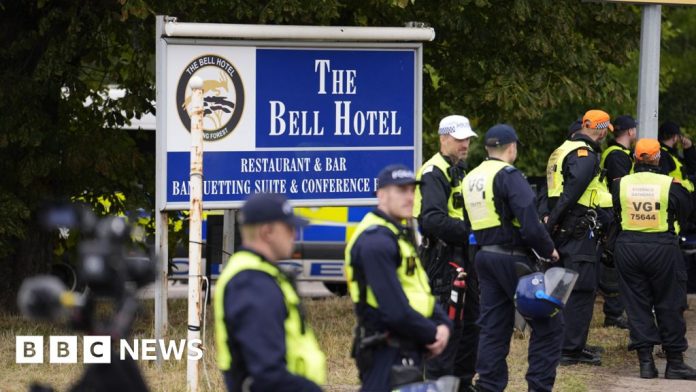
It follows the High Court granting a district council a temporary injunction blocking asylum seekers from lodging at The Bell Hotel in Epping, Essex.
All 12 councils controlled by Reform UK will “do everything in their power to follow Epping’s lead”, the party’s leader Nigel Farage said. A Conservative-run council in Broxbourne, Hertfordshire, also said it is considering taking similar action.
Border Security Minister Dame Angela Eagle said the government will “continue working with local authorities and communities to address legitimate concerns”.
Writing in the Telegraph, Farage urged people “concerned about the threat posed by young undocumented males living in local hotels” to “follow the example of the town in Essex” in peaceful protest.
Tory-run Borough of Broxbourne Council has since become the first to declare it is seeking legal advice “as a matter of urgency about whether it could take a similar action” over a hotel in Cheshunt.
Meanwhile, the leader of South Norfolk District Council, also run by the Conservatives, said it will not go down the same route over a hotel housing asylum seekers in Diss which has been the subject of protest.
Daniel Elmer said the council was using planning rules to ensure it was families being housed in the area rather than single adult males.
Government ministers say they are braced for other councils to follow Epping’s lead.
Dame Angela added: “Our work continues to close all asylum hotels by the end of this Parliament.”
The protests were also attended by those in support of asylum seekers.
Conservative-run Epping Forest District Council was eventually granted an injunction to block migrants staying at the hotel after an eleventh-hour effort from Home Secretary Yvette Cooper to have the council’s case dismissed was ignored.
During the case, the government’s lawyer said any injunction granted could act as “an impetus for further violent protests” and could “substantially interfere” with the statutory duty of the Home Office to avoid a breach of the asylum seekers’ human rights.
Asylum seekers staying at the hotel will be removed from The Bell Hotel by 12 September.