12.9 C
New York
Wednesday, May 13, 2026
Home Blog Page 319

Tomorrow is the final day for home buyers to qualify for Chase’s ‘mortgage rate sale’

0


In an unprecedented move to spark business in a difficult housing market, a leading national mortgage lender is offering a limited-time “mortgage rate sale.”

It ends on Monday. Here are the details.

Chase Home Lending has discounted its rates on mortgages nationwide with a limited-time mortgage rate sale on purchase applications, available only through Monday, Aug. 18.

“The offer provides personalized, lockable interest rate discounts for buyers looking to save on their mortgage and is stackable with other discounts the lender offers,” a press notice said.

Erik Schmitt, digital channel executive at Chase, said the discount can be as much as a quarter-point (0.25%). For example, an offered rate of 6.5% could be cut to 6.25%. That would save a borrower over $20,600 of interest with a 30-year term on a $350,000 loan — and reduce the payment by more than $55 a month.

The rate discount is for the life of the loan on fixed-rate mortgages, Schmitt said. For adjustable-rate mortgages, the discount will apply during the initial fixed-rate period of the loan. There are no additional discount points or fees related to the offer, he added.

The program is available on all Chase home purchase mortgages, including FHA loans.

The discount can be combined, Schmitt said, with other Chase programs, such as its relationship pricing program and the Chase DreaMaker loan, which has flexible credit requirements.

The bank also offers grants of $2,500 to $5,000 to borrowers in certain areas. Credit guidelines and income limits may apply.

Read more: Find Chase on our list of the best mortgage lenders this month

To get the discount, qualify for a Chase mortgage, and lock in your interest rate before Monday. The Chase “Lock and Shop” program protects you from interest rate increases for 90 days.

You also have a one-time relock option to get a lower rate if mortgage rates drop during your lock period.

“While customers must meet standard loan qualification criteria, there are no additional requirements to qualify for the promotional rate,” Schmitt told Yahoo Finance in an email.

Lock in your discounted Chase mortgage rate.

To qualify, home buyers must lock in a purchase rate by the end of business Monday, Aug. 18, 2025. The rate discount is not currently available for refinance loans.

Minimum credit score, loan-to-value, and property value guidelines apply, depending on which home loan program you choose. For example, a conventional loan has a higher credit score requirement than an FHA loan. The mortgage rate discount may vary by state.

My Money

Laura Grace Tarpley edited this article.

Plane makes emergency landing on Australian golf course

0


This is the moment a light aircraft made an emergency landing on a Sydney golf course, with the pilot and passenger escaping without major injuries.

The Piper Cherokee plane crashed at Mona Vale Golf Club during a training flight on Sunday, with an instructor and student on board.

Footage shows the plane flying low over the golf course, before quickly hitting the ground. Debris from the crash can be seen on the grass.

Authorities told local media outlet the Manly Observer that both the instructor and passenger received medical treatment for minor injuries and the cause of the crash is unknown at this stage.

New players may have window to disrupt after trucks exit California emissions deals

0


As the nation’s major truckmakers seek to abandon California’s stricter-than-federal emissions rules, experts are weighing whether this U-turn could allow new players to disrupt the market.

“All your competitors just announced their strategy,” Craig Segall, former deputy executive officer and assistant chief counsel of the California Air Resources Board (CARB), told The Hill. 

“How quickly can you ramp up to eat their lunch?” Segall asked. 

This now unmasked strategy — an about-face on compliance with the Golden State’s heavy-duty vehicle standards — came to light this week when four manufacturers sued California regulators over the matter. 

Soon after, the Federal Trade Commission (FTC) declared that a voluntary “Clean Truck Partnership” between the companies and the state was “unenforceable.” 

Then, Friday, the Department of Justice sued California about the same partnership, in a bid to “advance President Donald J. Trump’s commitment to end the electric vehicle (EV) mandate.”

The week’s initial lawsuit, filed Monday by Daimler Truck, International Motors, PACCAR and the Volvo Group, alleged the federal government had deemed California’s emissions rules “unlawful” in June.

At the time, President Trump signed off on three congressional resolutions revoking a Biden administration waiver that had allowed the state to set these rules. Under the 1970 Clean Air Act, California can create emissions standards that are stricter than federal norms but must acquire a waiver from the Environmental Protection Agency to do so.

In Monday’s filing, the truckmakers — also called original equipment manufacturers (OEMs) — argued California’s demands have “threatened” their ability to “design, develop, manufacture and sell heavy-duty vehicles and engines.”

The lawsuit noted the Department of Justice had instructed manufacturers “to immediately cease and desist compliance with California’s preempted and unlawful mandates,” leaving the companies “caught in the crossfire.”

CARB said it would not comment on pending litigation.

The FTC declaration that followed on Tuesday determined a 2023 voluntary agreement between truckmakers and CARB — the “Clean Truck Partnership” — was “unenforceable.” In that partnership, the companies had agreed to abide by California’s emissions standards in exchange for certain concessions.

One such standard was the Advanced Clean Trucks rule, requiring 7.5 percent of heavy-duty vehicles to be emissions-free by 2035. A second, the Omnibus Regulation, focused on slashing nitrogen oxide releases by 90 percent and updating engine testing protocols.

Segall described Monday’s lawsuit as “an audacious move,” noting in a Thursday op-ed that truckmakers just two years ago supported the Clean Truck Partnership, which he helped negotiate.

He accused companies such as Daimler, which controls 40 percent of the country’s truck market, of “badly letting the trucking industry down.” Meanwhile, he warned, China is accelerating electric truck adoption.

A possible goal of the sudden turnaround is to move costs onto the industry and “to drag out the transition from diesel as long as possible,” Segall told The Hill.

Because the companies haven’t faced serious new competition yet — disruptors such as Tesla in the car space — and have the federal administration “clearly on their side,” they “can burn the regulators for the fourth largest economy in the world,” Segall observed.

Yet at the same time, Segall noted, the truckmakers are up against a billion-person market in China, where other manufacturers “are rapidly eating their market share.’

The U.S. trucking giants, he continued, could jeopardize their presence in the world market while also getting the country “stuck in diesel for a few years.”

“That’s not a long-term win for them,” Segall said, arguing things may change when a new president enters office in 2029. 

The new president might realize “with horror, the U.S. is badly behind on EVs,” Segall said.

Policymakers at that point, he explained, could either revive CARB’s rules or enact national-level legislation. Rather than leaving the freight system “stuck in diesel” in 2040, Segall said he believes the industry will return “hat in hand” to Congress and California.

Pointing to the fact that delivery firms such as Amazon have smaller EV trucks operating nationwide, Segall forecast that “giant semitrailers” will make a similar transition soon.

With that in mind, he stressed there is “an interesting opening” for other competitors, such as Chinese electric truck startup Windrose.

Industry veteran Rustam Kocher echoed these sentiments in a recent post on LinkedIn, calling upon Windrose, other Chinese e-truck manufacturers and Tesla Semi to fill in this gap and “let the market-share eating competition commence.”

“This industry is changing, just like the light-duty industry is changing,” Kocher told The Hill.

While Kocher said he believes the companies made their decisions due to the short-term profit margins, he argued that “the profitability they’re going to gain off of combustion engines is going to change.”

“At some point, the resale value of those things is going to drop off the end of the Earth,” he added, noting Windrose or Tesla Semi are “perfect examples” of market entrants that could perform better and cheaper.

Kocher, who is now semiretired in Portugal, worked in various electrification-related roles for Daimler Truck North America from 2011-19 and then served as transportation electrification manager for Portland General Electric.

During his time at Daimler, he said he helped launch the e-mobility group and worked on developing fast-charging standards “with the full support of Daimler Truck, with the full support of everyone else in the trucking OEM world.”

Kocher acknowledged that from a business perspective, although electric trucks are viable, they are not currently as profitable as existing diesel trucks and cost more up front.

Yet they cost less to operate per mile and save money for fleets due to their reduced maintenance needs — needs that drive profits for truckmakers, according to Kocher.

“Every electric truck they put into the market means they’re taking a cut on profit,” he said. “They’re not going to make those maintenance and after-sale part sales.”

Recognizing the profitability “conundrum” that the industry is facing, Kocher expressed sadness that the firms he had held in high esteem decided to choose this direction.

“To see them turn around and do this, it’s made me very disappointed and frustrated,” he added.

The Hill has reached out to Daimler Truck, International Motors, PACCAR and the Volvo Group, as well as to the California regulators, for comment.

Best money market account rates today, August 17, 2025 (best account provides 4.41% APY)

0


Find out how much you could earn with today’s money market account rates. The Federal Reserve cut its target rate three times in 2024. So deposit rates — including money market account (MMA) rates — have started falling. It’s more important than ever to compare MMA rates and ensure you earn as much as possible on your balance.

The national average money market account rate stands at 0.62%, according to the FDIC.

Even so, some of the top accounts are currently offering rates of 4% APY and up. Since these rates may not be around much longer, consider opening a money market account now to take advantage of today’s high rates.

Here’s a look at some of the top MMA rates available today:

See our picks for the 10 best money market accounts available today>>

Additionally, the table below features some of the best savings and money market account rates available today from our verified partners.

The amount of interest you can earn from a money market account depends on the annual percentage rate (APY). This is a measure of your total earnings after one year when considering the base interest rate and how often interest compounds (money market account interest typically compounds daily).

Say you put $1,000 in an MMA at the average interest rate of 0.64% with daily compounding. At the end of one year, your balance would grow to $1,006.42 — your initial $1,000 deposit, plus just $6.42 in interest.

Now let’s say you choose a high-yield money market account that offers 4% APY instead. In this case, your balance would grow to $1,040.81 over the same period, which includes $40.81 in interest.

The more you deposit in a money market account, the more you stand to earn. If we took our same example of a money market account at 4% APY, but deposit $10,000, your total balance after one year would be $10,408.08, meaning you’d earn $408.08 in interest. ​​

Thousands of small boat arrivals since new migrant deal with France

0


Simon Jones & Ruth Comerford

BBC News

Getty Images Migrant families wade into the sea in an attempt to board a small boat on 12 August 2025 in Gravelines, France.Getty Images

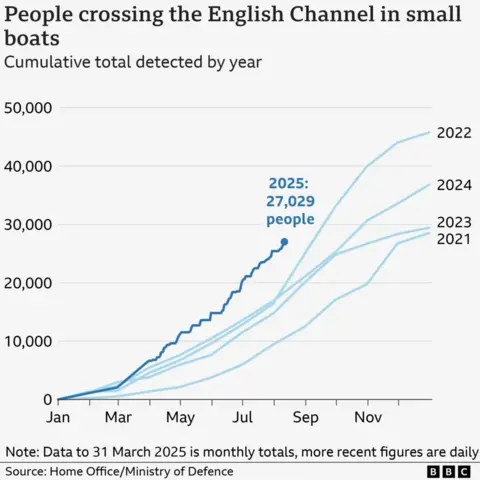
More than 2,500 migrants have crossed the Channel in small boats in the 11 days since the new “one in, one out” agreement with France took effect, figures from the Home Office show.

The plan proposes that for each migrant the UK returns to France, another person with a strong case for asylum in Britain will be allowed to stay.

Around 28,000 people have reached the UK in small boats so far this year and more than 50,000 have crossed since Labour came into power in July 2024.

Meanwhile, a boat holding more than 100 people was reportedly sighted in the Channel this week.

A Home Office spokesperson said the people-smuggling gangs “do not care if the vulnerable people they exploit live or die, as long as they pay”.

“That is why this government is implementing a serious and comprehensive plan to break the business model of the gangs, including enhanced cooperation with France to prevent small boat crossings and a pilot scheme to detain and return small boat migrants back to France.”

Rob Lawrie, a volunteer aid worker, told the BBC’s Today Programme on Friday smugglers estimate they can send up to 150 people on boats.

“That’s a lot more people, overcrowding an extra large boat,” he said.

“We’ve already had reports of children getting crushed, not only in the rush but within the dinghy itself.”

He added it was unclear how many people were falling overboard during crossings.

Crossings tend to increase in the summer months when the weather is calm in the Channel. Last August, more than 4,000 people made the journey.

These numbers can vary depending on factors including the supply of boat parts and how actively the police are patrolling the beaches in northern France, to try to prevent boats from launching.

A line chart showing the cumulative number of people who crossed the English Channel in small boats each year for 2021 to 2025 so far. Each year is represented by a line which tracks the numbers from January to December. 2021 saw the lowest of the five years, at 28,526 and 2022 saw the highest with 45,774. So far this year to 5 August the total is 25,436, which is the highest for that point in the year of any of the others.

The “one in, one out” pilot scheme was set up as part of a deal announced by Prime Minister Sir Keir Starmer and French President Emmanuel Macron during his state visit to the UK in July.

The first group of people to arrive under the scheme were detained in Dover earlier this month. Removals to France have yet to take place and could take up to three months.

When Labour came to power it promised to smash the gangs organising the crossings, but warned that it would not be quick or easy to do. Ministers are now under pressure to deliver results, though the deterrent effect of the returns deal may not become clear until deportations begin in earnest and increase in number.

Speaking about the first detentions earlier this month, Sir Keir said: “If you break the law to enter this country, you will face being sent back. When I say I will stop at nothing to secure our borders, I mean it.”

Set to last 11 months, the project will see the UK accepting an equal number of asylum seekers who have not tried to cross and can pass security and eligibility checks.

At the time, shadow home secretary Chris Philp criticised the government’s new deal as “having no deterrent effect whatsoever”.

The National Crime Agency said it has had some success in disrupting the business model of the smugglers.

Last week, 20 inflatable boats believed to be destined for the Channel were seized from a lorry in Bulgaria – the second such discovery in less than three weeks.

The government says it’s an illustration of the need for international cooperation to tackle illegal immigration.

Afghans were the top nationality arriving by small boat in the year to March 2025, according to Home Office figures.

Syrians made up the second largest group, followed by people from Iran, Vietnam and Eritrea.

These five nationalities accounted for 61% of all arrivals.

In 2024, almost one third of the 108,000 people who claimed asylum in the UK arrived on a small boat.

The Home Office can remove people with no legal right to stay in the UK, or refuse to let them enter.

But the 1951 Refugee Convention establishes the right to claim asylum in a foreign state if an applicant can prove they face a serious threat to life or freedom in their country of origin.

Trump tariffs: A grocery shopper's guide

0


President Trump’s tariffs could raise the cost of some of the most popular imports in American grocery aisles, from coffee and olive oil to wine, matcha and spices.

After the “Liberation Day” tariffs kicked in worldwide in early August, businesses and consumers alike are watching closely for when — and how much — prices tick up.

Inflation data released Tuesday did not show an overall increase in food prices, but economists say that’s likely to change as businesses pass more costs on to consumers. Wholesale prices surged 0.9 percent last month, the biggest monthly jump since June 2022 and a sign that inflation may not be cooling off just yet.

“Many of us anticipated ahead of time that you might see some faster movement in groceries, partly because you can’t stockpile stuff right in the same way,” said Martha Gimbel, the Budget Lab at Yale’s executive director. 

“You can’t stockpile a year’s worth of avocados. That being said, the price increases that we’ve seen in food so far are pretty muted, so we’ll just have to see what happens,” she said.

Here are six iconic imported grocery products that could be impacted by Trump’s tariffs.

Coffee

Coffee prices were already up before a 50 percent tariff on Brazil, the top coffee importer to the U.S., went into effect last week.

Coffee prices sharply rose 25 percent over the past three months, according to inflation data released Tuesday. Reuters reported Tuesday that Brazilian coffee exports have started seeing postponements to their U.S. shipments.

How hard your morning habit gets hit varies between brand, shop and choice of bean. 

Nespresso pods, for instance, are entirely produced in Switzerland, which is subject to a 40 percent tariff. Colombia, the second-largest importer of coffee to the U.S., only pays Trump’s 10 percent baseline duty.

“Some importers might shift sourcing toward countries with exemptions, but in many cases the increased costs will all be passed on to you, the coffee lover,” Todd Carmichael, the co-founder of La Colombe, wrote in The Washington Post earlier this week. 

“Surely, coffee is too essential and too global to put at the center of a geopolitical chess match.”

Rep. Ro Khanna (D-Calif.) said Wednesday he would introduce a bill with bipartisan support to repeal tariffs on coffee.

Olive oil 

Trump’s tariffs have only added to the uncertainty facing olive oil producers, who are grappling with climate shocks. Extended droughts in Spain in 2022 slashed production, and other top production regions like Sicily and Greece have also confronted record-high temperatures.

Allen Dushi, a co-founder of olive oil brand Graza, said the company has held off on increasing prices, adding that any uptick in import costs could take at least three to four months to reflect on grocery shelves. Many retailers or distributors require 60 to 90 days notice for a change, he said.

The company uses Spanish olives, and production and bottling are all based in Spain. That limits the extent to which the company can keep stocks in the U.S., which would have to be finished bottles. 

“We are not trying to stockpile inventory, because our priority number one is always the quality of what’s inside the bottle,” Dushi said. “That’s not something we really compromise on.”

Switching to American production wouldn’t help, Dushi added; the company would still have to pay tariffs on Spanish olives, as American olive production doesn’t meet the same standard. 

“So as long as you’re buying the oil, and importing the oil, you’re going to be paying the tariff on that,” he said. 

Spain and Italy accounted for two-thirds of U.S. olive oil imports in 2024. Both are subject to the 15 percent tariff under the trade deal struck between the European Union and the U.S. in July. Other top producers are still subject to tariffs, such as Tunisia (25 percent), Turkey (15 percent) and Argentina (10 percent).

Wine

The July U.S.-E.U. trade deal was seen as a starting point. As negotiations have continued, the beverage industry and European officials have pushed for an exemption for wine and spirits, The Wall Street Journal reported.

A group of nearly 60 associations representing wine, beer and liquor interests warned last week that the industry could face nearly $2 billion in lost sales and have to cut more than 25,000 jobs in the U.S. as a result of the tariff. The coalition, Toasts not Tariffs, pointed to products like cognac that have to be produced in a specific region and cannot be switched to a tariff-free alternative.

Eric Foret is a wine buyer at Le French Wine Club, which operates several locations in New York City and Washington, D.C., alongside an online shop. He said that he had to increase his prices, although they were fairly gradual.

“It’s a dollar here, a dollar there, a dollar here, a dollar there and then at the end, you spend ten dollars more on the bottle of wine, you don’t even notice it,” he said.

In addition to France, which accounted for more than one-third of U.S. wine imports last year, the EU tariff impacts shipments from Italy (33 percent of imports) and Spain (6 percent).

Matcha

A 15 percent tariff on Japan could impact the price of a matcha latte — already a pricey product before tax, tip and oat milk.

While U.S. trade data does not specifically track matcha, Japan generally accounts for about half of American green tea imports by value each year, and Japanese origin is a selling point for many specialty matcha shops.

The industry is also grappling with the impacts of record heat waves in Japan last summer that curbed harvests of tencha, the tea leaves dried and ground into matcha. Demand for the vibrant green beverage has also soared in recent years, driven by young enthusiasts and social media. 

David Cooper runs Spot of Tea, a Washington, D.C.-based shop with three locations selling matcha and other tea drinks. He considers himself lucky to have bought his 2025 stockpile before the tariffs and shortages hit. 

Now, however, “we’re looking at how much stock we have in our warehouse and then how much we’re going through per month and doing the math and trying to push the suppliers to finalize the order as quickly as possible,” he said. “It’s definitely a little anxiety-inducing.”

The uncertainty for the drink industry even extends to things like cups, Cooper said, which his shop sources from South Korea.

“I think on the day I was about to put the deposit down, Trump announced 25 percent tariffs for Korea. And so our supplier was basically, like, we cannot absorb all this cost,” he said. 

“It’s just so hard to tell at this point what percentage tariff is actually going to be applied.”

Chocolate

Switzerland, home to many famous chocolate brands, is facing a 39 percent duty, one of the highest in the world. 

Some of the country’s larger manufacturers will be able to escape some tariff impacts because they already have production sites in the U.S. 

Lindt & Sprüngli, for example, produces the “vast majority” of its products for the American market in New Hampshire, a company spokesperson said. That plant will still have to factor in tariff effects on raw materials like cocoa, imported from countries like Ivory Coast, Ecuador, Indonesia and Malaysia.

Other companies, however, have made their brand on manufacturing in Switzerland. That’s the case for Läderach, which is now figuring out how to manage “massive additional costs,” its CEO said this week.

“I cannot change the tariffs. It is only human to get angry about them, enquire on who’s guilt they are or be discouraged,” Johannes Läderach wrote in a LinkedIn post. “But none of these options change anything, so I better pray for serenity to accept it.”

Swiss leaders have attempted to negotiate with Washington on the tariff, which also impacts cheese and other exports. Swiss officials are now reportedly weighing whether to cancel an order for American F-35 fighter jets.

Spices

Trump shocked many observers by raising tariffs on India to 50 percent last week, citing its purchase of Russian oil.

India is the top U.S. importer for spices like nutmeg, cardamom, anise, fennel, coriander, and cumin. Indonesia, another key producer, is subject to a 19 percent duty after negotiating with the White House.

The American Spice Trade Association said in a Tuesday letter to Commerce Secretary Howard Lutnick and Trade Representative Jamieson Greer that many of its products could not be cultivated in the U.S..

“The importation of spices directly supports approximately 50,000 U.S. jobs across processing, quality assurance, distribution, and product development,” the association said.

Spice producer McCormick said in late June that tariffs could cost it as much as $90 million a year and that it was planning to raise some prices by the end of the year.


Thousands of small boat arrivals since new migrant deal with France

0


Simon Jones & Ruth Comerford

BBC News

Getty Images Migrant families wade into the sea in an attempt to board a small boat on 12 August 2025 in Gravelines, France.Getty Images

More than 2,500 migrants have crossed the Channel in small boats in the 11 days since the new “one in, one out” agreement with France took effect, figures from the Home Office show.

The plan proposes that for each migrant the UK returns to France, another person with a strong case for asylum in Britain will be allowed to stay.

Around 28,000 people have reached the UK in small boats so far this year and more than 50,000 have crossed since Labour came into power in July 2024.

Meanwhile, a so-called mega dinghy capable of holding more than 100 people was reportedly sighted in the Channel this week, amid concerns that people smugglers could be using larger boats to illegally transport people.

Home Office officials are trying to establish whether the presence of the mega dinghy was a one-off, or if it indicates gangs have started to use bigger boats.

Rob Lawrie, a volunteer aid worker, told the BBC’s Today Programme on Friday smugglers estimate they can send up to 150 people on a boat.

“That’s a lot more people, overcrowding an extra large boat,” he said.

“We’ve already had reports of children getting crushed, not only in the rush but within the dinghy itself.”

He added it was unclear how many people were falling overboard during crossings.

Crossings tend to increase in the summer months when the weather is calm in the Channel. Last August, more than 4,000 people made the journey.

These numbers can vary depending on factors including the supply of boat parts and how actively the police are patrolling the beaches in northern France, to try to prevent boats from launching.

A line chart showing the cumulative number of people who crossed the English Channel in small boats each year for 2021 to 2025 so far. Each year is represented by a line which tracks the numbers from January to December. 2021 saw the lowest of the five years, at 28,526 and 2022 saw the highest with 45,774. So far this year to 5 August the total is 25,436, which is the highest for that point in the year of any of the others.

The “one in, one out” pilot scheme was set up as part of a deal announced by Prime Minister Sir Keir Starmer and French President Emmanuel Macron during his state visit to the UK in July.

The first group of people to arrive under the scheme were detained in Dover earlier this month. Removals to France have yet to take place and could take up to three months.

When Labour came to power it promised to smash the gangs organising the crossings, but warned that it would not be quick or easy to do. Ministers are now under pressure to deliver results, though the deterrent effect of the returns deal may not become clear until deportations begin in earnest and increase in number.

Speaking about the first detentions earlier this month, Sir Keir said: “If you break the law to enter this country, you will face being sent back. When I say I will stop at nothing to secure our borders, I mean it.”

Set to last 11 months, the project will see the UK accepting an equal number of asylum seekers who have not tried to cross and can pass security and eligibility checks.

At the time, shadow home secretary Chris Philp criticised the government’s new deal as “having no deterrent effect whatsoever”.

The National Crime Agency said it has had some success in disrupting the business model of the smugglers.

Last week, 20 inflatable boats believed to be destined for the Channel were seized from a lorry in Bulgaria – the second such discovery in less than three weeks.

The government says it’s an illustration of the need for international cooperation to tackle illegal immigration.

Afghans were the top nationality arriving by small boat in the year to March 2025, according to Home Office figures.

Syrians made up the second largest group, followed by people from Iran, Vietnam and Eritrea.

These five nationalities accounted for 61% of all arrivals.

In 2024, almost one third of the 108,000 people who claimed asylum in the UK arrived on a small boat.

The Home Office can remove people with no legal right to stay in the UK, or refuse to let them enter.

But the 1951 Refugee Convention establishes the right to claim asylum in a foreign state if an applicant can prove they face a serious threat to life or freedom in their country of origin.

State Department halts Gaza visitor visas

0


The State Department on Saturday said it would halt Gaza visitor visas to the U.S.

“All visitor visas for individuals from Gaza are being stopped while we conduct a full and thorough review of the process and procedures used to issue a small number of temporary medical-humanitarian visas in recent days,” the department wrote in a Saturday statement on the social media platform X.

The Hill has reached out to the State Department for additional comment. 

The move comes a week after President Trump refrained from criticizing Israeli leaders’ efforts to ramp up strikes and increase control in Gaza. 

“I know that we are there now trying to get people fed. … As far as the rest of it, I really can’t say. That’s going to be pretty much up to Israel,” Trump told reporters in early August, committing to leading humanitarian aid efforts in the war-torn region.

Several nations and human rights groups have said starvation is persistent among Gazans, urging countries and organizations to aid in food and resource distribution. 

In response to on the ground reports, Germany halted military exports to Israel, seeking to dismantle prior support for the use of force in the Gaza Strip. 

France, Canada and the United Kingdom also expressed concerns with Israeli operations and announced their intent to recognize Palestinian as an independent sovereign state.

Seventy to 75 percent of Gaza is under Israeli control, according to Prime Minister Benjamin Netanyahu, who has denied reports about starvation.

Netanyahu said the government’s plans are to overtake parts of the Gaza Strip, which he said are under the control of Hamas.

“Israel’s Cabinet, Israel’s security Cabinet, instructed the IDF to dismantle the two remaining Hamas strongholds in Gaza City and the Central Camps,” he added, referring to the Israel Defense Forces (IDF). “Contrary to false claims, this is the best way to end the war, and the best way to end it speedily.”

In Washington, leaders across the aisle have become increasingly critical of Israel and the situation in Gaza.

“We each have to continue to have an open heart about how we do this, how we do it effectively, and how we take action in time to make a difference, whether that is stopping the starvation and genocide and destruction of Gaza, or whether that means we are working together to stop the redistricting that is going on, taking away the vote from people in order to retain power,” House Minority Whip Katherine Clark (D-Mass.) said during a Thursday event, referencing redistricting efforts across the country.

Clark is the highest-ranking House Democrat to use the term “genocide” to describe the crisis in Gaza.

Nashville woman’s employer overpaid her $42K despite her warnings — now they want it all back. Ramsay weighs in

0


Rachel, from Nashville, Tennessee, recently called into The Ramsey Show for advice about a payroll error that resulted in her being paid $48,000 instead of approximately $5,700 — an overpayment of $42,300.

“I told [my employer] before it hit my account. But they took so long to correct the error and get me my letter of debt repayment that we are now 10 months in the future,” said Rachel.

Unfortunately, the delay has pushed this problem across a tax year, causing issues for Rachel. She only has a portion of the approximately $42,000 overpayment because around $19,000 was withheld from her paycheck for tax purposes.

At this point, Rachel’s company wants her to repay the full amount of the overpayment. However, until the IRS returns the tax that was withheld, she isn’t able to do so.

Rachel noticed the error in October 2024 and promptly notified her company about the issue. Unfortunately, the overpayment wasn’t stopped in time. Instead, an extra $24,000 was deposited into Rachel’s bank account, and roughly $19,000 was withheld for taxes.

Rachel hasn’t received a tax refund for the $19,000, so she can only repay $24,000 of the overpayment. According to Dave Ramsey, the IRS should return the remaining amount, but it hasn’t happened yet. With her company wanting the full $42,000 back, she’s not sure what to do.

“Number one: You don’t pay more than what you actually owe,” said Ramsey.

Ramsey suggested a ‘two-check deal,’ which starts by Rachel returning the $24,000 overpayment that had been deposited into her bank account.

“And then you’ll have to repay them the taxes when the tax money comes,” said Ramsey.

In other words, once the company has resolved its paperwork with the IRS to correct the error, Rachel should receive the $19,000 tax refund, which she can then pass along to her employer.

“You need a tax professional, I think,” advised Ramsey.

The complex situation left co-host Ken Coleman frustrated. “A big company that has all the resources in the world to fix this, and they didn’t fix it quickly. Hate that for her, but it is fixable.”

Horse races cancelled in protest against proposed betting tax rise

0


British horse racing will go on strike on 10 September, taking the unprecedented action of refusing to race in protest against the Government’s proposed tax rise on betting on the sport.

As part of its industry-wide Axe The Racing Tax campaign, four fixtures scheduled for that day at Lingfield Park, Carlisle, Uttoxeter and Kempton Park have been rearranged by the British Horseracing Authority.

It is the first time the sport has voluntarily refused to race in its modern history.

The governing body is campaigning against the Treasury’s proposal to introduce a single remote gambling tax, which would increase the 15% tax rate paid by bookmakers on racing and aligning it with online gaming, which is currently taxed at 21%.

The BHA says this would have a “destructive impact” on the industry with its economic analysis predicting an estimated £330m loss in revenue and putting 2,752 jobs at risk in the first year alone.

BBC Sport has contacted the Department for Culture, Media and Sport for comment.

Chancellor of the exchequer Rachel Reeves’s autumn budget in October is expected to bring tax rises.

Brant Dunshea, chief executive at the British Horseracing Authority, said the proposals “threaten the very future” of the sport.

Race meetings in Britain take place 363 days a year, unless called off for adverse weather, equine virus outbreaks and national crises such as the Covid-19 pandemic.

The strike takes place the day before the start of the four-day St Leger festival at Doncaster Racecourse.

“British Racing is already in a precarious financial position and research has shown that a tax rise on racing could be catastrophic for the sport and the thousands of jobs that rely on it in towns and communities across the country,” added Dunshea.

“This is the first time that British Racing has chosen not to race due to Government proposals. We haven’t taken this decision lightly but in doing so we are urging the Government to rethink this tax proposal to protect the future of our sport which is a cherished part of Britain’s heritage and culture.”