Myron Medcalf covers college basketball for ESPN.com. He joined ESPN in 2011.
THE NORTH CAROLINA TAR HEELS are used to being under a microscope. This is a program with six national championships and the jerseys of icons such as Michael Jordan and James Worthy in its rafters and that has always brought the fair share of the scrutiny that comes with being a blue blood.
But in most seasons, UNC is fielding complaints about its talent, consistency and success. In 2024-25, the vitriol was different. After receiving a First Four slot as an 11-seed in the NCAA tournament, the Tar Heels were widely viewed as undeserving.
With an 8-6 record in its last 14 games of the regular season and a résumé void of signature wins, North Carolina making the field created so much controversy that West Virginia Gov. Patrick Morrisey held a news conference in the wake of Selection Sunday to accuse the selection committee — led by UNC’s athletic director Bubba Cunningham — of a fraudulent process and a “miscarriage of justice” (the West Virginia Mountaineers missed the tournament as a result of North Carolina’s inclusion).
“Last season was hard, and we worked, we fought, and I know we weren’t the best team, but I give my guys just the most kudos in the world for how much adversity and how much we fought through,” said Seth Trimble, the team’s top returning scorer. “And then just hearing the naysayers. I mean, we heard them all year long. We heard them during the tournament. We heard them right before the tournament. It was nothing new.”
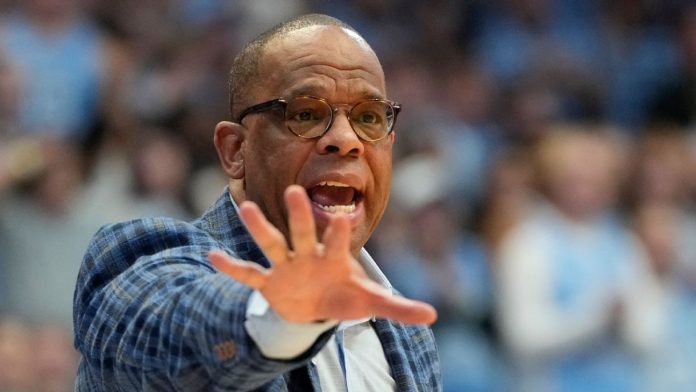
Coach Hubert Davis’ four years in charge of his alma mater have featured yo-yo finishes: a run to the national title game as an 8-seed in his first; missing the tournament altogether in his second. Two years ago, he led the Tar Heels to the Sweet 16 as a No. 1 seed, finishing with 29 wins. Last March, it was a lackluster 22-13 season and a first-round tournament loss.
Cunningham says he is confident in Davis’ ability to lead the program after extending his contract through 2030 earlier this year. But in his fifth year at the helm, another subpar season could mean Davis cannot consistently meet the standard in Chapel Hill, risking hot-seat talk turning into a storyline.
“I mean, can we win a national championship every year? No. Do we have aspirations to win it? Yes,” Cunningham told ESPN. “And are we going to continue to support our program, our coaches and our students with the resources to get to that level? Absolutely. That’s our ambition and we’re not going to back off of it.”
North Carolina did lose four of its top seven scorers from last season to the transfer portal and opened this season with its lowest ranking (No. 25) in the preseason AP poll since 2005, but the Tar Heels aren’t exactly underdogs as the 2025-26 season gets underway. Freshman Caleb Wilson is a confident, five-star recruit who anchors the No. 8 recruiting class in the country, one of the best in recent years for the Tar Heels. Plus, the return of Trimble and the additions of 6-foot-6 European star Luka Bogavac and 7-foot Arizona transfer Henri Veesaar should give the Tar Heels a chance to avoid another nerve-racking Selection Sunday. Still, it’s clear that North Carolina is trying to find itself — and perhaps a new identity — in the shifting landscape of college sports.
And if UNC’s prestigious past no longer guarantees a prestigious future, that puts even more pressure on Davis and his team. The Tar Heels’ fan base won’t accept that as an excuse for falling short.
“Even before I was head coach — as an assistant when I was here and when I played here — the expectation here is for every season for this program to have a chance [to win a national title],” Davis told ESPN. “And when I say the standard is the standard, that’s what I mean. And whether you get to the championship game or you make the NCAA tournament and lose in the first round like we did last year, the standard is the standard.
“Those are the expectations every year, regardless of whether we went to the championship the first year or not.”
A YEAR AFTER Matt Doherty won a national title as a reserve guard on a UNC team led by Jordan, Worthy and Sam Perkins — all future NBA stars — he went to a party with his teammates to celebrate that next season’s Elite Eight run.
Although North Carolina had just lost to Georgia in the 1983 regional final, he still expected a celebration for making it to the cusp of the Final Four. Instead, a Tar Heels fan made sure he knew his team had missed the mark.
“I remember going out one night and some guy said to me, ‘You guys suck,'” Doherty recalled. “I wanted to fight him.”
By the time Doherty was hired as the school’s head coach nearly 20 years later, the expectations were magnified. He’d carried the weight of wearing a North Carolina jersey as a player, but his attempt to uphold the school’s ambitions in the years that followed legendary coach Dean Smith’s retirement was more difficult than Doherty had ever imagined.
“You had high highs and low lows,” Doherty, who was fired in 2003, told ESPN. “And so dealing with that — the self-talk, the isolation — [because] you’re surrounded by a staff, your players, 22,000 fans, the athletic director, the chancellor, but you feel all alone. And so who do you talk to?”
Doherty is the one person in the North Carolina stratosphere who understands Davis’ plight. He is the only head coach the Tar Heels have fired over the past 75 years after he amassed a 53-43 record over three seasons (2000-2003), which included an eight-win season and only one NCAA tournament appearance. Although he knew that a program searching for its first national title since 1993 would place a heavy burden on his shoulders, Doherty quickly learned that the program had no appetite for losing. That reality has only been more challenging for Davis & Co. as they navigate the new compensation structures and transfer portal. Doherty said North Carolina, like other blue bloods, relied on its brand for too long in recruiting battles even as the landscape minimized the impact of that factor.
“I think they were slow to adopt the mindset and I don’t blame [Davis] for it,” he said. “I think it really was an institutional mindset: ‘We are North Carolina and we don’t pay players and this is a special place.’ And no one talks about being part of the Carolina family anymore. No one talks about academics. And so it comes down to two things for recruiting: ‘What are you going to pay me and what’s my path to the NBA look like?'”
After producing nine first-round NBA draft picks between 2016 and 2022, the Tar Heels have graduated only one in the three years since. Top high school recruits who might have picked North Carolina over programs without the same legacy and basketball pedigree — see: the No. 1 prospect in the 2025 class, AJ Dybantsa, who chose BYU — have rejected UNC’s overtures in recent years as the new financial rules have leveled the playing field.
As the negotiation battles for elite transfers and recruits unfolded last spring, the same North Carolina program that has historically been anchored by some of the game’s greatest college big men failed to land an elite power forward or center in the portal. Undersized and limited in the paint for the first time in years, the Tar Heels could not overcome their flaws and the struggles of former All-American RJ Davis.
“Obviously, last year we were small,” Davis said. “Playing at our level, you have to have size, you have to have positional size, and pretty much every game that we played, we were smaller than our opponent. And where it hurt us the most was rebounding.”
As the struggles progressed, everyone around the program could feel the gray cloud around Chapel Hill. The Tar Heels hadn’t adapted to the new rules of college sports the way their neighbor down Tobacco Road had, landing only one recruit (Wilson) ranked inside the top five of the SC Next 100 in the four recruiting cycles since NIL was adopted compared to three for Duke.
“He’s had some great winning seasons, he had an opportunity to win it all and he had some seasons that didn’t go so well,” former North Carolina star Raymond Felton said. “But that’s part of it, man. I support [Davis] 100%. I think he’s done a great job so far and he’s dealing with a lot that’s changed in the game of basketball with the NIL stuff and then the transfer portal and kids just being able to leave whenever they want to if they’re not happy.”
When Cunningham hired Davis — a former UNC star and assistant coach — to follow Roy Williams in 2021, he told him to be prepared to adapt. But he did not know what that would entail. Between a multimillion-dollar investment in football and talk of a new arena that could generate more revenue, UNC athletics — and UNC men’s basketball, by extension — has had to navigate all of this as the rules that govern college sports rapidly change.
As a result, Davis and his staff are tackling the greatest challenge facing every team: How do you build a winning program and then do it all over again a year later when anything short of a Final Four draws side-eyes and boos from fans?
“I think what Carolina has been really good at for 50 years is identifying elite high school talent that develops into great collegiate players and then onto the NBA,” Cunningham said. “And I think we’re still really good at that, but … I also think you need some transfers and some of the older players, and I think you need a mix. So I do think the transfer portal and NIL have added to the complexity for the coaches and the general managers to say, ‘OK, what is the right mix for us to be successful and what’s the right mix for us at this institution?'”
OVER THE SUMMER, a young podcaster spotted Wilson — a projected lottery pick in the 2026 NBA draft — on campus.
And, well, Wilson did the rest.
“I don’t like Duke, I don’t like NC State, I don’t like Wake Forest,” Wilson said in the viral clip. “This year we’re putting belt on everybody. I’m talking real belt, sparkle, bedazzle. You already know what time it is. Stay up. Tar Heels winning the damn game.”
UNC’s freshman Caleb Wilson has some words for Duke, NC State and Wake Forest! 😂 pic.twitter.com/0IgVRtB4i3
Months before his first game, the 6-foot-8 prospect had thrown the first punch against his school’s biggest rivals. Asked if he regretted his comments, the No. 5 recruit in the SC Next 100 for 2025 doubled down.
“I didn’t care,” he said of the reaction. “Honestly, I’m not a ‘say it and hide my tail’ kind of guy. If I say it out of my mouth, then that’s what I mean. Let me back it up when I get on the court.”
Every great North Carolina team has had a star with the swagger Wilson oozes. Davis says he believes in this season’s team as much as any that he has coached in Chapel Hill, in part because of Wilson, who understands the pressure that comes with trying to return the Tar Heels to the pinnacle of the sport — and seems to love it.
By all accounts, Wilson has spent the offseason showcasing a dominance in workouts and practices that has excited his teammates about what’s ahead.
“We have incredible talent and [Wilson], since he got here, he has surprised me a lot with his playmaking ability and just how smart of a player he is,” said Veesaar, the former Arizona standout. “I didn’t think it was possible coming out of high school. I knew he was a freak athlete and a really good player, but just the way he can actually read the game and pass is what has really stood out to me. I think he’s going to help us elevate our game.”
Of course, North Carolina is bigger than only one player. But Wilson is in Chapel Hill to help UNC start a new chapter and prove that Carolina is still Carolina — and he’s not alone. Veesaar was one of the top targets in the portal. Trimble, the only returning player who averaged double figures a season ago (11.6 PPG), is due for a breakout season. And Wilson is one of three top-60 recruits in Davis’ top-10 class. That ranking doesn’t include Bogavac, who has played professionally in Europe since he was a teenager.
It’s undeniable UNC has more players with potential than the proven commodities of past years. Davis says this season’s group is “coachable.” And this team won’t suffer the same physical disadvantages that hurt the program in past years.
Former NBA agent Jim Tanner was also hired as general manager to help the program identify and attract more elite players moving forward.
The ultimate test of these Tar Heels will be whether they can advance past the first round of the NCAA tournament after failing to do so two of the past three years. And with the program’s future spot in college basketball’s pecking order potentially on the line, blocking out the noise could prove more difficult than it has ever been — especially if the turbulence of last March carries over into this season.
“You’ve got to embrace that people aren’t rooting for you,” Trimble said. “People want to see you fail. People hate you. People hate the jerseys that you put on and you’ve just got to accept it, and you’ve got to go on the court with that extra motivation, with that extra confidence knowing that they want to see you lose.”
Davis, however, is notoriously difficult to rattle. He has disconnected from the internet and all of its vitriol. If there are any doubters out there, he doesn’t pay attention to them, he said.
“I’m not on social media,” Davis said. “[I’m] focusing on what is real and what is real is that it’s my job to, as the head coach, lead this program to the best of my ability. And that’s something that nothing will take my focus off of.
“[The] other thing is there are highs and lows in anything you do in your life. I’ve never seen or experienced anything where it was all sunny days. I’ve just never experienced that, so if that’s not possible, then on those rainy and stormy or cloudy days, those are the days to learn from and grow from. And if you look at it from that perspective, there are a lot more sunny days than cloudy days.”
Apple is reportedly working on a low-cost laptop powered by an iPhone chip. This could be a small deal, a decision made by supply chain economics and the fact that the M1 MacBook Air continues to sell well at Walmart. Or it could be huge, a return to form for a company that once seemed to have a clear purpose for each of its devices but whose lineup feels more confused than ever.
We’re hoping Apple picks the latter approach, and we have an idea for what it might look like: the iBook, a laptop line once so innovative that Phil Schiller had to jump off a ledge onto a mattress to prove its technical prowess. We can maybe leave the toilet bowl in 1999, but the spirit of those devices is once we’d love to see come back.
On this episode of The Vergecast, Nilay and David talk about whether this low-cost Mac is really coming, and what it might be. But first, they have some AI news to get to. Amazon and Perplexity are locked in a battle over agentic shopping, which is a useful frame for the whole fight over AI. (We like to call it The DoorDash Problem.)
Will the web soon be just a series of faceless databases, serving at the pleasure of an AI assistant? Lots of companies hope so; others will fight tooth and nail to make sure that never happens. The stakes couldn’t be higher.
After that, it’s iBook time. Seriously, if you’ve never seen the 1999 announcement, in which CEO Steve Jobs also passes a hula hoop over the iBook to prove it has no wires, you need to go watch it.
Finally, in the lightning round, it’s time for another round of Brendan Carr is a Dummy, plus news on party speakers and the Trump Phone, and a game of “name that sonic logo.”
If you want to know more about everything we discuss in this episode, here are some links to get you started, beginning with AI:
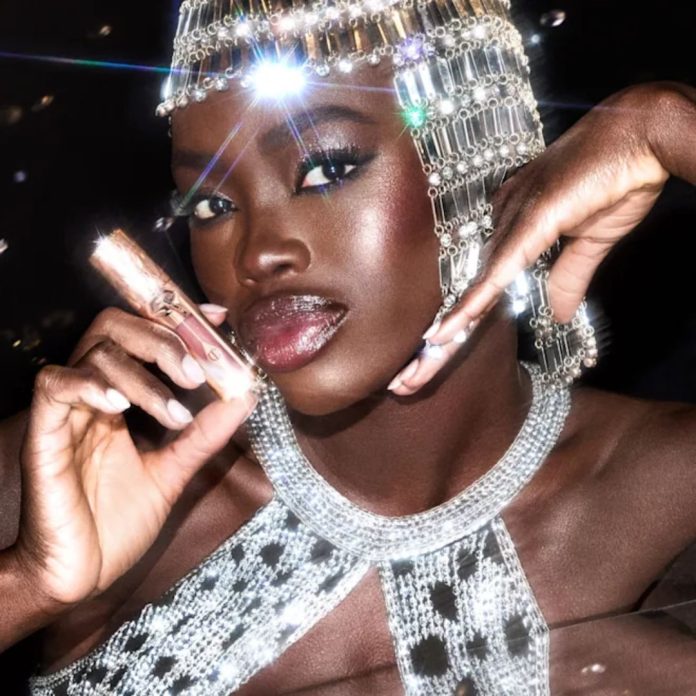
Black Friday came early for Charlotte Tilbury this year. The brand just revealed which of their super coveted gift sets will be discounted during their cyber sale—and you can shop them for up to 50% off right now.
You’ll also find other popular Charlotte Tilbury products, including Pillow Talk lipsticks and lip liners, Beauty Light blush and highlighter wands, and pressed powders, setting sprays, and foundations from their beloved Airbrush Finish line.
Darlings! Now’s the time to shop dazzling deals on your Charlotte Tilbury favorites. Hurry, though, because these highly desired sets are already starting to sell out.
Weight / Count
20 oz 1.2 lbs 1.1 lbs or 2.2 lbs 2.2 lbs 8.6 oz
Key Feature
Only 1 ingredients & 3rd Party Tested Only four ingredients: grass-fed collagen peptides, skin-healthy MCT powder, fermented cane sugar, and natural flavors. Only 1 ingredient: Pure Creatine Monohydrate Premium daily digestive supplement with only 7 ingredients Clean and Natural Ingredients
Grams of Protein
9g per serving 9g per serving – no data
– no data
– no data
Gluten Free
✓
✓
✓
✓
✓
Non-GMO
✓
✓
✓
✓
✓
Soy Free
✓
✓
✓
✓
✓
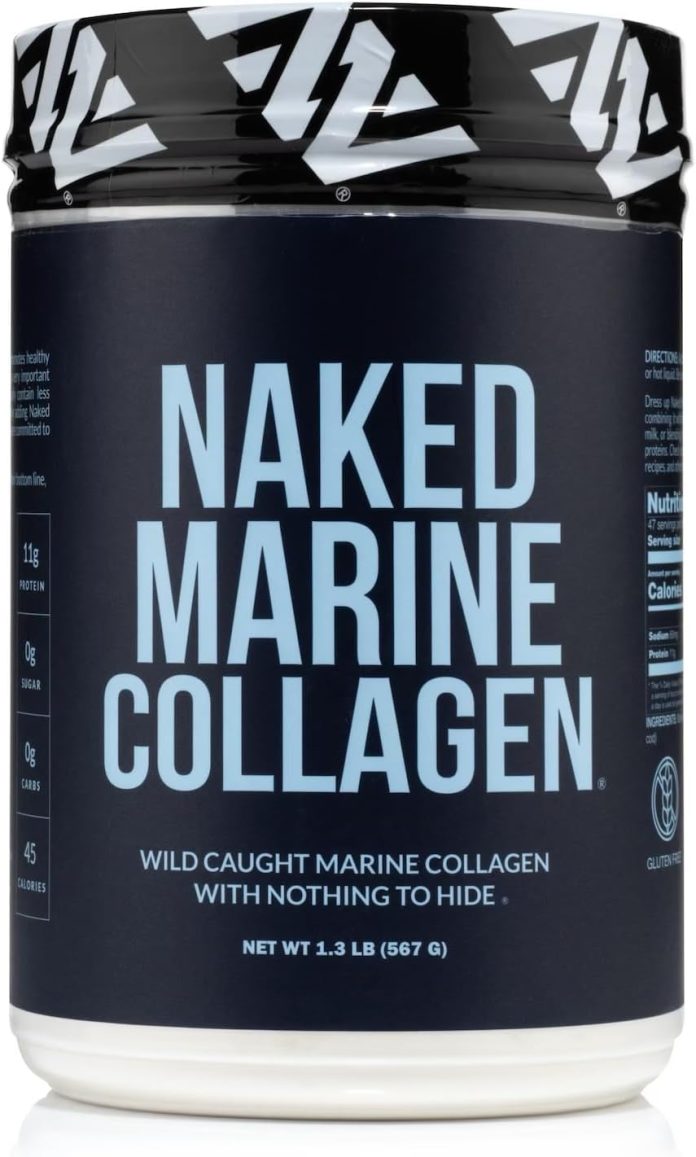
Product Dimensions : 4 x 5 x 7 inches; 1.25 Pounds Date First Available : September 8, 2018 Manufacturer : NAKED nutrition ASIN : B0DJNCCSC1 Best Sellers Rank: #43,081 in Health & Household (See Top 100 in Health & Household) #387 in Collagen Supplements Customer Reviews: 4.5 4.5 out of 5 stars 97 ratings var dpAcrHasRegisteredArcLinkClickAction; P.when(‘A’, ‘ready’).execute(function(A) { if (dpAcrHasRegisteredArcLinkClickAction !== true) { dpAcrHasRegisteredArcLinkClickAction = true; A.declarative( ‘acrLink-click-metrics’, ‘click’, { “allowLinkDefault”: true }, function (event) { if (window.ue) { ue.count(“acrLinkClickCount”, (ue.count(“acrLinkClickCount”) || 0) + 1); } } ); } }); P.when(‘A’, ‘cf’).execute(function(A) { A.declarative(‘acrStarsLink-click-metrics’, ‘click’, { “allowLinkDefault” : true }, function(event){ if(window.ue) { ue.count(“acrStarsLinkWithPopoverClickCount”, (ue.count(“acrStarsLinkWithPopoverClickCount”) || 0) + 1); } }); }); NAKED MEANS NOTHING ARTIFICIAL: 100% Marine Collagen Peptides Powder sourced from fresh, non-GMO, wild caught cod. Contains no artificial sweeteners, flavors, or colors and is GMO-Free, Dairy-Free, Soy Free, and Gluten-Free. ONLY ONE INGREDIENT: Our marine collagen contains only one ingredient: premium fish collagen powder from wild caught cod. Type 1 marine collagen with 16 amino acids including 2820mg glycine and 1380mg proline. MAXIMUM NUTRITION: 11g of Protein, 0g of Sugar, 0g of Carbs, 45 Calories, and 0.7g of BCAAs (branched-chain amino acids) per serving. HEALTH BENEFITS: Our diets today contain less collagen than in years past and once you hit age 30, your body also begins producing less. Naked Marine Collagen supports joint health, helps repair a leaky gut, and promotes youthful skin, stronger nails, and healthy hair. MIXES EASILY, ABSORBS FAST: Improve your overall health by adding our marine collagen powder to hot beverages, cold sports drinks, or protein shakes. Studies show that marine collagen is absorbed up to 1.5x more efficiently than alternative collagen sources.
Customers say
Customers find the collagen powder dissolves well in beverages and appreciate its clean ingredients and high-quality marine source. The product helps meet daily protein goals and provides benefits for skin, hair, and nails, with one customer noting improvements in skin texture and tone. Customers like the taste, with one mentioning it has no weird taste or smell.
Jeff Legwold covers the Denver Broncos at ESPN. He has covered the Broncos for more than 20 years and also assists with NFL draft coverage, joining ESPN in 2013. He has been a member of the Pro Football Hall of Fame Board of Selectors since 1999, too. Jeff previously covered the Pittsburgh Steelers, Buffalo Bills and Houston Oilers/Tennessee Titans at previous stops prior to ESPN.
Ryan McFadden covers the Las Vegas Raiders for ESPN’s NFL Nation. Prior to ESPN, McFadden was a Denver Broncos beat reporter for the Denver Post. McFadden also wrote about the Baltimore Ravens and University of Maryland athletics for The Baltimore Sun.
Nov 6, 2025, 11:37 PM ET
DENVER — It wasn’t artistic, but the Denver Broncos notched their seventh straight victory, outlasting the Las Vegas Raiders 10-7 in a defensive struggle at Empower Field on Mile High.
The Broncos stayed atop the AFC West thanks to a defense that sacked Raiders quarterback Geno Smith six times and held Las Vegas to only 10 first downs. Bo Nix hit Troy Franklin for Denver’s touchdown, while rookie running back Ashton Jeanty‘s touchdown was the only Raiders score. Raiders kicker Daniel Carlson missed a game-tying 48-yard field goal with 4:26 left.
Here are the most important things to know from Thursday night for both teams:
The Broncos continue to test the limits of one of the league’s best defenses week in and week out. Thursday night was no exception. as the Broncos overcame their own migraine-inducing struggles on offense and in the punt game to survive and grab the victory.
The Broncos improved to 8-2 and won their seventh straight game for the first time since 2015, but they didn’t make it easy. They didn’t get their initial first down on offense until there were just over five minutes left in the first half and didn’t score until tying the game 7-7 with 2:41 left in the first half. The Broncos’ offense had seven three-and-outs and an eighth possession that ended on an interception.
But other than a 41-yard touchdown drive on Las Vegas’ second possession of the game, when the Raiders inherited the ball in Broncos territory after a 30-yard punt by rookie Jeremy Crawshaw, the Broncos’ defense was in lockdown. It held the Raiders to 186 yards and had six sacks (five in the first half) to set up an AFC West showdown with the Kansas City Chiefs a week from Sunday.
What to make of the QB performance: Nix looked unsettled early, as his first three dropbacks of the game included a sack and a misfire to tight end Evan Engram on a three-and-out. But unlike previous weeks, he never found his balance. He certainly wasn’t helped by the Broncos’ field-position struggles for much of the first half — three of Denver’s first four possessions of the game started at its own 2, 20 and 1-yard lines, respectively — but 43 of his 101 passing yards in the first half came on one completion to rookie Pat Bryant. Nix threw two interceptions to Kyu Blu Kelly, one on a second-quarter overthrow and another on a tipped pass in the fourth. He finished 16-of-28 for 150 yards with a touchdown and two picks.
Biggest hole in the game plan: Broncos coach Sean Payton talks a lot about “sequencing” when discussing how he approaches playcalling, but the Broncos continue to struggle to find a first-half rhythm, especially when it comes to running the ball. The Broncos had six rushing attempts in the first half and didn’t commit much more to it until the third quarter. Yet, when faced with a third-and-1 in the third quarter, Payton elected to have wide receiver Courtland Sutton attempt a pass — he was sacked — instead of a short-yardage run. Wil Lutz missed a 59-yard field goal attempt on the next play.
Trend to watch: The Broncos are on the hunt of a record that has stood since 1984. With six more sacks Thursday, the Broncos have 46 after 10 games. The single-season record, set by the 1984 Chicago Bears, is 72. Denver’s 46 sacks after 10 games are the most since the New Orleans Saints had 44 after 10 games in 2000. — Jeff Legwold
The Raiders’ rookie growing pains were evident on Thursday. Las Vegas gave first-year wide receivers Jack Bech and Dont’e Thornton Jr. extended playing time following Tuesday’s trade of Jakobi Meyers, and they failed to take advantage of the moment.
Penalties on both players negated big plays by Las Vegas. A holding call on Bech took away a 32-yard, first-half carry by rookie running back Ashton Jeanty. Meanwhile, Tre Tucker‘s 31-yard touchdown catch on fourth down was wiped away due to an offensive pass interference call on Thornton.
Jeanty even dropped two passes, with one of them resulting in an interception in the third. Las Vegas’ defense put together its best performance of the season, holding the Broncos to 220 yards. However, the unit’s performance wasn’t enough to overcome the youthful mistakes.
What to make of the QB performance: Smith’s performance wasn’t pretty by any means, but he gave his team a fighting chance. He completed 16 of 26 passes for 143 yards and an interception. It didn’t help that Smith faced pressure throughout the game — he was sacked six times and pressured on 13 dropbacks. Despite playing with a quad injury he suffered in the second half, Smith managed to put his team in a position to at least tie the game. However, the Raiders were unable to capitalize, with Carlson missing a game-tying field goal.
Turning point: The Raiders’ bad luck continued in the third quarter. AJ Cole‘s punt attempt from deep in Raiders territory was blocked by Broncos safety JL Skinner. The ball caromed off Skinner’s face mask, with the Broncos recovering at the Las Vegas 12-yard line. The prime field position allowed Denver to convert a go-ahead field goal to take a 10-7 lead.
Stat to know: With another interception on Monday, Smith’s 12 interceptions are the most by a Raiders quarterback in the first nine games of a season since Kerry Collins had 12 through nine games in 2004, per ESPN Research. — Ryan McFadden
Next game: vs. Dallas Cowboys (Monday, Nov. 17, 8:15 p.m. ET)
Kiley McDaniel covers MLB prospects, the MLB Draft and more, including trades and free agency.
Has worked for three MLB teams.
Co-author of Author of ‘Future Value’
The MLB offseason is officially here! As free agency kicks off at 5 p.m. ET on Thursday, it’s time to rank the 2025-26 free agent class and predict how much money each player will get.
Let’s start with a quick rundown of what you need to know about these rankings and projections.
For simplicity, the players are ranked by the size of their projected guaranteed contracts, including the posting fee for foreign professionals, so technically it’s by the projected total cost to the signing team. (There are a number of players from Japan’s NPB and Korea’s KBO listed — that’s meant to be all the players who could in theory come to MLB; not all of them will this winter.) The contract projections are a mix of my opinions and those of agents and executives, but the goal is to predict what will happen, not decide what each player is worth.
The qualifying offer is a notable piece of this puzzle — a team can offer a pending free agent a one-year, $22.025 million deal that he can accept, or the team gets compensation if he signs elsewhere — and I see 10 players who should be offered the QO (I added an asterisk to their projected contracts). That happens to be every free agent projected for over $50 million who is eligible to get the QO, and one player who seems to be borderline: Lucas Giolito.
Here are last year’s projections to get a feel for how I did. One measure is to compare my projections with the actual contracts. There were 124 players I projected to get big league deals who did sign one — I projected $3.58 billion in guarantees and those players received $3.44 billion in guarantees.
I project overall spending this winter at a hair over $3.5 billion. That’s almost exactly where last winter’s spending landed, though I projected $3.78 billion for it at the time, suggesting overall spending could be down a bit this offseason. Shane Bieber and Jack Flaherty opting into their contracts was a bit surprising and ticked this winter’s projected spending down a little over $100 million.
Buzz around the industry is mixed about the market as a whole, so I’d expect a slower start to free agency as both sides feel out what teams are looking to accomplish. On to the projections!
Projected contract: 11 years, $418 million ($38M AAV)*
Tucker and Vladimir Guerrero Jr. had long been circled as the two players who could potentially sign megadeals in this free agent class, but Tucker is alone at the top since Vlad Jr. got his extension (14 years, $500 million) during the 2025 season. Tucker had some ups and downs to his 2025 season, covered in my September breakdown (and polling of the industry) of his free agent market. I go into a lot of depth about the comparables and how the market values Tucker vs. Vlad Jr.
The conclusion from that exercise (via the industry projections of his contract) is that Tucker should come in just below $400 million. I’ve found from my experience projecting these types of deals that the top-tier free agents tend to beat those projections. This is largely due to the competition among top teams to get the true difference-makers, and also because many teams think they can “make” role players from their own prospects and players signed on smaller free agent deals, thus shifting some spending from those types of players to stars. Every team knows what the “expected” contract is for these top players; a handful of interested teams aim for that target more or less, then run into competitive forces; and at least one team is willing to go a bit over the projection because of the lack of elite players available at any one time.
Tucker has been very consistent (he has the 11th-best WAR and is the ninth-best hitter in baseball since 2021) and has been lauded since early in his high school career for his pretty left-handed swing and big power, going fifth in the 2015 draft. That’s the kind of long track record and consistency (read: high floor, low bust potential) teams look for when they’re making giant investments.
The risk for a corner outfielder who will be 30 years old in the second season of his deal is that he could athletically fall off a cliff in the middle of this contract. Tucker is insulated from that concern a bit because he has a track record of being above average on the basepaths and defensively despite below-average top-end speed and only solid-average bat speed. He relies more on feel and precision than pure tools, thus the thinking is he’ll age better than the generic very good corner outfielder.
Projected contract: 6 years, $168 million ($28M AAV)*
Valdez is an easy sell: he’s a dependable (fifth-most regular-season innings since 2021) lefty with extensive playoff experience (most playoff starts and innings since 2020) who has regularly posted ERAs in the high 2s to mid-3s, averaging 3.20 since 2021, and that mark is driven by the highest ground ball rate in the league (among starters) in that span. Plus, the velocity of his sinker went up a bit in 2025 after a dip in 2024. On the other hand, he’s about to turn 32, doesn’t miss many bats relative to other nine-figure starters, and his 3.66 ERA in 2025 is his worst since 2019.
So, you’re not getting an ace, or at least not as most people think about an ace, but you’re likely getting a steady No. 2/No. 3 starter and clear starter in a playoff series, and you’re just hoping that he doesn’t transition to a softer-tossing back-end starter on this contract. The best recent comp is Aaron Nola (seven years, $172 million), though Valdez is hitting the market at roughly 18 months older than Nola did, so six years seems likely.
Projected contract: 6 years, $165 million ($27.5M AAV)
Bellinger won the NL MVP as a 23-year-old in 2019 with a 7.8 WAR season but hasn’t reached those heights again, relying more on being well-rounded and producing regular quality contact rather than massive exit velos. On the bright side, his second-best season was 2025, when he posted 4.9 WAR with above-average baserunning and defensive value.
Bellinger is an average defensive center fielder who is above average in a corner-outfield spot and solid at first base, as well. His wide base of skills and versatility give him a high floor, and the adjustability of changing his offensive approach in the big leagues suggests he’ll age well.
There aren’t many potential core position players in this class, but Bellinger still being young for a free agent while fitting well at four positions should give him a robust market. I see five or six years here, and I think he’ll clear $150 million.
Projected contract: 5 years, $160 million ($32M AAV)
Bregman opted out of a $40 million player option (with deferred money moving the net present value just under $32 million by one calculation) to hit the market again now one year older than last winter, but with his offensive stats ticking up a bit in 2025. Last winter, I projected six years, $187 million and Bregman’s high-end offers didn’t meet his liking, so he opted for a shorter deal with a higher AAV (only slightly higher after deferrals) and opt-outs: three years, $120 million.
Age is a massive factor in the math teams do to set the years and price they’re willing to pay to sign free agents, so five years is probably where things land if Bregman ends up getting a longer-term deal to his liking. I think teams with real interest would be fine with a roughly $30 million AAV at a four- or five-year term. My best guess is that negotiations will end up just above that because Bregman is the most consistent option (at least 14% above league average as a hitter every year of his career) of the hitters behind Kyle Tucker, with real age, defensive or consistency questions hindering the other hitters in contention for this kind of payday.
5. Tatsuya Imai, SP
2025 team: Seibu Lions (NPB)
2026 Opening Day age: 27
Projected contract: 6 years, $135 million ($22.5M AAV) + $22.125 million posting fee
Imai likely gets the biggest deal of any foreign professional this winter and is more of a solid No. 2 or No. 3 starter with some risk to get there than a potential ace, but his age and the lack of a qualifying offer will help bring up the amount teams are willing to pay for him. Imai will be subject to the posting system; the posting fee for this projected contract would be just over $22 million, paid to his NPB club, for an all-in cost of just over $157 million ($26.2M AAV).
A big selling point on Imai is his cratering walk rate, going from a BB/9 of 5.1 to 4.1 to 3.6 to 2.5 over the past four seasons, punctuated by his 2025 line: 163⅔ IP and a 1.92 ERA. Imai is 5-foot-11 and throws from a lower slot, so he creates a flat plane, excellent for swings and misses at the top of the zone for his 93-97 mph four-seam fastball that hit 99 mph last season. His miss rate on the pitch wasn’t elite because he didn’t throw it at the top of the zone very often, but that’s something that can be fine-tuned in the big leagues.
Imai has an above-average splitter, but his slider is a more interesting topic. His slider doesn’t slide: It averages arm-side movement, like Trey Yesavage’s, so it can be an effective pitch even if it’s unusual to see (especially when paired with a splitter and above-average fastball velocity, like Yesavage does). There’s some conventional wisdom in baseball that a backup slider is the best pitch in baseball (because nobody knows when a pitcher will misthrow the pitch like that), but that’s meant as a one-off, not a recurring quality to shoot for.
You could question Imai’s size or fastball miss rate or shorter track record of elite command, but the biggest concern teams have is if his slider will play in the big leagues for the long term. It played well this season, with a 45% miss rate and .212 xwOBA, both well better than MLB average for a slider. These qualities add up to both uniqueness in Imai’s shapes and release traits as well as adjustability due to his improving command: Some teams see these two qualities as the secret to projecting longevity and improvement with pitchers.
Every team would love to land a steady midrotation starter on a deal where half of it will take place in his 20s. If I miss this projection by $25 million or more, it’ll probably be because he got more money, not less.
Projected contract: 5 years, $145 million ($29M AAV)*
Cease has been a reliable front-line starter for the past five seasons, making at least 32 starts each year and ranking fourth in that span in pitcher WAR, ahead of Tarik Skubal, Max Fried and Valdez. He tends to underperform his peripherals a bit, but that spiked this year, when he posted a 4.55 ERA while his ERA estimators were in the mid-3s.
Cease is a right-handed version of Blake Snell in a number of ways, with vertically oriented movement due to his higher slot, a fastball/breaking ball-heavy power approach (at least 80% fastball/slider to both righties and lefties) and an elevated walk rate at times paired with a big whiff rate. Cease hasn’t been good in the playoffs over five appearances (8.74 ERA), but there are only so many pitchers who can give quality innings in bulk with the chance to show flashes of ace-level pitching for spurts when the locations of their power stuff are dialed in.
I see five years at roughly $30 million AAV as the neighborhood he should land in, but comparable starting pitching options and the (likely) qualifying offer being tied to him might dampen his market a bit from there.
Projected contract: 5 years, $130 million ($26M AAV)*
Whereas Tucker, Valdez and Bregman are steady, standout players, Bichette is one of a handful of players in the next tier of talent with more mixed résumés but similar upside. He was good immediately in the big leagues and was one of the top 30 players in the sport from 2021 through 2023, averaging 4.5 WAR per year during that stretch. His 2024 season was cut in half by injuries, but he also hit .225 with career-low power numbers and it wasn’t that unlucky: He was notably worse, particularly at the plate, although his bat speed and foot speed were basically the same.
Then, Bichette bounced back in 2025, performing at or just above his 2023 levels at the plate, but now his defense became more of an issue. His defensive metrics were the worst of his career, showing way below-average range at shortstop, something that could be pretty easily solved by moving him to second or third base. Bichette is the youngest of the MLB veteran free agents (a few potential NPB veterans are the only younger players) projected to land over $75 million.
His defensive contributions (though a position change addresses that), his durability and his 2024 offensive showing might make some pause, but Bichette has a solid track record with real upside. There’s a case he should make more than Marcus Semien’s seven-year, $175 million deal from 2022 (after a strong platform season as Toronto’s shortstop), though Semien hit 45 homers and was a superior baserunner and defender at that point, despite being three years older when he hit the market, which was also a hot, pre-labor stoppage market.
There’s also a chance Bichette’s market takes a turn similar to Bregman’s last winter, toward a shorter term with opt-outs (two or three years, roughly a $30 million AAV) if he doesn’t get the giant guarantee he’s looking for. This has a real chance to happen because Bichette could hit the market in his 20s next winter, and a full, healthy 2026, maybe even with better defense, would really help his case for a big long-term deal.
Projected contract: 4 years, $128 million ($32M AAV)*
I polled the industry on Schwarber’s deal, and expectations are roughly around four years at $30 million per year, though both figures could end up a bit higher. Schwarber swatted 56 homers and had a .323 isolated power (slugging minus batting average) and a .414 xwOBA, which are all career highs. Because he has played just 13 games in the field over the past two seasons and is a soon-to-be 33-year-old designated hitter, his market will be much lower than you might expect for those power numbers.
One way to read the industry projections is that there’s an expectation that Schwarber will be very productive for the next two seasons (maybe three), and to get him under contract, you’ll have to either pay as though he will definitely be good or toss in a fourth year. Some execs believe that since at least one team will likely offer a fourth year, a smart move could be to add a fifth year, effectively at a much lower salary (like $7-10 million more in guaranteed money), to get the AAV lower for CBT considerations and also to max out the total guarantee to (potentially) win the bidding process. J.D. Martinez’s five-year, $110 million deal with the Red Sox in 2018 is one of the few relevant historical comps, but he was about three years younger than Schwarber is now.
If I were to give numbers for those three-, four- and five-year projections, it would be something like three years for $115 million ($38.3 AAV), four years for $128 million ($32 AAV) or five years for $135 million ($27 AAV). From Schwarber’s perspective, I’d probably take the four-year deal. It also wouldn’t shock me if some teams approached these three scenarios at $15 million lower on each of the guarantees because they weigh position and age much more heavily in their projections. If a team were to end up well above these figures, execs I spoke with think it would be the Phillies.
Projected contract: 4 years, $110 million ($27.5M AAV)
Alonso was anticipated to get $150 million or so last winter, and his expectations for a long-term deal weren’t met, so he returned to the Mets on a two-year, $54 million deal that had an opt-out, which he exercised. The combination of being a poor defensive first baseman going into his 30s and his offensive numbers trending down from his peak didn’t get teams excited last winter — and owner Steve Cohen didn’t mandate the Mets re-sign Alonso at any cost — so the market for a huge deal didn’t materialize.
In 2025, however, Alonso put up his best offensive numbers since his rookie season, and one key underlying metric (xwOBA) was the best of his career. What changed? His strikeout rate was down and his power numbers were up, which both would be affected by the shortening of his swing length. The shortness of his swing was in the 74th percentile (ranked 58th) this season after being in the 51st percentile (ranked 104th) last season, among qualified hitters.
Alonso’s baserunning and defensive metrics continue to regress, almost entirely due to his range; some evaluators think he should be a primary DH going forward, which would hurt his long-term value. There’s some of the Schwarber logic here — everyone in baseball would like to have Alonso for the next few seasons, but then the interest gets more mixed around season three or four. I could see some teams offering a fifth year, but for a number about half of the AAV listed above, so something more like $120-125 million guaranteed. The industry values a left-handed bat (Schwarber) more than a right-handed one (Alonso), so that combined with Schwarber’s better 2025 numbers makes up for him being older than Alonso. I think all that adds up to Schwarber securing a bigger guarantee than Alonso, but it might be quite close.
10. Munetaka Murakami, 3B
2025 team: Yakult Swallows (NPB)
2026 Opening Day age: 26
Projected contract: 5 years, $80 million ($16M AAV) + $13.875 million posting fee
Murakami missed being age-eligible to be posted last winter by a few months. His posting process has been anticipated since he burst onto the scene in 2022 and hit 56 home runs in his age-22 season in Japan. Since then, a combination of injuries, positional questions and contact issues has dampened evaluators’ enthusiasm a bit.
On the bright side, Murakami is a left-handed hitter with massive raw power: His 90th percentile exit velos would’ve been fifth in MLB, his maximum exit velo would be 12th and his hard-hit rate would be first. On the other hand, he’s probably a long-term first baseman (but hasn’t really played there before), his contact rates would be among the worst in MLB and he has faced lesser velocity in NPB. Some evaluators think his contact rate could improve — even while facing better pitchers in the U.S. — if he can make some mechanical/approach adjustments, but that’s obviously speculative.
The bull case is that Murakami’s combination of elite exit velos, hitting from the left side, having some defensive value in the infield and being in his mid-20s is rare enough on the free agent market to get him an eight-figure AAV over a five- or six-year deal, with some execs assuming the total outlay plus posting fee will eclipse $100 million, possibly by a big margin. It’ll take a team with that perspective of Murakami to get to that number because other evaluators see a risky, one-dimensional player here.
A reasonable expectation is Murakami can be an immediate home run threat with a solid walk rate but a low average and not much in the way of baserunning or defensive value — maybe Kyle Manzardo/Matt Wallner on the lower end, Spencer Torkelson as a medium comp and Brent Rooker as the hopeful outcome. The above projected contract might look weird for that set of comps, and there are a number of teams that wouldn’t go over $50 million for Murakami, but there are also not many mid-20s position players on the free agent market with a clear carrying tool and no QO; these sorts of players demand a high price on the trade market if they’re even available. A comp that comes up is Joey Gallo, who most fans think was always a bad player, but he did post 4.4 WAR in his age-27 season, and next year will be Murakami’s age-26 season.
Remember Yoshinobu Yamamoto went for almost double of many of his pre-offseason contract projections with those same market factors also on his side, though he’s a starting pitcher. Murakami is hitting the market 3½ years younger than Masataka Yoshida was as a free agent with a similar amount of defensive and baserunning value, and Yoshida got $90 million from the Red Sox. I’m striking a bit of a balance with my projection, but I could see Murakami’s ultimate deal being around $50 million or well over $100 million (before posting fee), with the higher number more likely.
We can profile the sorts of teams that will be the most enthusiastic bidders. Teams with big payrolls that also highly value exit velo and age might see this gamble as an enticing one: The Yankees are one team that fits on both counts and the Cubs could fit as well. Chicago has Kyle Tucker hitting free agency along with Ian Happ, Seiya Suzuki and Nico Hoerner entering walk years, while Matt Shaw, Moises Ballesteros, Owen Caissie, Kevin Alcantara and Jonathon Long are battling for long-term spots, so the Cubs could add Murakami to that group to get some time at the four corner spots and DH.
2025 team: Philadelphia Phillies
2026 Opening Day age: 30
Projected contract: 4 years, $92 million ($23M AAV)
Suarez is fascinating: His fastball velocity has slipped from 93.4 mph to 92.0 to 91.2 over the past three seasons, but his ERA has gone from 4.18 to 3.46 to 3.20 and his WAR has gone from 2.4 to 3.4 to 4.0. Velocity obviously isn’t everything, but (potentially) betting nine figures and five years on Suarez’s future means teams would like to see key metrics either be steady or improving, not regressing.
A big difference in 2025 was Suarez leaned more into his changeup and cutter against righties and more into his slider against lefties (along with lowering his arm slot). Run values (every pitch has an outcome and each outcome has a value, so you just add them all up) tell us how that went: His changeup went from minus-2 runs for the season to plus-6, his cutter went from minus-6 to plus-2, and his slider went from being thrown twice all of 2024 to being a plus-1-run pitch in 2025.
Suarez’s command is measurably plus and he has two distinct mixes against righties and lefties, both headlined by his sinker, his one pitch that has clearly above-average movement traits on its own; the rest of his arsenal works due to the mix, locations and deception. A team that signs him would be betting that when his velo tails off more toward the end of the deal, his feel will still make him a solid fourth starter given these traits.
There are parallels here with Jordan Montgomery and Eduardo Rodriguez as medium-stuff lefty starters with good feel, bulk innings and postseason experience. They both landed multiyear deals with AAVs in the low 20s, but Suarez is younger than both and arguably had the best platform year, so four — or possibly five — years (and nine figures) seems reasonable.
2025 team: New York Yankees
2026 Opening Day age: 29
Projected contract: 4 years, $90 million ($22.5M AAV)*
After three straight years under the Mendoza line, Grisham stepped up in his walk year to hit .235, and he paired that with lots of walks (82) and lots of homers (34). He’s a fringy defender in center field who should transition to a corner outfield spot at some point during his next contract. Grisham’s combination of on-base and power skills compares well to Teoscar Hernandez’s case last winter, but Grisham offers a lot more defensive value and is hitting the market three years younger. Hernandez landed a three-year deal for $66 million with some deferrals, so I’d expect Grisham to get four years, or maybe five, at around $20 million AAV.
Projected contract: 4 years, $76 million ($19M AAV)*
Gallen regressed a bit this year (4.83 ERA) after a sterling three-year run from 2022 to 2024 (cumulative 3.20 ERA, seventh-best pitcher WAR in baseball). There isn’t a clear explanation, but a lot of it can be chalked up to bad ball-in-play luck after he was largely lucky on balls in play from 2022 to 2024.
The biggest regression was with his curveball, while his slider and cutter also performed worse but his fastball and changeup performed better. I read that as a combination of location/sequence tweaking and positive regression can take Gallen back to the 2024 version of himself next season. That would mean an ERA in the high 3s and strong bulk innings, making him a valuable No. 3 starter for the next few years at least. Gallen is roughly 2½ years younger as he hits free agency than Sean Manaea, who landed a three-year deal for a partly deferred $75 million last winter. Gallen’s age, righty vs. lefty numbers and platform year ERA mostly balance each other out, so I see a three- or four-year deal for an AAV of $17-23 million.
2025 team: New York Mets
2026 Opening Day age: 32
Projected contract: 4 years, $60 million ($15M AAV)*
Diaz opted out of the remaining two years and $38 million on his deal with the Mets and looks poised to add one or two more years at a similar rate. His underlying numbers and peripherals have been consistent over his past two seasons — matching those of an elite reliever with a mid-2s ERA — but his ERAs have fluctuated, with an ERA of 3.52 in 2024 (driven by a spike in home run rate) but then 1.63 in 2025, despite similar components of his performance both years. This is likely a three- or four-year deal that should eclipse $50 million in total.
2025 team: San Diego Padres
2026 Opening Day age: 30
Projected contract: 3 years, $57 million ($19M AAV)*
King missed about half of the 2025 season because of a nerve issue in his right shoulder and a knee injury. When he was on the mound, his pitch shapes were only slightly different from 2024, but the big difference was his four-seam fastball gave up way more damage than it did in 2024, going from a .402 slugging allowed to .814.
His sinker is his primary fastball and his four-seamer gives a different look than his crossfire, east-to-west-oriented stuff due to his low arm slot. Tweaking four-seam locations and usage seems like a solvable issue, but getting hit around more after an arm issue and his shorter track record as an elite starting pitcher cast some doubt on his long-term outlook. King’s unique angles and shapes will interest teams that excel at pitching development, as they tend to prize unique pitchers more than traditional clubs do. I think this will lead to a bifurcated market with some teams looking to get King on a one-year prove-it deal (maybe with an option attached) and other clubs willing to offer a multiyear deal (possibly for four years, too) that would be a discount compared with the contract expectations King might have had a year ago after posting 3.9 WAR in 2024.
Projected contract: 3 years, $57 million ($19M AAV)*
I thought Torres would land a three-year deal last winter, but he didn’t find the multiyear offer he wanted, despite being 27 years old when he hit the market, due to his numbers ticking down across the board in 2024. Things ticked back up in 2025: His defensive and baserunning metrics were both a few runs better (though still below average), and his offensive numbers were up, although he still underperformed his underlying hitting statistics. I see him staying at second base for at least half of a three-year deal and hitting enough to be an everyday player at any position for the whole deal, so I think he lands that multiyear deal this winter. That said, he could accept the qualifying offer (a one-year, $22.02 million deal) if Detroit extends it to him.
Projected contract: 3 years, $52.5 million ($17.5M AAV)
Naylor has some clear positives: He’s in his 20s for almost two more full seasons, he’s a solid average defender at first base, he has incredible baserunning instincts despite well below-average speed, and he’s a plus contact hitter. Those qualities give him a high floor and a solid two- to three-year outlook, but because he has roughly average raw power, chases out of the zone at a worse-than-average rate and is limited to first base, his ceiling is also limited. I would imagine he’ll get solid two-year offers or be forced to take a lower AAV on a three-year deal.
2025 team: Seattle Mariners
2026 Opening Day age: 34
Projected contract: 2 years, $45 million ($22.5M AAV)
Suarez has been an unsung but hugely productive slugger over the years: He’s sixth in baseball in home runs (261) since 2018, ahead of Juan Soto, Bryce Harper and Manny Machado. He has played third base almost exclusively for the past three seasons, but his defensive metrics have regressed, going from plus-8 runs to plus-3 to minus-3 in that span. Even though he has been very productive, there’s a ceiling — both financially and in terms of WAR — when projecting a right-handed-hitting future first baseman who’s 34 years old. Suarez has posted 3.5 to 4.3 WAR each of the past four seasons, but the league sees regression coming and is paying only for the future; this projection leans into that.
2025 team: New York Yankees
2026 Opening Day age: 31
Projected contract: 3 years, $45 million ($15M AAV)
Williams had a wild spike in his ERA (4.79) in his one year in New York after a great run from 2020 to 2024 (1.70 ERA over 222 IP) in Milwaukee, in which his 7.6 WAR was second best among relievers in that span. His underlying numbers were slightly worse in 2025 — his xERA was 2.29 in 2020-2024 and 3.07 in 2025 — but nowhere near as bad as what his ERA would have you believe. His velocity was up a bit in the second half, and his strikeout rate also jumped from 31% to 39%, so there’s a case to be made that bad luck amplifies a slight regression from arguably the best reliever in the game to merely one of the best 10 to 15 in the league. Williams might see more value in a shorter-term deal or one with an opt-out to reset his market, but I think there will be three-year interest at a healthy AAV.
2025 team: Chicago Cubs
2026 Opening Day age: 32
Projected contract: 3 years, $43.5 million ($14.5M AAV)
Imanaga had a strong first season in MLB in 2024, posting a 2.91 ERA over 173⅓ innings with ERA estimators in the mid-3s. His 2025 season was much more uneven. His velo slipped a full tick to 90.8 mph, and his ERA estimators ballooned into the mid-4s as his ERA rose to 3.73. His strikeout rate fell and his homer rate spiked down the stretch — in his last dozen starts of the regular season, he gave up 20 home runs — and he was also hit hard in the playoffs. The Cubs declined their option to tack on an additional three years to his deal for $57 million, and then Imanaga declined his player option for $15 million. He should be getting two- and three-year offers at around $15 million AAV, but the demand for reliable innings with some upside makes me think there will be a three-year offer a notch or two behind what the Cubs turned down.
Projected contract: 3 years, $36 million ($12M AAV) + Posting Fee: $6.925 million
Like Murakami, Okamoto primarily played third base in NPB and likely moves to first base in short order in MLB. Unlike Murakami, Okamoto has played a lot of first base, so there will be less of a breaking-in period as he’s also getting used to big league pitching. Okamoto has a track record of strong on-base percentages in Japan, though some evaluators think he could be challenged by the higher velocity in MLB. He has plus raw power and an excellent feel for getting to it in games, giving him some ceiling if his contact rates in MLB are good enough. A right-handed-hitting (likely) first baseman who will turn 30 next June and has no big league experience is still a bit of a risk without a ton of ceiling, but Okamoto is a good bet to be a solid contributor, with a chance to be more if it all translates.
Projected contract: 2 years, $35 million ($17.5M AAV)
Kelly is one of the softest-tossing right-handed starters in baseball, averaging under 92 mph on his four-seamer, but he finds success due to his feel for a deep repertoire headlined by a changeup that’s his most-used pitch. He missed about half of 2024 due to a strained shoulder but has otherwise thrown 150 to 200 innings per season since 2021. Kelly just turned 37 and doesn’t have much margin for error to keep his ERA in the 3s, but he has the feel to eat up innings regardless of his raw stuff.
2025 team: Toronto Blue Jays
2026 Opening Day age: 37
Projected contract: 2 years, $34 million ($17M AAV)
Bassitt has been incredibly consistent since he became a full-time starter in 2019, throwing the seventh-most innings (1087⅓) and posting the 24th-best pitcher WAR (16.9) in that span. He’ll turn 37 in February, and his velocity slipped from 92.7 mph in 2024 to 91.4 in 2025, so he is likely limited to a one- or two-year deal. That said, his track record ensures he’ll land an AAV in the $15 million-plus area.
24. Lucas Giolito, SP
2025 team: Boston Red Sox
2026 Opening Day age: 31
Projected contract: 2 years, $32 million ($16M AAV)
Giolito declined his end of a $19 million mutual option (with a $1.5 million buyout) to hit the open market, but the Red Sox could still offer him the one-year, $22.025 million qualifying offer. Giolito missed the entire 2024 season because of elbow surgery but had a solid bounce-back showing in 2025, posting a 3.41 ERA in 145 innings. He profiles as a fourth starter whose strikeout rate dropped from 26% in 2023 to 20% in 2025. Giolito signed a two-year, $38.5 million deal before the 2024 season, and I think two years makes sense again, but at a slightly lower figure this time.
2025 team: Philadelphia Phillies
2026 Opening Day age: 35
Projected contract: 2 years, $32 million ($16M AAV)
Realmuto has regressed from the heights of his 6.7-WAR season in 2022, settling in as a roughly league-average offensive threat and a slightly negative defensive catcher, mostly due to his framing. That still adds up to an average everyday catcher, probably for another year or two, and the clear best catcher on the market this winter.
Projected contract: 2 years, $30 million ($15M AAV)
Ozuna had a down year in 2025, is now hitting the market a week before he turns 35 years old and hasn’t played an inning in the field for two seasons. His regression (a .925 OPS in 2024 to a .756 OPS in 2025) overstates how much his underlying ability regressed, as his xwOBA suggests he was quite unlucky on ball-in-play outcomes. That said, this sort of player is the type that often falls off drastically around this age, so even after adjusting for that bad luck, his potential further regression in 2026 might result in teams projecting he’ll roughly repeat his surface numbers from 2025. Paul Goldschmidt was in a similar situation last winter and settled for a one-year deal at $12.5 million, but Ozuna’s case is a bit better, so he likely gets a one- or two-year deal at a bit more on the annual rate.
Projected contract: 2 years, $30 million ($15M AAV)
Martinez took the QO last winter — a one-year, $21.05 million deal — even when many thought he had a decent multiyear market, just probably not at that AAV. His peripherals regressed in 2025 — a lower strikeout rate, higher walk rate and higher home run rate — so he now falls into the bucket of a steady, veteran innings eater. That group comes with a high salary floor (tons of teams will pay eight figures a year due to the bulk innings) but also a ceiling; I can’t see him getting more than two years.
2025 team: New York Yankees
2026 Opening Day age: 32
Projected contract: 3 years, $30 million ($10M AAV)
Weaver came out of nowhere to transition from a mediocre starter to a dominating reliever in 2024. His fastball velocity slipped and his ERA jumped a bit in 2025, though his peripherals were pretty similar. I think Weaver’s market should be at two or three years and at roughly $10 million per year.
2025 team: San Diego Padres
2026 Opening Day age: 32
Projected contract: 2 years, $27 million ($13.5M AAV)
O’Hearn had a big year in 2025, with a .281 average, 17 homers and 3.0 WAR, all registering as career highs. He doesn’t have massive raw power, so he’s more of a steady on-base threat with some power that’s largely limited to first base and on the wrong side of 30 years old now. That boxes O’Hearn into a one- or two-year deal for a little over $10 million per year.
2025 team: New York Mets
2026 Opening Day age: 35
Projected contract: 3 years, $27 million ($9M AAV)
Rogers averages 83.5 mph on his fastball and has among the worst whiff rates in MLB, but he’s incredibly effective because of his location and the deception created by his submarine arm angle. Since 2021, he has the 29th-most reliever WAR in baseball and a 2.71 ERA over 378⅓ innings in that span, so this isn’t a fluke or small sample. Some of the sharpest teams prioritize having different looks (arm slots, movement profiles, etc.) in their bullpen, and Rogers offers arguably the most different look in the majors while having a skill set that seems more immune than most to losing effectiveness with age because velocity has nothing to do with his success.
2025 team: Seattle Mariners
2026 Opening Day age: 32
Projected contract: 2 years, $26 million ($13M AAV)
Polanco, defensively speaking, is somewhere on the second base/third base/first base/designated hitter spectrum. The switch hitter performed really well at the plate this year, ending up with near career bests in both strikeout rate and home runs. He doesn’t offer a ton outside of when he’s holding a bat in his hands, and he turns 33 years old next summer, so I think Polanco will be in the range of a two-year deal for over $10 million per year.
2025 team: Philadelphia Phillies
2026 Opening Day age: 31
Projected contract: 2 years, $25 million ($12.5M AAV)
Bader has been an above-average defensive center fielder for a long time and still is. The difference is he posted career bests at the plate in 2025, hitting .277 with 17 homers that contributed to a wRC+ of 122. There was a healthy amount of ball-in-play luck baked into that figure, so expect some regression back toward league average. I think there will be interest in a two-year deal with some risk that he might be a fourth outfielder in the second year of the deal.
Projected contract: 2 years, $25 million ($12.5M AAV)
Woodruff declined his end of a $20 million mutual option (with a $10 million buyout) to hit the open market after he had a sterling return to the Brewers’ rotation on the heels of missing the 2024 season due to shoulder surgery. In 12 starts in 2025, Woodruff narrowly set career bests for strikeout and walk rate, along with xERA, though his velocity understandably slipped a few ticks to 93.0 mph on average, which is now below league average. Woodruff has a new pitch mix and approach: His fastball, cutter and sinker are three variations of a fastball with slightly different targets and movement profiles, and his changeup is his pitch to keep hitters honest. He throws those four pitches 95% of the time.
Shoulder surgery is less of a slam dunk to fully return from than elbow surgery, so durability will be a question, though Woodruff seems poised to be a standout performer in any role if he can stay healthy. If he passes the physical, he seems tailor-made to land with a big-market team that can afford to gamble that it’ll have a standout arm for parts of the season, but it isn’t likely he’ll post 150 innings in a season again. This could also easily be a one-year deal for a smaller guarantee and lots of incentives if teams aren’t optimistic about his long-term durability when they get more information about his shoulder.
2025 team: Cincinnati Reds
2026 Opening Day age: 35
Projected contract: 2 years, $25 million ($12.5M AAV)
Suarez opted out of the last two years of his deal for $16 million, and I think he’ll do a bit better than that on the open market. He burst onto the domestic scene in 2022 after a stint in NPB and became one of the better relievers in the sport, but his strikeout rate regressed heavily the next year and ticked up only a bit in 2024 and 2025. He’s probably limited to a two-year deal given his age and the mixed signals his peripherals have sent the past few seasons, but I think he’ll post a low-to-mid-3s ERA the next few seasons (or at least peripherals that should equate to that). Having experience in the postseason and in the ninth inning also helps his case.
2025 team: Chicago Cubs
2026 Opening Day age: 28
Projected contract: 2 years, $23 million ($11.5M AAV)
Soroka was a starter for most of his career until he settled in the bullpen for the White Sox in 2024 and caught fire late in the season. The Nats signed him for 2025 on a one-year deal for $9 million to convert him back to a starter, which he was until he was traded to the Cubs at this year’s deadline and went back to the pen. Soroka missed time with a shoulder issue in 2025, throwing only 89⅔ innings with a 4.52 ERA. There are still some qualities here that I think teams will want to gamble on as a starter even though Soroka has topped 90 innings only once in his career. Since he’s still in his 20s, I could see Soroka choosing to take another shot at a one-year deal to prove he can throw 150 innings and potentially get a big deal next winter.
2025 team: Chicago Cubs
2026 Opening Day age: 30
Projected contract: 2 years, $22 million ($11M AAV)
From 2021 to 2022, Keller was tracking like a starting pitcher who could get an eight-figure deal as a reliable innings eater when he hit free agency, but injuries and ineffectiveness limited him to 27 big league appearances across 2023 and 2024 as he posted a combined minus-0.6 WAR. He looked to be mired in minor league deals for the next few years, but then, out of nowhere, he posted a dominant 2025 season as a setup man for the Cubs, helped by a spike in velocity. The sample size is just one season, and he’s already 30 years old, but he’ll get offered multiyear deals. I can’t even rule out a three-year deal.
2025 team: Cincinnati Reds
2026 Opening Day age: 34
Projected contract: 2 years, $22 million ($11M AAV)
Pagan’s fastball velocity spiked last season from 94.6 to 95.8 mph, and that helped both his fastball and splitter (his two most-used pitches) be much more effective. He gives up a lot of flyballs, which makes him susceptible to home run problems, but also collects whiffs and popups in the interim. There should be plenty of multiyear interest, despite his age.
2025 team: Detroit Tigers
2026 Opening Day age: 34
Projected contract: 2 years, $21 million ($10.5M AAV)
In 2024, Finnegan was fourth in baseball in four-seam fastball usage at 68%, which usually means a pitcher has a dominating, unique offering. But Finnegan didn’t — he was just late to the modern trend of throwing his fastball less often. He slightly reduced that usage to 66% with Washington last year, then he was traded to the Tigers at the deadline and dropped his fastball usage dramatically: down to 41% with all of that usage going to his splitter, which spiked to 55% usage. Finnegan’s strikeout rate went from 20% before the trade (over 39 innings) to 35% after it (over 18 innings); sometimes baseball can be that simple. It’s a short track record to base a multiyear deal on, but I wouldn’t be shocked if there’s a team that wants to be even more aggressive than I’m projecting here.
Projected contract: 2 years, $20 million ($10M AAV)
Houser had a good 2025 in large part because mechanical tweaks helped the velocity of his sinker go from 92.5 mph in 2024 to 94.4 in 2025. He profiles as a fourth starter, and those are in enough demand to land him a two-year deal.
2025 team: Texas Rangers
2026 Opening Day age: 33
Projected contract: 2 years, $20 million ($10M AAV)
Maton is somewhat unusual among elite relievers: He’s throwing a cutter or slower, sweepier curveball 74% of the time and doing it with a big extension from a lower arm slot. He’s a journeyman with a career ERA of 3.98, but his 2025 ERA was 2.79 and it wasn’t fluky, he just seemed to figure out how to tunnel, sequence and locate his stuff. Teams like to stockpile relievers with unique qualities, so I think Maton will get two-year offers, but I can’t rule out a three-year deal.
2025 team: Hanwha Eagles (KBO)
2026 Opening Day age: 31
Projected contract: 2 years, $18 million ($9M AAV)
Ponce was a second-round pick by the Brewers from Cal Poly Pomona in 2015 and made his big league debut in 2020 with the Pirates. His combination of stuff and command played at Triple-A but not the big leagues, so Ponce headed to Japan and Korea, where he played the past four seasons, and seemed to figure something out in 2025. His strikeout rate spiked to 36%, a career high by a lot, and he also threw by far the most innings of his career at 180⅔ while showing above-average control with a 6% walk rate.
Ponce’s fastball is 94-97, touching 99 mph, with an 88-to-92 mph cutter, 80-to-82 mph curveball and 86-to-89 mph changeup as his main pitches. They all grade as average to above average, and his locations/tunneling combos seem similar to those of other successful starters. He should find success in MLB with this approach. The contract comparison is Erick Fedde’s two-year, $15 million deal for the 2024 season after coming back from the KBO at basically the same age with quite similar numbers and stuff as Ponce. However, I think Ponce will beat that number by a bit.
2025 team: Atlanta Braves
2026 Opening Day age: 36
Projected contract: 2 years, $18 million ($9M AAV)
Iglesias’s numbers regressed a bit in 2025, and his velocity dipped 1 mph, but he’s still a steady late-inning performer who’s probably now just going to have an ERA that starts with a three instead of a one or two. His extensive ninth-inning experience is a nice bonus, and he likely won’t demand a third year due to his age, so he makes a lot of sense as a setup man for a contending club.
2025 team: Cincinnati Reds
2026 Opening Day age: 30
Projected contract: 2 years, $18 million ($9M AAV)
Littell is an odd pitcher to evaluate. His two most-used pitches are a cutter and splitter, and they were his worst-performing pitches by run value last year. As you might have guessed from that, Littell succeeds with excellent control, every sort of deception you can think of and durability. He’s younger than most free agents with that kind of profile, so I assume he can land a two-year deal, but he’s the kind of pitcher who plays a smaller role in the playoffs than the regular season.
2025 team: San Diego Padres
2026 Opening Day age: 28
Projected contract: 2 years, $17 million ($8.5M AAV)
Arraez draws different views on his value because he’s arguably the best pure hitter in the league but might not even be average at another relevant skill. Hitting is really important, though! Some teams see him as a role player or insurance policy, but given the postseason success of the Jays (tied to their high contact rate), some teams might see Arraez as a tone-setter who needs to be in the lineup every day. I think there will be some two-year interest, but Arraez getting a string of one-year deals wouldn’t surprise me.
2025 team: Boston Red Sox
2026 Opening Day age: 34
Projected contract: 2 years, $17 million ($8.5M AAV)
Matz has transitioned to a full-time reliever now after being a primary starter as recently as 2023. His bread-and-butter pitch is a mid-90s sinker and he keeps hitters honest with a curveball and changeup. The nature of his sinker is to induce weak contact rather than whiffs, and his history as a starter means he can go multiple innings, so he’s more valuable than a quick glance at his surface stats would suggest. Demand for reliable bullpen lefties tells me there’s a multiyear deal to be had here.
2025 team: Atlanta Braves
2026 Opening Day age: 30
Projected contract: 1 year, $16 million
Kim declined his $16 million player option after a rough season that was his worst in the big leagues, playing 48 games for Tampa Bay and Atlanta after labrum surgery on his shoulder. He regressed at everything, but he also missed time for back injuries and his shoulder wasn’t back to its pre-surgery arm strength, either. The 2025 season was basically a lost one for Kim, and optimistic evaluators will need to see it as an on-ramp to becoming some facsimile of his pre-shoulder injury self. I can see him becoming a 2-win type of player as soon as next season, but that requires some level of imagination. I could see a two-year deal, but a one-year prove-it deal for roughly the terms of his player option feels right.
2025 team: Seattle Mariners
2026 Opening Day age: 29
Projected contract: 2 years, $15 million ($7.5M AAV)
Ferguson is quite similar to Matz, just less famous and without history as a big league starter. He’s also five years younger, so it wouldn’t shock me if Ferguson actually ended up getting a bigger guarantee or even a third guaranteed year. Continuing to move away from his four-seam fastball and embracing his sinker, cutter and curveball would make him even more similar to Matz and could help his numbers a bit, too.
2025 team: Toronto Blue Jays
2026 Opening Day age: 31
Projected contract: 2 years, $15 million ($7.5M AAV)
You probably watched Dominguez pitch recently — you had plenty of chances with his 12 postseason appearances for Toronto. In many of those outings, and plenty in the regular season, you had to hold your breath, but he has been beating his ERA estimators for years now. His sweeper (mostly used vs. right-handed hitters) and splitter (mostly used vs. lefties) have emerged as Dominguez’s most effective pitches, and his upper-90s fastball and sinker function to keep hitters honest (and occasionally get hit hard or yield a walk). I think a two-year deal makes the most sense here given his high-wire style of pitching.
2025 team: Chicago Cubs
2026 Opening Day age: 28
Projected contract: 2 years, $14 million ($7M AAV)
Castro’s defensive metrics regressed in 2025 to minus-9 runs across second base, shortstop and third base after he posted a plus-4 across those three positions in 2024. The difference was mostly his lateral range — but, oddly, his defensive numbers in the outfield got a little bit better in 2025. Either way, Castro is a switch-hitting utility player who’s young for a free agent and has been a give-or-take average offensive threat for three years now. He’s probably not a starter for a contender, but he could be insurance for a contender or a starter for a second-division team.
It’s worth noting that Max Scherzer would be the next right-handed starter behind Verlander, but look at the list below of other free agents of note — there might be 15 more behind Scherzer who could fit in a rotation next year, so smart teams looking for length will separate themselves by whom they pluck out of that group. Verlander signed a one-year, $15 million deal with the Giants last year, and they got what they paid for: He was even a bit better in 2025 than 2024 by some measures. I assume he’ll get a little less this year, though he could also get the same contract again.
Here on Decoder, we’ve talked a lot about generative AI, which is a very big idea that is causing quite a few problems. One thing we keep hearing about over and over again is that generative AI is causing a lot of problems in schools.
A lot of people out there — including many of the listeners of this show who email us — are worried about the obvious problem: students using ChatGPT to cheat on assignments — and yes, some students definitely do.
But when our team went and poked at the story, we found that the issues with AI in education go a lot deeper, to the very philosophy of education itself.
The Decoder team sat down and talked to a lot of teachers — you’ll be hearing many of their voices throughout this episode — and we kept hearing one common theme echoed from many of them: what are we even doing here?
As one instructional designer you’ll hear says, “If this technology becomes more ubiquitous, we’ll have courses created by AI, graded by AI, with submissions from students absolutely generated by AI. So it begs the question: What are we even doing here in higher ed?”
Every teacher is having a different experience with AI in the classroom, and with their students, but the common thread is that a lot of those experiences feel bad. A few teachers who talked to us find tools like ChatGPT are helping their workflow, but a definite majority are facing those deep existential questions.
Luckily, there are people whose job it is to be experts in education and educational technology, to research what’s going on in a more detailed way. So I sat down with Dr. Adam Dubé, from McGill University, to talk about how generative AI is fitting into education right now, and where all of this might be going in the future.
If you’d like to read more about what we discussed in this episode, check out these links:
Questions or comments about this episode? Hit us up at decoder@theverge.com. We really do read every email!
The SKIMS founder added, “You truly are super woman and have been the absolute best role model just in the way you lead and live your life with such grace and compassion and joy! I Wannabe just like you when I grow up and have always said this my whole life! I love you so much mom!”
As for Khloe, she celebrated her “Queen” with a tribute that featured a throwback video of Kris showing off her tennis skills.
“Today we celebrate you,” the Good American founder wrote in part. “The woman who defines love, laughter, and legacy. The woman who made magic out of motherhood. The woman who is the party, the prayer, and the peace all in one. I love you endlessly, loudly, deeply, wildly until time runs out.”
Price: $24.99 - ($1.53 / ounce) (as of Nov 06, 2025 14:11:04 UTC – Details)
From the brand
SWIPE LEFT TO SEE MORE ←
Our Collagen Peptides Powder
Shop Our Collagen Powder
Shop Our CoQ10 With PQQ
CoQ10 with PQQ L-Carnitine
Our Mission
We strive to provide value-for-money pure and natural dietary supplements and vitamins, beauty and nutrition products, and bring a unique health experience to the life of every user.
Bring You Health and Happiness
We firmly believe that our products can help you live a healthier and happier life, whether you are a woman, a man, an elderly or a child.
Customers Come First
As a customer, you are our top priority. Therefore, we aim to provide you with the best shopping experience possible by improving everything we do, from product development to quality control and customer support.
Product Dimensions : 3 x 3 x 4 inches; 12.35 ounces Item model number : NT-JYDBTG-F30 Date First Available : March 31, 2022 Manufacturer : Nature Target LLC ASIN : B09SZ4NYQK Best Sellers Rank: #3,559 in Health & Household (See Top 100 in Health & Household) #29 in Collagen Supplements Customer Reviews: 4.6 4.6 out of 5 stars 3,252 ratings var dpAcrHasRegisteredArcLinkClickAction; P.when(‘A’, ‘ready’).execute(function(A) { if (dpAcrHasRegisteredArcLinkClickAction !== true) { dpAcrHasRegisteredArcLinkClickAction = true; A.declarative( ‘acrLink-click-metrics’, ‘click’, { “allowLinkDefault”: true }, function (event) { if (window.ue) { ue.count(“acrLinkClickCount”, (ue.count(“acrLinkClickCount”) || 0) + 1); } } ); } }); P.when(‘A’, ‘cf’).execute(function(A) { A.declarative(‘acrStarsLink-click-metrics’, ‘click’, { “allowLinkDefault” : true }, function(event){ if(window.ue) { ue.count(“acrStarsLinkWithPopoverClickCount”, (ue.count(“acrStarsLinkWithPopoverClickCount”) || 0) + 1); } }); }); 6 COLLAGEN POWDER HEALTH BENEFITS – Nature Target collagen powder contains type I, II, III, V, X collagen. Collagen complex comes from 4 food sources – pasture-raised cattle, chickens, wild-caught deep-sea fish and eggs. Plus digestive enzymes, vitamin C and hyaluronic acid help skin & anti-aging, promotes healthy hair & strong nails, improves gut function & digestion, supports joints mobility and while assisting in bone strengthening. HAVE A YOUTHFUL APPEARANCE WITH VITAMIN C & HYALURONIC ACID – Collagen diminishes with age, and collagen peptides with Vitamin C help promote the body’s natural collagen production. Our Multi Collagen is specially formulated with added hyaluronic acid and vitamin C to retain water, keep skin tissue well lubricated, reduce facial wrinkles. Gives you a youthful appearance and rejuvenates your body! ENHANCED ABSORPTION & DIGESTION SUPPORT – Hydrolyzed collagen has an absorption rate of 90%, versus 27% if acquired through food. Our collagen peptides contain digestive enzyme blends, which help your body digest the nutrients and collagen protein, making our Collagen Peptides Powder better absorbed than other collagen supplements. Plus 3 Billion CFU Probiotics for the digestion system, support gut health and increase your body bioavailability. HYDROLYZED COLLAGEN PEPTIDES – Our natural Collagen Tripeptide (CTP) is easily bio-available, digestible and soluble. CTP is the minimum unit of collagen consisting of 3 amino acids. CTP differs from conventional collagens – it can be directly absorbed by the intestinal tract and delivers the body with important Amino Acids. Our collagen powder dissolves quickly and easily in hot and cool liquids. No clump. You can into your favorite beverage or smoothie, or add to a recipe. GET MORE COLLAGEN PER SCOOP – Each scoop contains 10 grams of collagen peptides with 18 different amino acids including glycine, proline, and hydroxyproline. Non-GMO, dairy, soy and gluten-free as well as keto and paleo-friendly. All our products are third-party tested and are manufactured in a cGMP-certified facility to ensure our premium quality standards are met. This formula does not contain fillers, artificial flavors, colors, sugar, sweeteners or preservatives.
Customers say
Customers find this collagen powder effective, noting it dissolves well in hot beverages and morning coffee, and appreciate its multiple collagen sources. The supplement improves skin and hair health, with customers reporting healthier-looking skin and faster hair growth, while also reducing joint pain and stiffness. They like the taste, with one customer mentioning it helps control hunger.
Rich Cimini is a staff writer who covers the New York Jets and the NFL at ESPN. Rich has covered the Jets for over 30 years, joining ESPN in 2010. Rich also hosts the Flight Deck podcast. He previously was a beat writer for the New York Daily News and is a graduate of Syracuse University.
FLORHAM PARK, N.J. — The New York Jets‘ defensive shakeup continues.
“My coaches told me I was underperforming, that I’ve been underperforming since training camp,” Williams told ESPN on Wednesday after practice.
Williams, who said he was informed on Monday by the coaches, described himself as “a non-starting Jet.” He expects to be active Sunday against the Cleveland Browns, but he’s not sure about his role.
“I have no clue,” he said.
This has been a week of upheaval for the Jets (1-7), who returned to work Wednesday after the blockbuster deals at the trading deadline — Gardner to the Indianapolis Colts; Williams to the Dallas Cowboys.
In a span of 24 hours, Quincy Williams lost his starting job and lost his younger brother to another team. Quincy, too, was rumored to be on the trading block. There were rumblings about him being part of a package deal with his brother, but the Cowboys addressed their linebacker need by trading for Logan Wilson, formerly of the Cincinnati Bengals.
Rookie Kiko Mauigoa is the top candidate to replace Williams in the lineup.
Williams, 29, is in the final year of his contract. He has started 65 games for the Jets, dating to 2021. He was a first-team All-Pro in 2023, parlaying that success into a three-year, $18 million contract.
In four games this season, he has 22 tackles, 3 tackles for loss and 1 sack. Williams, who missed four games with a shoulder injury, was active in the last game, with two pass breakups and one tackle for loss in the Week 8 win over the Bengals.
“I’m not thrilled about it, but it’s one of those things where I’m not mad about it because they told me what I need to get better at,” said Williams, adding that the coaches want him to improve his hand usage and play with a more downhill mentality.
Coach Aaron Glenn is attempting a defensive makeover on the fly. The Gardner and Williams trades rocked the locker room, with players saying they were stunned by Tuesday’s news. Allen Lazard said he received a text from a friend that said simply “OMG,” and the receiver said he immediately checked social media and read about the trades.
“[Quinnen Williams] was such a huge pillar to the foundation of this locker room, and he embodied what it meant to be a Jet,” Lazard said.
The trades put Glenn in a delicate spot. The organization is building for the future — the two trades netted three future first-round picks — but Glenn’s job is to win games now. He insisted motivation won’t be a problem for the locker room.
His message to the long-suffering fans suggested that he’s already thinking beyond this season. Before Week 1, he said he wanted the Jets to be a team that made the fan base proud. That, he said, would define a successful season.
On Wednesday, he amended that with an eyebrow-raising remark.
“I want this to be a team that the fans are proud of, but again, I never said they were going to be proud of them right now,” Glenn said.
Predictably, players spouted the company line regarding the trades. They said it hurt to see two talented teammates get traded, but they reiterated what Glenn had told them in the morning team meeting: The only thing constant is the NFL is change, and that change brings opportunity.
“It’s just the nature of the business,” running back Breece Hall said. “[We] lost two really good players, two people I’m really good friends with. It sucks, but it is what it is.”
The Jets weighed offers for Hall, according to reports, but decided to keep him. Hall said he never requested a trade, but there were reports that he would’ve welcomed one. He didn’t flat-out deny that, saying his only focus is the Browns on Sunday. He’s in the final year of his rookie contract and could leave as a free agent.
“I think I’ve said this a million times, over and over, that Breece was not a guy I wanted to get rid of,” Glenn said. “I mean, he’s a damn good player.”
It’s surprising that the Jets didn’t trade Quincy Williams, considering their plans to bench him. Williams said he had “mixed emotions” about the trading deadline. He understood the rationale behind his brother’s trade.
“When we had our conversation, we talked about it being a new beginning,” Quincy said. “I’m happy for Sauce and Quinnen because they get new starts and stuff like that, and then also they get a change of perspective and stuff.”
In other developments, wide receiver Garrett Wilson, out the past two games with a knee injury, practiced on a limited basis and is trending toward a return on Sunday.
The Jets still haven’t named a starting quarterback. Said Justin Fields: “We’ll see.”