Michael Voepel is a senior writer who covers the WNBA, women’s college basketball and other college sports. Voepel began covering women’s basketball in 1984, and has been with ESPN since 1996.
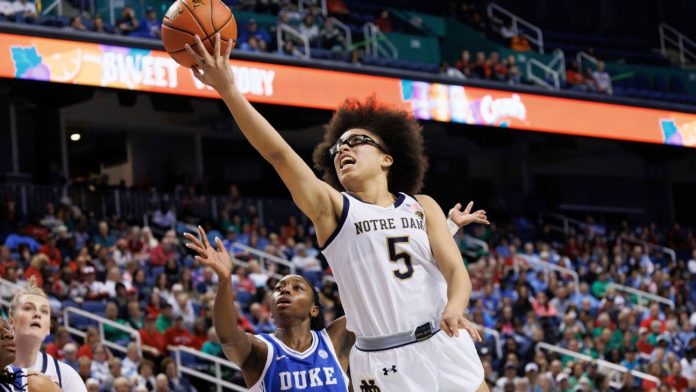
KANSAS CITY — TCU guard Olivia Miles said she knows many were surprised she bypassed being a likely lottery pick in the WNBA draft earlier this year to remain in college.
But with the WNBA’s ongoing collective bargaining negotiations, Miles, who transferred from Notre Dame for her final season, said she is content to observe that debate from afar.
“The WNBA is figuring out their own stuff [with the CBA] as we’re watching,” Miles, 22, told ESPN on Tuesday at Big 12 women’s basketball media day. “So, let them figure it out, and for one more year, I’ll enjoy college.”
After Miles’ junior season with the Fighting Irish was ended by TCU in the Sweet 16 in March, many expected her to then declare for the draft because she was age-eligible, having been at Notre Dame since her arrival in winter 2021. Instead, she opted to transfer and use her remaining season of eligibility at TCU. She is projected to be the No. 2 pick in ESPN’s most recent 2026 WNBA mock draft.
Miles said she knows there is a lot happening with negotiations for a new CBA, which has to be signed before the league moves forward with the expansion draft, the lottery for the 2026 regular draft and free agency. All that will have an impact on Miles’ future, but she is putting it to the side a while longer.
“Right now, it’s all still opinions on what is going to change,” Miles said of the CBA. “We hear there is going to be a lot of [player] movement and the league will look different next season. So, for now, I just prioritize what is right in front of me. I’ll start thinking about everything else later on.”
There is plenty for Miles to still accomplish in college. TCU is the preseason favorite in the Big 12, as chosen by the league’s coaches. Miles was a three-time all-ACC first-team selection at Notre Dame, where she averaged 14.2 points, 6.0 rebounds and 6.5 assists in 101 games.
She missed the 2022-2023 postseason and the entire 2023-2024 season with a knee injury. Miles said despite averaging 15.4 points, 5.6 rebounds and 5.8 assists last season for the 28-6 Irish, she still wasn’t 100% confident in her preparation to be in the WNBA. So, she bypassed the 2025 draft.
“[The lottery potential] was a lot to leave on the table,” Miles said, adding with a smile, “My parents thought I was crazy. Everyone thought I was crazy. Heck, I still hear comments like, ‘It doesn’t make sense. Why would she come back? Why did she go there?’
“But I wasn’t in great shape, still, mentally. I had a great season last year, but I still wanted to get more consistent and more disciplined, and in better shape physically. I didn’t think I was ready. Being at TCU feels so aligned; I couldn’t pass up on the opportunity, especially with their style of play. Why not stay in college? The pros will still be there.”
The Horned Frogs had a breakthrough season in 2024-2025, going 34-4 and winning the Big 12 regular-season and tournament titles before making the Elite Eight, all program firsts.
But TCU lost four senior starters and needed an infusion of experience and talent. Miles, the preseason Big 12 newcomer of the year, brings that, and coach Mark Campbell’s program offers a pick-and-roll offensive system that will help Miles when she goes pro after this season.
“She’s going to be the ball-dominant kid, and she’s going to get the usage — all of our actions will run through her,” Campbell said. “She wanted to use this year to really, really get her mind right and get ready for the pros. And she’s acted like a pro since day one.”
Watching the first few minutes of KPop Demon Hunters on Samsung’s Galaxy XR headset, I think Apple’s Vision Pro might be cooked.
It’s not because the Galaxy XR — which Samsung formerly teased as Project Moohan — is that much better than the Vision Pro. It’s that the experience is comparable, but you get so much more bang for your buck. Specifically, Galaxy XR costs $1,799 compared to the Vision Pro’s astronomical $3,499. The headset launches in the US and Korea today, and to lure in more customers, Samsung and Google are offering an “explorer pack” with each headset that includes a free year of Google AI Pro, Google Play Pass, and YouTube Premium, YouTube TV for $1 a month for three months, and a free season of NBA League Pass.
Did I mention it’s also significantly lighter and more comfortable than the Vision Pro?
Oh, and it comes with a native Netflix app. Who is going to get a Vision Pro now? Well, probably folks who need Mac power for work and are truly embedded in Apple’s ecosystem. But a lot of other people are probably going to want this instead.
These were the thoughts running through my head while I got my second official demo of Samsung’s headset ahead of today’s announcement. I’d gotten a demo of a Moohan prototype last December, but this was the final iteration of that product. There are a few notable changes. The front piece is more cushioned than I remembered from my last demo, and I finally got to try the removable bottom light seal. But otherwise, not much has changed.
The hardware still looks like a Vision Pro mixed with a Meta Quest 3. There aren’t creepy eyes on the front screen, though there is still a glass panel that houses several cameras to capture your surroundings and hand gestures. There are mini-LEDs inside that support 4K resolution and up to 90Hz refresh rates, which should make scrolling and games look smooth. Samsung promises up to 2.5 hours of battery life, right on a par with the Vision Pro.
It sure looks like a Vision Pro.Image: Owen Grove, The Verge
There’s no removable strap — it’s all a lightweight plastic with a cushioned back piece and a dial that you use to adjust tightness. The materials don’t feel as premium as the Vision Pro. But plastic is easier to clean than fabric, and when I slip it onto my head, it’s significantly lighter, and the weight is distributed more evenly. (The first Vision Pro was extremely front-heavy, but a new strap helps a lot with that.) It took until the end of the 30-minute demo for me to start feeling some tension.
So much of the experience inside the headset is similar to the Vision Pro that I can imagine Apple’s lawyers bristling. There’s a high-resolution passthrough, though I wouldn’t call it crystal clear. The headset tracks what you’re looking at, and you pinch your fingers to select. One difference is that there’s a Quest-like cursor when you point at menus and XR elements, making it a smidge easier to tell if the correct thing is highlighted. Otherwise, the interface is a Google-flavored version of what you’ll find in a Vision Pro.
They look like Vision Pros, but are much easier to wear.Photo by Victoria Song / The Verge
Feature-wise, there’s everything from spatial photos and immersive environments to blowing up multiple browser windows for maximum productivity. There’s also automatic spatialization for existing 2D content. As in, when I go to YouTube to watch a recent Vergecast episode, a 3D version of my colleague David Pierce leaps forward from the video.
Google and Samsung are keen to point out that this Android XR headset has Gemini. In fact, at a small keynote speech for the press, executives from both companies emphasized that this device has “AI at the core.”
The button that turns the device on and also cues Gemini.Image: Owen Grove, The Verge
That means that if, for some cockamamie reason, you decide to read a physical magazine with this headset on, you can Circle to Search any interesting products you happen upon and view them in virtual Chrome. When viewing an immersive 3D map in the Google Maps app, you can ask Gemini questions about your surroundings. If you’re viewing a photo or YouTube video, you can start a Gemini Live session, share your screen with the AI, and ask it questions. While looking at a photo of a fuzzy quadruped at Machu Picchu, Gemini told me that I was, in fact, looking at a llama and not an alpaca. It then proceeded to tell me llama facts. In the middle of watching a 3D YouTube video of an Icelandic volcano erupting. Gemini mistakenly identified it as a volcano in Hawaii. So, you know, there are limitations.
Samsung’s large demo screen shows a bit of what you see from inside.Image: Owen Grove, The Verge
I’m not convinced that the average person will ever want these expensive, high-tech XR headsets. You could argue Galaxy XR is also dead on arrival, especially since the zeitgeist seems to be shifting heavily toward smart glasses. But for those who do want headsets? On paper, the Galaxy XR headset is the much better value. You’re getting a similar consumption experience. It’s nearly half the price. (Heck, it costs less than a Z Fold 7!) It’s much easier to wear for a longer period of time.
There’s a wide swath of content, and you get access to Google apps like YouTube and Maps, among others. If you think AI is a selling point, Gemini is integrated into this headset far more effectively than Siri is in the Vision Pro. And, compared to gadgets like phones, tablets, and computers, these headsets are much easier to use as standalone devices. But the most popular use case we’ve seen so far for these headsets is using them as your own personal theater. The Galaxy XR may lack some of the Vision Pro’s premium polish — and what amounts to the power of a full-fledged Mac — but, immersive content-wise, it’s good enough.
Plus, if you want to use it for productivity, you can cast a Samsung Galaxy Book laptop screen to the headset (though it’s unclear how this compares to casting a Mac to a Vision Pro), answer calls from it, or share files between the headset and other devices.
In addition to hand gestures, the Galaxy XR can also be controlled with handheld controllers (sold separately.)Image: Owen Grove, The Verge
I’ll caveat all this with a reminder that demos are not the same as living with a device. When we get a Galaxy XR headset in for testing, it’s possible we’ll find things that tilt the balance back in the Vision Pro’s favor. I’m curious to see how the M5 Vision Pro — which goes on sale October 22nd — will fare. But if the Galaxy XR holds up as well in real-life testing as it has in demos, then there’s even less reason to buy a Vision Pro.
Follow topics and authors from this story to see more like this in your personalized homepage feed and to receive email updates.
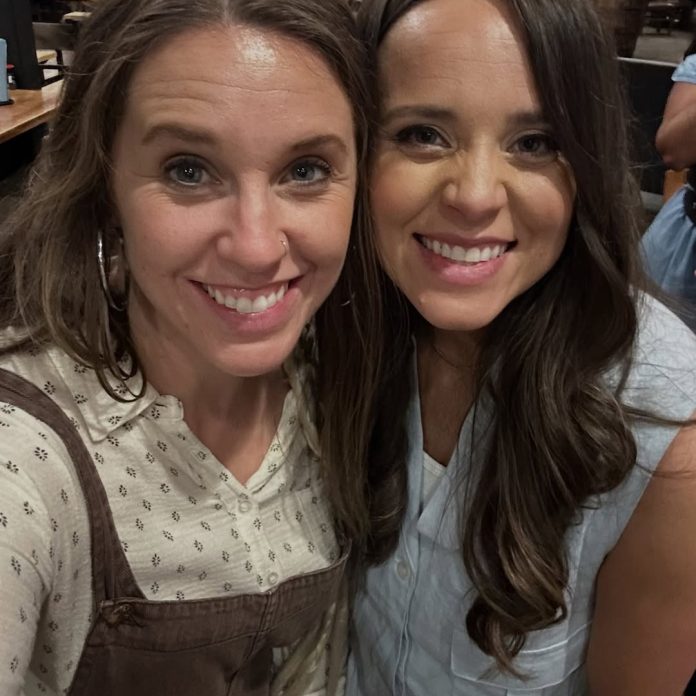
Jim Bob and Michelle’s fifth child, Jessa Duggar, was born Nov. 4, 1992.
Jessa met Ben through church and he began courting her in 2013—the old-fashioned approach to romance coming as a brand-new notion to a lot of viewers. The kids never talked about their romances pre-engagement, so Jim Bob explained to People, “Courting is getting to know each other in a group setting, both families spending time together and the couple setting goals together to determine if they are meant to marry. With dating, a couple will often pair off alone and that sometimes leads to a more physical relationship.”
Ben asked for Jessa’s hand and then proposed in August 2014—sealing the deal by holding her hand for the first time. They married on Nov. 1, 2014. Jessa was pregnant with their first child when 19 Kids and Counting was canceled and TLC subsequently aired a special about sexual abuse, featuring Jill and Jessa, to further educate viewers on the subject. The sisters would end up the stars of their own show, Jill and Jessa: Counting On, that winter; the show then evolved to become Counting On, featuring other Duggar siblings as well.
Meanwhile, Jessa and Ben welcomed son Spurgeon on Nov. 5, 2015, son Henry on Feb. 6, 2017, daughter Ivy Janeon May 28, 2019 and daughter Fern in July 2021. In February 2023, Jessa shared that she suffered a miscarriage over the 2022 holiday season. She gave birth to son George in December 2023.
Price: $19.99 - $17.97 (as of Oct 22, 2025 04:02:30 UTC – Details)
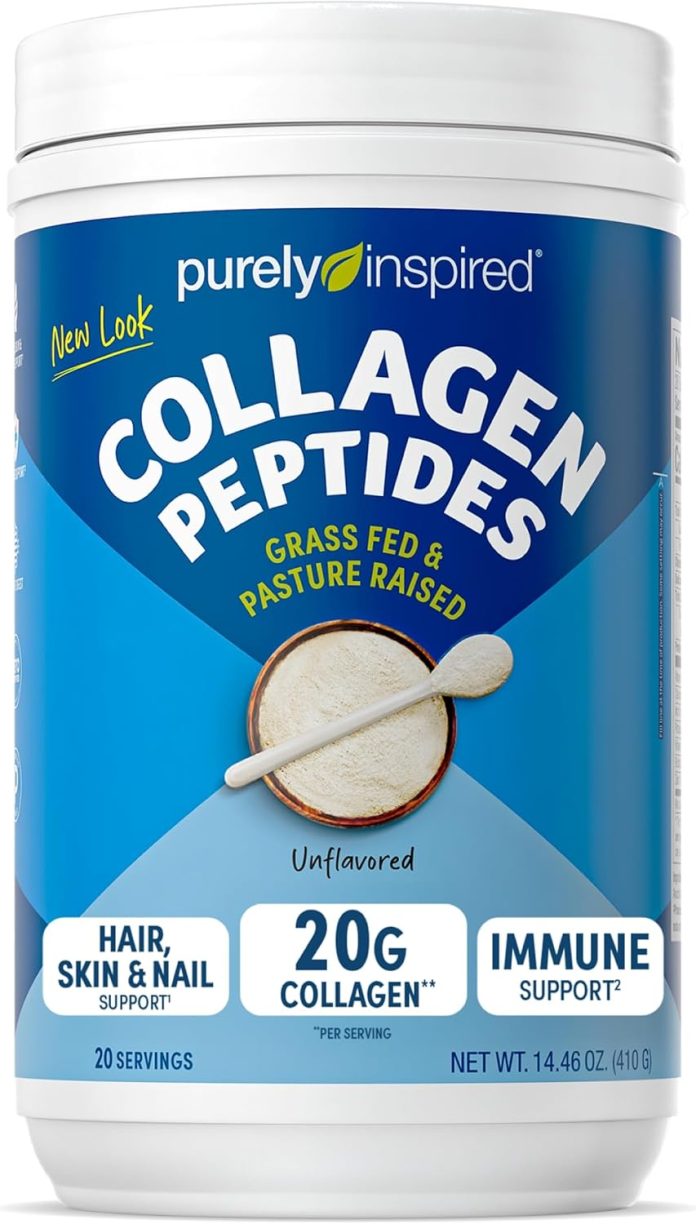
Purely Inspired Collagen Peptides is sourced from grass fed, pasture raised bovine and does not contain recombinant bovine growth hormone (rBGH). This unique formula provides 18g of protein, plus a B vitamin complex to support metabolic energy. PERFECT FOR YOUR ROUTINE Collagen is the most plentiful protein in the skin, and we have developed an easy way for you to get the collagen you want. Our Collagen Peptides also features biotin to give you added support for your skin, hair and nails. FORMULA YOU CAN TRUST Purely Inspired Collagen Peptides is sourced from grass fed, pasture raised bovine and does not contain recombinant bovine growth hormone (rBGH). It delivers 20g of collagen including Type I and Type III. Purely Inspired Collagen Peptides is also gluten and dairy free, contains no added sugar, is non GMO, and supports a keto and paleo diet. Product Dimensions : 4.84 x 4.84 x 7.16 inches; 14.4 ounces Item model number : 0631656712766 Department : Purely Inspired Collagen Peptides Date First Available : May 1, 2018 Manufacturer : Iovate Health Sciences Incorporated ASIN : B07CJPNGT3 Best Sellers Rank: #6,323 in Health & Household (See Top 100 in Health & Household) #55 in Collagen Supplements Customer Reviews: 4.3 4.3 out of 5 stars 10,571 ratings var dpAcrHasRegisteredArcLinkClickAction; P.when(‘A’, ‘ready’).execute(function(A) { if (dpAcrHasRegisteredArcLinkClickAction !== true) { dpAcrHasRegisteredArcLinkClickAction = true; A.declarative( ‘acrLink-click-metrics’, ‘click’, { “allowLinkDefault”: true }, function (event) { if (window.ue) { ue.count(“acrLinkClickCount”, (ue.count(“acrLinkClickCount”) || 0) + 1); } } ); } }); P.when(‘A’, ‘cf’).execute(function(A) { A.declarative(‘acrStarsLink-click-metrics’, ‘click’, { “allowLinkDefault” : true }, function(event){ if(window.ue) { ue.count(“acrStarsLinkWithPopoverClickCount”, (ue.count(“acrStarsLinkWithPopoverClickCount”) || 0) + 1); } }); }); Support Your Daily Glow: Purely Inspired Collagen Peptides delivers 20g of collagen, 18g of protein, and 0g of sugar in an easy-to-mix, unflavored formula—plus 300mcg of Biotin to support healthy hair, skin, and nails. 20 servings per container. Immune Support: Feel and look your best with every sip—packed with Vitamin C and Zinc to support immune health from the inside out. No Artificial Flavors or Colors: Purely Inspired Collagen Peptides is a clean formula you can trust. It’s made with no artificial flavors, colors or sweeteners and is non-GMO and gluten-free. How to Use: Simply mix 1 scoop into 8 oz. of water, coffee, tea, smoothies, or your favorite beverage. Collagen Peptides has no added flavor, making it a seamless addition to your routine. Pure, Delicious, & Transparent: Purely Inspired is committed to providing nutritional plant-focused choices for a healthier lifestyle. Our products are equal parts delicious and nutritious, crafted to help you stay nourished, feel better & live well.
Customers say
Customers find the collagen powder to be of good quality and consider it excellent value for money. The product improves skin health, with customers noting improvements in hair, skin, and nails. The taste and texture receive mixed feedback – while some find it not too sweet and easy to mix, others report it doesn’t dissolve well in hot coffee and gets clumpy. Additionally, the product has an unpleasant smell.
Kiley McDaniel covers MLB prospects, the MLB Draft and more, including trades and free agency.
Has worked for three MLB teams.
Co-author of Author of ‘Future Value’
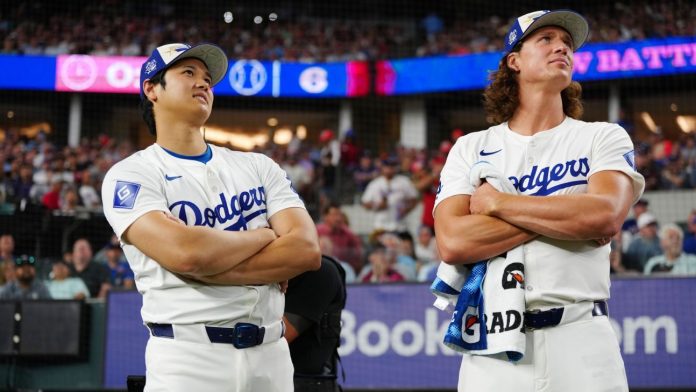
The Los Angeles Dodgers‘ pitching rotation has been the most dominant force of this year’s MLB playoffs, with L.A.’s four aces combining for a microscopic 1.40 ERA and 81 strikeouts over 10 postseason starts.
As L.A.’s four starters prepare to face the Toronto Blue Jays in the World Series, we’re here to get you ready for their Fall Classic appearances with a guide to what each does best and the pitch mix that makes the quartet so dominant.
Blake Snell: The Game 1 guy
What he has done this October: 0.86 ERA, 12.0 K/9 in 21 IP
What makes him so good: Snell’s excellence is easy to understand: He has been a front-line starter for almost a decade, signed a $182 million deal last year and is a lefty who throws in the mid-90s. He already has two Cy Young awards and a 3.15 ERA over his 10-year big league career. But there has been a subtle change in his approach during his first year with the Dodgers that has powered his playoff dominance.
How he uses his pitches: Snell had been a power fastball/breaking ball pitcher for basically his whole career — but this season, his changeup became his second-most-used pitch and his clear best by run value (i.e., good things happened when he threw it this year, much more so than with his other pitches). Run value can be somewhat deceptive — what if your dominating fastball gets hitters on their heels, but the changeup gets the strikeout and all of the statistical credit for the strikeout? Snell seems to believe in what the numbers are showing, too.
His changeup usage was 23.6% in the regular season and is 32.4% in the playoffs. His regular-season miss rate on the pitch was 43.5%, and it’s 65.5% in the playoffs. It has been at 60% or higher in all three of his playoff starts. The pitch movement and velocity is almost identical to last year’s version, but the outcomes, specifically the in-zone contact rate and launch angle allowed, have improved pretty dramatically.
Snell threw the pitch only 2% of the time against left-handed hitters in the regular season, but that has ticked up in the playoffs, increasing with each start to 7% against the Brewers.
Those extra changeups are basically coming at the expense of his fastball usage. Throwing fewer fastballs is somewhat common in the high-stakes environment of the playoffs, but Snell is thriving by relying more on his changeup than his slider and curveball in those key situations this year.
Yoshinobu Yamamoto: The six-pitch magician
What he has done this October: 1.83 ERA, 8.2 K/9 in 19⅔ IP
What makes him so good: Yamamoto came into the league last year with a lot of hype and largely met it, but he missed nearly three months because of a shoulder issue after being hit around in his first big league appearance.
This year, he took a big step forward and looks more than worth his $325 million deal, throwing 173⅔ innings with a 2.49 ERA and sparkling peripherals that added up to a 5.0 WAR in the regular season. If you consult run values, all six of his pitches were better in 2025 than 2024, in addition to him throwing almost twice as many innings. What did he change?
The velocity and movement of his pitches are basically the same, and the usage of those pitches was basically the same, other than shifting 5% usage of his curveball to his cutter as he improved the movement on his cutter by a few inches.
How he uses his pitches: Take a look at the subtle shifts with his two best pitches: his four-seam fastball and splitter. Here are the locations of his fastball against right-handed hitters in the 2024 regular season (left) and 2025 regular season (right).
It’s subtle, but that singular red dot down the middle has migrated toward the edge of the zone, and there’s a little more action across the top of the strike zone, which is where most of the misses are occurring. His run value per fastball thrown almost doubled and the total runs saved went from plus-5 to plus-17 (a top-10 figure in baseball) while the xwOBA (expected production by hitters) went from .360 to .299 and his miss rate ticked up by 2%.
Though the difference in locations isn’t as easy to see, the execution of Yamamoto’s splitter also improved. His average launch angle allowed went from plus-1 to minus-8, and the barrel rate dropped from 17% to 9% which helped fuel a 24-point drop in xwOBA and a spike in miss rate on that pitch. His run value on that pitch is plus-9, third best in baseball.
When Yamamoto is dealing, it’s because of those two pitches, which are his most-used offerings against lefties and righties. And yes, they also tunnel well:
Yoshinobu Yamamoto, 98mph Fastball and 93mph Splitter, Overlay
What he has done this October: 0.68 ERA, 12.2 K/9 in 13⅓ IP
What makes him so good: Glasnow’s style of pitching is a function of his immense physical gifts and, throughout his career, slowly figuring out how to solve the geometry problem they create.
He is 6-8 and a standout athlete who can generate the biggest extension (how far from the rubber he releases a pitch) in baseball while also throwing from one of the highest arm slots in the league. Glasnow’s long arms help create velocity easily but make it harder to repeat his delivery — so his precision within the strike zone can come and go. Due to this, he relies more on power than feel.
How he uses his pitches: Glasnow has mid-90s velocity but can achieve a flatter plane to the plate to get misses up in the strike zone due to his huge extension, which brings him lower on the mound to negate his height and high arm slot.
He has a natural ability to cut the ball, so his fastball has near-cutter break while sitting in the mid-90s, his slider has typical movement but comes in 3 mph harder than the average slider, and his curveball is also harder than the average bender — with six extra inches of drop.
He relies on that curveball against lefties because he doesn’t throw a changeup, and the slider is the breaker of choice against righties.
Glasnow’s use of these three main pitches puts hitters in conflict. He takes away their time to make decisions by throwing hard, and though he can’t get huge horizontal movement, he can tunnel the pitches so they look the same when the hitter is trying to decide. I could show you a plot of how he executes this, but it’s easier to see in video. Here’s a typical attack plan versus a right-handed hitter:
Glasnow’s game is one of extremes, but when he’s healthy and executing, he’s nearly unhittable.
Shohei Ohtani: The two-way sensation
What he has done this October: 2.25 ERA, 14.3 K/9 in 12 IP
What makes him so good: You mean besides being a three-time MVP (who is about to win his fourth award) as the most dominant two-way force the sport has seen — fresh off one of the most incredible performances in postseason history?
Well, the funny thing about Ohtani is that his eye-popping numbers at the plate and the two-way accolades make it easy to forget how good he is just as a pitcher. In a career that spans 100 regular-season starts, Ohtani has posted a 2.87 ERA and struck out 670 batters in 528⅔ innings.
How he uses his pitches: You remember Ohtani being a really good pitcher in 2023 with the Angels, and now he somehow seems better. How? Well, it’s pretty simple:
His velocity is up a few tenths on most of these pitches in the postseason, too, as you’d expect.
Before the “velocity isn’t everything” crowd blows a gasket, Ohtani’s zone% and strike% are better in 2025 than in 2023, and the shapes of his pitches haven’t really changed. He gave back an inch or so of movement on some of those off-speed pitches, a good swap given what the industry understands about pitching development.
When scouts in any sport talk about athleticism, it’s usually about several things that standout athleticism can affect. In Ohtani’s case, it’s quite obvious: He’s one of the best hitters, and at age 31, after multiple elbow surgeries, he can improve his velocity and strike-throwing at the same time when he was already one of the better pitchers in the game.
US District Court Judge James Donato has just agreed to push back enforcement of his permanent injunction until October 29th instead. Here’s the text of the order. It’s brief!
ORDER. At the joint request of the parties, MDL Dkt. No. 1110, the upcoming October 22, 2025 deadline on which certain provisions of the Injunction, MDL Dkt No. 1017, in this case are scheduled to take effect is vacated and extended to October 29th, 2025. Signed by Judge James Donato on 10/20/2025.
It’s also not clear why Google argued for the extension, or why Epic agreed to it, after Epic CEO Tim Sweeney previously celebrated the October 22nd deadline as the day “developers will be legally entitled to steer US Google Play users to out-of-app payments without fees, scare screens, and friction – same as Apple App Store users in the US!” Public documents filed by both parties don’t mention a reason for the delay.
So… October 29th. Google previously told The Verge that it would comply with its legal obligations while it continues its appeal, so that’s the day we expect to see Google pages like this one stop stating that Google Play Billing is required for developers who distribute apps via Google Play.
Unless, of course, the Supreme Court grants a stay by then… Google previously stated it would file its Supreme Court appeal by October 27th.
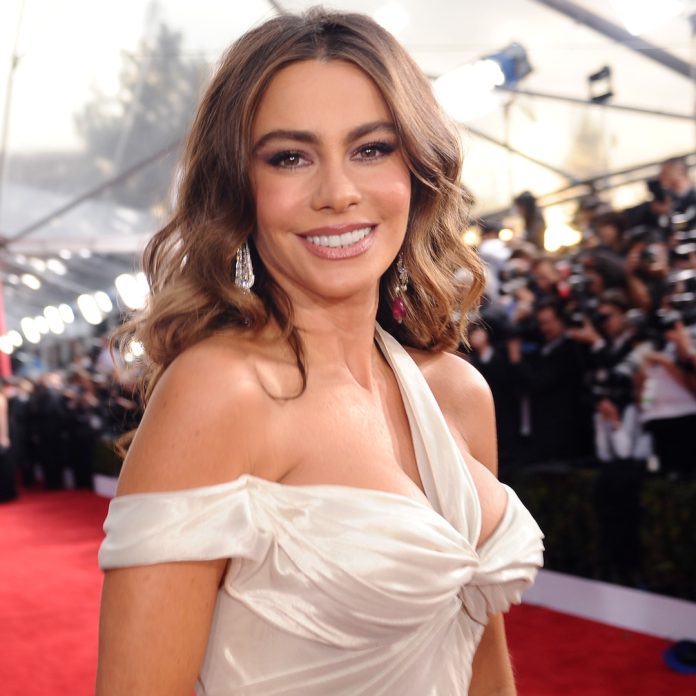
Sofía Vergarahas a pretty good idea what Gloria’s modern life would look like.
Five years after Modern Family finished its 11 seasons on ABC, the actress explained how she envisions her character would be stepping into a new phase of motherhood, as Gloria and husband Jay (Ed O’Neill) witness Manny (Rico Rodriguez) reach adulthood.
“Jay and Gloria would be getting ready for Manny to already have left for college,” she exclusively told E! News at Food Network’s New York City Wine & Food Festival Oct. 18. “That would have been I’m sure a really, really fun season, to just have now Jay and Gloria together with little Joe.”
And Sofía, 53, can certainly relate to sending a child off to school, as she saw her own son Manolo Gonzalez Vergara head off toEmerson College and graduate in 2015.
But Manolo himself has some ideas of how Gloria would be keeping busy without Manny at home, telling E! News that Gloria might even be out with them at the 18th anniversary of the food festival, which was presented by Invesco QQQ at The Seaport.
“Or she’d be here with her sauce,” he quipped, with Sofía adding, “Yeah, she’d be selling sauce here in New York.”
Price: $9.99 - $7.26 (as of Oct 21, 2025 04:52:46 UTC – Details)
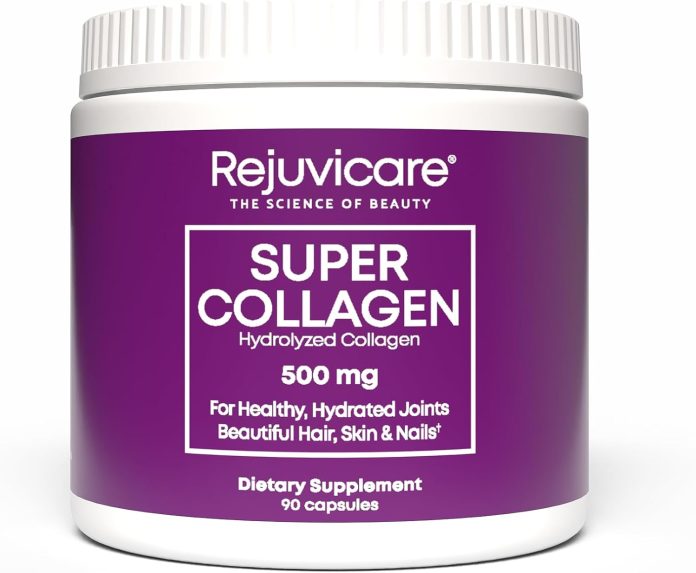
Rejuvicare Super Collagen capsules are an easy, affordable solution for individuals with dull or thinning hair, brittle finger nails, dry skin and achy joints. Collagen provides vital amino acids that help maintain elasticity and plays an important role in the development of all connective tissue. This high potency, antioxidant formula fortifies the body to help fight the signs of aging. A daily consumption of Rejuvicare Super Collagen may improve blood circulation that helps deter the appearance of fine lines and dry skin; plus promote vibrant hair, strong nails and temporarily relieve joint inflammation. Rejuvicare beauty formulas are designed to work where the aging process begins, on the inside. Is Discontinued By Manufacturer : No Product Dimensions : 2 x 2 x 4.75 inches; 2.4 ounces Item model number : N8745 Date First Available : February 19, 2016 Manufacturer : WINDMILL HEALTH PRODUCTS ASIN : B01BZ6EBX4 Best Sellers Rank: #17,513 in Health & Household (See Top 100 in Health & Household) #159 in Collagen Supplements #1,597 in Sales & Deals Customer Reviews: 4.6 4.6 out of 5 stars 3,510 ratings var dpAcrHasRegisteredArcLinkClickAction; P.when(‘A’, ‘ready’).execute(function(A) { if (dpAcrHasRegisteredArcLinkClickAction !== true) { dpAcrHasRegisteredArcLinkClickAction = true; A.declarative( ‘acrLink-click-metrics’, ‘click’, { “allowLinkDefault”: true }, function (event) { if (window.ue) { ue.count(“acrLinkClickCount”, (ue.count(“acrLinkClickCount”) || 0) + 1); } } ); } }); P.when(‘A’, ‘cf’).execute(function(A) { A.declarative(‘acrStarsLink-click-metrics’, ‘click’, { “allowLinkDefault” : true }, function(event){ if(window.ue) { ue.count(“acrStarsLinkWithPopoverClickCount”, (ue.count(“acrStarsLinkWithPopoverClickCount”) || 0) + 1); } }); }); Brand : Rejuvicare Size : 90 Capsules Supplies Collagen for Healthy Hair, Skin and Nails
Customers say
Customers report positive results with this collagen supplement, noting improvements in skin and hair health, with one mentioning noticeable skin tightening effects. The supplement works quickly, with customers reporting instant results, and helps with joint pain, particularly during exercise. Customers find it easy to swallow and consider it good value for money, while also appreciating its positive impact on skin brightness and nail health, with one customer noting their nails becoming less brittle.
After the defending champion Dodgers swept the Milwaukee Brewers in the National League Championship Series, the Blue Jays outlasted the Seattle Mariners in a thrilling American League series.
What carried Toronto and Los Angeles this far — and will it continue to work in the Fall Classic? Which stars will shine brightest? And who else must step up? Our MLB experts are here with your first look at this year’s World Series showdown.
Note: Matchup odds come from Doolittle’s formula using power ratings as the basis for 10,000 simulations to determine the most likely outcomes. Team temperatures are based on Bill James’ formula for determining how “hot” or “cold” a team is at any given point; average is 72°.
Toronto Blue Jays vs. Los Angeles Dodgers
For the first time in more than three decades, the Toronto Blue Jays are back in the World Series where they will find the well-rested, defending champion Dodgers waiting for them. It’s the third Fall Classic for the Toronto franchise but the first since the Jays won back-to-back titles in 1992 and ’93.
The Expos never won a pennant, so the two Toronto pennants account for all World Series appearances by Canada-based clubs. Game 1 at the Rogers Centre will mark the seventh World Series game played outside of the U.S. border. And, spoiler alert, Canada will be rocking.
There’s a fairly limited history between the teams in terms of regular-season interleague play. The Dodgers hold the all-time edge, 19-11, and the franchises did not meet until June 18, 2002. The Blue Jays won that initial encounter behind a Roy Halladay complete game that featured an interesting pair of leadoff hitters. Hitting first for Toronto in that game, at least at the outset, was Chris Woodward, the Dodgers’ current first-base coach. Leading off for the Dodgers was Dave Roberts, who went 0-for-4 against Halladay.
Before the season, my simulations gave this matchup a 2.28% chance of happening, ranking 13th of 165 matchups that popped up in at least one sim. But because the Jays weren’t forecast as a favorite, and the AL figured to be tightly packed (as turned out to be the case), there were eight other teams that faced the Dodgers more often in the 10,000 simulated seasons, including the Mariners, whom the Jays just vanquished in the ALDS.
It’s a novel Fall Classic matchup featuring teams with old-school traits. For the Dodgers, it has been a joyous leaning on a dominant starting rotation. For Toronto, it’s a throwback offense that features standout batting or, more precisely, all the traits that lead to what passes for a high average in 2025 baseball. All of this makes this first Dodgers-Jays showdown a fascinating clash of teams with contrasting styles of play. The games begin in Toronto on Friday. — Doolittle
Toronto Blue Jays
Odds of winning: 40.4%
Team temperature: 93°
What is the No. 1 factor that has carried the Blue Jays to the World Series for the first time in three decades?
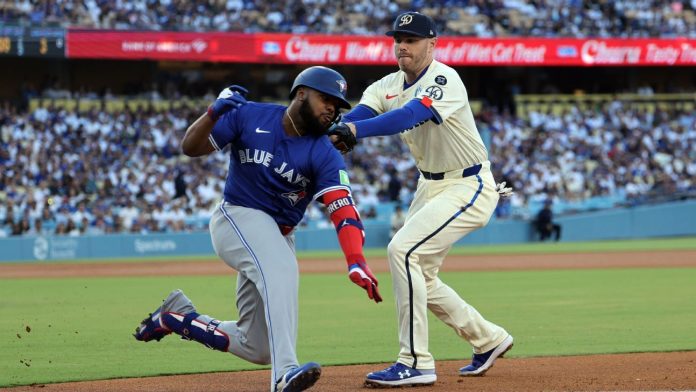
Jorge Castillo: This one is easy. Vladimir Guerrero Jr. has been the best player in this postseason — and, yes, that includes Shohei Ohtani. Six months after signing the third-largest contract in Major League Baseball history, Guerrero has played the part of superstar in October. He’s slashing an absurd .442/.510/.930. He has three strikeouts all month. His six home runs tied the Blue Jays franchise record for postseason home runs in a career. He has also showcased good defense at first base and smarts on the basepaths.
For a guy who entered October with a downright ugly October history — he slashed .136/.240/.182 without a home run in his first six career playoff games — Guerrero has put his stamp on this postseason to carry Toronto to its first World Series in 32 years. Four wins over the Dodgers, with Guerrero as the centerpiece of the upset, would make this one of the greatest October runs ever.
David Schoenfield: Yes, Jorge is correct: If Guerrero has a big World Series, it will go down as one of the greatest postseason performances of all time. Let’s also give a shoutout to rookie pitcher Trey Yesavage – and to the Blue Jays for having the belief in him to make him their No. 2 starter behind Kevin Gausman at the start of the postseason, even though Yesavage had made just three starts in the regular season.
He pitched 5⅓ hitless innings with 11 strikeouts against the Yankees in the ALDS, pure domination. He got three huge double plays to beat the Mariners in ALCS Game 6. Obviously, the stuff speaks for itself, but the Jays asked a lot from a young pitcher, and he has delivered.
Will it/won’t it continue against the Dodgers?
Castillo: Yes, but in limited doses because the Dodgers will probably pitch around Guerrero whenever possible. Nothing suggests Guerrero is going to slow down when given pitches to hit.
The Dodgers’ starting rotation has been utterly dominant, but Guerrero has hit elite pitching this month. He has hit all kinds of pitching. The pressure will be on the guys hitting behind him — Alejandro Kirk, Daulton Varsho and Ernie Clement — to make the Dodgers pay when they refuse to engage Guerrero.
Schoenfield: It will be a little more difficult. While the Dodgers, like the Mariners, strike out a lot, they also chase out of the zone far less often than Seattle (third lowest chase rate in the regular season compared to 17th for the Mariners). The scouting reports on Yesavage, which were thin at the start of the playoffs, now have three additional games to consider his tendencies. He was a little lucky to escape those two bases-loaded jams against the Mariners and given that his control can waver — he had three walks in each of his two ALCS starts — he’s going to have to be a little more crisp against the Dodgers.
Vlad Jr. has been scorching hot all month. What should we expect from him in the World Series?
Castillo: See above. More of the same, unless the Dodgers refuse to pitch to him. We saw the Yankees and Mariners occasionally dabble with not attacking Guerrero, but they did not avoid him for the most part. The series could hinge on how that dynamic plays out.
Schoenfield: He’s so locked in right now that you would expect it to continue. On the other hand, this Dodgers rotation has much better swing-and-miss stuff than Seattle’s rotation, which was missing Bryan Woo and featured a subpar Logan Gilbert.
We should also point out that Guerrero hit just 23 home runs in the regular season. Getting the ball in the air, like he’s been able to do in the playoffs, isn’t something he did consistently during the regular season, when he had several homerless dry spells.
Which other player is most crucial to the Blue Jays’ chances of winning a title?
Castillo: The bullpen is the Blue Jays’ weakest link, which makes Louis Varland a significant character in this series. Varland is John Schneider’s most trusted reliever. The right-hander has pitched in 10 of the Blue Jays’ 11 playoff games, often in the biggest spots in the middle innings. He has recorded more than three outs three times.
Varland, whose splits during the regular season weren’t all that drastic (a .662 OPS against vs. RHH and a .716 .OPS against vs. LHH) will surely find himself in a huge spot against one of the Dodgers’ left-handed boppers. Jeff Hoffman may be Toronto’s closer, but Varland, acquired at the trade deadline from the Twins, is the team’s best reliever and they need him to secure huge outs.
Schoenfield: At the beginning of the playoffs, we all pointed to Hoffman as a postseason key, but the Blue Jays have played so many blowout games in their two rounds – either winning or losing – that Hoffman hasn’t had any close leads to protect.
The concern was he allowed 15 home runs in the regular season, the second most of any reliever in the majors. He has pitched well in the postseason: 6.1 innings, three hits, one run, nine strikeouts, no home runs. But let’s see what happens when the games are closer.
Los Angeles Dodgers
Odds of winning: 59.6%
Team temperature: 122°
What is the No. 1 factor that has carried the Dodgers back to the World Series?
Jeff Passan: Their extraordinary starting pitching. In Los Angeles’ 10 games this postseason, its four starters — Blake Snell, Yoshinobu Yamamoto, Tyler Glasnow and Shohei Ohtani — have systematically dissected Cincinnati, Philadelphia and Milwaukee’s offenses. In 64.1 innings, they have a 1.40 ERA. It’s not by accident. Batters are hitting .132/.207/.201 against them. They have struck out four times as many as they’ve walked and allowed just two home runs.
Now it’s the Mariners’ turn. Their offense has had moments. They’re capable. But they haven’t seen a rotation like the Dodgers’ yet.
Alden Gonzalez: It is indeed their four starting pitchers, as Jeff noted. But the evolution of a fifth one, Roki Sasaki, has been just as critical. The Dodgers were searching for answers late in games when October arrived, and had it not been for Sasaki recapturing the velocity on his fastball and quickly adapting to a high-leverage bullpen role, they likely would not be here right now. The Dodgers have won nine of their 10 postseason games, and Sasaki has recorded the final out in five of them. In another, the Game 4 clincher in the NLDS, he pitched three perfect innings.
Will it/won’t it continue against the Blue Jays?
Gonzalez: The long layoff could be a boon for Sasaki, who had been in uncharted territory from a workload standpoint. Having essentially six days off means he will face few, if any, restrictions in the World Series. And if his arm is fresh and his command is right, opposing hitters usually don’t have much of a chance against his fastball-splitter combination.
One potential advantage for the Blue Jays, though, is that the book is essentially out on Sasaki by now, and they’ll have a much better feel for how to attack him than the Reds and Phillies, who had little to work with because Sasaki’s stuff was so much better than what he displayed earlier this season. If the Blue Jays can get to him, the Dodgers will be left with few other options late in games.
Passan: Toronto has scored the most runs, hit the most home runs and struck out at the lowest rate of any team this postseason. If any playoff offense can get to the Dodgers, it’s the Blue Jays’ offense. This series will be the unstoppable force vs. the immovable object.
Dodgers pitchers average 96.8 mph on their fastballs. Toronto batters are hitting .292 off 97-mph-plus heaters, and they’ve struck out in just six of the 50 plate appearances that ended with them. Expect even more two-strike spin from the team that averages just 35% fastballs on potential putaway pitches.
All of the Dodgers’ starters have at least four pitches — Yamamoto throws six and Ohtani seven — a buffet unfortunate to hitters. If Toronto can’t get to them, we’re looking at one of the greatest postseasons ever, like the 1983 Orioles but sustained over an even longer stretch.
It has been a mixed postseason for Shohei Ohtani. What should we expect to see from him in the World Series?
Gonzalez: When Ohtani gets going offensively — and if his performance in the pennant clincher wasn’t evidence of him getting back on track, I don’t know what is — he tends to carry it for a while. His career numbers against Blue Jays starters Kevin Gausman, Shane Bieber and Max Scherzer are not great (6-for-31 with 14 strikeouts and zero walks), and a long layoff normally is not a good thing for hitters.
Any concern about how the time off between the end of the NLCS and the start of the World Series might negatively impact Ohtani’s offense should easily be made up by how it could positively impact his pitching. Ohtani’s six scoreless innings in NLCS Game 4 came on 12 days’ rest; his five no-hit innings against the Phillies on Sept. 16 came on 11 days’ rest.
Passan: It’s fair to say that one can expect he won’t match Game 4 of the NLCS, one of the greatest individual performances in baseball history. But Ohtani will get at least one start in the World Series, giving him the opportunity to at least recreate some portion of his piece de resistance.
And at this point, anyone who doubts Ohtani’s ability to do anything simply hasn’t been paying attention. The reason there was such surprise at his struggles is because they’re such an unfamiliar sight. And the unfamiliarity comes from the rarity. If any of what he found at the plate in Game 4 carries over, expect fireworks.
Which other player is most crucial to the Dodgers’ chances of going back to back?
Gonzalez: Starting pitching will continue to lead the way for the Dodgers, but they combined to slash just .223/.313/.364 as an offense over the last two rounds. They know they have to do better if they’re going to repeat as champions. And Freddie Freeman in particular will be key.
The Mariners’ rotation is all right-handed, which means Freeman will hit in the No. 3 spot of the Dodgers’ lineup, directly behind Ohtani and Mookie Betts. When the Dodgers defeated the New York Yankees in last year’s World Series, it was Freeman who won MVP. But he’s slashing just .231/.333/.410 in these playoffs, and though he hit better against the Brewers, the Dodgers would love to see more power out of him on the biggest stage. He should be presented with plenty of RBI opportunities.
Passan: No pitcher has been better than Blake Snell this season, and with him lined up to get the ball in Game 1 — same as he did in the wild card series and NLCS — Snell will get to set the tone of the series and then be in line to pitch a potential clincher. In 21 innings, Snell has allowed 11 baserunners and struck out 28. He hasn’t yielded a home run.
He has been the personification of who the Dodgers hoped they were getting when they signed him last winter to a five-year, $182.5 million contract. If he replicates his performances over the first three rounds of the postseason, the Dodgers won’t need much offensive support to back him up, and Snell will get to celebrate his first championship.
Bill Barnwell is a senior NFL writer for ESPN.com. He analyzes football on and off the field like no one else on the planet, writing about in-season X’s and O’s, offseason transactions and so much more.
He is the host of the Bill Barnwell Show podcast, with episodes released weekly. Barnwell joined ESPN in 2011 as a staff writer at Grantland.
If you’re sure about anything in the NFL, just wait a few weeks. Heck, if you were sure about anything from Week 7‘s Giants-Broncos game, waiting a few minutes seemed to work just as well.
After six months of waiting for the NFL to return over the offseason, what we see in the first few weeks of action feels stickier and more meaningful than anything else, and we form opinions quickly.
Of course, we should know that what happens in September doesn’t always mean very much by the time we get to the postseason. Patrick Mahomes looking like a superstar in the first few weeks of the 2018 season? Important. The Eagles hitting their bye at 2-2 a year ago after losing to the Kirk Cousins-led Falcons and getting blown out by the Bucs? Nope. Philly casually went 16-1 the rest of the way, winning by an average of nearly two touchdowns per contest.
Everyone has their opinions and feelings about what we saw over the first month of the 2025 season. How many of those thoughts actually ring true as we hit the middle of October? Some things that seemed obvious or significant have faded into the September void, while other opinions only feel like they’ve solidified.
Today, let’s run through four of those September thoughts and see how Week 7 impacted what we knew — or thought we knew — about some of the NFL’s most interesting teams.
What we said in September: “This offense is broken.”
Well, it was. The Chiefs looked like a mess through their 0-2 start, and while they came up with a victory in Week 3 to get their season back on track in a 22-9 victory over the Giants, the offense still felt almost entirely dependent upon Mahomes scrambles and out-of-structure magic. We knew things were going to be at least a little better once Xavier Worthy and Rashee Rice returned to the fold, but the Chiefs looked like they were going to struggle to live up to even the 2023 and 2024 editions of their offense, let alone the halcyon days when Travis Kelce and Tyreek Hill were at their peaks.
Over the past four weeks? The Chiefs are fourth in EPA per play, a figure which rises to first when we remove garbage time (those plays where one team’s chances of winning are below 10%) from the equation. They’re second in points scored per drive. And if we again remove garbage time drives, the Chiefs have scored touchdowns on 56% of their possessions since the start of Week 4. The league average is 26%.
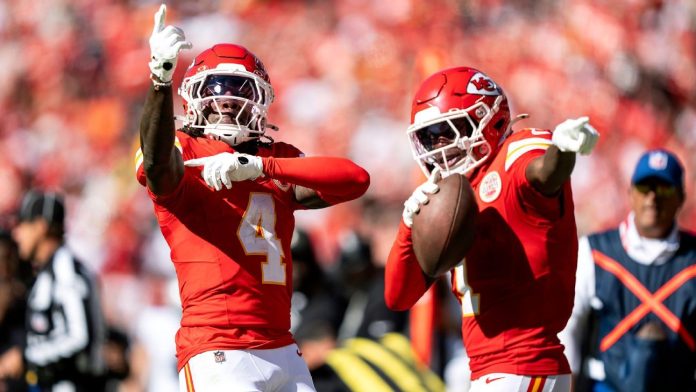
With Rice returning to the lineup for the first time in over a year Sunday after a knee injury and six-game suspension, the Chiefs finally got to field the first-string offense they had been waiting to unveil since the start of 2024. Rice, Worthy and Hollywood Brown were in the lineup together for the first time. Outside of rookie left tackle Josh Simmons, who is away from the team dealing with a personal matter, the Chiefs had everyone on their offensive depth chart available against the Raiders.
The results were dramatic. Even while sitting Mahomes for the entirety of the fourth quarter, the Chiefs scored 31 points and racked up 30 first downs. The Raiders ran only 30 plays, the second fewest by any team in a game since the 1970 merger. The Chiefs averaged 0.38 EPA per play with Mahomes on the field; that’s the best their offense has performed with Mahomes on the field in a regular-season game since Week 3 of the 2023 season. And this was the ninth-most productive regular-season performance of the Mahomes era by that metric.
Suddenly, the Chiefs’ offense is thriving. And while it’s easy to chalk that up to the return of Rice or the presence of a hapless Raiders defense (especially after Maxx Crosby went down injured), this really started back in a win against the Ravens in Week 4. The following week against the Jaguars, Mahomes threw a game-changing pick-six on the Jacksonville goal line, which swung that game toward the Jags (whom we’ll get to in a bit), but the Chiefs scored 28 points and had six drives of 50 yards or more against a very good defense. Then, they dropped 30 points on seven meaningful drives against the Lions, punting once all game.
What has changed? Less than you might think. The designed run game has been about as efficient as it was, if you account for garbage time. The Chiefs haven’t changed how often they throw in neutral game scripts (a lot, both before and after the Giants game). They’ve gotten better after the catch, though not significantly so; their raw yards after the catch are up quite a bit, but in looking at NFL Next Gen Stats’ metric yards after catch over expectation (YACOE), the Chiefs were 28th through three weeks and won’t land much higher over the ensuing four games.
The two most notable differences, at least to start, come through the passing game and the work of the receivers. For one, the Chiefs are doing a better job of bringing in Mahomes’ passes. They had a -6.7% catch rate over expectation through three games, the fourth-worst mark in the NFL. The only teams running a lower rate over that span were the Titans, who just fired their coach, and the Jaguars, who are still a mess.
Since Week 4, that has jumped to 0.8%, which is right around the middle of the pack. The Chiefs aren’t snatching balls out of thin air, but their receivers are holding their own and not letting their star quarterback down.
play
1:07
Why Daniel Dopp says Rashee Rice has WR1 upside on any given week
Daniel Dopp congratulates fantasy managers who stashed Rashee Rice and highlights why he has WR1 upside on any given week.
The bigger factor, though, is what has been missing around the Chiefs’ receivers: defenders. Through three games, just over 46% of Chiefs passes were thrown to open receivers. That figure was good for 22nd in the league. When we consider that the Chiefs were playing without their top two wideouts and had Mahomes trying to fit throws to guys like Brown and Tyquan Thornton in tight quarters, the underwhelming catch rate might not be too much of a surprise.
Over the past four games? That figure has risen to 62.8%, the best mark in the NFL.
The early-season difficulties in getting receivers open look like a historic outlier. Between 2018 and 2024, the Chiefs ranked no lower than fourth in the league in open target rate in any given season. Given how many receivers have come through Andy Reid’s offense in that span, and how the Chiefs have evolved stylistically to account for teams taking away big plays over the top, it’s hard not to give a significant portion of the credit for those improvements to Mahomes. He has an amazing ability to identify natural spaces with open pockets in coverages and then create explosives out of structure.
With receivers as open as the Chiefs have been over the past four weeks, Kansas City is running an astronomical expected completion rate. Per NFL Next Gen Stats’ model, an average group of receivers would be expected to turn 73.6% of Mahomes’ attempts into completions over the past month, also tops in the league. Offenses can run a high expected catch rate by throwing the ball short, as the Raiders are doing over that time span, but the Chiefs are averaging a shade under 7 air yards per attempt.
And now, after the returns of Rice and Worthy, the Chiefs don’t have an average set of receivers. For the first time in years, Reid can really stretch the field and create impossible binds for opposing defenses. Rice got a 2-yard score on a tap pass, but the other touchdowns were simply mismatches. Rice was isolated against oft-picked-on corner Kyu Blu Kelly for a back-shoulder TD in the second quarter Sunday. Later in the game, when the Raiders blitzed Mahomes and played Cover 0, the legendary blitz-defeating quarterback had no trouble finding Brown in the slot for a score. Those are just easy completions without much risk for Mahomes.
The tight ends got in the mix Sunday, too. A blown coverage on a deep crosser led to a 44-yard catch-and-run for Kelce, while Noah Gray picked up 28 yards on a fake screen-and-wheel up the sideline. The Chiefs have struggled out of 12 personnel (1 RB, 2 TEs, 2 WRs) this season, but they had a 61% success rate with two or more tight ends against the Raiders, their best mark of the season.
And the pass protection problems that plagued Mahomes in 2024 haven’t been as present this season. Over the past month, Mahomes has dealt with quick pressures on just 6% of his dropbacks, comfortably the lowest rate in the league (average is about 15%). He’s doing that while holding the ball at a rate well above league average, so it isn’t simply a product of getting the ball out fast.
With Mahomes taking sacks on just 3% of his dropbacks over the past month and turning the ball over just once (on that aforementioned pick-six in the Jaguars game), the Chiefs are emulating the Bills and becoming a positive play factory. Last season, just under 47% of the Chiefs’ plays on first and second down were successful by EPA. That was ninth in the NFL.
Over the past four weeks, the Chiefs are second in success rate on early downs, trailing only the Bills. Last year’s team needed to thrive on third down to survive, and with few explosive plays and a huge blinking light of a problem at left tackle, too many Chiefs drives ended short of the end zone because they couldn’t count on Mahomes to make it through four or five third downs without having the play blown up from his blind side. Now, with both improved offensive line play and more success on first and second down, third-and-long hasn’t been as pressing of an issue. The Chiefs faced third down with more than 4 yards to go just three times while Mahomes was in the game Sunday.
Will all of this stick? Maybe not quite as intensely as it has over the past four games. The Chiefs have gone 12-for-14 scoring touchdowns in goal-to-go situations over that time after going 1-for-4 in those same spots over the first three weeks of the season. Mahomes has gotten away with a dropped interception or two, including a pick that should have been made by the Raiders in the second quarter on a drive that ended with Rice’s second touchdown of the game.
With Rice and Worthy in the mix and Mahomes playing spectacular football, though, this looks and feels like the Chiefs who have terrified the league on offense once again.
What we said in September: “The defense can hold up a sloppy offense.”
For all the optimism and explosive plays coming out of Jacksonville’s 4-1 start to open the season, it was pretty clear to anyone paying close attention that Trevor Lawrence and the offense weren’t holding up their end of the bargain. That offense was producing the occasional big play or highlight-reel moment, but the operation simply wasn’t up to what should have been realistic expectations.
Even through that 4-1 start, the Jags led the league in procedural penalties, the sort of unforced errors that have little to do with what happens after the snap. They were plagued by illegal shifts and false starts. The offense took delay of game penalties, even in critical spots or from dead-ball moments. Lawrence threw an illegal forward pass after traveling beyond the line of scrimmage in Week 1 against the Panthers, then did it again in Week 5 against the Chiefs.
On top of that, the Jags were sloppy with the football. Lawrence lost what looked to be a critical fumble trying to leap over the pile for a fourth-and-short touchdown against the Chiefs, only to have the ball punched out of his hands. Brian Thomas Jr. struggled with drops, which has led to picks for Lawrence; the QB seemed to throw one brutal interception per game, which usually came in the second half.
The defense covered up those problems by forcing gobs of takeaways. Turnover regression toward the mean was one of the biggest reasons I included the Jags as one of my teams most likely to improve in 2025, but nobody saw Jacksonville forcing 15 takeaways through its first five games. One of those takeaways became a touchdown, as Devin Lloyd now-famously took Mahomes’ only turnover of the past month 99 yards the other way, dramatically flipping that game back in Jacksonville’s favor.
The other 14 turnovers helped create shorter fields for the Jags. Through those first five games, the Jaguars had 14 drives start on their own 40-yard line or closer to the opposition end zone. Those drives produced five touchdowns, four field goals and three failures via a missed field goal or fourth-down stuff. (The other two ended in kneel-downs to seal up victories.) The Lions and Colts were the only teams to start more often in what’s generally considered to be positive field position.
But over these past two losses? The Jaguars have had one short field, which came against the Rams on Sunday in London. It quickly evaporated after an illegal man downfield penalty and a 13-yard sack on a free rush where Lawrence didn’t have a hot answer and tried to scramble his way out of pressure. Instead, the Jags were knocked out of field goal range and had to punt down 21-0.
Not much has changed on the long drives. The Jaguars were 24th in points per possession on drives starting inside their own 40-yard line during the 4-1 start, and they’re 27th by that same metric on those same possessions over the past two weeks. The defense hasn’t been able to force any turnovers over that span, though, and that has put all of the pressure on the Jaguars’ offense to sustain long, successful drives.
That’s where the procedural penalties continue to bite. The Jags have added 10 more procedural penalties on offense to their ledger over the past two games, tying them for the league lead. That’s without considering penalties like offensive holding and illegal blocks above the waist — the sort of calls efficient offenses ideally avoid as much as possible.
play
0:30
Travis Hunter hauls in 34-yard pass for 1st NFL TD
Trevor Lawrence airs one out to Travis Hunter for Hunter’s first career NFL touchdown.
The most unnecessary of those penalties came against the Seahawks in Week 6. As Thomas wrestled a 50-50 ball away from Seahawks cornerback Josh Jobe for a touchdown in the third quarter, a flag hit the other side of the field, with rookie hybrid player Travis Hunter getting flagged for being offside. The penalty didn’t matter a ton in the big picture, since the Jaguars continued the drive and eventually scored a touchdown anyway, but other less conspicuous calls do make a difference.
Drops, a problem plaguing the Jags seemingly since Lawrence arrived into town, continue to be a concern. Thomas came under scrutiny earlier in the season for shrinking in tight quarters and failing to make some tough catches. I’m not sure those complaints were completely warranted, but I did think that story was behind us now. Instead, this is still an issue.
Thomas had three potentially catchable balls fall to the ground Sunday, including a dig where the pass was knocked out of his hands by a big hit from Kamren Kinchens and an out that was nearly brought in by a leaping Thomas. And last week, Thomas didn’t do a good enough job of bringing in a dig thrown at his helmet, producing a three-and-out and punt in an eight-point game in the fourth quarter.
The Jags have the second worst catch rate over expectation of any offense in the NFL this season, ahead of only the Bears, per NFL Next Gen Stats. And while it’s easy to pick on Thomas given his stardom, everyone is to blame. Tim Patrick had a bad drop against the Chiefs that should have produced a pick, only for three different Kansas City defenders to exaggeratedly whiff on catching the ball. Dyami Brown dropped a would-be touchdown pass that hit him in the hands against the Bengals.
When teams commit too many penalties and don’t have short fields, they end up inevitably needing to convert third-and-long — often more than once on a drive — to score points. The Jags faced third-and-10 or more eight times Sunday, with Lawrence picking up one of those attempts. The Jags failed on third-and-short, too; they came up short on a third-and-2 when a Thomas flat route picked up only 1 yard, on a third-and-3 Thomas drop and on a third-and-2 throw from an empty set that Lawrence sailed while trying to hit backup tight end Johnny Mundt.
Liam Coen still seems to be finding the right places to fit his players on offense. Mundt is probably not the guy you want split out catching hitches on third down. I’m pretty sure I saw a Hunter Long choice route earlier this season. The Jags started the season with Thomas running plenty of in-breaking routes and struggling before modifying his route tree. Hunter’s role has seemed to fluctuate from week to week, though he did have his biggest game as a pro in London, turning 14 targets into eight catches for 101 yards and a score. And Travis Etienne Jr., who was drafted two coaching regimes ago for his relationship with Lawrence and ability as a pass catcher, has 14 catches for 80 yards.
There’s talent here, but the Jags make too many mistakes to reliably and consistently win games with their offense right now. The defense has proved its ability to lead the way, but it’s always going to be tough for teams in the modern NFL to force multiple takeaways every week. When the onus has fallen on the offense, the Jags have generally fallen apart this season. Until they clean things up, that’s not going to change.
What we said in September: “They have a clear path to the top seed in the AFC.”
The Bills are on what became a well-timed bye this week, but after a disappointing loss to the Falcons on “Monday Night Football” last week, their sudden downshift is worth discussing here.
When Buffalo rolled off a dramatic comeback win over the rival Ravens in the opener, it looked like the Bills were in great position to make sure the conference bracket would ride through Buffalo. The Chiefs would land at 0-2, the Ravens would eventually fall all the way to 1-5, and the Bills had what appeared to be a very generous schedule. Having to face the Jets, Dolphins, Saints, Patriots and Falcons before the Week 7 bye, it looked like Buffalo might not have much trouble starting 7-0. Throw in a win against Carolina on extra rest in Week 8, and Bills fans could envision a world where they were 8-0 before hosting the Chiefs in early November.
Well, schedules can be a funny thing. The Bills did win their first four games over that span, although the Dolphins put up a fight in Western New York in Week 3, and the Saints got within two points during the fourth quarter before Josh Allen eventually pulled away. A little sloppy, perhaps, but the Bills were stacking wins, and that’s what mattered.
And then the stack fell over. The Bills couldn’t get into top gear against a feisty Patriots team, and when Drake Maye made a couple of big-time plays on the final drive to get the Pats into field goal range, a 52-yard kick by Andy Borregales handed the Bills their first loss of the season. A week later, the offense couldn’t get comfortable while facing a Falcons team that had been blown out by the Panthers earlier in the season, with the Bills mustering just two scores in a 24-14 defeat. Suddenly, 4-0 was 4-2, and the Bills were out of the top spot in the AFC.
What has gone wrong for the Bills? I’ll start with the simplest possible explanation: They’ve been able to lean on a formula that nobody else in the league has managed to match, and that formula has come undone, especially over the past two games. If anyone is capable of rounding back into that form, it’s the Bills, but what they were doing was mostly unprecedented in league history.
It’s the turnovers. The offense simply never gave away the football. Between their bye week in November last year and the win over the Dolphins, the Bills played 12 games. Their offense turned the ball over exactly one time. That has never happened before, and it has never even been approached. Nobody else in league history has a stretch of 12 games with fewer than four turnovers on offense, and the team that pulled that off was last season’s Eagles.
We live in an era where turnovers are at historic lows, but NFL teams aren’t supposed to be able to play three months of football and turn the ball over one time. That interception, which came last year against the Patriots, was a third-and-16 deep ball from Allen that was picked off in the end zone and amounted to an arm punt. The Bills essentially had not dealt with a meaningful turnover since their last regular-season game against the Chiefs.
Over the past three games, the Bills have six turnovers. Allen threw an interception against the Saints when he couldn’t step into a throw to get as much as he wanted on a hole shot, allowing Jonas Sanker to make a nice play for his first career INT. And once that happened, suddenly, the spell seemed to be broken. Allen made an awful decision to force a throw into double coverage in the red zone for another pick. Another compressed pocket led to an impacted throw and a pick at the end of the first half against the Falcons, while another Allen pass was tipped and picked in the final minute to seal the 10-point margin of defeat.
Beyond Allen, the Bills fumbled an exchange on a jet sweep and couldn’t fall on the football against Atlanta, while a Keon Coleman fumble inside the 10-yard line gave the Patriots a critical short field early in their road win. The Bills had another ball hit the turf against the Falcons on a third-and-1 jet sweep to Elijah Moore, and while he recovered the fumble, he was stopped behind the line for a loss.
Some of this is Allen throwing in unexpectedly negative game scripts. And some of it was their luck being bound to change; during that 12-game streak, the Bills recovered 11 of their own fumbles on the offensive side of the ball. Some of those are bad exchanges that are likelier to end up back with the offense than other fumbles in the open field, but the Bills couldn’t count on continuously falling on the ball.
With Allen taking sacks at historically low rates for most of last season and the early part of this season, and coordinator Joe Brady being very comfortable going for it on fourth down, the Bills were an even more intense version of the positive play machine I referred to earlier with the Chiefs. Over our 12-game span, Allen took sacks on just 3.1% of his dropbacks, which he more than made up for with his ability to extend plays and scramble for significant yardage.
play
0:52
Jeff Saturday: Bills’ loss to Falcons a bad sign
Jeff Saturday explains his concerns about the Bills after their loss to the Falcons.
In addition to the six turnovers over the past three weeks, Allen has taken eight sacks at a 9.2% rate that nearly triples what he had been doing over the prior three months. Again, game script matters here, but there’s a much different formula underpinning the Bills’ offense from the one that had led Allen to the MVP nod last season.
With Allen avoiding sacks and making so many out-of-structure plays, he was the rare quarterback who was better under pressure than he was working out of a clean pocket. Again looking at that span, Allen’s 87.6 QBR under pressure was nearly 15 points better than that of anybody else. Over the past three games, with sacks and takeaways becoming an issue? Allen’s QBR has dropped to 12.2 under pressure, 25th among quarterbacks. He has gone 8-of-21 for 90 yards, a touchdown throw and three picks over that span.
If your offense isn’t a relentless on-schedule machine that never gets off track, you need to create explosive plays on offense to survive. Allen’s obviously capable of doing that, but the game scripts and the added yardage needed for conversions leaned into Buffalo’s lack of playmakers in the passing game. James Cook III has been very good this season, and there have been concerns that the Bills aren’t getting him the ball often enough, but Brady has already leaned more heavily into the run. The Bills are 18th in neutral-script run rate on early downs, just narrowly off from 17th the year prior. Even during this rough patch, the Bills are second in the NFL in success rate on offense.
The Bills’ offense needs more explosives and fewer takeaways. But the Bills’ defense needs to go in the opposite direction. If anything, the defense has been more dependent on forcing turnovers in recent years to thrive. Earlier this year, I wrote about how it’s difficult to sustain turnover rates in the top five on defense, just given how much variance can swap takeaway figures.
Well, here are two important rankings for the Bills. The first one is how often they ended opposing drives with takeaways. The second is where they ranked in points allowed per possession on drives that didn’t end with a fumble or interception. You’ll notice a sudden drop-off:
This was an excellent defense between 2021 and 2023. In 2024? The Bills weren’t great at stopping opposing offenses, but they created more turnovers than any other team in the league on a per-drive basis, so the stops they did come up with were disproportionately valuable.
This year, though, the Bills have only five takeaways in six games. They’ve yet to have a multiturnover game on defense after producing 10 of them in the 2024 regular season, nine of which yielded Bills victories. They have lost the turnover battle in consecutive weeks after winning or tying it in every one of their regular-season and postseason games of last season.
Pressure hasn’t been a problem for the Bills, as a resurgent year from Joey Bosa has helped Buffalo sustain the league’s second-best pressure rate this season. Without pressure? The Bills have been putty. They’re 28th in opponent QBR allowed without any sort of pressure getting home, just ahead of the Commanders, Cowboys, Titans and Ravens — all of whom are going through their own crises in the secondary.
The Bills are going through one as well, even if coach Sean McDermott refuses to acknowledge as much. This simply has not been a unit up to their standards. Some of that has been injury-related; the Bills haven’t had first-round pick Maxwell Hairston, who has been out all season so far with a knee injury. And in turn, veteran Tre’Davious White — a cap casualty in Buffalo two years ago — has allowed a 100.6 passer rating, a figure that doesn’t include the pass interference penalty he took in the end zone against the Patriots to help set up a score at the end of the first half.
The safeties have been every bit as disappointing, and there isn’t the same injury excuse. Cole Bishop and Taylor Rapp were Buffalo’s two best safeties on paper, and they’ve been on the field all season. They’re just not able to make plays. Rapp couldn’t even get close enough to make tackle attempts at times on Derrick Henry in the opener, and Bishop has made both mental and tackling mistakes. Through two seasons, his career missed tackle rate is nearly 12%, an unsustainable amount for any safety. It’s one thing to take a difficult angle and miss a tackle on Bijan Robinson‘s 81-yard touchdown scamper, but Bishop whiffed on a tackle of Stefon Diggs in the fourth quarter of the Patriots game, turning what should have been a 6-yard gain on a third-and-5 into a 30-yard gain and a first-and-goal opportunity. The Patriots scored a touchdown to go up 10 and never trailed the rest of the way.
There are two ways to go from here. One is to get back on the old formula — dominate the turnover battle, eliminate the negative plays and win by making fewer mistakes than their opponents. The other is to find a new formula. The Bills can figure out other ways to win, but with a resurgent Chiefs team coming to town in two weeks, they need to find or redefine their identity and fast.
What we said in September: “The Daniel Jones-led offense is a flash in the pan.”
Nope. After their 38-point shellacking of the Chargers on Sunday afternoon, I’m not sure how you can really poke many holes in what the Colts are doing on offense. They’re the best offense in the league, and it really isn’t particularly close. They’re scoring 3.5 points per possession, and by that metric, the second-placed Chiefs are closer to 13th than they are to the Colts in first.
The Colts also lead the league in EPA per play, ahead of the Cowboys, Chiefs, Packers and Lions. It might feel as if that’s going to fade, and there aren’t any guarantees that the Colts will be the best offense in football over the rest of the season, but we’ve now seen them dominate opposing defenses for 419 snaps in 2025. And while seven games isn’t even half of a season of data, it’s usually enough to know that a team isn’t about to suddenly collapse and fall to the bottom half of the league.
Going back through 2010, the league leader in EPA per play after seven weeks has generally continued to play well throughout the remainder of the season. They’ve, on average, been the league’s seventh-best offense from Week 8 onward. No EPA leader has been worse than 14th in EPA per play after Week 7 onward. That team, the 2012 Giants, finished the regular season ninth in EPA per play over the entire year. They’re the only leader through seven weeks since 2010 that didn’t finish the regular season in the top five.
Barring an injury to Jones, which would leave the Colts with rookie Riley Leonard under center, the Colts don’t have some sort of fatal flaw or underlying metric waiting to hint toward their collapse. They’ve recovered three of four fumbles on offense, but the signal there is fumbling only four times in seven games, which is impressive. They’re third in the league in third down conversion rate and seventh in red zone touchdown rate, which are on the high side but hardly out of whack for an offense that’s rolling on early downs and outside the red zone, too. Will the Colts go 17-for-17 in goal-to-go situations the rest of the year? Probably not, but they don’t need to do that to be a very good offense.
Some of the arguments that would have been fair to bring up about the Colts during their hot start in September don’t really apply now. Let’s run through them:
They’ve faced an easy schedule. It was certainly one thing when the Colts dropped 33 points on a hapless Dolphins defense in the opener. Even then, it was clear that Miami had punted on building an NFL-caliber secondary and were going to be a target for opposing offenses all season. The Browns, who have been an offensive mess all season, scored 24 points against the Dolphins on offense yesterday. The Panthers ran for 239 yards on Miami. Nobody should be launching their great offensive campaign on beating the Dolphins.
Well, in Week 2, the Colts scored 29 points and racked up 473 net yards on the Broncos, who have a great defense. While Indy has enjoyed some of the league’s easier defenses (Titans, Raiders) around a 20-point, three-turnover performance in a loss to the Rams, Sunday was another prove-it game against a Chargers defense that ranked 10th in EPA per play before facing the Colts. Indianapolis had what was arguably its best offensive performance of the season, scoring 38 points and topping 400 yards.
play
0:20
Daniel Jones flicks TD pass to Michael Pittman Jr.
Daniel Jones connects with Michael Pittman Jr. to extend the Colts’ lead over the Chargers.
The Colts started the game with three touchdown drives, all of which went 70 yards or more, including a 17-play epic in the second quarter. After a punt, they kicked a field goal and drove downfield for two more touchdowns. After another punt, the Colts chewed up the final three-and-a-half minutes of clock to seal a two-TD victory.
It’s one thing to spike a couple of big plays or take advantage of a few short fields, but the Colts were consistently explosive and able to create big play opportunities throughout this game. Even facing a Chargers team that has a quarterback and a set of receivers known for their ability to create those big plays, the Colts were easily the more explosive team of the two.
After Justin Herbert and the L.A. offense struggled to piece together an 11-play, 76-yard drive to get within two scores in the third quarter, the Colts just hopped on the field and moved the ball with ease. Tyler Warren leaked into the flat, shrugged off a tackle from safety Derwin James Jr. and turned upfield for 29 yards. Michael Pittman Jr. picked up 11 yards. Alec Pierce went for 14. And with the Colts just entering field goal range, Jonathan Taylor made up for an earlier run for no gain on the drive by taking the ball 19 yards to the house. They moved 73 yards on five plays, simply overwhelming a very good Chargers defense along the way.
Jones isn’t going to keep making this many big plays. At his best in New York under Brian Daboll, Jones had evolved into a point guard and quick distributor. Daboll dialed up run-pass options, quick-game stuff and one-read concepts that allowed Jones to either get the ball out quickly or get to scrambling. That offense worked in 2022, even as Jones threw the shortest average pass of anybody in the league, but it was less effective in 2023 and 2024.
There are no such limitations this time around. Jones is averaging 8.4 air yards per throw, the seventh-highest figure for any quarterback in the NFL. He’s a relatively modest 12th in the league in yards per attempt on deep passes, but Jones doesn’t have to be early-career Mahomes or Philip Rivers in terms of picking teams apart downfield to thrive on offense. He just needs to be good enough to give opposing defenses pause, and Jones has more than met that prerequisite this season.
Shane Steichen has helped make life easier for Jones in working off play-action. Jones is taking a play-fake on 33.5% of his dropbacks this season, comfortably the highest rate in the league. (Second, coincidentally, is Giants quarterback Jaxson Dart.) Owing in part to how devastating the Colts’ run game has been, Jones is averaging 9.5 yards per dropback with play-action this season, the fifth-best rate in the league. On Sunday, Jones was 10-of-13 with play-action for 130 yards and a touchdown pass.
There’s no shame in saying that the Colts playmakers are helping fuel some of those big plays with what they do after the catch, too. Taylor has been the best back in football (alongside Bijan Robinson), while every one of Indy’s playmakers has leveled up and looks as if they’re a tier above where they were with Anthony Richardson Sr. at quarterback.
play
0:28
Daniel Jones and Tyler Warren link up for another Colts TD
Daniel Jones fires another dart, this time to Tyler Warren, as the Colts extend their lead over the Chargers.
I’m not sure any offensive player has been more fun to watch from a film perspective this season than Warren, whose role in the offense might as well be Steichen’s Coach of the Year submission. Nobody plays more meaningful roles within the offense and gets the ball from a wider range of places, with Puka Nacua as the only potential competition for that title. Warren has picked up first downs running the triple option and running the famed Nacua Sail route out of the backfield through the offensive line. He has been a lead blocker and a Wildcat quarterback. And against the Cardinals, Warren lined up as the wing tight end and then took the handoff on a counter on third-and-5 for a 6-yard run, setting up his touchdown catch on the ensuing first-and-goal snap.
Jones will take too many sacks. The Broncos and Chargers don’t exactly have gentle pass rushes, and Jones has managed to survive. The same quarterback who ran an 8.5% sack rate in New York, including a 15.8% mark in a six-game sample in 2023, is taking sacks on just 2.6% of his dropbacks this season. That’s the best mark in the league, and it might be one of the single biggest improvements any player has made from season-to-season.
There has been a little bit of magic where players collide, and Jones somehow manages to avoid the fray and run forward for a first down, but he has legitimately been very good about finding the line between extending plays with the hopes of creating something explosive and giving up on a play at the right time. Jones has held onto the ball for five seconds or more just three times all season. For context, Caleb Williams and Cam Ward are tied for the league lead with 20 such plays.
Jones is also less involved in the run game than he has been in past years. Taking kneel-downs out of the equation, Jones has 22 carries for 86 yards through six games. Those numbers aren’t going to look good compared to what the 2019 first-round pick was able to do at his best with the Giants, but it’s also a safer way to live. Jones took hits on nearly 31% of his dropbacks between 2023 and 2024 in New York, a figure topped only by Justin Fields. That figure is down to just over 21% this season. Fewer hits mean fewer opportunities to get injured.
Injuries will be a problem. Nobody can predict injuries, but it’s fair to at least note that Jones has played just one full season of football in his pro career as the starter without missing time. That possibility is going to hang over the Colts, especially given that the untested Leonard is one bad Jones hit away from being their starting quarterback. At the same time, adding a veteran with a healthy résumé isn’t a guarantee, either; Kirk Cousins had been healthy for most of the prior decade before tearing an Achilles. And Indianapolis’ O-line has been excellent throughout the season. Outside of losing Taylor or something, the Colts and Jones should be fine.
They won’t be able to throw in negative game scripts. This might end up being true. The problem is that nobody is able to get out to a big enough lead to find out. Jones hasn’t taken a single snap trailing by more than one score all season. When they have fallen behind, Jones and Taylor have done a great job of getting the Colts immediately back into the game. And once they’ve gotten ahead, Jones and Taylor have typically done an excellent job of keeping them there.
play
1:13
Jonathan Taylor goes off with a trio of TDs for Colts
Jonathan Taylor torches the Chargers’ defense, finding the end zone three times for the Colts.
At 6-1, the Colts are suddenly in first place in the entire AFC, let alone the South. Jones has been one of the players of the year so far. It’s quickly becoming more difficult to poke holes in his success with Steichen and Indianapolis. With another impressive win over one of the league’s more imposing defenses, Jones is firmly establishing himself as part of the quarterback reclamation class of 2025. He might even end up being valedictorian.