Anker’s latest Soundcore Sleep A30 sleep buds do what its A20 buds promised but couldn’t deliver: mask snoring. It accomplishes this with the inclusion of Active Noise Cancellation in the buds and a microphone inside the charging case that actively adjusts masking audio to cancel out the sound of sawing logs.
Of course I want that! said my monkey brain when I first saw those specs attached to slightly smaller earbuds, which should make them even more comfortable for side sleepers. But after testing them every night for the last month, I’ve come to a different conclusion. Then again, my bedtime buddy doesn’t usually snore.
$230
The Good
Masks light to moderate snoring
Good for side sleepers
Smaller than last generation
The Bad
ANC kills the small batteries
More expensive than predecessors
Unresponsive touch controls
First, I should explain how poorly I sleep. I listen to podcasts to quell my busy mind, and that means earbuds – Apple’s AirPods Pro, usually – to avoid disturbing my wife when falling asleep. To complicate matters, I wake up frequently each night, anywhere between one and about five times, requiring a podcast rewind and restart. And if I roll over I have to switch out earbuds since the AirPods are too big to sleep on. It sucks, but that’s my routine for years now.
Anker advertises 9 hours of battery life per charge with ANC enabled (extended to 45 hours with the case), but that’s only when you’re primarily listening to white noise or snore-masking sounds like rain, wind, and campfire crackles stored locally on the buds. If that works for you, then the A30 buds will easily make it through the night.
However, they last closer to 6.5 hours per charge if you’re primarily streaming audio over Bluetooth. At least twice a week, I’d wake before dawn and attempt to restart a podcast on dead earbuds, especially on nights when I got sucked into a doomscrolling session before falling asleep. I didn’t have that problem with the passive A20 sleep buds.
No wireless charging, these are USB-C only.
The buds can emit a stream of beeps if lost.
Next to my trusty AirPods Pro.
The buds really are small making them good for side sleepers.
The smaller A30s are more comfortable than the A20s when sleeping on my side. I still have to adjust my pillow just so to make sure the pressure isn’t too acute and that the audio isn’t muffled. And so far, I haven’t woken up with any soreness. Side sleeping with AirPods or any other popular earbuds just isn’t a possibility, so this is a major win for Anker.
To test the adaptive snore masking, I took advantage of Alexa’s ability to play snoring sounds on my original Amazon Echo speaker placed about a meter from my head. With the Soundcore charging case nearby, I tested the A30 buds with ANC turned on, with local snore-masking audio, and with podcasts streamed over Bluetooth. I did the testing with the Echo at volume levels of 3 (akin to my wife after too many glasses of wine), 6 (time to seek relationship counseling), and 9 (divorce!).
At volume level 3, the A30 sleep buds blocked the snoring 100 percent, or 90 percent with just ANC enabled and no masking sounds or podcast playing. It was so good that I had to remove the buds to make sure the snoring sound effects were still playing from the speaker. The buds with masking audio did a reasonable job at level 6, blocking about 70 percent of the sound — but I was able to clearly hear the repetitive drone next to me. At volume level 9, well, you can’t expect miracles.
Anker’s bedtime buds also offer a sleep tracking feature that gives a general sense of how well you slept, but with far too much confidence, enthusiasm, and specificity. For example, on one particularly restless night — I felt like shit after waking up 4 or 5 times over an eight-hour span, including a stretch from 4am to 5:15am where I listened to a podcast from beginning to end. Yet Anker congratulated me on an 87 sleep score, with a “Wow, you slept like a baby! Start your day in the best shape possible!” It also said I spent 29 percent of the night “prone,” even though I never sleep on my stomach.
The buds can supposedly detect when you fall asleep. However, I wonder if this is just a timer — they repeatedly shut off after about an hour of continuous use when watching a movie, for example.
I also found the touch controls to be unreliable. The buds respond to single or double taps to switch from Bluetooth to local modes, skip tracks, adjust volume, etc. Yet they fail frequently enough that I never expect them to register on the first attempt. And battery life is such that when the taps don’t register after a few tries, I just assume the buds have gone dead, only to launch the app and see they’re not. This isn’t what you want to deal with when trying to fall back asleep.
The buds can also be set to playback a wide variety of white noise and other audio soundscapes, with enough bubbling brooks and loon calls to make a spa operator swoon. The “AI Brainwave Audio” feature promises restful sleep by delivering different frequencies to each ear, which supposedly “helps sync your brainwaves with calming patterns to promote relaxation and restful sleep.” I found it pointless, but that bullet point sure looks like gee-whiz tech to investors and wellness nerds. I’m envious of you if these features can calm you and help you fall asleep, as Anker claims.
The Soundcore app offers personalization features like sleep reminders and alarms. I didn’t find them compelling enough to use or supplant what’s already available in iOS.
The case doesn’t offer wireless charging; it’s USB-C only.
Volume for local mode audio can’t be controlled from the phone’s volume buttons, only via the Soundcore app (or the tap controls on the buds if configured).
The sound emitted from the Find Device feature is loud enough to help find a bud lost in the sheets or under the bed.
The buds now include a microphone for making calls.
If, like me, you’re a side sleeper who likes to fall asleep listening to white noise or podcasts, then you can save a few bucks with the excellent Soundcore Sleep A20 buds, which can still be purchased for $179.99. Paying a $50 premium for the $229.90 Soundcore Sleep A30 buds will be easy to justify if they help restore sanity to anyone partnered up with a light to moderate snorer, assuming those tiny batteries last through the night.
Bill Connelly is a writer for ESPN. He covers college football, soccer and tennis. He has been at ESPN since 2019.
One of the lessons we learned in last season’s Champions League league phase was that there’s little sense in playing for draws. Twenty-six teams won at least three of their eight matches, and 24 advanced. Feyenoord lost by scores of 4-0 and 6-1, but advanced with three wins. Club Brugge lost by scores of 3-0, 3-1 and 3-1 and advanced. Hell, three wins for Dinamo Zagreb damn near overcame a 9-2 first-matchday loss to Bayern Munich.
If Matchday 1 of this year’s competition is any indication, teams figured this out, too, because teams were going for it. Sixteen of 18 matches featured at least two goals, and 11 featured at least four. We saw 18 goals after the 80th minute, and it only felt like all those were in the epic 4-4 between Juventus and Borussia Dortmund.
We know that one matchday won’t teach us everything we need to know about a given competition; in last year’s Champions League, after all, eventual champion Paris Saint-Germain barely salvaged a meek 1-0 win over a bad Girona team, and eventual semifinalist Barcelona lost to Monaco. Reserved reactions are smart, but they’re also no fun whatsoever. So as we do at the start of the club season, we’re going to take the regulator off a bit and overreact.
Here are five things I’m far more confident in than I was when matches began Tuesday.
The only surprise about Arsenal‘s 2-0 win at Athletic Club on Tuesday was that they didn’t score from a set piece. Otherwise, it was just about as Arsenal as an Arsenal match could be in that a) very little happened over a long period of time and b) Arsenal won. They have long been happy to default to “war of attrition” mode (total goals in their first four Champions League league phase matches last season: 4), and following a summer of ambitious spending — eight new acquisitions, nearly €300 million in transfer fees — they now have the depth to really lean on opponents.
That depth earned them three points in Bilbao. Through 70 minutes, the two teams had combined for just 0.9 xG from 17 shots. But in the 72nd minute, substitute Gabriel Martinelli scored on a breakaway assisted by substitute Leandro Trossard, and then Trossard put the match away with a goal (assisted by Martinelli) at the end of another vertical attack in the 87th minute.
Arsenal’s subs were difference-makers. Meanwhile, in a combined 82 minutes, Athletic’s five subs combined for two shots (combined xG: 0.05) and no chances created. In fact, after a decent run of attacking to start the second half, Athletic managed only those two shot attempts in the final 33 minutes.
Arsenal already have the best defensive setup in Europe at a time when many top clubs, including Premier League rivals Liverpool and Manchester City, are struggling at times with transition defense and tactical balance. Now coach Mikel Arteta knows he can eventually find attacking answers, too, even if he has to wait for opponents to wear down first. That means he has even less reason to take major tactical risks. Athletic had kept wingers Eberechi Eze and Noni Madueke mostly quiet on the night, and they’d gotten away with allowing a couple of decent opportunities to Viktor Gyökeres. But even without injured stars Bukayo Saka, Martin Ødegaard and Kai Havertz, Arsenal still landed a knockout blow.
You can make an easy case that the Gunners overpaid for both Eze and Gyökeres — both are 27 years old, neither are heavily involved in link-up play or intricate passing sequences, and both could become albatrosses by the end of their respective contracts. But Arsenal can afford them, they’re clearly in win-now mode, and it’s hard not to like their chances of making a run even deeper than last year’s semifinal trip. (I said something similar about their chances in their other primary competition recently.)
Arsenal threw body blows, bided their time and then put the match away. Thrilling? No. Effective in a way that could remain effective through May? Yes.
No other Premier League team will make a major run
Arsenal obviously weren’t the only English club to spend absurd amounts to build roster war chests this summer. In fact, among the Premier League’s Champions League teams alone, their outlay of transfer fees (€293.5 million) was dwarfed by that of Liverpool (€484.7 million) and Chelsea (€339.2 million) and nearly matched by Newcastle’s (€278.9 million). The league threw its financial weight around in an almost unprecedented way.
However, spending power has not bought loads of Champions League runs in recent seasons. After producing all-Premier League finals in 2019 and 2021, the league has averaged only one semifinalist per year since. And aside from Arsenal, the other English teams in this competition are in odd places at the moment.
Liverpool is less a team and more a collection of adrenaline junkies at the moment. They’ve already blown five leads in six matches, including three two-goal leads. Now, they’ve still won five of those six, including all four Premier League matches and Tuesday’s raucous affair against Atlético Madrid. They’ve scored five game-winners after the 82nd minute, too, three in stoppage time. This is an absolute thrill-ride, and with their suddenly epic spending, they’re almost developing a Real Madrid-like inevitability. But Real Madrid’s most clutch squads weren’t blowing leads at this rate, and relying on late heroics is a good way to eventually fall in a knockout competition.
That said, from a stats perspective, their match against Atletico was probably their best of the season. They attempted 20 shots to Atleti’s 10 despite leading most of the way, and their plus-2.1 xG advantage was far greater than in early Premier League wins over Bournemouth, Newcastle and Arsenal (combined: plus-0.3). Yes, it was another blown lead, but it required a couple of miraculous Marcos Llorente goals — the kind he particularly enjoys delivering at Anfield (and Anfield only) — and it was otherwise a one-sided affair. Maybe that’s a good sign.
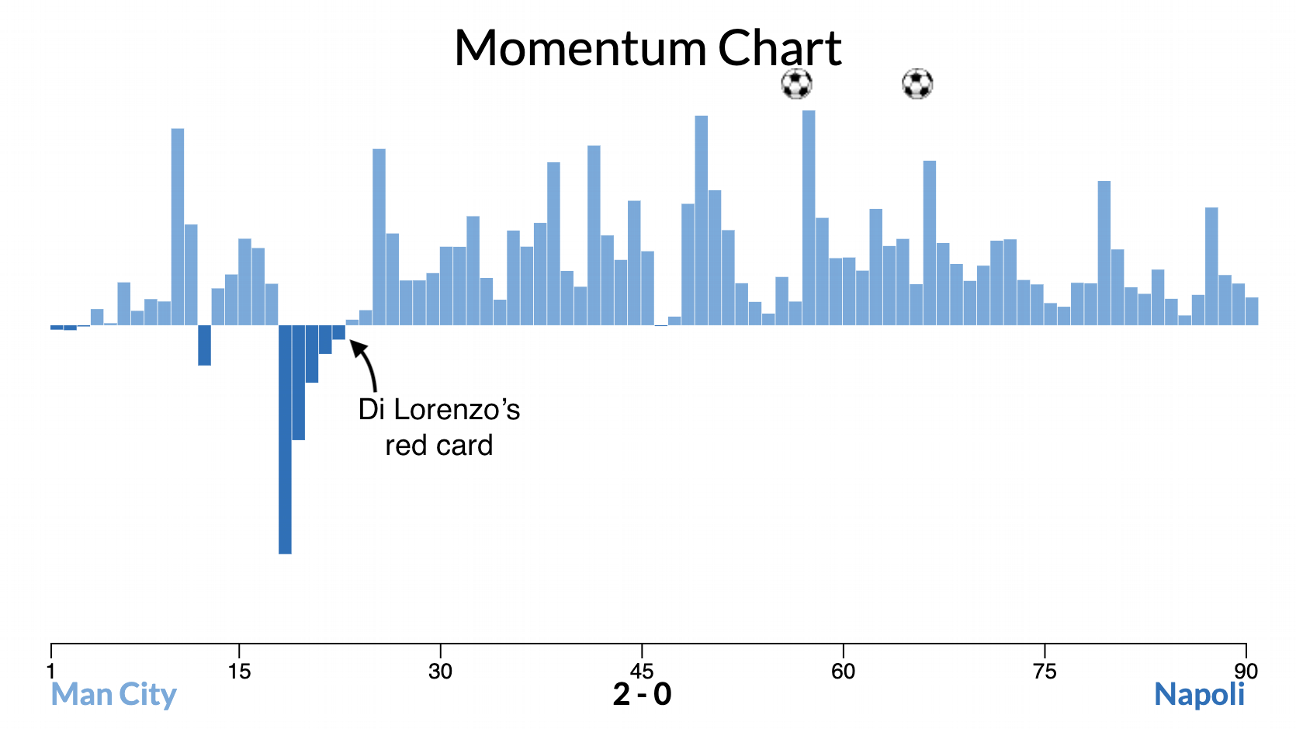
Manchester City also handled its business just fine this week, eventually easing to a 2-0 win over 10-man Napoli. Napoli were enjoying their only particularly threatening spell at the time of Giovanni Di Lorenzo‘s red card in the 21st minute, and it was one-way traffic from there. It looked for a while that Napoli might be able to will themselves to a 0-0 draw, but Erling Haaland put an end to that in the 56th minute.
Napoli finished with one shot attempt and 26% possession, but that one shot was a close-range effort on a set piece and required a pretty good save from Gianluigi Donnarumma. It was worth 0.17, which just about mirrored the average xG per shot City are allowing in Premier League play. Going back to the 4-3 Club World Cup loss against Al-Hilal, there’s a level of defensive fragility here that makes it hard to trust this team just yet.
Tottenham Hotspur also won their opener, but they did the bare minimum against Villarreal, scoring on a dreadful error from keeper Luiz Júnior in the fourth minute and closing up shop. They attempted just nine shots (0.5 xG) and allowed 10 (0.5). They got the job done, but did nothing to assuage my concerns about their ability to create quality shots — they’re currently 17th in the Premier League in xG per shot — and I’m guessing this is a round-of-16 or quarterfinal team this year.
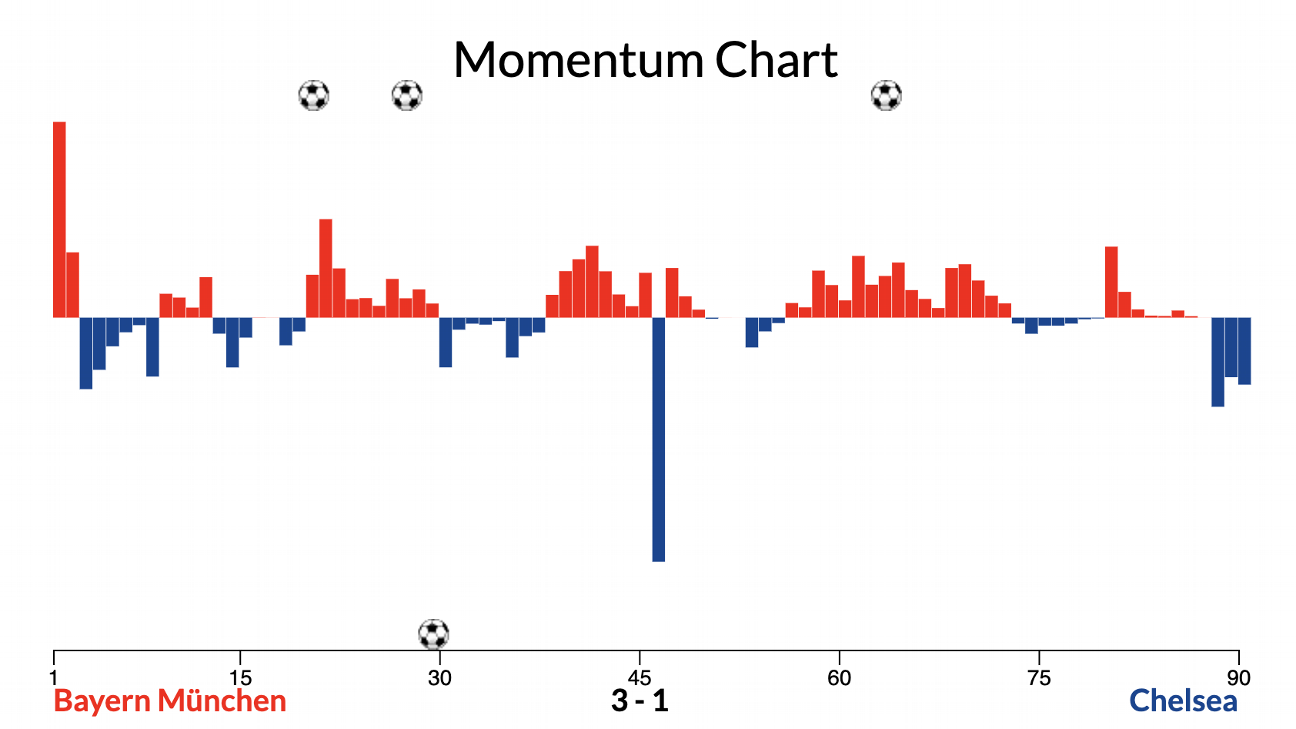
On paper, Chelsea certainly have the pieces to make a run, but their dramatic Champions League inexperience was laid bare in Munich on Wednesday. Against a sharp Bayern Munich, they were outshot and outrun 3-1. Cole Palmer scored on a counterattack and had a second goal disallowed, but Chelsea ceded control to their hosts in a way that a genuine contender rarely does. They looked like an inexperienced underdog. Not a great start.
Newcastle United probably deserved a better outcome Thursday against Barcelona; they generated more xG in 10 shots (1.4) than Barça did in 19 (1.3), but they were bested by Barça’s high defensive line, possession-hungry play and two goals — one good, one unbelievable — from Marcus Rashford.
The concerns I have for Newcastle in the Premier League — depth and scoring capabilities, basically — certainly apply in the Champions League, and their chances of securing a top-eight finish in the league phase took a hit here.
A Belgian team is making the quarterfinals
Don’t ask me which one, though, because two have a shot.
Since a Super Cup loss to Club Brugge, Belgian champion Union St.-Gilloise — one of the most enjoyable teams to follow in recent years as they leapt from the second division to immediate top-division contention and landed exciting young player after exciting young player — has laid down a path of destruction. They’ve outscored seven Belgian opponents by a combined 15-3 margin this season, and in their first-ever Champions League match on Tuesday, they traded haymakers with PSV for most of an hour, then shut things down and won easily, 3-1.
PSV finally scored in the 90th minute, and they perhaps deserved more after creating shots worth 2.2 xG, but USG generated 3.4 xG from 18 shots. They out-PSV’d PSV.
Club Brugge, meanwhile, out-everythinged Monaco in a 4-1 home win Thursday. They’ve dropped some points in domestic play, but they could be forgiven since, including qualification ties, they’ve outscored five Champions League opponents by a combined 17-3 thus far. Veteran Hans Vanaken and the left-sided duo of Christos Tzolis and Joaquin Seys have combined for seven goals and eight assists; Vanaken had one of each as four different FCB players scored.
Going back to last year’s round-of-16 run, Club Brugge have now won nine of their last 14 UEFA matches. Via the Opta Supercomputer, they now have the 12th-highest projected point total for the league phase now; USG is 11th. Both are ahead of Borussia Dortmund, Napoli, Newcastle, Juventus and Atlético Madrid, among many others.
Dutch teams have the far greater history in this competition, but their neighbors to the south are looking great, and they’ve positioned themselves well.
The price tag for Eintracht’s Can Uzun keeps going up
One of the most ruthless aspects of European competitions is that even if an upstart emerges and threatens to upend the status quo, the sport’s powers can pluck that upstart apart in the transfer window before the competition is even over.
Benfica had one of the most impressive teams in the group stage of the Champions League in 2022-23, winning a group with both PSG and Juventus while going unbeaten against both. But Chelsea offered eleventy million Euros (OK, €121 million) for star midfielder Enzo Fernández — who had himself only arrived from River Plate that previous summer — in the January transfer window, and that was that. Benfica still walloped Club Brugge in the round of 16 in February, but they fell with little resistance against Inter Milan in the next round. (Chelsea grabbed another breakout star, Shakhtar Donetsk’s Mykhailo Mudryk for €70 million in that same window. That one hasn’t worked out quite as well.)
For players on teams that aren’t mega-clubs, European competitions are almost like auditions. Eintracht Frankfurt know this as well as anyone. Omar Marmoush‘s four goals and two assists in 406 Europa League minutes last season helped to provide proof of concept for a €75m January transfer to Manchester City.
For good measure, Hugo Ekitike (four goals and three assists in 809 minutes) then left for Liverpool for €95 million over the summer and even though they aimed for more of a veteran presence with their own summer acquisitions, another young star has quickly emerged. Nineteen-year-old Can Uzun has three goals and two assists in three Bundesliga matches this season, and he made an immediate Champions League impact with a go-ahead goal against Galatasaray on Thursday.
Eintracht have made a lot of money due to their recent run of great talent identification and development, and it seems they’ll probably be rewarded for Uzun’s star turn, too. But it would be awesome to see what they might be capable of if they could keep some of this talent in-house for a bit longer at some point. They scored five goals against Galatasaray even without Marmoush and Ekitike, after all.
If we’re doing some proper scouting for future big moves, here are eight other players who probably saw their respective stock prices rise quite a bit this week under the floodlights.
Ismael Saibari, PSV Eindhoven (24). He’s a central midfielder who plays so advanced that he was second in the Eredivisie in assists last season (11) and ninth in goals (11), and for all the nice words I paid to Union Saint-Gilloise above, Saibari created a couple of spectacular chances to redefine the game, missing opportunities in the sixth (0.54 xG) and 55th (0.80 xG) minutes.
Camilo Durán, Qarabag (23). Qarabag have come to rule Azerbaijan’s Premier League with a veteran-heavy squad, but Durán, acquired this summer from Portugal‘s Portimonense, took full advantage of a shot at Portuguese giants Benfica. He assisted Qarabag’s first goal, then scored its second as the Atlilar (the Horsemen, a pretty fantastic nickname) came back to secure their first-ever group stage victory in the Champions League.
Lamine Camara, Monaco (21). Monaco got absolutely wrecked by Club Brugge, but Camara still filled the box score. He had 20 combined progressive passes and carries and 10 ball recoveries, most of anyone in Matchday 1. He also suffered two fouls and won seven ground duels. He enjoyed a breakout season last year, with seven league assists, and if Monaco did anything right on Thursday, Camara was probably behind it.
Daniel Bassi, Bodo/Glimt (20). He has only just begun to work his way into the rotation for the Arctic Circle club, but in just 45 minutes on Wednesday, he won a penalty, scored to cut Bodo/Glimt’s deficit to 2-1, then played a key role in the sequence that made it 2-2.
Youssoupha Mbodji, Slavia Prague (21). Why was Bodo/Glimt down two goals to begin with? Because Mbodji scored twice, appearing out of nowhere from his left back position to finish two great opportunities.
Georgiy Sudakov, Benfica (23). A Benfica player recently acquired from Shakhtar? He was destined to become a Champions League star! And while his team played poorly enough against Qarabag to get its manager fired, Sudakov was fantastic, creating one assist from two chances and completing 12 progressive passes.
Nicolo Tresoldi, Club Brugge (21). After a couple of solid seasons in the 2. Bundesliga, the 6’0 Tresoldi joined a Champions League team, and including qualification he has two goals and an assist in 226 minutes. He scored Brugge’s first against Monaco, and I’m guessing that’s not his last in the league phase.
Marcus Rashford, Barcelona (27). Have you heard of this up-and-comer? OK, no, this list was neither meant for known onetime stars or Barcelona players, but I had to squeeze him in here somewhere. I mean, did you see this strike?
This is what life looks like when you escape Manchester United, I guess.
My off-the-cuff 1-to-36 rankings after one matchday
• 1. Arsenal • 2. PSG • 3. Liverpool • 4. Real Madrid • 5. Bayern Munich • 6. Barcelona • 7. Manchester City • 8. Inter Milan
Real Madrid are a perfect 5-for-5 since the Xabi Alonso era began in earnest last month, and while they needed a pair of penalties to survive Marseille at home, 2-1, the score was misleading — Real Madrid generated far more quality chances (even while playing down a man for about 20 minutes because of Dani Carvajal‘s foolish red card) and got away with both the red card and an early-game injury to Trent Alexander-Arnold.
• 9. Chelsea • 10. Tottenham • 11. Napoli • 12. Newcastle • 13. Borussia Dortmund • 14. Juventus • 15. Eintracht Frankfurt • 16. Sporting CP
BVB-Juventus set the early bar for Match of the Tournament with eight second-half goals, a brilliant surge from Borussia Dortmund, and an equally brilliant stoppage time comeback from the home team.
• 17. Atlético Madrid • 18. Bayer Leverkusen • 19. Villarreal • 20. Union Saint-Gilloise • 21. Club Brugge • 22. Atalanta • 23. Athletic Club • 24. Bodo/Glimt
The fightin’ Glimts of Bodo, semifinalists in last year’s Europa League, erased a 2-0 deficit at Slavia Prague to salvage a point, and now they’ll get a shot at revenge with a semifinal rematch at home against Tottenham Hotspur in two weeks. (Monaco, Juventus and Manchester City must also visit the Arctic circle. Love it.)
I got to know this Qarabag team watching them nearly take down Bayer Leverkusen in the Europa League two years ago, and with the dose of energy Durán has given them, they look awfully fun. Their comeback win over Benfica was a stunner, and they might need to spring only one more surprise to advance to the knockout rounds.
We haven’t made it to Halloween yet but beware, the holiday season is fast approaching. Pretty soon, your days will be filled with travel, parties, and lots and lots of delicious food.
In the meantime, though, it’s time to lock in. That means going on your hot girl walks, hitting the gym, and embracing the Pilates princess lifestyle.
To help motivate you, why not treat yourself to some new activewear pieces?
It’s the best way to get you in the mood to workout, especially because Amazon has tons of affordable options. In other words, you don’t have to wait until October Prime Day to score amazing deals on workout pieces because a bunch of them are already on sale.
Right now, you’ll score up to 50% off running shoes from Adidas, New Balance, and Brooks. Or snag yourself a pair of editor-approved squat-proof leggings that are less than $25.
Lock in and get ahead. Run to Amazon for amazing deals on activewear ahead of October Prime Day.
Price: $12.99 (as of Sep 19, 2025 12:07:18 UTC – Details)
Ready to nourish your body, boost your energy, and embrace a radiant plant-powered lifestyle—without the overwhelm? Whether you’re new to plant-based eating or just seeking flavorful, health-conscious recipes, this beginner-friendly cookbook makes your transition simple, sustainable, and satisfying.
Inside this transformative guide, you’ll discover 162 easy, affordable, and nutrient-rich recipes carefully designed to support your health goals, weight management, glowing skin, and long-term energy—all while keeping your meals exciting and accessible.
🌿 Why This Cookbook is Your Essential Plant-Based Companion:
✅ 162 Wholesome Recipes – From vibrant salads to hearty mains, protein-rich breakfasts, and indulgent desserts—without guilt
✅ Balanced Nutrition 30-Day Meal Plan – Jumpstart your transformation with a done-for-you, step-by-step roadmap to healthy eating
✅ Beauty & Body Benefits – Fuel your skin, metabolism, digestion, and energy levels with nutrient-dense, anti-inflammatory meals
✅ Beginner-Friendly Guidance – No confusing steps or expensive ingredients—just real food made simple
✅ High-Protein Options – Stay satisfied and energized with naturally protein-rich meals
✅ Smart Shopping Tips – Save money and time with pantry swaps and meal prep tricks
✅ Sustainable Lifestyle Approach – Support your health and the planet with every bite
💡 More Than Just Recipes—A True Lifestyle Guide Learn the why behind plant-based nutrition with expert-backed insights on macronutrients, gut health, and the benefits of whole foods. Whether you’re aiming to slim down, clear your skin, improve heart health, or simply feel better in your body, this book gives you the tools and support to succeed.
✨ Perfect For:
First-time plant-based eaters
Busy individuals wanting fast, healthy meals
Anyone focused on long-term beauty, vitality, and wellness
Don’t wait to start feeling better, looking brighter, and living more fully.
📦 Scroll up and click “Buy Now” to begin your plant-based transformation today!
From the Publisher
Plant-Based Diet Cookbook for Beginners: Delicious, Easy, and Healthy
Embark on a delicious and nourishing journey with this beginner-friendly plant-based cookbook. Discover 162 easy and healthy recipes that will delight your taste buds while supporting your wellness goals, from radiant skin to sustained energy.
Your Journey Starts Today
Transform the way you eat and feel with Plant-Based Diet Cookbook for Beginners. With delicious recipes, practical tips, and step-by-step guidance, you’ll build a healthy lifestyle you love—one flavorful bite at a time.
Everything You Need to Thrive on a Plant-Based Diet
162 Wholesome Recipes: A perfect balance of breakfasts, mains, sides, snacks, and desserts—each crafted for busy lifestyles.Beginner-Friendly Guidance: Simple step-by-step instructions and accessible ingredients help you cook with confidence.Budget & Family Friendly: Enjoy hearty, affordable meals that everyone at the table will love.Time-Saving Tips: Learn smart kitchen hacks, meal prep strategies, and cooking shortcuts.
Start Your Plant-Based Journey with Flavor, Confidence & Ease
This cookbook makes it easy to stay excited about plant-based eating with a wide selection of satisfying recipes. You’ll enjoy everything from comforting classics to fresh new flavors.
ASIN : B0FG1VS3BS Publisher : Independently published Publication date : June 24, 2025 Language : English Print length : 107 pages ISBN-13 : 979-8289561077 Item Weight : 12 ounces Dimensions : 8.5 x 0.25 x 11 inches Best Sellers Rank: #1,076,475 in Books (See Top 100 in Books) #385 in Vegetarian Diets (Books) #1,288 in Weight Loss Recipes #4,376 in Other Diet Books Customer Reviews: 4.8 4.8 out of 5 stars 8 ratings var dpAcrHasRegisteredArcLinkClickAction; P.when(‘A’, ‘ready’).execute(function(A) { if (dpAcrHasRegisteredArcLinkClickAction !== true) { dpAcrHasRegisteredArcLinkClickAction = true; A.declarative( ‘acrLink-click-metrics’, ‘click’, { “allowLinkDefault”: true }, function (event) { if (window.ue) { ue.count(“acrLinkClickCount”, (ue.count(“acrLinkClickCount”) || 0) + 1); } } ); } }); P.when(‘A’, ‘cf’).execute(function(A) { A.declarative(‘acrStarsLink-click-metrics’, ‘click’, { “allowLinkDefault” : true }, function(event){ if(window.ue) { ue.count(“acrStarsLinkWithPopoverClickCount”, (ue.count(“acrStarsLinkWithPopoverClickCount”) || 0) + 1); } }); });
Security researchers employed ChatGPT as a co-conspirator to plunder sensitive data from Gmail inboxes without alerting users. The vulnerability exploited has been closed by OpenAI but it’s a good example of the new risks inherent to agentic AI.
The heist, called Shadow Leak and published by security firm Radware this week, relied on a quirk in how AI agents work. AI Agents are assistants that can act on your behalf without constant oversight, meaning they can surf the web and click on links. AI companies laud them as a massive timesaver after users authorize their access to personal emails, calendars, work documents, etc.
Radware researchers exploited this helpfulness with a form of attack called a prompt injection, instructions that effectively get the agent to work for the attacker. The powerful tools are impossible to prevent without prior knowledge of a working exploit and hackers have already deployed them in creative ways including rigging peer review, executing scams, and controlling a smart home. Users are often entirely unaware something has gone wrong as instructions can be hidden in plain sight (to humans), for example as white text on a white background.
The double agent in this case was OpenAI’s Deep Research, an AI tool embedded within ChatGPT that launched earlier this year. Radware researchers planted a prompt injection in an email sent to a Gmail inbox the agent had access to. There it waited.
When the user next tries to use Deep Research, they would unwittingly spring the trap. The agent would encounter the hidden instructions, which tasked it with searching for HR emails and personal details and smuggling these out to the hackers. The victim is still none the wiser.
Getting an agent to go rogue — as well as managing to successfully get data out undetected, which companies can take steps to prevent — is no easy task and there was a lot of trial and error. “This process was a rollercoaster of failed attempts, frustrating roadblocks, and, finally, a breakthrough,” the researchers said.
Unlike most prompt injections, the researchers said Shadow Leak executed on OpenAI’s cloud infrastructure and leaked data directly from there. This makes it invisible to standard cyber defenses, they wrote.
Radware said the study was a proof-of-concept and warned that other apps connected to Deep Research — including Outlook, GitHub, Google Drive, and Dropbox — may be vulnerable to similar attacks. “The same technique can be applied to these additional connectors to exfiltrate highly sensitive business data such as contracts, meeting notes or customer records,” they said.
OpenAI has now plugged the vulnerability flagged by Radware in June, the researchers said.
Jonathan Kuminga‘s agent, Aaron Turner, told ESPN that Kuminga is prepared to take the $7.9 million qualifying offer unless the Golden State Warriors improve their current offers.
“There’s a lot of upside,” Turner said in an interview with the Hoop Collective podcast. “He wants to pick where he wants to go. So the QO is real for sure.”
The Warriors have presented Kuminga with three separate frameworks, as ESPN reported earlier this week. The most lucrative is a three-year, $75.2 million deal with a team option on the third season. It guarantees Kuminga $48.3 million in the first two seasons.
He is also being offered a two-year, $45 million deal with a team option on the second season and a three-year, $54 million deal without options. Kuminga, to this point of the negotiations, has declined everything put in front of him. He is requesting the Warriors turn the team option into a player option and he will sign it.
The Warriors have declined to put a player option in any offer to Kuminga.
“If (the Warriors) want to win now, if you want a guy that’s happy and treated fairly who is a big part of this team, we believe, moving forward, you give him the player option,” Turner said. “You do lose a little of that trade value (giving that up). But if it’s about the here and now, you give him that. You don’t get a perfect deal, but you get a pretty good deal and he gets to feel respected about what he gets and we all move on and worry about winning, helping Steph (Curry).”
The Warriors are the only NBA team this summer who have not signed a free agent. Less than two weeks until training camp, they only have nine players on their roster. The expectation is they will sign veterans Al Horford, De’Anthony Melton and Gary Payton II once the Kuminga domino falls, but the negotiations have been in a three-month gridlock.
If Kuminga signs the qualifying offer, he’d be relinquishing more than $40 million in guaranteed money over the next two seasons, but it would grant him his unrestricted free agency next summer and give him an inherent no-trade clause — a hefty price to control his own destiny.
“If JK wants to take it, it does have upside, right?” Turner said. “We’ve talked about that. You’re not getting traded. You’re gonna have unrestricted free agency (next summer). People are gonna say, ‘Well, Aaron, there’s not gonna be 10 or 12 teams (with cap space).’ Fine, there’ll be six teams with cap space for the clear-cut under-35 top wing on the market. So there’s a lot of upside.”
Kuminga has spent the summer exploring his market, including the big-picture opinions from those outside the Warriors’ organization. The Sacramento Kings (three years, between $63 and $66 million) and Phoenix Suns (four years, between $80 and $88 million) have been most aggressive in pursuing Kuminga. They haven’t been able to put together sign-and-trade offers to entice the Warriors to give up Kuminga. But they’ve clearly had an impact on his mindset.
“He’s gotten a chance to hear from other teams,” Turner said. “You know, Sacramento, he’s spent some time with them, got to meet (general manager) Scott Perry, (head coach) Doug Christie, the Suns and what they’ve offered him. There’s been other teams, too, maybe planting seeds for (2026 or 2027). But they’re saying, ‘Hey, we want you to be you. We don’t want you to change anything. We want to put the ball in your hands. We want to give you a huge opportunity to play.'”
Turner contrasted that to the Warriors. He said that Kuminga isn’t averse to returning to the Warriors, but Kuminga would be suppressing his personal ambitions and that sacrifice should matter in contract talks.
“I don’t think it’s about not wanting to be on the Warriors,” Turner said. “Having repped guys on all different teams, it is as first class as you get. I mean, everything there is awesome, from the facility, how they treat the guys, it’s, like, amazing. But, these other places are offering him opportunities to start games, finish games, know your role. ‘We don’t want you to change anything. Continue to develop and spread your wings.'”
Kuminga would return to a likely bench role with the Warriors, behind a Jimmy Butler, Draymond Green and Horford frontcourt.
“No guarantees he starts any games,” Turner said. “He may, but we don’t know. Finishing games, night to night, who knows? It depends if Steve (Kerr) has a combination he likes and it’s working. Maybe he sticks with it. Maybe he doesn’t. You’re going to have to not have the ball as much. You’re going to have to stay away from developing certain parts of your game, or wanting to lean into certain parts of your game, especially shooting any type of mid-range jump shots, which is something JK does work on. But in the Golden State offense and the role he’s in, that’s not gonna be a big shot that he’s really gonna be able to take much.”
So Turner said his messaging to the Warriors through this entire process has been to sell the contract and not the basketball situation if they want Kuminga to be on board.
“You’re gonna have to sacrifice your game from where other teams would his fifth year,” Turner said. “In addition to that, he might get traded. He knows that. We know that. They know that. I mean, we went in exploring all options. Myself, Mike Dunleavy, can we find a sign and trade that works? Can we duck around this base compensation rule, that only allows them to bring back half the money? But (Kuminga) knows it’s a real thing he may get traded. I really can’t find where I’ve seen a free agent at, you know, $20 million or above, where you sign and go, you know, I know there’s a very good chance he gets traded.”
Warriors owner Joe Lacob flew to Miami to meet with Kuminga in August in an attempt to resolve the contract dispute, but it continues to drag deep into September.
“(Kuminga) said this in the meeting with Joe (Lacob). ‘I’m all in to help Steph. Let’s send him out. We should be focusing on winning right now and I’m fine with that.’ But, again, you have to take a little bit of the hit.”
The hit to the Kuminga side is the Warriors giving him a player option on either the two-year or three-year contract offers. They’d also be willing to sign the two-year deal with the Warriors in that $45 million range if they let him keep the inherent no-trade clause, allowing him a say in where he plays next.
But the Warriors haven’t relented on that, either, requesting Kuminga waive the no-trade clause. Turner has said Kuminga would be willing to do a team option deal if the Warriors move the per year number up toward $30 million or take the current deals on the table if they include a player option. If not, they are threatening to take the qualifying offer, which would tank his trade value.
“Two years from now, if you want to keep him, you’ll have his bird rights (even if you give him a player option),” Turner said. “You treat him good and you show him the plan, then maybe you keep him. (The player option contract) is not perfect, but I don’t think anybody can get everything they really want. If you ask JK, he wants Jalen Green‘s deal. He’s not getting that. He wants Jalen Johnson‘s deal. You’re not getting that. If the Warriors, we feel like, pick the front end (of the contract), if that number needs to be lower to stay under a second apron, (it’s a) player option. Or if it’s about really controlling the back end of the deal, move the number up, shake your roster up and you can have a team option. Or, the hybrid model, let him keep his no-trade clause.”
ESPN baseball reporter. Covered the L.A. Rams for ESPN from 2016 to 2018 and the L.A. Angels for MLB.com from 2012 to 2016.
LOS ANGELES — Clayton Kershaw has decided he will retire at the end of this season, which will mark his 18th with the Dodgers.
The Dodgers announced Kershaw’s decision Thursday, adding that Friday will mark the final regular-season home start of his career. Kershaw is scheduled to hold a news conference later Thursday.
“On behalf of the Dodgers, I congratulate Clayton on a fabulous career and thank him for the many moments he gave to Dodger fans and baseball fans everywhere, as well as for his profound charitable endeavors,” Dodgers owner Mark Walter said in a statement. “His is a truly legendary career, one that we know will lead to his induction in the Baseball Hall of Fame.”
Kershaw has won an MVP and three National League Cy Young Awards in a career that will undoubtedly finish in the Hall of Fame, while making 11 All-Star Games, accumulating 222 victories and posting a 2.54 ERA. Earlier this year, he became the 20th pitcher in baseball history to accumulate 3,000 strikeouts.
His 18 seasons with the Dodgers are tied with Bill Russell and Hall of Famer Zack Wheat for most in franchise history. His 222 wins are second only to Don Sutton in franchise history.
Now 37, Kershaw rejoined the Dodgers’ rotation in the middle of May, in the wake of offseason knee and toe surgeries, and helped to stabilize a group that had once again been ravaged by injury. In August, as the rotation began to round into form, Kershaw elevated to another level, winning all five of his starts while posting a 1.88 ERA. All told, he is 10-2 with a 3.53 ERA in 20 starts this season, despite throwing the slowest fastball of his career.
After Kershaw starts against the San Francisco Giants on Friday, his role will be unclear. The Dodgers will head into the postseason with six capable starters, making it highly unlikely that Kershaw makes another start.
“I feel that there’s a place for him on our postseason roster,” Dodgers manager Dave Roberts told ESPN earlier this week.
“I don’t know what role, but I think that the bottom line is, I trust him. And so, for me, the postseason is about players you trust.”
As for Kate—mom to Prince George, 12, Princess Charlotte, 10, and Prince Louis, 7, with William—the engagement with Melania is the latest since she returned to her royal duties last fall after completing chemotherapy. While the Princess of Wales had been out of the spotlight following her diagnosis with cancer, following the end of her treatment she gradually returned to her public duties.
And since then, she’s shared insight into what it’s been like for her to return to a semblance of normalcy following her health battle.
“You put on a sort of brave face, stoicism through treatment,” she said during a visit to a hospital in July, per People. “Treatment’s done, then it’s like, ‘I can crack on, get back to normal,’ but actually, the phase afterwards is really, really difficult.”
She urged fellow cancer survivors to give themselves grace.
“You have to find your new normal and that takes time,” she said, “and it’s a rollercoaster, it’s not smooth, like you expect it to be. But the reality is you go through hard times.”
Price: $13.99 - $9.99 (as of Sep 18, 2025 13:05:25 UTC – Details)
Are you a Christian woman who’s tired of dieting, overwhelmed by food cravings, and longing to lose weight in a way that honors God—not the scale? You’re not alone. And the good news? You don’t have to choose between faith and fitness anymore. Introducing the life-changing solution you’ve been praying for: Christian Weight Loss Meal Plan for Women: Burn Fat, Boost Energy, and Honor God Through Clean, Purposeful Eating This is not just another weight loss cookbook or quick-fix cleanse. This is a spiritual wellness transformation—designed specifically for Christian women who want to lose weight God’s way and reclaim their health without guilt, stress, or obsessing over calories. Inside this powerful 30-day journey, you’ll discover: ✔️ A clean eating meal plan for women rooted in Scripture and science—no starvation, no shame. ✔️ Faith-based weight loss devotionals to help you renew your mind and break free from emotional eating. ✔️ Over 100 low-carb, anti-inflammatory recipes that are easy, delicious, and digestion-friendly. ✔️ A realistic, bloat-reducing fat-burning meal plan created to reset your gut, reduce inflammation, and boost your metabolism. ✔️ Grocery lists, prep guides, and journal prompts that make it easy to follow through—because your breakthrough is in the daily habits. ✔️ Biblical strategies to fight food cravings, overcome self-sabotage, and walk in the fruit of self-control. Whether you’re battling weight gain after 40, dealing with hormonal imbalance, struggling with sugar addiction, or just tired of the endless diet cycle, this 30-day plan gives you the tools to: 🔥 Lose weight naturally 🔥 Heal your gut and balance your hormones 🔥 Gain energy and mental clarity 🔥 Break free from emotional and spiritual strongholds around food This book is more than weight loss. It’s renewal. Whether you’re struggling with:Emotional eatingPCOS or thyroid-related weight gainHormonal imbalanceBinge eating cyclesFaith burnout or discouragement around your health…this book meets you where you are—with grace, truth, and practical tools. Faith Meets Food Freedom You’re not lazy. You’re not broken. You’re not weak for struggling. You’ve just been fighting a spiritual battle with physical weapons—and that ends now. Let this be the book that changes everything. No more dieting. No more shame. No more trying to “fix yourself” without God. This time, you’re inviting Jesus into your wellness journey—and that changes everything. Buy Now If You’re Ready To:Reclaim your health, energy, and purposeEnd the guilt-diet cycle once and for allFuel your body without idolizing itLose weight without losing your soulYour body is a temple. This is your invitation to steward it with grace. ASIN : B0FLD2RKCM Accessibility : Learn more Publication date : August 5, 2025 Language : English File size : 794 KB Screen Reader : Supported Enhanced typesetting : Enabled X-Ray : Not Enabled Word Wise : Enabled Print length : 157 pages Page Flip : Enabled Best Sellers Rank: #354,239 in Kindle Store (See Top 100 in Kindle Store) #42 in Catholicism Self Help #207 in Low Carb Cooking #444 in Christmas Cooking Customer Reviews: 3.5 3.5 out of 5 stars 2 ratings var dpAcrHasRegisteredArcLinkClickAction; P.when(‘A’, ‘ready’).execute(function(A) { if (dpAcrHasRegisteredArcLinkClickAction !== true) { dpAcrHasRegisteredArcLinkClickAction = true; A.declarative( ‘acrLink-click-metrics’, ‘click’, { “allowLinkDefault”: true }, function (event) { if (window.ue) { ue.count(“acrLinkClickCount”, (ue.count(“acrLinkClickCount”) || 0) + 1); } } ); } }); P.when(‘A’, ‘cf’).execute(function(A) { A.declarative(‘acrStarsLink-click-metrics’, ‘click’, { “allowLinkDefault” : true }, function(event){ if(window.ue) { ue.count(“acrStarsLinkWithPopoverClickCount”, (ue.count(“acrStarsLinkWithPopoverClickCount”) || 0) + 1); } }); });
Waymo is teaming up with tech transit startup Via to integrate its autonomous vehicles into city public transit networks, starting with a growing suburb of Phoenix.
In Chandler, Arizona, Waymo’s robotaxis will soon join the town’s Flex microtransit service. Users book rides on the Chandler Flex app to be picked up by a shared vehicle and taken to their destination, often connecting to Valley Metro bus routes. Soon, users may be matched with Waymo’s fully autonomous vehicles as part of the service.
The service will run Monday through Friday, 6AM-9PM, with rides booked through Chandler Flex costing just $2 for regular riders, $1 for seniors and wheelchair users, and free for middle and high school kids. (Waymo recently introduced teen accounts in Phoenix so kids as young as 14 can ride without their parents.)
The partnership has the potential open up more passengers to Waymo’s driverless technology. Phoenix residents have been able to hail a Waymo via the Waymo or Uber apps for years now, with rides priced comparably to human-driven rideshare trips. But autonomous rides along a planned route for a low-cost, flat fare is sure to open up the technology to a new segment of the population.
The partnership has the potential open up more passengers to Waymo’s driverless technology.
Chandler Flex operates using technology developed by Via, which sells software and operational services to cities, transit agencies, schools, and other institution that want to combine on-demand ridesharing with public transit. Via’s software enables transit officials to create “flexible routes” based on passenger demand, while also complying with federal and accessibility reporting requirements, the company says. If everything goes well, Waymo and Via plan on pitching a similar model to other cities for their microtransit needs.
But some transportation experts worry that autonomous vehicles will siphon riders from transit, which could lead to service cuts. Most ridesharing users don’t want to transfer to another mode of transportation — they just want to get to their destination. And regular transit users, which tend to be more low-income, have difficulty affording many rideshare trips.
The microtransit option is a neat way at circumventing some of these pitfalls. And Waymo isn’t the only one to have this idea. Michigan-based autonomous driving startup May Mobility also worked with Via to connect it with potential riders in Sun City, Arizona, a retirement community outside of Phoenix. Its vehicles were free to use through the week, though that partnership has since concluded.