-11.8 C
New York
Saturday, January 24, 2026
Home Blog Page 845

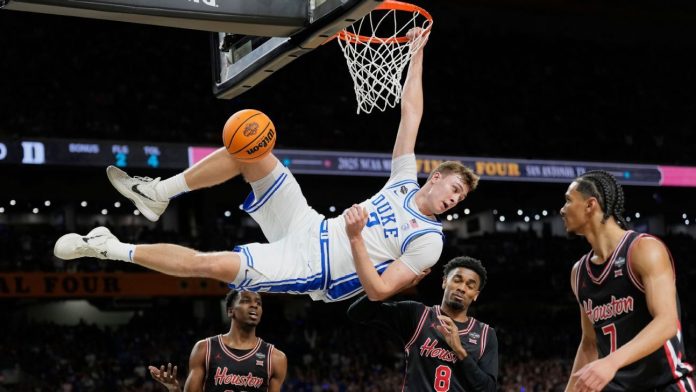
Cooper Flagg, the Dallas Mavericks and one of the most shocking NBA draft lotteries in decades

0


ON THE AFTERNOON of May 12, Cooper Flagg’s immediate family gathered inside his hotel room at the Marriott Marquis in downtown Chicago. There was his twin brother, Ace (who is one minute older), his father, Ralph, and his mother, Kelly.

They finished getting dressed for the 2025 NBA draft lottery, which began later that night at 7 p.m. local time at the McCormick Place Convention Center, a short walk from their hotel.

But before heading out together, the family of the Duke superstar freshman, and the presumed No. 1 overall pick in Wednesday’s NBA draft, spent 30 minutes chatting about his future.

They had held these discussions before, weighing all the likely landing spots and what each one presented, but this would serve as a final debrief before one of the most heralded American prospects in years would, later that night, finally know where he’d likely begin his NBA career.

The family had known for months that the Washington Wizards, Utah Jazz and Charlotte Hornets held the highest chances of landing the top pick, and inside the room, they again went over positives about each one.

Washington was a short flight from Maine and North Carolina — the two states where the family split their time. Charlotte offered the same, plus it had a built-in fan base for Duke alums, they said. And Utah was helmed by Jazz CEO Danny Ainge, who played for the 1980s Boston Celtics teams that Cooper’s parents admired so much and introduced their sons to at a young age.

They also weighed a singular, unsolvable negative. Like so many top prospects, Flagg had never endured sustained losing at any level, and almost regardless of his rookie-year performance, he was almost certainly about to do so. And though he long maintained that he “just wanted to hoop” anywhere, those around him say they harbored concerns about how the ultra-competitive prospect would adjust emotionally to such a dynamic.

“It would be hard for me to imagine Cooper going through a season with a lot of losing,” Duke coach Jon Scheyer told ESPN.

Flagg’s father admitted as much. “It was something we talked about,” he said.

A short time later, the family walked to the convention center, and Flagg’s representation offered guidance: The cameras would be on them throughout the night, and especially as the lottery order was being announced, and any reaction — good or bad — would lead to headlines. It was best, they told Flagg and his family, to stay neutral.

Flagg sat in a front-row seat, next to his Duke teammate, Kon Knueppel. Ralph, Kelly, Ace and Flagg’s longtime trainer Matt MacKenzie sat in the row just behind Cooper. Facing the stage, they all watched NBA deputy commissioner Mark Tatum rapid-fire announce the first 10 picks in 2 minutes and 15 seconds. But even that brief window of time was filled with stunners.

Washington and Utah had fallen out of the top four, while the Dallas Mavericks and San Antonio Spurs had leapt into it.

Sitting in their seats, the family tried to maintain their composure, while considering the new possibilities unfolding.

Flagg had imagined, even briefly, a possible pairing with 7-foot-5 Victor Wembanyama, the Spurs’ top pick in the 2023 draft.

Then, Tatum announced the next pick: Charlotte. That meant Dallas, San Antonio and the Philadelphia 76ers were in the top three. The odds of that being the case were, according to ESPN Research, just 1%.

Then, 12 seconds later, Tatum announced that the 76ers would pick third, and the Spurs would pick second, which meant the Mavericks, who entered the night with a 1.8% chance of winning the lottery, had won.

The Mavericks had the fourth-lowest odds to win the lottery since 1985; they jumped 10 spots, the biggest by any team since the NBA changed the draft lottery format in 2019.


IN ONLY A FEW minutes, the Flagg family’s entire calculus, what they had, for months, been outlining and planning for, changed.

The announcement sent shockwaves across the NBA. A franchise — and a fan base — still recovering from the devastating midseason trade of superstar Luka Doncic was now positioned to draft another generational talent in Flagg.

From their seats, Flagg’s family was just as stunned.

“Dallas wasn’t even on our bingo card,” his father, Ralph, said.

Text messages poured in. Were they happy? Sad? Why weren’t they reacting? Did they realize what had just happened?

Their minds raced.

Instead of the pressure of being one of the best players on a losing team, he’d be on one that, just a year ago, went to the NBA Finals. He would be, by any narrative or measure, the man to heal the wounds left by the departure of Doncic, who by 25 had earned five All-Star appearances and been named first-team All-NBA five times.

Flagg immediately would face a different pressure, one few No. 1 picks have experienced: to help a pair of All-Stars, in point Kyrie Irving and forward Anthony Davis, win in the NBA — and fast.

“We never even considered that the impossible could happen on May 12,” one Mavericks team source said. “I’m not sure there has ever been a more abrupt reversal of fortune.”

play

1:16

What Cooper Flagg brings to a franchise

Cooper Flagg’s energy and leadership are the big traits that stand out to Jonathan Givony.

JON SCHEYER, WHO coached Flagg for one season at Duke, watched from his hotel in Amelia Island in Florida, where the ACC spring meetings were being held.

“To me, it’s a dream spot,” Scheyer said of the Mavericks. “I really feel that way.”

And as Flagg and his family walked out of the convention center that night, they began to feel the same.

Two Duke players were already on the roster, Irving and center Dereck Lively II, a first-round pick in the 2023 draft. Scheyer told Flagg soon after that center Khaman Maluach and Lively were two of the best people he had coached. Flagg had played alongside Maluach during his freshman season with Duke; now he’d likely play alongside Lively during his first season in the NBA in Dallas. “Enjoy that!” Scheyer told him.

Flagg could learn from players who had won championships, they thought, such as Irving, Davis and, they hoped, retired Dallas legend Dirk Nowitzki.

“He’s not going to go into Dallas thinking he’s got all the answers,” Scheyer said. “He’s going to learn from Kyrie, he’s going to learn from [Davis]. He’s going to learn from Derek Lively and Jason Kidd and his staff. He’s coming in to learn, and I think that’s a special part about him.”

Like so many, the Flagg family had monitored the voluminous backlash from Mavericks fans after Doncic was traded abruptly to the Los Angeles Lakers last season. The Flaggs saw the jersey burnings, the mock funerals, the protests.

To them, though, it represented strength — an admirable bond with the organization, even if it had been badly strained.

“They are a very passionate fan base,” Ralph said, “and I think from what we understand and what we’ve seen on social media, they’re ready to fully embrace Cooper.”

“Dallas has been lucky for many years,” Scheyer said. “They’ve been able to watch Dirk, Luka — so many winning teams. Now, you’ve got a guy in Cooper, who I think will carry that tradition forward.”

His impact on the organization was felt immediately, first on the team’s bottom line.

“We surprisingly renewed 75-80% of our season tickets,” one Mavericks team source said. “But we had a lot of work to do in earning back the confidence and fandom of a not insignificant segment of our fan base.

“We sold $8 million in new season tickets in the three days after the lottery.”

After the backlash from the Doncic trade, one company that was considering a sponsorship partnership with the Mavericks paused, the source said. Then, after seeing the lottery and the positive fan reaction, that same company agreed on a new sponsorship deal with the team.

“We have done two additional new sponsor deals, one the second largest in our history, since the luck of the lottery,” the Mavericks source said.

After the lottery, Flagg bounced across the country, working out with MacKenzie at a gym in Westlake Village, about an hour west of Los Angeles. Flagg traveled to North Carolina to see his brother graduate from high school, and then north to Maine to see his former classmates at Nokomis graduate from high school.

The Flagg family already has an Airbnb booked in Las Vegas to watch him during summer league. And while draft parties are being organized in Flagg’s hometown of Newport, Maine, the family has enjoyed a brief solace from the noise and focus of television cameras in Westlake Village, where Flagg continued to work out before heading back to New York for the draft.

Recently, the family visited a Hugo Boss store in Los Angeles for Flagg to be fitted for a suit on draft night. As they watched while specialists worked with Flagg, the gravity of the moment — and what was coming next, the start of his NBA journey — settled in for those around him. They all looked at each other and couldn’t believe how fast everything had flown by.

“He’s in a good place mentally,” MacKenzie said. “He’s in a good place physically, and I think that he’s ready for this next chapter of his career.”
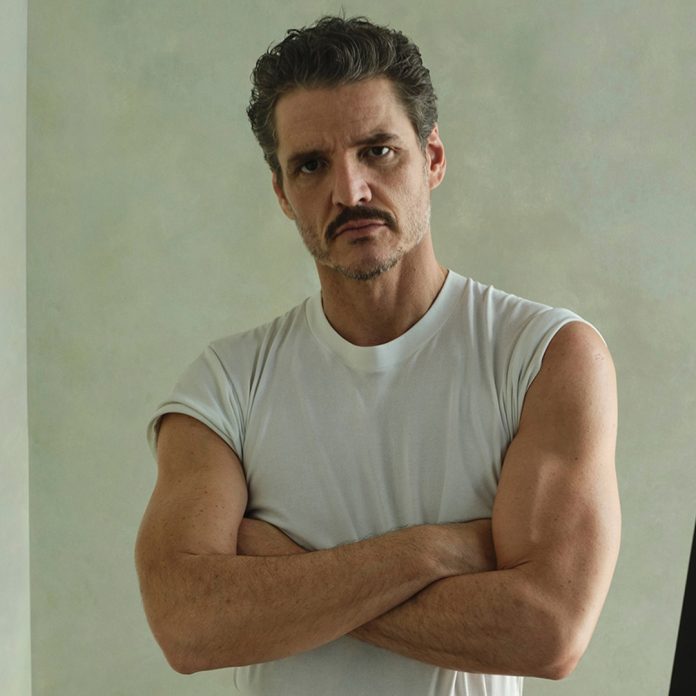


Pedro Pascal on Private Dating Life

0


Dakota Johnson Shares Best Part About Working With Pedro Pascal in New Movie (Exclusive)

Pedro Pascal would be the last of us to get candid on his love life.

Considering he’s never had a public romance, the Materialists star explained what fans have misunderstood about his dating life.

“I always feel perplexed when I’m identified in whatever form of media as a ‘highly private person,’ because that’s the opposite of me,” Pedro told Vanity Fair in an article published June 24. “I’m very unprivate in my private life.”

So, why does he keep his lips sealed about his romantic pursuits?

“I just know that personal relationships are such a complex thing to navigate,” he shared, “even without having this enormous lens on them.”

And the Last of Us actor is no stranger to dealing with that magnifying glass being placed over his social life. In fact, he shot down rumors earlier this year that he and pal Jennifer Aniston were romantically involved after they were spotted out together. 

‘I wish they wouldn’t call it the tea time slot’

0


Mark Savage

Music Correspondent

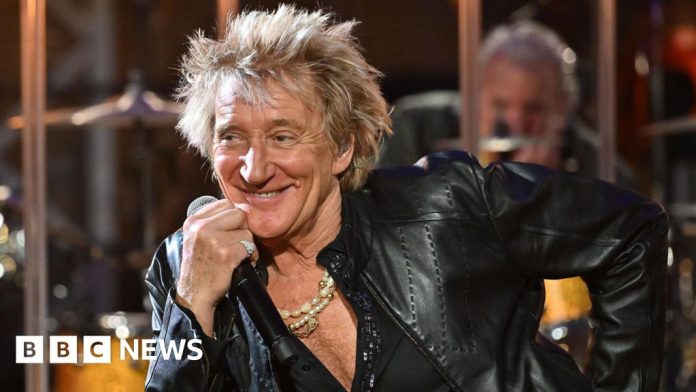
Mark Allan / BBC Rod Stewart, dressed in black leather, smiles as he leans on a piano top, during a recording of the BBC's Later... With Jools HollandMark Allan / BBC

Rod Stewart is the first artist to headline Glastonbury and play the Sunday afternoon “legend” slot

“Did you know I can run 100 meters in 19 seconds?”

Rod Stewart, Sir Rod Stewart, is boasting about his physical prowess. And why not?

At the age of 80, he’s still cavorting around the world, playing sold out shows, recording new music and even writing a book about his beloved model train set.

This weekend, he’ll play the coveted “legends” slot on Glastonbury’s Pyramid stage… although the former headliner isn’t 100% happy about his billing.

“I just wish they wouldn’t call it the tea time slot,” he complains.

“That sounds like pipe and slippers, doesn’t it?”

He’s also persuaded organisers to extend his set, securing an hour-and-a-half slot after initially being offered 75 minutes.

“Usually I do well over two hours so there’s still a load of songs we won’t be able to do,” he says.

“But we’ve been working at it. I’m not gonna make any announcements between songs. I’ll do one number, shout ‘next’, and go straight into the next one.

“I’m going to get in as many songs I can.”

Getty Images Rod Stewart talks into a microphone with one hand on his hip, while wearing a silver paisley coat and a brocaded waistcoat. He looks fabulous.Getty Images

The star is affectionately known as “Phyllis”, thanks to a nickname coined by Elton John (aka Sharon)

It’s not like he’s short of choice. Sir Rod has one of the all-time classic songbooks, from early hits with the Faces such as Stay With Me and Ooh La La, to his solo breakthrough with Maggie May, the slick pop of Do Ya Think I’m Sexy and his reinvention as a crooner on songs like Downtown Train and Have I Told You Lately.

The last time he played Glastonbury, in 2002, he was viewed as an interloper – sitting awkwardly on the bill beside the likes of The White Stripes, Coldplay and Orbital.

At first, “the crowd was wary” of the musician, who “looked to be taking himself too seriously”, said the BBC’s Ian Youngs in a review of the show.

But a peerless setlist of singalongs won them over. By the end of the night, 100,000 people were swaying in time to Sailing as if they were genuinely adrift on the surging tides of the Atlantic.

Amazingly, Rod has no memory of it.

“I don’t remember a thing,” he confesses. “I do so many concerts, they all blend into one.”

One particular show does stand out, though. On New Year’s Eve 1994, Sir Rod played a free gig on Brazil’s Copacabana Beach, drawing a crowd of more than three million people.

But it wasn’t the record-breaking audience that made it memorable.

“I was violently sick about an hour before I was supposed to go on,” he confesses.

“I’d eaten something terrible, and I was in a toilet going, ‘huerrrgurkurkbleaggggh’

“I didn’t think I was going to make it but luckily they got a doctor to sort me out.”

Carl De Souza/Shutterstock Rod Stewart stretches out his arms to greet the Glastonbury crowd during a performance in 2002Carl De Souza/Shutterstock

Rod Stewart last played Glastonbury in 2002, when tickets cost £97 and only 140,000 festivalgoers could access the site.

We’re talking to the star about a month before Glastonbury at the Devonshire, a relaxed, old-school boozer just off Picadilly Circus that’s become the favoured haunt of everyone from Ed Sheeran to U2.

It’s a bit too early for a drink, though, so Sir Rod orders up a venti coffee, shooing away an over-eager assistant who attempts to stir in his sugar.

He’s dressed in a cream jacket and black jeans, which sit above the ankle to show off his box-fresh, zebra-striped trainers. His white shirt is unbuttoned far enough to display a diamond-encrusted necklace with the crest of his beloved football club, Celtic.

And then there’s the hair. A bleached blonde vista of windswept spikes, so famous that it earned a whole chapter in the singer’s autobiography.

Steve Marriott of The Small Faces once claimed that Sir Rod achieved this gravity-defying barnet by rubbing mayonnaise into his scalp, then rubbing it with a towel.

This, says the musician, is utter “bollocks”.

“Nah, nah, nah. I used to use sugared hot water, before the days of hair lacquer. And I couldn’t afford hair lacquer, anyway.”

But what really sets Sir Rod apart is that voice.

Raspy, soulful, raw and expressive, he’s one of rock and roll’s best interpretive singers. There’s a reason why his covers of Cat Steven’s First Cut Is The Deepest or Crazy Horse’s I Don’t Wanna Talk About It have eclipsed the originals.

So it’s a surprise to learn that he was discovered not for his vocals, but his harmonica skills.

That fateful night in 1964, he’d been at a gig on Twickenham’s Eel Pie Island, and was drunkenly playing the riff from Holwin’ Wolf’s Smokestack Lightnin’ while he waited for the train home, when he was overheard by influential blues musician Long John Baldry.

“As he described it, he was walking along platform nine when noticed this pile of rubble and clothes with a nose pointing out,” Sir Rod recalls.

“And that was me playing harmonica.”

At the time, he “wasn’t so sure” about his singing voice. But, with Baldry’s encouragement, he started to develop his signature sound.

“I wanted to always sound like Sam Cooke and Otis Redding, so that’s the way I went,” he says. “I suppose I was trying to be different from anybody else.”

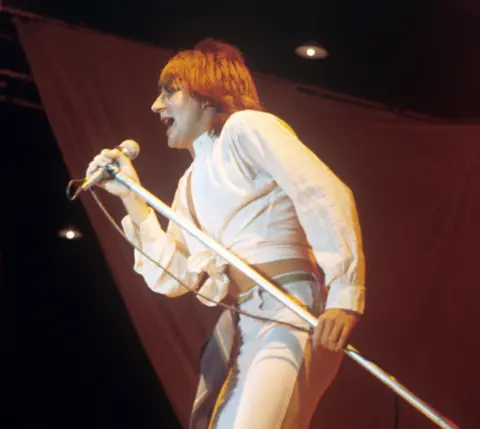
PA Media Rod Stewart holds a microphone stand and sings, in a picture taken in the 1970sPA Media

The singer has more than 60 hit singles, including seven UK number ones, across his back catalogue

Sir Rod began his ascent to stardom with the Jeff Beck Group and the Faces, a boisterous blues-rock outfit heavily inspired by the Rolling Stones – both on and off the stage.

They were regularly so drunk he’d forget the words to his own songs, he admits. In the US, the group received a 40-year ban from the Holiday Inn hotel chain after racking up a $11,000 bill (£8,000 – or £54,000 in 2025 money) for trashing their rooms.

“We only did it because the Holiday Inns would treat us so badly, like we were the scum of the earth,” he says.

“So we’d get our own back by smashing the hotels up. One time we actually got a couple of spoons and chiselled through the walls to one another’s rooms.

“But we used to book in as Fleetwood Mac, so they’d get the blame.”

How come he never succumbed to drink and drugs, like many of his contemporaries?

“I never was a really druggy person, because I played football all the time and I had to be match fit,” he says.

“I would use the word dabble. I’ve dabbled in drugs, but not anymore.”

Perhaps a more destructive force was the singer’s womanising.

He wrote You’re In My Heart for Bond girl Britt Ekland, but they split two years later, due to his persistent unfaithfulness.

His marriage to Alana Stewart and relationship with model Kelly Emberg ended the same way.

“When it came to beautiful women, I was a tireless seeker of experiences,” he wrote in his memoir.

“I didn’t know how to resist. And also… I thought I could get away with it.”

He thought he’d settled down after marrying model Rachel Hunter in 1990, but she left him nine years later, saying she felt she had “lost her identity” in the relationship.

The split hit Sir Rod hard.

“I felt cold all the time,” he said. “I took to lying on the sofa in the day, with a blanket over me and holding a hot water bottle against my chest.

“I knew then why they call it heartbroken: You can feel it in your heart. I was distracted, almost to the point of madness.”

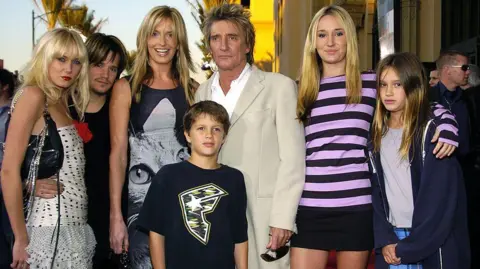
Getty Images Rod Stewart with five of his eight children, and future wife Penny Lancaster at the 2003 American Music AwardsGetty Images

Rod Stewart with five of his eight children, and future wife Penny Lancaster at the 2003 American Music Awards

However, since 2007, the star has been happily married to TV presenter / police constable Penny Lancaster, with the couple reportedly renewing their vows in 2023.

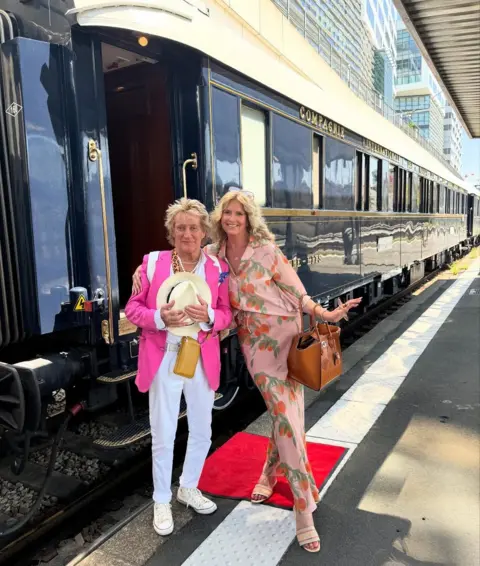
Last week, they celebrated their 18th wedding anniversary with a trip on the Orient Express from Paris, where they met in 2005, to La Cervara in Portofino, where they held their wedding ceremony, in a medieval monastery.

These days, Sir Rod says, family is his priority.

“I’ve got eight kids all together, so sometimes I’ll wake up in the morning and see all these messages, Stewart, Stewart, Stewart, Stewart… and it’s all the kids. It’s just gorgeous.”

His youngest, Aiden, is now 14, and becoming an historian of his dad’s work.

“He’s gone back and listened to everything I’ve done, bless him,” says the star. “He knows songs that I don’t even remember recording!”

Instagram Penny Lancaster hugs her husband Rod Stewart, as they pose outside the Orient Express at a train station.Instagram

Sir Rod and Penny Lancaster celebrated their 18th wedding anniversary with a trip on the Orient Express

His Glastonbury appearance coincides with the release of a new greatest hits album – his 20th. (“Is it really?” gasps Sir Rod. “Oh gawwwwd.“)

So how does it feel to look back over those five decades of music?

“Oh, it’s tremendous,” he says. “It’s a feeling that you’ve done what you set out to do.

“I don’t consider myself a particularly good songwriter,” he adds. “I struggle with it. It takes me ages to write a set of lyrics.

“So I don’t think I’m a natural songwriter. I’m just a storyteller, that’s all. A humble storyteller.”

Maybe – but this humble storyteller is going to draw a crowd of thousands when he plays the Pyramid Stage on Sunday afternoon.

“You know, it’s wonderful,” he concedes. “I’ll be in good voice. I’ll enjoy myself. I don’t care anymore what the critics think.

“I’m there to entertain my people.”

Massie fires back at Vance VP 'excitement' question: 'Ask Mike Pence'

0


Rep. Thomas Massie (R-Ky.) fired back at a Tuesday post from Vice President Vance questioning if his successors saw as much “excitement” as him while in office. 

“Ask Mike Pence about his last month,” the Kentucky lawmaker wrote.

Massie’s reply appeared to reference Pence’s refusal to nullify the 2020 presidential election on Jan. 6, 2021, and comes amid his conflict with President Trump. 

The president has exerted a concerted effort to vote Massie out of office alleging he’s “bad for the Constitution” after he voted against key GOP initiatives and railed against the leader’s “big, beautiful bill.”

A Trump-aligned PAC recently formed to help unseat Massie ahead of the mid-term election cycle. 

Despite naysayers, the Kentuckian has leaned into the backlash and used its publicity to boost fundraising for his campaign. 

He also co-sponsored a bipartisan bill to end U.S. involvement in strikes between Israel and Iran, warranting continued rebukes from Trump.  

“MAGA should drop this pathetic LOSER, Tom Massie, like the plague! The good news is that we will have a wonderful American Patriot running against him in the Republican Primary, and I’ll be out in Kentucky campaigning really hard,” Trump wrote in a Sunday Truth Social post

“MAGA is not about lazy, grandstanding, nonproductive politicians, of which Thomas Massie is definitely one.”

The next day, Massie hit back making a joke out of the president’s repeated posts about him. 

“I’m going to program my debt badge to display the number of milliseconds that have elapsed since @realDonaldTrump has tweeted at me last,” Massie wrote.

Home Sales Rose in May, but Housing Market Is Still Sluggish

0


Home Sales Rose in May, but Housing Market Is Still Sluggish

A nasal spray company wants to make it harder for the FTC to police health claims

0


In the midst of the covid-19 pandemic, a health products company called Xlear began advertising its saline nasal spray to people desperately searching for ways to protect themselves from a new virus. In its marketing, Xlear pointed to studies that it said supported the idea that ingredients in the spray could block viruses from sticking to the nasal cavity. Based on its interpretation of the science, Xlear promoted the product as one part of a “layered defense” against contracting covid.

In 2021, the Federal Trade Commission, in a bipartisan vote, decided to sue Xlear for making allegedly “unsupported health claims,” saying the company had “grossly misrepresented the purported findings and relevance of several scientific studies” in its advertising. Earlier this year, the Trump Justice Department, on the FTC’s behalf, asked for the lawsuit to be dismissed with prejudice, though it didn’t explain its reasoning. But Xlear still wanted its day in court. Now, it’s suing the FTC because it wants a court to make it harder for the agency to attempt to go after health claims.

Xlear is filing the lawsuit at a time where the government’s standard operating procedures around both science and administrative law have been upended. Health and Human Services Secretary Robert F. Kennedy Jr. recently expelled all the members of the Centers for Disease Control and Prevention’s vaccine policy advisory committee, a simultaneously radical and predictable outcome given his career in spreading anti-vaccine falsehoods. Meanwhile, the current FTC is engaged in helping President Donald Trump undermine the agency’s long-standing independence from the White House. After Trump purported to fire its two Democratic commissioners, the FTC has even openly taken up long-standing conservative grievances over alleged censorship in the digital sphere.

Like Kennedy, Xlear is advocating for a path that could open up the health products space to alternative — and possibly less-tested — upstarts. “There’s a tension here between the reform movement of MAHA [Make America Healthy Again] and the old-guard approach of the FTC,” Xlear’s lead counsel, Rob Housman, tells The Verge. “If you want to break our focus on drugs and pharmaceuticals, one of the things you have to do is make space for innovation and things like hygiene and other approaches.”

“There’s a tension here between the reform movement of MAHA and the old-guard approach of the FTC”

Xlear insists it’s not trying to lower the bar for health marketing claims, but simply hold the FTC to a reasonable legal standard. Housman believes the Supreme Court’s decision to strike down Chevron deference last year — removing long-standing precedent telling courts they should often defer to federal agencies’ expertise — makes the case even easier. “We don’t want people to think we’re trying to reduce the burden of science,” he says. “We, in fact, want to up the burden of science. We just want to make sure that companies are complying with the law — not the law as the FTC says it is.”

As Xlear sees it, the FTC has stepped beyond its authority to enforce the law against false and misleading claims, coming up with arbitrary standards of what kinds of evidence should be considered adequate to justify a health claim. Housman points to the agency’s 2022 guidance that says randomized controlled trials (RCTs), especially when replicated at least once, are most reliable to substantiate health claims. There’s no magic number for the number or kinds of studies, according to the guidance, but it says “randomized, controlled human clinical trials (RCTs) are the most reliable form of evidence and are generally the type of substantiation that experts would require for health benefit claims.” The FTC did not immediately respond to a request for comment on the lawsuit.

Xlear says this is far too high of a hurdle, especially for smaller companies that may not have the money to conduct such resource-intensive trials. Housman compares it to an adage about how there’s no RCT trials to prove parachutes work — the punchline being that no one would conduct a study where a control group jumped out of a plane without a parachute. (It’s unclear how removing this high hurdle would “up the burden of science.”)

One reason it’s bringing the lawsuit is so that it can freely make health claims about another product it sells, which it believes can be an alternative to fluoride

Xlear says that one reason it’s bringing the lawsuit is so that it can freely make health claims about another product it sells, which it believes can be an alternative to fluoride, which Kennedy wants to strip from the water supply. Fluoride is a mineral that prevents tooth decay. A recent study from the National Toxicology Program found that very high levels of fluoride (atypically high in the US) are linked to slightly lower IQ scores for kids, but fluoride has been the subject of conspiracy theories for almost a century, even making an appearance as a comedic bogeyman in the movie Dr. Strangelove, in which General Jack D. Ripper refers to it as “the most monstrously conceived and dangerous communist plot” to “sap and impurify all of our precious bodily fluids.”

Housman says that even if Xlear wins its lawsuit on every count, “this doesn’t allow people to make up bogus marketing claims.” The FTC will still have the authority to take down truly false and misleading claims, just not by the allegedly arbitrary standard it has been. He adds that the threat of private lawsuits is effective to keep egregious marketing claims at bay. “We don’t believe anybody should be making bogus claims,” Housman says, “but we also believe that the agency has the responsibility to do the work.”

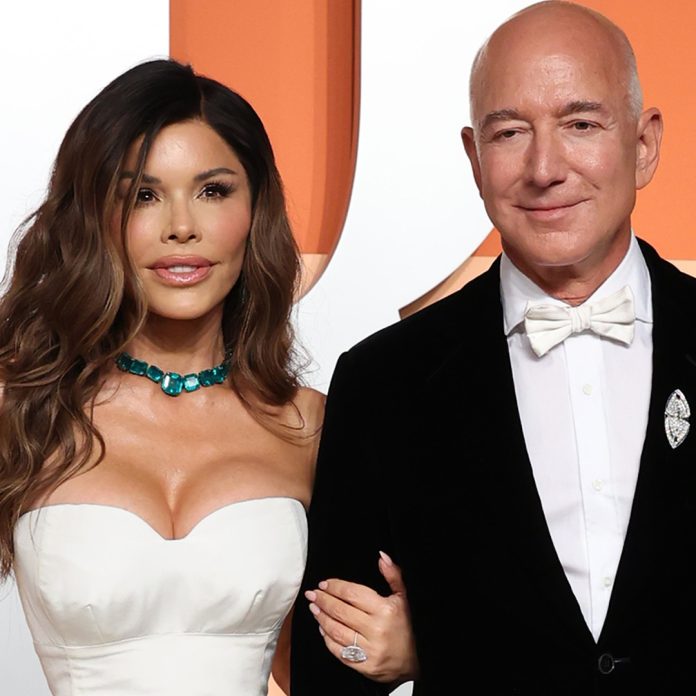
Jeff Bezos, Lauren Sánchez’s Wedding Invite Reveals Gift to Guests

0


Jeff Bezos and Lauren Sánchez Host Foam Party on $500 Million Yacht Ahead of Wedding

Jeff Bezos and his fiancée Lauren Sánchez are doing away with one major wedding tradition.

As the couple gear up to exchange vows in Venice, Italy, they’ve given their guests specific instructions for the extravagant affair, according to a copy of their wedding invitation obtained by E! News.

“We are excited for you to join us,” the invitation read. “We have one early request: please, no gifts.”

In lieu of accepting presents, the pair—who got engaged in 2023 after making their relationship public in 2019—said they would be contributing to local causes in their loved ones’ honor to thank them “for making the journey” to the destination wedding.

“Donations on your behalf are being made to the UNESCO Venice Office to safeguard this city’s irreplaceable cultural heritage,” the invite continued, “to CORILA to restore the vital lagoon habitats that protect Venice’s future, and to Venice International University to support research and education for sustainable solutions.”

Should this lab-grown burger really be served in restaurants?

0


Pallab Ghosh profile image
BBC A treated image showing a burger in black and white on a red backgroundBBC

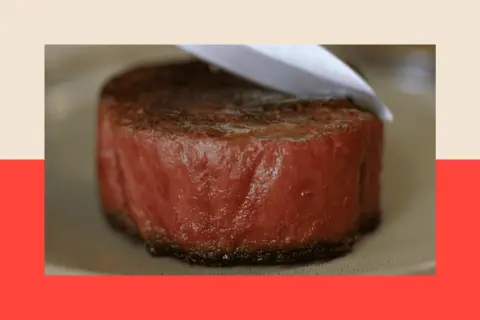
Inside an anonymous building in Oxford, Riley Jackson is frying a steak. The perfectly red fillet cut sizzles in the pan, its juices releasing a meaty aroma. But this is no ordinary steak. It was grown in the lab next door.

What’s strangest of all is just how real it looks. The texture, when cut, is indistinguishable from the real thing.

“That’s our goal,” says Ms Jackson of Ivy Farm Technologies, the food tech start-up that created it. “We want it to be as close to a normal steak as possible.”

Lab-grown meat is already sold in many parts of the world and in a couple of years, pending being granted regulatory approval, it could also be sold in the UK too – in burgers, pies and sausages.

Unlike so-called vegetarian meat, which is already available in UK supermarkets – from fake bacon rashers made from pea protein to steaks made of soy, and dyed bright red to resemble the real thing – lab-grown meat is biologically real meat, grown from cow cells.

Ivy Farm Technologies A knife slices into a lab grown steakIvy Farm Technologies

The lab-grown steak from Ivy Farm Technologies has a texture indistinguishable from regular steak

To some, this could be a smart technological fix for a growing environmental problem: the rise in planet-heating gases caused, in part, by the rapid and growing demand for meat.

But others argue that the environmental benefits of lab-grown meat, officially known as cultivated meat, have been oversold. Some critics say that more effort should instead be expended on reducing meat consumption, instead of looking to a technology fix.

Then there are questions around the ultra-processed nature of this meat, which some also worry will be produced by a handful of multinational companies.

So now, with dog food made from meat that was grown in factory vats having already gone on sale in the UK earlier this year and with the possibility of lab-grown food for humans becoming available sooner than expected – the debate has never been more prescient.

Nor has the question: to grow or not to grow?

Curbing greenhouse gas emissions

Global demand for meat is growing. According the the UK’s Food and Agriculture Organisation, meat production has increased fivefold since the 1960s and reached around 364 million tonnes in 2023.

Producing 1kg of beef can generate planet-heating greenhouse gases, equivalent to roughly 40kg of carbon dioxide, though estimates can vary depending on the type of production.

A study published in Nature Food in 2021 concluded that food production was responsible for a third of global greenhouse gas emissions. Cattle also burp planet-heating methane gas, plus they require water and land.

Ivy Farm Technologies Pallab looks on as a lab grown steak is cookedIvy Farm Technologies

The BBC’s Pallab Ghosh witnessed Ivy Farm’s lab-grown steak being cooked but was unable to sample it as it is not yet approved

Tim Lang, a professor of food policy at City St George’s, University of London argues that the issue is a ticking environmental time bomb. “The situation is absolutely dire,” he says.

“Politicians are fearful of engaging with the issue. They don’t want to take on the meat and farming industry, nor do they wish to risk unpopularity by enacting policies that would reduce meat consumption.”

Lab-grown meat has been marketed as part of a solution. Its advocates claim that it can meet the growing demand for meat with much less carbon emissions and land use, plus it can help governments hit certain targets.

In the UK, for example, a 2021 independent review for the Department for the Environment Food and Rural Affairs (Defra) has called for a 30% reduction in meat consumption by 2032 to meet the country’s net zero target.

Lab-grown sausages, eel and caviar

The science behind lab-grown meat is also relatively straightforward. Researchers take cells from a farm animal and grow more of them in a dish. When they have enough, they are put into ever larger vats until they have enough to produce a meat product.

Turning this into something that people want to eat is trickier. Each company has its own closely guarded secret sauce. But in the main, the cells are developed in a cocktail of nutrients, which encourage them to grow in the right way, after which other ingredients are sometimes added to boost the nutritional values.

The result is a paste, which is then processed and mixed with other foods such as soy to make it look, feel and taste more like meat. There are also plans to produce fish-like products this way, including eel and even caviar.

Good Meat, Inc. GOOD Meat's labGood Meat, Inc.

The laboratory at GOOD Meat – its cultivated chicken is approved for sale in Singapore and the United States

Ivy Farm Technologies is currently the only UK business that has applied for approval. If granted, its first products won’t be steaks but burgers and sausages.

It plans to combine cultivated mince, (which is cheaper and easier to produce than trying to replicate the taste of a real steak) with regular mince to create a blended cow-cultivated beef burger.

“If you want to make a sustainable difference, you have to go for mass production and burgers are where the masses are,” says the firm’s CEO Dr Harsh Amin. “If you blend our cultivated meat with animal derived meat, you are [still] reducing the carbon footprint.”

“Hope not hard evidence”?

Ivy Farm claims this type of meat can lead to significant reductions in greenhouse gas emissions and other environmental benefits. Other companies make similar claims, but these are based more on hope than hard evidence, according to Dr John Lynch, of Oxford University, who has carried out a comprehensive, independent assessment of the climate impact of lab-grown meat.

“There have not been any accurate climate assessment studies because production is not happening at large scale at the moment,” he adds.

The problem with comparing the climate impact of lab-grown meat with agricultural production is that there is little data and many variables.

Growing cells in vats requires energy, as does producing the chemicals that are added. Businesses keep the details of their processes secret, for perfectly legitimate reasons, so it is hard to produce a single figure for the climate cost of cultivated meat.

Farm Images via Getty Herd of Hereford beef cattle in the English landscapeFarm Images via Getty

Methane from cows disappears from the atmosphere after about 12 years but the CO2 used to produce lab-grown food may stay around for longer

Dr Lynch has assessed the data available in scientific papers and found that the best-case cultivated meat carbon footprints were as low as 1.65 kg of CO2 per kg, which is better for the climate than traditional beef production.

However, if a lab-grown meat process needs a lot of energy, some estimates put the figure as high as 22kg of CO2 per kg, making its climate advantage less certain.

Then there is the fact that the cows’ methane gas burps disappear from the atmosphere after 12 years or so, whereas the CO2 produced to grow the lab meat continues to do its damage for much longer.

So, in the long run, it may be a bad idea to replace cows with high energy lab-grown production, according to Dr Lynch’s assessment. Yet that may be counter-balanced by the fact that cultivated meat production would require far less land.

The bottom line is that the environmental advantages of lab-grown beef over cattle farming is a closer run thing than its advocates argue – but it is likely to have the edge as production methods scale up and become more efficient, according to Dr Lynch.

“For beef, it is quite viable for cultured meat to come out on top,” he argues. “But I don’t think it is the same story for chicken and pork, which convert their feed into meat more efficiently than cattle.”

Lab-grown salmon in fine dining restaurants

Singapore became the first country to allow the sale of cell-cultivated meat for human consumption in 2020. This was followed by the United States three years later and Israel in 2024.

UK firms have complained that the regulatory approvals process is too slow for them to keep up with overseas competitors. But sales in those countries have in the main been peripatetic, with many firms only offering tastings or serving it in upmarket restaurants for short periods.

Good Meat, Inc. GOOD Meat’s chickenGood Meat, Inc.

Good Meat’s lab-grown chicken was served at a restaurant in Washington, DC

This is largely because manufacturers are not able to mass-produce their products in sufficient quantities or as cheaply as traditional meat.

In the US, four companies have received some form of regulatory approval for their lab-grown chicken, pork fat and salmon. Salmon from Wildtype, for example, is now served at Kann, a fine-dining restaurant in Oregon, while Good Meat’s chicken was introduced at a restaurant in Washington, DC.

The response from consumers so far has been “optimistic and curious”, according to Suzi Gerber who is the executive director of the US Association for Meat, Poultry and Seafood Innovation.

What farmers and fishermen say

Some parts of the US cattle industry have, however, expressed opposition to the technology and lobbied for it to be banned, though other livestock firms have remained neutral or been supportive.

The National Cattlemen’s Beef Association and several state-level organisations publicly oppose bans, perhaps in case it sets a precedent for banning other scientific advances, such as bio-engineered food stock for cattle.

The cultivated meat industry says that their products should have no effect on the livestock industry – people will always prefer real meat over artificial. The role of the new technology is, they say, to meet the demand that livestock production is unable to.

The seafood industry has also shown openness: for example, the US National Fisheries Institute recognises cultivated seafood as part of a broader domestic production of on-land fish, like aquaculture.

Will “high-protein slurry” really save the planet?

Ellen Dinsmoor is chief operating officer of Vow, a Sydney-based firm that sells cultivated Japanese quail products in Singapore. It recently received approval to sell in Australia too.

Unlike some cultivated meat firms, Vow is not trying to copy normal meats. Instead, the firm has chosen quail because fewer people know what it is supposed to taste like.

“What we have to do is produce a really delicious product that people want,” she explains. “A little later we can sell it on nutrition, for example we can add healthy omega-3 oils found only in salmon into chicken. And then if we can do all that at a fraction of the price, this is where it becomes interesting to consumers.”

This is all part of a strategy to create a stable high-end market, which could in time enable investment in producing food that is less posh and in larger quantities.

But for some critics, the potential benefits of this technology for the environment, or indeed for the poorest communities in the world, are being lost.

Vow Vow Japanese Quail Foie Gras and Japanese Quail Whipped Pate Vow

Unlike other lab-grown meat companies, Vow isn’t trying to copy traditional meats – its products include Vow Japanese Quail Foie Gras and Japanese Quail Whipped Pate

Some of the start-up companies involved are driven by delivering swift returns to their investors, argues Dr Chris van Tulleken, author of Ultra-Processed People, which can be more easily done by producing high-priced products in high-income countries.

A simpler, cheaper and easier option, he argues, would be to persuade people in both developed and emerging countries to eat less meat.

“It is all very well to propose to people that they should eat a high-protein slurry to keep themselves well,” he argues, “but… I don’t think it is something we should impose on already marginalised groups of people.”

He also worries that the emergence of cultivated food is an acceleration of a long-term trend away from environmentally sustainable, locally sourced, whole foods and toward factory mass-produced fare. “And at the moment the process is pretty energy intensive.”

But like it or not, lab-grown meat is here. To some, it’s a healthier option with less cholesterol, no animal suffering – and a clever solution to a pressing environmental problem. To others, those benefits may have been overblown.

For all the promises and potential about helping the world, however, most people choose food for more personal reasons, namely how it tastes and how affordable it is. That, more than anything, may well decide its future.

BBC InDepth is the home on the website and app for the best analysis, with fresh perspectives that challenge assumptions and deep reporting on the biggest issues of the day. And we showcase thought-provoking content from across BBC Sounds and iPlayer too. You can send us your feedback on the InDepth section by clicking on the button below.

Trump’s ‘both sides’ approach to Israel, Iran comes into question

0


96
<!–
*{box-sizing:border-box}body{margin:0;padding:0}a[x-apple-data-detectors]{color:inherit!important;text-decoration:inherit!important}#MessageViewBody a{color:inherit;text-decoration:none}p{line-height:inherit}.desktop_hide,.desktop_hide table{mso-hide:all;display:none;max-height:0;overflow:hidden}.image_block img+div{display:none}sub,sup{font-size:75%;line-height:0}#converted-body .list_block ol,#converted-body .list_block ul,.body [class~=x_list_block] ol,.body [class~=x_list_block] ul,u+.body .list_block ol,u+.body .list_block ul{padding-left:20px} @media (max-width:620px){.desktop_hide table.icons-outer{display:inline-table!important}.image_block div.fullWidth{max-width:100%!important}.mobile_hide{display:none}.row-content{width:100%!important}.stack .column{width:100%;display:block}.mobile_hide{min-height:0;max-height:0;max-width:0;overflow:hidden;font-size:0}.desktop_hide,.desktop_hide table{display:table!important;max-height:none!important}.reverse{display:table;width:100%}.reverse .column.first{display:table-footer-group!important}.reverse .column.last{display:table-header-group!important}.row-10 td.column.first .border,.row-8 td.column.first .border{padding:5px 5px 15px 25px}.row-10 td.column.last .border,.row-12 td.column.last .border,.row-8 td.column.last .border{padding:5px 20px 25px 5px}.row-12 td.column.first .border{padding:5px 5px 15px 25px;border-bottom:15px solid transparent}}

{beacon}