After a few social media users responded negatively to the 31-year-old sharing a photo of her dadBruce Willisamid his battle with frontotemporal dementia, also known as FTD, Tallulah—whose mom is Demi Moore—shared insight into why she decided to share a moment with him publicly.
“As a family we use our discretion when posting,” she wrote back to a fan who shared criticism under the June 23 post. “Today was a great day filled with smiles. I made the judgement call to show that to the world, because I know what he means to everyone.”
Indeed, in one photo of the post, Tallulah is all smiles as she holds the Die Hard star’s hand as he sits in a chair and she sits next to him on the ground. Another sees her fiancé, Justin Acee smiling with his arm wrapped around Bruce—who is also dad to Rumer, 36, and Scout, 33 with ex Demi as well as Mabel, 13, and Evelyn, 11, with wife Emma Heming Willis.
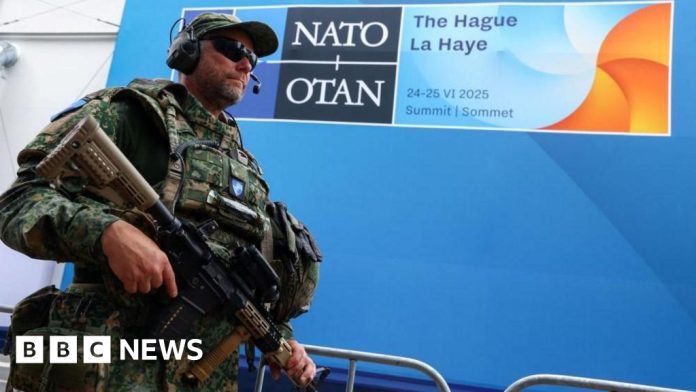
Security is tight at the Nato summit – President Trump’s first since 2019
German Chancellor Friedrich Merz has warned that Russia’s president understands only the language of force and that Tuesday’s “historic” Nato summit in The Hague will aim to ensure peace in Europe for generations to come.
Merz told Germany’s parliament hours before the summit was due to start that Vladimir Putin remained determined that Ukraine should be part of Russia, and he said Berlin would pay its “fair share” to defend Europe.
US President Donald Trump is on his way to the Hague for his first Nato summit since 2019 where all 32 leaders are set to commit to spending 3.5% of national output on defence and a further 1.5% on related infrastructure.
Ahead of a summit overshadowed by Israel-Iran conflict, Nato Secretary General Mark Rutte told his European colleagues to stop worrying about the US commitment to the Western alliance and focus on investing in defence and supporting Ukraine.
He insisted the US president and senior leadership had a “total commitment” to Nato, that came with an expectation of matching American military spending.
Rutte said Europe and Canada had already committed to more than $35bn (£26bn) in military support for Ukraine this year.
Ten people were killed in Russian attacks on Ukraine on Tuesday, and the German chancellor said every attempt to bring Russia to the negotiating table had so far been unsuccessful.
A missile attack on the eastern city of Dnipro killed seven people and wounded another 70, according to the regional chief Serhiy Lysak. He said many of the victims had been in a shelter at the time of the attack.
An earlier missile strike on Sumy in the north-east killed three people, including a child.
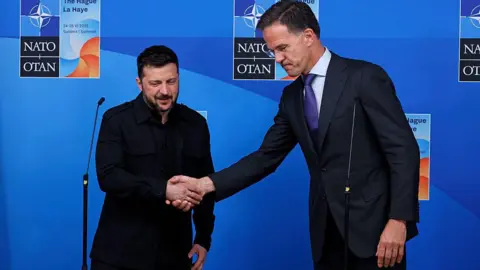
Ukraine’s Volodymyr Zelensky, who has arrived in The Hague, is due to meet Donald Trump on the sidelines of the Nato summit. It would be their first encounter since they met at Pope Francis’s funeral at the Vatican in April.
Omar Havana/Getty Images
Zelensky (L) was greeted by the Nato secretary general on arrival at The Hague
Nato member states are expected to approve a major new investment plan which will raise the benchmark for defence investment to 5% of GDP.
Many of the allies are far below the commitment to spend 3.5% of GDP on defence by 2035, but the German government backed a budget deal on Tuesday to hit that target by 2029.
Some €62.4bn (£53bn) will be spent on defence in 2025, rising to €152.8bn in 2029, partly financed by debt and special funds.
“We’re not doing that as a favour to the US and its president, we’re doing this out of our own view and conviction, because Russia is actively and aggressively endangering the security and freedom of the entire-Euro-Atlantic area.”
During the summit, Merz is due to meet UK Prime Minister Sir Keir Starmer and France’s President Emmanuel Macron.
Mark Rutte has spent much of the nine months since becoming Nato Secretary General working to get allies to commit to the 5% target. The figure is more than double Nato members’ current 2% guideline and seemed unthinkable – and unrealistic – to most when President Trump first set it in January.
The two-day Nato summit has been scaled back, so that after Tuesday’s dinner hosted by the Dutch king, there will be a working session of under three hours on Wednesday and a five-paragraph statement, apparently to accommodate President Trump.
The wording of the commitment in the statement is key.
While 3.5% of of the target spending will cover core defence requirements, 1.5% will be spent on “defence-related expenditure” – a suitably broad expression that encompasses investments in anything from cybersecurity to infrastructure.
Reaching the 3.5% core defence spending target will still require a significant adjustment for the majority of Nato countries. Out of 32 allies, 27 spend under 3%, with eight hovering well below the 2% threshold set by the alliance in 2014.
He said the UK had to “navigate this era of radical uncertainty with agility, speed and a clear-eyed sense of the national interest”. The UK government said it expected to spend 2.6% of GDP on core defence within two years, alongside 1.5% on defence-related areas.
EPA
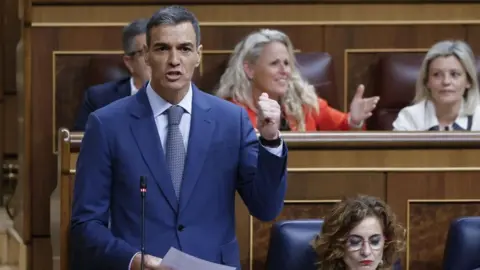
Spain’s prime minister Pedro Sánchez has argued his country should be exempt from the 5% spending target
At the bottom of the rung is Spain, whose defence spending is below 1.3%.
Madrid would need to more than double its funding to meet Rutte’s new target – something that Socialist Prime Minister Pedro Sánchez has long resisted, arguing it “would not only be unreasonable but also counterproductive”.
It would also, crucially, be unpopular at home – not least among his left-wing governing coalition – at a time when Sánchez’s government is teetering.
On Sunday Sánchez said Spain had reached a deal that would see it exempted from the target – something Rutte swiftly pushed back on. “Nato is absolutely convinced Spain will have to spend 3.5% to get there,” he said on Monday.
Sánchez’s suggestion of a lower spending threshold was enough for Belgium and Slovakia to also express interest in an exemption – denting Rutte’s hard-won image of a united alliance.
“I can assure you that for weeks our diplomats have been working hard to obtain the flexibility mechanisms,” said Belgium’s foreign minister Maxime Prévot. Brussels’ spending is currently at 1.3% – and Slovakia has also said it reserves the right to decide when to meet the new target.
Despite their comments, all 32 states are expected to sign up to the new pledge.
As Nato leaders and the leaders of more than a dozen partner states made their way to The Hague, train travel from Schiphol Airport near Amsterdam was badly disrupted after cables were damaged by fire.
Security Minister David Van Weel said sabotage could not be ruled out. “It could be an activist group, it could be another country. It could be anything,” he told public broadcaster NOS. “The most important thing now is to repair the cables and get the traffic moving again.”
President Trump ripped into Israel and Iran on Tuesday morning, as the outlines of a ceasefire he announced Monday took hold and quickly fell apart.
“We basically, we have two countries that have been fighting so long and so hard that they don’t know what the f— they’re doing,” Trump told reporters at the White House before taking off for a trip to The Hague for the NATO Summit.
The president said he was going to see if he could “stop it” when asked about the continued attacks lobbed by both sides overnight after parts of the ceasefire were to be put in place.
Trump will be at the NATO Summit through Wednesday, where the war in Ukraine and increased defense spending are on the agenda. Ukrainian President Volodymyr Zelensky is expected to attend some of the gathering.
On Capitol Hill, the Senate parliamentarian continues to comb through the Republican’s “big, beautiful” spending bill. Senate Majority Leader John Thune (R-S.D.) still plans to bring the bill to the floor this week but faces stiff headwinds from colleagues on cuts to Medicaid.
Fed Chair Jerome Powell will testify in Congress both Tuesday and Wednesday in his semi-annual report that comes amid pressure from Trump and other Republicans to lower interest rates.
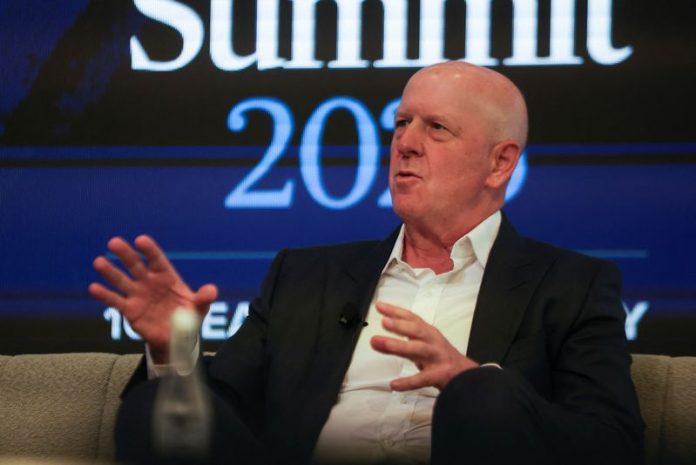
(Reuters) -Goldman Sachs CEO David Solomon urged Europe to reconsider its “extensive” regulatory requirements through an opinion piece published in French newspaper Les Echos on Tuesday, as they place unnecessary burden on companies.
“Europe remains an outlier in terms of the extensive – often overbearing, duplicative, and costly – obligations it places on firms,” the chief of the world’s second-largest investment bank wrote, as he plans to convene a board meeting in Paris this week.
The region’s financial system – often seen as a barrier to investment – has been criticized for its national-level regulations, overlapping reporting obligations and slow progress on capital markets and banking union reforms.
Companies, analysts and investors have argued that the rules raise costs, complicate cross-border activity and put the bloc at a disadvantage to the U.S. and other major economies.
Solomon said one of the EU’s biggest challenges is that individual countries can veto reforms to protect narrow national interests, a dynamic that he argued has consistently weakened the bloc’s economic, financial and geopolitical power.
“Reducing or eliminating unwieldy and ineffective structures and processes will send a loud message that the EU is focused on efficiency, results and economic growth,” Solomon said in his opinion piece.
His comments come as initial public offerings in Europe trail the U.S. due to weaker valuations and patchy investor demand.
“Member states need to play their part in building the pools of long-term capital needed to channel financing more forcefully into both public and private markets – where much of the economic activity in Europe is now happening,” Solomon wrote.
In the first quarter, Goldman earned the highest fees from advising clients on deals in Europe, the Middle East and Africa region, according to data from Dealogic.
It was ranked second by revenue earned in the region’s overall investment banking league tables. Goldman’s London office, its largest in Europe, is the headquarters for its international operations.
(Reporting by Manya Saini in Bengaluru and Saeed Azhar in New York; Editing by Arun Koyyur)
AT&T is updating its next-gen 911 network to give users more efficient ways to share important information with emergency services. Starting in October, AT&T’s ESInet emergency communications platform will make it easier for AT&T customers to share pictures and video messages with supported dispatch centers, helping to quickly explain the situation and better prepare first responders who will arrive on the scene.
The ESInet platform helps 911 dispatch centers process callouts faster and more reliably by replacing traditional analog connections with fiber-based IP networks. Since its launch in 2018, AT&T says 1,700 emergency call centers have now been upgraded to the new communications technology.
Sending multimedia content to emergency dispatchers is currently a complicated process, but AT&T says the incoming update will make it as effortless as texting family and friends. While AT&T will be the first US carrier to support these capabilities, picture and video messaging will be interoperable with other network providers who choose to integrate it.
Emergency multimedia messaging support will roll out alongside security features that provide dispatchers with a dedicated private internet connection to access public safety data from the cloud, helping to protect sensitive emergency information from cyber threats. Select 2026 Toyota vehicles equipped with a built-in AT&T Connected Car SIM will also be able to automatically send crash data to emergency dispatchers, including airbag status and precise vehicle location.
Andreas Hale is a combat sports reporter at ESPN. Andreas covers MMA, boxing and pro wrestling. In Andreas’ free time, he plays video games, obsesses over music and is a White Sox and 49ers fan. He is also a host for Sirius XM’s Fight Nation. Before joining ESPN, Andreas was a senior writer at DAZN and Sporting News. He started his career as a music journalist for outlets including HipHopDX, The Grammys and Jay-Z’s Life+Times. He is also an NAACP Image Award-nominated filmmaker as a producer for the animated short film “Bridges” in 2024.
With a wicked fifth-round stoppage of Jin Sasaki in Japan, Brian Norman Jr. could now be recognized as the new king of the welterweights, as Jaron “Boots” Ennis’ departure from the division appears imminent.
Norman holds firm as the No. 2 welterweight and will ascend to the top once Ennis secures a fight at 154 pounds. The devastating knockout loss pushes Sasaki out of the top 10, allowing the undefeated Raul Curiel to enter the rankings at No. 10.
The biggest divisional shakeup of the weekend belongs to the flyweights as Francisco Rodriguez Jr. pulled off a monster upset, thumping previously unbeaten Galal Yafai for twelve one-sided rounds to win the interim WBC flyweight title via unanimous decision. Rodriguez leaps into the top 5 at No. 3. Yafai falls out of the top 5 and is replaced by Ricardo Sandoval in the No. 4 spot and IBF champion Masamichi Yabuki debuts at No. 5.
ESPN’s divisional boxing rankings highlight the best in the sport in every weight class. Rankings will change based on recent results and performances. Fighters who have announced they are moving to a different weight class will be ranked in that new division, if warranted, only once they fight in that weight class. Fighters who currently own titles in two divisions can be ranked in both.
Fighters who haven’t competed in the past 12 months — and don’t have a fight scheduled — will be dropped from the rankings until they fight again. Any fighter who tests positive for a performance-enhancing substance will also be removed. That boxer will be eligible to reenter the rankings after his next bout.
For a list of the current champions in all weight classes, click here. For ESPN women’s divisional rankings, click here.
Oleksandr Usyk unanimously defeats Tyson Fury in rematch
Oleksandr Usyk retains the heavyweight championship with another decision victory over Tyson Fury on Saturday, this time unanimously in an epic rematch.
1. Oleksandr Usyk Previous ranking: 1
Record: 23-0, 14 KOs Last: W (UD12) Tyson Fury, Dec. 21 Next: July 19 vs. Daniel Dubois
Record: 26-1, 12 KOs Last: W (MD12) Tomoki Kameda, May 24 Next: TBA
5. Luis Alberto Lopez Previous ranking: 5
Record: 31-3, 18 KOs Last: W (KO1) Eduardo Montoya, March 29 Next: TBA
6. Brandon Figueroa Previous ranking: 6
Record: 25-2-1, 19 KOs Last: L (UD12) Stephen Fulton, Feb. 1 Next: TBA
7. Bruce Carrington Previous ranking: 7
Record: 15-0, 9 KOs Last: W (TKO3) Enrique Vivas, March 29 Next: July 26 vs. Mateus Heita
8. Tomoki Kameda Previous ranking: 8
Record: 42-5, 23 KOs Last: L (MD12) Angelo Leo, May 24 Next: TBA
9. Robeisy Ramirez Previous ranking: 9
Record: 14-3, 9 KOs Last: L (TKO6) Rafael Espinoza, Dec. 7 Next: TBA
10. Mirco Cuello Previous ranking: 10
Record: 15-0, 12 KOs Last: W (TKO10) Christian Olivo Barreda, Feb. 1 Next: TBA
JUNIOR FEATHERWEIGHT (UP TO 122 POUNDS)
play
1:54
Naoya Inoue overpowers Ramon Cardenas with 8th-round TKO
After getting knocked down early, Naoya Inoue overpowers Ramon Cardenas and earns a TKO win in the eighth round to retain his undisputed junior featherweight championship.
1. Naoya Inoue Previous ranking: 1
Record: 30-0, 27 KOs Last: W (TKO8) Ramon Cardenas, May 4 Next: TBA
2. Marlon Tapales Previous ranking: 2
Record: 40-4, 21 KOs Last: W (TKO3) Jon Jon Jet, April 27 Next: TBA
3. Murodjon Akhmadaliev Previous ranking: 3
Record: 14-1, 11 KOs Last: W (TKO8) Luis Castillo, May 30 Next: TBA
4. Sam Goodman Previous ranking: 4
Record: 20-0, 8 KOs Last: W (UD10) Cesar Vaca Espinoza, May 14 Next: Aug. 16 vs. Nick Ball
Our writers and editors independently determine what we cover and recommend. When you buy through our links, E! may earn a commission. Learn more.
Dermstore has the deal of the summer: $452 worth of beauty products from top brands for just $75. They come in a set called the Best of Dermstore: Jet Set Edit. This insane edit includes reviewer-loved skincare and beauty products from brands like Bioderma, EltaMD and R+Co. They come in full or deluxe sizes, so don’t worry about receiving sample sizes here.
If you love high-end beauty, but your wallet doesn’t, here’s a way to try some great new products for so much less. Our readers especially love the cult-favorite EltaMD UV Daily sunscreen that’s included. It’s great for sensitive skin and doesn’t leave a white cast. And our editors swear by dry texture sprays like the included R+Co Bleu Lifestyler Volume Texture Spray to make curls last longer and to pump them up with major volume.
These kits are a rare find, and they’re selling fast. We have no idea how many there are, so it’s best to strike now. They make for an impressive gift or a great self-care moment this summer.
All of a sudden, this is a grave crisis for Sir Keir Starmer, perhaps the gravest of his year in Downing Street so far.
Politically, it looks very hard for the government to proceed with its flagship welfare policies.
Economically, it is very hard to see how the government cannot proceed.
Labour whips, I’m told, have been jumping up and down for weeks trying to warn their colleagues in 10 and 11 Downing Street that the rebellion over the welfare reforms (or, depending on which wing of the Labour Party you are speaking to, welfare cuts) was shaping up to be much bigger than anticipated.
A year after the prime minister won a landslide of extraordinary magnitude, he cannot be sure of winning a crucial parliamentary vote. That is the kind of story familiar to collapsing governments, not new ones.
To call what the rebel MPs have signed up to an “amendment” does it a bit of a disservice. This is not some modest tweak.
A so-called “reasoned” amendment, it would stop the bill in its tracks, thwarting, for some time and perhaps for good, the welfare plans which the government, and especially Chancellor Rachel Reeves and Work and Pensions Secretary Liz Kendall, made a test of their own toughness just a few months ago.
The changes are intended to save the government £5bn a year by 2030, and more generally help them meet their economic rules.
As it stands, the government is meant to be bringing the bill – which make changes to Personal Independence Payments (Pips) and Universal Credit – to the Commons for a vote on Tuesday next week.
It is hard to see how that can now happen.
That’s not our view, that’s the view of almost everyone we have spoken to in the Labour Party this morning, on every wing of the party. One Labour MP said they felt “fury” on behalf of “those who want this government to succeed”.
A few hours later came an update. “I can’t see how the bill isn’t withdrawn now”.
This is simple arithmetical reality. The number of Labour MPs who have publicly put their name to this effort is enough to defeat the government with votes to spare, assuming they are joined by opposition parties.
The fact the amendment would defeat the government is likely to incline the opposition parties to do just that.
Potentially, the Conservatives will calculate that it would make Labour’s political pain all the more acute if they decided instead to vote with Starmer – meaning his flagship policy would pass only because of Conservative support.
This would just make the prime minister’s political predicament worse, and likely fuel a further rebellion from Labour MPs who came into politics in part because of a profound disagreement with the Conservatives on the nature of the welfare state.
Actually the first question facing the Conservatives is whether they would like to table an alternative “reasoned” amendment of their own.
If they do, that would make it much less likely that Sir Lindsay Hoyle, the Commons Speaker, decides to hold a vote on the Labour rebels’ amendment.
For that reason, the Conservatives may well hold their fire. Sir Lindsay, who has previously faced allegations of helping Sir Keir out in difficult moments, will also have to be sensitive to any perception of helping the prime minister out of a bind.
A leading signatory said that some people had signed the amendment in the expectation that it would not be called by the Speaker.
They wanted to highlight the strength of feeling – with the amendment being something of a very public petition, and in the hope that some in cabinet would use it to try to convince the prime minister and chancellor to re-think.
Getty Images
The government’s changes prompted protests outside Parliament earlier this year
How did things get to this point? Part of it is fundamental.
Just as many of the New Labour landslide generation in 1997 had come into politics fuelled by anger at Thatcherism, many of this intake were brought into politics by protests about Conservative welfare policies.
One person involved in drawing up these reforms saidthe welfare state was to Labour MPs what Europe was to Conservative MPs.
The government’s argument is that it is exactly because of the importance of the welfare state that these measures are necessary — to ensure it is affordable and retains public support in the long-term.
After all, the cuts are only slowing the projected rate of increase in the welfare budget, rather than cutting it overall.
Some of what has brought this argument to this point is more mundane. Several Labour insiders said this morning that this amendment reflects poor handling of the parliamentary Labour Party, dating right back to when Starmer came into office almost exactly a year ago.
One signatory – a former frontbencher – told us: “Party management has been appalling right from the start. Holding meetings isn’t the same as listening – they have not listened to us. There has been a lot of frustration.”
A similar point is made by another rebel about Starmer himself. “The thing is, he doesn’t listen. He doesn’t spend anywhere near enough time over here in Parliament listening. Tony [Blair] and Gordon [Brown] did so much more of it – and it matters.”
Among the leading signatories, one insider said, are “basically a load of people who found out they weren’t ministers on Twitter” last July.
That may be so, but it does not explain the willingness of so many members of the 2024 intake to defy the man who led that election campaign.
‘Nod and a wink’
How firm is the signatories’ support for the amendment though? The fact that they have not just criticised the government, but actually signed an amendment on Parliament’s order paper, would suggest it is pretty firm.
One of them told us: “People have crossed a line – this isn’t some whips’ letter where the names are never leaked.”
One of those behind the amendment told us if it ultimately isn’t selected for a vote by the Speaker, it would be a bigger ask to expect people to vote against – and potentially vote down – their own government’s legislation, and it was difficult to know what the final figures would look like, but still there would be a substantial rebellion.
If the government pushes ahead with the vote next week, the only way to get the numbers down, they argued, would be to make concessions.
But a complicating factor is that not all potential rebels want the same changes.
So rather than more concessions being offered, so far whips – we are told – are giving a ‘nod and a wink’ to rebels that disabled people won’t lose out – that with no cuts to Pips scheduled until 2027, there is room to revisit the details further down the line without having to put off next week’s vote.
There are those in government who believe that if they face them down, some of those rebels will come round. For now, that seems to be the plan in Downing Street.
The stakes are impossibly high. Pulling the bill would raise serious questions about the prime minister’s authority. Pressing ahead and losing would raise even more.
The prime minister’s credibility and authority are on the line like never before.
President Trump targeted Federal Reserve Chair Jerome Powell ahead of his testimony to Congress Tuesday, bashing him once again for not lowering interest rates.
“‘Too Late’ Jerome Powell, of the Fed, will be in Congress today in order to explain, among other things, why he is refusing to lower the Rate. Europe has had 10 cuts, we have had ZERO,” Trump wrote on Truth Social. “No inflation, great economy — We should be at least two to three points lower. Would save the USA 800 Billion Dollars Per Year, plus. What a difference this would make.”
The president, in his early morning rant, also called Powell “dumb” and “hardheaded.”
He continued, “If things later change to the negative, increase the Rate. I hope Congress really works this very dumb, hardheaded person, over. We will be paying for his incompetence for many years to come. THE BOARD SHOULD ACTIVATE. MAKE AMERICA GREAT AGAIN!”
Powell is set to give his semiannual testimony to Congress before the House Financial Services Committee on Tuesday and the Senate Banking Committee on Wednesday.
The president has consistently ripped Powell, going after him for the central bank’s decision to keep rates steady. Trump last week suggested appointing himself to head the Federal Reserve, saying, “I’d do a much better job than these people.”
With less than a year left in the Fed chair’s term, the president has repeatedly threatened Powell’s job, criticized his handling of the economy and accused him of rigging interest rates to support Democrats.
The Federal Reserve has held off cutting interest rates through the first half of 2025 amid the uncertainty driven by Trump’s tariff plans and aggressive trade policy.
Powell reiterated his call for patience last week, after the Fed kept rates steady once again.
“What we’re waiting for, to reduce rates, is to understand what will happen with the tariff inflation. There’s a lot of uncertainty about that,” he said.
“Someone has to pay the tariffs … between the manufacturer, the exporter, the importer, the retailer, ultimately somebody putting it into a good of some kind — or just the consumer buying it,” the Fed chair added.
Tower Leasing, a UK-based asset finance provider, has announced it has exceeded £200 million in gross receivables through its own book lending, a major milestone the company says reflects “over a decade of strategic transformation and sustained growth.”
According to a press release, the achievement marks a key moment in Tower Leasing’s evolution from a traditional finance broker into a fully integrated hybrid funder. Since launching its direct funding capability in 2013, the company has steadily increased the share of agreements funded through its own book, now comprising the majority of its business.
“This number represents more than financial success, it’s a testament to the resilience and dedication of our team over the past 30 years,” said Kerry Howells, CEO of Tower Leasing. She added that the 2013 launch of direct lending was a pivotal step in shaping the company’s current model.
Tower’s growth strategy has included investments in technology and infrastructure, most notably the introduction of Tower Extra, a proprietary tool that allows real-time proposal tracking and credit automation, and has “significantly improved the funding experience” for brokers, vendors, and end customers, according to the company.
Institutional partnerships have also bolstered the firm’s funding capabilities. Tower has secured a total of £121.75 million in capital facilities, including £46.75 million from the British Business Bank’s ENABLE Funding programme, £25 million from British Business Investments, and a £50 million integrated wholesale funding agreement with Conister Bank.
“We’ve always remained focused on growing sustainably and building something that lasts,” Howells said, while also crediting longstanding vendor relationships for their role in the company’s expansion.
Founded in 1989 and headquartered in Bracknell, Berkshire, Tower Leasing specialises in vendor-led and direct-to-customer SME finance.
“Tower Leasing surpasses £200m in gross receivables” was originally created and published by Leasing Life, a GlobalData owned brand.
The information on this site has been included in good faith for general informational purposes only. It is not intended to amount to advice on which you should rely, and we give no representation, warranty or guarantee, whether express or implied as to its accuracy or completeness. You must obtain professional or specialist advice before taking, or refraining from, any action on the basis of the content on our site.








 Previous ranking: 1
 Previous ranking: N/R
 Previous ranking: 3