Shooting, chasing, exploring – hit video games tend to have themes that set the pulse racing.
One of the world’s most popular new titles, however, is about something considerably more sedate – gardening.
Grow a Garden involves players slowly developing a little patch of virtual land. It’s something that, earlier this month, more than 16m people – many of them children – chose to spend their weekend doing.
That smashed a record for concurrent players set by the somewhat more adrenalin-filled Fortnite.
What is it about this plant-growing simulation that has got so many people hooked – and could it persuade more people into real-life gardens?
How your garden grows
Roblox
Grow a Garden was acquired from its original creator in Roblox, and then developed by Janzen Madsen from New Zealand and his team of 20 employees at Splitting Point Studios
Players of Grow a Garden, which features on the online gaming platform, Roblox, do exactly what the title suggests.
When I gave the game a go, I was presented with my own little brown patch of land.
To the sounds of some relaxing music, I bought seeds from the local shop, and watched them as they grew, something that continues even when you are offline.
Once your garden produces a harvest, you can sell your items. You can also steal from the gardens of others.
“It’s a really fun game,” says eight-year-old Eric Watson Teire, from Edinburgh. He and his 10-year-old brother, Owen, are massive fans.
Eric said “a lot” of his friends at school are playing it too.
“We can do competitions with each other – like, whose got the most Sheckles [the in-game currency], whose got the best plant.”
They are not the only ones. According to Roblox, the game has had about 9bn visits since it was created in March. It says 35% of the Garden’s players up until now have been aged 13 and under.
Teire family
Owen (left) checks out what his brother Eric is growing in his digital garden
It’s fair to say the premise does not appeal to everyone – there are online forums puzzling at the popularity of a game which its detractors say is “the equivalent of watching paint dry.”
Eric says the slowness of the game has an appeal. “There’s a bit of patience to it,” he explains.
Owen told the BBC he enjoyed the competitive element of it – but its virtual produce also caught his attention.
“Could there be a sugar apple – which is the best plant you can get? Or will there be a carrot, which is the worst?”
The gameplay can be sped up if you use Robux, the Roblox currency, which is paid for with real money.
Some players are very willing to do that. On eBay, it is possible to buy some of the most sought-after items – such as a mutated candy blossom tree or a dragonfly – for hundreds of pounds.
US-based Roblox is one of the world’s largest games platforms. In the early months of this year, it had 97.8m daily users.
Its vast empire includes some 40 million user-generated games and experiences, and Roblox is the most popular site in the UK for gamers aged eight to 12.
Roblox told the BBC earlier this year it was confident in its safety tools, and took the approach that “even one bad incident is one too many”.
‘A seed of an idea’
Roblox
One of the appeals of the Grow a Garden game is your garden continues to grow even when the player themselves is offline
If people discover they love virtual gardening, might they be encouraged to take up the real thing?
Andrew K. Przybylski, a professor of human behaviour and technology at the University of Oxford, said it was possible the game could “plant a seed” that could lead to a passion for plants. But, overall, he’s sceptical.
“It is unlikely that a game like this will encourage real world gardening any more than Super Mario Wonder encourages plumbing,” he told the BBC.
Prof Sarah Mills of Loughborough University has carried out research into the experience of young people and gaming. She highlights a key appeal of Grow a Graden is it is free to play, but the in-game currency is important.
“This wider landscape of paid reward systems in digital games can impact children and young people’s experiences of gaming and financial literacy,” she said.
“It can also cause challenges for many families to navigate, changing the nature of pocket money.”
Gardening podcaster and BBC presenter Thordis Fridriksson, meanwhile, is hopeful that any interest in gardening is a good thing.
“Obviously the whole process is pretty different to real life, but it taps into the same thing which makes gardening so addictive, and that’s planting seeds and watching your garden grow.
“Fingers crossed some of the people who love the game will try growing something at home.”
Outside the living room in Edinburgh where they play the game is Owen and Eric’s actual garden, which both boys help in.
“I like gardening – and gardening in Grow a Garden,” says Owen.
But asked which one he prefers, he’s emphatic: “Grow a Garden!”
President Trump on Friday celebrated a newly announced deal to end the conflict between Rwanda and the Democratic Republic of the Congo but lamented that he may not win a Nobel Peace Prize for his work in the deal, or for other international agreements he helped negotiate in office.
The State Department announced Wednesday that Rwanda and Congo will sign a deal to end fighting in eastern Congo, where rebels that Congo has accused Rwanda of backing have seized strategic cities since January. The United States was brought in to assist the peace talks at the request of Congo President Felix Tshekedi.
“This is a Great Day for Africa and, quite frankly, a Great Day for the World,” Trump wrote in a post on Truth Social, calling the agreement “a wonderful Treaty.”
But he also griped that he believed he may not receive accolades for the deal, nor for a host of other conflicts that the United States has helped resolve.
“I won’t get a Nobel Peace Prize for this, I won’t get a Nobel Peace Prize for stopping the War between India and Pakistan, I won’t get a Nobel Peace Prize for stopping the War between Serbia and Kosovo,” he wrote, also naming conflicts in North Africa and the Middle East.
Trump’s post came just hours after Pakistan announced that it would nominate him for the Peace Prize. India and Pakistan agreed to a ceasefire in May after several days of intense rocket fire between the two countries, an agreement that Trump said he played a significant role in. Indian Prime Minister Narendra Modi has sought to downplay Trump’s claims.
Trump also said repeatedly on the campaign trail that he should be awarded the prize, which former President Obama won in 2009.
Pakistan’s nomination of Trump marks his fifth nomination. The pool of people who can submit nominations for the award is extensive, including university professors and members of national assemblies such as Congress. Michael Jackson and the international soccer federation FIFA have also been nominated in the past.
“No, I won’t get a Nobel Peace Prize no matter what I do, including Russia/Ukraine, and Israel/Iran, whatever those outcomes may be, but the people know, and that’s all that matters to me!” Trump added.
We recently published a list of 10 Stocks Take A Shocking Nosedive. Trip.com Group Limited (NASDAQ:TCOM) is one of the worst-performing stocks on Thursday.
Trip.com Group saw its share prices drop by 6.81 percent on Wednesday to finish at $56.54 apiece following news that one of China’s e-commerce giants is making foray into the travel sector with a hotel membership program.
In an open letter to hoteliers, JD.com said that it would provide supply-chain services without any commission for three years in a bid to lower operational costs, enhance guest experience, and support consumer traffic to hoteliers.
The announcement weighed in on investor sentiment for Trip.com Group Limited (NASDAQ:TCOM), one of the leading multinational travel agencies globally.
Trip.com Group Limited’s (NASDAQ:TCOM) drop followed the company’s “buy” recommendation from investment firm Jefferies, with a price target of $80.
Trip.com (TCOM) Drops as E-Commerce Giant Emerges as Potential Competitor
A customer in a travel agents office, highlighting the convenience of the companies corporate travel solutions.
According to Jefferies, its analysis reflected its share repurchase agreement with MakeMyTrip, under which, Trip.com Group Limited (NASDAQ:TCOM) will sell a portion of its Class B ordinary shares back to MakeMyTrip for cancellation.
While we acknowledge the potential of TCOM as an investment, our conviction lies in the belief that some AI stocks hold greater promise for delivering higher returns and have limited downside risk. If you are looking for an extremely cheap AI stock that is also a major beneficiary of Trump tariffs and onshoring, see our free report on the best short-term AI stock.
At this point, it’s becoming easier to say which AI startups Mark Zuckerberghasn’t looked at acquiring.
In addition to Ilya Sutskever’sSafe Superintelligence (SSI), sources tell me the Meta CEO recently discussed buying ex-OpenAI CTO Mira Murati’sThinking Machines Lab and Perplexity, the AI-native Google rival. None of these talks progressed to the formal offer stage for various reasons, including disagreements over deal prices and strategy, but together they illustrate how aggressively Zuckerberg has been canvassing the industry to reboot his AI efforts.
Now, details about the team Zuckerberg is assembling are starting to come into view: SSI co-founder and CEO Daniel Gross, along with ex-Github CEO Nat Friedman, are poised to co-lead the Meta AI assistant. Both men will report to Alexandr Wang, the former Scale CEO Zuckerberg just paid over $14 billion to quickly hire. Wang told his Scale team goodbye last Friday and was in the Meta office on Monday. This week, he has been meeting with top Meta leaders (more on that below) and continuing to recruit for the new AI team Zuckerberg has tasked him with building. I expect the team to be unveiled as soon as next week.
Rather than join Meta, Sutskever, Murati, and Perplexity CEO Aravind Srinivas have all gone on to raise more money at higher valuations. Sutskever, a titan of the AI research community who co-founded OpenAI, recently raised a couple of billion dollars for SSI. Both Meta and Google are investors in his company, I’m told. Murati also just raised a couple of billion dollars. Neither she nor Sutskever is close to releasing a product. Srinivas, meanwhile, is in the process of raising around $500 million for Perplexity.
Spokespeople for all the companies involved either declined to comment or didn’t respond in time for publication. The Information and CNBC first reported Zuckerberg’s talks with Safe Superintelligence, while Bloomberg first reported the Perplexity talks.
While Zuckerberg’s recruiting drive is motivated by the urgency he feels to fix Meta’s AI strategy, the situation also highlights the fierce competition for top AI talent these days. In my conversations this week, those on the inside of the industry aren’t surprised by Zuckerberg making nine-figure — or even, yes, 10-figure — compensation offers for the best AI talent. There are certain senior people at OpenAI, for example, who are already compensated in that ballpark, thanks to the company’s meteoric increase in valuation over the last few years.
Speaking of OpenAI, it’s clear that CEO Sam Altman is at least a bit rattled by Zuckerberg’s hiring spree. His decision to appear on his brother’s podcast this week and say that “none of our best people” are leaving for Meta was probably meant to convey a position of strength, but in reality, it looks like he is throwing his former colleagues under the bus. I was confused by Altman’s suggestion that Meta paying a lot upfront for talent won’t “set up a great culture.” After all, didn’t OpenAI just pay $6.5 billion to hire Jony Ive and his small hardware team?
Alex Himel.
“We think that glasses are the best form factor for AI”
When I joined a Zoom call with Alex Himel, Meta’s VP of wearables, this week, he had just gotten off a call with Zuckerberg’s new AI chief, Alexandr Wang.
“There’s an increasing number of Alexes that I talk to on a regular basis,” Himel joked as we started our conversation about Meta’s new glasses release with Oakley. “I was just in my first meeting with him. There were like three people in a room with the camera real far away, and I was like, ‘Who is talking right now?’ And then I was like, ‘Oh, hey, it’s Alex.’”
The following Q&A has been edited for length and clarity:
How did your meeting with Alex just now go?
The meeting was about how to make AI as awesome as it can be for glasses. Obviously, there are some unique use cases in the glasses that aren’t stuff you do on a phone. The thing we’re trying to figure out is how to balance it all, because AI can be everything to everyone or it could be amazing for more specific use cases.
We’re trying to figure out how to strike the right balance because there’s a ton of stuff in the underlying Llama models and that whole pipeline that we don’t care about on glasses. Then there’s stuff we really, really care about, like egocentric view and trying to feed video into the models to help with some of the really aspirational use cases that we wouldn’t build otherwise.
You are referring to this new lineup with Oakley as “AI glasses.” Is that the new branding for this category? They are AI glasses, not smart glasses?
We refer to the category as AI glasses. You saw Orion. You used it for longer than anyone else in the demo, which I commend you for. We used to think that’s what you needed to hit scale for this new category. You needed the big field of view and display to overlay virtual content. Our opinion of that has definitely changed. We think we can hit scale faster, and AI is the reason we think that’s possible.
Right now, the top two use cases for the glasses are audio — phone calls, music, podcasts — and taking photos and videos. We look at participation rates of our active users, and those have been one and two since launch. Audio is one. A very close second is photos and videos.
AI has been number three from the start. As we’ve been launching more markets — we’re now in 18 — and we’ve been adding more features, AI is creeping up. Our biggest investment by a mile on the software side is AI functionality, because we think that glasses are the best form factor for AI. They are something you’re already wearing all the time. They can see what you see. They can hear what you hear. They’re super accessible.
Is your goal to have AI supersede audio and photo to be the most used feature for glasses, or is that not how you think about it?
From a math standpoint, at best, you could tie. We do want AI to be something that’s increasingly used by more people more frequently. We think there’s definitely room for the audio to get better. There’s definitely room for image quality to get better. The AI stuff has much more headroom.
How much of the AI is onboard the glasses versus the cloud? I imagine you have lots of physical constraints with this kind of device.
We’ve now got one billion-parameter models that can run on the frame. So, increasingly, there’s stuff there. Then we have stuff running on the phone.
If you were watching WWDC, Apple made a couple of announcements that we haven’t had a chance to test yet, but we’re excited about. One is the Wi-Fi Aware APIs. We should be able to transfer photos and videos without having people tap that annoying dialogue box every time. That’d be great. The second one was processor background access, which should allow us to do image processing when you transfer the media over. Syncing would work just like it does on Android.
Do you think the market for these new Oakley glasses will be as big as the Ray-Bans? Or is it more niche because they are more outdoors and athlete-focused?
We work with EssilorLuxottica, which is a great partner. Ray-Ban is their largest brand. Within that, the most popular style is Wayfair. When we launched the original Ray-Ban Meta glasses, we went with the most popular style for the most popular brand.
Their second biggest brand is Oakley. A lot of people wear them. The Holbrook is really popular. The HSTN, which is what we’re launching, is a really popular analog frame. We increasingly see people using the Ray-Ban Meta glasses for active use cases. This is our first step into the performance category. There’s more to come.
What’s your reaction to Google’s announcements at I/O for their XR glasses platform and eyewear partnerships?
We’ve been working with EssilorLuxottica for like five years now. That’s a long time for a partnership. It takes a while to get really in sync. I feel very good about the state of our partnership. We’re able to work quickly. The Oakley Meta glasses are the fastest program we’ve had by quite a bit. It took less than nine months.
I thought the demos they [Google] did were pretty good. I thought some of those were pretty compelling. They didn’t announce a product, so I can’t react specifically to what they’re doing. It’s flattering that people see the traction we’re getting and want to jump in as well.
On the AR glasses front, what have you been learning from Orion now that you’ve been showing it to the outside world?
We’ve been going full speed on that. We’ve actually hit some pretty good internal milestones for the next version of it, which is the one we plan to sell. The biggest learning from using them is that we feel increasingly good about the input and interaction model with eye tracking and the neural band. I wore mine during March Madness in the office. I was literally watching the games. Picture yourself sitting at a table with a virtual TV just above people’s heads. It was amazing.
TikTok gets to keep operating illegally. As expected, President Trump extended his enforcement deadline for the law that has banned a China-owned TikTok in the US. It’s essential to understand what is really happening here: Trump is instructing his Attorney General not to enforce earth-shattering fines on Apple, Google, and every other American company that helps operate TikTok. The idea that he wouldn’t use this immense leverage to extract whatever he wants from these companies is naive, and this whole process makes a mockery of everyone involved, not to mention the US legal system.
Amazon will hire fewer people because of AI. When you make an employee memo a press release, you’re trying to tell the whole world what’s coming. In this case, Amazon CEO Andy Jassy wants to make clear that he’s going to fully embrace AI to cut costs. Roughly 30 percent of Amazon’s code is already written by AI, and I’m sure Jassy is looking at human-intensive areas, such as sales and customer service, to further automate.
A 26-year ban on foreign goalkeepers in South Korea’s top flight has been lifted for the start of the 2026 season.
Only Korean goalkeepers have been allowed to play in the K League — the oldest professional domestic league in Asia — since 1999. The rule was introduced in a bid to protect homegrown talent when there were only 10 professional clubs.
The K League announced after a board meeting in Seoul this week that because there’s now 26 professional clubs in the top two tiers of competition, there’s enough room for international goalkeepers.
“The increase in the number of clubs means that there are enough opportunities for domestic goalkeepers to play even if foreign goalkeepers are allowed,” the board said in a statement.
“We considered the fact that with foreign player registrations restricted, the salary increase rate of domestic goalkeepers has increased disproportionately to outfield players.”
There were reportedly concerns, due to the increased size of modern rosters which contain three or four goalkeepers, that there’s a shortage of quality keepers in the country.
The move will put the K League in line with other major Asian leagues in Japan, Saudi Arabia and China.
When asked if he could list all 12 of his kids by name, the Masked Singer host realized he couldn’t freestyle his way out of forgetting a couple of them.
“I usually get in trouble. I know all of them, but like…” Nick said on the June 19 episode of Bobbi Althoff’s The Really Good Podcast. “Here we go. I’ll lay them all out for you.”
The Wild ‘N Out star then proceeded to name 10 of his children, including twins Moroccan and Monroe, 14, who he shares with ex Mariah Carey; Golden, 8, Powerful, 4, and Rise, 2, with ex Brittany Bell; twins Zion and Zillion, 4, with ex Abby De La Rosa; Legendary, 2, with ex Bre Tiesi; Onyx, 2, with ex LaNisha Cole; and the late Zen, who died in 2021 at 5 months old from brain cancer, whom he shared with ex Alyssa Scott.
However, the 44-year-old fell short of all 12, admitting, “I’m missing two.”
Indeed, Nick left out his two youngest kids—daughter Beautiful, 2, who he shares with Abby and daughter Halo, 2, who he shares with Alyssa.
As for why the musician has fathered so many kids? He explained it’s because of how he views himself.
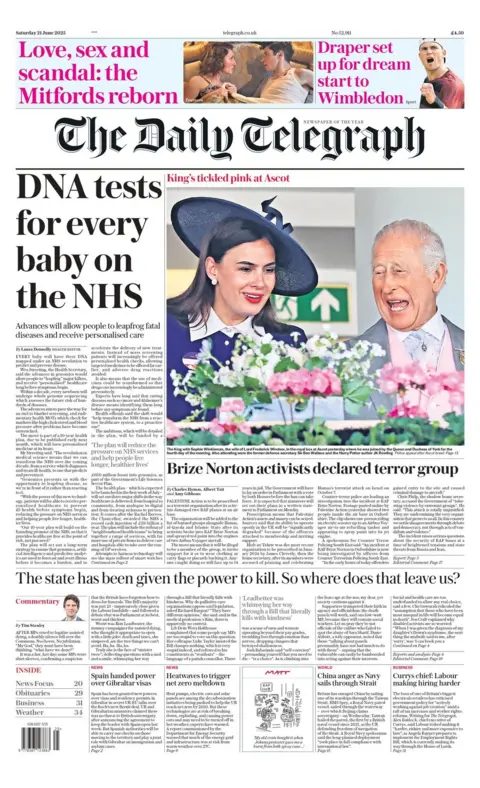
The Daily Mail leads on Friday’s historic Commons vote, which saw MPs narrowly back a bill to give some terminally ill adults in England and Wales the right to end their own lives. The paper says peers have promised an “attritional fight” when the bill moves to the House of Lords, claiming the narrow margin of 23 votes in favour is a “sign of concern about the bill”.
The Times likewise emphasises that the bill must go through the Lords to become law – and says it faces an “uphill battle” in doing so. It reports a peer said there were “black arts that could be used to kill the bill off”. Several front pages carry pictures from Royal Ascot – and the Times says author JK Rowling made a “rare public appearance” at the races.
The Daily Express uses more positive language as it splashes on The Terminally Ill Adults Bill. It declares the vote a “victory” for campaigners, “dignity in dying” and “choice in assisted dying”. Elsewhere, with a heatwave across the UK set to intensify on Saturday, the Express reports that “storms will cool us down” as a yellow warning for thunderstorms is issued.
The Daily Mirror also splashes on the “historic” assisted dying vote. It says it “spark[ed] joy among supporters” gathered outside Parliament, where opponents also protested against the result.
The Sun turns its attention elsewhere. It brands pro-Palestinian activists who broke into an RAF base and sprayed military planes with paint “air heads”. The government is set to ban the Palestine Action group as a result of what the paper calls a “security shambles”. A spokesperson for the group said on Friday: “When our government fails to uphold their moral and legal obligations, it is the responsibility of ordinary citizens to take direct action.”
The Daily Telegraph likewise includes the break-in at RAF Brize Norton on its front page. It highlights that the government’s move to make Palestine Action a proscribed group effectively declares them a “terror group”. It also splashes on plans to map the DNA of every baby under an “NHS revolution,” and carries a comment piece which says the assisted dying vote gave the state “the power to kill”.
The Guardian meanwhile splashes that end-of-life care is “to be transformed” in a “societal shift” after the assisted dying bill vote. It is one of few front pages with an eye on the Middle East this morning, reporting that fighting “continued to escalate” between Israel and Iran as the conflict entered its second week.
In other news, the FT Weekend reports that a US private capital group is to provide billions to support Somerset’s Hinkley Point C nuclear power station – which it calls a “delayed and over-budgeted project”. The paper also reports that mania for the “ugly-but-cute” Labubu dolls has turned its Chinese maker into one of the world’s biggest toy groups.
The Daily Star likewise widens Saturday’s news agenda with its front page, claiming Pope Leo XIV says AI is “doing [the] devil’s work”. Reporting that the pontiff “warns AI could be bad for kids,” it brands his remarks “Pope versus bot”.
It’s the first meeting of the Advisory Committee on Immunization Practices (ACIP) since Kennedy fired all 17 members and appointed eight new panelists, several of whom are vocal vaccine critics.
As part of its scaled-down two-day meeting beginning Wednesday, the committee is set to vote on influenza vaccines that contain thimerosal — an ingredient wrongly linked to autism.
Kennedy has long advocated for banning thimerosal, a preservative that was widely used for decades in a number of biological and drug products, including many vaccines. In his 2014 book, Kennedy said thimerosal was “toxic to brain tissue” and likely caused autism.
Thimerosal, a compound that contains mercury, is used as a preservative to prevent harmful bacteria in multidose vials of vaccines. The compound has been largely phased out as manufacturers have shifted toward single-use vials that contain little or no thimerosal, according to the Centers for Disease Control and Prevention (CDC).
Thimerosal was largely removed from pediatric vaccines by 2001, amid concerns that it could be linked to autism in children. But according to the CDC, “a robust body of peer-reviewed scientific studies conducted in the U.S. and other countries support the safety of thimerosal-containing vaccines.”
The draft agenda for next week’s ACIP meeting revisits issues that scientists and public health experts have long considered to be settled, including the use of the measles mumps, rubella and varicella vaccine in children under 5 years old.
It’s unclear yet what the panel will discuss regarding the shot.
The current CDC childhood vaccine schedule recommends two doses for children, with the first dose at age 12-15 months and the second at age 4-6 years. CDC suggests that the MMR vaccine be given rather than MMRV for the first dose, but both shots have been on the schedule for decades.
Welcome to The Hill’s Health Care newsletter, we’re Nathaniel Weixel, Joseph Choi and Alejandra O’Connell-Domenech — every week we follow the latest moves on how Washington impacts your health.
The Trump administration is shortening ObamaCare’s annual open enrollment period and ending the law’s coverage of immigrants that entered the U.S. illegally as children, according to a final rule announced Friday. The Biden administration made it easier and more affordable to sign up for Affordable Care Act plans, causing enrollment to swell to an all-time high. The Trump administration claims those moves opened a wave …
Patients and doctors say the latest COVID-19 variant spreading in the U.S. in some cases causes a sore throat so painful it has earned the nickname “razor blade throat.” The nimbus variant, which is officially known as NB.1.8.1., is a descendant of the omicron and is being monitored by the World Health Organization. “Your throat is so dry, so cracked, it’s so painful, it’s even hard to drink sometimes,” Muhammad Azam, …
ChatGPT can harm an individual’s critical thinking over time, a study released this month suggests. Researchers at MIT’s Media Lab asked subjects to write several SAT essays and separated subjects into three groups — using OpenAI’s ChatGPT, using Google’s search engine and using nothing, which they called the “brain‑only” group. Each subject’s brain was monitored through electroencephalography (EEG), …
FDA’s vaccine advisory committee meets Wednesday to discuss GlaxoSmithKline’s application for an RSV vaccine in people ages 60+.
In Other News
Branch out with a different read from The Hill:
Agencies they can’t enforce anti-trans bias policies against Catholic groups: Judge
BISMARCK, N.D. (AP) — Two federal agencies cannot punish Catholic employers and health care providers if they refuse for religious reasons to provide gender-affirming care to transgender patients or won’t provide health insurance coverage for such care to their workers, a federal judge ruled Thursday. The ruling from U.S. District …
Senate Parliamentarian Elizabeth MacDonough has ruled that several key pieces of the massive bill to implement President Trump’s agenda run afoul of … Read more
12:30 Report is The Hill’s midday newsletter. Subscribe here or using the box below: Close Thank you for signing up! Subscribe to more newsletters … Read more
Molina Healthcare Inc logo on phone-by T_Schneider via Shutterstock
Valued at a market cap of $16 billion, Molina Healthcare, Inc. (MOH) is a provider of managed healthcare services under the Medicaid and Medicare programs, and through the state insurance marketplaces. Headquartered in Long Beach, California, the company operates in four segments: Medicaid, Medicare, Marketplace, and Other.
Companies worth $10 billion or more are generally labeled as “large-cap” stocks, and Molina Healthcare fits this criterion perfectly. The company focuses on underserved communities and operates health plans across multiple U.S. states. It emphasizes cost-effective and quality healthcare access to patients.
Molina Healthcare stock has dropped 19.1% from its 52-week high of $365.23. Shares of MOH have decreased 6.9% over the past three months, slightly underperforming the S&P 500 Index’s ($SPX) 6.5% increase.
www.barchart.com
In the long term, shares of Molina Healthcare have dipped 3.5% over the past 52 weeks, lagging behind the SPX’s 9% return over the same time frame. Additionally, MOH stock has gained 1.5% on a YTD basis, whereas the SPX has risen 1.7%.
The stock has been trading below its 50-day and 200-day moving averages since late May.
www.barchart.com
Molina Healthcare stock fell 5.5% following Q1 2025 results on Apr. 23. The company reported revenue of $11.2 billion, marking an increase of 12.2% from the year-ago quarter, beating the Street forecasts. Meanwhile, its adjusted EPS came in at $6.08, up 6.1% year-over-year, surpassing the analysts’ estimate. However, the decline in stock was driven by rising medical costs, with the medical care ratio increasing to 89.2% due to higher-than-expected utilization in long-term care and behavioral health.
In contrast, Centene Corporation (CNC) has lagged behind MOH stock. Shares of CNC have declined nearly 9% on a YTD basis and 16.9% over the past 52 weeks.
Even though MOH has underperformed relative to SPX, analysts are moderately optimistic about its prospects. The stock has a consensus rating of “Moderate Buy” from the 16 analysts covering it, and it is currently trading below the mean price target of $358.64.
On the date of publication, Sohini Mondal did not have (either directly or indirectly) positions in any of the securities mentioned in this article. All information and data in this article is solely for informational purposes. This article was originally published on Barchart.com
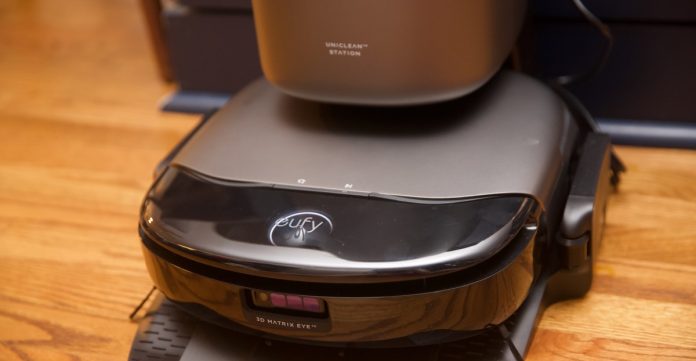
We’re in an age where you can realistically delegate tasks to smart hunks of metal, whether it’s a self-driving car or a robot that can clean on your behalf. Most of us probably won’t be able to afford the helpful sentient humanoids being developed in our lifetimes, but robot vacuums are an affordable way to experience that promised utopia right now.
Today’s floor cleaners are also more advanced than ever. In addition to vacuuming, many of the best models can now mop, allowing you to tackle both carpet and hardwood flooring. Some can automatically dispense of their trash and dirty water, too, and clean their own components without intervention. We now even have models that can pick up dirty laundry and purify the air in your home, preventing you from having to lift a finger.
But if you need something relatively affordable for daily cleaning, you’d be surprised how little you have to pay for premium features. Below, we’ve listed the best deals currently available on a slate of Verge-approved robot vacuums, whether you prefer a budget entry-level model from Yeedi or a top-of-the-line offering from iRobot, Dreame, and more.
Roborock’s S8 MaxV Ultra, our pick for the best robot vacuum overall, is available at Amazon for $999.99 ($800 off) — its best price to date — as a part of a limited-time lightning deal. The combination of a 10,000Pa suction power and dual rubber roller brushes makes it a terrific vacuum, one that can easily pick up pet hair and other debris. It can also mop with great efficiency thanks to a sonic mopping system that vibrates the mop pad 4,000 times a minute, allowing it to clean sticky juices, thick condiments, and other common spills. The mop arm can extend to cover corners and baseboard edges, too.
The S8 MaxV Ultra’s camera-equipped AI obstacle avoidance makes it the best navigator in Roborock’s lineup and one of the top models overall, though it’s not quite as strong as Roomba’s. The mobile app offers ample options to customize cleaning zones and schedules, and you can use its dedicated voice assistant to start and stop routines. It’s also a Matter-ready robot that’s compatible with Amazon Alexa, Google Home, and Apple Home.
$1000
With top-notch vacuuming performance, an easy-to-use app, and built-in voice control, the S8 MaxV Ultra is a superb vacuum and good mop. It features Roborock’s best obstacle detection, innovative features like dirt detection, and a hands-free dock that makes it an expensive but excellent choice.
The Roborock Q8 Max Plus is a cheaper alternative you can currently pick up from Roborock, Amazon, and Lowe’s for $399.99 ($419 off), which is the lowest price we’ve seen. It isn’t as powerful or feature-packed as the S8 MaxV Ultra, but it still delivers a solid 5,500Pa of suction power, rendering it good enough for most cleaning tasks. It also handles mopping well, with 30 adjustable water flow levels and a sizable 350ml water tank that allows it to cover larger areas without frequent refills. The robovac can map your home efficiently and avoid most obstacles thanks to built-in lidar navigation, though it lacks a built-in camera for advanced object recognition.
$400
The Roborock Q8 Max Plus offers strong 5,500Pa suction, solid mopping features, and reliable obstacle avoidance.
The Dreame X40 Ultra is another mopping robot, and while it’s on the more expensive side, you can currently pick it up for $999.99 ($500 off) from Dreame and Amazon (if you’re a Prime member), which is $100 shy of its all-time low. You’re paying a premium for 12,000Pa of suction power and a pair of removable, self-retracting mop pads, which it can automatically clean and dry on its own using the included base. It can also empty its own bin and refill its own water tank.
The Dreame X40 Ultra features an extendable side brush and mop pads, too, offering better coverage for baseboards, corners, and the underside of your furniture. It uses a combination of AI-powered cameras and “3D-structured light” (presumably based on lidar technology) to map and navigate rooms, with customizable keep-out zones and more functions available in the app. There’s also a dirt detection system that can identify messier spills and adjust its cleaning routine accordingly.
$1000
With a unique ability to remove and reattach its mop pads, the Dreame X40 solves the problem of vacuuming carpets (with 12,000Pa suction power) while also mopping hard floors. Its mops can also swing out and under low furniture, getting where most bots can’t reach.
The Dreame L20 Ultra is currently available for $649.99 ($350 off) from Amazon (for Prime members) and Dreame, which is $90 shy of its all-time low but still one of its better prices to date. The L20 Ultra is an excellent alternative to Dreame’s newer flagship robots, including the X40. It lacks a bit of power in comparison, though its 7,000Pa of suction power is still enough for most cleaning jobs. It also doesn’t have the L40’s tri-cut brush, which makes the step-up model more efficient at picking up pet hair. The only other real advantage the X40 holds over the L20 is its self-extending arms for vacuuming (though the dual mop pads can extend a bit for baseboard and corner coverage), nor does it have dirt detection.
The L20 Ultra’s base station is rather large, but it can take care of the entire cleaning process, including emptying the dustbin, emptying and refilling the water tanks, and washing and drying the mop pads. It doesn’t have a heated cleaning function for the mop pads, however. It uses a lidar-based AI-powered navigation system, and you can prompt it to start cleaning by voice using Amazon Alexa and Google Assistant voice commands.
$650
The L20 Ultra is a great all-around bot that can remove its mop pads to vacuum carpet and do the splits with its mops to better clean your baseboards. It has 7,000Pa suction, a bigger base station, and fewer advanced cleaning features than the newer X30 and X40 Ultra models, but it’s still an excellent robot vacuum.
The SwitchBot S10 is available directly from SwitchBot for an all-time low of $459.99 ($740 off) when you use coupon code SYPT700. The S10 is one of the most affordable robot vacuum / mop hybrids you can buy, one that can refill its own tank so long as you hook the battery-powered base station into your home’s plumbing. It can also dry its own mop pads and empty its own bin at a separate docking bay, and offers enough capacity to run for up to 90 days without intervention.
The S10’s self-cleaning roller mop is more effective than the typical pads we see in most other units, but it’s also limited to a smaller coverage area. It only has a single roller brush for vacuuming, but its respectable 6,500Pa suction can make up for it. And while it has lidar mapping and AI-powered obstacle avoidance, we found it still has a tendency to get stuck on laundry, bath mats, and other obstacles. The S10 is also one of the few robovacs with Matter support, however, which effectively enables native control through Apple Home, Google Home, and Alexa (though said platforms don’t yet fully support robot vacuums).
The S10 is a great mopping robot with a battery-powered water refill dock that makes it the most hands-free robovac we’ve tested. A separate auto-empty dock takes care of the dust. It’s big and loud and lacks some features found on high-end robots, but it does a great job of keeping your floors clean.
The SwitchBot K10 Plus is available for $176 ($224 off) from SwitchBot (with promo code SYPT505), which is an all-time low. At 3.6 inches high and 9.8 inches wide, it’s a more petite option if you want something that can maneuver tighter spaces, which it does to decent success with a lidar-based mapping system that supports digital keep-out zones. It only has 2,500Pa suction, but that should be powerful enough to lift dirt in all but the deepest carpeting. You can also attach disposable mopping pads, though their mopping function doesn’t work well. The K10 Plus comes with a self-emptying dock that can hold a respectable four liters of dirt before it needs emptying.
$176
The smallest robot vac on the block, the K10 Plus, doesn’t compare to the other bots here in terms of performance, but if you have a small space where other vacs can’t get to, it’s better than nothing. It’s also very quiet, making it ideal for small spaces like home offices and bedrooms or a very small studio apartment.
The Eufy X10 Pro Omni — our current pick for the best midrange robot vacuum / mop — is down to an all-time low of $549.99 ($250 off) at Eufy’s online storefront when you use promo code WS7DV2T3DNEO, with Amazon and Best Buy matching said deal price.
The X10 Pro Omni is a bit of a novelty, at least in comparison to other robovacs in its price range, in that it offers AI-powered obstacle detection, which allows it to deftly navigate cables and other clutter. It also features a slew of functions you’d expect from top-of-the-line models, including 8,000Pa of suction power, speedy lidar-powered mapping, and oscillating dual spinning brushes for mopping.
Mind you, none of these features are as effective as they are on more premium models, though the result is an all-in-one bot that punches above its weight. Plus, it has heated mop drying and onboard water reservoir, the latter of which prevents it from having to return to its multifunction auto-empty / wash / fill dock too frequently.
$550
The X10 is a great robovac with excellent AI-powered obstacle detection, powerful oscillating mops, a user-friendly app, and good mapping capabilities.
Now through June 25th, the Omni S1 Pro is on sale for an all-time low of $799.99 ($500 off) when you purchase it directly from Eufy with offer code WS24T2071111. The S1 Pro is an excellent robovac if you have mostly hardwood floors, with a long 11.4-inch roller mop, a square shape, and dual spinning side brushes that leave floors spotless (it can even reach into corners).
What’s more, the S1 Pro is capable of self-washing its own mop with water jets as it cleans, which it can then dry afterward using hot air. It’s also a decent vacuum with 8,000Pa of suction, which is enough power to pick up most debris. Its AI-powered obstacle avoidance system is effective as well, allowing it to navigate around larger objects with relative ease.
$800
The Eufy Omni S1 Pro’s 11.4-inch roller mop does a great job of cleaning up hardwood floors. It self-washes and dries its mop as it works, while doubling as a decent vacuum with 8,000Pa of suction.
If you’re looking for a bump-and-roll model that’s relatively budget-friendly,the discontinued Eufy 11S Max is still on sale at Amazon for just $159.99 ($120 off). The 11S Max stands out from other robovacs because it doesn’t use Wi-Fi, meaning it doesn’t require you to fiddle with a mobile app on your phone. Instead, you can control it using an on-board button or with the included remote, which also allows you to create cleaning schedules. It’s relatively quiet and reliable, too, with 2,000Pa of suction power and replaceable parts, making it a great long-term investment for those who want something basic.
$160
The Eufy 11S Max is a super slim, repairable bump-and-roll bot with a large 600ml bin and three cleaning levels. Its biggest selling point, however, is that it lacks Wi-Fi, meaning you don’t have to fiddle with an app.
The Yeedi Cube is currently down to an all-time low of $246.99 ($243 off) at Amazon at checkout. It’s not easy to find a self-emptying / self-cleaning vacuum at this price, as those features are typically only available on robots that cost upward of $600 or more.
With 5,100Pa of suction power, the Cube can tackle most common vacuuming scenarios, though its single hybrid rubber / bristle brush can get easily tangled with pet hair. It mops better than most models in its range, however, namely because its vibrating microfiber pads can actually scrub your floors. The Cube uses lasers for object avoidance, too, though it’s not as effective for navigation as those with lidar and AI smarts. It can avoid large furniture and other objects, but it might need your help rerouting around cables, toys, and laundry. Still, we found it navigates better than most other robots under $300.
$247
One of the first robots that can vacuum, mop, self-empty, self-wash, and self-dry with hot air for under $1,000, the Yeedi Cube is an older model that currently retails for under $500. It’s a good vacuum and mop for hands-free cleaning on a budget.
The Shark Matrix Plus 2-in-1 is a great robot vacuum / mop hybrid that’s now on sale for $399.99 ($320 off) at Amazon, Best Buy, and directly from Shark, which is $20 shy of its all-time low price. Before the Eufy X10 Pro Omni took its place, the Matrix Plus 2-in-1 was our runner-up pick for those seeking a midrange robot vacuum that mops and automatically empties its own bin. Its vibrating, sonic mopping feature does an excellent job of scrubbing hardwood floors; however, keep in mind that you’ll have to fill and attach the mop reservoir manually.
$400
The Shark Matrix Plus 2-in-1 Robot Vacuum and Mop mops very well — doing a swingy, scrubbing movement with its rear end when in “Matrix mode.” However, you have to manually fill and attach the mop reservoir and empty the bin when it mops, as it only self-empties in vacuum mode and can only avoid larger objects.
You can get iRobot’s Roomba Combo 10 Max from Amazon for $799.99 ($600 off), which is its second-best price to date. We think it’s the best robot vacuum for pet hair, one that combines high suction power with rotating dual rubber brushes that pick up without getting tangled. What’s even more impressive is that it comes with a new multifunction charging dock that allows it to empty its bin, wash its own mop, and even refill its mopping tank. Add in Matter support, excellent AI-powered obstacle detection, and a retractable mop arm, and you’ve got a robovac that makes cleaning almost entirely hands-free.
$800
iRobot’s first mopping bot that can refill its water tank and wash and dry its mop, the Combo 10 Max, features a retractable mop arm and superior suction power. It’s also iRobot’s first robot to support Matter.
If you’re working with a tight budget, the Combo i5 is also a good vacuum / mop — one you can pick up on sale at Amazon and directly from iRobot right now for $199, down from $349.99. It’s not as powerful as the aforementioned Combo 10 Max and can’t refill its water tank or wash and dry its own mop; however, it still features Roomba’s wide, dual rubber brushes, which do an excellent job of picking up dirt and debris. It doesn’t support virtual keep-out zones or Matter, either, though you can schedule it to clean specific rooms at set times. It’s also compatible with both Amazon Alexa and Google Assistant, and like all Roombas, it’s relatively easy to repair.
$200
The Roomba Combo i5 Plus is the company’s budget vacuum and mop robot with room mapping features but no virtual keep-out zones.
$1100
The Deebot X8 Pro Omni remains our favorite robot vacuum / mop. It represents a welcome return to form for Ecovacs’ flagship line, with great obstacle avoidance, a small dock, and a convenient self-cleaning brush system.
$210
A budget robot vacuum and mop with high-end features, including room-specific cleaning, carpet boost, and smart navigation, it also features an auto-empty dock for just $80 more.
$700
A superior mopping bot with a superior price tag, the Narwal is smart enough to know when it needs to go back and mop more. Its vacuuming is good, and its unique onboard compression bin means no loud auto-emptying.
Update, June 20th: Updated to reflect current pricing / availability and a newer deal for the Eufy Omni S1 Pro.



 Roblox
 Roblox
 Teire family
 Roblox