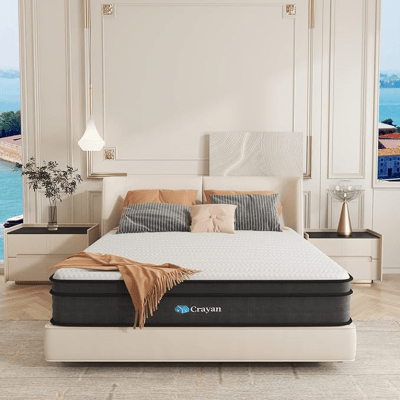
(NEXSTAR) — About 100,000 Crayan brand mattresses, which were sold exclusively on Amazon, are being recalled over concerns they don’t meet federal safety flammability requirements and could catch fire.
The recalled mattresses were sold online at Amazon.com from July 2022 to June 2024, for $100-$220. Consumers should stop using the mattresses immediately, says the retailer, Foshanshi Liyue Jiaju Youxian Gongsi, dba Crayan Inc., of China.
Size(s) in inches: 10-inch mattresses and 12-inch mattresses
Bed size(s): Twin, Full, Queen and King
All were sold compressed in a box
Single-sided Crayan mattresses will show “Crayan” printed on a grey side panel, in addition to a white knit quilted top
A white label sewn into the mattress cover will show fiber content, size and show “WG/P Foundation” on the label
Crayan says customers can contact the company to receive a full refund. In order to receive a refund, Crayan says customers will need to mark the mattress permanently with the word “RECALLED” written in large letters across the top white panel. Then, Crayan asks customers to submit a photo of the marked mattress to the company’s Hotmail address before receiving a refund.
Crayan says it’s contacting all known purchasers directly.
Astro Bot is filled with whimsy and silliness that makes you want to pay attention to the details. But in a presentation at this year’s Game Developers Conference, director Nicolas Doucet shared one particular aspect of Astro the robot that I hadn’t noticed but blew me away.
Doucet talked about how Team Asobi worked hard to give the game a good tempo with things like enemy placement and how you can interact with Astro’s spaceship with the DualSense’s gyro controls on loading screens. One thing that kept the momentum going was Astro himself and how he shows his impatience. Doucet showed a video of one idle animation where Astro is hopping up and down on his feet and pointing forward, almost like a little kid that’s demanding you go to the playground.
It’s adorable — and was added “very, very late” in development, Doucet says when I chat with him a few weeks after the presentation. While a lot of games have characters simply breathing or looking left to right while they’re idle, Team Asobi thought that it could do something a little more fun. Since the game is about rescuing characters, the team started to tie the animations to the idea of looking around, Doucet says. The team even reduced the amount of time it takes for the animations to show as a way to more quickly remind the player of the goal to find the bots. Doucet thinks of this as a subliminal way to put players in the mood to move faster.
Astro actually originates from a 2013 PS4 pack-in game called The Playroom that used the PS4 camera. In that game, the robot is named Asobi, but he looks a lot like the charming Astro from Astro Bot: Asobi has big blue eyes and a cute, pudgy robot body. “Back then, the design of the character came from two angles,” Doucet says. One was that the development team didn’t have much time, so they went for a simple character design instead of a human that might require a lot of facial animations.
But they also picked a robot because of where it would be making its debut: a preinstalled game on (at the time) new Sony hardware. When you think about Sony or PlayStation, Doucet says that there is an “aspiration to the future” or something “a little bit science fiction.” Team Asobi uses the term “techno magic.” The robot’s design came from that: “we wanted the playful fun character, but also coupled with something really cool and futuristic.”
The PS5 hardware and Astro might share a lot of similarities — white plastic with black parts and blue lights — but that’s an accident, Doucet says. Instead, both the character designers and hardware team were following similar values.
While it’s flattering to hear that people treat Astro as PlayStation’s mascot, Doucet says that wasn’t the design team’s original intention for the character. Instead, a mascot needs to be something that “grows naturally” and something that the users decide or feel. That happens through repeated consistency and quality, Doucet believes.
In retrospect, the awards for the game — including Game of the Year at The Game Awards — are well deserved, but the goal was primarily to put platformers and family-friendly games back on the map and release “as good a game as we can.” Doucet used to look at renowned PlayStation studios like Naughty Dog (Uncharted, The Last of Us) and Santa Monica Studio (God of War), and think they knew some kind of “black magic” that Team Asobi didn’t.
But following Astro Bot, the takeaway was that “actually, it became the sum of lots of small things that are carefully made.” If the team keeps that consistency and makes sure that “every bit” of the game is done as well as possible, then “the sum of it ends up being high quality.” No wonder Astro is impatient to explore.
The NBA offseason has officially arrived! Sure, Game 7 of the Finals is Sunday, but that doesn’t mean all 30 teams haven’t been working the phones, trying to figure out if there are deals to be made.
With the NBA draft just days away, and free agency just days after that, league chatter is only getting louder.
Here are five trades, featuring 10 different teams, that our NBA insiders think could shake up the draft’s first round before Adam Silver even announces the first overall pick.
Consider this Part 2 of the Grizzlies’ trade from Sunday that sent Bane to the Orlando Magic for Caldwell-Pope, the No. 16 pick and three future first-rounders. This deal redirects up to three of those four picks and Caldwell-Pope to the Nets for Johnson, who would replace the shooting Bane provided Memphis at a lower cost.
The Grizzlies should feel like that series of transactions is a win. Although Johnson is older, at 29, and doesn’t offer the kind of playmaking Bane did, he’s also a career 39% 3-point shooter and perhaps a better fit with Memphis from a size perspective.
The Grizzlies could shift Jaylen Wells to shooting guard next to Johnson on the wing and play small lineups at times with a Johnson-Jaren Jackson Jr. frontcourt that would stress opposing bigs with its floor spacing.
Crucially, Memphis would pocket the best of the four picks coming from the Magic — a 2026 first-rounder that will most likely come from the Phoenix Suns. And by including Konchar in this trade, the Grizzlies would create nearly $13 million in cap space they could use to renegotiate Jackson’s contract in conjunction with a long-term extension.
From the Nets’ standpoint, they’d get a variety of draft assets in exchange for one of the remaining veterans who don’t quite fit their rebuilding timeline.
This year’s move up from No. 27 to No. 16 is worth a late first-round pick on its own, and Brooklyn would add a second first-rounder in 2028 plus another potential swap in 2030. It’s also possible the Nets could rehabilitate Caldwell-Pope’s trade value after a seasonlong shooting slump with the Magic.
Because this trade doesn’t require cap space to complete, Brooklyn could maximize its spending power by using league-high cap space on signings or other deals first, then complete this one. — Kevin Pelton
play
2:44
Why Stephen A. would have the conversation about trading Ja Morant
Stephen A. Smith explains why it’s worth it for the Grizzlies to consider moving on from Ja Morant.
Bulls add Barrett, Raptors get … potential Giannis flexibility
The Bulls would, in the 25-year-old Barrett, add another 20-point scorer to their young lineup and in doing so move on from Williams, the 2020 fourth overall pick who has regressed offensively after signing a five-year, $90 million deal.
The upside for Chicago is that it should get far more nightly box-score production, especially in terms of scoring, from the Canadian southpaw, aiding the Bulls’ 20th-ranked offense.
On the flipside, the Raptors — who have thrived developing young, rangy wings over the years — get to work with Williams, still just 23, with fewer expectations.
Williams’ salary is significantly smaller than Barrett’s $25 million, which matters as the team is set to pay Scottie Barnes, Brandon Ingram and Immanuel Quickley a combined $142 million next season alone.
What will be worth watching is whether Toronto selects a player with the No. 12 pick, or kicks it down the road to load up on future picks instead.
The latter wouldn’t be all that surprising, particularly if the Raptors want to stay flexible to be a team in the running for a potential megadeal for Giannis Antetokounmpo, should he request a trade. — Chris Herring
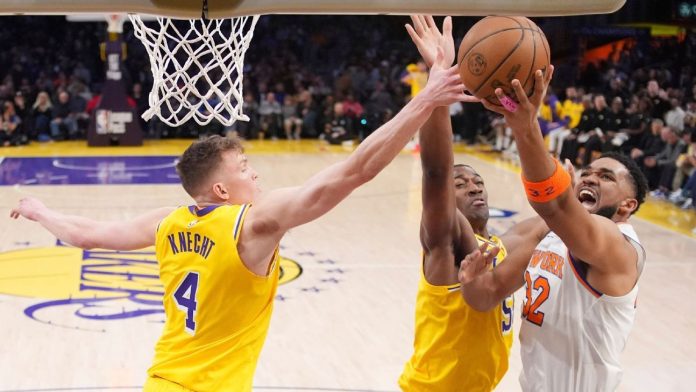
Lakers trade Knecht — again — and land starting center
Brooklyn Nets get: No. 11 pick (via Portland), 2031 unprotected first (via Los Angeles) Los Angeles Lakers get: No. 8 pick (via Brooklyn), No. 36 pick (via Brooklyn) Portland Trail Blazers get: G Dalton Knecht, 2027 top-4 protected first (via New York)
It should be noted that this trade is contingent on whether Duke’s Khaman Maluach is on the board when Brooklyn is picking.
If he is, then the Lakers have their starting center for the future, but at the cost of last year’s first-round pick, Knecht, and an unprotected first in 2031. It is the same package the Lakers sent to Charlotte in the failed Mark Williams trade last February, except the 2031 first-round swap is not included.
Lakers president of basketball operations Rob Pelinka made it clear after the season that acquiring a starting center is the priority.
“I think when you make a huge trade at the deadline where you trade your starting center for a point guard, of course that’s going to create significant issues with the roster, and we saw some of those play out. We know this offseason, one of our primary goals is going to be to add size in our frontcourt at the center position.”
In Maluach, the Lakers get a lob partner for Luka Doncic, a rim protector and the paint presence they lacked in the first-round loss to the Minnesota Timberwolves.
The Lakers could have waited until free agency to get a starting center, but they had only the $5.7 million tax midlevel exception available. Because of the first apron, the Lakers were also limited in taking back more money in a trade.
As for the Nets, they move back three spots to No. 11 but pick up a 2031 unprotected first from the Lakers. The Nets still have three firsts in the draft (No. 19, 26 and 27) along with 12 future firsts in the next seven years, including four unprotected.
For Portland, the trade is similar to one last June when they traded the 14th pick to the Washington Wizards for Deni Avdija and a future first. This time it is Knecht and a future first from New York. — Bobby Marks
play
1:12
JWill: Giannis handles things differently than other players
Jay Williams weighs in on Giannis Antetokounmpo’s future in the NBA and how he handles things differently than other players.
Bucks add youth to aging core
Milwaukee Bucks get: No. 15 pick and No. 24 pick Oklahoma City Thunder get: 2031 first (top-1 protected)
Oklahoma City already has the NBA’s deepest roster, and the Thunder aren’t set to lose any players from this season’s team this summer. They also will add Nikola Topic, last year’s No. 12 pick, who fell in that draft and missed all of his rookie season due to a torn ACL. So what is Sam Presti going to do with two post-lottery picks in the first round? His roster doesn’t even have room for them.
The Thunder’s enviable position means Presti could keep his picks and opt for a draft-and-stash player. He could bundle a few picks — either both from this year or some of his future hoard — to move up and target a specific prospect. Or he could trade the present for the future, knowing he doesn’t need more youngsters now but will once his team’s stars have all graduated to larger contracts and cap space will be at a premium.
Presti has already worked a bit in this latter direction when he traded a less valuable 2024 first-rounder for unprotected swap rights with the Mavericks in 2028. There’s a chance that swap will never materialize, meaning Presti would have traded a first-rounder for nothing — but there’s also a chance that Oklahoma City could reap greater rewards with a higher pick in 2028.
The same logic would apply in this trade: Trade two guaranteed firsts of middling value to Milwaukee, which doesn’t have a 2025 first of its own and is in desperate need of a youth talent infusion, in exchange for a potentially juicier selection down the line, at which point Giannis Antetokounmpo would be entering his late 30s.
The same setup could work with any win-now team that has identified a couple of players it wants in the middle of the 2025 first round. For now, all of the Thunder’s extra first-rounders will be exhausted by 2029, so they’d do well to start pushing some of those selections farther into the future to help maintain a surplus indefinitely. — Zach Kram
The Rockets were No. 2 in the West this season with a young, talented unit that was strong on defense but lacked individual scoring ability.
The latter was apparent in their first-round loss to the Golden State Warriors, as their leading scorer, wing Jalen Green, struggled as the focal point of the Warriors’ defense, and the Rockets weren’t able to find other ways to create offense.
Enter DeRozan, one of the league’s best isolation scorers, who is coming off his 12th straight season averaging more than 20 points.
DeRozan would provide a huge lift to the Rockets’ half-court offense with his ability to create consistent high-level shots off the dribble while also taking some of the burden off Green and Alperen Sengun. Plus, the Rockets have a plethora of talented defenders on the wing, including Amen Thompson and Tari Eason, to replace Brooks’ defensive abilities.
Even without DeRozan, the Kings have plenty of scoring ability on the wing, with the additions of Zach LaVine and Malik Monk — a duo capable of combining for more than 40 points per game.
Their biggest holes this offseason are on defense and point guard, after they traded away De’Aaron Fox to bring in LaVine. Brooks, with his aggressive 3-and-D game, would fit in well on the Kings’ wing. The No. 10 pick would also be an upgrade from the Kings’ 13th pick that they’ve traded away to the Atlanta Hawks.
Mock drafts project several point guard prospects could be available at No. 10, including Kasparas Jakucionis from Illinois and Egor Demin from BYU, who could develop into the Kings’ point guard of the future. — André Snellings
A judge described the attack as “senseless”, resulting in “catastrophic injuries”
The daughter of a murdered woman says her life shattered when she saw the killer enter her mother’s home via a ring doorbell alert.
Dean Mears dragged grandmother Catherine Flynn, 69, from her bed and stamped on her, breaking every bone in her face during the attack in October 2024.
Mrs Flynn’s daughter Natasha Flynn-Farrell said she watched helplessly after she received a doorbell camera alert of the drug dealer breaking into her mother’s home in the seaside town of Rhyl in Denbighshire.
Jailing him for life with a 27 year and 128 day minimum term, Judge Rhys Rowlands said Mears, 35, was responsible for a “savage, and quite ferocious and merciless attack”.
He said the recording captured on the doorbell camera “can only be described as horrific”.
“It was by all accounts a truly shocking and cruel way to end her life.”
Mears, from Kinmel Bay in Conwy, was found guilty of murder after a nine-day trial in Caernarfon in May.
The jury heard he had taken ketamine and cannabis before breaking into the frail grandmother’s home – a woman he had never met.
He then smashed a window and entered the home, going straight to Mrs Flynn’s bedroom.
He could be heard screaming at her before the sickening sound of stamping was captured on the doorbell recording.
Mrs Flynn was taken to hospital after suffering extensive facial trauma and multiple fractures, where she died the following day.
Prosecutor Andrew Jones KC said she had suffered serious health and mobility issues, and used a stairlift and a walking frame inside her house.
She was just 4ft 10in (1.47m) and weighed less than eight stone (50kg).
Family photo
Catherine Flynn, who was known by family and friends as Cathy, died from extensive stamp injuries to her head and neck
Mrs Flynn-Farrell addressed her mother’s killer in the dock on Friday.
“You Dean Mears – you can’t even look at me,” she said.
“You didn’t just kill my mum – you killed a part of me.
“You Dean Mears took the light out of my life.
“I want my words and my face to be etched into your brain.”
She said she lived with the footage and sounds captured by the doorbell camera during the attack.
“I hear those thuds to her head, face and neck every day.
“It replays in my in slow motion – thud, thud, thud.
“That moment was the vilest, sickening moment of my life.
“How could you do what you did to my mum – my queenie. You should hang your head in shame.
“You are nothing but a coward. I’ll never forgive you Dean Mears.”
North Wales Police
Mears pleaded guilty to manslaughter, but was found guilty of murder by a jury after a nine-day trial in May
Pathologist Dr Brian Rodgers told the jury Mrs Flynn’s injuries were “the types of injuries you see in high-speed road traffic collisions”.
The doorbell recording suggested there were up to 15 blows from her killer.
Mears admitted he had carried out the attack, but said he had no recollection of what happened.
His defence team argued Mears had been suffering from post-traumatic stress disorder (PTSD), after being stabbed twice following a prison sentence for drug dealing.
Natasha Flynn-Farrell says her mother’s murder has left her family “shattered”
Speaking to BBC Wales before the sentencing, Mrs Flynn-Farrell recounted the moment she received the doorbell notification to tell her someone was at her mother’s front door.
“It is the worst night of my life I have ever experienced,” she said.
“My life just shattered in that second,” she said.
“As soon as I clicked on that notification, that was the moment my world crumbled.”
Mrs Flynn-Farrell was home alone as events unfolded a short drive away at her mother’s house, and could only watch and listen until Mears left before she could phone the police.
“For those two minutes I had to watch that out. It felt like two hours. I was hysterical.”
Arriving at the house, Mrs Flynn-Farrell was kept outside while police went in to see what had happened to her mother.
“I did know it was serious but I was trying to tell myself it was going to be OK, that hopefully it wasn’t as bad as what I’d heard.
“But it was awful. It was the worst outcome that could have ever happened for her – and for all our family.”
Mrs Flynn-Farrell said Mears was “not worth the air we breathe”.
“To be able to do that to a defenceless, 69-year-old, frail, seven stone little woman. She was like a little doll.
“He’s a monster and he’s a coward.
Mrs Flynn-Farrell said her mother’s murder has had a profound affect on her and those around her.
“There are so many lives he has ripped apart,” she said.
“The ripple effect this has had – not just on the family, on the community, on complete strangers. It’s been a whirlwind of emotions for everyone.”
She said she was still living with the impact every day.
“I find it hard most days to get up and go out. I don’t want to see anyone, I’ve lost contact with my friends.
“It’s given me bad anxiety, depression, PTSD. I don’t even watch the telly anymore, in case things trigger it.
“I’m living a nightmare still.”
The murder took place at Cefndy Road in the Rhyl
Mrs Flynn-Farrell said she hoped the sentencing could finally bring some closure to the tragedy and wants to be able to help others facing family trauma in the future.
She coined the social media tag #JusticeforQueenie as the murder case went through the court system, as a platform to remember her mother and to talk about what had happened.
“It’s not just for my mum – it’s for everyone’s Queenie,” she said.
“I want this to carry on and be a platform against violence for women and girls. It’ll be used to help other organisations, femicide awareness and things like that.”
(NewsNation) — A new study has found that addiction to social media, video games and mobile devices is linked to a higher risk of suicidal behaviors and thoughts.
JAMA Network published the study Wednesday, which looked at data from over 4,000 children starting at 9 or 10 years old. The study followed these children for years and found that, by the age of 14:
Around a third of participants became increasingly addicted to social media
About 25% of kids were increasingly addicted to their cell phones
Over 40% showed signs of being addicted to video games
The study author, Yunyu Xiao, said, “And these youth are significantly more likely to report suicidal behaviors and thoughts.”
According to NPR, Dr. Jason Nagata, a pediatrician at the University of California, San Francisco, said, “It’s an important study and raising awareness about screen addiction. … It shows that elements of addiction related to screen use are more strongly predictive of poorer mental health and even suicide risk compared to just screen time. So, I think that it provides more nuance.”
Study followed participants for years, assessed addiction with questionnaire
Data was used from an ongoing longitudinal study called the Adolescent Brain Cognitive Development Study, which has been following these children for years. During that time, these children were questioned about their average daily screen time, among other things, with a standardized questionnaire.
Xiao said that some of the statements in the questionnaire would include, “‘I spend a lot of time thinking about social media apps or planning to use social media apps'” and “‘I try to use the social media app less, but I can’t.'” Then, each child’s response would be monitored over the years to see how it changed.
Nearly 60% of the participants had low levels of social media addiction, and they stayed stable over the years. However, around a tenth of the children had an increasing social media addiction that peaked around the third and fourth year of the study.
When it came to cell phone use, around half showed a high addiction, and a quarter had an increasing addiction. Then, with video games, there were two groups: Around 60% showed low addiction that was stable, and 41% were highly addicted throughout a certain period of time.
Those with high social media addiction had higher risk of suicidal thoughts
The study found that those who had high and increasing addiction to mobile phones and social media platforms were at a higher risk of suicidal behaviors and thoughts. At year four, almost 18% of kids reported having suicidal thoughts, and 5% said they had suicidal behaviors.
This correlation was also observed in individuals who were highly addicted to video games. However, total screen time had no effect on a lower or higher suicide risk.
Nagata said, “We all get reports from our phones about our weekly screen time. Screen time is an easily understandable metric because it’s minutes or hours a day that we’re spending on screens.”
Psychologist Mitch Prinstein, a professor at the University of North Carolina, also said, “Some kids might spend their time on screen reading the news, and some might be trolling some pretty dangerous sites. So it’s really hard to know what to make of screen time as a risk factor.”
(Bloomberg) — MiniMax is considering an initial public offering in Hong Kong, people familiar with the situation said, in what would be a landmark industry debut for a Chinese AI startup valued at about $3 billion.
Most Read from Bloomberg
High Yield Savings Offers
Powered by Money.com – Yahoo may earn commission from the links above.
MiniMax, one of the country’s so-called AI Dragons or Tigers, could aim to list as soon as this year, according to the people, who asked not to be identified because the information is confidential. The Shanghai-based company has hired financial advisers for the IPO, they said.
Deliberations are ongoing and details such as valuation and timing could change, the people said. The company didn’t respond to a request for comment.
A MiniMax IPO would enable investors to buy into a new generation of Chinese firms advancing AI technology. Another, Zhipu, is also preparing to debut. The emergence of DeepSeek in January fired up interest in the startups, which are now vying with larger tech companies to compete with US leaders like OpenAI.
Founded in 2021, MiniMax raised $600 million last year in a financing round that valued it at about $2.5 billion at the time. The deal was led by Alibaba Group Holding Ltd. and followed fundraising involving Tencent Holdings Ltd., among others. Zhipu is also backed by Alibaba and Tencent.
Chinese tech firms are racing to build low-cost AI products and will require capital to sustain a dizzying pace of investment and research. Other AI Tigers including Baichuan and Moonshot have unveiled new models in recent months.
MiniMax just this week outlined a spate of new services. It released a reasoning model called the M1, saying it’s bigger and less resource-consuming than DeepSeek’s latest. It plans to roll out a pair of products that autonomously perform tasks on behalf of users, upping its game in the realm of agentic AI against the likes of OpenAI and Manus.
And it upgraded a text-to-video model underpinning its video editor Hailuo AI. Other products include AI companion app Talkie, which competes with Character.AI in the US.
–With assistance from Zheping Huang.
(Updates with Minimax’s foray into AI agents in the 8th paragraph.)
Shared micromobility startup Voi is on the hunt for acquisitions. And on CEO Fredrik Hjelm’s wishlist is Bolt, the European mobility super-app best known for ride-hailing.
Not that Bolt’s micromobility business is necessarily for sale — despite talk of Voi buying the company’s scooter and bike arm. Bolt declined to comment when TechCrunch reached out.
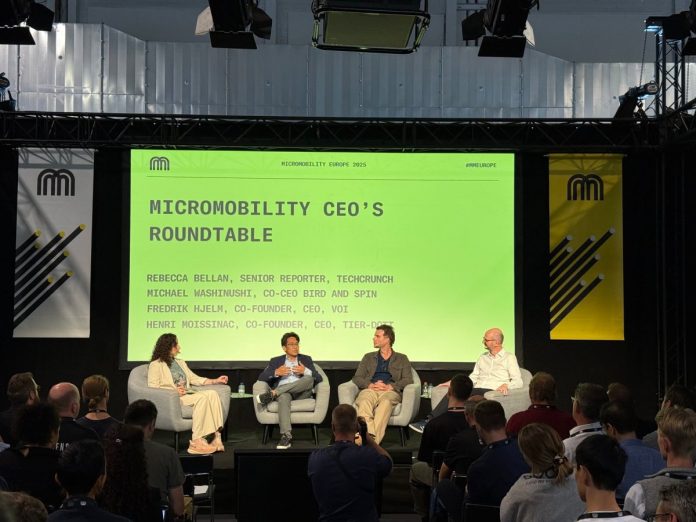
“Bolt is a great company, but they are mainly a ride-hailing company,” Hjelm told TechCrunch onstage at the Micromobility Industries roundtable in Brussels, where he was joined by Bird co-CEO Michael Washinushi and Dott/Tier CEO Henri Moissinac.
Hjelm said Bolt’s challenge is that it needs to be “extremely good in several verticals.” Aside from ride-hailing, Bolt offers grocery and food delivery, as well as car rentals.
“Micromobility is very difficult, and it has the hardware aspect, but no network effect like how food delivery and ride-hailing [can lead to] grocery delivery, as well,” Hjelm said.
He noted most people who pick up a dockless e-scooter or e-bike are locals who prioritize experience and affordability rather than the ability to use a “super app” like Bolt.
When provided an example of riders who use micromobility services because they recognize the brand — and might not want to download another app — he stuck to this thesis. Hjelm said he doesn’t think brand recognition is enough to make up for a worse user experience.
Of course, there’s no data proving that Voi offers a better user experience than Bolt. That didn’t stop others on the panel from joining the Bolt pile-on.
“Bolt uses price as a loss leader,” said Bird’s Washinushi, referring to Bolt’s ability to rely on revenue from its other operations to grow its micromobility business at a loss. “They discount the price, and that’s how they acquire installs. My sense is they don’t make a huge investment in…really good operations in micromobility.”
Washinushi noted that Bird, as well as Dott and Voi, use a lot of data to rebalance vehicles.
“You can dump thousands of vehicles and hope people get rides, or you can… place half those vehicles at the right place and right time to optimize the rides and optimize the price,” he said. “And that’s [how] the business has really evolved in the past two or three years… that, for us, makes it a very self-sustaining business.”
In 2024, Bird said it achieved $19 million adjusted EBITDA profitability — quite the feat for a company that had delisted from the stock market and filed for bankruptcy two years ago. Voi also achieved its first profitable year last year with adjusted EBITDA of $17.9 million.
Bolt hasn’t shared financial numbers for its micromobility business. In November 2024, the company said it had hit $2.11 billion in annual revenue across its business units, but didn’t share how much it lost. According to local reports, Bolt recorded revenue of around $2 billion in 2023 on an operating loss of $108 million.
TechCrunch attempted to follow up Wednesday with Hjelm about why he’d want to acquire Bolt and whether he has been in talks with the company.
“I’m at the Swedish House Mafia reunion and will think about Bolt tomorrow,” he responded.
TechCrunch will update this story if Hjelm has more to say on the matter.
Rachel Doerrie is a professional data consultant specializing in data communication and modelling. She’s worked in the NHL and consulted for professional teams across North American and Europe. She hosts the Staff & Graph Podcast and discusses sports from a data-driven perspective.
There are late-round gems in every NHL draft class that go on to have impactful careers. With the increase in scouting coverage and analytics, teams do a better job of drafting those players earlier, but inevitably, a few of these late-round diamonds in the rough emerge.
Gone are the days of getting Pavel Datsyuk, Henrik Lundqvist or Brett Hull in the late rounds. However, smaller players who possess skill seem to be drafted much later. The reigning Calder Trophy winner Lane Hutson is hardly a late-round pick — he went 62nd overall in 2022 — but he should’ve been selected a lot earlier.
Some recent late-round gems include Troy Terry (No. 148 in 2015), Andrew Mangiapane (No. 166, 2015), Jesper Bratt (No. 162, 2016), Brandon Hagel (No. 159, 2016) and Mark Stone (No. 178, 2010). There were concerns about all of them in the draft process, whether it was size, skating or questions about the translatability of their game to the NHL. But each has far exceeded their draft expectations and gone on to represent their country on the international stage. Your draft slot does not make or break you. The earlier picks will get more chances while the later picks have to earn their looks, but there is a pathway to success.
The common denominator in a late-round pick’s success is that they are elite in at least one category; or as one NHL executive put it, “they possess a separating skill that differentiates them from others.”
This year, there are a few players who may end up as the diamonds in the rough. Generally speaking, a player drafted after the third round has a less than 3% chance of playing 200 games in the NHL, which means it is likely that only four or five players drafted after pick No. 96 will make it. There is a less than 1.5% chance of that player becoming an impact player, goaltenders not included. The darts at the board are worth throwing, but a few players in this class have separating skills that may give them a better chance.
Cameron Schmidt, RW, Vancouver Giants (WHL)
While Schmidt is rated much higher in public rankings — and remained a first-rounder in those rankings for the majority of the season — NHL teams with which I spoke do not view him in the same light. Many scouts believe Schmidt will be selected between the third and fifth rounds because he’s much smaller than the average NHL player at 5-foot-7.
Still, Schmidt’s ceiling as a second-line scoring winger in the vein of Alex Debrincat should excite teams. It is understandable that teams would be hesitant to select a player of his stature with an early pick because of the rarity of success for player shorter than 5-9. Schmidt is arguably the fastest player in the draft, with an elite shot. He has more than one “separating skill” that scouts look for, with one opining that if he were 6-1, he may be in the conversation for being picked in the 10-15 range.
Netting 40 goals in 61 games makers him one of the best goal scorers available in the draft. He can score multiple ways; off the rush in stride, on one-timers, by net-front finishing and a smooth but powerful catch and release. There is a high likelihood that Schmidt leads the CHL in goals over the next two seasons with his separating speed and well-rounded finishing ability.
Debrincat is 5-8, and if Schmidt grows to that height or even 5-9, there’s a real chance he becomes a reliable goal-scorer at the NHL level. Instead of drafting for physicality and size, taking a chance that someone grows who already possesses elite talent could be very rewarding for a team.
Jacob Rombach, D, Lincoln Stars (USHL)
A defenseman who is nearly 6-7 with punishing physical traits and the potential to become a shutdown defender will be very attractive to teams. Rombach lacks a lot of the offensive skill that teams like to see in their top-end defenseman, but there is a real path to becoming a No. 4/5 defender in the NHL.
Defensively, he possesses one of the most complete skill sets in the draft, which will only improve as he refines those skills. He has impressive puck-retrieval ability, scanning for threats and allowing him to pre-emptively escape pressure situations. He employs head fakes to shake forecheckers, and makes a simple and efficient pass when the lane opens.
When defending, he uses his frame to disrupt plays on the rush, kill plays on the wall and makes it difficult for teams to generate off the cycle. He isn’t overly physical, and while that is easily developable at his size, scouts like that he doesn’t get caught out of position trying to make a big hit. When he closes gaps on players all over the ice, he leads with a strong stick and smothers them, forcing turnovers or dump-ins.
If his skating and physicality improve, Rombach has the tool kit to be an effective shutdown defender who can kill penalties and play secondary matchups.
David Bedkowski, D, Oshawa Generals (OHL)
The old-school hockey types love Bedkowski because he loves physicality. He is a throwback in the sense that he lives for the violence. A menacing defenseman at nearly 6-5 and 215 pounds, Bedkowski is the most punishing defender in the draft class. While that doesn’t always equate to NHL success, the Florida Panthers‘ blueprint will surely have executives thinking about Bedkowski’s ability to play highly effective transition defense while inflicting significant pain on opponents with his physical play.
He is one of the best zone-entry defenders in the draft class, and if he can pick his spots a little better in terms of stepping up to make contact, there is a path to becoming an effective bottom-pair defender.
His ceiling isn’t high in terms of becoming a No. 4/5 guy, but teams need depth and brute force to win in the playoffs, and Bedkowski may develop into a defenseman who can reliably provide that.
Viktor Klingsell, LW, Skelleftea AIK (J20)
Another candidate to be a steal in the later rounds is world under-18 championships standout Klingsell. He didn’t produce at the level Jesper Bratt did in Sweden, but he outperformed Bratt when playing against his peers. Given the similarity in height, the high-end playmaking and vision, it isn’t surprising to see some believe Klingsell could be a “Bratt lite” in the NHL. He lacks physicality — which isn’t particularly surprising given his stature — but his instincts and offensive tool kit are amongst the best available among European skaters.
The main concern is his pace. Klingsell has a boom-or-bust type of profile. If he hits, he’ll be a second-line offensive facilitator who notches 50-plus assists every year. If he doesn’t, he’s likely to become a very good SHL player. That is the type of swing you take in the later rounds, especially when speed is the concern. But it is much easier to develop skating and speed than it is to find a player with the natural offensive instincts and playmaking capabilities that Klingsell possesses.
Filip Ekberg, LW, Ottawa 67’s (OHL)
Another Swede with a chance to make a team very happy is dual-threat forward Ekberg. The first half of the season was plagued by illness and a limited role. As the calendar flipped, Ekberg’s play took off, culminating in a standout performance at the U18s, where he tallied 18 points in seven games and earned himself an invite to Sweden’s World Junior summer team.
There is real reason to believe Ekberg is on the cusp of a major scoring breakout in the OHL that would vault his projection to a middle-six scorer at the NHL level.
Ekberg is a well-rounded forward anticipates and reads the play, facilitates offense and owns an excellent catch and release. He lacks dynamism that you’d like to see, but showed legitimate flashes of ability when healthy at the U18s. If he can improve his skating, he has all the hallmarks of a smaller player who can succeed in the NHL, in a secondary scoring and power-play role.
Aidan Lane, RW, Saint Andrew’s College/Brampton Steelheads (OHL)
If not for a standout performance in the OHL at the end of the season, Lane’s NHL projection would not exist. The CHL/NCAA rule change allowed the Saint Andrew’s College graduate to play the final 13 games in Brampton, where he tallied a point per game.
It is very difficult to project prep school players, as there is limited sample size. However, the high-motor winger looked every bit the part in a top-six role for Brampton. He has a chance to become a power winger in the bottom six at the NHL level, with his strength, physicality and his ability to generate offense.
He was smooth in transition, was able to draw defenders to him and make positive value plays. He was also able to use his physical package to overpower seasoned OHL players. Lane has the motor, physical tools and displayed promising offensive tools that could make him a high value pick beyond the fourth round. His speed and explosiveness will need to improve if he is to effectively use his tools to forecheck and create offence in a secondary role at the NHL level.
Given his chosen path to play in the NCAA at Harvard, he will have plenty of time to develop against the best amateur competition.
L.J. Mooney, RW, USNTDP (USHL)
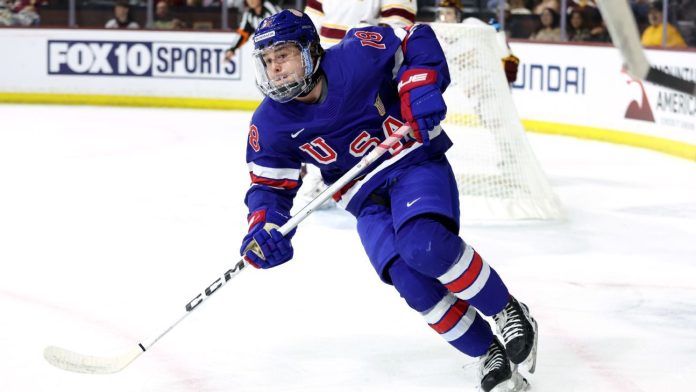
Another diminutive winger, Mooney is one of my personal favorites in the draft class. He’s a dynamic skater and gets fans out of their seats with his puck handling skill. At 5-7, possessing multiple separating skills should be enough for a team to take a chance on him in the middle rounds.
He’s a non-stop player who is constantly drawing the viewer’s eye. His blistering speed is immediately noticeable, especially when combined with fantastic puck skill. There is real potential for him to become a transition nightmare for defenders. For that to happen, Mooney will need to improve his ability to facilitate offense and read the play. He needs to utilize his elite skating and puck skill to attack the middle of the ice to create high-danger scoring chances.
Given his size and questions about playmaking ability, he’s close to a boom-or-bust player. However, many players with that skill level do not possess the motor and inner drive to compete. Mooney does not leave any doubts about his will to compete given his fearless play, consistent pace, and willingness to play both sides of the puck.
If a team has multiple second- or third-round picks and lacks a dynamic skater, as well as someone who could be a legitimate contributor — the Philadelphia Flyers, Montreal Canadiens and Detroit Red Wings are in this boat — Mooney is a worth a shot.