0.3 C
New York
Monday, January 19, 2026
Home Blog Page 921

Amber heat health alerts issued as temperatures above 30C likely

0


Simon King

Lead Weather Presenter

PA Media A woman walks along the pavement with the Houses of Parliament behind her. The sky is blue and the weather sunny.PA Media

Amber heat health alerts have been issued across the whole of England with temperatures likely to exceed 30C for the first time this year.

The alerts, which will be in effect from midday on Thursday until 09:00 BST on Monday, come as an expected heatwave approaches much of the country.

The UK Health Security Agency (UKHSA) said “significant impacts are likely” for health and social care services, including increased demand.

Temperatures will widely be between 27C and 30C on Thursday across east Wales, the Midlands, and East and South East England with a few locations around Greater London and the home counties reaching 31C.

Elsewhere, temperatures will climb to between 23C and 27C though along the coast it will feel cooler, with temperatures sitting around 20C.

It follows a period of high temperatures across the UK with yellow heat health-alerts having previously been in place.

The alert system works in conjunction with the Met Office but has a focus on health risks using four levels of warning; green, yellow, amber and red.

An amber warning means weather impacts “are likely to be felt across the whole health service”.

Among examples given by UKHSA are difficulties managing medicines, the ability of the workforce to deliver services and internal temperatures in care settings exceeding the recommended thresholds.

The agency also refers to a possible rise in deaths – particularly among those aged 65 or over or with health conditions.

At this level, it is possible some health impacts will be seen across the wider population and not just affecting those who are most vulnerable.

The rising temperatures are down to an area of high pressure situated across the UK which, with a south-easterly wind, draws in hot weather from other parts of Western Europe.

A temperature of 29.3C was recorded at St James’ Park in London on Wednesday evening, just slightly lower than the record for the year so far which stood at 29.4C and was recorded in Suffolk on 13 June.

Some locations in Lincolnshire and Suffolk have already had two consecutive days where the temperature has exceeded the heatwave threshold of 27C. Thursday would make it a third day which would therefore place these parts in an official heatwave.

Friday will again see temperatures widely in the mid to high twenties across the UK, with a few spots in South East England once again exceeding 30C.

While northern and western parts of the UK will see a slight fall in temperature on Saturday with the risk of some showers or thunderstorms – for central and eastern England it will be the peak in the heatwave with temperatures rising to between 30 and 33C.

A change in wind direction to a westerly on Sunday is set to cause the heatwave to break and all parts will be a little cooler.

Although eastern areas won’t be as hot, temperatures will still be in the mid to high twenties.

SNAP work requirement carveouts for vets, homeless caught in crosshairs of Trump bill

0


Congress could soon put an end to work requirement exemptions for veterans, homeless individuals and youth that were in foster care who receive food assistance.

While House Republicans preserved the exemptions to work requirements under the Supplemental Nutrition Assistance Program (SNAP) as part of their broader package to advance President Trump’s tax cut and spending priorities, Senate Republicans omitted the key language in their version of the bill. The exemptions were initially negotiated as part of a bipartisan deal two years ago.

The GOP-led Senate Agriculture Committee confirmed the provision’s absence would mean the exemptions would no longer be retained for members of the three groups.

The move has drawn little attention on both sides of the aisle so far, as other pieces of the Republicans’ megabill take center stage, including significant changes to Medicaid and what some estimates have projected as a multitrillion-dollar tax package. 

Even multiple GOP members of the Senate committee that produced the text say they intend to press for more information about the potential change before the upper chamber votes on the bill.

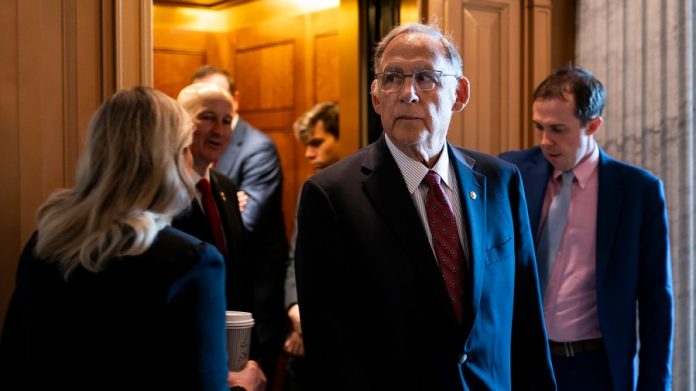
Senate Agriculture Committee Chair John Boozman (R-Ark.) said Wednesday that “everybody ought to be treated the same” when asked about the matter. A Senate Republican aide also noted that individuals who aren’t “able-bodied” wouldn’t “have to meet those requirements” under the Senate plan.

Congress had previously agreed to temporary changes to work requirements for SNAP in 2023 as part of a bipartisan deal to cap annual federal spending and raise the nation’s debt limit. That included measures carving out exemptions through September 2030 for individuals experiencing homelessness, veterans, and young adults who were in foster care at the age of 18.

In a statement on the matter last Friday, the Senate committee said Republicans are working “to encourage greater independence through work and training opportunities.” 

However, it noted its plan would still allow for “individuals who are physically or mentally unfit for employment are not required to meet the 20 hours per week work requirement whether in those groups or not.”

The decision comes as Republicans in both chambers are working to root out “waste, fraud and abuse” in what some have described as a “bloated” government program that has seen its spending climb over the years.

Other notable changes Republicans are seeking to make to SNAP include requiring states to cover some of the cost of benefits and front a greater share of administrative costs for the program, as well as limiting the federal government’s ability to increase monthly benefits in the future.

The Senate Agriculture Committee estimates its plan will yield “an approximate net savings of $144 billion” in the coming years, with Republicans’ proposal requiring states to cover some SNAP benefits costs estimated to account for a significant portion of the projected spending reductions.

The plan is part of a larger pursuit by the party to find measures to reduce federal spending by more than a $1 trillion over the next decade that can ride alongside an extension of Trump’s 2017 tax cuts and other tax priorities.

Democrats have come out in staunch opposition to the evolving proposal that is being exclusively crafted between House and Senate Republicans.

“The Republican bill takes food away from vulnerable veterans, homeless people and young adults who are aging out of the foster care system and may not know where their next meal is coming from,” Rep. Angie Craig (Minn.), top Democrat on the House Agriculture Committee, said in a statement on Wednesday.

“Republicans want to make these cuts to food assistance to fund new tax breaks for people who are already wealthy and large corporations,” she added. 

Some experts are also sounding the alarm.

“It is a huge deal. These groups were carved out for a reason. They are vulnerable for a reason,” Kyle Ross, a policy analyst for Inclusive Economy at the left-leaning Center for American Progress, said, adding the exemptions apply to “different populations with their own special set of circumstances.”

“There are an estimated 1.2 million veterans receiving SNAP, and veterans are more likely to live in a food insecure household than nonveterans, so they’re really more likely to be in need of some food assistance,” he said, while also pointing to barriers homeless individuals and those aging out of foster care face in the job market.

But others have argued against the need for the special carveouts. 

Angela Rachidi, senior fellow at the right-leaning American Enterprise Institute (AEI), described the 2023 spending caps deal as “a political compromise,” noting that Republicans had also secured increases to the age threshold for SNAP as part of the deal under the Biden administration. Some hardline conservatives had also been critical of the deal at the time, while pointing to SNAP’s exemptions. 

“Many states would exempt people anyway because of mental health issues and you don’t always necessarily have to have a doctor’s note for it,” she said, while also arguing there wasn’t “anything unique about those populations that make them not capable of work.”

She added that doing away with the carveouts could help lessen states’ burden by removing “another level of screening.”

“They don’t have to assess somebody for their veteran status or foster status, and they would assess them anyway for their shelter status,” she said, while suggesting from a “bureaucratic perspective, it actually might make it easier.”

At the same time, Lauren Bauer, a fellow in Economic Studies at the Brookings Institution, pointed to the added strain states could face if other proposals from Republicans to increase states’ cost share of the program’s benefits and administrative cost also take effect.

“What the bill also does is, on both sides, you know, reduces the support that the federal government gives to states to administer the program and identifying and validating exemptions, the health exemptions, etc. is very expensive,” Bauer said.

“And administering work requirements is also very, very expensive, because it is onerous not only on the SNAP participant, it’s onerous on the state who is managing the program,” she added. 

China talks up digital yuan in push for multi-polar currency system

0


SHANGHAI/BEIJING (Reuters) -The head of China’s central bank pledged to expand the international use of the digital yuan and called for the development of a multi-polar global currency system, where several currencies dominate the world economy.

China will establish an international operation centre for e-CNY in Shanghai, People’s Bank of China Governor Pan Gongsheng said on Wednesday at the Lujiazui Forum, a high-profile gathering of local and foreign financial industry executives and regulators.

The remarks come in the wake of renewed appetite for a global yuan, as international trade tensions sparked by U.S. tariff policies prompt investors to seek alternatives to dollar-based investments.

At the same time, China is accelerating efforts to develop financial systems independent of Western institutions, moves that have gained fresh impetus as shifting trade patterns and geopolitical realignments reshape the global economic landscape.

“Developing a multi-polar international monetary system will help strengthen policy constraints on sovereign currency countries, enhance the resilience of the system, and better safeguard global financial stability,” Pan said.

Such a system would pave the way for some currencies to hold sway in their respective regions, lessening reliance on the dollar.

Pan expects several key global currencies to coexist in mutual competition with checks and balances in place.

Washington’s aggressive and chaotic rollout of tariffs has shaken faith in the U.S. currency and other U.S. assets, prompting a broader shift by investors away from the U.S. dollar and towards Asian currencies and the euro.

The eroding U.S. dollar appeal also comes amid rising global interest in cryptocurrencies, including stablecoins – a type of virtual currency that is backed by an asset and holds a stable price.

GLOBAL YUAN AMBITIONS

China has long harboured ambitions for the yuan to be a global currency, similar to the euro or dollar and reflective of the importance of the world’s second-biggest economy.

But that goal has been hampered by unwillingness to open the capital account, and while there’s no sign of that changing, progress on other fronts, where it has gained in places such as Russia and other trading partners, stands to accelerate.

On Wednesday, six foreign banks including Standard Bank and First Abu Dhabi Bank agreed to use China’s Cross-Border Interbank Payment System (CIPS), the yuan-based international settlement system in future, state broadcaster CCTV reported, a step that further expands the use of yuan in global trade.

Six-month-old, solo-owned vibe coder Base44 sells to Wix for $80M cash

0


There’s a lot of talk in the startup world about how AI makes individuals so productive that it could give rise to a generation of “solo unicorns” — one-person companies worth over $1 billion.

While an actual solo unicorn remains a mythical creature, Israeli developer Maor Shlomo provided compelling evidence Wednesday that the concept might not be impossible. 

Shlomo sold his 6-month-old, bootstrapped vibe-coding startup Base44 to Wix for $80 million, Wix announced Wednesday. And the deal was cash, Wix confirmed to TechCrunch. 

Admittedly, this wasn’t a billion dollars or close to it. And Shlomo wasn’t truly solo — he had eight employees, Wix confirmed. They will collectively receive $25 million of the $80 million as a “retention” bonus. Wix declined to give details on that part of the deal, like how long they have to stay in their jobs to get full payouts.

Still, Base44’s rapid rise and impressive sale price have been the talk of the vibe-coding community

In its six months as a stand-alone company, Base44 reportedly grew to 250,000 users, hitting 10,000 users within its first three weeks. According to Shlomo’s posts on X and LinkedIn, the company was profitable, generating $189,000 in profit in May even after covering high LLM token costs, which he also documented publicly.

Base44 spread mostly through word of mouth as Shlomo, a 31-year-old programmer, shared his building journey on LinkedIn and Twitter. The project began as a side venture, he told Israeli tech news site CTech.  

“Base44 is a moonshot experiment — helping everyone, technical or not, build software without coding at all,” he explained on LinkedIn when he launched it to the public.

It’s one of the newer crop of vibe-coding products designed for non-programmers. Users enter text prompts, and the platform builds complete applications, with database, storage, authentication, analytics, and integration. It also supports email, texting, and maps, with a roadmap for more enterprise-grade security support.

Base44 isn’t unique in this area. Other vibe coders like Adaptive Computer handle similar infrastructure work. But Base44’s fast rise was astounding all the same.

Shlomo was already known in the Israeli startup community through his previous startup, the Insight Partners-backed data analytics company Explorium. His brother is also a co-founder of an AI security startup, Token Security, which just raised $20 million led by Notable Capital (formerly GGV Capital) and a bunch of Israeli tech angels.

He quickly gained partnership agreements for Base44 with big Israeli tech companies like eToro and Similarweb.

After posting about his decision to use Anthropic’s Claude LLM through AWS instead of models by OpenAI — mostly for cost-per-performance reasons — Amazon invited Base44 to demo at a Tel Aviv AWS event last month, which Shlomo documented.

“Crazy f***ing journey so far,” Shlomo posted on LinkedIn when announcing the news of the acquisition. Despite the growth and the profits — or really because of it — he sold his still-bootstrapped company because “the scale and volume we need is not something we can organically grow into … If we were able to get so far organically, bootstrapped, I’m excited to see our new pace now that we have all the resources in place,” he wrote.

For its part, Wix picked up a proven, fast-growing, local vibe-coding platform for a relative song because of its youth. OpenAI paid $3 billion for Windsurf, which was founded in 2021. 

Wix, of course, offers no-code website building that look professionally designed. Adding a profitable LLM vibe-coding product to its offerings is a logical move.

Shlomo could not be immediately reached for additional comment.

Chelsea’s Mykhailo Mudryk faces up to 4-year ban after doping charge

0


Mykhailo Mudryk is facing a potential ban of up to four years after the Football Association charged the Chelsea winger with a doping offence.

The 24-year-old was provisionally suspended in December having tested positive for a performance-enhancing substance named meldonium.

The Blues were awaiting the results of a ‘B’ sample test to support or contradict the initial ‘A’ results and the FA announced on Wednesday that the Ukrainian winger now faces potential further punishment.

“We can confirm that Mykhailo Mudryk has been charged with Anti-Doping Rule Violations alleging the presence and/or use of a prohibited substance, in terms of Regulations 3 and 4 of The FA’s Anti-Doping Regulations,” said the FA in a statement. “As this is an ongoing case, we are not in a position to comment further at this time.”

Chelsea declined to comment on the FA’s latest action. Guidelines suggest Mudryk could now face a lengthy suspension despite the player previously denying knowingly breaking any rules.

Sources have told ESPN that the drug was likely administered while he was outside of the United Kingdom.

Shortly after his initial suspension became public knowledge in December, Mudryk wrote on Instagram that “this has come as a complete shock as I have never knowingly used any banned substances or broken any rules, and am working closely with my team to investigate how this could have happened.

“I know that I have not done anything wrong and remain hopeful that I will be back on the pitch soon. I cannot say any more now due to the confidentiality of the process, but I will as soon as I can.”

Idaho Murder Case: DoorDash Driver Expected to Testify

0


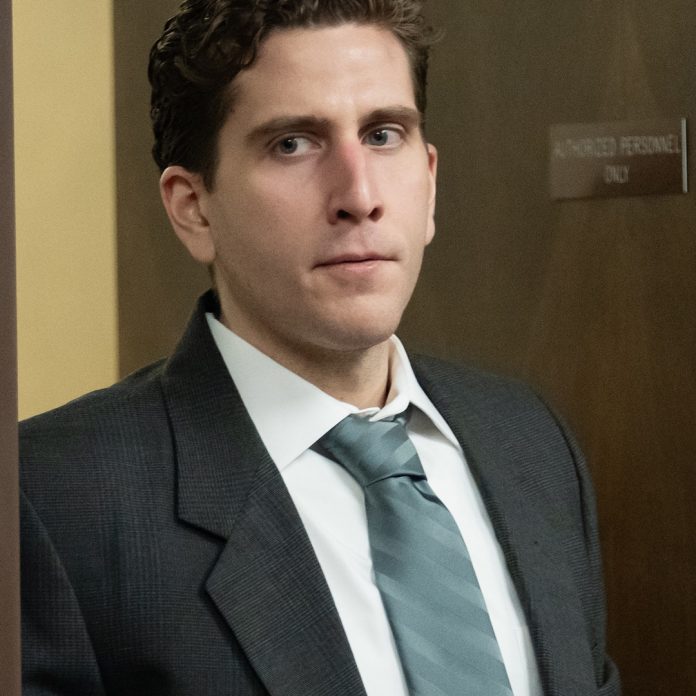
Bryan Kohberger
Bryan Kohberger’s murder case is set to gain an unexpected witness.
A woman told police in Pullman, Wash., she expects to take the stand when the 30-year-old’s case goes to trial later this…

PFA Young Player of the Year nominees: Liam Delap, Morgan Rogers and Ethan Nwaneri among nominees

0


Chelsea striker Liam Delap and Arsenal defender Myles Lewis-Skelly are among six nominees for the PFA Young Player of the Year award.

Bournemouth full-back Milos Kerkez, former Cherries defender Dean Huijsen, Arsenal winger Ethan Nwaneri and Aston Villa midfielder Morgan Rogers make up the shortlist.

Delap, who joined Chelsea from Ipswich in a £30m deal earlier this month, scored 12 goals in the Premier League last season as the Tractor Boys were relegated to the Championship.

Lewis-Skelly enjoyed a breakthrough campaign for Arsenal and scored on his England debut earlier this year against Albania.

Team-mate Nwaneri, 17, scored nine times in 37 appearances for the Gunners last term.

Spain international defender Huijsen earned a move to Real Madrid for his stellar performances for Bournemouth last season, while Hungarian full-back Kerkez is attracting attention from Premier League champions Liverpool after his fine performances for the Cherries.

Rogers contributed 14 goals and 15 assists as Aston Villa narrowly missed out on Champions League qualification.

The winner of the award will be announced on 19 August at a ceremony in Manchester.

Fed holds tight

0


96
<!–

*{box-sizing:border-box}body{margin:0;padding:0}a[x-apple-data-detectors]{color:inherit!important;text-decoration:inherit!important}#MessageViewBody a{color:inherit;text-decoration:none}p{line-height:inherit}.desktop_hide,.desktop_hide table{mso-hide:all;display:none;max-height:0;overflow:hidden}.image_block img+div{display:none}sub,sup{font-size:75%;line-height:0}#converted-body .list_block ol,#converted-body .list_block ul,.body [class~=x_list_block] ol,.body [class~=x_list_block] ul,u+.body .list_block ol,u+.body .list_block ul{padding-left:20px} @media (max-width:620px){.desktop_hide table.icons-outer{display:inline-table!important}.image_block div.fullWidth{max-width:100%!important}.mobile_hide{display:none}.row-content{width:100%!important}.stack .column{width:100%;display:block}.mobile_hide{min-height:0;max-height:0;max-width:0;overflow:hidden;font-size:0}.desktop_hide,.desktop_hide table{display:table!important;max-height:none!important}.reverse{display:table;width:100%}.reverse .column.first{display:table-footer-group!important}.reverse .column.last{display:table-header-group!important}.row-8 td.column.first .border{padding:5px 5px 15px 25px;border-bottom:15px solid transparent}.row-10 td.column.last .border,.row-12 td.column.last .border,.row-8 td.column.last .border{padding:5px 20px 25px 5px}.row-10 td.column.first .border,.row-12 td.column.first .border{padding:5px 5px 15px 25px}}

sup, sub { font-size: 100% !important; } sup { mso-text-raise:10% } sub { mso-text-raise:-10% }

Welcome to The Hill’s Business & Economy newsletter
{beacon}

Soybeans Extend Higher on Tuesday

0


Soybean pods on plant by Mailson Pignata via iStock

The soybean market closed out the Tuesday session with contracts 4 to 8 cents higher. The cmdtyView Cash Bean price was up 4 ½ cents to $10.25. Soymeal futures were up $1.40 to $3.20/ton. Soy Oil saw a slight pullback, with losses of 9 to 32 points in the nearbys.

The USDA reported a private export sale of 120,000 MT of 2025/26 soybean meal to unknown destinations this morning.

The weekly USDA crop progress report showed a 2% drop in soybean conditions to 66% gd/ex. The Brugler500 index dropped 5 points to 367. Improvement was noted in NE (4), with SD (+3), NC and TN also higher. Ratings dropped in IL and IA (-1), with IN, MO, and ND all 3 points lower.

EU Soybean imports are tallied at 13.58 MMT as of June 15 (since July 1), which is up from the 12.65 MMT in the same period last year. Brazilian soybean exports are projected to total 14.37 MMT in June, above the 14.08 MMT estimate from last week.

Jul 25 Soybeans  closed at $10.74, up 4 1/4 cents,

Nearby Cash  was $10.25 1/1, up 4 1/2 cents,

Aug 25 Soybeans  closed at $10.76 1/4, up 4 1/2 cents,

Nov 25 Soybeans  closed at $10.67 3/4, up 7 1/4 cents,

New Crop Cash  was $10.14 3/4, up 8 1/4 cents,

On the date of publication, Austin Schroeder did not have (either directly or indirectly) positions in any of the securities mentioned in this article. All information and data in this article is solely for informational purposes. This article was originally published on Barchart.com

‘Kid-pilled’ Sam Altman ‘constantly’ asked ChatGPT questions about his newborn

0


Across hundreds of thousands of years of human existence, an impossible question has befuddled our species: Why is the baby crying?!

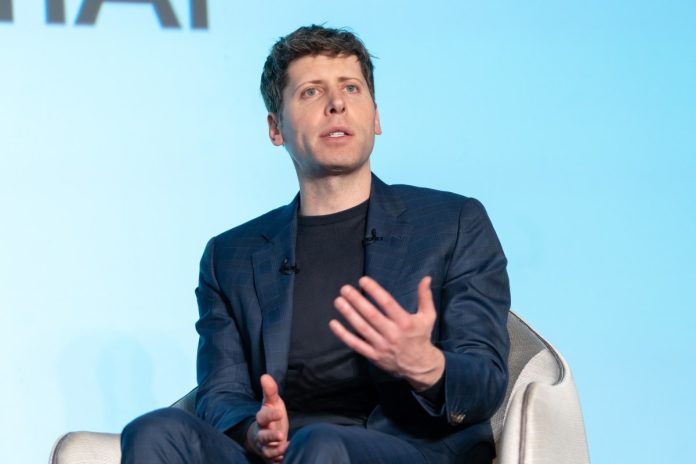
Sam Altman, who is both the father of a 3-month-old and CEO of OpenAI, hopped on OpenAI’s new podcast today to talk about how his company is impacting his experience with fatherhood. Altman, who describes himself as “extremely kid-pilled,” said he was “constantly” using ChatGPT to ask questions about the behavior of babies during the first few weeks of his son’s life — now that he’s a bit more settled, he’s using ChatGPT to ask more general questions about children’s developmental stages.

“I mean, clearly, people have been able to take care of babies without ChatGPT for a long time,” Altman said. “I don’t know how I would’ve done that.”

This, obviously, isn’t fundamentally different from frantically Googling questions about babies, something that even the most well-prepared parents have been doing for decades. But, given who Altman is, his choice of internet tool to use is no surprise.

Still, when hallucination remains a challenge for AI products, it may be concerning to imagine relying so heavily on a chat AI for baby-care answers.

But parents have been known to turn to many a questionable source for information in the middle of the night. My colleagues with children describe the “bottomless pit” of Google, and the minefield of parenting Facebook groups. Is ChatGPT really much different than taking the advice of someone online who’s insisting that you are a neglectful caretaker if you aren’t basing your baby’s bed time on the current phase of the moon?

Perhaps the idea of parents using AI in search for child-raising answers is less of a “primal alarm bell” than the idea of very young children using it, which Altman also discussed.

“There’s this video that always has stuck with me of a baby, or a little toddler, with one of those old glossy magazines [tapping] the [cover],” Altman said. The child thought that the magazine was an iPad. “Kids born now will just think that the world always had extremely smart AI.”

Former OpenAI science communicator Andrew Mayne, who was interviewing Altman, recalled seeing a social media post from a parent who used the voice mode of ChatGPT to talk to his child about his obsessions.

“He got tired of talking to his kid about Thomas the Tank Engine, so he put ChatGPT into voice mode… An hour later, the kid’s still talking about Thomas the train,” Mayne said gleefully.

“Kids love voice mode,” Altman interjected.

As today’s parents turn to ChatGPT for all sorts of similar uses, this will likely end up reflecting the same repetitive discourse around the “iPad kid” generation (yes, it’s probably bad to let your kid watch hours and hours of “Cocomelon”; no, it’s not fair to expect parents to occupy their kids’ time 24/7).

But existing children’s media is at least, for now, created by a team of humans, while ChatGPT’s own policies recommend it not be used by children under age 13. It does not have a vetted parental controls mode. Even Altman is aware of the risks, he said.

“It’s not all going to be good. There will be problems,” Altman said. “People will develop these somewhat problematic, or maybe very problematic parasocial relationships, and society will have to figure out new guardrails.”

Altman is correct. We do not fully know the effect of letting kids talk to a large language model about Thomas the Tank Engine for an hour. But at the end of the day, Altman is the head of a massive company spending billions and billions of dollars with the hope of building AI that is smarter than humans, and he never forgets that in his messaging.

“The upsides will be tremendous!” Altman said. “Society in general is good at figuring how to mitigate the downsides.”