

Martha Plimpton is reflecting fondly on her ex River Phoenix.
The Raising Hope actress—who dated the late actor for four years in the ‘80s and ‘90s—explained that she remained close friends with…
River Phoenix’s Ex Martha Plimpton Makes Rare Comment About Romance

Three years left to limit warming to 1.5C, top scientists warn
Mark Poynting
Climate reporter, BBC News

 EPA
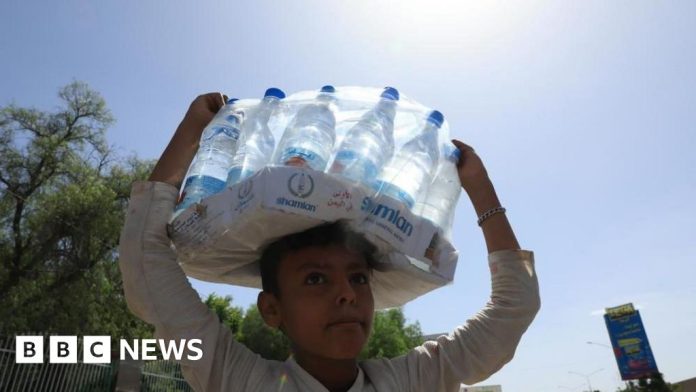
EPAThe Earth could be doomed to breach the symbolic 1.5C warming limit in as little as three years at current levels of carbon dioxide emissions.
That’s the stark warning from more than 60 of the world’s leading climate scientists in the most up-to-date assessment of the state of global warming.
Nearly 200 countries agreed to try to limit global temperature rises to 1.5C above levels of the late 1800s in a landmark agreement in 2015, with the aim of avoiding some of the worst impacts of climate change.
But countries have continued to burn record amounts of coal, oil and gas and chop down carbon-rich forests – leaving that international goal in peril.
“Things are all moving in the wrong direction,” said lead author Prof Piers Forster, director of the Priestley Centre for Climate Futures at the University of Leeds.
“We’re seeing some unprecedented changes and we’re also seeing the heating of the Earth and sea-level rise accelerating as well.”
These changes “have been predicted for some time and we can directly place them back to the very high level of emissions”, he added.
At the beginning of 2020, scientists estimated that humanity could only emit 500 billion more tonnes of carbon dioxide (CO2) – the most important planet-warming gas – for a 50% chance of keeping warming to 1.5C.
But by the start of 2025 this so-called “carbon budget” had shrunk to 130 billion tonnes, according to the new study.
That reduction is largely due to continued record emissions of CO2 and other planet-warming greenhouse gases like methane, but also improvements in the scientific estimates.
If global CO2 emissions stay at their current highs of about 40 billion tonnes a year, 130 billion tonnes gives the world roughly three years until that carbon budget is exhausted.
This could commit the world to breaching the target set by the Paris agreement, the researchers say, though the planet would probably not pass 1.5C of human-caused warming until a few years later.
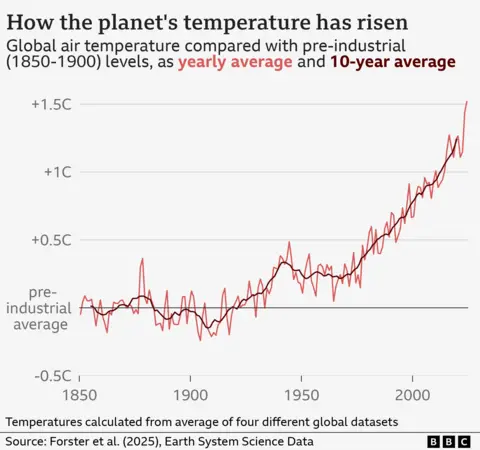
Last year was the first on record when global average air temperatures were more than 1.5C above those of the late 1800s.
A single 12-month period isn’t considered a breach of the Paris agreement, however, with the record heat of 2024 given an extra boost by natural weather patterns.
But human-caused warming was by far the main reason for last year’s high temperatures, reaching 1.36C above pre-industrial levels, the researchers estimate.
This current rate of warming is about 0.27C per decade – much faster than anything in the geological record.
And if emissions stay high, the planet is on track to reach 1.5C of warming on that metric around the year 2030.
After this point, long-term warming could, in theory, be brought back down by sucking large quantities of CO2 back out of the atmosphere.
But the authors urge caution on relying on these ambitious technologies serving as a get-out-of-jail card.
“For larger exceedance [of 1.5C], it becomes less likely that removals [of CO2] will perfectly reverse the warming caused by today’s emissions,” warned Joeri Rogelj, professor of climate science and policy at Imperial College London.
‘Every fraction of warming’ matters
The study is filled with striking statistics highlighting the magnitude of the climate change that has already happened.
Perhaps the most notable is the rate at which extra heat is accumulating in the Earth’s climate system, known as “Earth’s energy imbalance” in scientific jargon.
Over the past decade or so, this rate of heating has been more than double that of the 1970s and 1980s and an estimated 25% higher than the late 2000s and 2010s.
“That’s a really large number, a very worrying number” over such a short period, said Dr Matthew Palmer of the UK Met Office, and associate professor at the University of Bristol.
The recent uptick is fundamentally due to greenhouse gas emissions, but a reduction in the cooling effect from small particles called aerosols has also played a role.
This extra energy has to go somewhere. Some goes into warming the land, raising air temperatures, and melting the world’s ice.
But about 90% of the excess heat is taken up by the oceans.
That not only means disruption to marine life but also higher sea levels: warmer ocean waters take up more space, in addition to the extra water that melting glaciers are adding to our seas.
The rate of global sea-level rise has doubled since the 1990s, raising the risks of flooding for millions of people living in coastal areas worldwide.
While this all paints a bleak picture, the authors note that the rate of emissions increases appears to be slowing as clean technologies are rolled out.
They argue that “rapid and stringent” emissions cuts are more important than ever.
The Paris target is based on very strong scientific evidence that the impacts of climate change would be far greater at 2C of warming than at 1.5C.
That has often been oversimplified as meaning below 1.5C of warming is “safe” and above 1.5C “dangerous”.
In reality, every extra bit of warming increases the severity of many weather extremes, ice melt and sea-level rise.
“Reductions in emissions over the next decade can critically change the rate of warming,” said Prof Rogelj.
“Every fraction of warming that we can avoid will result in less harm and less suffering of particularly poor and vulnerable populations and less challenges for our societies to live the lives that we desire,” he added.

Proposed sale of millions of acres of public land under GOP budget bill prompts backlash
Related video above: Trump and Musk feud continues over ‘Big, Beautiful bill’
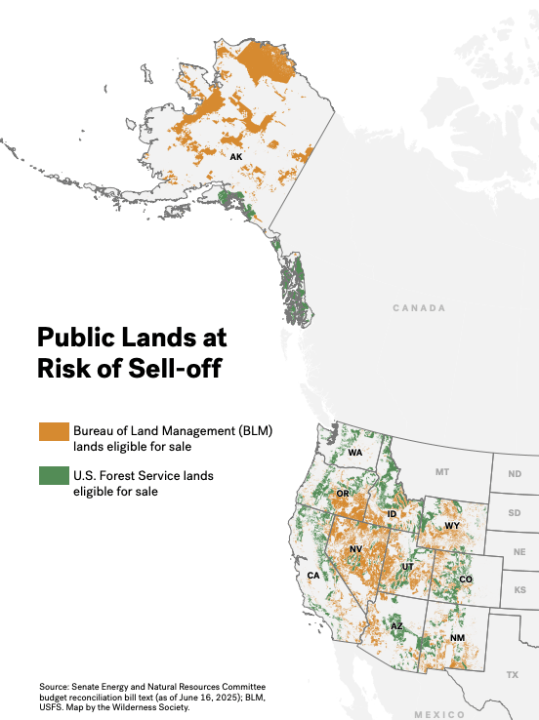
(NEXSTAR) – Over 2 million acres of public land would go up for sale across 11 states under the current version of the Republican budget bill – a proposal that has met criticism from conservationists, hunting groups, local politicians and even some conservatives.
Utah Republican Sen. Mike Lee, who chairs the Energy and Natural Resources Committee, included the sale of federal lands – a longtime ambition of Western conservatives to cede lands to local control – in a draft provision of the so-called “One Big Beautiful Bill.”
Lee has defended the plan as a way to boost domestic energy production, create new revenue streams and increase housing. The Republican said in a video released by his office that the sales would not include national parks, national monuments or wilderness. They would instead target “isolated parcels” that could be used for housing or infrastructure, he said.
“Washington has proven time and again it can’t manage this land. This bill puts it in better hands,” Lee said last Thursday.
Lee has struggled to convince some members of his own party, however, and a similar measure was rejected by the House.
Montana Republican Rep. Ryan Zinke led an effort to strip land sales out of the House version, saying he was a “hard no” on similar measures. Montana was removed from the proposal over the protests of Zinke and other local officials.
What lands could be sold?
An analysis by The Wilderness Society found that more than 250 million acres currently under the Bureau of Land Management and Forest Service are at risk of sale.
Lee’s proposal does not specify what properties would be sold. It directs the secretaries of interior and agriculture to sell or transfer at least 0.5% and up to 0.75% of U.S. Forest Service and Bureau of Land Management holdings. That equals at least 2.1 million acres (868,000 hectares) and up to 3.2 million acres (1.3 million hectares).

The states potentially affected by the proposal are Alaska, Arizona, California, Colorado, Idaho, Nevada, New Mexico, Oregon, Utah, Washington and Wyoming.
| State | Total Acreage |
| Alaska | 82,831,388 |
| Arizona | 14,423,967 |
| California | 16,682,607 |
| Colorado | 4,352,632 |
| Idaho | 21,685,823 |
| Nevada | 33,580,624 |
| New Mexico | 14,312,074 |
| Oregon | 21,745,380 |
| Utah | 18,746,709 |
| Washington | 5,371,690 |
| Wyoming | 14,940,234 |
| Total | 258,673,128 |
The Wilderness Society and other conservation groups have reacted with outrage, saying it would set a precedent to fast-track the handover of cherished lands to developers.
“Shoving the sale of public lands back into the budget reconciliation bill, all to fund tax cuts for the wealthy, is a betrayal of future generations and folks on both sides of the aisle,” said Michael Carroll with The Wilderness Society.
Others have expressed doubt that the lands potentially up for sale would ever be suitable for housing development. Some of the parcels up for sale in Utah and Nevada under the House proposal were far from developed areas.
“I don’t think it’s clear that we would even get substantial housing as a result of this,” Sen. Martin Heinrich, the ranking Democrat on the energy committee, said of the Senate version. “What I know would happen is people would lose access to places they know and care about and that drive our Western economies.”
Conservative environmentalist calls sale a ‘loser issue’
Benji Backer, author of “The Conservative Environmentalist,” has accused Sen. Lee on social media of “secretly trying to sell” America’s public land for development.
“I’ve never seen so many conservatives AND liberals stand together as I’ve seen in opposition of this proposed mass sale of public lands,” Backer posted on X. “Conservation of our nation’s beauty is a deeply patriotic and nonpartisan value.”
An April poll sponsored by the Trust for Public and and conducted by YouGov found that, of the 4,000 Americans surveyed, 71% opposed the sale of public land. The opposition was bipartisan: 61% were Trump voters in 2024, and 85% Harris voters.
The Associated Press contributed to this report.
Technical Assessment: Bullish in the Intermediate-Term

Technical Assessment: Bullish in the Intermediate-Term
NFC is getting a range boost

The next version of the Near Field Communication (NFC) standard aims to make it easier to make payments, pair devices, and unlock doors using your phone or smartwatch. The most notable improvement is a boost to the distance of contactless connections from 0.5cm to 2cm, extending the range by x4.
The NFC Release 15 standard update means NFC chips shouldn’t need to be as precisely aligned with terminals to register a connection, which is especially beneficial for users who have to fumble with smaller devices like smart watches or rings. Tap-to-pay systems like Apple Pay will also start sooner, making contactless payments faster and more reliable.
While some devices already register contactless connections at greater distances than 5mm, the NFC Forum behind the standard says the spec update is “redefining the baseline.” The NFC Release 15 is needed to support contactless applications that “demand higher reliability and a broader operating range,” according to the NFC Forum. That includes NFC tech being integrated into increasingly smaller devices and performing more complex activities with a single tap, such as using a wallet app to pay for products, receive digital receipts, and collect store loyalty points.
The NFC Release 15 is currently available to high level NFC Forum member companies, including Apple, Google, Sony, and Huawei, allowing them to start implementing the improvements in their own products. Compliance certification will be made available to the public sometime this fall. The Verge has asked the NFC Forum if existing NFC devices can be updated to support the new release standard when it rolls out but didn’t hear back before publication.
Why one LSU fan brought a 30-foot Tiger float to the MCWS
-

Elizabeth Merrill
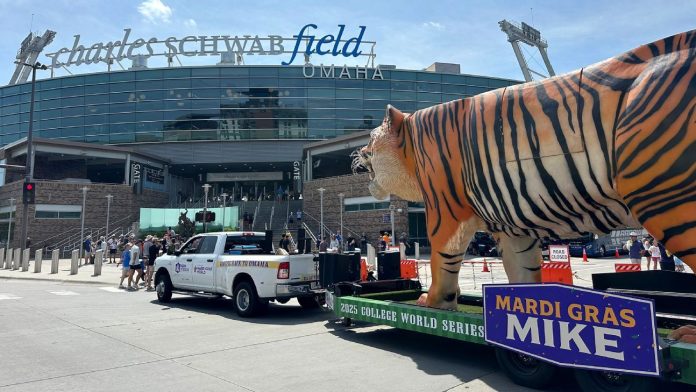
OMAHA, Neb. — Rush hour hits different when you’re towing a 30-foot-long tiger.
There’s no road rage — you’re driving 15 mph — and no rush to get anywhere, just around and around the streets near Charles Schwab Field, home of the Men’s College World Series.
Zane Greene fidgeted with his phone in the passenger seat early Tuesday evening, tapped the screen and started a playlist that blasted over four speakers in the back. “LSU Pregame” was the first song, and Greene’s uncle, Jacob Stone, steered the 15,000-pound fiberglass tiger around traffic. A man in a Jeep sidled up beside them and rolled down his window.
“It sure is an eye-catcher,” he told them.
Mardi Gras Mike, an homage to LSU’s mascot, is a creation of Kern Studios. Fitz Kern, CEO of the company that produces the majority of the floats at Mardi Gras, was inspired to make the float after watching the Tiger Walk before last fall’s LSU-Ole Miss football game. He wanted to create something that LSU fans could rally around.
“We wanted Mardi Gras Mike to channel the spirit of LSU fans,” Kern said, “and the spirit of Louisiana.”
The float was unveiled last week at Alex Box Stadium in Baton Rouge, Louisiana, as fans sent off the MCWS-bound LSU baseball team to Omaha. From there, Mardi Gras Mike went on a 900-plus-mile journey to Omaha that was chronicled on social media. There was a snapshot of Mike at Arrowhead Stadium, home of the Kansas City Chiefs, and a little troll photo of the float parked in Fayetteville, Arkansas, at Arkansas’ football stadium.
The Razorbacks — SEC rivals — were LSU’s first opponent in the MCWS. LSU went on to win that game 4-1. They will again be the Tigers’ opponent on Wednesday (7 p.m. ET, ESPN) in the semifinals of the MCWS. An LSU win would put them in the championship series.
Fitz Kern hoped that his Tigers would survive until this weekend so he could join in on the fun in Omaha. He stayed behind so he could help celebrate his daughter’s third birthday. LSU did its part on Tuesday, beating UCLA 9-5 in a winner’s bracket game. As LSU fans celebrated near the east side of the stadium, Stone stopped the float in the street. For a moment, it was a scene from home — fans dancing and snapping photos with the snarling tiger. Then a police officer working traffic gave him a stern warning to move along.
It was Stone’s first day on the job. The farmer from Leon, Iowa, who sometimes helps Kern Studios during Mardi Gras, got a call on Monday asking if he was available to do some work at the MCWS. Stone and Greene were working out in the field until after 1 o’clock in the morning, but they were up at 6 a.m. Tuesday to drive 2 hours and 40 minutes to Omaha.
They didn’t know they’d be driving Mardi Gras Mike around until Tuesday morning. The drivers they replaced sent them a playlist — mostly LSU fight songs plus Survivor’s “Eye of the Tiger” and Creedence Clearwater Revival’s “Born on the Bayou” — and ran them through the route a couple of times. Then they were off to the airport.
Rain was in the forecast Tuesday in south-Central Iowa, so Stone and Greene had just planned to sit inside watching westerns anyway. Because they spend most of their time feeding their cows and baling hay, neither one of them is interested in college baseball, or sports in general.
They seemed nonplussed by the thousands of people surrounding them who rise and fall over the trajectory of a baseball. By midafternoon, though, Greene was picking up on the lingo and hand signals.
“A lot of people throw up the ‘L,'” he said, “which I would think meant ‘loser.’ But it’s the LSU fans.”
Everywhere they went, people grabbed their phones and took pictures and video. LSU fans screamed, pointed, jumped and nodded, as if they’d seen an old friend. A guy in a fireman’s hat looked as if he was going to jump into the truck.
The only negative feedback Greene and Stone experienced, in the first eight hours of the day at least, were a few thumbs-down from opposing fans.
Around 6 p.m., the float headed south, through the Old Market, and diners sitting on patios raised their glasses and cheered. Then Mardi Gras Mike made another trip to the Embassy Suites, the team hotel for the Tigers, while random people on the street yelled, “Tigers!”
Nearly everyone smiled as the float passed by.
“That’s how Mardi Gras is, too,” Stone said. “Everybody’s just happy.
“How many people get to do this in their life?”
Halsey Stops Concert to Save Person From Fire

Halsey took full control at her recent Pittsburgh performance.
The “Bad at Love” singer stepped in just in time to save a videographer from getting burned by stage pyrotechnics during her June 14 concert.
As they noticed the cameraman coming closer to her as they sang “Without Me,” they mouthed, “Get out of the way,” and waved the videographer to the side of the stage as they knew the fire was set to appear where the videographer was approaching. After the videographer failed to pick up on the cue, the singer jumped up without missing a beat, quickly exclaiming, “There’s pyro coming! Move!” while rushing to shove the videographer off to the side of the stage just before the flames shot up.
Following the scary moment, the 30-year-old—who shares son Ember, 3, with ex Alev Aydin—quickly ran back to the center of the stage with a nervous giggle to continue singing the hit lyrics, “Tell me how it feels, sitting right there…”
Karen Read found not guilty of murdering police officer boyfriend

Kwasi Gyamfi Asiedu
BBC News
Karen Read, a US woman charged with running over her police officer boyfriend and leaving him for dead in a snowbank, has been found not guilty of second-degree murder in a case that gripped true-crime fans nationwide.
The jury also found Ms Read, 44, not guilty of vehicular manslaughter while intoxicated and leaving the scene of the collision in January 2022. But she was convicted of operating a vehicle under the influence of alcohol (OUI).
Her July 2024 trial stemming from the death of Boston police officer John O’Keefe collapsed after the jury was unable to reach a verdict.
She again pleaded not guilty in the retrial, with her lawyers arguing she was being framed for Mr O’Keefe’s death.
 The Patriot Ledger/Reuters
Prosecutors and Ms Read’s attorneys agreed to a one-year probation order for the intoxication charge. It means she will avoid prison time.
As the verdict was read out, a loud cheer could be heard from outside the Massachusetts court, where a large crowd had gathered, many wearing pink to show support for Ms Read. She hugged her defence attorneys and cried.
Ms Read was greeted by loud cheers as she emerged from the building to thank supporters. The crowd chanted “Free Karen Read” and made “I love you” signs in American Sign Language. Some waved US flags and sang God Bless America.
“No-one has fought harder for justice for John O’Keefe than I have,” she said in a brief statement.
Ms Read’s trial has generated intense public interest, spawning a Hulu television show, several podcasts, and an upcoming Netflix documentary.
Her father, William Read, thanked “all the content providers who helped spread the word”.
The O’Keefe family left court still without comment.
But several witnesses in the case said on Wednesday the outcome was “a devastating miscarriage of justice”.
Their statement said they “lament the cruel reality that this prosecution was infected by lies and conspiracy theories spread by Karen Read, her defense team, and some in the media”.
 Getty Images
Aidan “Turtleboy” Kearney, a blogger who has publicised the case, told NBC10 local news that the verdict was “a surreal emotional experience”.
“To finally hear those words: ‘not guilty’, I have been dreaming about this… It was a happy ending.”
Kearney himself faces several charges of witness intimidation, which he denies.
His writing frequently questions the investigation into Mr O’Keefe’s death and he often publicly confronts witnesses about the case.
Ms Read worked as an adjunct professor at Bentley University and an equity analyst at Fidelity Investments.
She and Mr O’Keefe were together for about two years before his 2022 death, but their relationship had become volatile, prosecutors argued.
 Boston Herald via Getty Images
In closing arguments, state prosecutor Hank Brennan told the court Ms Read was drunk-driving when, enraged by their faltering relationship, she backed into Mr O’Keefe at the home of a fellow officer in the Boston area.
He alleged she left him to die during a snowstorm. Mr O’Keefe, who died at the age of 46, had spent 16 years with the Boston Police Department.
Ms Read’s attorneys contended that O’Keefe was instead beaten inside the home, bitten by a dog and dumped in the snow. They argued Ms Read was the victim of an elaborate plot by local police to frame her.
The jury deliberated over four days before Wednesday afternoon’s verdict was delivered.
Court filings show the jury members’ names will not be made public.
How close is Iran to a nuclear bomb?


Iran’s nuclear breakout time has become a key question as President Trump considers whether to bomb the Islamic regime’s key underground nuclear facility.
Israeli Prime Minister Benjamin Netanyahu, in justifying his unprecedented strikes on the regional rival last week, said Iran was “marching very quickly” toward a nuclear weapon.
That seemed to diverge from U.S. assessments — voiced by Director of National Security Tulsi Gabbard in a March congressional hearing — that Iran was not actively building a nuclear weapon.
Trump was clear about where he stood when asked Tuesday about Gabbard’s testimony.
“I don’t care what she said. I think they were very close to having one,” Trump told reporters on Air Force One.
Nuclear watchdogs have had limited ability to monitor Iran’s stockpiles since Trump withdrew from the Obama-era nuclear deal in 2018. For that reason and others, experts say pinning down a specific nuclear timeline is complicated.
“When people give different estimates of Iran’s breakout timeline, I think it’s because they’re talking about different things,” said Heather Williams, a senior fellow at the Center for Strategic and International Studies, pointing to Gabbard’s testimony and Trump’s pushback.
“Tulsi Gabbard said there is no evidence that Iran is weaponizing. That can be a true statement at the same time as Iran is pursuing a nuclear weapons capability,” she said. “If you want to talk about actual weaponization, that is a very specific activity. It involves developing trigger technologies, figuring out how an implosion device works.”
Given its current level of enrichment, experts estimate it would take Iran a week or two to produce the weapons-grade uranium needed for a nuclear weapon and another few months to build a crude weapon.
Then Iran would need to figure out how to deliver the bomb to Israel, more than 1,000 miles away, either fitting it onto a missile, dropping it from a plane, or smuggling it across the border by land.
According to CNN, U.S. officials think Iran is up to three years away from actually launching a nuclear weapon. Andreas Krieg, a lecturer in security studies at King’s College London, put that figure closer to 18 months. He said he was skeptical of Israel’s claims of a rapidly closing window to halt Iran’s nuclear ambitions.
“The assessment of what the Israeli intelligence says, we only have it filtered through the government, and the government obviously has an intention to say ‘they’re very close,’ and hence, this was a preemptive strike rather than an act of aggression,” Krieg said.
“I’m not sure whether the Israeli intelligence service really says this, or if this is the Israeli government abusing or exploiting a narrative,” he added. “No one has seen that report.”
A spokesperson for the Israeli military did not respond to questions about its latest assessments.
Israel has pounded Iranian nuclear facilities in the past week, possibly setting back the country’s nuclear program by a few months. However, experts say eliminating Iran’s near-term nuclear threat requires destroying the Fordow nuclear facility, which is buried in the side of a mountain.
Only the U.S. has the 30,000-pound bombs required to penetrate the thick concrete bunker shielding the nuclear centrifuges underground.
Trump returned early from the Group of Seven summit in Canada and summoned his national security team to the White House on Tuesday as he considers sending U.S. bombers and pilots to join Israel’s war.
Latest assessments
A day before Israel’s strikes, a quarterly report by the International Atomic Energy Agency (IAEA) found that Iran had amassed 400 kilograms of 60 percent enriched uranium, a stockpile that “remains a matter of serious concern,” according to the agency tasked with monitoring Tehran’s nuclear program.
The report was the first time since 2005 that the IAEA board of governors had found Iran in violation of its non-proliferation pledges.
“The first time in 20 years that you find someone to be in breach, it is a big deal and it should be very concerning,” Williams said.
Ninety percent enrichment is considered weapons-grade, and experts have said Iran’s uranium supply is well above what would be needed for civilian use in a nuclear power plant.
The 2015 nuclear deal negotiated by the Obama administration included provisions for Iran to allow the IAEA significant access to its nuclear program, including installing cameras and sensors at nuclear sites.
After Trump pulled out of the deal in 2018, the Iranian government has limited inspections and removed cameras at its sites altogether, though the IAEA has been able to retain some investigatory power and access.
Since at least 2019, the U.S. has assessed that Iran is not actively pursuing a workable nuclear device.
Annual reports from the Office of the Director of National Intelligence typically included the line “Iran is not currently undertaking the key nuclear weapons-development activities necessary to produce a testable nuclear device.”
Last year, American intelligence agencies shifted to say that Iran has “undertaken activities that better position it to produce a nuclear device, if it chooses to do so” but maintained that Iran did not have an active nuclear military program.
Before it launched its attacks last week, Israel told the United States that Iran had renewed research efforts useful for a nuclear weapon, including studying an explosive triggering system, The Wall Street Journal reported.
But U.S. officials weren’t convinced those efforts amounted to a decision by Iran to actually build a weapon.
Different perspectives
David Des Roches, a professor at the Near East South Asia Center for Strategic Studies, said Israeli officials were inclined to be more cautious than their U.S. counterparts when assessing Iran’s nuclear threat.
“The Americans are more capable of looking at the capability and saying, ‘yes, yes, yes, but,’ and then examining intent. I think Israeli strategic culture is fundamentally different,” he said. “Their culture is preventing annihilation while the world stands by, so their calculus is less accepting of risk.”
Gabbard told lawmakers in March that the U.S. had seen a shift in Iranian rhetoric around nuclear weapons.
“In the past year, we’ve seen an erosion of a decades-long taboo in Iran on discussing nuclear weapons in public, likely emboldening nuclear weapons advocates within Iran’s decisionmaking apparatus,” she said.
But she noted Supreme Leader Ayatollah Ali Khamenei had not reauthorized Iran’s nuclear weapons program suspended in 2003, and she said the U.S. still believed Iran was not actively pursuing a nuclear weapon.
Krieg argued that any decision made by Iran to begin sprinting toward a nuclear weapon would be known by Western intelligence agencies.
“Looking at how penetrated Iran is right now, we see that the Mossad [Israel’s spy agency] has been able to operate with impunity across all levels of the regime,” he said. “If any of these decisions had been made, it would have come to all our attention.”
Daily Spotlight: India Anticipated Growth Leader in 2025
Daily Spotlight: India Anticipated Growth Leader in 2025