Chocolate prices in the UK rose at the fastest pace on record in May as the overall cost of food continued to climb, official figures suggest.
The main rate of inflation remained at 3.4% in the year to May.
However, food prices grew for the third month in a row, as some economists speculated that businesses were passing on recent increases in employer National Insurance payments to customers.
The rise, along with a higher minimum wage, came into effect in April, after Chancellor Rachel Reeves announced the increases in last October’s Budget aimed at raising £25bn.
Food prices have risen for three months in a row and, at 4.4% in May, are the highest since February last year.
Ruth Gregory, deputy chief economist at Capital Economics, suggested that the increase “perhaps provides a tentative sign that firms are passing on more of April’s rise in National Insurance Contributions in their selling prices”.
Chocolate in particular has been affected by bad harvests in cocoa-producing regions, as bad weather hit Ghana and Ivory Coast.
Chocolate stocks fell to all-time lows earlier in the year, making the price surge.
In the year to May, chocolate prices rose by 17.7%, according to the ONS. This is the fastest pace since 2016 when the ONS’s records began.
Rising food inflation was partially offset by cheaper travel prices in May.
The Office for National Statistics said that the cost of plane tickets fell compared with a large rise last year “as the timing of Easter and school holidays affected pricing”.
The overall pace of price rises in May was the same as in April, following a revision by the Office for National Statistics (ONS), and means that inflation remains at its highest for more than a year.
Inflation is above the Bank of England’s target rate of 2% but it is not expected to cut interest rates when it meets on Thursday.
Commenting on the inflation rate, Chancellor Rachel Reeves said: “This government is investing in Britain’s renewal to make working people better off.”
But shadow chancellor Mel Stride called the latest inflation figures “deeply worrying for families”.
“Labour’s choices to tax jobs and ramp up borrowing are killing growth and stoking inflation – making everyday essentials more expensive,” he said.
Kris Hamer, director of insight at the British Retail Consortium, which represents the sector, said: “Since October, retailers have warned that the costs from the chancellor’s Budget could not be fully absorbed and would inevitably lead to higher prices for shoppers.”
‘Young families now price-check’
Getty Images
Coffee stand owner Zayna Omer says young families are spending less on food
Zanya Omer, owner of coffee stand Harbour Grind in Whitstable told the BBC that business is “good” but she has noticed consumers’ budget are squeezed.
Customers are not buying as much food from her, opting instead to bring packed lunches when they take a day trip to the Kent seaside town.
“Most people here are retirees, so they have income,” Ms Omer said.
“But the young families, you do notice with them they will price check first or compare prices along the strip, and then come back.”
Ms Omer said hidden costs – such as card machine fees which cost her about 10p extra per coffee sold – have led to her offering cash customers a small discount.
For now, she will keep her prices as they are. “I’d go out of business if I increase my prices,” she said.
Inflation could remain high from potential higher energy costs, as the oil-rich middle East is affected by a recent escalation in violence between Israel and Iran.
“Any major disruption in the Strait of Hormuz could echo the supply chain shock of 2021, with surging oil and shipping costs. Many smaller businesses will have little capacity to absorb these pressures,” said head of research at the British Chambers of Commerce, David Bharier. He added price pressures could be reduced by easing the tax burden on businesses, and reducing trade friction between both the EU and USA”.
sup, sub { font-size: 100% !important; } sup { mso-text-raise:10% } sub { mso-text-raise:-10% }
Welcome to The Hill’s Business & Economy newsletter
{beacon}
Business & Economy
Business & Economy
<!–
The Big Story
Inside the Senate GOP plan to advance Trump’s agenda
The Senate Finance Committee’s portion of President Trump’s “big, beautiful bill” contains some of the thorniest provisions and could set them on a collision course with the House.
The House narrowly passed its version of the legislation last month. Here’s what’s in the Senate’s bill.
2017 tax cuts: The bill makes many of the core elements of their 2017 tax cuts permanent but scales back additional cuts from what the House passed. The Senate bill locks in existing federal tax brackets, boosts the standard deduction and maintains the termination of personal exemptions — all without sunsets. In contrast with the House version, the bill sets a lower increase for the child tax credit, raising it to $2,200 per child as opposed to the House’s $2,500.
Taxes on tips: The bill creates new deductions for taxes on tips, overtime pay and car loan interest — a priority of Trump’s that he campaigned on — but doesn’t make them fully deductible. Tips are deductible up to $25,000 through 2028. Overtime pay is deductible up to $12,500, or $25,000 for joint filers, through 2028. Auto loan interest is deductible up to $10,000, also through 2028.
Medicaid funding: Senate Republicans are taking a bigger swing at Medicaid in their version of the bill. The legislation would effectively cap provider taxes at 3.5 percent by 2031, down from the current 6 percent, but only for the states that expanded Medicaid under the Affordable Care Act.
The cap would be phased in by lowering it 0.5 percent annually, starting in 2027. Nonexpansion states would also be prohibited from imposing new taxes, but as was true in the House-passed version, their rates would be frozen at current levels. The lower cap would not apply to nursing homes or intermediate care facilities.
The House-passed version of President Trump’s tax cut and domestic policy bill would add $3.3 trillion to the national debt, even when accounting for its impact on economic growth, according to an analysis released Tuesday by the Congressional Budget Office (CBO).
The Federal Reserve looks set to maintain its pause on interest rate cuts at its meeting this week amid President Trump’s ongoing trade war and geopolitical tensions that are roiling commodity markets.
A group of plaintiffs suing President Trump over his reciprocal “Liberation Day” tariffs said they asked the Supreme Court to leapfrog a lower court to immediately take up whether the levies are legal.
New estimate finds Trump tax bill adds $3.3T to debt
The House-passed version of President Trump’s tax cut and domestic policy bill would add $3.3 trillion to the national debt, even when accounting for its impact on economic growth, a new analysis by the Congressional Budget Office (CBO) finds.
The new estimate, which factors in how the bill’s policies would affect economic growth, found that the One Big Beautiful Bill Act would add $3.3 trillion to the national debt by the end of 2034.
The national debt, currently north of $36 trillion, would equal 125 percent of gross domestic product (GDP) by 2034.
CBO said the bill would increase GDP by just 0.5 percent over the span of that decade.
CBO Director Phillip Swagel said the bill’s economic effects would increase deficits and interest rates, leading to an on-net increase in the national debt. Trump’s tax cuts, among other measures, would lead to a $3.7 trillion decline in federal revenue over the next ten years.
The new CBO score comes as the House-passed bill faces several obstacles in the Senate, which is already plowing ahead with its own version of Trump’s policy bill. Republican senators have objected to issues including the overall cost of the bill, cuts to Medicaid and other health programs and tax provisions.
California Gov. Gavin Newsom (D) got a frosty reception at a federal appeals court Tuesday afternoon as it scrutinized a lower judge’s ruling blocking President Trump’s federalization of the National Guard in Los Angeles. The three-judge panel on the U.S. Court of Appeals for the 9th Circuit … Read more
The U.S. military is positioning itself to potentially join Israel’s assault on Iran, as President Trump weighs direct action against Tehran to deal a permanent blow to its nuclear program. Read more
Pope Leo XIV is making the threat of AI to humanity a key issue of his legacy, challenging the technology industry that has spent years courting the Vatican.
The new American pope’s namesake, Leo XIII, stood up for the rights of factory workers during the Gilded Age, a period from the late 1870s to the late 1890s of swift economic change and extreme wealth inequality led by corrupt industrial robber barons.
Speaking to a hall of cardinals last month, the pope said he would rely on 2,000 years of church social teaching to “respond to another industrial revolution and to innovations in the field of artificial intelligence that pose challenges to human dignity, justice, and labor,” reports The Wall Street Journal.
In attempts to shape Rome’s dialogue on AI and, by association, influence governments and policymakers, leaders of Google, Microsoft, Cisco, and other tech giants have flown to the Vatican to preach the good word of emerging technologies.
The Vatican has pushed for a binding international treaty on AI, something most tech CEOs would say threatens to stifle innovation.
Ryan O’Hanlon is a staff writer for ESPN.com. He’s also the author of “Net Gains: Inside the Beautiful Game’s Analytics Revolution.”
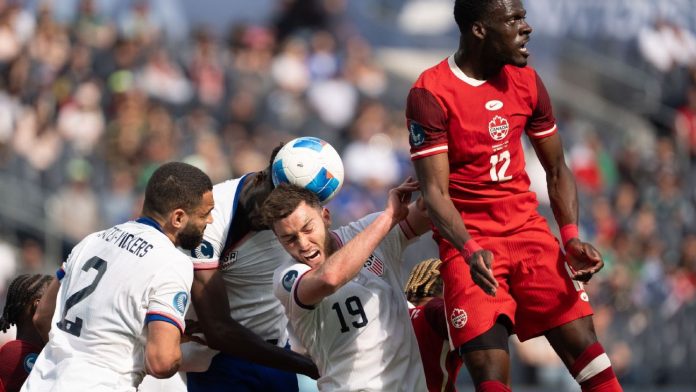
Are you or a loved one “getting Concacafed?”
Are you experiencing symptoms of a referee giving you a yellow card for getting punched by another player? Have you felt confusion upon watching another man somersault across the grass in anguish after you shook his hand to congratulate him on a nice play? Ever seen a group of ball boys shrug their shoulders and sit, immobile, after a goalkeeper literally punted the ball into the Atlantic Ocean? Want to scream because you just lost a game on a field of knee-high grass against a team of players who spent most of the past week on a commercial fishing boat?
If you’ve followed North American soccer for long enough, you’re familiar with the term. Heck, ESPN contributor Jon Arnold writes an entire newsletter about it every week; it’s called Getting CONCACAFed.
Arnold’s newsletter celebrates the conundrum that is Concacaf — a region that features two of the richest federations in all of the sport, the United States and Mexico; another one that mostly plays hockey, Canada; and then a bunch of other soccer-loving nations with varying (low) levels of resources and degrees of professionalism. Just a few years ago, the 60-year-old president of Surinameforced himself into a Concacaf league match. This is the same federation within which Lionel Messi plays his club ball and the likes of Christian Pulisic and Alphonso Davies represent their countries. It all exists together, and it’s beautiful.
At its worst, though, the fans who talk about getting Concacafed are fans of the richest country in the region, and they’re complaining about the “uncultured methods” of their poorer regional brethren. God forbid the underdogs try to find ways to even the playing field.
But what actually happens in Concacaf, from minute one through 90? It’s a question with competitive consequences in the Gold Cup, which begins Saturday, for the U.S. men’s national team, Mexico and Canada — all of whom also hope to make it deep into next summer’s World Cup.
How different is the sport played here, compared with over there? Let’s look into the numbers.
Physicality
We’ll start with the place where it seems Concacaf is most different from everywhere else: its apparent tolerance for violence.
In the rest of this piece, we’ll be comparing the Gold Cup with the Copa América, the Euros and the Premier League. Because there aren’t many games in any one international tournament, we’re using data from the past two Gold Cups, Copas América and Euros. And then we’re using only this past season of Premier League data, since there are way more games. This should give us a sense of how Concacaf stacks up against the two best regions for international soccer and then the gold standard for club soccer.
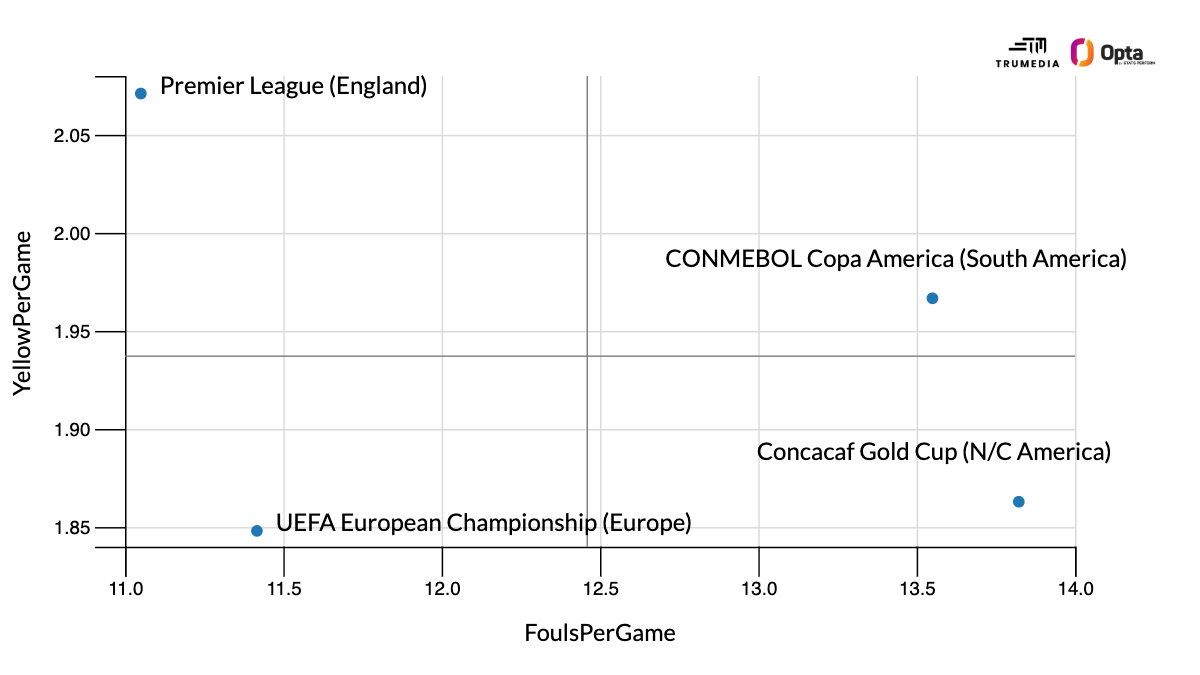
Here’s a graph that plots the number of yellow cards per game and the number of fouls per game for the average team:
Though the Gold Cup averages more fouls per game than any of the three other competitions, it also averages the second-fewest yellow cards — just barely more (1.86 per game to 1.85) than at the Euros.
The way I’d interpret this data: The Concacaf referees allow a lot more physicality than refs do in any of the other tournaments. Though the Copa América has a reputation for being one big rock fight, there aren’t as many fouls as in North America, and the referees are way quicker on the draw with their yellow and red cards.
Passing
One of the themes here is that, stylistically, South American soccer has a lot more in common with North American soccer than it does with European soccer. Part of the reason for the similar data is that a few Concacaf teams played in last summer’s Copa América, but that’s not enough to skew the numbers much.
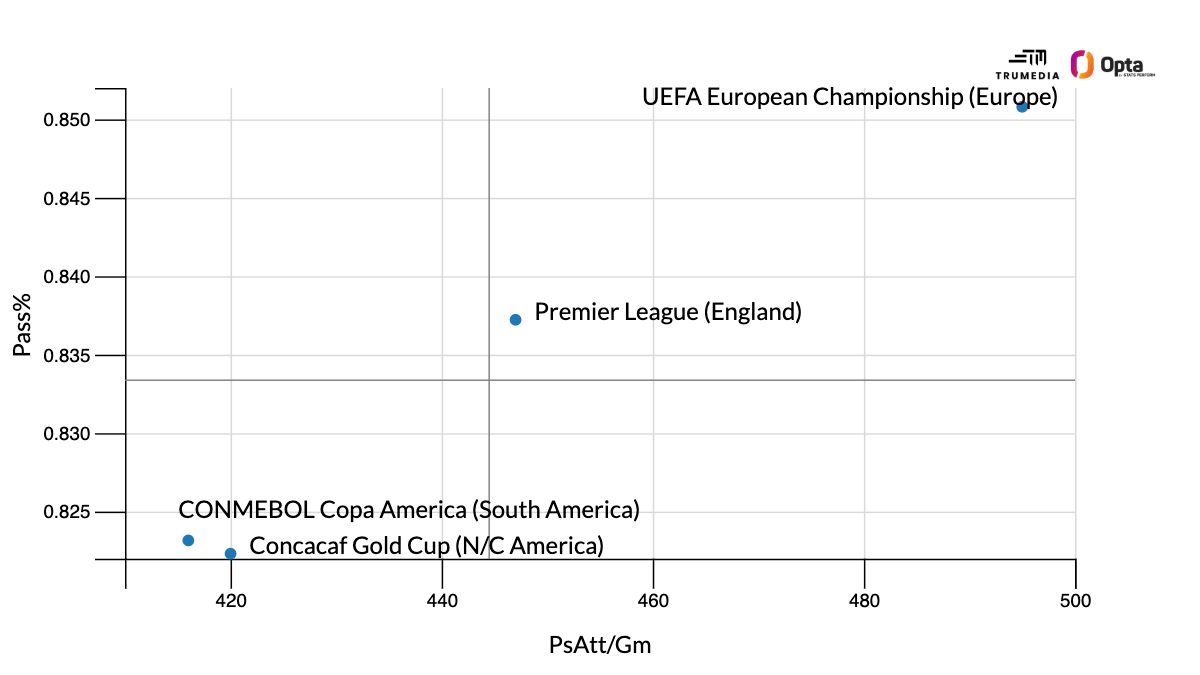
Now, take a look at our next graph:
Why are the Euros all the way in the upper right corner? The possession game is more prevalent in Europe, but in the Premier League, teams are coming up against much more athletic players and much more aggressive pressing systems than in the Euros. So, in the Euros, it’s not that these teams are better at passing than Premier League clubs; it’s just a lot easier to pass. Plus, both Euros in the dataset came at the end of long seasons, so teams tended to sit on the ball longer once they won possession.
However, the average Gold Cup team attempts around 420 passes per game and completes 82% of them. Those are, nearly exactly, the same numbers that relegated Leicester City put up in the most recent Premier League season.
Although the passing numbers are quite similar, the major area where Concacaf and CONMEBOL differ is in how often dribbles are attempted. Copa America teams attempt 21.2 take-ons per game — the most of the four competitions we’re looking at — while Gold Cup squads try to beat their opponents on the dribble 17.7 times per game, second fewest in our dataset.
Aggression
This is where Concacaf sits on its own — but not for the reasons you might think.
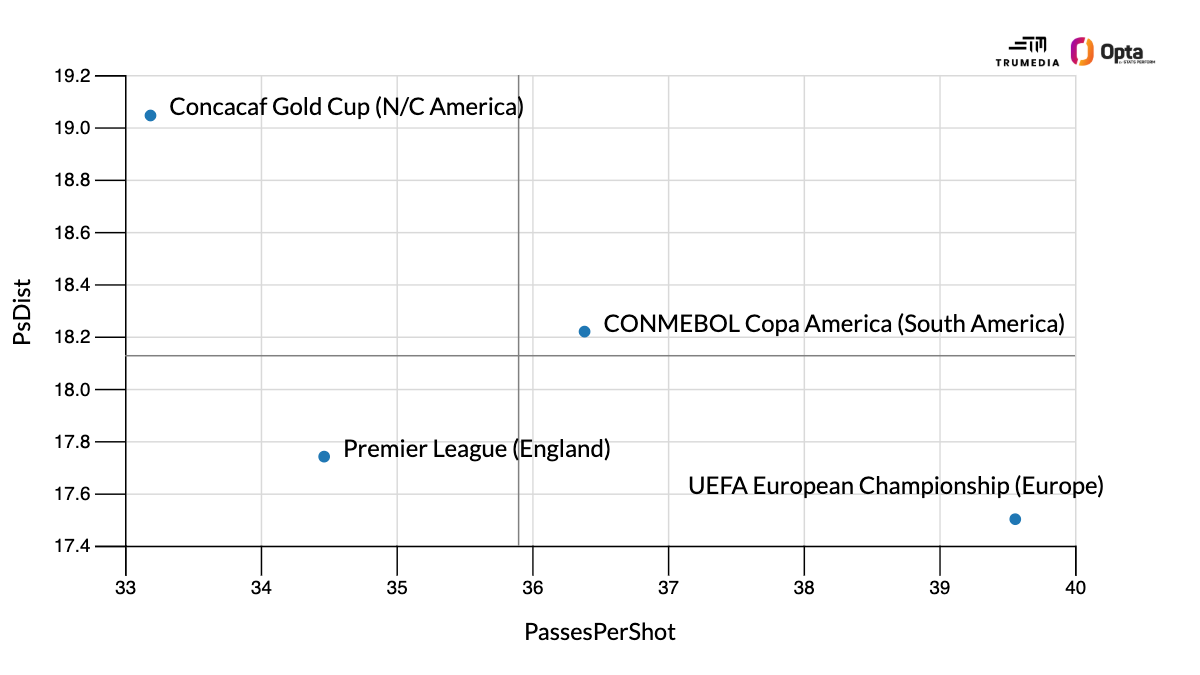
When I say “aggression” here, I don’t mean, “How much do you try to injure your opponents?” Instead, I mean: “How aggressively are teams trying to move the ball forward?” There are two ways to determine that: How far do they pass the ball, and how many passes do they make before they attempt a shot?
Behold, the answer!
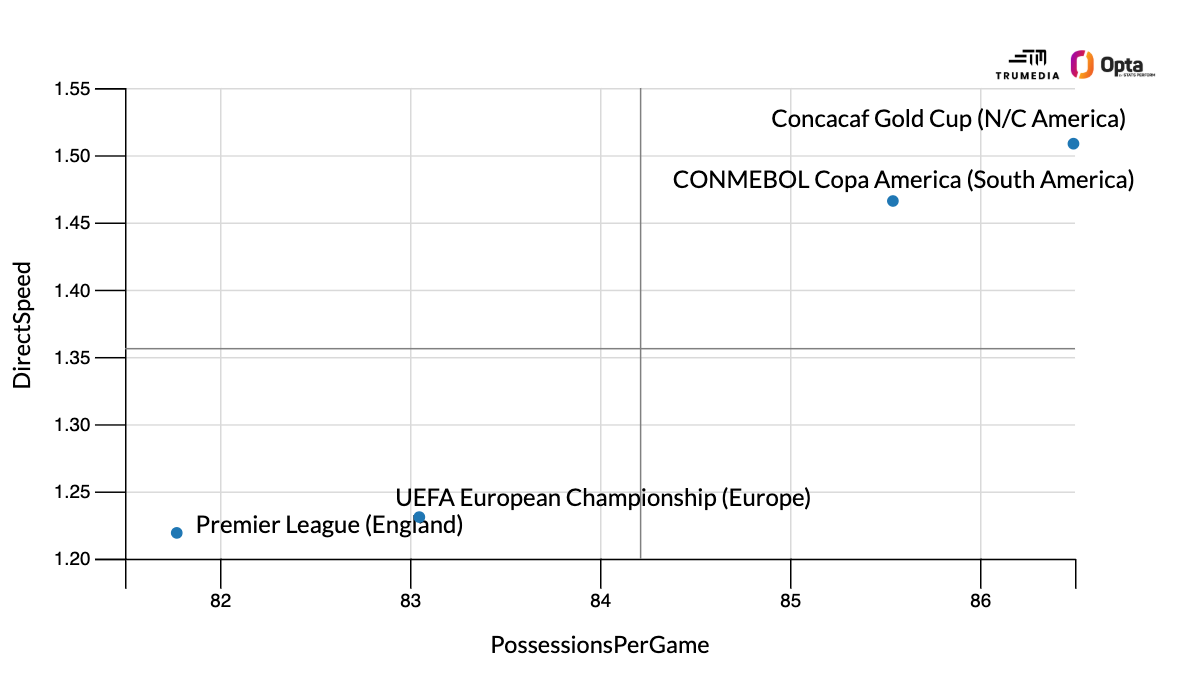
The longer passing and trigger-happy approach also leads to more moments of transition. In Concacaf, the ball changes hands more frequently (the number of possessions per game) and moves up the field more quickly than in the other competitions:
Those possession and speed numbers are almost exactly what Andoni Iraola’s Bournemouth averaged this past season. Tyler Adams was born to play in this tournament — and yet, he never has. Depending on how serious his foot injury is, it’s possible he never will.
Shooting
All right, so we now know that there are lots of fouls and very few cards at the Gold Cup. We know there aren’t many passes attempted, and there are even fewer completed. There’s not much dribbling, either. But there’s lots of long, aggressive passes, plenty of turnovers and a bunch of shots. Broadly, this is what Gold Cup games look like.
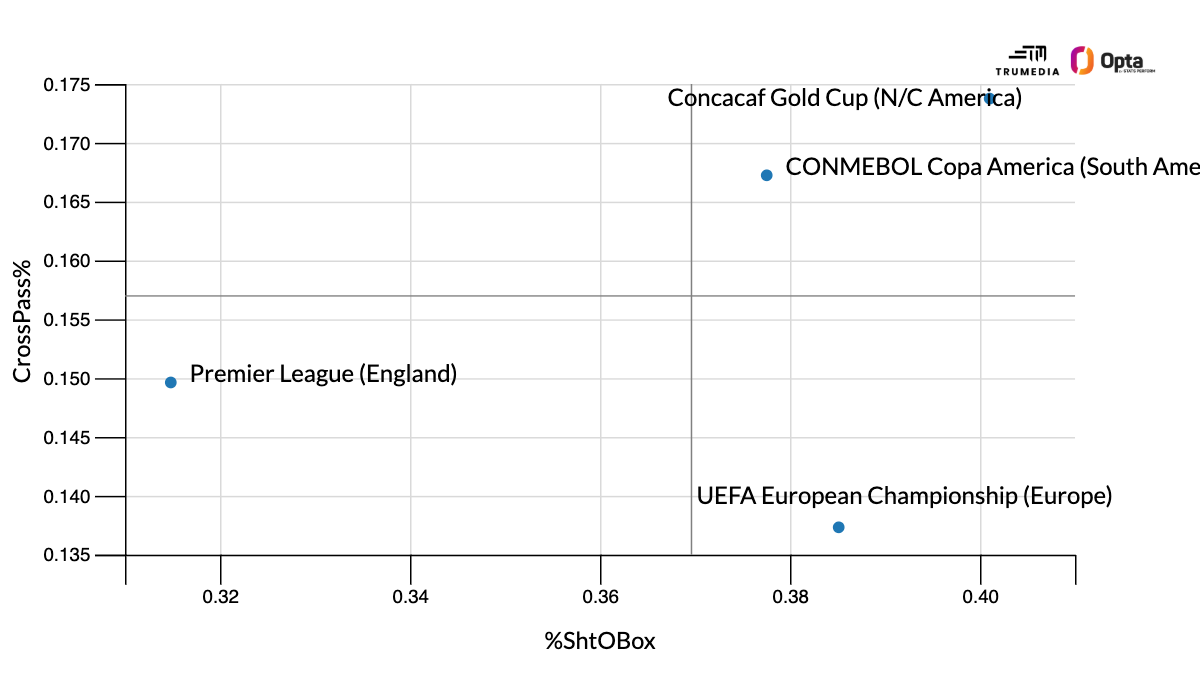
What about the shots themselves? We know how teams are getting the ball forward, what midfield play tends to look like, and how frequently shots are being attempted. But what kind of shots are these?
If there are two basic tactical takeaways from soccer’s still-fledgling analytics movement, they are: (1) stop shooting from outside the box and (2) stop crossing so much. Now, this isn’t to say you should never cross, but most crosses don’t lead to shots; they lead to turnovers that leave your defense scrambling. And even when crosses lead to shots, those shots tend to be with your head, and headers are way less likely to turn into goals than shots with your feet.
As for point one, well, yeah, duh. The hallmark of every analytical revolution in sports was something obvious: For baseball players, getting on base is good, no matter how you do it; passing a football is easier than running; 3-point shots are worth more than 2-pointers; shots from close to the goal are more likely to go in.
Well, as of yet, it doesn’t appear as if anyone has told anyone in Concacaf any of these things.
But in the Gold Cup, goals saved is right around expectation. The same kind of talent-level disparity doesn’t exist in any kind of consistent way for keepers.
And then there’s pressure on the ball. Perhaps because defenders in the other regions are more talented, or their tactics are more fine-tuned, or because possession play isn’t so hectic, the Gold Cup averages the fewest shots under what Stats Perform defines as high pressure, but the most shots under either moderate or low pressure. Defensive pressure, or even the possibility of defensive pressure, has a large effect on shot conversion — and there’s just not as much of it in the Gold Cup, so we get more goals.
So what does it all mean?
I’ve written before about how the wide-open style of play in the German Bundesliga just isn’t preparing Bayern Munich for the Champions League. Most teams in Germany aren’t employing typical underdog strategies, so Bayern don’t have to figure out how to break down low blocks. But they’re also way more talented than everyone else in the league thanks to their massive resource advantage, so they’re not playing games where they can’t just expect to dominate the ball.
Then, in Europe, they play teams that challenge their claim to possession or fine-tune their own counterattacking strategies — neither of which Bayern get any practice with at home.
There’s probably some similar kind of translatability problem for the likes of the U.S., Mexico and even Canada. The soccer you see in Concacaf is just significantly different from what you’ll see when you play in the World Cup, a tournament that theoretically gathers most of the best teams in the world. Plus, Concacaf is quite different from what all of the USMNT’s best players experience on a week in, week out basis for their club teams in Europe these days.
The flipside of this is that the friendlies against European clubs better mirror the tactical environment the U.S. will be facing at the World Cup — especially the first halves, when teams tend to be less experimental and at least enter the match with a cohesive lineup and some kind of plan. But, uh, yeah: Mauricio Pochettino’s team has been outshot 17 to 4 — to the tune of 0.14 expected goals for and 3.2 xG against; one goal for, six against — across the two first halves of the recent Turkiye and Switzerland matches. This team is getting UEFAed, too.
Such is the nature of international soccer, then, that the sport the U.S. plays at the Gold Cup this summer will have only a vague connection to the sport it’s going to play next summer. Also, the players playing this summer will only vaguely resemble the players who are playing next summer.
Given the recent performances, the latter is a positive. As for the former? It means we’re unlikely to learn a whole lot from the Gold Cup about the team’s chances at the World Cup. Given the trending direction of recent results, that’s probably a good thing, too.
We included these products from Paige DeSorbo because we think you’ll like her picks. Paige is a paid spokesperson for the Amazon Influencer Program. Our writers and editors independently determine what we cover and recommend. When you buy through our links, E! may earn a commission. Some brands featured in this article are partners of Amazon’s Creator Connections program, which means E! may make an increased commission on your purchase if you buy something through our links.Learn more.
Where in the world is Paige DeSorbo? Packing with her fans for a summer vacation in Italy. Her recent “Pack with Me for Italy” Amazon Live had the cutest European summer fashion picks that are super affordable.
Whether you want to know what sandals Paige would pack for a Euro summer, or how she styles on-trend capri pants, she breaks it all down in her Amazon Live.
From fun matching sets to the best body butter, you can shop Paige’s favorites on Amazon ahead. Check out some highlights from her Live below, plus hear more about why Paige loves each piece and how she would style it.
Northamptonshire Police said it had failed Harry Dunn’s family “on a number of fronts”
An American diplomat who was driving on the wrong side of the road when she caused a fatal car crash “could and should have been arrested”, a review has concluded.
Motorcyclist Harry Dunn, 19, died in 2019 after being hit by a car driven by Anne Sacoolas, who weeks later left the UK under diplomatic immunity laws.
An independent report has criticised Northamptonshire Police’s handling of the investigation, with Mr Dunn’s family saying they had been “failed by the very people we should have been able to trust”.
Northamptonshire Police has apologised, saying it failed “to do the very best for the victim”.
Mr Dunn died as a result of injuries suffered when his Kawasaki motorcycle was hit by Sacoolas’s car outside RAF Croughton in Northamptonshire on 27 August 2019.
The 118-page report, commissioned by Chief Constable Ivan Balhatchet and written by Karl Whiffen, a former senior officer from the East Midlands Special Operations Unit, examined the force’s handling of the case and made 38 separate recommendations.
The review found that Sacoolas was not arrested at the scene because she was deemed to be in a state of shock and that it was not deemed necessary at the time.
“A prompt and effective investigation was not considered or articulated,” the report said.
“The view is that in these circumstances the suspect could and should have been arrested to assist the evidence gathering process.”
After leaving the country she pleaded guilty to causing death by careless driving via video link at the Old Bailey in December 2022, and was handed an eight-month prison sentence, suspended for 12 months.
Mr Dunn was not under the influence of any substance at the time of the collision, but the report found that he was subjected to drug testing, while Sacoolas was not.
Aaron Chown/PA Images
Harry Dunn’s mother Charlotte Charles said Northamptonshire Police “mishandled vital evidence, including Harry’s clothing, which we now know was left in storage for years with his remains still on it”
A witness overheard Sacoolas say “it’s all my fault, I was on the wrong side of the road”, according to the report.
None of the officers at the scene managed to gather footage from their body worn video – one tried but failed after their camera indicated either low battery or no memory available.
The report is also heavily critical of Northamptonshire Police’s former chief constable, Nick Adderley.
He made “erroneous statements” about Sacoolas’s immunity status in media interviews and his criticism of the Dunn family spokesman, Radd Seiger, during a news conference was also singled out for criticism.
Mr Adderley was subsequently sacked for gross misconduct in 2024 for lying about his career in the Royal Navy.
The BBC has attempted to contact him but has so far not received a response.
PA Media
Disgraced former Northamptonshire Chief Constable Nick Adderley was singled out for criticism in the report
There was also a delay in telling the family the US State Department employee had fled the country under diplomatic cover.
This was at the request of the Foreign, Commonwealth & Development Office (FCDO), the report said.
The FCDO, which the report author said did not co-operate with the inquiry, subsequently appeared to seek to distance itself from the impact of that decision, it added.
The FCDO said: “The Foreign Secretary has met with members of Harry Dunn’s family.”
“He has the deepest respect for the resolve they have shown since Harry’s tragic death and remains personally committed to ensuring lessons are learned from the handling of the case under the previous Government” a spokesman added.
‘Left to die’
Responding to the report, Harry’s mother Charlotte Charles told BBC Radio 4’s Today show: “Having had 48 hours now to reflect, my anger is as high as it probably was in the beginning.
“To learn that they [police] prioritised Anne Sacoolas’s welfare over my boy, that was dying in that ditch, I’m just bewildered.
“I’m absolutely bewildered that the most fundamental of policing was not carried out. I’m struggling to get my head around that.”
The report added that her son’s clothing had been bundled together in a single bag along with the other crash debris.
“These are failures no family should ever have to endure,” Ms Charles told the BBC.
“I remain so angry at Adderley to this day. We knew from the outset that there was a problem with him and we will never forgive him for launching his personal attacks on our neighbour and spokesperson, Radd Seiger.”
But she singled out the officer in charge of the case, who has not been named, for showing “genuine care and commitment when others above her fell short”.
She added that she appreciated the “candid and transparent approach to this report,” and would make sure the 38 recommendations were “absolutely carried out and seen through, so that nobody gets treated the way my boy and our family did”.
Family spokesperson, Mr Seiger said it was “astonishing” how police got a “relatively straightforward road traffic collision… wrong right from the start”.
“We don’t really blame the junior officers, but the report is very critical of the leadership,” he said.
“They should have arrested her; had they arrested her, the course of justice might have been different. We’ll never know now.
“The police are such a fundamental public body in our society, and we trust them. Six years ago, things could not have been handled any worse.”
‘Significant shortcomings’
Assistant Chief Constable Emma James said: “First and foremost, on behalf of Northamptonshire Police, I want to apologise to Harry’s family for what is now clear was a failure on our part to do the very best for the victim in this case.
“It was vitally important that Northamptonshire Police conducted this review into the most high profile case in the force’s history, a case where clear and significant shortcomings have now been properly and independently unearthed.
“The picture which emerges is one of a force which has failed the family on a number of fronts, and we hope the findings, which are troubling in several respects, will provide some answers to questions which the family will have wanted to know in the years that have passed.”
She said she had met with Mr Dunn’s mother and his father, Tim Dunn, in private on Monday to present the report’s findings.
The BBC has tried to contact Sacoolas.
Get our flagship newsletter with all the headlines you need to start the day. Sign up here.
Rep. Ilhan Omar (D-Minn.) criticized the Trump administration’s use of the military, saying the U.S. is turning into “one of the worst countries.”
In an interview late last week, Omar noted the deployment of U.S. troops to quell protests in Los Angeles took place in the same week that the administration held the military parade, which celebrated 250 years of the U.S. Army’s existence, and which happened to fall on President Trump’s birthday and Flag Day.
“Can you imagine that image that is going to be coming out of our country? I mean, I grew up in a dictatorship, and I don’t even remember ever witnessing anything like that,” Omar said, referring to her early childhood in Somalia.
“To have a democracy, a beacon of hope for the world, to now be turned into one of the, you know, one of the worst countries, where the military are in our streets without any regard for people’s constitutional rights, while our president’s spending millions of dollars propping himself up like a failed dictator with a military parade — it is really shocking,” she continued.
Omar said that image should inspire Americans to speak out publicly.
“It should be a wake-up call for all Americans to say, ‘This is not the country we were born in. It’s not the country we believe in. This is not the country our Founding Fathers imagined, and this is not the country that is supported by our Constitution, our ideals, our values.'”
“And we should all collectively be out in the streets, rejecting what is taking place this week,” she added.
Amazon CEO Andy Jassy says advancements in AI will “reduce” the company’s corporate headcount over the next few years. In a memo to employees on Tuesday, Jassy writes that Amazon expects the change due to “efficiency gains from using AI extensively across the company,” without specifying how many employees would be affected.
“As we roll out more Generative AI and agents, it should change the way our work is done,” Jassy says. “We will need fewer people doing some of the jobs that are being done today, and more people doing other types of jobs.”
He notes that workers should also “be curious about AI” and how to use it to “get more done with scrappier teams:
Those who embrace this change, become conversant in AI, help us build and improve our AI capabilities internally and deliver for customers, will be well-positioned to have high impact and help us reinvent the company.
Other companies have shared statements about how they expect AI to impact their workforce as well. In April, Shopify CEO Tobi Lütke told employees asking for more headcount or resources that they should explain why they “cannot get what they want done using AI.” Duolingo CEO Luis von Ahn also stated that the company plans on replacing contract workers with AI as part of a new “AI-first” approach.



 Getty Images
 Getty Images




 Paraguay or