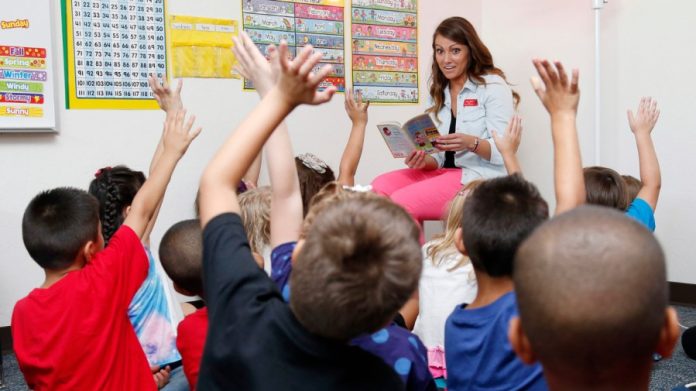
In January 2024, Ann Arbor Public Schools became the first public school district in the country to pass a resolution calling for a cease-fire in Gaza.
Regardless of one’s stance on the conflict, the resolution marked a troubling shift: A public K-12 school district was taking an official position on a deeply divisive geopolitical issue.
As a parent advocate in Ann Arbor concerned about my children’s schools providing an inclusive and high quality education, I was struck not only by the content of the resolution but by the precedent it set — one that risks politicizing our classrooms and alienating families.
What we have seen in K-12 education in the last several years mirrors the ideological shifts on college campuses, in which institutions of higher learning promote specific politicized viewpoints to both the student body and the outside world.
To counter the growing trend of universities taking official positions on a wide variety of divisive social and political issues particularly after Oct. 7, 2023, a number of leading universities, including the University of Michigan, Northwestern University and the University of Pennsylvania finally embraced the principle of institutional neutrality first articulated in the 1967 Kalven Report at the University of Chicago.
These institutions now recognize that taking official stances on controversial political or social issues undermines academic freedom and chills open inquiry. Instead, they have now committed to remaining neutral with the goal of improving their ability to allow diverse viewpoints to flourish.
In the K-12 context, neutrality is even more essential. K-12 students are still forming their understanding of the world.
When a school district, administrator or teacher takes a political stance, it risks pushing impressionable young minds to conform, stifling freedom of thought and marginalizing dissenting voices.
The San Francisco District agrees: “When at work, [district] employees hold a unique position of influence of students in their care, and this influence is a privilege.”
When teachers take political positions, it can undermine the ability of students to develop critical thinking skills, distract from building core educational skills and lead to declines in academic outcomes.
As my colleague David Bernstein explained, “When U.S. K-12 schools invest valuable time and resources into politicizing the classroom … actual educational outcomes suffer.”
Not only is neutrality a wise academic practice, it is also legally sound. Public schools, as government institutions, are entitled to limit educators’ speech in the classroom to serve the greater good of academic focus.
As the National Education Association, the largest teachers union in the country, rightly points out, “When the government is a public school or university, it has broad authority to limit educators’ speech on the job as well as to limit speech off the job that directly impacts the workplace.”
And unlike universities, where students are there by choice, K-12 schoolchildren are there by law.
As the Supreme Court recently explained in Mahmoud v. Taylor, the majority of K-12 children attend public, government-run schools “either by choice or necessity.” And, as public institutions, these schools must not take sides.
Just as our constitutional principles resist religious indoctrination in schools, so too should we resist ideological indoctrination.
A K-12 school system that adopts institutional neutrality empowers parents to advocate for policies that keep schools focused on education, not activism.
This is not about silencing discussion. On the contrary, neutrality creates the conditions for genuine dialogue by ensuring that no single viewpoint is institutionally endorsed. It affirms that schools exist to educate, not indoctrinate.
Across the country, in places like San Francisco and Chicago, parents and school leaders are waking up to the dangers of politicized classrooms.They know we must continue demanding schools return to their core mission: educating, not indoctrinating.
By organizing around shared values of freedom, opportunity, inclusion and unity, we can restore trust in public education and ensure that every child is taught how to think, not what to think.
Institutional neutrality isn’t just a policy, it’s a promise to our children that their schools will be inclusive places of learning, not battlegrounds of ideology. The future of our democracy depends on it.
Sharon Ceresnie Sorkin is the director of Community Engagement at North American Values Institute.
It’s September, and many among us are dealing with back to school, and anticipating the colder weather that’s on its way (at least, if you live in the northern climes). This, plus a somewhat fraught political atmosphere, means that you might be looking for reliable, affordable ways to escape the doldrums.
You don’t need us to tell you that a way to do that is by watching some movies and TV shows. Through September 18th, Paramount is offering a doozy of a deal on both tiers of its Plus streaming service. You can save 50 percent on an annual subscription to Paramount Plus Essential, or its mostly ad-free Premium plan. The Essential Plan is down to $29.99 (from $59.99) and a Premium plan goes to $59.99 (from $119.99). The neat thing is that you can take advantage of this whether you’re a new or a returning subscriber (but be careful to mark your calendar; it will renew after that year at full price).
It’s a tempting deal, whether you go for the ad-supported Essential or the skip-the-ads Premium. The latter also lets you download your shows, which could be very handy when you’re traveling with kids, and from its library of Showtime Originals. Either way, you not only get recent shows like Tales of the Teenage Mutant Ninja Turtles, the entire Yellowstone catalog, Top Gun: Maverick, Star Trek: Strange New Worlds, and Bob Marley: One Love, but animation series like South Park and SpongeBobSquarepants, and live NFL games. Also, it hosts every Mission Impossible movie, aside from the latest one, The Final Reckoning.
We are all familiar with the cliche “be careful what you wish for.” Of course, cliches become cliches because, more often than not, they are proven true or serve as indicators of regularly repeating patterns.
Of late, there is growing speculation that President Trump and the Republican Party would “love it” if far-left, socialist, anti-Zionist Zohran Mamdani were elected mayor of New York City in November. This is true for some Republicans, for sure. For Trump, I doubt it.
In an article this week on this site titled “Trump tied in knots by Mamdani questions in New York,” the question arose: How best for Trump and the GOP to handle Mamdani should he win? The consensus seems to be that if Mamdani wins, Trump would then want to pound him nonstop over the next year as an “out-of-touch socialist” who personifies the failing policies Democrats seek to inflict upon the nation.
Ultimately, I don’t see Trump taking that route. It would add oxygen to a growing far-left populist narrative that not only pushes “free is for me” but that the wealthy are to blame for the plight of the poor and disenfranchised and therefore must be taxed at the highest rate possible as punishment for their “sins against the people.”
Political history shows us time and again that “free is for me” and “the wealthy are responsible for what ails you” has always worked to some degree with certain constituencies. Not only does Trump know that, but he understands that the far-left populist Mamdani is getting better with his messaging and will be aided if the president and the GOP make him the face of the left. It is much better, then, to attack his failed policies rather than elevate him to mythical status.
To this point, while I have long been a fan of former White House Press Secretary Kayleigh McEnany, I take issue with something she recently said on Fox News. Speculating about the possible election of Mamdani, McEnany said, “For the sake of New York City, you absolutely do not want this to happen. But for the Republican Party, what a foil this would be.”
Again, for me, this comes down to “be careful what you wish for.” If one were writing a strategy paper for Republicans, an obvious tactic would be to vilify Mamdani while making him the face of the Democratic Party going forward. But such a strategy would overlook or underestimate two critically important realities.
The first is that much of the mainstream media is still in the tank for the Democrats. That acknowledged, current events this week demonstrated why one party controlling most of the national narrative is never a good idea. The latest example is the disgusting and ghoulish comments by some in the liberal media associated with the assassination of Turning Point USA CEO Charlie Kirk. Next is the “nothing to see here” way the media has largely ignored the shocking videotaped murder of a young female Ukrainian refugee in Charlotte, N.C.
The left never pays the full price for its errors because it has a vise-like grip on most major media. As I write this, the narrative from the left’s noise machine is once again turning back against Trump and the Republican Party.
None of this should come as a surprise to anyone who follows power and politics. As I have stressed in the past, over the last five decades, the left has taken majority control over what I call the “five megaphones of our nation” — the media, academia, entertainment, science and medicine.
Republicans need to understand that come 2026 and 2028, that will still be the case. If they don’t get it, I can assure them that Mamdani, his team and the Democrats do and have that reality baked into every strategy.
The next potentially growing attraction of the “Mamdani effect” is that historically many poor, working-class or disenfranchised people will vote for the candidate promising a “chicken in every pot” while simultaneously ignoring his or her failed policies in order to blame the “wealthy.” Making Mamdani the foil and the face of the Democrats risks awakening millions of struggling Americans to the “free is for me” grift.
At the moment, a number of powerful voices in the Democratic Party are still tiptoeing around Mamdani and his socialist message. However, if he not only wins in a big way in November, but there is evidence that his socialist policies would travel quite well out of New York City, those leaders — purely for self-serving reasons — would begin to embrace Mamdani and his movement.
The Republican Party may be “thrilled” to have Mamdani as a foil. But don’t forget, “Be careful what you wish for” became a cliche for a reason.
Douglas MacKinnon is a former White House and Pentagon official.
For years, that tagline of Charlie Kirk and his group, Turning Point USA, enraged many on the left. In “an age of rage,” nothing is more triggering for the perpetually angry than an invitation to debate issues.
Indeed, someone has now killed him for it.
What is most chilling about the assassination is that it was not in the slightest degree surprising. This follows two attempted assassinations of President Trump and the killing of a pair of Minnesota politicians.
I heard of the assassination in Prague as I prepared to speak about the age of rage and the growing attacks on free speech. I was profoundly saddened by the news. I knew Charlie and respected his effort to challenge the orthodoxy on college campuses. We all have received regular death threats (and Charlie more than most), but there is still a hope that even the most deranged will leave these threats at the ideation rather than the action stage.
This killer left Charlie’s wife, Erika, and her two young children as the latest victims of senseless violence against someone who refused to be silenced.
We do not have to know much about the shooter to recognize the rage. The person who killed Charlie did not view him as a father or even as a person. That is the transformative, enabling effect of rage.
In my book, “The Indispensable Right: Free Speech in an Age of Rage,”I write about rage and the uncomfortable truth for many engaging in rage rhetoric: “What few today want to admit is that they like it. They like the freedom that it affords, the ability to hate and harass without a sense of responsibility. It is evident all around us as people engage in language and conduct that they repudiate in others. We have become a nation of rage addicts, flailing against anyone or anything that stands in opposition to our own truths. Like all addictions, there is not only a dependency on rage but an intolerance for opposing views. … Indeed, to voice free speech principles in a time of rage is to invite the rage of the mob.”
Charlie was brave, and he was brash. He refused to yield to the threats while encouraging others to speak out on our campuses.
He was particularly hated for holding a mirror to the face of higher education, exposing the hate and hypocrisy on our campuses. For decades, faculty have purged their ranks of conservatives and libertarians. Faced with the intolerance of most schools, polls show that a large percentage of students hide their values to avoid retaliation from faculty or their fellow students.
Charlie chose to change all that. TPUSA challenges people to engage and debate them. The response from some on the left has been to trash their tables and threaten the students. Recently, at UC Davis, police stood by and watched as a TPUSA tent was torn apart.
Charlie is only the latest such victim, and he is unlikely to be the last.
For months, some of us have warned about the rise in rage rhetoric. Some believe that they can ride a wave of rage back into power. House Minority Leader Hakeem Jeffries (D., N.Y.) has called for people to take to the streets to save democracy and posted a picture of himself brandishing a baseball bat.
Likewise, California Governor Gavin Newsom (D) declared, “I’m going to punch these sons of bitches in the mouth.”
Various radical groups welcome such rage rhetoric, particularly Antifa. The most violent anti-free speech group in the U.S., Antifa has long attacked journalists and others with opposing views. In his “Antifa: The Anti-Fascist Handbook,”Professor Mark Bray noted that “most Americans in Antifa have been anarchists or antiauthoritarian communists. … From that standpoint, ‘free speech’ as such is merely a bourgeois fantasy unworthy of consideration.”
Alleged shooter Tyler Robinson, 22, reportedly left telltale Antifa markings on evidence, including marking bullets inscribed with the lyrics: “Bella Ciao, Bella Ciao, Bella Ciao, Ciao, Ciao”(from an Italian anti-fascist anthem) and “Hey, fascist! Catch!”
I previously testified in Congress about the dangers of Antifa, and I discuss the group in my book. Despite such warnings, Democratic leaders have dismissed those dangers or actually embraced Antifa.
Former Democratic National Committee deputy chair Keith Ellison (D), now Minnesota’s attorney general, previously celebrated how Antifa would “strike fear in the heart” of Trump. Liberal sites sell Antifa items to celebrate the violent group, including onesies for “Antifa babies.”
Some politicians have privately expressed alarm at the rising violent speech in their ranks. One Democratic member told Axios, “Some of [our supporters] have suggested … what we really need to do is be willing to get shot.”
Just before he was shot at Utah Valley University, Kirk rallied the group with its signature chant of “prove me wrong.” Someone responded by killing him.
Of course, the murder proved nothing except that senseless hate is sweeping over our country. Someone preferred to kill Kirk rather than engage with him or others who held opposing views.
It is precisely the lack of debate and dialogue that has triggered this type of violence. For those dwelling deep in the hardened silos of our news and social media, dissenting voices become increasingly intolerable.
Charlie is still exposing that hypocrisy. As I prepared to address Charlie’s murder in Prague, anti-free speech groups were already using his murder to justify even greater limits on free speech to combat hate and disinformation. This is the ultimate dishonoring of his life and his legacy. Charlie died in the fight for free speech, challenging speech codes and censorship.
Greater censorship will not make political violence less likely; it will only make the likelihood of another Charlie Kirk less likely. Europe shows that extremists flourish under speech controls. The neo-Nazis are having a banner year in portraying themselves as victims.
It is the rest of us that are deterred by speech codes. According to polling, only 18 percent of Germans feel free to express their opinions in public. Fifty-nine percent of Germans do not even feel free expressing themselves in private among friends. Only 17 percent feel free to express themselves on the internet.
Charlie was hated because he exposed the left’s intolerance of opposing views … all in the purported cause of achieving greater tolerance. By challenging others to debate, he triggered a generation of speech-phobics who are more interested in silencing others than speaking on their own account.
Charlie was hated for stripping away the pretense and self-delusion of those canceling, blacklisting, and attacking others for holding opposing views. He did so by standing in harm’s way.
The conservatives that Kirk coaxed out of the shadows can honor his memory by showing that they will not be silenced. They can step forward and renew his same challenge: “Prove me wrong.”
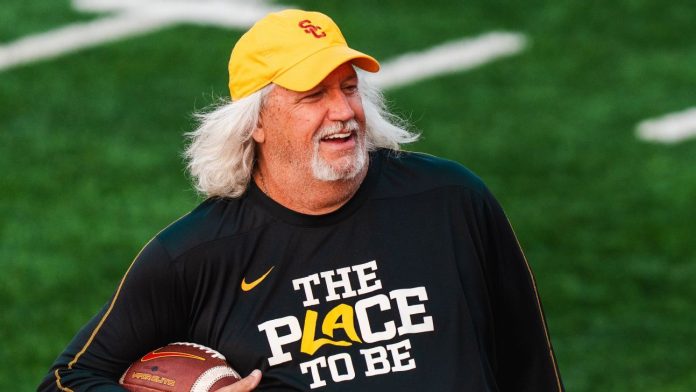
LOS ANGELES — Rob Ryan might be as relaxed as he has ever been.
The longtime defensive coach walks out on the balcony of USC‘s John McKay Center, his alabaster white hair flowing in the slight breeze that frames an idyllic summer afternoon in Los Angeles, and as always, he is not lacking for words.
“I’m totally different than most people,” he said with a chuckle. “And I don’t care.”
Even Ryan’s robust laugh — a kind of deep guffaw that fills any room inside or out — carries with it a tone that projects his breadth of experience: nine NFL teams, five power conference programs, two Super Bowl rings and hundreds of stories.
The son of legendary coach Buddy Ryan and brother of former NFL head coach Rex Ryan has held clipboards and drawn up defensive formations everywhere from the Arizona desert to the Atlantic coast, from Tennessee State to the New England Patriots, Hutchinson Community College to the Dallas Cowboys.
However, college football — USC, of all places — is different. This, the 62-year-old Ryan admits, is unexpected, even for him.
“I honestly never thought about it,” Ryan says. “I was happy in pro football.”
His eyes dart down for a second, and he remembers how he ended up here — wearing USC colors, living in a downtown L.A. apartment and coaching 18-year-old linebackers — more than 25 years after he last coached in college football, nearly 40 years from when he started in this profession.
“I can remember parking the car here [at USC] and walking up,” Ryan says. “I thought, ‘Man, there’s no way I’m ever going to take this job.'”
THE LAST TIME Ryan patrolled the college football sidelines, Peyton Manning was coming off his rookie season in the NFL and Ricky Williams had just run all over the sport on his way to the 1998 Heisman Trophy.
Ryan, then the defensive coordinator at Oklahoma State, remembers Williams’ prowess, but more than that, he remembers how his defense countered it.
“You can ask Ricky,” he said. “He didn’t win the Heisman against us.”
A year before Ryan made his way to Stillwater in 1996, Oklahoma State’s defense was one of the worst in the country. Texas had walloped the Pokes 71-14, and Ryan remembers grabbing tapes of the defense and spending countless hours in a room with his dad, trying to remedy it.
“Me and my dad watch ’em every day after we work on the farm,” Ryan said. “And he’s drawing stuff up on napkins, ‘Well, maybe you can do this.’ I’m like, sure. But I see one of his napkins, he’s [telling me] how he could run the wide tackle six. I go ‘What the hell is that? That’s not the wide tackle of six.’ But I did use them. We beat ’em 55 to 10 the next year. There you go. That was a good napkin.”
Over the course of the 1997 and 1998 seasons, Williams had only four games where he didn’t rush for over 100 yards — two of them were against Ryan’s OSU defense.
“I remember that,” Ryan said.
To describe Ryan’s brain as a football encyclopedia would be an understatement. The wealth of knowledge is voluminous and vast. It spans decades, eras, coaching trees and schemes. His coaching career has included being up close with Bill Belichick, the NFL head coaching legend who hired Ryan in 2000 after his college stint as the New England Patriots‘ linebackers coach. to now witnessing Belichick as North Carolina‘s head coach.
“When I was a coordinator in college back 25 years ago, we just had to stop the run,” Ryan said. “Nobody could throw the ball. Well now everybody can throw it, and with all the space there, you have to have an unbelievable plan. Whatever it is, you got to be able to adapt.”
A lot has changed in the sport since, both in the pros and in the college ranks. Through it all, Ryan has remained unabashedly himself, bouncing with a contagious joy thanks to a job where, as Ryan says, “you don’t have to be anything different but yourself.”
“He’s the smartest guy in the room, but he doesn’t want you to know that,” Rex Ryan said. “He’ll work his ass off, outwork every single person in that school, any school. He’ll put every one of them motherf—ers to sleep.”
Perhaps no one hypes Rob up more than his twin brother, Rex, whose coaching history is just as broad while also featuring a stint as an NFL head coach. It’s a career apex that Rob never reached, but according to Rex, what makes Rob such an effective position coach or coordinator is the fact that he has never been interested in that top job.
“He’s not looking for somebody else’s job. This guy’s there to advance the head coach’s plan and to be right there, to be right hand man to D’anton [Lynn], and that’s exactly what he’s going to do,” Rex, now an analyst for ESPN, said. “And he’s just one hell of a f—ing guy. That’s the thing. And if you can’t get along with him, you’re a f—ing jerkoff. Simple as that. You’re a f—ing a–hole.”
As self-assured as Rob is now, even he can admit that this hasn’t always been the case.
WHEN THE CALL came from a familiar voice, Ryan was facing a situation he knew all too well.
The Las Vegas Raiders, with whom he had been working as a senior defensive assistant since 2022, were undergoing a coaching change after the franchise fired Antonio Pierce. While other coaches might have fretted, Ryan — who took the USC job a week before Pete Carroll was hired with the Raiders — wasn’t too anxious.
“When I was young, man, I couldn’t handle it. That was super hard,” Ryan said of his early firings. “It was pressure. You just feel it, man. It’s a mountain. … It destroyed me. I couldn’t enjoy work. I couldn’t come to work and enjoy it. I couldn’t. It was hard. I was so worried. And it affected me off the field too.”
Ryan was not in a rush to find his next stop, but at USC, the program’s previous linebackers coach, Matt Entz, had left to take the head coaching job at Fresno State. Defensive coordinator D’Anton Lynn — fresh off his first season in the position — went outside the box.
When Lynn was a defensive analyst on the Buffalo Bills in 2016, his father Anthony was the interim head coach and offensive coordinator, and Ryan was the assistant head coach for defense. Then, in 2021, when a 31-year-old Lynn was hired as the Baltimore Ravens safeties coach, the team’s inside linebackers coach invited Lynn to crash at his house for a few months. That coach was 57-year-old Ryan.
“We go way back,” Ryan said. “He’s an old roommate.”
Lynn and USC head coach Lincoln Riley wanted someone with experience who could also add a little extra juice to the staff, a certain kind of appeal that couldn’t be found in an up-and-coming college position coach. So Lynn rang Ryan and made his pitch.
“As we talk about building our scheme, just having someone with all that experience to bounce ideas off of has been huge,” Lynn said in a recent interview. “And for our guys, they get a chance to just get exposed to what it is to have an NFL position coach, and they’re getting coached as if they were in the NFL.”
Even though Ryan arrived on campus for his interviews with skepticism, he was quickly swayed by Riley and Lynn, whom Ryan has repeatedly referred to as a Mike Tomlin in the making.
“I’m like, ‘Man, this is awesome.’ I talked to D’Anton again and then talked to Lincoln. I’m like, ‘Man, I’m going to do this. I’m just going to take a chance,'” Ryan said. “And I have no regrets. I’ve absolutely loved it. It’s like a breath of fresh air. It’s getting started again. I mean, I’m new again.”
Ryan does not shy away from the fact that his own particular situation afforded him an invaluable opportunity growing up. As the head coach of the Arizona Cardinals in 1994, Buddy Ryan was the one who gave Rob and his brother Rex their first big breaks as NFL position coaches that season.
“We were young coaches, we thought we were good, but he had to take a chance, and he hired us,” Rob Ryan said. “People screamed nepotism, and it was nepotism! There was no question, but we were great, and we were ready. Once we got there, we were ready. But we had to have a chance. Somebody had to give us a chance.”
It’s not too shocking then that Ryan finds himself in his father’s role — in the latter stages of his career with a son who has a business degree from Clemson but can’t seem to shake the family bug. This time, it’s Rob who wants to give his son, Matthew, the chance to give coaching a real shot.
“It’s the family business. We probably can’t do anything else, but we damn sure can coach, and that’s our niche, that’s our life,” Rex said. “We never got in the business to make money, but now, f—, you make a ton of money. We certainly didn’t get in the business to do that.”
While talking to Riley and Lynn about the position, Rob Ryan said that the opportunity — not just for him, but for Matthew to become a defensive analyst on staff — was one he could not pass up.
“It’s not really for my growth, cause I’m not going anywhere,” Ryan said. “I want to be a part of something great, but it’s for Matthew to learn. … This is the perfect place for that. But I mean, it’s for me too. Look around, I’m having more fun than anybody else.”
RYAN REMEMBERS WALKING into a team meeting with the Cardinals back in 1994 and being appalled at just how his dad was running things. In short, Ryan explained, the way a former master sergeant in the Korean War would run a team meeting.
“It’s like the things he was saying was like, oh hell, HR would have him out of there in two seconds. He had no problem having a player do anything,” Ryan said. “I thought, ‘God Almighty, I’m not going to do that. I can’t do that.’ So I realized I needed to be genuine to myself.”
Over the past 30 years, Ryan’s personality has crystallized into a coaching style that runs on a type of magnetic zeal that isn’t affected by game-to-game results.
“He has the most energy every single day, and he is also the oldest on the staff,” Lynn said.
His effervescence, players say, is contagious. He doesn’t connect by trying to relate to players 40-plus years his junior as much as he tries to find common ground in the game they’re trying to excel at, the game that he’s still enamored with to this day.
“He’s got a million stories, lived every one of them,” Rex said. “There’s also a confidence and a thing where nothing’s going to intimidate him. He’s not afraid of the f—ing devil.”
Position meetings, though chock-full of traditional insight and strategy, often include an open session where Rob leans into what makes him, well, him.
“He’ll just have a story for us, just a random story, every day, he’ll have us dying laughing,” Madden said. “It may be something that happened a week ago or something 20 years ago”
USC’s linebackers are already privy to not just Ryan’s storytelling, but also the kind of confidence he has given them.
“He definitely wants us to just be who we are,” freshman linebacker Desman Stephens II said. “He talks about how we’ve been playing football our whole life and we have instincts that are helpful to our game. So he just allows us to go out there and play, not carefree but loose.”
“Even though he’s old-school, even though he’s accomplished a lot in this game, he still has an open ear,” redshirt junior linebacker Anthony Beavers Jr. said. “I think he’s forever learning and that’s unique.”
Ryan likes to say that he teaches football more than he coaches it, an approach bolstered by the many stops he has had throughout his career. But he is also supercharged by what he refers to as an affinity for the game that he wants to not just convey, but impress upon his players.
“I think I love what I’m doing. I think it shows,” Ryan said. “I want ’em to love football. I don’t want ’em to dread it. I don’t want ’em to come to work like it’s in a factory. I’ve worked in factories, but I want ’em to love the game. I think my style is: I’m going to have more fun than anybody on that field.”
TO HEAR RYAN speak about football is to be met with someone who has known no other life. Anything prior to his time as a coach, even the years he spent as a defensive end at Southwestern Oklahoma State University alongside Rex, feel like an inconsequential fable at this point. All that matters is what has transpired inside locker rooms and in between the hash marks over the course of the past four decades — good or bad — and the way that he has held on.
“No one’s more used to being fired than me,” Rob Ryan said. “I get fired. At least I was myself. So I can live with that.”
It all raises the question: How long will Ryan keep doing this? And when will he know to pry himself away from the very thing that has defined him?
“He will probably be there 10 years, he loves to coach that much,” Rex said. “He’ll be a guy they’ll have to drag his ass off the football field.”
Rob could have stayed in the NFL if he wanted to, Rex said, but the fact that he didn’t makes Rex believe Rob’s committed to USC for the foreseeable future, or at the very least, “until they tell him to leave.”
“This is it for us,” Rob Ryan, whose wife is from California, said for the both of them. “This is our last move until we walk off in the sunset.”
In this very moment, as the sun fades away and washes every brick-laden building on the USC campus in an orange hue, Rob isn’t ready to go just yet.
“When I retire, cool, I’ll be retired. I’ll probably be the happiest guy in the world in retirement,” he said. “But right now, I’m the happiest guy in the world still doing this.”
President Trump reupped his call for NATO members to stop buying Russian oil amid a wider sanctions push in hopes of forcing Russian President Vladimir Putin to halt the war in Ukraine.
The president said Saturday morning he is “ready” to impose “major” sanctions on Russia when other NATO nations do the same — and when all of them halt their purchases of Moscow’s oil.
“As you know, NATO’S commitment to WIN has been far less than 100 percent, and the purchase of Russian Oil, by some, has been shocking! It greatly weakens your negotiating position, and bargaining power, over Russia,” the president wrote on Truth Social.
“Anyway, I am ready to ‘go’ when you are. Just say when? I believe that this, plus NATO, as a group, placing 50 percent to 100 percent TARIFFS ON CHINA, to be fully withdrawn after the WAR with Russia and Ukraine is ended, will also be of great help in ENDING this deadly, but RIDICULOUS, WAR,” he added.
Trump indicated in a Friday “Fox and Friends” interview that his patience with the Russian leader is “running out fast.”
Also on Friday, Canada hosted a meeting of G7 finance ministers. Treasury Secretary Scott Bessent reiterated Trump’s call for G7 nations to slap tariffs on countries buying Russian oil if they are “truly committed” to ending the three-and-a-half-year conflict in Eastern Europe.
Bessent and U.S. Trade Representative Jamieson Greer also welcomed “commitments” to increase sanctions pressure and “explore using immobilized Russian sovereign assets to further benefit Ukraine’s defense.”
“Only with a unified effort that cuts off the revenues funding Putin’s war machine at the source will we be able to apply sufficient economic pressure to end the senseless killing,” Bessent and Greer said in a joint statement.
“Thanks to President Trump’s bold leadership, the United States has already taken dramatic action against the purchasers of Russian oil,” the two officials added. “We are encouraged by the assurances of our fellow G7 nations that they are committed to ending this war, and we are hopeful that they will join us in taking decisive action at this critical time.”
The president’s push for cutting oil purchases and sanctions talks comes as the deadline for a potential meeting between Putin and Ukrainian President Volodymyr Zelensky has passed.
Russia has shown no signs of slowing down its military operation, continuing to shell Ukraine with aerial attacks.
The Kremlin said on Friday that negotiations with Ukraine are on “pause,” less than a month after Trump met with Putin in Alaska.
Trump said Saturday morning that China has a strong grip over Russia and that tariffs will “break that grip.”
“This is not TRUMP’S WAR (it would never have started if I was President!), it is [former President] Biden’s and Zelenskyy’s WAR. I am only here to help stop it, and save thousands of Russian and Ukrainian lives (7,118 lives lost last week, alone. CRAZY!),” the president wrote. “If NATO does as I say, the WAR will end quickly, and all of those lives will be saved! If not, you are just wasting my time, and the time, energy, and money of the United States.”
GOP senators are urging Trump to allow a vote on a Russia sanctions package after the Kremlin’s incursion into Polish airspace this week, a strong escalation.
“I think it’s time for the sanctions bill to come to the floor,” Sen. Shelley Moore Capito (W.Va.) told The Hill this week. “I think the president’s got to make the final call on that, so I respect that, but I’m ready to vote for that.”
President Trump met with Qatari Prime Minister Sheikh Mohammed bin Abdulrahman al-Thani on Friday, days after Israel struck Doha in hopes of killing Hamas leaders.
The White House confirmed the two leaders had dinner late Friday in New York, but did not offer further details. Trump’s special envoy Steve Witkoff was also attended the dinner.
“Great dinner with POTUS,” Qatar’s deputy chief of mission, Hamah Al-Muftah, said late Friday on social platform X. “Just ended !”
On Tuesday, Israel launched an assassination strike against the Palestinian militant group’s political leadership in Qatar, killing five of the group’s members and a member of Qatar’s internal security force.
Trump said he was not happy with the strike, which was condemned by nearly all nations in the Middle East and some European countries.
Al-Thani’s dinner with Trump and Witkoff came hours after the Qatari prime minister met with Secretary of State Marco Rubio and Vice President Vance at the White House.
Trump earlier this week expressed his frustration with the strike during a call with Israeli Prime Minister Benjamin Netanyahu, reiterating he wants “peace,” the White House said.
Shortly after the attack, al-Thani vowed to retaliate against Israel.
“The state of Qatar is committed to act in a decisive way with anything that would target its territories and will reserve the right to retaliate and will take all the needed measures to retaliate,” al-Thani said.
The Qatari prime minister said on Thursday that Israeli strikes on Hamas leaders in Doha “killed any hope” of freeing hostages from the Gaza Strip.
Qatar is a key mediator in the ceasefire talks between Israel and Hamas, designated as a foreign terrorist organization by the U.S. government, regarding releasing the hostages and the plan for the war-torn enclave following the conflict.
Rubio traveled to Israel this weekend amid these rising tensions.
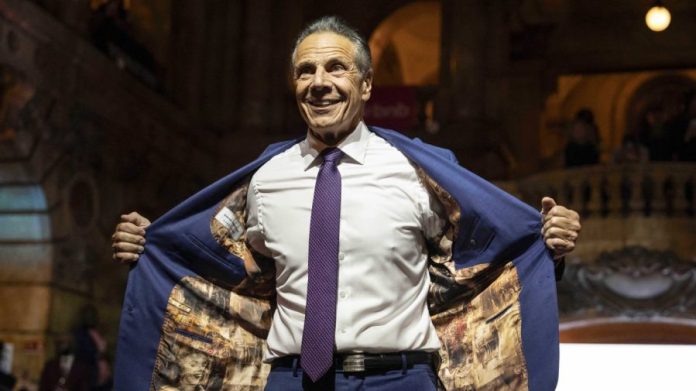
New York mayoral candidate and former Gov. Andrew Cuomo made his catwalk debut this week.
Politicians from across New York, including former Gov. David Patterson (D) and Republican mayoral competitor Curtis Sliwa, joined Cuomo for the second annual “Style Across the Aisle” event during New York Fashion Week on Wednesday.
Hosted by the Gracie Mansion Conservancy, the bipartisan event seeks to bring Democrats and Republicans together to highlight local designers. The event was founded by Skye Ostreicher, a former journalist.
“We see what’s going on out there: the violence, the protests, people not getting along, just because of politics,” Ostreicher said at the end of the show, according to The New York Times. “I know for a fact that every person here wants to collaborate and work together and reach across the aisle and move New York City forward.”
Cuomo donned a custom blue suit from Bond & Bari Bespoke, a Manhattan based tailor and menswear label. The brand also dressed New York City Department of Citywide Administrative Services Commissioner Louis Molina.
The Hill reached out to Cuomo’s campaign for comment.
The mayoral candidate made his New York Fashion Week debut as the mayoral election heats up.
Democratic mayoral candidate Zohran Mamdani holds a comfortable lead over both Cuomo and incumbent Mayor Eric Adams. Both Adams and Cuomo are running as independents in November’s election.
Polling from Emerson College Polling/PIX11/The Hill this week showed Mamdani 15 points ahead of Cuomo, 43 percent to 28 percent.
Proceeds from Wednesday’s fashion show will support Witness to Mass Incarceration, a nonprofit providing support to formerly incarcerated individuals. Fashion week ends on Sept. 16.
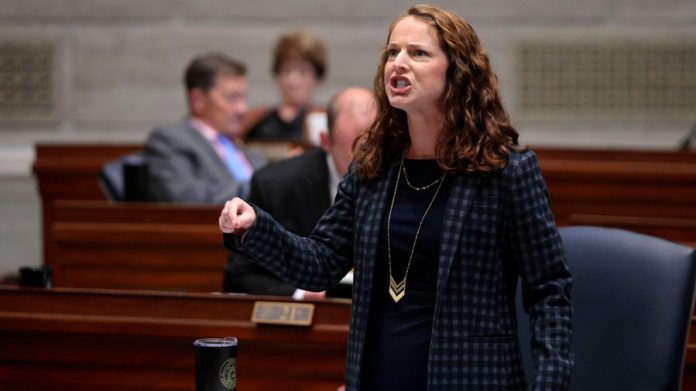
Gov. Mike Kehoe (R) is poised to sign the new map into law for the 2026 midterms after the state Senate gave approval on Friday. The map would likely give Republicans one additional seat in the House as the GOP tries to hold its narrow majority, taking out a current Democratic House member.
But Democrats may be able to send the issue to Missouri voters as a veto referendum for them to decide whether the map should be used.
Here’s what to know:
How it would work
Democrats legislatively didn’t have many options to stop the map other than temporary stalling tactics. But the vote margins that the map received in the legislature can determine whether they have another chance to stop it.
Missouri law has a mechanism for voters to effectively veto legislation passed by lawmakers by gathering support to force a statewide vote.
The legislation for the new map passed this week didn’t include a so-called emergency clause, which would have made the bill effective as soon as the governor signs it, local outlets reported. Despite the Republican dominance in both chambers of the legislature, the threshold for approving the emergency clause is higher than the number of seats the GOP has in the state House.
Now, Democrats and other opponents will have 90 days after the map is signed to collect enough signatures — five percent of voters in each of two-thirds of the state’s congressional districts — to order a referendum, according to the Missouri Secretary of State’s rules.
If enough signatures are gathered, an election would be held and the public’s vote would decide the map’s fate.
“I think that’s kind of the Democrats’ best bet at this point, that they’ll be able to use the referendum to beat it back,” said Greg Vonnahme, a political science professor at the University of Missouri-Kansas City.
The Missouri Democratic Party declared its support for a referendum following the state Senate’s vote.
“They don’t care about the will of the people, or about protecting our voice in government,” said state party Chair Russ Carnahan about those who voted for the map. “Now it’s up to us to do what they won’t.”
The nonpartisan coalition People NOT Politicians – Missouri formally filed a referendum petition with the Missouri Secretary of State’s office on Friday, starting the process of gathering signatures.
Protests, polling signal opposition
Big crowds have reportedly gathered at the Missouri Capitol this week as thousands protested the redistricting plan, signaling a vocal opposition in the Show Me State as observers wonder whether a referendum push could get the support it would need.
Polling is sparse, but a Change Research survey commissioned by the Democrats’ House campaign arm at the end of August, as shared by Politico, found 48 percent of Missouri voters oppose the redrawing. Another 37 percent supported it, with 19 percent undecided.
Chris Melody Fields Figueredo, the executive director of the Ballot Initiative Strategy Center, said the protests suggest people are energized to oppose the map and opponents are in a strong position to block it through the referendum process. The progressive organization works to use ballot measures to strengthen democracy, draw attention to marginalized communities and advance racial equity, according to its website.
“We’ve had thousands of people at the state capitol speaking out against this illegal gerrymander,” she said, adding that groups have a long history of using the initiative and referendum process to ensure that Missourians’ voices are heard.
But Dan Butler, a political science professor at Washington University in St. Louis, Mo., suggested that it may not be in Democrats’ best political interest to push forward with a referendum.
“When voters go to the polls, maybe there are people who normally vote Republican, but they’re upset about this district map. They want to send a message. If there’s not a referendum … they’ll vote against the Republicans, in favor of Democrats,” Butler said.
“But if now they can vote both against this redistricting plan and still vote Republican, it actually, I think, ironically — potentially, it protects Republicans from some of the blowback they might get otherwise.”
Voters used referendum to reject law in 2018
Precedent exists for this type of process in the Show Me State to overturn actions from the legislature.
“Missouri is pretty active in its initiative use. But … we really don’t see the popular referendum used that much at all,” Vonnahme said.
Still, voters last used a referendum in 2018 to reject a right-to-work law that passed through the GOP-controlled Legislature. Labor advocates submitted roughly three times the signatures they needed to set up a statewide ballot vote, then rejected the law by a 2-to-1 margin.
“Grassroots organizations should use any opportunity available to them to defend direct democracy that has been widely popular in the state,” Figueredo said.
Targeted Democrat promises legal fight
Republicans control six of eight districts in the Show Me State, and the new maps would dramatically reshape Rep. Emmanuel Cleaver’s 5th Congressional District in Kansas City to help Republicans net a new seat.
After the Missouri House approved the maps this week, Cleaver called it “deeply disappointing” that legislators had “put the demands of DC power brokers ahead of the wishes of Missouri families in yet another partisan power grab.”
Cleaver, who has been in Congress for two decades, won reelection with 60 percent of the vote last fall, after line changes in 2022.
The Associated Press reported that Cleaver plans to challenge the new map in court –- and run for reelection next year, no matter what his district looks like.
“I think for opponents, the only shot is legal challenge, or this referendum avenue,” said David Kimball, a political scientist at the University of Missouri-St. Louis.
Suzan DelBene, chair of the Democrats’ House campaign arm, said “all options” are on the table.
“Missourians hate Republicans’ plot to gerrymander the state. The voters have pushed back to stop state Republicans from their past attempts to ignore the will of the people, and all options, including legal action and the referendum process, are on the table to ensure fair maps,” DelBene said in a statement after the state Legislature approved the maps.
The Los Angeles County Department of Public Health this week reported the death of a school-aged child due to a rare complication occurring from a measles infection experienced as an infant.
In a statement Thursday, the health department said the child had become infected before they were eligible to receive the measles vaccine. Their death was due to subacute sclerosing panencephalitis (SSPE).
The department described SSPE as a “rare, progressive brain disorder that is a late complication of infection from the measles virus.” It affects roughly 1 in 10,000 people who get measles, but this rate jumps to 1 in 600 for those who get measles when they are an infant.
“SSPE usually develops two to ten years after the initial measles infection after the patient seemed to fully recover. It is characterized by a gradual and worsening loss of neurological function with death occurring one to three years after the initial diagnosis,” added the agency.
In light of the death, the agency encouraged Los Angeles County households to ensure that all members are protected against measles.
Children typically receive their first dose of the measles vaccine at 12-15 months and receive their second dose when they are between 4 years old and 6 years old.
This death comes just weeks after the measles outbreak in West Texas was declared over. More than 700 cases were ultimately confirmed in the Texas outbreak, causing two deaths of school-aged children who were unvaccinated and had no underlying conditions.
“This case is a painful reminder of how dangerous measles can be, especially for our most vulnerable community members,” Muntu Davis, Los Angeles County health officer, said in a statement.
“Infants too young to be vaccinated rely on all of us to help protect them through community immunity. Vaccination is not just about protecting yourself—it’s about protecting your family, your neighbors, and especially children who are too young to be vaccinated.”