16.7 C
New York
Tuesday, May 5, 2026
Home Blog Page 202

Trump stands firm on India tariffs as Modi reiterates Russia, China ties

0


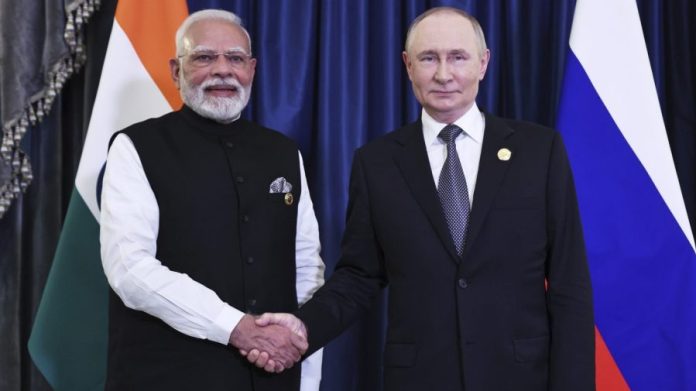
President Trump stood by the steep tariffs he imposed on India as a penalty for buying Russian oil, as Indian Prime Minister Narendra Modi met with Russian President Vladimir Putin on Monday in a display of deepening ties with the Kremlin.

In a post on his Truth Social platform, Trump reiterated his concerns about what he characterized as a trade imbalance, calling the relationship between the U.S. and India “a totally one sided disaster!”

“What few people understand is that we do very little business with India, but they do a tremendous amount of business with us. In other words, they sell us massive amounts of goods, their biggest ‘client,’ but we sell them very little – Until now a totally one sided relationship, and it has been for many decades,” Trump wrote in his post Monday morning.

“The reason is that India has charged us, until now, such high Tariffs, the most of any country, that our businesses are unable to sell into India. It has been a totally one sided disaster!” he continued. “Also, India buys most of its oil and military products from Russia, very little from the U.S.”

The import tax on Indian goods increased to 50 percent on Wednesday, after the implementation of Trump’s additional 25 percent tariff imposed as a penalty for oil purchases that Trump argues are helping fuel Moscow’s war efforts in Ukraine. India already faced a 25 percent “reciprocal” tariff on exports to the U.S.

India has defended buying Russian oil, which it has described as financially necessary to meet the energy needs in its populous country.

“They have now offered to cut their Tariffs to nothing, but it’s getting late. They should have done so years ago. Just some simple facts for people to ponder!!!” Trump said in his post.

Some analysts have said Trump’s steep tariffs and his souring attitude toward Modi have inadvertently led India to seek closer ties with Russia and China. Modi met with Chinese President Xi Jinping on Sunday.

Just after Trump announced he would increase the tariff on New Delhi to 50 percent, Modi said that he held a “very good and detailed conversation” with “my friend” Putin. 

On Monday, Putin and Modi met on the sidelines of the Shanghai Cooperation Organization (SCO) in the port city of Tianjin, China, where discussions focused on regional stability, bilateral trade and energy cooperation.

In remarks at the start of their talks, Modi called his partnership with Moscow “special and privileged,” and Putin addressed Modi as a “dear friend” and praised the relationship as special, friendly and trusting.

“Russia and India have maintained special relations for decades. Friendly, trusting. This is the foundation for the development of our relations in the future,” Putin said. “These relations are absolutely non-partisan in nature, supported by the overwhelming majority of the peoples of our countries.”

The Associated Press contributed.

Crypto Investment Products See $2.48B Weekly Inflows, Pushing August Total to $4.37B

0


Digital asset investment products bounced back last week, drawing in $2.48 billion in inflows after a brief period of outflows.

Key Takeaways:

  • Digital asset products saw $2.48B in weekly inflows, pushing August’s total to $4.37B.

  • Ethereum led the charge with $1.4B in inflows, while Bitcoin saw continued outflows.

  • Altcoins like Solana and XRP gained momentum on optimism around potential U.S. ETF launches.

The surge pushed August’s total inflows to $4.37 billion, bringing the year-to-date figure to $35.5 billion, according to a Monday report by CoinShares.

Despite the strong showing, momentum slowed on Friday after the release of Core PCE inflation data, which tempered hopes of a Federal Reserve rate cut in September.

The Fed’s preferred inflation gauge, the core Personal Consumption Expenditures (PCE) index, showed a 2.9% annualized rise in July, the highest since February.

Invest in Gold

Powered by Money.com – Yahoo may earn commission from the links above.

The news, coupled with recent price pressure across crypto markets, caused a dip in sentiment and trimmed total assets under management by 10% to $219 billion.

The United States remained the clear leader, accounting for $2.29 billion of last week’s inflows. Switzerland, Germany, and Canada also posted gains of $109.4 million, $69.9 million, and $41.1 million, respectively.

Analysts suggest the Friday pullback likely reflects profit-taking rather than a broader shift in investor sentiment.

Ethereum continued to outperform its peers, attracting $1.4 billion in inflows last week alone. For the month of August, Ethereum has pulled in nearly $4 billion, while Bitcoin posted outflows of $301 million.

Meanwhile, altcoins like Solana and XRP gained further traction on expectations surrounding potential U.S.-based exchange-traded funds (ETFs). Solana recorded $177 million in inflows, while XRP followed with $134 million.

The latest figures show renewed appetite for digital assets, particularly among investors looking for alternatives to Bitcoin and betting on future ETF approvals.

As reported, the US Securities and Exchange Commission (SEC) is currently reviewing 92 crypto ETF applications, according to Bloomberg Intelligence analyst James Seyffart.

A detailed spreadsheet published on August 28 shows most of these filings, especially those linked to Solana, XRP, and Litecoin, are facing final decisions by October.

The wave of new applications reflects growing interest in altcoin-focused ETFs and could spark fresh capital inflows into the crypto market.

Solana and XRP are leading the ETF race, with eight and seven pending applications respectively. These altcoins now rank as the most targeted crypto investments after Bitcoin and Ethereum.

Marc Guehi transfer: Liverpool agree deal to sign England defender from Crystal Palace

0


Guehi has been a key target for Liverpool this summer after Jarrell Quansah left Anfield for Bayer Leverkusen.

There have also been concerns about the solidity of Liverpool’s defence after they conceded six goals in their first three games of the season.

They lost the Community Shield on penalties to Palace – who Guehi captained at Wembley – and gave up two-goal leads in the Premier League to Bournemouth and Newcastle before fighting back to win.

After also bringing in Isak, Hugo Ekitike, Milos Kerkez, Jeremie Frimpong, Giorgi Mamardashvili, Armin Pecsi and Giovanni Leoni, the Guehi deal will take Liverpool’s spending to about £451.2m without add-on fees – the highest total in Premier League history.

It is only the second time that an English side has shelled out more than £400m in a summer window, following Chelsea’s £401.2m outlay in 2023.

Meanwhile, the departures of Luis Diaz, Darwin Nunez, Quansah, Caoimhin Kelleher, Trent Alexander-Arnold, Tyler Morton and Ben Doak have recouped an initial amount of about £190m.

Former CDC directors sound alarm over Kennedy’s agency shake-up

0


Related video – DC Bureau: Changes Atop the CDC

Former directors of the Centers of Disease Control and Prevention (CDC) on Monday rebuked Health and Human Services (HHS) Secretary Robert F. Kennedy Jr. for his leadership at the agency and for his decision to fire its director, Susan Monarez.

In a New York Times op-ed, nine former CDC directors and acting directors — who have served under every administration since former President Carter — sounded the alarm about the changes Kennedy has made at the CDC, which they described as alarming.

“What Health and Human Services Secretary Robert F. Kennedy Jr. has done to the C.D.C. and to our nation’s public health system over the past several months — culminating in his decision to fire Dr. Susan Monarez as C.D.C. director days ago — is unlike anything we have ever seen at the agency, and unlike anything our country has ever experienced,” they wrote in the piece.

The former CDC leaders expressed concern about the “wide-ranging impact” of Kennedy’s decisions at the agency, from firing thousands of health workers, to canceling investments in medical research, to replacing experts on advisory committees, to ending support for global vaccination programs.

They expressed particular concern about Monarez’s ouster last week, which led to at least four other top CDC officials resigning from their posts, accusing the administration of weaponizing public health and applauding Monarez for standing up for science.

“When Secretary Kennedy administered the oath of office to Dr. Monarez on July 31, he called her ‘a public health expert with unimpeachable scientific credentials.’ But when she refused weeks later to rubber-stamp his dangerous and unfounded vaccine recommendations or heed his demand to fire senior C.D.C. staff members, he decided she was expendable,” they wrote in the piece.

“These are not typical requests from a health secretary to a C.D.C. director. Not even close,” they continued. “None of us would have agreed to the secretary’s demands, and we applaud Dr. Monarez for standing up for the agency and the health of our communities.”

The Hill reached out to HHS for comment about the op-ed.

The former CDC directors also applauded the agency’s staff “who continue to perform their jobs heroically in the face of the excruciating circumstances, saying, “Their ongoing dedication is a model for all of us.”

“But it’s clear that the agency is hurting badly. The loss of Dr. Monarez and other top leaders will make it far more difficult for C.D.C. to do what it has done for about 80 years, to work around the clock to protect Americans from threats to their lives and health,” they continued.

The group called on other sectors of government and public health to “rally to protect the health of every American,” including for Congress to increase its oversight authority, for state and local governments to increase funding gaps when possible, for philanthropy and the private sector to increase community investments and for the American people “to look out for one another.”

“The men and women who have joined C.D.C. across generations have done so not for prestige or power, but because they believe deeply in the call to service. They deserve an H.H.S. secretary who stands up for health, supports science and has their back. So, too, does our country,” they wrote.

Monarez’s ouster and the subsequent resignations of other CDC officials rocked the public health community and drew mixed reactions on Capitol Hill. 

Kennedy and the White House have defended Monarez’s firing. White House press secretary Karoline Leavitt told reporters on Thursday the president has the “authority to fire those who are not aligned with his mission.” 

“The president and Secretary Kennedy are committed to restoring trust and transparency and credibility to the CDC by ensuring their leadership and their decisions are more public-facing, more accountable, strengthening our public health system and restoring it to its core mission of protecting Americans from communicable diseases, investing in innovation to prevent, detect and respond to future threats,” Leavitt said during the briefing.

The op-ed was signed by William Foege, who served as director from 1977 to 1983; William Roper, who served as director from 1990 to 1993; David Satcher, who served as director from 1993 to 1998; Jeffrey Koplan, who served as director from 1998 to 2002; Richard Besser, who served as acting director in 2009; Tom Frieden, who served as director from 2009 to 2017; Anne Schuchat, who served as acting director in 2017 and 2018; Rochelle Walensky, who served as director from 2021 to 2023; and Mandy Cohen, who served as director from 2023 to 2025.

BYD records consecutive monthly production drops for first time since 2020

0


SHANGHAI (Reuters) -BYD’s production slid for a second straight month in August, marking its first consecutive monthly contraction since 2020 in a further sign that the Chinese EV giant is putting the brakes on its massive years-long expansion.

The world’s biggest EV producer made 353,090 electric vehicles and plug-in hybrids (PHEV) globally last month, down 3.78% from a year earlier, according to a monthly filing with the Hong Kong Stock Exchange on Monday. That follows a 0.9% drop in July.

The last time BYD’s production fell for two consecutive months was in June and July 2020.

Reuters reported in June that BYD, the biggest Chinese rival to Tesla, was slowing its production pace by reducing shifts at some factories in China and had delayed plans to add new production lines.

Its sales in China, meanwhile, slid 14.3% year on year to 292,813 vehicles, down for a fourth consecutive month, even as global sales remained slightly up. BYD’s sales in Europe are growing fast, data showed on Monday.

China sales, however, account for nearly 80% of BYD’s total sales.

Monday’s data suggests the company has only met 52.1% of its yearly sales target of 5.5 million units in the first eight months. And some analysts have said that the company is unlikely to meet that target.

China Merchants Bank International analysts said they had cut their BYD sales forecast by 5% to 4.9 million units for this year, as they believe it “has become more cautious about its inventories”.

The drop in production and sales come shortly after BYD reported that quarterly profit fell for the first time in three and a half years, reflecting how pressure to stay competitive was beginning to take a toll.

The company’s shares fell sharply on Monday.

A drop in BYD’s PHEV production and sales since April persisted, while overall EV sales grew 34.4% and production rose 26% in August versus a year earlier. BYD has begun making and selling more EVs than PHEVs since April.

(Reporting by Shanghai Newsroom; Editing by Joe Bavier and Susan Fenton)

CEO who snatched boy’s hat at US Open says he made ‘huge mistake’

0


The man who was caught on camera snatching a hat off a young boy at the US Open has said he made a “huge mistake” after footage of the incident went viral.

Piotr Szczerek, a Polish chief executive of a paving firm, said he was “convinced” tennis star Kamil Majchrzak had been “passing his hat in my direction”.

“I know I did something that seemed like consciously collecting a memento from a child,” he wrote in a statement. “This wasn’t my intention, but it doesn’t change the fact that I hurt the boy and disappointed the fans.”

The video, taken during Majchrzak’s match on Thursday, showed the tennis player offering his cap to a child, before Mr Szczerek appears to take it.

Versions of the clip were shared widely on social media and prompted criticism of Mr Szczerek’s actions.

The 50-year-old wrote on social media on Monday: “I would like to unequivocally apologise to the injured boy, his family, as well as all the fans and the player himself.”

He added that he had given the hat back to the boy, and hoped that it had “at least partially repaired the damage that was done”.

Majchrzak, 29, who had just won his match against Russian ninth seed Karen Khachanov when the incident unfolded, told the New York Post on Saturday that “obviously it was some kind of confusion”.

“I was pointing, giving the hat, but I had a lot going on after my match, after being super tired and super excited for the win,” he said.

“I just missed it. I had like a dead look, if you know what I mean. I’m sure the guy was also acting in the moment of heat, in the moment of emotions.”

The tennis star reunited with the boy over the weekend, sharing clips of him giving the young fan a cap and other merchandise on Instagram.

“Today after warm up, I had a nice meeting,” the tennis star wrote, adding: “Do you recognise [the cap]?”

Majchrzak, ranked 76th in the world in men’s singles, came back from two sets down to beat Khachanov in a second-round match at Flushing Meadows, but was forced to retire injured during the first set of his third-round tie against Switzerland’s Leandro Riedi on Saturday.

He later confirmed he had torn an intercostal muscle.

Mr Szczerek and his wife Anna founded his paving company Drogbruk in 1999, polish outlet Tenis Magazyn reported. The company sponsors sporting events and Polish athletes.

The couple and their two sons are amateur tennis players who compete in local leagues, and have hosted Polish tennis pro Urszula Radwańska on their home court, according to Tenis Magazyn.

Bad news awaits Republicans returning to DC

0


Remember back in July when Speaker Mike Johnson (R-La.) abruptly adjourned the House of Representatives for summer recess? The quick exit gave Republicans an escape from headlines about the Trump administration’s refusal to release files on Jeffrey Epstein, the deceased sex offender.

Now, Congress is about to return. And the Epstein drama is just one fire burning among many. As September begins, Republicans remain on the defensive, and this time they won’t be able to call a time-out.

The bottom line for congressional Republicans this fall is not governance but survival.

The hottest flame coming at them is the burning threat of an Oct. 1 government shutdown, unless there is a budget deal. Despite Republican majorities in both houses, the GOP has failed to pass next year’s appropriations, despite allowing government debt to reach record highs. To get a deal done, Republicans will likely need some Democratic votes. In exchange for their votes, the Democrats have demands in hand.

First, they want Republicans to restore cuts to Medicaid and the Affordable Care Act (also known as Obamacare). Both health care plans were decimated by President Trump’s recently passed tax and budget reconciliation bill.

Democrats risk paying a price with voters if they force a government shutdown. But 20 million Americans are about to be hit with higher health insurance premiums due to the Trump cuts. A big bloc of voters across party lines has already told pollsters that they agree with Democrats on this.

And with Trump’s approval numbers now in negative territory — especially on his handling of rising health care costs as well as overall inflation — Republicans on the Hill lack his shield from political heat.

Congressional Republicans also know that Trump’s name will not be on the 2026 ballot. In the past, his support within the MAGA base shielded them. There is no Trump shield next year, and Republicans are getting dire forecasts for their prospects in the midterms. As Tony Fabrizio, Trump’s pollster, said in July, “midterms election are always a slog” for the majority party and “you are always running against history.”

The most relevant history is that Republicans lost 40 seats in the midterms during Trump’s first term.

Democrats, meanwhile, want to show they can put up a fight over the budget. That was not the case in March, when Democrats gave the GOP the votes to keep the government open. Democrats said they avoided a fight to prevent Trump from having a free hand to cut programs during a government shutdown.

Senate Minority Leader Chuck Schumer (D-N.Y.) was blasted by his party for not putting up a fight.

Now it is a different game. Before the August break, Trump and Schumer failed to agree on a deal to get more of the presidents’ nominees quickly approved. Schumer asked Trump to end a hold on spending previously approved by Congress in exchange for speeding up approval of nominees.

When Trump rejected the offer, he put up a post full of rage, telling Schumer to “GO TO HELL!”

Trump’s anger at Schumer has since shifted to Senate Judiciary Committee Chair Charles Grassley (R-Iowa). Trump dismissed the veteran Republican as merely a disloyal acolyte, posting “I got [him] re-elected to the U.S. Senate when he was down by a lot.”

Trump insisted that Grassley lacks the “courage” to “solve the ‘Blue Slip’ problem” — referring to the Senate tradition of requiring both senators from a given state to sign off on certain judicial nominees. Grassley replied that he was “offended by what the president said, and I’m disappointed that it would result in personal insults.”

Look for that internal feud to slow the GOP. At best, congressional Republicans will try to nudge, if not elbow, the president to make a deal on the budget and on nominations. Senate Majority Leader John Thune (R-S.D.) said before the break that Schumer and Trump need to negotiate.

“At some point, obviously,” Thune told Politico, “there are certain things they are just going to have to figure out, because on some of these things where we need 60 [votes], there are going to have to be conversations.”

Schumer said Trump is “going to have to learn that he has to work with Democrats if he wants to get deals … going at it alone will be a failed strategy.”

While Republicans try to dig out of their hole, Democrats are poised to gain political momentum. Victories in gubernatorial races and legislatures in Virginia and New Jersey in November would boost morale.

And the president’s deployment of troops to occupy Washington D.C. is alienating independent swing voters the Republican Party needs for the midterms.

Meanwhile, the Epstein saga keeps boiling. The president’s team is trying to lower the heat, dispatching the deputy attorney general to interview Epstein’s imprisoned partner, Ghislaine Maxwell, who said Trump did no wrong.

Now, House Republicans are calling former Trump Labor Secretary Alex Acosta to testify. As the U.S. Attorney in Miami at the time of his first prosecution, Acosta had engineered the slap-on-the-wrist deal that allowed Epstein to shield his co-conspirators.

I still believe Acosta should testify. His testimony is crucial — particularly given investigative journalist Vicky Ward’s reporting that Acosta told Trump transition vetting officials that he had been instructed to “back off” of Epstein because of his ties to U.S. intelligence.

Is that true? Every news outlet should lead with his answer.

Epstein remains a problem for Republicans as Congress returns. But there are fires everywhere. And should Democrats take control in 2026, a third Trump impeachment will be on the table.

Juan Williams is senior political analyst for Fox News Channel and a prize-winning civil rights historian. He is the author of the new book “New Prize for These Eyes: The Rise of America’s Second Civil Rights Movement.”

Prosper Stars & Stripes Exited Helen of Troy Limited (HELE) After Achieving Solid Returns

0


Prosper Stars & Stripes, a long/short equity fund, recently released its second quarter 2025 investor letter. A copy of the letter can be downloaded here. The fund underperformed and generated a net return of +9.6% compared to a total return of +8.5% for the long-only small-cap Russell 2000 Index (the “Russell”), and a total return of +5.0% for the long/short equity hedge fund peer group represented by the HFRX Equity Hedge Index (the “HFRX”). For the six months ended 2025, Prosper Stars & Stripes returned a net return of (0.8%) compared to (1.8%) for the Russell and +5.9% for the HFRI. The portfolio demonstrated strong outperformance relative to its net exposure during the quarter. In the second quarter of 2025, US equities reversed the declines seen in the first quarter. In addition, please check the fund’s top five holdings to know its best picks in 2025.

In its second-quarter 2025 investor letter, Prosper Stars & Stripes highlighted stocks such as Helen of Troy Limited (NASDAQ:HELE). Helen of Troy Limited (NASDAQ:HELE) offers a wide range of consumer products that operates in Home & Outdoor and Beauty & Wellness segments. The one-month return of Helen of Troy Limited (NASDAQ:HELE) was 13.82%, and its shares lost 54.01% of their value over the last 52 weeks.  On August 29, 2025, Helen of Troy Limited (NASDAQ:HELE) stock closed at $24.55 per share, with a market capitalization of $563.553 million.

Prosper Stars & Stripes stated the following regarding Helen of Troy Limited (NASDAQ:HELE) in its second quarter 2025 investor letter:

“Helen of Troy Limited (NASDAQ:HELE) was the largest contributor in our short book during the second quarter of 2025. The company is a consumer-packaged goods (“CPG”) firm with a diversified portfolio spanning categories such as Home & Outdoor and Beauty & Wellness. We have held a negative view of the company for some time, as we believe management was overly reliant on acquiring second-tier brands and was underinvesting in innovation. As consumers have become more price sensitive and selective with their spending, Helen of Troy’s brand strength deteriorated while leverage rose, an unfavorable combination. We successfully shorted HELE about a year ago, and our successful short during Q2 is an illustration of how our process allows us to reinvest with names from our focus lists. We previously noted that then-CEO Noel Geoffroy used the cautionary phrase “reset and revitalize” to describe the company’s status in Q2 2024. Geoffroy stepped down effective May 2, 2025, after approximately 14 months in the role, signaling continued fundamental pressure. After achieving solid returns, we exited our short position during the quarter.”

Randal Kolo Muani transfer: Tottenham agree season-long loan for PSG striker

0


Tottenham Hotspur have agreed a season-long loan deal for Paris St-Germain striker Randal Kolo Muani.

The 26-year-old has been linked with Premier League clubs for several months, with interest from Spurs, Manchester United, Chelsea and West Ham.

He is set to move to Tottenham on transfer deadline day after personal terms were agreed with Thomas Frank’s side.

Kolo Muani spent last season on loan at Juventus, scoring eight goals in 16 Serie A games.

The former Nantes and Eintracht Frankfurt forward joined PSG in September 2023 and has won two Ligue 1 titles.

Kolo Muani also has 31 senior caps for France, scoring in the 2022 World Cup semi-final victory over Morocco and playing in the final defeat by Argentina.

Without consequences, union violence will continue and grow

0


On Labor Day, we affirm that everyone should have the freedom to seek employment wherever they choose, and should never be bullied or harassed for exercising that freedom.

Americans should be able to get a job and go to work without, for example, being swarmed by knife-wielding Teamsters who trap them in vans for hours.

Unfortunately, that is not an exaggerated hypothetical, but a real situation that nearly 40 Boston-area Republic Services workers recently found themselves in as they pulled up in vans to a waste management facility being picketed by the Teamsters union.

Teamsters-controlled garbage collectors in Boston went on strike in July, leaving trash piling up across the city. To prevent a dangerous public health situation and to attempt to serve its customers, Republic hired workers to conduct periodic trash pickups while it negotiates with the Teamsters officials.

But as a group of these workers arrived in vans at a Republic facility in Revere, Mass., they were descended upon by a swarm of Teamster thugs who slashed the van’s tiers with knives, scratched it with keys, and threatened the workers inside.

According to a legal complaint filed by the company, the Teamsters constructed a makeshift barrier with buckets and two-by-fours and trapped the vans for three hours. This happened in full view of the Revere police, who, according to the complaint, “took no immediate action.”

The judge who heard Republic’s complaint also felt no action was warranted, even though the company detailed example after example of Teamsters militants blocking worker-operated garbage trucks on busy highways, cutting trucks’ brake lines, spraying cleaner on windshields to block drivers’ views, flashing strobe lights to blind drivers, and subjecting drivers to threats and abuse.

The striking Teamsters expect to be shielded from consequences at work, since the union has demanded “amnesty” for its members as part of negotiations. And with the police and courts looking the other way, it is likely they won’t face any legal consequences either.

Violence, threats, and the destruction of property have long been union tactics. But these tactics put people’s lives at risk. Workers have been beaten and killed for working during union strikes, and even for working in areas a union considered to be its “turf.” Unionized local police often ignore the problem.

Congress passed the Hobbs anti-extortion act so that federal charges could be brought in situations where local law enforcement refuse to act. But there’s a problem: According to a 5-4 Supreme Court decision in the controversial 1973 U.S. v. Enmons case, the Hobbs Act doesn’t apply to violent extortion committed in pursuit of “legitimate union organizing objectives.”

Union bosses can therefore order their union thugs to attack workers and destroy equipment in the hopes that an employer will capitulate at the bargaining table or a group of employees will agree to unionize — two outcomes which promise more dues revenue for the union.

That’s exactly the kind of extortionate tactic the Hobbs Act was meant to deal with, but the Enmons precedent blocks the way.

Union violence is an ongoing problem, made worse by politicians and a legal system that refuse to intervene. Boston city officials have even threatened fines if the garbage isn’t collected soon — fines not against the strikers or the union, but against Republic Services!

Some political leaders don’t tolerate union violence. Congressman Scott Perry (R-Pa.) has introduced a bill called the Freedom From Union Violence Act, which closes the Enmons Supreme Court loophole so that union bosses will once again have to fear prosecution under anti-extortion laws when they use violence for their own financial gain.

Every member of Congress who supports Americans’ right to work without being attacked or threatened by union militants should support Perry’s bill.

Mark Mix is president of the National Right to Work Committee.