21.8 C
New York
Sunday, May 10, 2026
Home Blog Page 269

Blue badge holders should not pay airport drop-off fees, charity says

0


Mitchell Labiak

Business reporter, BBC News

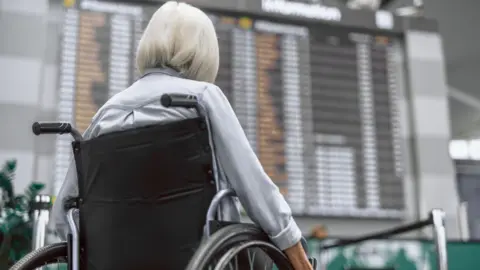
Getty Images Wheelchair user photographed from behind looks at a large departures board in an airportGetty Images

All UK airports should stop charging blue badge holders for being dropped off close to terminals, a disability charity has said.

Several people with blue badges got in touch with the BBC following news that more than half of the busiest airports had raised the so-called “kiss-and-fly” fees to as high as £7 in some cases.

Many airports already offer discounts or waive the fee for disabled drivers, but blue badge holders say the system is complex and inconsistent.

Graham Footer, chief executive of Disabled Motoring UK, said some airports have “allowed greed to cloud their judgement”, and argues people with disabilities should not have to pay the charge at all.

“Disabled customers deserve to be treated with respect and dignity and not fleeced as soon as they arrive,” he said.

Free drop offs

The BBC contacted the 20 busiest airports in the UK to confirm their policy on drop-off charges for blue badge holders.

London City does not charge drop-off fees for any kind of passenger.

Gatwick, Birmingham, Edinburgh, Heathrow, Liverpool John Lennon and Manchester all charge a drop-off fee, but blue badge holders do not have to pay it.

Luton, Glasgow, Belfast International, Belfast City, East Midlands, Aberdeen, and Southampton all charge blue badge holders the same as other passengers for using the drop-off spaces closest to the airport. But they also all offer separate free drop-off parking specifically for blue badge holders elsewhere.

For Glasgow and Aberdeen, this parking is only free if blue badge holders are being dropped off by family or friends – not if they are dropped off by taxi.

All airports offer free drop-off options further from the terminals for all passengers – not just blue badge holders – such as “park and ride” facilities where people can leave their car and take a bus to the airport.

Bristol, Leeds Bradford, and Bournemouth all charge blue badge holders for drop off but allow them to stay for longer than other passengers at a lower fee.

Bristol charges £7 for 40 minutes, Leeds Bradford charges £7 for 60 minutes, and Bournemouth charges £5 for four hours because it said disabled passengers “may require more time”.

Only Cardiff, Newcastle, and Stanstead charge the same fee with no discount at all.

Cardiff charges £3 for 10 minutes, Newcastle charges £5 for 10 minutes, and Stanstead charges £7 for 15 minutes.

Airports UK, which represents the industry, said that the best accessible drop-off for blue badge holders depends on the layout of the airport.

“No one option is ideal at all airports, so to optimise access at each airport the offer will necessarily be different,” it said.

It advised passengers to check the airport’s website before travelling to identify the best drop-off location.

‘You have to jump through hoops’

Most of the airports that waive drop-off fees do so if a disabled driver shows their blue badge at the airport on the day.

However, for Heathrow and Liverpool, the exemption needs to be claimed online or on the phone either before or after travelling. Heathrow says its online process for confirming blue badges can take five days to complete, though it told the BBC it usually takes 48 hours.

James Williams, 67, from London finds these services difficult to use.

“I am a blue badge holder and I have to pay because I am not computer literate,” he says, arguing that “you have to jump through hoops to get this discount”.

James Williams A medium close up of James Williams wearing a grey top and glassesJames Williams

James Williams, a blue badge holder from London, says he ends up paying drop-off fees because he’s “not computer literate”

Jonathan Cassar, 51, from London says the complex nature of online registration means that “disabled people who need to be dropped at terminal cannot be spontaneous as others can”.

Heathrow said it had tried to make the blue badge registration process “as simple as possible” and advised anyone who needs registration urgently to get it approved over the phone.

Liverpool said it had introduced online confirmation “to minimise abuse of the blue badge system”.

‘Not against principle’

Not all blue badge holders feel being charged for airport drop off is unfair.

Gordon Richardson, chair of the British Polio Fellowship Board, is a blue badge holder but says he is “not against the principle” of disabled people paying the same as non-disabled people.

He says what is most important is that the space is accessible and easy to use.

He urges blue badge holders to contact airports before travelling so that the airports can have the staff ready to help them and ensure they get their discount or free parking.

Many of the airports the BBC contacted said their blue badge policies had been drafted in consultation with disability groups and with special consideration for their needs.

Trump selects Airbnb co-founder as first government design head

0


President Trump selected Airbnb co-founder Joe Gebbia this week as the U.S.’s first chief design officer as part of the administration’s push to update the federal government’s design language to be both “usable and beautiful.” 

Gebbia, who joined the Department of Government Efficiency (DOGE) earlier this year and is on the board of Tesla, said Saturday that his directive is to improve government’s services to be as “satisfying to use as the Apple Store: beautifully designed, great user experience, run on modern software.” 

“An experience that projects a level of excellence for our nation, and makes life less complicated for everyday Americans,” the billionaire entrepreneur said in a post on social platform X. 

Gebbia will lead the newly created National Design Studio that will work on making digital services at various federal government agencies more efficient. Trump created the National Design Studio in his Thursday executive order, saying that the new body will advise agencies on how to “reduce duplicative design costs, use standardized design to enhance the public’s trust in high-impact service providers and dramatically improve the quality of experiences offered to the American public.” 

Gebbia, who will help “recruit top creative talent, coordinate with executive departments and agencies (agencies) and devise innovative solutions” in his new role, according to Trump’s executive order, will report to White House chief of staff Susie Wiles. 

The heads of government will “consult” with Gebbia to “implement the America by Design initiative at their respective agencies and shall produce initial results” by July 4, 2026, the executive order said. 

The studio will close down in three years, according to the order. 

Gebbia thanked Trump and his administration Saturday for “creating this vision, and supporting America by Design (@americabydesign).” 

I will do my best to make the U.S. the most beautiful, and useable, country in the digital world,” he added. 

This Nvidia-Backed Stock Just Announced a New Technical Breakthrough That Could Rival Tesla

0


WeRide (WRD), the autonomous driving company backed by Nvidia (NVDA), just unveiled WePilot AiDrive, a revolutionary one-stage end-to-end advanced driver-assistance system (ADAS) that could fundamentally challenge Tesla’s (TSLA) Full Self-Driving (FSD) dominance. This breakthrough represents a significant leap beyond traditional two-stage autonomous systems.

Typically, conventional approaches separate sensing and decision-making into distinct processes. However, WePilot AiDrive integrates both functions into a unified architecture, enabling vehicles to “see and act” simultaneously, mimicking skilled human drivers. This innovation delivers faster response times, efficient routing, and superior fault tolerance compared to existing systems.

Developed in partnership with Tier 1 supplier Bosch, the technology has completed core function validation and is expected to enter mass production later in 2025. The system has showcased remarkable capabilities across complex scenarios, including lane changes in heavy traffic, navigation around unplanned construction, unprotected intersection turns, and intricate interactions with pedestrians and obstacles in urban environments.

www.barchart.com
www.barchart.com

WeRide’s technical advantages are compelling. The scalable computing architecture runs on high-performance platforms while scaling down to mid- and low-power setups through model distillation. Its proprietary middleware decouples algorithms from hardware, enabling rapid adaptation across different platforms. The system supports both pure vision and multi-sensor fusion configurations, providing flexibility that Tesla’s camera-only approach lacks.

The WePilot AiDrive employs extensive driving data to automatically generate training labels and continuously improve performance, a capability that strengthens with each mile driven. This creates a self-improving system that handles edge cases and long-tail scenarios effectively over time.

WeRide has also achieved another milestone: approval for late-night Robotaxi testing in Beijing’s challenging conditions. Equipped with over 20 sensors, including high-precision cameras and LiDARs, the system achieves 360-degree coverage with a 200-meter detection range, ensuring stable operation even in poor lighting and adverse weather.

The Papers: 'Heading for IMF bailout' and 'Border farce!'

0


A leading economist has warned that the economy is at risk of “collapse”.

Homan says order to shutdown Alligator Alcatraz 'not going to stop' ICE operations

0


President Trump’s border czar Tom Homan said on Saturday that a Florida judge’s order to temporarily shut down some of Alligator Alcatraz is “not going to stop” Immigration and Customs Enforcement (ICE) operations, indicating that migrants apprehended by federal agents could be sent to other detention facilities. 

“They’re not going to stop us doing what we’re doing. We’ll follow the judge’s order and we’ll litigate and we’ll appeal it. But [the] bottom line is, we’re going to continue to arrest public safety threats and national security threats every day across this country,” Homan said in an exclusive interview with NewsNation, The Hill’s sister network.

“If we have to send them to another facility. That’s what we’re going to do. That’s why the president has asked for 100,000 beds in the Big, Beautiful Bill. So, we’re going to build 100,000 beds, so we’re not going to have a lack of bed space,” the White House’s border czar told NewsNation’s correspondent Libbey Dean. “For every illegal alien we arrest. We need a bed. And that’s why the 100,000 beds is important. So we’re going to keep doing what we’re doing, and these radical judges make these decisions, they may slow us up a bit, but they’re not going to stop us.” 

U.S. District Judge Kathleen Williams, an appointee of former President Obama, ruled late Thursday that Florida is barred from bringing in more migrants to Alligator Alcatraz and that parts of the facility be temporarily shut down. 

Williams said the Sunshine State has to stop the facility’s expansion, the installation of additional lighting and remove all “generators, gas, sewage, and other waste and waste receptacles that were installed to support this project” within two months.

Florida appealed the decision Friday morning. 

Florida Gov. Ron DeSantis (R) rebuffed Williams’ order, arguing the judge was not “going to give us a fair shake.” 

“This was preordained, very much an activist judge that is trying to do policy from the bench,” the Florida governor said on Friday at an event in Panama City. 

“This is not going to deter us,” DeSantis added. “We’re going to continue working on the deportations, advancing that mission.” 

Homan said the administration follows “every judge’s order while we appeal it and litigate it.” 

“So, it will be shut down in the interim?” Dean asked Homan. 

“I don’t think that decision’s been made yet. We’re, we’re reviewing. Really, it’s a DOJ [Justice Department] question. We’re reviewing the order, and we’ll see where we go from there,” Homan said on Saturday. “We’re not going to defy a court. We just take it to a higher level and appeal it.” 

7 Things You Need To Know About Personal Loan Interest Rates

0


Personal loans can be a smart alternative to credit cards, often offering lower interest rates and a chance to build or strengthen your credit. Your own bank or credit union may have competitive options, but shopping around is key to getting the best rate.

Find Out: 4 Moves to Make if You Can’t Pay All Your Bills this Month

Read Next: The 5 Car Brands Named the Least Reliable of 2025

Before you borrow, it helps to understand the biggest factors that determine what rate you’ll pay. Here are seven key things you need to know about personal loans.

Interest rates on personal loans are determined by larger economic forces and the individual borrower’s credit history and score. Some of the factors that have the biggest impact are:

  • Economic environment: Federal Reserve policy, inflation and overall credit market conditions drive rates up and down.

  • Lender’s risk tolerance: Rates also reflect the lender’s own costs, operational overhead and their risk tolerance for potential loss if a borrower defaults.

  • Borrower-specific factors: Lenders evaluate individual borrowers’ credit scores, debt-to-income (DTI) ratio employment status and repayment history.

Check Out: 8 Smart Ways Frugal People Are Living Like There’s Already a Recession

Of all these factors, credit score plays a big role in the rate you’ll be offered, as it’s the lender’s way of understanding their level of risk in loaning you money.

Higher credit scores (670 and up) may qualify for lower rates, while those with scores in the fair (580 to 669) to poor (below 580) credit tiers may see significantly higher interest rates.

The loan length determines how quickly or slowly you’ll repay the money you’ve borrowed and will also affect how much interest you pay. Shorter-term loans (24 to 36 months) tend to come with lower rates as a kind of incentive for the likely lower risk the lender is taking. Thus, longer-term loans (60 to 84 months) tend to come with higher interest, since there’s a greater likelihood of missed or defaulted payments the longer you have to pay it back.

While a longer-term loan often results in a lower monthly payment, over the life of that loan you’re paying a lot more in interest.

For example: A $10,000 loan at 10% over three years costs around $1,600 in interest. The same loan at 12% over seven years will cost you around $4,800, additionally — a significant amount of money.

There are two main ways that interest can be applied to your loan, either fixed-rate or variable-rate loans.

Indian-UK researchers recreate faces from 2,500-year-old skulls

0


Cherylann Mollan

BBC News

Reporting fromKeeladi, Tamil Nadu
Face Lab/Liverpool John Moores University A digital portrait of one of the skulls excavated from Kondagai, Tamil Nadu, India.Face Lab/Liverpool John Moores University

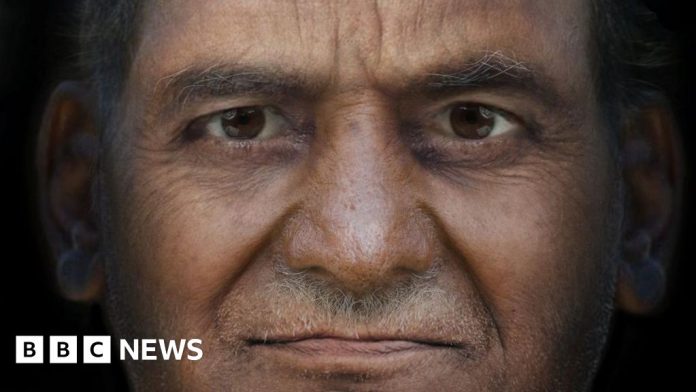
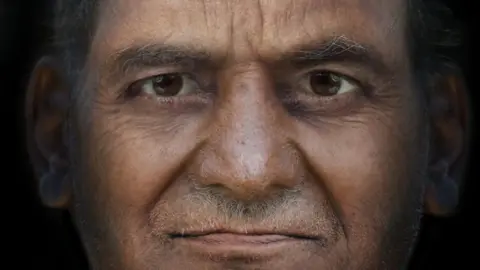
The facial reconstruction of a 2,500-year-old skull excavated at Kondagai

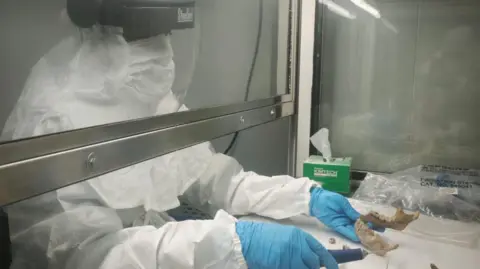
In a modest-sized university lab in the southern Indian state of Tamil Nadu, researchers are using a tiny drill to scrape away enamel from a 2,500-year-old tooth.

Researchers at Madurai Kamaraj University say the tooth belongs to one of two human skulls that they have used as models to digitally reconstruct faces to understand what the region’s early inhabitants might have looked like.

The skulls, both belonging to men, were excavated from Kondagai, an ancient burial site about 4km (2.5 miles) from Keeladi – an archaeological site that has become a political flashpoint in India.

Tamil Nadu state department archaeologists say an urban civilisation dating back to 580BC existed in Keeladi, a claim that adds a new dimension to the story of the Indian subcontinent.

The Indus Valley Civilisation, that emerged over 5,000 years ago in the northern and central parts of present-day India, is the country’s first major civilisation – and narratives around urbanisation have so far been confined to the north.

But state archaeologists say the findings at Keeladi indicate for the first time that an ancient independent civilisation existed in southern India as well.

They say the people of Keeladi were literate, highly-skilled and engaged in trade across the subcontinent and abroad. They lived in brick houses and buried their dead along with daily necessities like food grains and pots in massive burial urns in Kondagai.

Archaeologists have excavated about 50 such urns from the site so far.

Tamil Nadu State Department of Archaeology Burial urns found at Kondagai, Tamil Nadu, India.Tamil Nadu State Department of Archaeology

Burial urns at Kondagai have been found to contain human remains and goods

Researchers at Madurai Kamaraj University are now extracting DNA from human bones and other goods found in these urns to better understand who the inhabitants of Keeladi were and what their lifestyle was like.

But a more profound quest seems to be under way.

“We want to understand our ancestry and the migration routes of our ancestors,” says professor G Kumaresan, who heads the genetics department at the university. “It’s a journey towards answering the larger question of ‘who are we and how did we come to exist here’,” he adds.

The exercise of reconstructing faces of the 2,500-year-old skulls has revealed clues that can answer at least one part of this question.

“The faces mainly have features of Ancient Ancestral South Indians – a population group believed to be the first inhabitants of the Indian subcontinent,” says Prof Kumaresan.

The features also reveal traces of Middle-East Eurasian and Austro-Asiactic ancestries, hinting at global migration and the mixing of ancient population groups. But Prof Kumaresan says that more research is needed to properly establish the ancestries of Keeladi’s residents.

The facial reconstruction of the skulls began with researchers at Madurai Kamaraj University creating 3D scans of the skulls.

These digital scans were then sent to Face Lab at Liverpool John Moores University in the UK. Face Lab specialises in creating digital craniofacial reconstructions using forensic, artistic and scientific principles and technologies.

Experts at the lab used computer softwares to add muscles, flesh and skin to the scans of skulls, bringing out their facial features. These additions were made according to standard human anatomical proportions and measurements.

A researcher uses a drill to extract bone fragments from a human skull at Madurai Kamaraj University in Tamil Nadu, India.

A researcher at work at the ancient DNA lab in Madurai Kamaraj University

Then came the big challenge: adding colour to the images.

This brought up questions like which shade of brown should the men be, what colour should their eyes have and how should their hair look?

Prof Kumaresan says the standard practice of using colours that matched physical traits of people currently living in Tamil Nadu was followed, but the digital portraits still evoked lively discussions on social media.

They underscored longstanding divisions in Indian society – around race, culture and heritage.

Historical narratives championing Aryans (a term commonly used to describe people who settled in the northern part of India) as the “original citizens” of the country clashed with those that ascribed this title to Dravidians (a term used to describe people living primarily in India’s southern states).

India has always been plagued by a north-south divide that stems partly from the popular belief that Indian civilisation – and everything associated with it, like language, culture and even religion – took root in the north and shaped the rest of the country.

But Prof Kumaresan says the facial portraits of the Keeladi skulls reveal a message that’s more complex and inclusive.

“The message we can all take home is that we are more diverse than we realise, and the proof of this lies in our DNA,” he says.

This isn’t the first time that researchers in India have attempted to recreate faces from ancient skulls.

In 2019, scientists reconstructed faces of two skulls found at a cemetery in Rakhigarhi – an important Indus Valley Civilisation site in India. But the sketches lack colour and other physical traits.

“As humans, we have a fascination with faces – our ability to recognise and interpret faces is part of our success as a social species,” says Caroline Wilkinson, who headed the Face Lab team that worked on the Keeladi men.

“These facial depictions also encourage the audience to understand ancient remains as people rather than artefacts, and to establish a connection through personal narrative rather than a wider population history,” she adds.

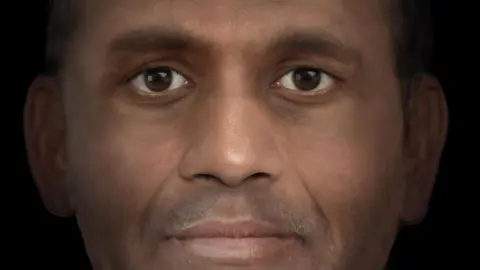
Face Lab/Liverpool John Moores University A digital portrait of the other skull excavated at Kondagai in Tamil Nadu, India.Face Lab/Liverpool John Moores University

A digital portrait of the other skull excavated at Kondagai

At the Madurai Kamaraj University, efforts are under way to study Keeladi as thoroughly as the Indus Valley Civilisation.

“So far, we have learnt that the people of Keeladi were involved in agriculture, trade and cattle-rearing. They kept deer, goats and wild pigs and ate lots of rice and millets,” says Prof Kumaresan.

“Interestingly, we have found evidence that they also consumed dates, even though the date palm isn’t ubiquitous in Tamil Nadu at present,” he adds.

But the most challenging task for his team remains extracting sufficient DNA from human skeletons found at Kondagai to create a gene library. Because the skeletons are badly degraded, the DNA extracted from them is low and of poor quality. But Prof Kumaresan is hopeful that some good will come out of these endeavours.

“Ancient DNA libraries are like portals to the past; they can reveal fascinating insights about life as it was and life as we know it to be,” he says.

Follow BBC News India on Instagram, YouTube, Twitter and Facebook.


Maher commends Newsom for strategy to ‘out-stupid’ Trump

0


Comedian Bill Maher praised California Gov. Gavin Newsom’s (D-Calif.) social media strategy of trying to “out-stupid” President Trump. 

“Gavin Newsom is now trolling Trump. I’ve never seen a Democrat do this. I think it’s very funny… he’s imitating Trump’s exact style,” Maher said Friday during his “Real Time With Bill Maher” show. 

“This is Newsom: ‘And he will fail as he always does, sad. And I, the peacetime governor, our nation’s favorite, will save America once again. Many are calling me the, you know, Gavin Newsom, many say the most loved and handsome governor,’” Maher added, reading a post Newsom made on X.

Newsom and his communications team have tried to mimic Trump’s rhetoric and social media persona in recent days, writing social media posts in all caps and borrowing some words the president uses, like “beautiful.” 

“I feel like Gavin has grasped the essential thing about American culture in this day and age. Don’t try to outsmart people,” Maher said. “You have to out-stupid them.”

Some Democratic strategists have welcomed Newsom’s strategy as the Democratic Party looks to bounce back from losses in November and build up some momentum going into the 2026 midterms. Others, who are close to the administration, said the governor’s attempts are not landing. 

“If he wanted to get under President Trump’s skin, it didn’t work,” one Trump ally told The Hill this week. “I think everyone around here viewed it as comical.”

“Let’s face it, there’s only one Trump,” the person added. 

Vice President Vance, during an interview with Fox Business, argued that the idea that Newsom is “somehow going to mimic Donald Trump’s style, I think that ignores the fundamental genius of President Trump’s political success, which is that he’s authentic.” 

“He just is who he is. You got to be yourself. You actually got to talk to people about the issues,” Vance added. “I don’t think it’s that complicated.”

Earlier this month, Newsom described his efforts as a “no regrets strategy,” telling The Hill that he has to “fight fire with fire” to counter the Texas GOP’s push, blessed by Trump, to redraw Congressional lines ahead of the 2026 midterms. 

The president shot back at Newsom on Wednesday, writing that the California governor is “way down in the polls.” 

“He’s viewed as the man who is destroying the once Great State of California,” the president added. “I will save California!!!”

3 Reasons You Should Buy Apple Stock Ahead of a Major Product Launch

0


When it comes to the rise and fall of Apple stock, there are a number of catalysts investors look out for, and one of them is product launches. Apple consistently moves the market with their new releases, making product drops notable for consumers and investors alike.

Discover More: Self-Made Millionaires Suggest 5 Stocks You Should Never Sell

Find Out: The New Retirement Problem Boomers Are Facing

The tech giant’s annual product releases aren’t just tech events. They’re market-moving moments that not only trigger Apple’s stock price but also the entire industry. If you’re considering adding Apple shares to your portfolio, here are three reasons the experts say to buy ahead of major product launches.

Generally, many analysts recommend buying Apple stock, citing the company’s strong fundamentals and potential for future growth, especially in AI and services. Though 2025 has been a mixed bag for Apple and its CEO, Tim Cook, here are a few key takeaways as to how the stock is currently performing as of Aug. 21, 2025, according to MarketWatch:

So, is Apple stock a buy ahead of major product launches? Here are the things experts say you should consider.

Read Next: Robert Kiyosaki Is Dumping Gold and Silver: Here’s What He’s Buying Instead

You’ve probably heard the phrase “buy the rumor, sell the news.” This means buying a stock in anticipation of a major event that could drive prices up and selling when the news goes public, often at a profit.

Apple is a great example of this phenomenon. Leading up to major product launches, speculation is high. Analysts release bold forecasts, and hedge fund managers start to increase their positions — all of this often skyrockets Apple’s stock price before the actual launch.

“Whenever there’s a product launch or some upcoming news, a big news catalyst that everyone knows about, you’ve got to buy significantly ahead of the news,” said David Capablanca, founder of The Friendly Bear University. “Because when the product comes out, the stock price is already baked in. Everyone already loaded up before the product launch, and then the launch itself becomes what they call a ‘sell the news’ event.”

History repeats itself. So, don’t wait until Apple launches its new products like the iPhone 17 or a new version of iPad Air to buy the stock. Buy the rumor and ride pre-launch momentum.

Every time Apple is about to release a new product, its valuation goes up. Why? Investors and hedge fund managers jump in to buy the stock. As more people buy, Apple’s stock price goes up, and so does its valuation.

Pub and travel bans proposed in sentencing overhaul

0


People convicted of crimes in England and Wales could find themselves barred from going to pubs, concerts and sports matches under changes to sentencing rules being planned by the government.

The reforms would allow courts imposing non-custodial terms to also have the power to hand out driving and travel bans, as well as order offenders to remain in specific areas.

The Ministry of Justice (MoJ) said the changes would “toughen up community punishments” and deter reoffending.

It comes after a recent review of sentencing policy recommended fewer custodial sentences for less serious offences as a way of dealing with overcrowding in prisons.

Courts are currently able to impose limited bans on people convicted of certain offences – for instance, someone found guilty of violence at football matches can be banned from all stadiums.

But the MoJ says it plans to introduce legislation to allow more restrictions to be imposed by judges and magistrates “as a form of punishment for any offence in any circumstance”.

It means offenders could face additional penalties unrelated to their specific offence, with those who break the rules being taken back to court.

Offenders released from prison who are supervised by the Probation Service could also face similar restrictions under the plans – as well as more mandatory drug testing, even if they do not have a history of misuse.

The MoJ said the plans were part of wider sentencing reforms aimed at deterring crime and ensuring prisons never ran out of places for dangerous offenders.

The government began releasing thousands of inmates early soon after coming to power in 2024, saying they had inherited a prison system from the previous Conservative government that was on the brink of running out of spaces.

Justice Secretary Shabana Mahmood said widening the range of sentencing options short of prison time was part of Labour’s plan to cut crime and make streets safer.

“When criminals break society’s rules, they must be punished,” she said.

“Those serving their sentences in the community must have their freedom restricted there too.”

The latest announcement comes in the wake of the MoJ giving details of its plan to place tighter restrictions on serious sexual and violent criminals when they are released from prison, forcing them stay in a specific area.

The government said limiting offenders to a geographical zone, policed by tougher monitoring and enhanced tagging, would give victims greater peace of mind.

Under reforms announced in May, some prisoners in England and Wales will now be eligible for release after serving a third of their sentence.

But this – as well as the early releases – have faced criticism for shifting further pressure on to the probation service and police forces.

The MoJ said new technology will free up the administrative burden on probation officers to increase supervision of the most dangerous offenders.

The MoJ says at least 1,300 new trainee probation officers will be recruited into the service this year, and that the service will receive a £700m funding boost by 2028.