8.3 C
New York
Sunday, May 3, 2026
Home Blog Page 164

Trump went too far on tariffs — the Supreme Court can give him a political out 

0


Unless the Supreme Court rules otherwise, President Trump will soon require approval from Congress to keep in place the broad-based tariffs he has imposed, altering the nation’s social contract and increasing economic inequality.

Trump and his Cabinet have boasted that tariffs, now averaging almost 20 percent, will bring in tens or even hundreds of billions annually in new revenue into federal coffers. Alongside this narrative, administration officials claim that the tariff revenue can replace income taxes to fund government operations and pay interest on the national debt.

But the U.S. Court of Appeals underscored just before Labor Day that tariffs are taxes — and that only Congress has the power to raise taxes.

The International Emergency Economic Powers Act upon which Trump hinges most of his tariffs does not authorize the president to impose tariffs or any other tax, the court ruled. Trump’s unconstitutional use of these emergency powers is particularly poignant because his tariffs, which are expected to raise as much as $3.3 trillion over 10 years, affect a major part of the U.S. economy.

For most of our country’s early history, tariffs served as the federal government’s primary source of revenue. Congress set tariffs, not the president; income and other taxes were later added to cover the cost of major wars and expanding government services. “In the late nineteenth and early twentieth centuries,” according to the majority opinion, “Congress began to delegate to the Executive limited authority to ‘activate or suspend’ tariff rates through international agreements,” as the U.S. became more engaged in global affairs.

Today, in their 7-4 ruling, the judges join a growing number of economists and business analysts who conceptualize tariffs as sales taxes passed along to the citizenry in the form of higher prices. This year’s historic spike in tariffs — coupled with the tax cuts just made permanent by Congress — make the U.S. tax system more regressive by shifting the tax burden toward the lower-income end of the scale.

“Heavy reliance on sales and excise taxes makes tax systems more regressive,” the Institute on Taxation and Economic Policy states in its annual Who Pays? report. “A progressive, graduated rate income tax makes overall tax systems less regressive or more progressive.”

Federal tax policy analysts measuring the effects of suddenly higher and fast-changing tariffs are in a whole new territory. But they can look to states’ experience in weighing the impact and fairness of a variety of taxes, including those on sales, income and property.

At the state level, a proposal to impose a 20 percent sales tax and flatter income tax, as Trump and Congress have essentially just done, would be decried as unfair, because the burden would fall disproportionately on people with lower incomes.

By affirming the appeals court decision, the Supreme Court could provide an off-ramp with political cover for Trump’s administration to back away from tariffs increasingly perceived as harmful to Trump’s working-class base — and bring back the Constitution’s intent that lawmakers control the power of the purse.

To control the national debt, for example, Congress could replace Trump’s jumbled high tariffs with a smaller national sales tax covering both foreign and domestic products. It could also impose a value added tax, as many other countries do. Or national sales taxes could be set slightly higher for imports.

The important thing is that Congress needs to act — and a ruling to that effect could be a win-win if it preserves the separation of powers and gives Trump an escape route from a misguided tariff scheme.

Karl Polzer is founder of the Center on Capital and Social Equity.

Zscaler Stock Falls Despite Strong Outlook. Is It Time to Jump Into the Stock?

0


  • The cybersecurity provider turned in solid results for its fiscal fourth quarter.

  • Zscaler is seeing strong momentum in newer vectors, such as AI security.

  • A closer look points to revenue growth accelerating in the new fiscal year.

  • 10 stocks we like better than Zscaler ›

While Zscaler (NASDAQ: ZS) stock has had a strong run this year, the momentum shifted after the cybersecurity company reported its fiscal 2025 fourth-quarter results following the close of trading Tuesday. Though the period’s numbers were good, and management issued upbeat guidance, the stock sank 4% in Wednesday trading. However, even after the pullback, the stock is still up by about 50% year to date.

Let’s take a closer look at the company’s results and guidance to see if Wednesday’s dip has created a buying opportunity.

While endpoint cybersecurity companies like CrowdStrike (NASDAQ: CRWD) and Palo Alto Networks (NASDAQ: PANW) tend to get more attention from investors, Zscaler has carved out an important niche in a fast-growing part of the cybersecurity sector. It’s focused on zero trust security, which is built around the idea that no individual user or device should automatically be trusted, even if it was previously found to be trustworthy. That means that all users’ access to various platforms must be verified, authorized, and then regularly revalidated.

The rise of artificial intelligence (AI) and AI agents, meanwhile, has only added to the complexity of the cyberthreat landscape. This is leading to growth in newer areas for Zscaler, including AI Security, Zero Trust Everywhere, and Data Security Everywhere, which combined to exceed $1 billion in annual recurring revenue (ARR) in its fiscal Q4, which ended July 31. The company is also working on solutions to secure agent-to-agent and agent-to-application communications.

All of this helped Zscaler achieve robust revenue growth. In the quarter, its revenue climbed 21% year over year to $719.2 million, easily surpassing management’s prior guidance for revenue of between $705 million and $707 million. Adjusted earnings per share (EPS) climbed to $0.89 from $0.72 a year earlier. That was also well ahead of the company’s $0.79 to $0.80 forecast.

Zscaler generated operating cash flow of $250.6 million and free cash flow of $171.9 million. It ended the period with $3.6 billion in cash and short-term investments on its balance sheet and $1.7 billion in debt in the form of convertible notes. It also completed the acquisition of managed detection and response specialist Red Canary for an undisclosed sum right after the quarter ended, so that cash position is likely to come down.

JMU’s icy white threads top best Week 2 college football uniforms

0


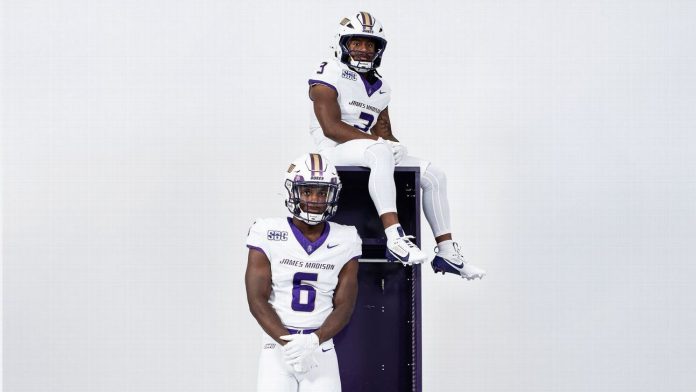
When you’re looking to make a statement in the College Football Playoff race, it’s always wise to keep style in mind.

The James Madison Dukes cruised in their Week 1 opener against Weber State, but will hit the road for a major test against the Louisville Cardinals in Week 2. Playing under the lights Friday night (7 p.m. ET, ESPN2), the Sun Belt contenders will look to pull off a power conference upset and assert themselves as an early contender for the top Group of 5 team in the country.

The Dukes will contrast the Friday night sky with their uniforms — a simple but clean all-white look.

Accenting the white threads will be the school’s primary colors, purple and gold, featured on the jersey’s numbers and nameplate as well as on a stripe running down the center of the helmets.

James Madison won’t be the only team bringing uniform heat this weekend. Here are some of the top uniforms from Week 2 of the college football season.

Local pride

You might have heard of the Idaho Vandals. But how about the Idaho Fightin’ Taters?

No? Don’t worry, it’s a limited-time moniker — in its Week 2 home opener against the St. Thomas-Minnesota Tommies, Idaho football will don helmets that feature the text “Fightin’ Taters.” The helmet pays homage to the state’s deep connection with the potato industry. The distinctive black lid will be paired with a matching all-black jersey and pants set, completing a look that’s memorable and sleek.

Speaking of a school honoring its location, the SMU Mustangs are making clear what city their program represents with their uniforms.

The Mustangs’ Dallas threads come with a number of unique elements — most noticeably, the jersey has the city’s name in script on the front, as opposed to the customary “SMU.” Dallas is honored on the helmets as well, as the school’s red mustang motif is placed inside the negative space of a “D” outline.

The UTEP Miners call El Paso, Texas — nicknamed the Sun City — home, and the team is paying homage to the city’s moniker on its helmets this week.

The lids feature a unique logo design that includes the nickname positioned under a mountain sunset, with the negative space between the “Sun City” text and sunset forming the Miners’ traditional pickaxe emblem. The sun rays take inspiration from El Paso’s city flag.

It’s a standard blue and white uniform for the Buffalo Bulls this week, but with one notable twist on the helmet art.

This week’s helmets for the Bulls will prominently feature the numbers 716 on one side, an homage to the city of Buffalo’s traditional area code.


Slick threads

You won’t find many color schemes as pretty as the one the Rice Owls are rolling with this Saturday.

The light blue the Owls are repping is already easy on the eyes, but what really makes the uniform are the colors accenting that shade. Navy complements the baby blue on helmets and shoulder sleeves, and the numbers are outlined in red, creating a look akin to the powder blue threads once donned by the Houston Oilers.

The Mississippi State Bulldogs host the No. 12 Arizona State Sun Devils on Saturday, seeking to pull off a major upset in a prime-time kickoff.

The Bulldogs’ uniforms reflect the nighttime kickoff — the team is going with an all-black look for the SEC vs. Big 12 matchup. The black helmet, jersey and pants are complemented by maroon stripes that run across the shoulder sleeves and down the center of the helmet.

It’s easy to score a hit with all-white threads, and the Liberty Flames are rolling with their own variation of the classic look against Jacksonville State.

In addition to a clean script “Liberty” on the front of the jersey, the distinguishing feature of the Flames’ uniforms comes on the helmet. Instead of the school’s name or logo, the helmet features a cartoon eagle in mid-throwing motion.

After an all-gold Week 1, the Minnesota Golden Gophers are sticking with the color-rush style theme for Week 2.

This time, Minnesota is going all-in on the school’s other primary color, maroon. The Golden Gophers will don maroon pants, jerseys and helmets this week, with the helmet featuring an outline of Goldy Gopher as opposed to the standard block M design.


Arrests made at rally against Palestine Action ban in London

0


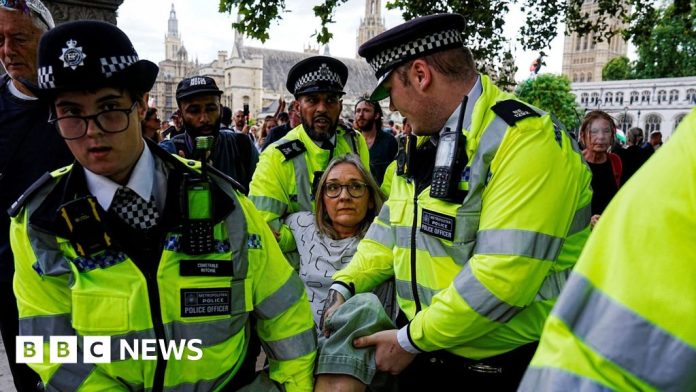
Police have started arresting protesters at a demonstration against the government’s ban of the campaign group Palestine Action.

Hundreds of people have gathered in Parliament Square in central London, some waving Palestinian flags and chanting “free Palestine”. Others held placards saying: “I oppose genocide, I support Palestine Action.”

Officers have been seen carrying people out of the crowd, after some protesters said they planned to refuse bail and go “floppy” if they were arrested.

The Metropolitan Police had earlier warned that people showing support for the group, which has been proscribed under terrorism law, would face arrest.

The government proscribed Palestine Action under the Terrorism Act in July, making membership of or support of the group a criminal offence, punishable by up to 14 years in prison.

Saturday’s protest follows a major demonstration last month which saw more than 500 people arrested for displaying placards in support of Palestine Action.

The average age of those arrested at the August rally was 54, and the most arrests – 147 of them – were of people aged between 60 and 69.

Kilmar Abrego Garcia threatened with deportation to Eswatini

0


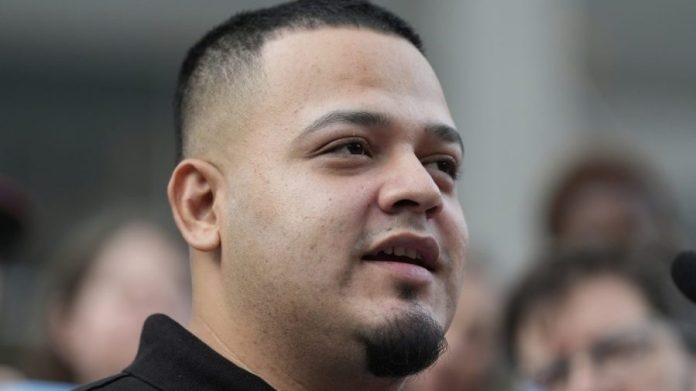
The Trump administration notified Kilmar Abrego Garcia’s team that immigration authorities are looking to deport the Salvadorian national to Eswatini, a small nation in southern Africa, according to multiple news outlets

A Department of Homeland Security (DHS) official said in an email that Abrego Garcia’s attorneys told the department that their client, who entered the U.S. illegally when he was young, that he fears “prosecution or torture” in Uganda, where the administration previously sought to deport him. 

“That claim of fear is hard to take seriously, especially given that you have claimed (through your attorneys) that you fear persecution or torture in at least 22 different countries,” an Immigration and Customs Enforcement (ICE) official said. 

“Nonetheless, we hereby notify you that your new country of removal is Eswatini, Africa,” the official added. 

The Hill has reached out to DHS for comment. 

The push marks the administration’s latest effort to deport Abrego Garcia, whom Trump officials have accused of being a member of the notorious MS-13 gang. The Salvadorian national and his legal team have denied the allegations.

Abrego Garcia is currently being held at an immigration detention facility in Virginia. 

Earlier this year, the administration sent the man, who was living in Maryland under a temporary protective order, to a notorious mega-prison in El Salvador despite an order from a judge barring the deportation to the country in Central America. He was later moved to a different prison and the Supreme Court ruled that the U.S. had to facilitate his return.

The Trump administration brought Abrego Garcia back to the U.S. in June, where he faced criminal charges in Tennessee. He has pleaded not guilty in that case and has fought for the case to be dismissed.

Eswatini is one of the few African nations that have accepted migrants that the U.S. has deported in recent weeks. The administration sent five men, all of whom have criminal backgrounds and convictions, to the small nation in July. 

Robinhood Soars on S&P 500 Inclusion as Strategy Gets Snubbed

0


Shares of Robinhood jumped 7% in after-hours trading Friday after the retail brokerage was named to the S&P 500.

Key Takeaways:

  • Robinhood shares jumped 7% after being added to the S&P 500, joining the index on September 22.

  • Strategy, despite a $95B valuation and $70B in Bitcoin holdings, was left out of the reshuffle.

  • Robinhood posted strong Q2 earnings, with $989M in revenue and $386M in profit.

Robinhood (HOOD) closed just above $101 and soared past $108 in extended trading following the announcement.

The company’s share price has climbed over 150% year-to-date, driven by strong earnings and growing retail interest in stocks and crypto.

Robinhood will officially join the index on September 22, alongside ad-tech firm AppLovin, according to S&P Dow Jones Indices.

While Robinhood celebrates its inclusion, Strategy, the Bitcoin treasury firm formerly known as MicroStrategy, was left off the list, despite meeting S&P’s $20 billion market cap requirement.

Strategy, which now holds more than $70 billion in Bitcoin, saw its shares fall 3% in after-hours trading following the announcement.

The omission surprised some observers, given Strategy’s $95 billion valuation and its pioneering role in bringing Bitcoin to public balance sheets.

Based in Tysons Corner, Virginia, the company has become synonymous with corporate crypto adoption.

The S&P reshuffle comes amid rising institutional interest in digital assets and a more favorable political environment.

Earlier this year, Coinbase was added to the S&P index, signaling growing recognition of crypto-native companies in traditional financial markets.

Robinhood’s strong fundamentals further fueled its rally. In Q2, the company posted $989 million in revenue, up 45% year-over-year, beating Wall Street estimates.

Net income hit $386 million, with earnings per share of $0.42, well above analyst forecasts.

Crypto trading revenue came in at $160 million, nearly doubling year-over-year but down from the previous quarter’s $252 million.

Meanwhile, income from options trading and equities reached $265 million and $66 million, respectively, making options Robinhood’s top revenue stream once again.

Last month, Robinhood Derivatives took legal action against regulators in Nevada and New Jersey, accusing the states of unfairly blocking its entry into the sports event contracts market, despite recent federal court rulings in favor of rival platform Kalshi.

The firm said it began offering event contracts in both states after federal judges ruled earlier this year that Nevada and New Jersey gaming regulators could not enforce their bans against Kalshi, which offers contracts regulated by the U.S. Commodity Futures Trading Commission (CFTC).

Robinhood argued that regulators have ignored those rulings and continued to threaten enforcement action, creating an uneven playing field.

“If state regulators are permitted to act against Robinhood but not Kalshi, then Robinhood will lose out in the sports event contracts space,” the company said in its filings.

Meanwhile, Robinhood has come under regulatory fire in the EU after launching tokenized stock products linked to private companies like OpenAI and SpaceX.

The Bank of Lithuania confirmed it is investigating the legality and investor disclosures related to these blockchain-based “Stock Tokens,” which launched on June 30.

OpenAI publicly disavowed any connection, stating it never approved the tokens and warning investors to be cautious.

Read original story Robinhood Soars on S&P 500 Inclusion as Strategy Gets Snubbed by Amin Ayan at Cryptonews.com

Nigel Farage shifts on two-week small boats pledge

0


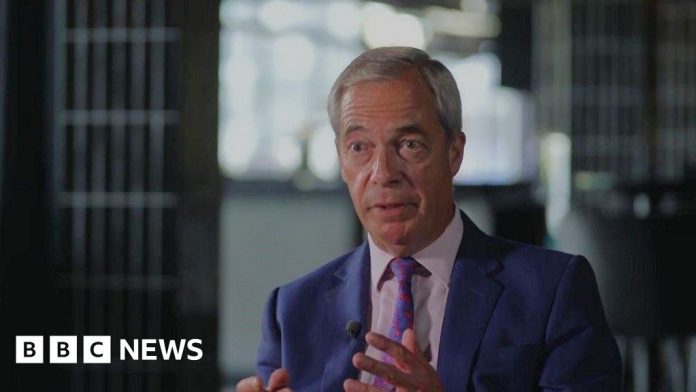
Reform UK leader Nigel Farage has shifted on his pledge to stop migrants arriving on small boats within two weeks of entering government if they win power.

Farage told the BBC’s Sunday with Laura Kuenssberg programme that he would stop the boats within two weeks of passing laws that he says would allow him to deport migrants quickly.

When asked if passing those laws could take months, Farage said a government led by him would “want to do it as quickly as we possibly can”.

The two week pledge was one of the standout announcements of Farage’s keynote speech to his party’s conference in Birmingham on Friday.

He told activists: “We will stop the boats and we will detain and deport those who illegally break into our country.”

He said this was what “nearly every normal country around the rest of the world does”.

“You cannot come here illegally and stay. We will stop the boats within two weeks of winning government,” he added.

In plans announced last month, Reform UK suggested it would be prepared to deport 600,000 migrants over five years if it won power at the next general election.

Farage said his party would bar anyone who came to the UK on a small boat from claiming asylum and make £2bn available to offer payments or aid to countries like Afghanistan to take back migrants.

Key to the plan is the passage of a new law called the Illegal Migration (Mass Deportation) Bill.

Reform UK said the bill would create a legal duty for the home secretary to remove illegal migrants, and ban anyone who had been deported from re-entering the UK for life.

The bill would also “disapply” international treaties like the Refugee Convention, a 1951 treaty that prevents signatory countries like the UK from returning refugees to countries where they face serious threats to their life or freedom.

When asked how that would work, given the complexities and typical timelines of passing legislation, Farage told Laura Kuenssberg: “As soon as the law is in place. As soon as you have the ability to detain and deport, you’ll stop it in two weeks.”

Citing Australian policies, Farage said once the country had “the legal base” to tow small boats back to Indonesia they solved the problem in two weeks.

Under former Australian Prime Minister Tony Abbott’s offshore detention policy, asylum-seeker vessels were controversially turned back to Indonesia and would-be refugees sent to Papua New Guinea and Nauru in the Pacific for processing and resettlement.

In June 2014, Abbott said Australia had marked six months since the last asylum-seeker boat arrival in December 2013 – a few months after he took office.

When Farage was asked if he was making promises he could not keep, he said he meant what he said about mass deportations.

He accused other political parties of telling “the electorate what they think the electorate want to hear without every intending to deliver it”.

Farage has also said he mis-spoke when he said he bought a house in his Clacton constituency before the last general election, telling Sky News that his partner had bought the property.

He said: “I should have said ‘we’. All right? My partner bought it, so what?” adding, “I own none of it. But I just happen to spend some time there.”

He added: “I should have rephrased it. I didn’t want…to put her in the public domain.”

Watch the full interview with Farage on Sunday with Laura Kuenssberg at 0900 BST on BBC One and on BBC Iplayer.

Appeals court rules against Trump's effort to cut nearly $5M in foreign aid

0


A federal appeals court on Friday ruled against President Trump’s effort to cut billions of dollars of foreign aid that was previously approved by Congress through “pocket rescissions.”

The U.S. Court of Appeals for the District of Columbia Circuit, in a 2-1 decision, refused to block a lower court ruling from earlier this week that said the administration must release the preapproved funding and ruled the effort to withhold it was likely illegal. 

The three-judge panel did not elaborate on their ruling, writing that “appellants have not satisfied the stringent requirements for a stay pending appeal.” 

Justices Cornelia Pillard and Florence Pan — appointed by former Presidents Obama and Biden, respectively — supported the lower court decision, while Judge Justin Walker, an appointee of Trump, dissented.

The ruling came two days after U.S. District Judge Amir Ali that condemned the administration’s unwillingness to spend the funds appropriated by law. 

“Defendants’ reasons for not developing an argument here over the numerous months and opportunities given may be many, including that, even having changed their position, there is not a plausible interpretation of the statutes that would justify the billions of dollars they plan to withhold,” Ali said Wednesday in his 43-page ruling.

He added, “Whatever the reason, Defendants have given no justification to displace the bedrock expectation that Congress’s appropriations must be followed and that absent a ‘claim of unconstitutionality that has not been rejected by final Court order, the Executive must abide by statutory mandates.'”

In late August, Trump notified Congress of his intention to claw back $4.9 billion in funding allocated to the State Department and the U.S. Agency for International Development (USAID) utilizing a rare “pocket rescission.” 

The effort to rescind the funding was met with opposition from Senate Appropriations Committee Chair Susan Collins (R-Maine), who called it an “attempt to undermine the law.”

Access to this page has been denied.

0


Access to this page has been denied because we believe you are using automation tools to browse the
website.

This may happen as a result of the following:

  • Javascript is disabled or blocked by an extension (ad blockers for example)
  • Your browser does not support cookies

Please make sure that Javascript and cookies are enabled on your browser and that you are not blocking
them from loading.

Reference ID: #65f10940-8b22-11f0-a07d-e302261f2b48

Nigel Farage shifts on two-week small boats pledge

0


Joshua NevettPolitical reporter

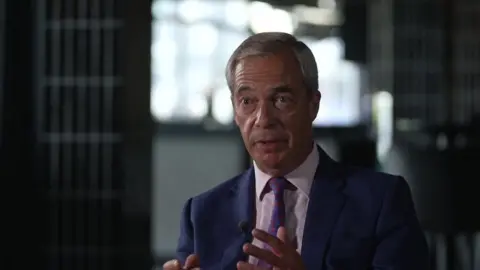
BBC Nigel Farage, dressed in a dark suit and tie, stares intently at the cameraBBC

Reform UK leader Nigel Farage has shifted on his pledge to stop migrants arriving on small boats within two weeks of entering government if they win power.

Farage told the BBC’s Sunday with Laura Kuenssberg programme that he would stop the boats within two weeks of passing laws that he says would allow him to deport migrants quickly.

When asked if passing those laws could take months, Farage said a government led by him would “want to do it as quickly as we possibly can”.

The two week pledge was one of the standout announcements of Farage’s keynote speech to his party’s conference in Birmingham on Friday.

He told activists: “In his conference speech on Friday, Farage said: “We will stop the boats and we will detain and deport those who illegally break into our country doing what nearly every normal country around the rest of the world does.

“You cannot come here illegally and stay we will stop the boat within two weeks of winning government.”

In plans announced last month, Reform UK suggested it would be prepared to deport 600,000 migrants over five years if it won power at the next general election.

Farage said his party would bar anyone who came to the UK on a small boat from claiming asylum and make £2bn available to offer payments or aid to countries like Afghanistan to take back migrants.

Key to the plan is the passage of a new law called the Illegal Migration (Mass Deportation) Bill.

Reform UK said the bill would create a legal duty for the home secretary to remove illegal migrants, and ban anyone who had been deported from re-entering the UK for life.

The bill would also “disapply” international treaties like the Refugee Convention, a 1951 treaty that prevents signatory countries like the UK from returning refugees to countries where they face serious threats to their life or freedom.

When asked how that would work, given the complexities and typical timelines of passing legislation, Farage told Laura Kuenssberg: “As soon as the law is in place. As soon as you have the ability to detain and deport, you’ll stop it in two weeks.”

Citing Australian policies, Farage said once the country had “the legal base” to tow small boats back to Indonesia they solved the problem in two weeks.

Under former Australian Prime Minister Tony Abbott’s offshore detention policy, asylum-seeker vessels were controversially turned back to Indonesia and would-be refugees sent to Papua New Guinea and Nauru in the Pacific for processing and resettlement.

In June 2014, Abbott said Australia had marked six months since the last asylum-seeker boat arrival in December 2013 – a few months after he took office.

When Farage was asked if he was making promises he could not keep, he said he meant what he said about mass deportations.

He accused other political parties of telling “the electorate what they think the electorate want to hear without every intending to deliver it”.

Watch the full interview with Farage on Sunday with Laura Kuenssberg at 0900 BST on BBC One and on BBC Iplayer.