
18.4 C
New York
Sunday, May 10, 2026
Home Blog Page 271

Congress should create a public AI wealth fund

0


Artificial intelligence threatens to cause a jobs shock across offices, warehouses, call centers, clinics, classrooms and more. Faced with backlash among displaced workers, the industry and its lobbyists will likely lean on cash‑transfer schemes — universal basic income and its like — as a release valve. 

That path would paper over dislocation while entrenching gatekeepers. It would weaken bargaining power at work and create new and unintended social and fiscal dependencies.

We can do better than that. We have an opportunity instead to bend the trajectory, level the playing field and ensure that the public that pays for the externalities of AI also benefits from its returns. 

What does this entail? Open and contestable markets; modern data rights; liability that governs control; guard-railing technological change to serve the shared good; and most importantly, public sharing in AI’s upside.

The U.S. should establish a professionally managed, firewall‑insulated Public AI Wealth Fund that holds diversified stakes across the AI stack and distributes an annual dividend tied to the AI upside (i.e. realized returns).

This would put the focus on public dividends, not basic income; it would give the public a meaningful, lasting stake in AI’s returns, while using competition, data, labor and energy rules to keep the field open and the harms in check.

The deal between Nvidia and AMD and the U.S government, which involves payments of 15 percent of revenue from sales of some advanced chips, provides precisely the platform to kick-start the creation of this Public AI Wealth Fund.

Capitalize it with equity warrants from firms receiving large subsidies, tax credits or preferential contracts; a compute excise above thresholds set by rulemaking; a windfall‑profits surtax on extraordinary AI margins; and location‑based fees where data centers draw on subsidized energy or water. 

Adopt a simple fiscal rule: preserve principal and pay a universal dividend from realized returns. Dividends will start off modest and grow as the fund matures, aligning public returns with performance rather than with permanent deficit finance.

Sharing in the upside should complement — not replace — open markets and individual economic choice.

Congress should treat exclusive deals as presumptively anticompetitive once market‑share triggers are met; bar self‑preferencing in AI marketplaces; and scrutinize “model‑plus‑platform” tie‑ups as potential vertical restraints. Interoperability and portability — APIs, export formats, and the ability to move fine‑tunes — should be the default, with clear timelines and contractual exit rights. These rules ensure the public is not forced to buy into entrenched barriers.

Individuals need a clear opt‑out for the use of personal data in training, a right to know whether their data was used, and remedies for unauthorized use. For high‑risk uses — hiring, housing, health care, finance and critical infrastructure — deployers should bear a duty of care: documented impact assessments, human‑in‑the‑loop plans, incident reporting, and audit trails. The burden should rest on those who profit from deployment to show they have met these duties.

The Federal Trade Commission can scrutinize deceptive AI claims, dark patterns and data misuse. The Justice Department and the FTC can challenge exclusionary bundles and exclusivity in contracts. The Securities and Exchange Commission can require disclosure of material workforce impacts from AI deployments, not just AI “strategies.” Civil‑rights agencies can enforce explainability, auditing and appeal rights in automated decisions. Energy and water regulators can require facility‑level reporting from hyperscale data centers and condition interconnects on demand‑response and conservation plans.

The executive branch and states should move in parallel. States should seed their own AI wealth funds with data‑center and related revenues and equity warrants tied to subsidized projects, coordinated with — but independent from — the national fund. A federated research cloud across universities, national labs and state innovation hubs would give academia and students access to shared AI infrastructure without having to depend on vendor credits.

Ask schools, employers and hospitals which systems they use, how they were evaluated, and how you can appeal decisions. Insist that public dollars tied to AI come with ownership, transparency and exit rights.

Talk to your elected officials and those that are running for office; tell them it is time for our nation to build a Public AI Wealth Fund.

John deVadoss was a general manager at Microsoft for two decades. He did his Ph.D. work in AI, at the University of Massachusetts at Amherst, specializing in Machine Learning.

Best CD rates today, August 23, 2025 (best account provides 4.4% APY)

0


Find out how much you could earn by locking in a high CD rate today. The Federal Reserve cut its federal funds rate three times in 2024, so now could be your last chance to lock in a competitive CD rate before rates fall further. CD rates vary widely across financial institutions, so it’s important to ensure you’re getting the best rate possible when shopping around for a CD.

The following is a breakdown of CD rates today and where to find the best offers.

Generally, the best CD rates today are offered on shorter terms of around one year or less. Online banks and credit unions, in particular, offer the top CD rates.

As of August 23, 2025, the highest CD rate is 4.4% APY offered by Marcus by Goldman Sachs on its 6-month CD. There is a $500 minimum opening deposit.

Here is a look at some of the best CD rates available today:

The amount of interest you can earn from a CD depends on the annual percentage rate (APY). This is a measure of your total earnings after one year when considering the base interest rate and how often interest compounds (CD interest typically compounds daily or monthly).

Say you invest $1,000 in a one-year CD with 1.81% APY, and interest compounds monthly. At the end of that year, your balance would grow to $1,018.25 — your initial $1,000 deposit, plus $18.25 in interest.

Now let’s say you choose a one-year CD that offers 4% APY instead. In this case, your balance would grow to $1,040.74 over the same period, which includes $40.74 in interest.

The more you deposit in a CD, the more you stand to earn. If we took our same example of a one-year CD at 4% APY, but deposit $10,000, your total balance when the CD matures would be $10,407.42, meaning you’d earn $407.42 in interest. ​​

Read more: What is a good CD rate?

When choosing a CD, the interest rate is usually top of mind. However, the rate isn’t the only factor you should consider. There are several types of CDs that offer different benefits, though you may need to accept a slightly lower interest rate in exchange for more flexibility. Here’s a look at some of the common types of CDs you can consider beyond traditional CDs:

  • Bump-up CD: This type of CD allows you to request a higher interest rate if your bank’s rates go up during the account’s term. However, you’re usually allowed to “bump up” your rate just once.

  • No-penalty CD: Also known as a liquid CD, type of CD gives you the option to withdraw your funds before maturity without paying a penalty.

  • Jumbo CD: These CDs require a higher minimum deposit (usually $100,000 or more), and often offer higher interest rate in return. In today’s CD rate environment, however, the difference between traditional and jumbo CD rates may not be much.

  • Brokered CD: As the name suggests, these CDs are purchased through a brokerage rather than directly from a bank. Brokered CDs can sometimes offer higher rates or more flexible terms, but they also carry more risk and might not be FDIC-insured.

Hawaii’s Kilauea volcano erupts creating lava fountain

0


Huge fountains of lava have sprayed 100ft into the air in the most recent eruption of Hawaii’s Kilauea volcano.

Video released by the United States Geological Survey (USGS) shows Kilauea, located on Hawaii’s Big Island, erupting for the 31st time in less than a year – making it one of the world’s most active volcanoes.

Fresh lava began to spew out of the volcano at about 14:04 local time (01:04 BST).

The volcano’s activity is closely monitored, and this new incident did not threaten any homes.

US seeks to deport Abrego Garcia to Uganda

0


The federal government said it would deport Kilmar Abrego Garcia to Uganda after he declined a plea deal, according to court filings.

Federal prosecutors on Thursday offered Abrego Garcia the option to “live freely” with refugee or residency status in Costa Rica after serving prison time for federal human smuggling charges in exchange for a guilty plea, per his lawyers in the Saturday filings.

Abrego Garcia, who was mistakenly deported to a notorious prison in his native El Salvador, declined the offer on Friday to instead return to his family in Maryland. He had been imprisoned in a Tennessee jail.

After his return to Maryland, Abrego Garcia’s attorneys were notified later in the day that he must report to an Immigration and Custom Enforcement (ICE) field office in Baltimore on Monday — and that the Department of Homeland Security (DHS) intends to deport him to Uganda.

Uganda is one of the latest countries to strike an agreement with the Trump administration to accept deportees. But some critics have sounded the alarm over human rights violations in the East African country.

“The only thing that happened between Thursday—Costa Rica—and Friday—Uganda— was Mr. Abrego’s exercise of his legal entitlement to release under the Bail Reform Act and the Fifth Amendment…,” Abrego Garcia’s defense team wrote.

“There can be only one interpretation of these events: the [Justice Department], DHS, and ICE are using their collective powers to force Mr. Abrego to choose between a guilty plea followed by relative safety, or rendition to Uganda, where his safety and liberty would be under threat.”

The Friday release from prison is the first time Abrego Garcia has been outside custody since March, when he was deported due to an “administrative error” and sent to a megaprison in El Salvador despite an immigration judge barring his return to his home country in 2019.

The Trump administration has previously mused about deporting Abrego Garcia to a third country.

DHS Secretary Kristi Noem on Friday condemned the El Salvadorian native’s release, calling it a “new low.”

“Today, we reached a new low with this publicity hungry Maryland judge mandating this illegal alien who is a MS-13 gang member, human trafficker, serial domestic abuser, and child predator be allowed free,” she said in a statement.

Abrego Garcia’s attorneys did not offer any additional comments on the matter, and DHS did not immediately respond to inquiries.

Why a famed strategist says the government bond market could spoil a fragile bull rally

0


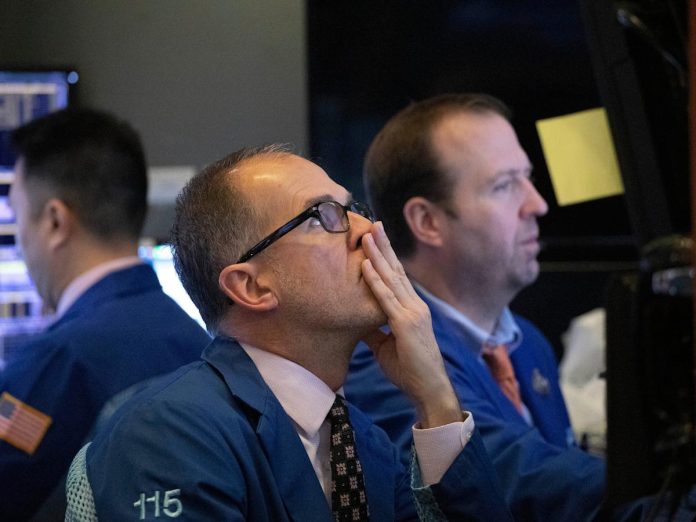
FILE - In this Jan. 2, 2020, file photo traders monitor stock prices at the New York Stock Exchange. The U.S. stock market opens at 9:30 a.m. EST on Thursday, Jan. 9. (AP Photo/Mark Lennihan, File)
FILE – In this Jan. 2, 2020, file photo traders monitor stock prices at the New York Stock Exchange. The U.S. stock market opens at 9:30 a.m. EST on Thursday, Jan. 9. (AP Photo/Mark Lennihan, File)Associated Press
  • Albert Edwards warns of a tech stock bubble amid high valuations.

  • The tech sector is now 37% of the US stock market, surpassing the dot-com era peak.

  • But rising bond yields will eventually stop the rally, Edwards said.

Like the high market valuation levels he warns about, Société Générale strategist Albert Edwards‘ bearish missives don’t tend to serve well as near-term market timing tools.

He acknowledges as much.

“An equity investor who heeded my words of caution on the US Tech ‘bubble’ will by now have taken to sticking pins in plasticine models of me,” Edwards wrote in an August 21 note to clients. “Indeed, my ankle has been hurting for over six months and although the physio says it is tendonitis, I strongly suspect otherwise.”

But there’s no denying that Edwards, a stark contrarian amid the pervasively bullish attitude on Wall Street these days, has some concerning observations about where the market sits — particularly with respect to tech stocks, and in the context of government bond yields.

Building on his argument that the market is in a bubble, he highlighted in his latest note that the tech sector now makes up 37% of the total US market, which is higher than at the peak of the dot-com bubble in 2000. Over the last few years, investors have piled into tech amid the frenzied excitement about AI.

tech sector
SOCIETE GENERALE

Another metric showing that the tech sector has historically high valuations is a falling free cash flow yield. This means that current market prices are high relative to cash flow after expenses as tech firms dump money into AI development. The sector has a free cash flow yield of around two. This is also reflected in the S&P 500’s low dividend yield of 1.2%.

Meanwhile, long-term government bond yields have surged at the same time as the tech rally, and offer virtually risk-free yields of over 4%.

The ratio of 10-year Treasury yields to the market’s dividend yield has climbed to dot-com era levels.

10y bond yield vs stock market dividend yield
SOCIETE GENERALE

Historically, rising bond yields have weighed on stock valuations, but that hasn’t seemed to be the case so far in this market. Edwards says it’s only a matter of time until that changes.

“Only the other day, interest rates were rock bottom and equity bulls were telling us that sky high equity valuations were justified by TINA — There Is No Alternative,” he wrote. “But that TINA magic no longer works, now that interest rates are so much higher. So, how come the equity market is able to shrug off the relentless rise in long bond yields by feeding off news of strong profits from a handful of mega-cap tech stocks and the promise of more to come?”

Eberechi Eze: Arsenal sign forward from Crystal Palace

0


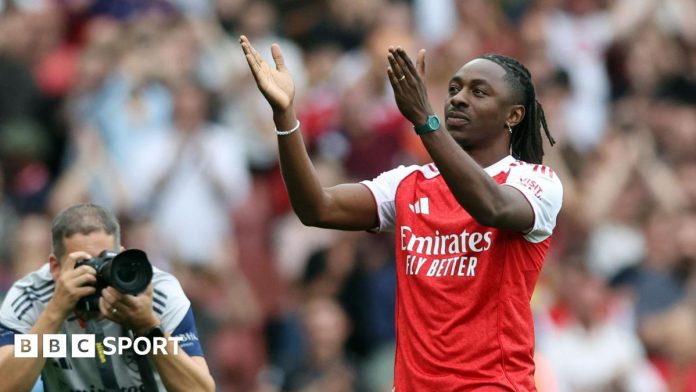
Arsenal have completed the signing of England forward Eberechi Eze from Crystal Palace.

The Gunners agreed a deal worth £60m, including £8m in add-ons, for the 27-year-old to become their seventh summer signing.

Eze had been one of Tottenham’s prime targets this summer and Spurs had agreed terms with both Palace and Eze.

But Spurs’ north London rivals then made a move for Eze on Wednesday and the boyhood Arsenal fan chose to rejoin the Gunners having started his youth career with the club.

A relaxed Eze, wearing an Arsenal shirt and jeans, sauntered out to a rapturous reception from fans before the match against Leeds.

Sporting director Andrea Berta described Eze as a “creative and explosive talent with huge technical quality”.

Manager Mikel Arteta said: “He is a powerful and exciting player who will give us a new dimension in our attacking game. What stands out just as much as his talent and intelligence as a player, is the way he has worked hard throughout his career to get where he is today.

“His journey, his mentality and his ambition are exactly what we want in our team, and we love how much it means to him and his family to be joining our club.”

Wall Street Journal hammers DOJ over Bolton raid: Trump ‘the real offender here’

0


The Wall Street Journal slammed the raid of President Trump’s former national security adviser John Bolton’s home on Friday, labeling it a part of the president’s “vendetta campaign.”

Law enforcement said the investigation into Bolton was over classified records stored at his residence in Bethesa, Md. But, the Journal argued the probe reeks of political “retribution.”

“It’s hard to see the raid as anything other than vindictive. Mr. Bolton fell out of Mr. Trump’s favor in the first term and then wrote a book about his experience in the White House while Mr. Trump was still President. Mr. Trump tried and failed to block publication,” a Friday op-ed from the outlet reads, referencing Bolton’s 2020 book.

“The President then claimed Mr. Bolton had exposed classified information, though the book had gone through an extensive pre-publication scrub at the White House for classified material,” it continues. 

The Journal says Trump is “out for blood,” citing other blows to Bolton, including the president’s January decision to nix his security detail.

Bolton has made frequent cable appearances critiquing Trump’s foreign diplomacy efforts, alleging the leader is a pawn for Russian counterpart Vladimir Putin.  

The Journal argued on Friday that this criticism is the motive behind the federal government’s probe.

“It’s unlikely that Mr. Bolton broke any laws on national secrets, and he certainly didn’t share any with us over our long association with him. But perhaps Mr. Trump intends for the process itself to be the punishment even if there is ultimately no criminal charge,” the op-ed says. 

“Mr. Bolton has to pay for legal counsel, and his family has to endure the anxiety of being under federal government siege,” the Journal adds. 

Agents raided Bolton’s home on Friday after he left for work and confiscated his wife’s phone. 

Despite some questioning whether the raid is an act of retribution, Vice President Vance said the investigation is not tied to political revenge. 

“What I can tell you is that, unlike the Biden DOJ and the Biden FBI, our law enforcement agencies are going to be driven by law and not by politics. And so, if we think that Ambassador Bolton has committed a crime, of course, eventually prosecutions will come,” Vance told MSNBC’s Kristen Welker in an interview airing Sunday. 

Trump told reporters Friday he was unaware of the raid at Bolton’s home and would remain distant from any prosecutorial efforts led by Attorney General Pam Bondi.

The president sued the Wall Street Journal a few weeks prior to the Friday op-ed over an article stating he sent a suggestive birthday card to deceased sex offender Jeffrey Epstein. Trump slammed the outlet’s credibility in several posts following the move.

Paying Off A Car Tanked His Credit Score Below 700, Sparking Job Security Concerns. Dave Ramsey Calls His Employers ‘Too Stupid To Work For’

0


A Missouri man named Ren called into “The Ramsey Show” with a question that mixed personal finance with job stability. He had just paid off his car loan, but instead of feeling accomplished, he was worried.

Ren explained that he works in IT for various financial institutions. As part of his contract work, his credit score is checked every six months. When his score dipped below 700 after closing an old auto loan, it set off a possible red flag. “They put it in the form of, ‘Hey, if you can’t manage your finances, then why do we give you access to other people’s finances?’” he said.

Don’t Miss:

But Dave Ramsey and co-host Jade Warshaw weren’t having it. “They’re not going to kill you for not having a credit score. They’ll hurt you for having bad credit, right? But not no credit,” Ramsey said.

When Ren shared that he still had about $22,000 in consumer debt to go, Ramsey made it clear: becoming debt-free is the right move. If employers penalize him for that, Ramsey said, “These are people too stupid to work for.”

Ramsey told Ren to confront the people behind the contracts. “If I am financially irresponsible, yes, fire me. But I have no debt. That is not financially irresponsible. And that drives your credit score down.”

Trending: An EA Co-Founder Shapes This VC Backed Marketplace—Now You Can Invest in Gaming’s Next Big Platform

He didn’t hold back: “You’re so freaking scared. You’re not going to lose these accounts, man. When you go in and verbally accost them the way I’m describing and say, ‘I am financially responsible. I’m out of debt. The reason my credit score went down is not because I didn’t pay my bills, you doobers.’”

Ramsey then launched into a takedown of the credit score system. He called the FICO score a “sucker score” that banks use to determine how much money they can make from someone via interest.

“If I wrote you a check for $10 million and you put it in your bank account, your FICO score doesn’t change one point,” he said. “You get completely out of debt and build a million dollars in your 401(k), it does not change your FICO score one point, except it will go down because you got out of debt.”

See Also: Bezos’ Favorite Real Estate Platform Launches A Way To Ride The Ongoing Private Credit Boom

Ramsey argued that FICO doesn’t measure financial responsibility, just payment behavior. “The only way you get a 700 to 800 credit score is you have paid hundreds of thousands of dollars over the scope of your life in interest to a bank.”

Women’s Rugby World Cup 2025: Scotland stun Wales in six-try show of solidarity

0


Scotland: Chloe Rollie; Rhona Lloyd, Emma Orr, Lisa Thomson, Francesca McGhie; Helen Nelson, Leia Brebner-Holden; Leah Bartlett, Lana Skeldon,Elliann Clarke, Emma Wassell, Sarah Bonar, Rachel Malcolm (capt), Rachel McLachlan, Evie Gallagher

Replacements: Elis Martin, Molly Wright, Lisa Cockburn, Jade Konkel, Eva Donaldson, Alex Stewart, Caity Mattinson, Beth Blacklock.

Wales: Nel Metcalfe; Lisa Neumann, Hannah Dallavalle, Courtney Keight, Jasmine Joyce-Butchers; Lleucu George, Keira Bevan; Gwenllian Pyrs, Kelsey Jones, Donna Rose, Alaw Pyrs, Gwen Crabb, Kate Williams (co-capt), Bethan Lewis, Alex Callender (co-capt).

Replacements: Carys Phillips, Maisie Davies, Sisilia Tuipulotu, Abbie Fleming, Georgia Evans, Seren Lockwood, Kayleigh Powell, Carys Cox.

Mamdani raises over $1M in latest NYC fundraising haul, drowning out Cuomo, Adams

0


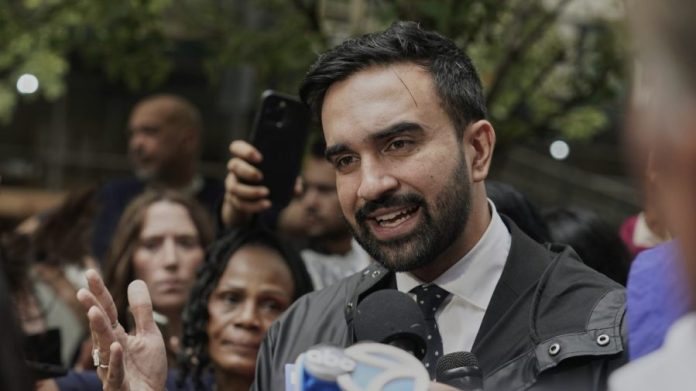
New York mayoral candidate Zohran Mamdani (D) raked in over $1 million in campaign funding in recent weeks, out-earning both former Gov. Andrew Cuomo and incumbent Mayor Eric Adams.

Mamdani raised just over $1 million through a pool of small donations from his grassroots campaign efforts between July 12 and Aug. 18, according to the city’s campaign finance board

The Democratic nominee’s average donor contributed $121 with almost an equal split of contributions from both in and outside of state.

Cuomo’s donations totaled $541,301 during the same period, with an average contribution size of $646. Some of the funding was pulled from his former state campaign account.

Adams, who is running as an independent, fundraised $425,181  with an average donation of $770.

Mamdani’s dominance in the campaign funding realm has also translated into a clear lead in the polls.

Early August surveys show him leading the five-person field race by double digits.

A poll from Sienna College found Mamdani ahead of his challengers by almost 20 points, while a poll average from Decision Desk HQ’s (DDHQ) projects him besting Cuomo, who is also running as an independent, by 13 points. 

Mamdani’s policies promoting a rent freeze, city run grocery stores and free childcare has resonated with voters in recent weeks, with some dubbing him the “champion” of working class voters.

If elected, he’d become New York City’s second democratic socialist mayor.