18.5 C
New York
Monday, May 11, 2026
Home Blog Page 273

The One Loan That’s Almost Guaranteed To Deliver Financial Disaster

0


Just as you’ve made ends meet this month, catastrophe strikes. Pipes burst in your house — and while you always wanted a swimming pool, you definitely didn’t want it in your basement. Or for it to smell like that. Then someone in your family texts you: The car’s totaled.

For You: Dave Ramsey Says This Is the Best Way To Pay Off Debt

Learn More: 3 Advanced Investing Moves Experts Use to Minimize Taxes and Help Boost Returns

Life happens, sometimes all at once. And even the most robust emergency fund might not cover it all. As you’re pacing in the muddy basement water, you start searching for fast solutions — and up pops an ad for a payday loan.

In a few simple clicks, you could have enough money to cover the costs. The relief washes over you, momentarily distracting you from the fine print about interest rates and rollover fees.

Slow your roll. That short-term relief could come with long-term financial consequences.

For experts like Michelle Kruger, a practicing financial planner, teacher and author, payday loans can be a “dangerous financial trap disguised as a helpful opportunity.” We spoke with her as part of GOBankingRates’ Top 100 Money Experts series to understand why payday loans so often backfire and what safer alternatives exist.

https://www.youtube.com/shorts/PWwD1DLu1XE

According to Kruger, the biggest pitfall of payday loans is built into their very structure. “Payday loans are short-term, high-interest loans,” she explained. “They typically have a repayment term of two weeks with a repayment date coinciding with the borrower’s next pay date.”

Just how high can those interest rates get?

The District of Columbia Department of Insurance, Securities, and Banking reports that payday loan interest rates can exceed a whopping 400% APR. The agency has advised consumers to avoid payday loans despite their increased visibility and availability online, primarily because many payday lending operations take advantage of people in crisis by using deceptive, or even illegal lending practices.

Even if you meet your immediate financial needs with the initial loan, your next paycheck might not stretch far enough to repay it. That’s when rollover fees and penalties kick in, quickly turning a modest loan into a crushing financial burden.

Read Next: 4 Moves To Make if You Can’t Pay All Your Bills this Month

Those fees add up fast.

Kruger notes that payday lenders typically charge 15% to 20% in finance fees for each two-week loan. “On an annualized basis, that can equal an APR of 300% to 500%,” she said. By comparison, credit card interest rates, which are already considered high, tend to fall between 20% and 30% APR.

Australia 73-0 Samoa: Desiree Miller bags hat-trick in record win

0


Australia XV: Halse; Stewart, Friedrichs, Smith, Miller; Moleka, Wood; Pohiva, Amosa, Karpani, Leaney, Leonard, Duck, Chancellor.

Replacements: Talakai, Hoy, O’Gorman, Fernandez, Marsters, Morgan, Hinds, Cramer.

Samoa XV: Wright-Akeli; Col Aumua, Pouri-Lane, Makisi, Falaniko; Vatau, Afuie; Mamea, Filimaua, Aiono, Sio, Onesemo-Tuilaepa, Ryder, Pauaraisa, Atonio.

Replacements: Leuta, Aiolupotea, Iosefo, Taylor, Iva, Onosemo-Tuilaepa, Salale, Tugaga.

Referee: Lauren Jenner (NZ)

Judge blocks Trump admin from slashing ‘sanctuary city’ funding

0


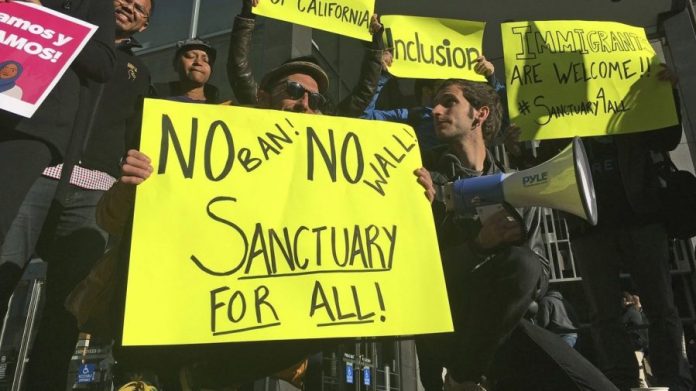
A federal judge on Friday extended a preliminary injunction that blocks President Trump from withholding funds from more than 30 “sanctuary cities” over policies that restrict local police from participating in immigration enforcement.

U.S. District Judge William Orrick in San Francisco, an appointee of former President Obama, wrote in his decision that the Trump administration did little to object to his original order, instead appealing the decision and merely arguing the injunction was wrong. He also barred the administration from imposing conditions on grant programs that provide funding “for a variety of critical needs.”

Orrick wrote that the executive orders issued by the president requiring federal agencies to remove funding from jurisdictions that don’t adhere to the administration’s immigration agenda is a “coercive threat” that is “unconstitutional.”

The White House did not immediately respond to The Hill’s request for comment.

The list of “sanctuary cities” protected by the ruling include Boston, Denver, Los Angeles, Chicago, among others. The latest decision widens the scope of Orrick’s April order which also shielded cities in the West such as Portland, Ore., Seattle and San Francisco.

Despite the original ruling, Attorney General Pam Bondi personally sent letters to multiple jurisdictions last week threatening legal recourse for those who have “undermined” or “obstructed” federal forces. 

In May, the Department of Homeland Security publicly listed 500 cities, counties and states that were not adhering to their interpretation of immigration laws. The list has been removed.

Trump, since returning to the White House in January, has also surged funding to carry out his crackdown on illegal immigration. The massive spending and tax bill, signed into law last month, also includes a boost in funds for immigration enforcement agencies, including U.S. Immigrations and Customs Enforcement (ICE).

An uptick in ICE deportation raids, primarily in blue-run cities, have triggered protests across the nation. Democrats have also pushed back on the administration’s moves to build more migrant detention facilities that hold those awaiting deportation — such as “Alligator Alcatraz” in the Florida Everglades — sparking legal battles.

Florida mom wants to gift her son-in-law $30K — while dad says no handouts. Dave Ramsey says both are wrong

0


Josephine, a retiree living in Florida, called into the Ramsey Show to get advice on helping her daughter and son-in-law financially.

While she feels that it’s important to give her daughter’s family a leg up, her husband disagrees and feels his daughter and son-in-law should manage their own bills and should not get a handout.

Josephine and her husband are comfortable financially, and can afford the $30,000 gift she proposes. She hopes it will enable her son-in-law to buy a new car and pay down some student debt.

Ramsey said that both Josephine and her husband are neglecting to answer a key question: “What’s best for the kid?”

Ramsey acknowledged that Josephine has good intentions. As she explained, her daughter and son-in-law are not asking for money. She just feels that she wants to help.

The daughter and son-in-law live frugally in a modest house, and have no car payments. However, the son-in-law has been driving a “beater” for the past few years and the daughter’s car needs to be replaced. He also has a lot of student debt to get ahead of.

Ramsey asked Josephine how much her daughter and son-in-law earn to help figure out why they would need her financial assistance. When she told him they earn $180,000 per year, he laughed and said, “You’ve got to be kidding me.”

Josephine explained that they have two kids, which eats up a lot of their income. But Ramsey didn’t buy it.

“They’re pissing their money away,” he insisted.

In terms of answering the question of whether Josephine and her husband should gift their daughter money, Ramsey said, “Neither one of you are right. Both of you are wrong.”

Read more: Do you own rental properties in the US? These 6 hacks can help you boost your income and lower your tax burden

Josephine’s daughter and son-in-law live in Michigan, where the cost of living is lower than average. BestPlaces data shows that Michigan is about 8.5% cheaper than the average U.S. state in terms of living costs, and that a minimum annual income of $41,760 is needed for a family to live comfortably. So in Ramsey’s mind, there’s no reason Josephine’s daughter and son-in-law can’t afford to buy a modest car and pay off their student debt.

Coventry City Football Club purchases CBS Arena

0


Alice Cullinane

BBC News, West Midlands

Simon Gilbert

BBC Political Reporter, Coventry and Warwickshire

PA Media Coventry City owner Doug King pictured with manager Frank Lampard at the Coventry Building Society Arena celebrating with fans. They are both smiling and Frank Lampard has his left first raised in celebration.PA Media

Coventry City owner Doug King (left), pictured with manager Frank Lampard, said the purchase was a “proud” moment for the club

Coventry City has completed the purchase of its home stadium, the Coventry Building Society Arena, the club has revealed.

The Sky Blues bought it from Frasers Group and said it marked a “pivotal moment” in the club’s history.

Doug King, chairman and owner of Coventry City, said owning the CBS Arena meant the club could be safeguarded “not only [for] the present but for future generations”.

“This is more than a transaction. It is a statement of ambition and belief in Coventry,” he said.

The announcement comes in the week of the 20th anniversary since the arena opened. The Championship club said the move would provide “long-term stability”.

King thanked supporters for their “unwavering” loyalty through years of uncertainty and said the ownership came with “immense pride and great joy”.

“As owners we can invest in facilities, fan experience, and wider opportunities for our community. We are proud to finally call this stadium our own.”

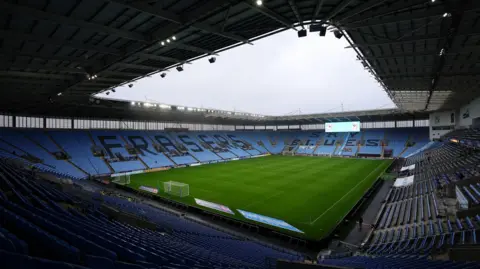
PA Media A general view of the stadium with blue tiered seating and a green football pitchPA Media

Doug King said the purchase would allow the club to enhance the fan experience

It emerged last month that King had been exploring the possibility of building a new 40,000-seater stadium at the site of Butts Park Arena, although the chairman of Coventry Rugby Club described the plans as “unfeasible”.

The Sky Blues’ agreement to play at the CBS Arena had been due to expire at the end of the 2027-28 season.

It has been a torturous time for supporters since they left Highfield Road in 2005. In that time they have had four stadium owners, four home grounds, three football club owners and countless protests.

But now, finally, the stadium, which was built for Coventry City, belongs to the club.

The club has not revealed how much it paid Fraser Group, however, it was last purchased for £17m in 2022 by tycoon Mike Ashley.

At the time, new owner of the club King made a last-minute bid of £25m to purchase the stadium, but a court ruled the offer was too late.

A man is wearing a blue top and glasses. He has brown hair and a beard.

Mark Smith from the All Things Sky Blue podcast described the news as “monumental”

Mark Smith, who hosts the All Things Sky Blue podcast, said he was excited about the future of the club and looked forward to attracting more quality players.

He described the news as “monumental” and a long time in the making.

“The ground was built for Coventry City Football Club, this is our ground. Hopefully now we can kick on and get back to where we belong in the Premier League,” he said.

The Sky Blues are hosting Queens Park Rangers at the CBS Arena at 15:00 BST, and coincidentally the visitors were the first away team to play at the stadium in 2005.

“This weekend they return as Coventry celebrates not just an anniversary, but a new era of ownership and ambition,” Coventry City said.

Getty Images Two men are playing football and wearing football kits while standing on a football pitch. Getty Images

Former Coventry City player Garry Thompson said the move was “monumental” for the club

Garry Thompson, who played for Coventry City for six seasons, said he had kept re-reading the “fantastic” news about the club when he woke up on Saturday morning.

He said the announcement opened up a “whole new avenue” for the club and Sky Blue fans would be “absolutely made up” by the news.

“We’ll get better revenue streams which means you can bring in better players in the long term. The club can only get better and bigger,” he said.

“CBS Arena was a massive stadium but then you realised you don’t own it. What Doug King has done is absolutely monumental for this club.”

Remember Iraq's Yezidis

0


I recently attended a small Hill event on a beautiful day to remember a dark anniversary: Eleven years after the Islamic State began its genocide against Yezidis in Iraq, Yezidi speakers shared about their challenges and needs.

Convened in a small room deep in the Capitol Visitors Center, Yezidis shared stories of courage and pain. But no members of Congress attended, nor did any senior administration officials. It was a troubling symbol for how policymakers have forgotten their plight, as well as a warning sign for decreasing interest from both Republicans and Democrats in the issue of religious persecution.

In August 2014, in northern Iraq, a genocide began. ISIS slaughtered men and boys while enslaving and raping women and girls, all because they believed in something different. Eleven years later, the Yezidi community still struggles to recover.

I have been deeply involved with this community since my time in government, first at the U.S. Commission on International Religious Freedom, and then later at the State Department in a special envoy role focusing on religious minorities in the Middle East during the Obama and Trump administrations.

The Yezidi community has been clear on their needs for years: they want peace, to return to their homes to live in safety and dignity, to account for missing loved ones. But they need help.

Unfortunately, thousands of Yezidis still live in squalid displaced person camps around northern Iraq, a glaring failure by the international community and the Iraqi government. Despite global recognition of the ISIS atrocities, efforts have fallen short to see Yezidis return in large numbers.

But many Yezidis may not be ready to leave the relative security of the camps, due to fear of the Islamic State reemerging and Turkish airstrikes. And although efforts have been made to resolve the situation of Sinjar and other disputed areas, Yezidis have largely been excluded from discussions affecting their future.

Tragically, more than 2,500 Yezidi women and girls remain missing and unaccounted for. There are occasional good news reports of survivors finding their way home from Syria, but these reports are increasingly rare.

Eleven years after the genocide, many Yezidis believe loved ones reside with their captors in the Al-Hol camp in eastern Syria. But time is running out to rescue children who are growing up and being indoctrinated. The U.S. and the international community can do more to help search for the missing, given the limited progress made so far.

The Yezidis are surviving because that’s what they’ve had to do for thousands of years. But as one Yezidi youth, who now lives in Lincoln, Nebraska, said, “the next generation deserves more than survival.”

Yezidis need Congress –– both chambers and both parties –– to remember their plight and provide resources. They need the Administration to revive efforts begun during the first term to help them survive through political support and reconstruction assistance. However, the no-shows at the event were not encouraging.

Yezidis are one of the most vulnerable religious minority communities in the entire Middle East. They face dangers similar to those of Christians and others like the Druze, who also need support. But Yezidis don’t have broader networks to rally assistance.

For more than a quarter century, since Congress passed the International Religious Freedom Act of 1998, the U.S. has been a global leader in promoting freedom of religion or belief internationally. We have placed this front and center while advancing our foreign policy, simultaneously grounded in values and our interests. Was it perfect? No, but it was good, and it was more than most other nations combined.

However, in years past, their memorial events were well attended. I fear the lack of participation by Members and officials signals an overall decline in support for U.S. religious freedom promotion abroad.

Since 2014, I have come to know the Yezidi people and consider many of them my friends. I have visited their holy city of Lalish and their American homes in Lincoln — two global centers of Yezidi life. I have been continually impressed by their kind spirit, steadfastness in the face of impunity, and commitment to maintaining their way of life and beliefs. And they are brave and tough, but not indestructible.

Toward the end of the event, a community member said, “Please remember the Yezidis.” Will we? Will the U.S. remember them and the millions of other faiths suffering under oppressive systems that violate religious freedom? The persecuted people of the world are praying we don’t forget. And that we find a way to act.

Knox Thames served in a special envoy position during the Obama and Trump administrations focused on religious minorities in the Middle East and South/Central Asia. His book, Ending Persecution: Charting the Path to Global Religious Freedom, was released in September by University of Notre Dame Press.

Walmart Sent a Warning to Stock Markets and the Fed. Why Powell Faces an Inflation Crisis.

0


Walmart Sent a Warning to Stock Markets and the Fed. Why Powell Faces an Inflation Crisis.

What to know about Menendez brothers’ case and when could they be released

0


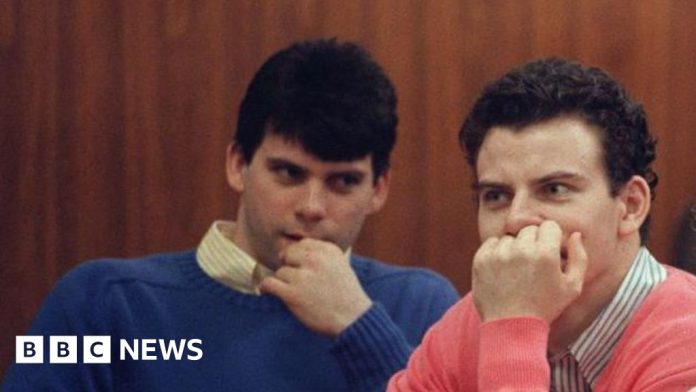
Getty Images Erik (left) and Lyle in courtGetty Images

Erik and Lyle were aged 18 and 21 when they killed their parents

In 1989, brothers Lyle and Erik Menendez killed their parents by shooting them repeatedly at close range at their mansion in Beverly Hills.

They were found guilty of first-degree murder and conspiracy to murder in 1996, and sentenced to life imprisonment without the possibility of parole.

Public interest in the case has grown since a new Netflix drama, Monsters: The Lyle and Erik Menendez Story, was released in 2024. Their story continues to divide opinion.

In a resentencing hearing in May 2025 a judge made them eligible for parole. However in August, both brothers were denied release.

What happened at the parole boards?

Erik, now 54, appeared before a panel at the California Department of Corrections and Rehabilitation on 21 August. He was told that he still posed a risk to public safety and had not been a model prisoner.

A day later 57-year-old Lyle, long regarded as the dominant sibling, was denied parole by a different board.

It cited the brutal nature of the killings and Lyle’s lack of self-control.

“We find your remorse is genuine,” parole commissioner Julie Garland told him. “But despite all those outward positives, we see … you still struggle with anti-social personality traits like deception, minimisation and rule-breaking that lie beneath that positive surface.”

What’s next for the brothers?

They can try for parole again in three years’ time – although this can be reduced to 18 months with good behaviour.

California Governor Gavin Newsom is examining a separate request to offer the brothers clemency – possibly in the form of a pardon.

Newsom, who is in the midst of a political transformation and might have his eyes set on a White House run, has the power to accept or reject any parole board recommendation.

Why were the brothers resentenced?

In 2024, the previous district attorney of Los Angeles, George Gascón, requested that the brothers’ sentence of life without the possibility of parole be changed to 50 years to life.

During a hearing at Los Angeles County superior court, the brothers apologised for their actions. Their bid for resentencing was supported by family members and a former fellow inmate.

Prosecutors said the brothers had continued to “make excuses” for their conduct instead of taking full responsibility and were not rehabilitated.

But the judge agreed to resentence the brothers, saying they had “done enough in the past 35 years that they should get that chance”.

The ruling made them eligible for parole under California’s youthful offender law which allows those who committed crimes before the age of 26 to seek a reduced sentence.

The siblings were aged 18 and 21 at the time.

Watch: “Redemption is possible” – Family and attorney of Menendez brothers react to resentencing

What did the Menendez brothers do?

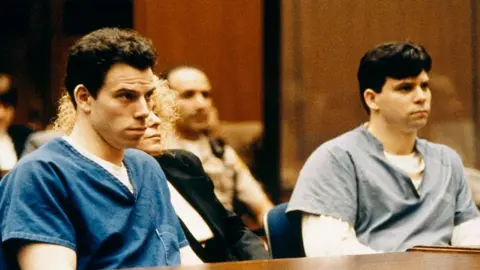
Getty Images Lyle and Erik Menendez sit in courtGetty Images

A jury found the brothers guilty of murder in 1996

Lyle and Erik Menendez killed their parents, Jose and Kitty Menendez, on 20 August 1989 at their home in Beverly Hills.

Their father, a 45-year-old Hollywood executive, was shot six times with a shotgun the brothers had purchased days before the attack.

Their mother died after suffering 10 shotgun blasts to several parts of her body.

The brothers initially told police they found their parents dead when they arrived home.

They were arrested after the girlfriend of a psychologist who had been treating Erik Menendez went to police to say that he had physically threatened the doctor.

Why did the Menendez brothers kill their parents?

The brothers claimed they committed the murders in self defence after years of alleged physical, emotional and sexual abuse, although no molestation was ever proven in court.

They said they feared their father would kill them after they threatened to expose him.

However, prosecutors argued that the young men had killed their successful parents to inherit their multi-million-dollar estate.

What happened during the original Menendez trials?

The brothers were taken into custody in 1990, and in 1993 they were tried for the murders, first individually, with one jury for each brother.

However, both juries were deadlocked in 1994, resulting in a mistrial, and the pair were later tried again together in 1995.

During their joint trial the judge excluded apparent evidence of abuse from their defence case. Taped sessions with a doctor, in which the killings were discussed, were ruled admissible in court by the judge.

A jury found them guilty and the pair were convicted of first-degree murder and conspiracy to murder in 1996.

The brothers, who were separated during their detention after a detective who investigated the slayings said they may conspire to escape if housed together, reunited in jail in 2018.

What impact has the Netflix drama had on the case?

Netflix Cooper Koch (left) and Nicholas Chavez as Erik and Lyle MenendezNetflix

Cooper Koch (left) and Nicholas Chavez played Erik and Lyle Menendez respectively in the 2024 Netflix series

The case was thrust back into the spotlight after Netflix released a drama series about the brothers in September 2024.

Monsters: The Lyle and Erik Menendez Story, shot to the top of the platform’s streaming chart and was reported to have had more than 12 million views in the first weekend after release alone.

The programme explores what might have led the siblings to kill their parents and presents the murders from different perspectives.

Its creators said the series was based on extensive research.

It includes the brothers’ claims of abuse as well as showing things from the parents’ point of view.

The show introduced the case to a new generation and garnered attention from celebrities – including Kim Kardashian and Rosie O’Donnell – who called for the brothers to be released.

The series was a follow-up to the controversial first Monsters series about US serial killer Jeffrey Dahmer.

What have the Menendez brothers said about the Netflix series?

Following its release, Erik Menendez shared a statement, released on X by his wife.

He said the show was “disheartening slander” and he “believed we had moved beyond the lies and ruinous character portrayals of Lyle”.

“It is sad for me to know that Netflix’s dishonest portrayal of the tragedies surrounding our crime have taken the painful truths several steps backward – back through time to an era when the prosecution built a narrative on a belief system that males were not sexually abused, and that males experienced rape trauma differently than women,” he added.

Members of the family also spoke out and said the brothers had been “victimised by this grotesque shockadrama,” and the show was “riddled with mistruths”.

Ryan Murphy, who created the show, told Variety that the comments were “predictable at best”.

He added that the family’s response was “interesting because I would like specifics about what they think is shocking or not shocking. It’s not like we’re making any of this stuff up. It’s all been presented before”.

Texas Senate approves new map, sending it to Abbott's desk

0


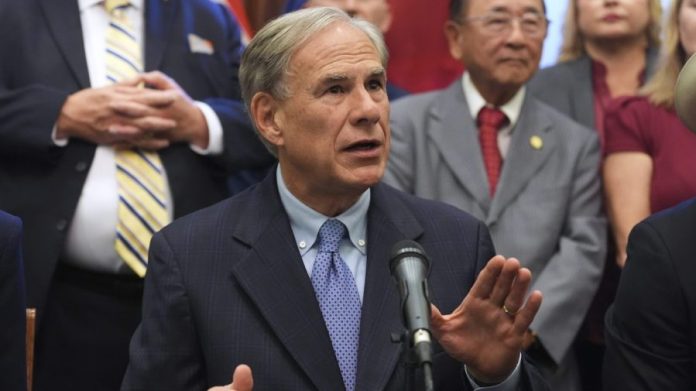
The Texas state Senate early Saturday signed off on a new congressional map, sending the legislation to Gov. Greg Abbott (R) to sign into law ahead of the 2026 midterms.

The vote passed the upper chamber in a 18-11 party-line vote as expected, with Democrats denouncing the effort as a power grab. It came after the state House approved the map also in a party-line vote after Democratic members of the body returned to the state and ended a two-week standoff over the map proposal.

The Senate had already passed the new map proposal last week, but the body needed to approve it again because the first special legislative session that Abbott called ended. The Republican governor called a second session that began this week.

A key Senate panel in charge of overseeing redistricting approved the House-passed map earlier on Thursday, sending it to the full Senate.

Democrats were prepared to show resistance and push the vote into the early morning hours, as state Democratic Caucus chair Sen. Carol Alvarado (D) announced on social media that she would filibuster the bill. The Senate broke for a long break just as she planned to start and Republicans were able to block the planned speech, according to The Associated Press.

The new district lines are likely to add up to five additional U.S. House seats for Republicans in next year’s midterms.

Abbott is expected to sign the map into effect quickly, though court challenges are also likely to come soon after to try to stop it. Democrats have already vowed to appeal.

Texas Republicans’ actions have seemed to set off an arms race of sorts with multiple other Republican- and Democratic-led states seeking to also conduct redistricting and try to pick up seats. California lawmakers met this week to approve a ballot measure that would allow voters to weigh in on whether the state should redraw its lines to be in effect for the rest of the decade.

The Golden State Legislature formally approved the measure on Thursday and Gov. Gavin Newsom (D) signed the legislation not long after. The new map could also give Democrats up to five additional seats in the U.S. House.

Still, Republicans may have more opportunities to redistrict, with states like Florida and Missouri also looking at drawing new Congressional lines.

Steff Danielle Thomas contributed.

S&P Futures Tick Higher With All Eyes on Powell’s Jackson Hole Speech

0


September S&P 500 E-Mini futures (ESU25) are trending up +0.26% this morning, attempting to snap a five-session losing streak, with focus squarely on a highly anticipated speech from Federal Reserve Chair Jerome Powell.

In yesterday’s trading session, Wall Street’s major indices ended in the red. Renewable energy stocks slumped after President Trump said in a social media post that the U.S. would not approve solar or wind power projects, with First Solar (FSLR) sinking about -7% to lead losers in the S&P 500 and Sunrun (RUN) sliding more than -4%. Also, Walmart (WMT) fell over -4% and was the top percentage loser on the Dow after the world’s largest retailer posted weaker-than-expected Q2 adjusted EPS. In addition, Coty (COTY) tumbled more than -21% after the cosmetics company posted an unexpected quarterly loss and projected that steep sales declines would continue in FQ1. On the bullish side, Nordson (NDSN) rose +3% after the manufacturing company reported better-than-expected FQ3 results and raised its full-year earnings guidance.

Economic data released on Thursday showed that the U.S. S&P Global manufacturing PMI unexpectedly rose to a 3-year high of 53.3 in August, stronger than expectations of 49.7. Also, U.S. existing home sales unexpectedly rose +2.0% m/m to 4.01 million in July, stronger than expectations of 3.92 million. At the same time, the number of Americans filing for initial jobless claims in the past week rose by +11K to a 2-month high of 235K, compared with the 226K expected.

“The great PMI numbers have made it more difficult for Powell to pivot to employment weakness… No fun in the equity space either,” said Andrew Brenner at NatAlliance Securities.

Cleveland Fed President Beth Hammack said on Thursday that she would not support lowering interest rates if policymakers were making a decision tomorrow. “We have inflation that’s too high and has been trending upwards over the past year,” Hammack said. Also, Atlanta Fed President Raphael Bostic said he still views just one rate cut as appropriate for this year, but added that the labor market’s trajectory is “potentially troubling” and warrants close attention. In addition, Kansas City Fed President Jeffrey Schmid said that inflation risks still outweigh risks to the labor market. Finally, Chicago Fed President Austan Goolsbee said that although some recent inflation data have come in better than expected, he hopes one “dangerous” reading proves to be just a temporary blip.

Meanwhile, U.S. rate futures have priced in a 69.3% chance of a 25 basis point rate cut and a 30.7% chance of no rate change at September’s policy meeting.

Today, all eyes are focused on Fed Chair Jerome Powell’s speech at the central bank’s annual Economic Policy Symposium in Jackson Hole, Wyoming. Investors are watching to see whether Powell provides any signal about what the Fed might do at the September meeting. However, it may be difficult for him to give a clear signal, especially with some of his colleagues still not in a rush to cut rates.

A survey conducted by 22V Research revealed that 43% of investors expect the market reaction to Jackson Hole to be “neutral,” 39% anticipate “risk-off,” and only 18% expect “risk-on.”

“Key to the Jackson Hole symposium will be whether Fed Chair Powell updates his monetary policy reaction function. In our base case, Powell sticks to his reaction function laid out in July. We think this would surprise markets hawkishly,” said Calvin Tse at BNP Paribas.

The U.S. economic data slate is empty on Friday.

In the bond market, the yield on the benchmark 10-year U.S. Treasury note is at 4.340%, up +0.21%.

The Euro Stoxx 50 Index is up +0.31% this morning, edging closer to an all-time high, with focus firmly on Fed Chair Jerome Powell’s annual speech at the Jackson Hole symposium. Chemical stocks led the gains on Friday, lifted by a more than +5% advance in Akzo Nobel (AKZA.NA) after activist investor Cevian Capital took a 3% stake in the paints maker. Automobile stocks also gained ground. The benchmark index is on track to post its third consecutive weekly gain. Final data from the statistics office Destatis released on Friday showed that Germany’s economy contracted more than initially estimated in the second quarter, with industry performing worse than expected as U.S. tariffs weighed on exports. Separately, data showed that France’s business climate indicator held steady in August. Meanwhile, the European Union pressed for lower U.S. tariffs on select sectors after Brussels and Washington issued the long-awaited joint statement sealing the trade deal they reached nearly a month ago. The EU said on Thursday it would work to ensure that lower tariffs on car exports are applied retroactively from August 1st while continuing to push for a preferential tariff on wine and spirits. In other news, UBS Global Wealth Management has projected a 3% contraction in the Eurozone’s corporate earnings growth this year, compared to a prior estimate of flat growth, as weak second-quarter results and currency headwinds threaten to weigh on profits. In other corporate news, Hensoldt AG (HAG.D.DX) rose over +3% after Citi upgraded the stock to Neutral from Sell.

Germany’s GDP and France’s Business Survey data were released today.

The German GDP has been reported at -0.3% q/q and +0.2% y/y in the second quarter, weaker than expectations of -0.1% q/q and +0.4% y/y.

The French August Business Survey came in at 96, in line with expectations.

Asian stock markets today closed in the green. China’s Shanghai Composite Index (SHCOMP) closed up +1.45%, and Japan’s Nikkei 225 Stock Index (NIK) closed up +0.05%.

China’s Shanghai Composite Index closed sharply higher today, hitting a fresh 10-year high, as renewed tech optimism added further momentum to the ongoing rally. Semiconductor stocks jumped on Friday after The Information reported that Nvidia had told some component suppliers to halt production tied to the H20 AI chip. The directive comes just weeks after Beijing urged local companies to avoid using the H20 due to alleged security concerns. The news boosted hopes that more of the chips used in China will be produced locally. Analysts noted that another boost for chip stocks on Friday came from Chinese AI startup DeepSeek, which hinted in a technical paper that the next generation of AI chips from Chinese companies is on the way. Meanwhile, the benchmark index posted its best weekly gain in nearly nine months. Chinese shares have been climbing in recent weeks, supported by easing trade tensions between the world’s two largest economies and improved liquidity conditions, as well as investors rotating out of bonds and into stocks. Goldman Sachs analysts said, “For now, FOMO sentiment still dominates, leading to buy-the-dip flow on every market correction.” In other news, China on Friday issued interim rules for overseeing and managing its rare earths mining, smelting, and separation activities. In corporate news, Li Ning surged over +8% in Hong Kong after the sportswear maker posted better-than-expected first-half net income.

Japan’s Nikkei 225 Stock Index closed just above the flatline today as investors digested fresh inflation data from the country and braced for Fed Chair Jerome Powell’s speech at the Jackson Hole symposium. Insurance and bank stocks outperformed on Friday as Japanese government bond yields climbed following stronger-than-expected domestic inflation data and tracking a rise in U.S. Treasury yields overnight. Higher bond yields improve the outlook for revenue from investment and lending. Still, the benchmark index notched a weekly loss. Government data released on Friday showed that Japan’s core inflation slowed in July but remained well above the Bank of Japan’s 2% target, reinforcing market expectations that the central bank will raise its benchmark interest rate again this year. The data came about a week after U.S. Treasury Secretary Scott Bessent took the unusual step of criticizing the BOJ’s handling of inflation, saying that “they’re behind the curve.” With trade uncertainty easing somewhat after a deal between Tokyo and Washington in late July, market participants anticipate the BOJ to hike its policy rate in the near term as persistent cost pressures weigh on consumers’ wallets. Capital Economics’ senior APAC economist, Abhijit Surya, wrote in a note, “With the economy holding up well and tariff-related uncertainties abating, the Bank should feel comfortable with resuming policy normalization before long.” BOJ Governor Kazuo Ueda is attending the Kansas City Fed’s conference in Jackson Hole, Wyoming, this weekend. Investors will be watching for any signals from the gathering that could point to the potential timing of another BOJ rate hike. The Nikkei Volatility Index, which takes into account the implied volatility of Nikkei 225 options, closed up +0.20% to 25.11.

The Japanese July National Core CPI rose +3.1% y/y, stronger than expectations of +3.0% y/y.

Pre-Market U.S. Stock Movers

Zoom Communications (ZM) climbed over +5% in pre-market trading after the videoconferencing platform posted upbeat Q2 results and raised its full-year guidance.

Ulta Beauty (ULTA) rose over +1% in pre-market trading after Barclays upgraded the stock to Overweight from Equal Weight with a price target of $589.

Nvidia (NVDA) fell more than -1% in pre-market trading after multiple reports said that the chipmaker had told some component suppliers to halt production tied to the H20 AI chip.

Intuit (INTU) slumped over -5% in pre-market trading after the company issued tepid FY26 guidance.

Workday (WDAY) slid more than -5% in pre-market trading after the human-resources software company provided slightly weaker-than-expected Q3 subscription revenue guidance and announced an agreement to acquire Paradox.

You can see more pre-market stock movers here

Today’s U.S. Earnings Spotlight: Friday – August 22nd

BJ’s Wholesale Club (BJ), RLX Technology (RLX), Buckle (BKE).

On the date of publication, Oleksandr Pylypenko did not have (either directly or indirectly) positions in any of the securities mentioned in this article. All information and data in this article is solely for informational purposes. This article was originally published on Barchart.com