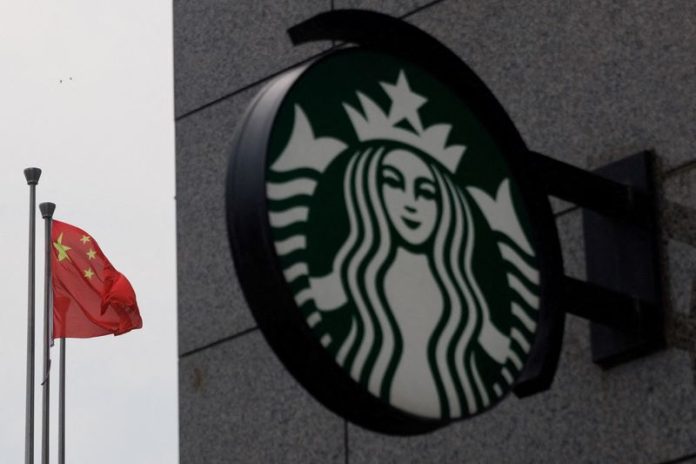
HONG KONG (Reuters) -Starbucks has asked a short-listed group of potential bidders to submit non-binding bids for a stake in its China business within the next two weeks, two people with knowledge of the matter said.
The U.S. coffee shop chain invited interested parties including private equity firms Carlyle, EQT, Hillhouse Investment and Primavera Capital to attend management presentations where it would disclose financial and operational details of its China business, said one of the people as well as a third person with knowledge of the presentations.
Other potential bidders include Bain Capital, KKR & Co and technology major Tencent, said one of the first two sources and two other people familiar with the matter.
A new partner in China could add impetus to a business whose market share has more than halved in the past five years, as low-price local rivals grow apace while consumers become increasingly cost-conscious in a stuttering economy.
In May this year, Starbucks began the sale by inviting interested parties to answer questions about their businesses by late June, Reuters previously reported.
The Seattle-based company said at the time it was not considering a full sale of the business – which bidders expect will be valued at up to $10 billion, CNBC reported citing sources.
In July, it selected up to 10 interested parties and signed non-disclosure agreements ahead of granting potential access to financial and operational figures, the five people said.
It has yet to finalise the structure of the sale or size of the stake, said the people, who declined to be identified as the information was not public.
The cafe chain has held informal talks with a range of potential buyers since the second half of last year and aims to reach a deal by year-end, sources previously told Reuters.
CEO Brian Niccol on Starbuck’s quarterly earnings call last month said the cafe chain had received interest from more than 20 parties and was evaluating options.
“We remain committed to our China business and want to retain a meaningful stake… We will only enter a transaction if it makes sense for Starbucks,” said Niccol, CEO since August last year.
Starbucks on Friday declined to comment further.
Primavera, Carlyle, EQT, KKR and Bain declined to comment. Hillhouse and Tencent did not respond to requests for comment.
Starbucks is pursuing the sale after reporting strong overall revenue for the three months through June 29 under a turnaround plan Niccol implemented after several quarters of falling earnings.
Net revenue rose 3.8% to $9.46 billion, slightly exceeding the average analyst estimate, though same-store sales fell for a sixth consecutive quarter, by 2%.
In China, Starbucks faces sluggish economic growth and competition from local brands such as Luckin Coffee, which has gained market share with cheaper products and greater presence in smaller cities.
Starbucks’ market share in the world’s second-largest economy – home to more than a fifth of its cafes – was 14% last year versus 34% in 2019, showed data from market researcher Euromonitor International.
The chain has since taken the rare step of reducing prices for some non-coffee drinks in China and increased the pace of new and China-centric product innovation.
Comparable-store sales in China increased 2% in the quarter ended June 29 versus zero growth in the previous quarter.
Starbucks operated 7,828 stores in China as at June-end, its latest quarterly report showed. It did not disclose core earnings at its China business.
(Reporting by Kane Wu and Julie Zhu in Hong Kong; Additional reporting by Casey Hall in Shanghai; Editing by Christopher Cushing)
Marc: I love listening to music… learning different things, whether it’s trying to learn DJ-ing – I’ve tried to do that a little bit – or reading different books. I love going to the movies, to the cinema, because no-one goes to the cinema, so it’s nice to be in a cinema on your own… popcorn! I drummed at church for a long time. I drummed at school. I don’t have a drum set but I really want one. That’s a really good way to enjoy music and escape.
My favourite book? I’d say Fahrenheit 451 by Ray Bradbury. It’s set in a future world where firefighters don’t put out fires, they start fires. They’re burning books – burning all the knowledge in the world – and there is one firefighter who is questioning all that.
On Aug. 8, a gunman sprayed hundreds of bullets at buildings on the agency’s main campus in Atlanta, killing a responding police officer. A little over a week later, the Trump administration sent permanent termination notices to hundreds of employees.
Agency staff who spoke to The Hill said morale is at rock bottom, and the latest round of layoffs hit especially hard following the revelations that the attacker was motivated by his distrust of COVID-19 vaccines.
“The shooting feels like a violent manifestation of the hatred that we’ve been subjected to for the last seven months, and then losing many staff right after that is really just the cherry on top of all the trauma that we’ve been experiencing,” said one current employee who spoke on condition of anonymity.
The layoffs had been anticipated, but coming so soon after the attack caught people by surprise. Without warning, people started losing access to agency systems as early as last Saturday.
One former employee said they had been on administrative leave since February; still getting paid, but unable to go to work. They were officially laid off this week.
“We didn’t all get notices. Some people had some trickling in through email … and there’s some people who still haven’t gotten anything. It’s all just very messy and chaotic and not organized,” the former employee said.
Adding to the frustration and anger: Many of the people who were fired this week worked in the division of violence prevention.
“Just days after a domestic terrorist attack that we know was in part, caused by mental health challenges and access to automatic weapons, and that is the work that the people who were [fired] were doing … all of that was just erased,” the employee said.
Another agency staffer said it felt like the administration has done a textbook job of dismantling the agency through thousands of small cuts. There’s still a hiring freeze, employees can’t travel and it’s unclear what level of funding CDC will get for the next fiscal year.
“Since January, I just feel completely useless, like I’m completely wasting my career right now,” another employee said. “I certainly feel like I had my dream job, and that has just been ripped out from under all of us.”
But despite the frustration, agency staff have started speaking up and fighting back.
“When you are literally shot at, and then many people lose their jobs … it’s a message and a signal that we don’t have anybody protecting us or standing up for us, at least at the highest levels of leadership, and all we have ourselves,” a current employee said. “More people are finding their voice because they have nothing to lose, especially if they just lost their job.”
More than 750 current and former employees sent Health and Human Services (HHS) Secretary Robert F. Kennedy Jr. a letter Wednesday calling on him to stop “spreading inaccurate health information” and do more to protect public health professionals in the wake of the shooting.
HHS pushed back, citing Kennedy’s visit to CDC and said he “is standing firmly with CDC employees—both on the ground and across every center—ensuring their safety and well-being remain a top priority.”
“Any attempt to conflate widely supported public health reforms with the violence of a suicidal mass shooter is an attempt to politicize a tragedy,” the agency said in a statement.
Welcome to The Hill’s Health Care newsletter, we’re Nathaniel Weixel, Joseph Choi and Alejandra O’Connell-Domenech — every week we follow the latest moves on how Washington impacts your health.
An updated legal challenge from Planned Parenthood in South Carolina seeks to preserve Medicaid for its health centers after a recent Supreme Court decision allowed the state to restrict federal funding. The filing challenges the constitutionality of Gov. Henry McMaster’s (R) order that blocks Medicaid funds from clinics that provide abortions. The complaint asked a federal judge to block the policy and allow …
The Department of Health and Human Services (HHS) moved Friday to derecognize labor union representation for staffers at multiple subagencies and offices, claiming the action is “removing unnecessary obstacles to mission-critical work.” The HHS is derecognizing representation within several offices represented by the National Treasury Employees Union; American Federation of Government Employees (AFGE); National …
The Trump administration is attempting to reverse decades-old policy to exclude a broad group of immigrants from accessing social services and health benefits, causing widespread fear among immigrant advocates even as it has yet to take effect. Immigration groups and health experts say millions could be harmed by cutting off access to basic health services, including for people who are U.S. citizens and immigrants who have …
Doctors take on RFK Jr. on back-to-school COVID vaccines
The medical community is waging a public relations fight against Health and Human Services Secretary Robert F. Kennedy Jr. over COVID-19 vaccines as students head back to school across the U.S. The American Academy of Pediatrics (AAP) on Wednesday issued more expansive COVID-19 recommendations for children than the Department of Health and Human Services (HHS), underscoring the growing breakdown in cooperation between doctors …
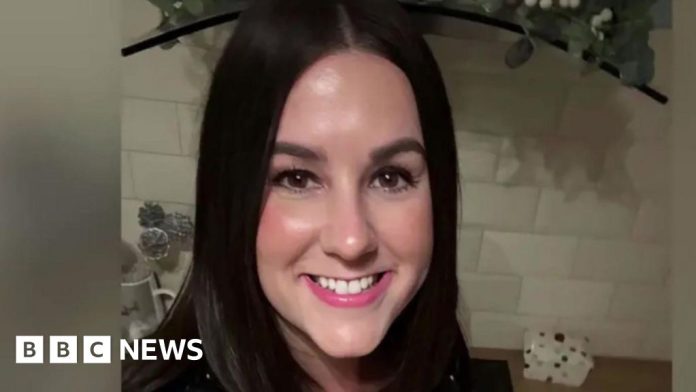
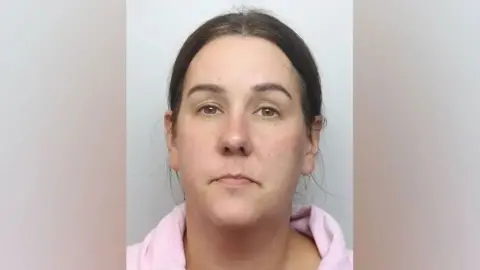
The 42-year-old wife of a Tory councillor had called for people to “set fire” to hotels housing asylum seekers in the wake of the Southport attack in July 2024.
In her first newspaper interview since her release, Connolly told the Telegraph she considered herself and “several other people” to “absolutely” be political prisoners of the prime minister.
“I, for some reason, seem to have had the most coverage, but there are people that are in equally awful situations that shouldn’t be in there,” she said, speaking to journalist Allison Pearson, who had campaigned for Connolly’s release.
“I think with Starmer he needs to practise what he preaches.
“He’s a human rights lawyer, so maybe he needs to look at what people’s human rights are; what freedom of speech means; and what the laws are in this country.”
In a separate interview, Connolly said she would be meeting members of Donald Trump’s administration on Saturday, but did not know what they would discuss.
“Just that they’re very interested in the way things are going in the UK, and they are obviously big advocates for free speech, and their lawyers are keen to speak with me,” she told Dan Wootton on his YouTube channel.
A recent report from the US State Department raised concerns around “serious restrictions” on freedom of expression in the UK, pointing to what it said were interventions by government officials “to chill speech” in the wake of the Southport attack.
Northamptonshire Police
The former childminder posted her tweet on X on 29 July and was arrested on 6 August 2024
On 29 July last year – the day of the Southport attack – she had posted on X that there should be “mass deportation now” and said “if that makes me racist, so be it”.
Connolly’s post had been deleted before she was arrested on 6 August, but it had already been viewed 310,000 times.
She pleaded guilty to inciting racial hatred by publishing and distributing “threatening or abusive” written material on X.
Connolly also told the Telegraph she was “upset and angry beyond belief” after the murders in Southport, and that she knew “how that feels because I’ve lost a child”.
“Of course,[the tweet] wasn’t my finest moment and I don’t, I definitely don’t advocate violence or burning anything down or anything of the sort.”
She said she was considering legal action against the police over a statement that was released by the Crown Prosecution Service after her sentencing, which claimed she had told police in an interview that “she did not like illegal immigrants” and “that children were not safe from them”.
Her comments had been “massively twisted and used against me”, she claimed.
‘Volatile situation’
When questioned about the sentence at Prime Minister’s Questions in May, Sir Keir said: “I am strongly in favour of free speech; we’ve had free speech in this country for a very long time and we protect it fiercely.
“But I am equally against incitement to violence against other people. I will always support the action taken by our police and courts to keep our streets and people safe.”
At Connolly’s sentencing in October, Judge Melbourne Inman KC said: “When you published those words you were well aware how volatile the situation was.
“That volatility led to serious disorder where mindless violence was used.”
Connolly will remain on licence until the end of her sentence.
A Northamptonshire Police spokesperson said the force was aware of comments made by Connolly after her release.
“We hope to contact Mrs Connolly in the coming days to understand the issues she has raised around Northamptonshire Police,” they said.
(NewsNation) — Republican Sens. Roger Wicker (Miss.) and Deb Fischer (Neb.) embarked on a trip to the Indo-Pacific region on Friday as part of efforts to strengthen U.S. national security interests.
The Congressional Delegation (CODEL), including the lawmaker duo, will first stop at military installations in Hawaii before meetings in Guam, Tinian, Palau, the Philippines, and most notably, Taiwan.
“We live in the most dangerous national security moment since World War II,” Wicker exclusively told NewsNation, The Hill’s sister network, before his departure.
“Congress plays a vitally important role in reassuring U.S. allies and partners of our commitment to maintaining a favorable regional order in the Indo-Pacific,” he continued.
Wicker said he hopes to assist President Trump in ensuring the U.S. “maintain peace through strength.”
“At a time of global unrest where the Chinese Communist Party continues its military buildup, maintaining a free and open Indo-Pacific plays a crucial role in safeguarding our nation’s and our allies’ security,” Fischer added. “I look forward to joining Chairman Wicker on this CODEL to see firsthand how we can strengthen our posture in the region in order to safeguard American interests and our allies,” she added.
(Reuters) -Shares of Australia’s Zip surged over 25% on Friday to hit their highest level in more than three years after the buy-now-pay-later (BNPL) company reported higher annual earnings and announced plans for a secondary U.S. listing.
The company’s cash earnings before taxes, depreciation and amortization (EBTDA) more than doubled to A$170.3 million ($109.38 million) in the year ended June 30, higher than a Visible Alpha consensus estimate of A$160 million.
The earnings growth came on the back of strong performance of its U.S. business, which delivered a 41.6% growth in total transaction volume (TTV), driven mainly by spend on non-discretionary items.
The company’s net bad debts were 1.5% of TTV, down from 1.7% last year.
Zip said it expects more than 35% growth in its U.S. TTV in fiscal year 2026. According to Citi analysts, that, along with an assumption of 6% revenue growth in Australia, implies cash EBTDA of A$230 million this fiscal, ahead of consensus estimate of A$215.8 million.
The company also said it was considering a listing on Nasdaq, while maintaining its primary listing in Australia.
“It is expected that a dual listing will support Zip’s significant growth opportunity in the U.S. (which now represents over 80% of divisional cash earnings),” Zip said in a statement, adding that it had seen an increase in interest from U.S. investors.
Zip shares jumped as much as 25.6% to A$3.920 by 0102 GMT, reaching their highest point since early January 2022. The stock was also the best performer on the ASX 200 benchmark index, which was down 0.3%.
Zip shares have gained more than six-fold in value since the end of 2023, when reduced consumer spending, rising interest rates, and heightened regulatory scrutiny sapped confidence in BNPL stocks.
($1 = 1.5569 Australian dollars)
(Reporting by Himanshi Akhand in Bengaluru; Editing by Subhranshu Sahu)
Britain’s true national sport is complaining about the weather. But does the Sun really shine brighter everywhere else, or is this quite a green and pleasant land after all?
Compare your location to cities across the world, and find out if you’re forecast to become the BBC’s next star meteorologist.
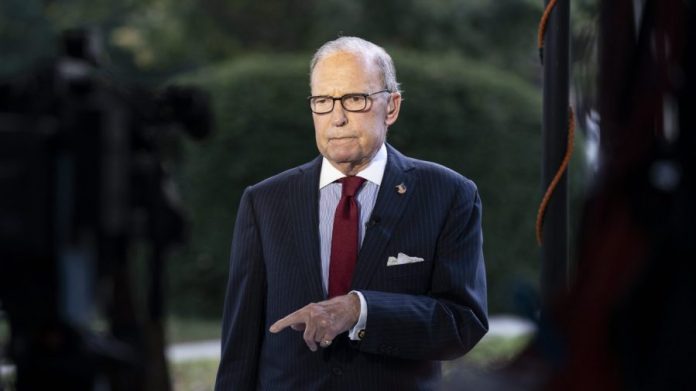
Fox Business’s Larry Kudlow expressed concern on Friday over the Trump administration’s move to take a 10 percent stake in mega chipmaker Intel.
“I am very, very uncomfortable with that idea. I’m very uncomfortable with that one, but that’s a conversation for another meal on another day,” Kudlow told economist Stephen Moore, in an interview highlighted by Mediate.
Moore, earlier in the appearance, also criticized the administration’s decision, calling it “terrible.”
“I hate corporate welfare. That’s privatization in reverse. We want the government to divest of assets, not buy assets. So terrible, one of the bad ideas that’s come out of this White House,” Moore told Kudlow, who served under President Trump as the director of the National Economic Council during his first term.
Trump on Friday announced that the U.S. government now owns 10 percent of Intel shares.
“The United States paid nothing for these Shares, and the Shares are now valued at approximately $11 Billion Dollars. This is a great Deal for America and, also, a great Deal for INTEL. Building leading edge Semiconductors and Chips, which is what INTEL does, is fundamental to the future of our Nation. MAKE AMERICA GREAT AGAIN!” he wrote on social media.
The Hill reached out to the White House for comment.
Commerce Secretary Howard Lutnick said the purchase would boost the struggling American chipmaker. The government will use funds allocated under former President Biden’s CHIPS and Science Act.
“So we’ll deliver the money which was already committed under the Biden administration,” Lutnick said. “We’ll get equity in return for it, get a good return for the American taxpayer instead of just giving grants away.”
After the deal, the CEO of Intel, Lip-Bu Tan lauded the agreement on social media, stating it will “boost American semiconductor leadership.” X
“I’m excited about the work ahead to ensure the most advanced silicon technology and computing products of the future are designed and built right here in the USA. Thank you @potus and @howardlutnick for the confidence you have in Intel to deliver for our country,” he continued.
The agreement marks a sharp reversal in Trump’s relationship with the chief executive, whom he asked to resign earlier this month. The president on Friday shared how the government made the deal after visiting with Tan.
“And he came in, he saw me, we talked for a while. I liked him a lot. I thought he was very good,” he told reporters. “I thought he was somewhat a victim, but, you know, nobody’s a total victim, I guess.”
“And I said, ‘You know what? I think the United States should be given 10 percent of Intel.’ And he said, ‘I would consider that,’” the president continued. “Intel has been left behind, as you know, compared to [Nvidia CEO] Jensen [Huang] and some of our friends.”