
Your Kids Are Your Pride and Joy. They Are Also a Tax Break.
Your Kids Are Your Pride and Joy. They Are Also a Tax Break.
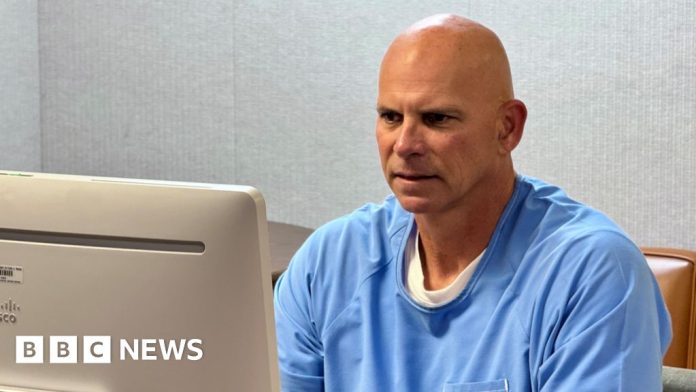
Lyle Menendez joins brother, denied parole in parents’ LA killing
Nardine Saad
BBC News, Los Angeles

 California Department of Corrections and Rehabilitation
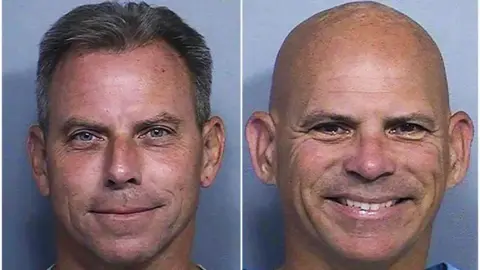
Lyle Menendez has been denied parole one day after his brother Erik was similarly blocked from being freed from prison after more than three decades.
The Menendez brothers, who were convicted in the 1989 killings of their parents in their Beverly Hills mansion, were both rejected for release after separate, lengthy hearings before California’s parole board.
It marks a major setback for the pair who had seen recent court wins that brought them closer than ever to freedom.
The elder Menendez brother, 57, who has long been portrayed as the dominant sibling, can try for parole again at a hearing in three years, though the panel said that could be reduced to 18 months with good behaviour.
The grisly murders of their parents, Jose and Kitty Menendez, and the trials that followed were among the criminal cases that defined the last century.
During their trials, the brothers claimed the killings were done in self-defence after years of sexual and emotional abuse from their father that they said was enabled by their mother.
Prosecutors, though, argued they were greedy, entitled monsters who meticulously planned the killings then lied to authorities investigating the case while going on a $700,000 (£526,000) spending spree using money they had inherited.
It was Lyle, long considered the dominant brother, who at first told police that he believed his parents’ brutal deaths were a mob hit job. He also fashioned elaborate stories that involved people lying for him to cover up their involvement.
The pair were not arrested until police got word of their admissions to a psychologist.
“I’m profoundly sorry for who I was … for the harm that everyone has endured,” Lyle told the board. “I will never be able to make up for the harm and grief I caused everyone in my family. I am so sorry to everyone, and I will be forever sorry.”
Focus on Lyle’s illicit cell phone use in prison
Lyle faced a different panel of parole commissioners than his brother, who was denied release from prison on Thursday after a similarly lengthy hearing.
Like his brother, Lyle also appeared virtually for the hearing from the San Diego prison where he has been housed. The proceedings stretched to more than 10 hours and concluded after the sun had set in Los Angeles.
The panel reviewed whether Lyle posed a risk to society if released and examined his life before the killings and his time in prison. He asked about his time as a student at Princeton University and how he was accused of plagiarism and suspended as a result, as well as speeding violations and burglary allegations.
They also asked questions about moments of the killings, what led up to the murders and his motivation.
The panel repeatedly brought up his illicit cell phone use in prison, which they said he appeared to have near constant access to for years. Commissioner Patrick Reardon, one member of the panel, questioned if they should give so much weight to all the positive things he did in prison – like his schooling and programmes he created for inmates – when he was constantly violating the rules.
The panel noted he plead guilty to a cell phone violation as recently as March of this year.
Although he had a tablet that he was allowed to use, he said he continued to use cell phones because it gave him more privacy.
Mobile phones are prohibited in prisons and considered to be as corrosive as drugs to a prison environment over concerns that they can further criminal activity, like moving drugs, intimidating witnesses and even organising escapes. All communications while behind bars are monitored, except for attorney-client conversations.
“I would never call myself a model incarcerated person. I would say that I’m a good person, that I spent my time helping people. That I’m very open and accepting,” Lyle told the board on Friday, noting he’s done a lot to help vulnerable inmates.
“I’m the guy that officers will come to, to resolve conflicts,” he said, describing himself as a “peacekeeper”.
He graduated with a degree while in prison and is currently in the process of getting his master’s. Lyle has also been lauded for mentorship of other inmates, his work helping others who survived sexual abuse and a beautification programme he helped launch.
A risk assessment done before his hearing found that Lyle would face a “moderate risk” of violence if released and noted he has anti-social traits, as well traits of entitlement, deception, manipulation and issues with accepting consequences, citing his mobile phone use in prison.
What comes next for the Menendez brothers?
The brothers’ trek to freedom is not over yet, as they each can appear in front of the board again, each after three more years.
The parole denials will shift focus to California Governor Gavin Newsom, who is separately considering a clemency request from them.
Clemency could come in the form of a reduced sentence or even a pardon. Weighing in on such a high-profile and controversial case could be politically risky for Newsom, who is said to be mulling a presidential run.
In addition to the clemency request, the brothers are also asking for a new trial in light of newly uncovered evidence alleging childhood sexual abuse by their father.
A judge is mulling that request, but it is opposed by the Los Angeles district attorney’s office.
 California Department of Corrections
During Friday’s hearing, prosecutor Ethan Milius lobbied against Lyle’s release. He questioned whether he has “genuinely” taken accountability for his conduct and pointed to Lyle’s inability to “follow basic rules while in a highly structured setting.”
“There is no growth. It is just who Lyle appears to be,” Milius said. “When you look at him, Lyle has a long-documented history of lies made to avoid the consequences of his own actions.”
A coalition of relatives who have long advocated for them, as well as supporters, were also in attendance virtually for Friday’s hearing and spoke on his behalf. Some of them refused to speak after audio of his brother’s hearing was released to a media outlet, which spurred anger from attorneys and a dramatic pause in the deliberations.
Lyle’s cousin Eileen Cano, who also spoke to the panel during Erik’s hearing on Thursday, told the board that she is amazed by how much Lyle has achieved despite facing life in prison without parole.
“While most people surrender to the crushing weight of prison life, Lyle rose above it,” she said.
“Lyle will not be a risk to the community because we as a family will hold him accountable,” she continued. “Delaying his release would serve no purpose. Lyle is not the man who went to prison 35 years ago.”
DC's shadow representative not seeking reelection


Oye Owolewa, the District of Columbia’s shadow representative, will not seek reelection in 2026 after five years in office.
“I’m incredibly proud of our work since assuming this office. Ever since you first elected me in 2020, I took it upon myself to raise the bar. Together, we did just that!” Owolewa, a Democrat, said in a statement.
“And most importantly, we continue to fight back against Donald Trump’s continued oppression on us DC residents. With that said, it’s time to pass the baton to the next generation of leaders,” he continued.
Owolewa is a shadow representative, meaning he has no voting power, but he is tasked with lobbying for Washington, D.C., statehood. In 2024, he was reelected with 90.7 percent of the votes. Congress does not recognize his role.
Calls for D.C. statehood have surged as President Trump’s federalization of the Metropolitan Police Department and deployment of National Guardsmen to the nation’s capital has sparked backlash from residents.
D.C. Mayor Muriel Bowser (D), earlier this month, reupped her long-standing call for the District to be recognized as a state.
“It’s times like this when America needs to know why your nation’s capital — a place where 700,000 taxpaying Americans live — should be the 51st state,” Bowser told “The Breakfast Club” on Aug. 12, referring to Trump’s D.C. crime crackdown.
The outgoing representative spoke to The Hill’s “Sunrise on The Hill” on Friday, echoing other Democrats’ concerns about federal law enforcements’ presence in the nation’s capital.
“One of the reasons why we don’t want to see National Guards on the street, especially those that come from out of town, is because they don’t have that cultural competency of our community,” he said.
Owolewa also raised questions about crime spiking after the National Guard leaves if there is no long-term investment in the community.
“If we don’t address root causes and really have wrap-around services for those who need it the most, we won’t have those long-lasting benefits to support D.C.,” he continued.
In his statement announcing his decision to not seek reelection, Owolewa highlighted some of his accomplishments in Congress, such as providing free legal services to Washingtonians, helping local businesses and providing D.C. children easier access to science.
Meta signs over $10 billion cloud deal with Google, source says
(Reuters) -Google has struck a six-year cloud computing deal with Meta Platforms worth more than $10 billion, a source familiar with the matter told Reuters on Thursday, the search giant’s second big agreement recently after one with OpenAI.
Under the agreement, Meta will use Google Cloud’s servers, storage, networking and other services, the source, who asked not to be named because the discussions are confidential, said.
Google and Meta did not immediately respond to requests for comment.
The deal was first reported by the Information.
The news comes after Meta CEO Mark Zuckerberg’s comments in July that the company would spend hundreds of billions of dollars to build several massive AI data centers.
The company raised the bottom end of its annual capital expenditures forecast by $2 billion, to a range of $66 billion to $72 billion last month.
Meta is seeking outside partners to help it fund the massive infrastructure needed to power AI by offloading $2 billion in data center assets, the company disclosed in a filing earlier this month.
In June, Reuters reported that OpenAI was planning to add Alphabet’s Google Cloud service to meet its growing needs for computing capacity, a surprising collaboration between two prominent competitors in the artificial intelligence sector.
Amid this flurry of deals, Google parent’s cloud-computing unit delivered an almost 32% jump in second-quarter revenue in July, which surpassed expectations.
(Reporting by Sayantani Ghosh in San Francisco and Angela Christy in Bengaluru; additional reporting by Yazhini MV and Mrinmay Dey in Bengaluru; editing by Alan Barona)
Ghislaine Maxwell interview transcripts released by US justice department
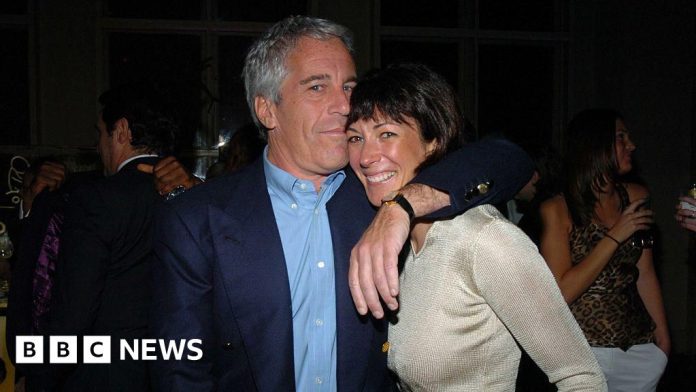
Ghislaine Maxwell, the convicted associate of sex offender Jeffrey Epstein, told US officials that a highly discussed “client list” does not exist, according to a released transcript of her interview.
In a July interview with Deputy Attorney General Todd Blanche, Maxwell said she was “not aware of any blackmail” and did not witness any inappropriate conduct by President Donald Trump or former President Bill Clinton.
She also discussed her and Epstein’s relationship with Prince Andrew and called allegations of him having sexual relations with an underage girl in her home “mind-blowingly not conceivable”.
Maxwell is seeking a pardon from Trump and has been accused of lying to federal officials.
The interview took place as the Trump administration was under continued pressure to disclose more information about Epstein – with whom Trump was friendly before, according to the president, they fell out in 2004.
Shortly after the interview with Blanche – who previously worked as Trump’s personal attorney – Maxwell was moved from her Florida prison to another low-security prison in Texas. It’s unclear why the move was made.
The White House has been adamant that “no leniency is being given or discussed” in Maxwell’s case.
Maxwell is currently serving a 20-year sentence in a sex trafficking scheme, and has petitioned the US Supreme Court to overturn her conviction. Her attorney has said they would “welcome” a pardon from the president.
Pressure has also been growing from Trump’s own Republican Party for more transparency around investigations of Epstein. But the president has accused his political opponents of using the case to distract from what he sees as his administration’s victories.
In the transcripts – which amount to 300 pages, some heavily redacted – Maxwell said that while she believes Trump and Epstein were friendly “in social settings”, she does not think they were close friends.
“I actually never saw the President in any type of massage setting,” she said, alluding to the massage services that some victims have said were used to enlist them in Epstein’s crimes. “The President was never inappropriate with anybody.”
“In the times I was with him, he was a gentleman in all respects,” she added.
She also said she doesn’t recall Trump sending Epstein 50th birthday note in 2003, which drew recent headlines after the note was reported in the Wall Street Journal.
In the interview, Blanche also asked Maxwell about the alleged “client list” of high-profile personalities that has become the object of conspiracy theories in recent years.
Maxwell was asked about several other well-known figures, including Bill Gates, Elon Musk, former Israeli Prime Minister Ehud Barak, Health and Human Services Secretary Robert F Kennedy Jr, actor Kevin Spacey, model Naomi Campbell and Prince Andrew – whom she denied she introduced to Epstein.
The list of his high-profile associates had become a focal point for conspiracy theorists who insisted that it was being kept hidden by the “deep state” to protect prominent participants in Epstein’s crimes.
Several figures in Trump’s administration – including FBI Director Kash Patel and deputy director Dan Bongino – repeated those claims in the past, although they have since backtracked.
“There is no list,” Maxwell said.
She also spoke about Prince Andrew, whose relationship with Epstein led to a fallout where he stepped down from royal duties.
She called it a “flat untruth” that she’d been the one who introduced the Duke of York to Epstein.
“First of all, let’s just state, I did not introduce him to Prince Andrew,” she said.
She spoke at length of Epstein’s relationship with both Price Andrew and the Duchess of York Sarah Ferguson.
Maxwell also spoke about Prince Andrew’s alleged relationship with a woman, whose name has been redacted in the transcript.
She says she finds the allegations against the Duke of York “mind-blowingly not conceivable”, partly due to the size of her house where the events allegedly took place.
She is asked about a “famous photo” of Prince Andrew and the unnamed woman, with Maxwell in the background. She tells Blanche this photo is fake.
The prince was accused by Virginia Giuffre, who is not named in the transcript, of sexually abusing her when she was 17. He denied the allegations but reached a financial settlement with her in 2022, which contained no admission of liability or apology.
A widely circulated photo shows him alongside Giuffre with Maxwell in the background. Andrew has previously disputed its authenticity.
Giuffre took her own life earlier this year. Her family has condemned the justice department for interviewing Maxwell and said she is a “monster” whose testimony cannot be trusted.
According to Maxwell, she first befriended Epstein in 1991, and subsequently developed a sexual relationship with him.
Even after that relationship ended, she said she was still paid by Epstein – up to $250,000 (£184,782) a year by 2009 – and remained “friends with benefits”. She added that their relationship was “almost non-existent” between 2010 and his death.
Maxwell was asked for her thoughts on the death of Epstein, who died by suicide in a New York jail cell in 2019 while awaiting trial on sex trafficking charges.
“I do not believe he died by suicide, no,” she remarked, although she added that she does “not have any reason” to believe that he was killed in a bid to silence him.
“It’s ludicrous,” she said of theories that he was murdered. “I also happen to think if that is what they wanted, they would’ve had plenty of opportunity when he wasn’t in jail.”
“And if they were worried about blackmail or anything from him, he would’ve been a very easy target,” she added.
Ahead of the release of the transcript, pressure had been mounting on Trump – including from many of his own supporters and from voices within his own political party – for more transparency on what the investigations into Epstein uncovered.
Earlier this year, reports emerged that Trump had been told by US Attorney General Pam Bondi that his name appeared in the files.
He has never been accused of any wrongdoing in connection with the case – and on the campaign trail last year said he would publicise more information about the case.
But he reversed his position several months into his administration, saying the case was closed, and criticising supporters and journalists who continued to press him on it.
The Associated Press had reported that earlier on Friday, the House Oversight Committee received the first round of files – which they had subpoenaed for – from the justice department.
“The Committee intends to make these records public after thorough review to ensure any victims’ identification and child sexual abuse material are redacted,” a spokesperson for Oversight Committee Chair James Comer was quoted as saying by US media.
“The Committee will also consult with the DOJ to ensure any documents released do not negatively impact ongoing criminal cases and investigations.”
Trump administration halts offshore wind project in Rhode Island


The Trump administration on Friday issued an order stopping all activities of a wind energy project in Rhode Island that could have supplied electricity to 350,000 homes.
The Bureau of Ocean Energy Management (BOEM) in a letter sent to Ørsted, the Danish company operating the project, said the stop work order seeks “to address concerns related to the protection of national security interests of the United States and prevention of interference with reasonable uses of the exclusive economic zone, the high seas, and the territorial seas.”
“You may not resume activities until BOEM informs you that BOEM has completed its necessary review,” the letter added.
The Revolution Wind Project, a $1.5 billion plan, approved under former President Biden is 80 percent complete and projected to be finished by 2026, according to Ørsted. The company says it’s “fully permitted, having secured all required federal and state permits.”
Friday’s order is the latest move by the Trump administration to dismantle wind and solar projects. Congress passed the One Big Beautiful Bill, which heavily limits incentives for renewable energy enacted in Biden’s Inflation Reduction Act.
On top of that, the Interior Department announced last month that it would conduct strict review processes for all wind and solar projects. Interior Secretary Doug Burgum’s office said this would include decisions on grants, environmental impact and land leases.
This week, the administration also launched a national security probe into imports of wind turbines. Why wind turbine imports are considered a national security problem remains unclear. However, the administration requested comments from the public about the impact of foreign government subsidies, among other topics.
“Ørsted is investing into American energy generation, grid upgrades, port infrastructure, and a supply chain, including U.S. shipbuilding and manufacturing extending to more than 40 states,” the company said in a statement.
“Revolution Wind is already employing hundreds of local union workers supporting both on and offshore construction activities. Ørsted’s US offshore wind projects have totaled approximately 4 million labor union hours to date, 2 million of which are with Revolution Wind,” they continued.
The project was approved in 2023 and had a 20-year power purchase agreement. When fully built, the project could have provided electricity to hundreds of thousands of homes in Rhode Island and Connecticut. In May, the Attorney General of Connecticut, William Tong, and 17 other AGs sued the administration over its attempts to restrict wind projects.
“Ørsted is evaluating the potential financial implications of this development, considering a range of scenarios, including legal proceedings,” the company said on Friday.
The Interior Department did not immediately respond to The Hill’s requests for comment.
Ørsted has another wind project in Rhode Island, named South Fork, which was approved in 2021 and also part of the Biden administration’s aim to start the clean energy transition.
Revolution Wind is the third project halted by the Trump administration this year. In early August, the Interior Department reversed Biden’s approval for the Lava Ridge Wind Project in Idaho, which could have supplied 500,000 homes with electricity.
“Gargantuan, unreliable, intermittent energy projects hold America back from achieving U.S. Energy Dominance while weighing heavily on the American taxpayer and environment,” Burgum said in the press release early August.
In April, the Interior Department also halted the Empire 1 Wind project off the coast of Long Island, N.Y.
Workday Profit Rises With Jump in Revenue
Workday Profit Rises With Jump in Revenue
Why India’s polling monitor is facing a test of credibility
 Getty Images
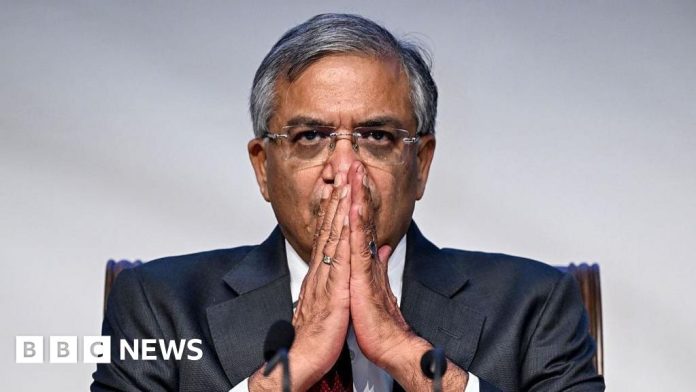
India’s Election Commission (ECI), one of the most trusted public institutions in the world’s largest democracy, is facing a test of its credibility.
Over the past few weeks, it has fielded a string of allegations from the opposition, ranging from voter fraud and manipulation to inconsistencies in electoral rolls. It has denied all of these.
Opposition leaders, who have held massive protests against the ECI in recent days, said they were considering an impeachment motion to remove the chief election commissioner from his position. They hadn’t filed the motion by Thursday, the last day of the monsoon session of parliament, and currently don’t have the numbers to see it through.
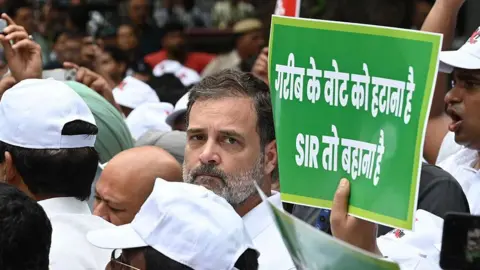
Meanwhile, Rahul Gandhi, the leader of India’s main opposition party Congress, has launched a 16-day, 1,300km (807 miles) march – known as the Voter Adhikar Yatra (Voter Rights March) – in Bihar state to protest against the ECI, marking a dramatic escalation in the political fight. Bihar, set to vote in a key state election later this year, has been in the middle of a heated controversy over a recent revision of electoral rolls.
Gandhi first made the allegations of vote theft in August, accusing the ECI of colluding with the governing Bharatiya Janata Party (BJP) to rig the 2024 general elections.
Using granular data from the ECI’s own records, he alleged that a parliamentary constituency in the southern state of Karnataka had more than 100,000 fake voters, including duplicate voters, invalid addresses and bulk registrations at single locations.
The ECI has repeatedly called the claims “false and misleading”. And the BJP has strongly denied these allegations, with leader Anurag Thakur saying the Congress and the opposition had come together to make these “baseless claims” because they were anticipating a loss in Bihar.
Gandhi’s press conference was held as the controversy in Bihar was raging.
The Special Intensive Revision (SIR) happened between June and July, with the ECI saying its representatives visited all of Bihar’s 78.9 million voters for verification.
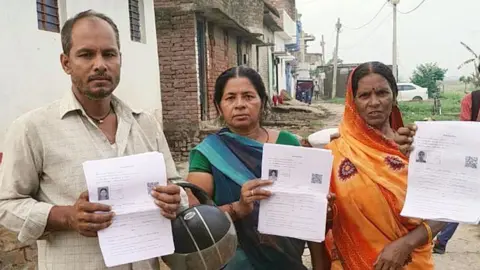
The ECI says this was done to update the voter lists after more than 20 years, but opposition leaders say the process may have disenfranchised tens of thousands of people, especially migrants, because of the haste with which it was conducted and the onerous documentation required as proof.
After a draft of the updated list was published on 1 August, several reports, including by the BBC, highlighted errors in the count, such as the wrong gender and photos assigned against people’s names, and dead voters on the rolls.
The new draft rolls have 72.4 million names – 6.5 million fewer than before, with the commission saying the omissions include duplicate, deceased and migrant voters. Those who believe their names were wrongly struck off have been given until 1 September to appeal.
 AFP via Getty Images
Meanwhile, criticism also intensified over the manner in which the ECI published the names of the 6.5 million people that were excluded from the draft rolls.
Opposition parties questioned why the commission was putting up scanned physical copies, rather than machine-readable lists of omitted voters, which could be independently verified by analysts and political parties.
Eventually, India’s top court told the ECI to publish a searchable list of voters and also state the reasons for their exclusion.
The court’s intervention highlighted the ECI’s “procedural failures” and must be seen as a “rap on the knuckles”, an editorial in the leading Hindu newspaper said.
Amid the mounting criticism, ECI held a rare weekend press conference on17 August to address some of the allegations.
“If you use terms like vote theft and mislead citizens, then what else would you call this, other than an insult to India’s constitution?” Chief Election Commissioner Gyanesh Kumar said, referring to Gandhi’s allegations.
He cited a 2019 Supreme Court judgment to say the opposition’s demand for machine-readable voter lists could impinge on people’s privacy.
He also demanded that Gandhi either give an affidavit under oath proving his allegations, or apologise to the nation for his remarks.
But instead of putting the matter to rest, the statements sparked further outrage, with some opposition politicians accusing Kumar of either avoiding answering specific questions or providing unsatisfactory explanations.
Pawan Khera of the Congress party told BBC Hindi that Kumar’s “adversarial tone” at the press conference made it seem “as if a BJP leader was speaking”.
Experts say that on their own, the allegations by Gandhi, or the fact that millions of new voters have been added or removed from the rolls in Bihar, don’t prove any wrongdoing.
“When the voter list is intensively verified, such large differences in numbers are bound to occur,” former chief election commissioner N Gopalaswami told BBC Tamil.
Mr Gopalaswami added that when the electoral roll for the southern state of Karnataka was revised in 2008, some 5.2 million voters were removed, with nearly one million people applying to be added again.
He also agreed with the ECI’s demand for a signed affidavit by Gandhi, saying that responding to allegations without a written complaint sets a bad precedent for the institution.
 Getty Images
But with Gandhi’s voter rights march under way and the Bihar elections looming, the issue is unlikely to die down.
“Whatever the Election Commission says, the opposition will definitely make it an issue in the upcoming Bihar elections,” senior journalist Smita Gupta told BBC Hindi.
In the meantime, there are larger concerns at play about the impact of all of this on the public’s trust in the ECI.
“The trust the ECI once commanded almost unquestioningly is now under greater public scrutiny,” former chief election commissioner SY Quraishi wrote in the Indian Express newspaper.
He added that while the “procedural architecture for transparency in elections remains in place… the perception of impartiality is as important as its reality. Reinforcing this trust is as crucial as ensuring technical accuracy”.
According to a survey published this month by Lokniti, a research programme at the Centre for the Study of Developing Societies (CSDS), however, trust in the ECI has dropped sharply.
The agency’s chief Sanjay Kumar has been separately in the crosshairs of the ECI and the BJP after he issued an apology for sharing wrong data on voter turnout in the state of Maharashtra, but its findings in other states point to a rising trust deficit with the ECI.
In all the six states surveyed by CSDS in 2025, the number of people who had no trust in the EC had risen sharply from 2019 – In Uttar Pradesh, India’s most populous state, it rose from 11% to 31% in the period.
This systematic erosion, Mr Kumar told The Wire news portal, “should be a big worry” for the commission.
“It is not only the trust of the opposition which has gone down, it is also the trust among the people that has come down. The data clearly indicates that,” Mr Kumar said.
Follow BBC News India on Instagram, YouTube, X and Facebook.
Noem condemns Abrego Garcia release: A 'new low'
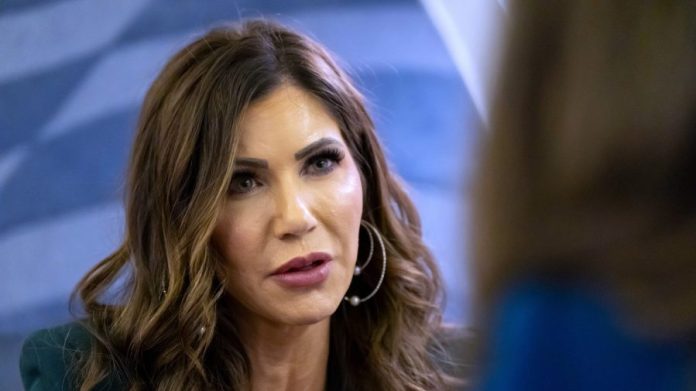

Secretary of Homeland Security Kristi Noem condemned the Friday release of Kilmar Abrego Garcia, who was mistakenly deported but returned to the U.S., calling it a “new low.”
Abrego Garcia has been petitioning for his release from federal custody since his March deportation to El Salvador. U.S. Magistrate Judge Barbara Holmes on Friday ordered the release of Abrego Garcia from a Tennessee jail.
“Activist liberal judges have attempted to obstruct our law enforcement every step of the way in removing the worst of the worst criminal illegal aliens from our country,” Noem said in a Friday statement. “Today, we reached a new low with this publicity hungry Maryland judge mandating this illegal alien who is a MS-13 gang member, human trafficker, serial domestic abuser, and child predator be allowed free.
“By ordering this monster loose on America’s streets, this judge has shown a complete disregard for the safety of the American people. We will not stop fighting till this Salvadoran man faces justice and is OUT of our country,” she added.
Abrego Garcia has been a target of the Trump administration in its crackdown on immigration, with the Department of Homeland Security deeming him a “known MS-13 gang member” and “public safety threat.”
The El Salvadorian native, who faces human trafficking charges related to a 2022 traffic stop in Tennessee, is now back in Maryland while he awaits trial. He is moving to dismiss the Tennessee criminal case against him, with his lawyers arguing that he’s been the object of selective prosecution by the Trump administration.
“Kilmar Abrego Garcia has been singled out by the United States government. It is obvious why. And it is not because of the seriousness of his alleged conduct. Nor is it because he poses some unique threat to this country. Instead, Mr. Abrego was charged because he refused to acquiesce in the government’s violation of his due process rights,” his attorneys wrote in a Tuesday filing.
Crude Oil Rallies on Tighter Inventories and Signs of Stronger Energy Demand

October WTI crude oil (CLV25) on Thursday closed up +0.81 (+1.29%), and October RBOB gasoline (RBV25) closed up +0.0281 (+1.43%).
Crude oil and gasoline prices rallied on Thursday, with crude posting a 2-week high and gasoline posting a 2.5-week high. Crude and gasoline have carryover support from Wednesday, when weekly EIA crude and gasoline inventories fell more than expected. Also, strength in global manufacturing activity is supportive for energy demand and crude prices. Gains in crude were limited after the dollar index (DXY00) rose to a 1.5-week high.
Signs of strength in global manufacturing activity are bullish for energy demand and crude prices. The US Aug S&P manufacturing PMI unexpectedly rose +4.5 to a 3-year high of 53.3, better than expectations of a decline to 49.7. Also, the Eurozone Aug S&P manufacturing PMI unexpectedly rose +0.7 to a 3-year high of 50.5, stronger than expectations of a decline to 49.5.
Oil prices have support from doubts about negotiations for an end to the Russian-Ukrainian war after Russian Foreign Minister Lavrov said Russia should have a say in security arrangements for Ukraine, and that any unilateral guarantees would be “hopeless.”
Concern about higher OPEC production is bearish for crude prices after OPEC+ on August 2 endorsed an additional 547,000 bpd increase in its crude production for September 1. OPEC+ is boosting output to reverse the 2-year-long production cut, gradually restoring a total of 2.2 million bpd of production by September 2026. OPEC+ has 1.66 million bpd of supplies that are currently due to remain offline until late 2026. OPEC July crude production fell by -20,000 bpd to 28.31 million bpd.
A decline in crude oil held worldwide on tankers is bullish for oil prices. Vortexa reported Monday that crude oil stored on tankers that have been stationary for at least seven days fell by -12% w/w to 82.49 million bbl in the week ended August 15.
Wednesday’s weekly EIA report showed that (1) US crude oil inventories as of August 15 were -5.6% below the seasonal 5-year average, (2) gasoline inventories were -0.7% below the seasonal 5-year average, and (3) distillate inventories were -13.0% below the 5-year seasonal average. US crude oil production in the week ending August 15 rose by +0.4% w/w to 13.382 million bpd, modestly below the record high of 13.631 million bpd posted in the week of 12/6/2024.