
Joao Pedro gets a goal and an assist as Chelsea come from behind to comfortably beat West Ham 5-1 in the Premier League at London Stadium.
West Ham booed as Chelsea score five in convincing win

Multiple dead after tour bus rollover on New York highway
BUFFALO, N.Y. (WIVB) — A tour bus with 52 people on board crashed on I-90 in Pembroke, New York, Friday, resulting in multiple deaths and dozens of injuries.
State police said at least one child was among the dead. Several other people were injured along with multiple others who were trapped under and around the bus. Police said most of the passengers did not have their seatbelts on, resulting in many ejections.
State Police said every person on the bus, which was going from Niagara Falls to New York City, had some level of injury.
The crash occurred around 12:40 p.m. near Pembroke, which is about 25 miles east of Buffalo. State police said the bus lost control, went into the median and turned over into a ditch on the side of the road. The bus did not hit any vehicles. Police said the driver of the bus was alive.
-
First responders work to rescue victims at the scene of a tour bus that crashed and rolled over on the New York State Thruway near Pembroke, N.Y., Friday, Aug. 22, 2025. (Libby March/Buffalo News via AP) -
Rescue personnel work the scene of a tour bus that crashed and rolled over on the New York State Thruway near Pembroke, N.Y., Friday, Aug. 22, 2025. (Libby March/The Buffalo News via AP) -
Rescue personnel work the scene of a tour bus that crashed and rolled over on the New York State Thruway near Pembroke, N.Y., Friday, Aug. 22, 2025. (Libby March/The Buffalo News via AP)
The New York State Thruway Authority said a lengthy stretch of the roadway had been shut down in both directions and drivers were being urged to avoid the area.
Several Mercy Flights were requested as well as all Mercy Flight ambulances.
“It’s a very active scene,” said Mercy Flight president Margaret Ferrentino. “At this time, we’re praying for the victims.”
Among the injured were people with Indian, Chinese and Philippine nationalities. Police said there were language barriers and translators were sent to the scene.
Peter Cutler, the vice president of communications and internal affairs at Erie County Medical Center, said the Buffalo hospital, known as ECMC, received a “mass casualty notification.” As of 3:30 p.m., they had received 16 patients.
New York Gov. Kathy Hochul said on X that she was briefed on “the tragic tour bus accident” and that her office was working with police and local officials.
The Associated Press contributed to this report.

Will Serena Williams’s weight-loss admission help shed stigma of anti-obesity drugs?

Serena Williams, one of the most successful athletes of all time, has spoken out about using weight loss drugs – she says, to lift the “stigma” around using such medication.
Will her outspoken comments instil a new sense of confidence in those using the drugs? And could her honesty quieten the critics?
The 43-year-old tennis star, who broke records and won 23 grand slam titles through her career, was the embodiment of fitness and athletic prowess. But, after having kids, even she, like so many of us, has admitted to struggling to shift those extra pounds.
In the end, Williams told the Today Show on TV in the US, that she had to look at her extra weight as “an opponent”. Despite “training five hours a day” and “running, walking, biking, stair climbing,” she couldn’t pulverise this adversary like she did to her opponents on the tennis court – so in the end, she says, she had no other choice but to “try something different”.
Many of her friends were using GLP-1 – the group of medications which help with weight loss, so she decided to try it.
Williams is adamant that the medication route – she won’t say which brand she is taking – wasn’t easy, and certainly not a shortcut to her losing 31lb (14kg) over the past eight months.
There is scepticism about the timing of the tennis star’s recent transparency – she has just become a spokesperson for Ro, a company which sells GLP-1 brands like Wegovy and Zepbound (known as Mounjaro in the UK) through its weight-loss programme, and her husband is also an investor.
Despite this and the potential side effects of taking the medication, her honesty will hit a nerve for many – she says she is speaking out to take away the shame that so many women feel when it comes to using drugs to help them lose weight.
Caleb Luna, assistant professor of feminist studies at the University of California, says having someone like Serena Williams speaking out is “a breakthrough”.
They say it helps silence the critics of how “weight loss is achieved” who say that “people are taking the easy way out” by using weight loss drugs.
“It gets rid of the stereotype that these drugs are for fat people who are being lazy and incompetent.
“In that respect it’s maybe a good thing.”
But Caleb also says the revelation about her need to resort to using GLP-1 medication is slightly “terrifying” and makes them feel “a little bit sad”. They worry that all it does is belittle hard work and dedication, instead, focussing on appearance and the pressure to look a certain way.
“She has achieved things that so few people, in our time and throughout history have achieved.
“But now it just shows how all those accomplishments can be undermined by body size.
“Scarily, weight loss seems to outshine all those record-breaking achievements.”
Williams’ weight and her looks have been scrutinised throughout her life. The burden, the pressure to fit in with society’s expectations does not diminish no matter how much sporting success an athlete has in their career.
And while she may be the most high profile sports star who openly uses weight loss medication, there are many others in the public eye who have spoken out.
Oprah Winfrey says she uses GLP-1 as a tool, along with exercise and healthy eating, to stop herself “yo-yoing” with her weight.
Actress Whoopi Goldberg says she lost the weight of “two people” after taking the drug, and singer Kelly Clarkson, who says she was “chased” by her “doctor for two years” before she agreed to take it, are among the dozens of stars who have been open about taking the medication.
Williams left the world of tennis behind back in 2022, when she played the final match of her career in the US Open, but she is still a powerhouse of strength and has wanted to reach what she describes as her “healthy weight” since the birth of her second child, Adina.
In her interview with the Today Show, says she felt like her “body was missing something” and she wasn’t able to get down to what she felt comfortable with – despite intense training.
Dr Claire Madigan, a senior research associate in behavioural medicine at the School of Sport, Exercise and Health Sciences at Loughborough University, says elite athletes can find it hard to lose weight.
“They are used to consuming a lot of calories and when they leave the sport they can find it difficult – it needs a change in behaviour.”
Dr Madigan said it was good to see that Williams mentioned her weight loss was not just down to the drug – “she did have to focus on the diet and physical activity”.
She added: “It’s great she is talking about how difficult it is to lose weight after having a baby.”
But she wonders if Williams’s message might be lost and even demotivate some women. “The drugs are quite expensive and the average person may think here is an elite athlete, she’s got access to the gym, she’s got time, she has a nutritionist… and she’s had to use GLP-1s”.
Dr Madigan also expressed concern that the potential side effects of taking the drugs – which can include gastrointestinal problems like vomiting and diarrhoea, and in rare cases, gallbladder and kidney problems – may not have been widely discussed in the publicity surrounding Williams’s announcement.
Williams says she did not experience any side effects, and told Women’s Health magazine that she is finally seeing the benefits of all her hard work at the gym.
“My joints are a lot better,” she says, “I just had my check-up, and the doctor said everything – including my blood sugar levels – looked great.”
And, even though, she’s no longer breaking new ground on the tennis courts, she is still smashing her own records, with the help, she says of weight loss drugs. She’s currently training for a half marathon.
“I am running farther than I ever have,” she says proudly.
Additional reporting by Alex Kleiderman
Company looks to deploy drones to combat school shootings
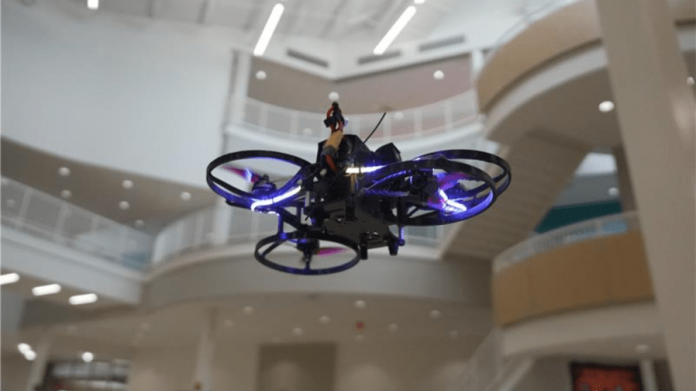

The Campus Guardian Angel is looking to deploy drones to combat school shootings, running test trials in Florida.
Campus Guardian Angel CEO Justin Marston told The Hill the system puts drones in boxes at different points around a school, triggered by an emergency silent alarm and moving within 5 seconds.
The drones are then deployed and controlled by specialists in Texas to stop the shooter by deploying non-lethal projectiles and assisting police with video surveillance.
“If law enforcement is already there, we’ll team with them, like giving them close air support, like having a pack of entirely disposable police dogs that are super smart,” Marston said.
“We shouldn’t risk police lives unnecessarily. We shouldn’t put them into incredibly difficult situations where they’re having to make a lethal targeting decision in fractions of a second. Let us do all of that difficult work, because we don’t care if we get shot. We’re a lump of plastic. We’re entirely disposable,” he added.
Pilot programs are happening in three Florida school districts, which set aside money in the state budget to try the program. Marston said the system costs around $4 a month per student.
In 2024, hundreds of school shootings occurred as educators try to find ways to combat the tragedies. Tactics such as school shooting drills have been criticized for scaring students and debates about effectiveness have occurred.
Marston said their system has received bipartisan support, with skeptics typically interested after seeing a demonstration of the technology that can break through windows to stop a shooting.
“I think that generally, especially when people see the demonstration, when people see a live demonstration on site … 95 percent plus of people who see it go through that paradigm shift in that moment, no matter how mentally prepared they were to not like the idea when they came in” they change their minds, Marston said.
“But it comes down to the incredible capabilities of the pilots and what they can do with these drones, how fast they can move, what advantages they bring to law enforcement, how they can reduce the risk of collateral damage,” he added.
Four things we learned from Erik Menendez’s parole hearing
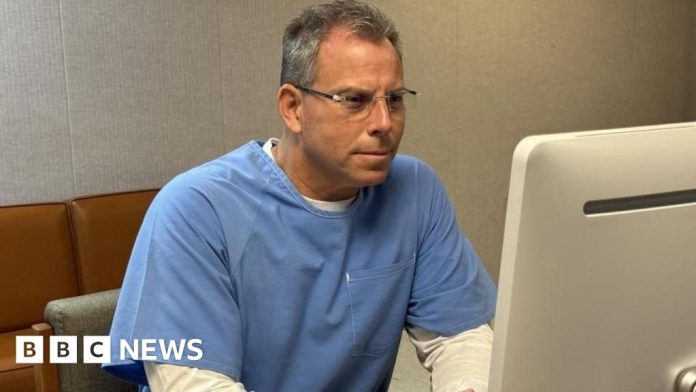

 California Department of Corrections and Rehabilitation
Erik Menendez’s lengthy parole hearing in California on Thursday contained several insights into his time behind bars – some of which factored into the board’s decision to refuse his request for release.
Along with his brother Lyle, Erik has spent decades behind bars for the shotgun killings of his wealthy parents in 1989, which was also discussed at the hearing. The brothers claimed self-defence, and have long pushed for their freedom.
Lyle has a hearing of his own on Friday. Here is some of what we learned about the killings and Erik’s time in prison, based on Thursday’s hearing, which he attended virtually.
Prison behaviour, not killings, prompted refusal
The parole commissioner, Robert Barton, said the main reason for his denial was not the killings themselves, but Menendez’s behaviour in prison.
Barton rejected any notion that Menendez had been a “model prisoner”, though he said he was “gaining insight”. There was discussion of Menendez’s involvement in fights, drug use and even a tax-fraud scam while linked to a gang.
Menendez earned Barton’s censure over his possession of prohibited materials – in particular his repeated illicit use of a mobile phone.
“What I got in terms of the phone and my connection with the outside world was far greater than the consequences of me getting caught with the phone,” Menendez explained. But he said he had later rethought this view.
Menendez saw father and mother ‘as one person’
Menendez, who was 18 at the time of the crime, was asked why he and brother shot dead their parents rather than simply leave home.
He and his brother have long claimed the killings were a matter of self-defence, as their father was sexually abusing them.
“When I look back at the person I was then and what I believed about the world and my parents, running away was inconceivable,” Menendez responded. “Running away meant death.”
Asked why they killed their mother as well as their father, Menendez said he “saw them as one person” after he learned that his mother was aware of the abuse.
Contraband art materials also caused trouble
As well as the mobile phone, the other contraband goods that Menendez was revealed to have stashed included candles, ingredients for making wine, and art materials.
The art supplies had been used to decorate his cell.
Commenting on the smuggled goods, Barton said Menendez’s “institutional misconduct showed a lack of self-awareness”.
More than a dozen relatives back brothers’ release
Acknowledging the impact of his crimes on his relatives, Menendez told the hearing: “I just want my family to understand that I am so unimaginably sorry for what I have put them through.”
Eighteen people, most of whom are relatives, spoke during the hearing in support of his release.
One of them, the brothers’ aunt Teresita Menendez-Baralt, tearfully said she forgave the pair for killing her brother. Explaining that she had late-stage cancer, she spoke of her wish to welcome Erik into her home to “wrap my arms around” him before it was too late.
Barton acknowledged the support, but told Menendez: “Two things can be true. They can love and forgive you, and you can still be found unsuitable for parole.”
DOJ turns over first batch of Epstein files to Oversight panel, releases Maxwell interview

The Department of Justice (DOJ) turned over the first batch of documents related to the late sex offender Jeffrey Epstein to the House Oversight and Government Reform Committee on Friday, in response to a subpoena from the panel seeking the full “Epstein Files.”
Separately, the DOJ also released a transcript of the interview that Deputy Attorney General Todd Blanche conducted last month with Epstein associate Ghislaine Maxwell.
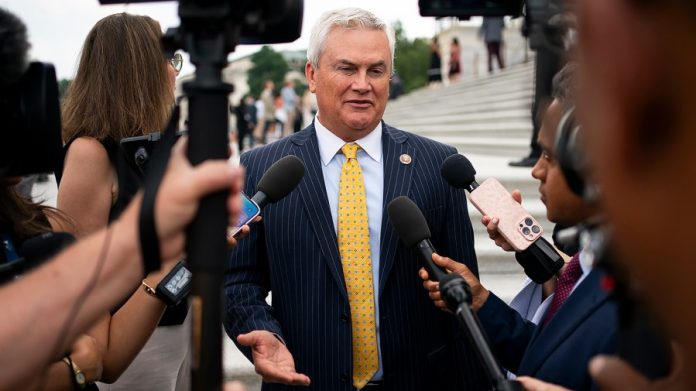
“The House Oversight Committee has received the Department of Justice’s first production of Epstein records pursuant to Chairman James Comer’s subpoena. The production contains thousands of pages of documents,” A House GOP Oversight Committee spokesperson said in a statement.
While the documents came several days later than the panel’s original Tuesday deadline, and more releases are expected, the Oversight Republicans praised the disclosure.
“The Trump DOJ is providing records at a far quicker pace than anything the Biden DOJ ever provided. In fact, former Attorney General Garland obstructed Chairman Comer’s subpoena for the audio of Special Counsel Hur’s interview with President Biden to hide his cognitive decline,” the GOP spokesperson said.
Chairman James Comer (R-Ky.) and the spokesperson have said that the panel intends to make the records public after reviewing to ensure any identification of victims or child sexual abuse material are redacted.
“The Committee will also consult with the DOJ to ensure any documents released do not negatively impact ongoing criminal cases and investigations,” the spokesperson said.
“We’re going to work as quickly as we can,” Comer told reporters on Thursday. “This is sensitive information. We want to make sure we don’t do anything that [will] harm or jeopardize any victims that were involved in this. But we’re going to be transparent.”
The Oversight Committee’s move to subpoena of the Department of Justice for files related to Epstein came in wake of widespread outrage over an unsigned July memo from the DOJ and FBI saying that they would not release any more information from the so-called Epstein files.
The announcement led to outcry from conservatives who believe the government is shielding powerful individuals who may have been involved with Epstein’s abuse of young women and underage girls — and furor from Democrats who have sought to link President Trump to Epstein and accuse him of covering up the files’ release.
The Oversight panel subpoenaed the DOJ for the files this month pursuant to a Democratic-led motion in a subcommittee to subpoena the Justice Department for the “full, unredacted Epstein files.” Three Republicans joined Democrats to move to subpoena the DOJ, and Comer issued the subpoena in August.
This is a developing story and will be updated.
UK agrees to pay Kenyans affected by Lolldaiga fire
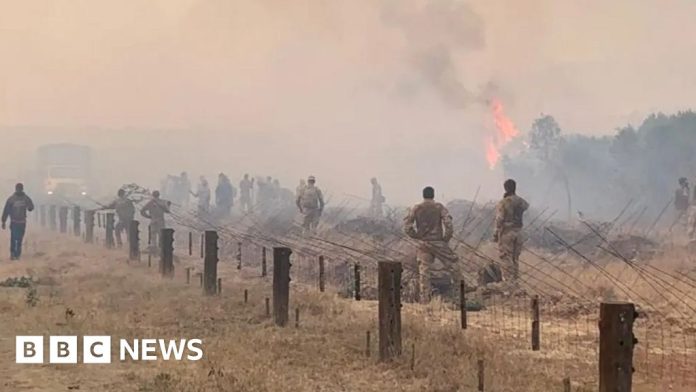
The UK government has agreed to pay compensation to thousands of Kenyans who were affected by a fire caused by a British military training exercise four years ago.
The out-of-court settlement follows a lengthy legal battle in which 7,723 claimants said they had lost property and suffered health complications because of the 2021 fire in the Lolldaiga conservancy in Kenya’s Rift Valley.
A spokesperson from the British High Commission in Nairobi said the fire was “extremely regrettable” and that the UK had devoted “considerable time, effort and resource” to resolve claims.
The British government has not confirmed how much was paid out, but the lawyer in the case told the BBC it was £2.9 million.
Kevin Kubai called it the “best possible outcome” despite complaints from his clients that the sums they received were much too small to compensate their losses.
He said the alternative “would have been to continue litigation for another period of nearly seven years to be able to prove these cases on a case-by-case analysis”, which would be difficult because much of the evidence had been lost after four years.
Mr Kubai acknowledged that his clients did not have medical records backing up their claims of health damage due to smoke inhalation from the Lolldaiga fire, and that they were also exposed to smoke because they used firewood for cooking.
The UK Ministry of Defence said in 2022 that the fire was likely caused by a camp stove knocked over during the training exercise in the conservancy. It found that around 7,000 acres of private land were damaged, but no community land was directly affected.
The legal action argued there had been environmental damage in surrounding communities because of the smoke, and the destruction of property because of stampeding wild animals.
The British government has helped the conservancy with restoration of the burnt area and the military exercises still take place there.
The Lolldaiga conservancy – about 49,000 acres of hilly bushland with a backdrop of the ice-capped Mount Kenya – is part of the Laikipia plateau, where hundreds of thousands of acres were seized by the British during the colonial era, leading to land disputes which continue to this day.
It is just 70km (45 miles) from the Lewa conservancy, where the Prince of Wales proposed to Kate Middleton in November 2010.
A few kilometres to the south are the newly-refurbished Nyati Barracks, a £70 million facility which is part of the British Army Training Unit Kenya (Batuk).
It hosts thousands of British troops every year for massive exercises in locations such as Lolldaiga, which offers ideal conditions for harsh environment training.
BATUK contributes tens of millions of pounds to the Kenyan economy annually.
But over the years controversy surrounding the behaviour of some of the soldiers has attracted media attention, including allegations of fatal hit-and-runs, murder and sexual exploitation of Kenyan women.